Showing Posts From
Usa finance

 DollarLedger Team
- 14 Nov, 2026
How to Pay Off Your Car Loan Early in 2026 — and When NOT To
Paying off a car loan early feels like an obvious win — and most of the time it is. Every extra dollar sent to a 7% loan earns a guaranteed 7% return. But the math is simple and the decision is not: the same dollar might earn more elsewhere, or protect you more elsewhere. The average 60-month new-car loan rate is 7.06% (Bankrate, November 11, 2026); the Federal Reserve's G.19 puts the commercial-bank average at 7.54% (August 2026), and Experian puts the new-car average at 6.35% (Q2 2026). Run this test on your own APR. All figures checked November 13, 2026.Caption: Photo: The goal is a paid-off car and keys that are fully yours — not just a lower monthly payment. (Photo: Pexels) What You Will LearnCheck for a prepayment penalty before you pay extra Your loan's real numbers — the $25,000 example The break-even test: when paying early wins How to make extra payments hit principal When NOT to pay early — card debt, no emergency fund, a cheap loan How to finish the loan and get the titleStep 1: Check the contract first — the penalty and the interest type What to do: Before you send extra money, check for a prepayment charge, and whether the loan is simple-interest or precomputed-interest. How: Prepayment penalties are uncommon, but they exist — and your contract, not your lender's website, is the only thing that counts. The Consumer Financial Protection Bureau (CFPB) says your contract and state law decide whether you can pay off early, and some states prohibit prepayment penalties for certain loans. Find the "Prepayment" section of your Truth in Lending disclosure, where the lender must state whether a charge applies; if there is one, the CFPB says you can ask to have it removed. Check the interest type too: on a simple-interest loan, interest is charged daily on the balance you owe, so every extra dollar cuts tomorrow's interest; on a precomputed-interest loan, all the interest is calculated up front, so extra payments save far less. Example: A 2% penalty on a $10,000 balance is $200. Common mistake: Assuming there is no penalty. Most lenders have none — but "most" is not your contract.Caption: Illustrative diagram - The six steps to a paid-off car loan. NOT a real CFPB screenshot. Step 2: Know your loan's real numbers — the $25,000 worked example What to do: Work out exactly what your loan costs on schedule, so the saving from paying early is a real number, not a feeling. How: Take a $25,000 loan at 7.06% — Bankrate's 60-month new-car average, November 11, 2026 — over 60 months. The monthly payment is $495.74, and over five years you pay $29,744.28 in total: $4,744.28 of interest on top of the $25,000 you borrowed. That is the number you are fighting. At the Experian Q2 2026 used-car average of 11.19%, the same loan costs $7,755.95 in interest — nearly $3,000 more. At 4%, it costs only $2,624.78. Example: Divide one month's interest by your balance and multiply by 12 — if it is close to your APR, extra principal will save what the maths says. Common mistake: Judging the loan by the monthly payment. $495.74 sounds manageable; $4,744.28 of interest is the real price.Caption: Illustrative diagram - A $25,000 loan at 7.06% costs $4,744.28 in interest over 60 months. NOT a real Bankrate screenshot.Caption: Photo: Run the numbers before you send extra money — the saving is real, but only if the loan is the right target. (Photo: Pexels)Caption: Illustrative diagram - The break-even test: pay the highest rate first. NOT a real Federal Reserve screenshot. Step 3: Run the break-even test — does paying early actually win? What to do: Compare your car loan's APR with what the same money would do elsewhere, and pay off the loan only if it wins. How: Every extra dollar sent to the loan earns a guaranteed return equal to your APR — 7.06% here. Top savings accounts pay about 4.2% APY (NerdWallet, November 2026), so a 7.06% loan beats savings by nearly 3 points, guaranteed. But credit-card debt averages 22.36% APR on accounts assessed interest (Federal Reserve G.19, Q3 2026) — over three times your car loan. The test is a ranking: pay the highest rate first. A payoff's return is guaranteed; an investment's is not. Example: You have $200 a month spare, a car loan at 7.06% and a card at 22.36% — send the $200 to the card. Common mistake: Paying off the car because it feels good to own it, while a 22% card balance costs three times as much. Step 4: Send extra money to principal — early, every month What to do: Add a fixed extra amount to every payment, and make sure it goes to principal — not to future payments. How: Some servicers treat an extra payment as paying next month early — your due date moves, but your interest does not fall. Tell the lender — in writing, or through the portal's principal-only option — that extra money goes to principal. Then check the next statement. An extra $100 a month from the start pays the $25,000 loan off in 49 months instead of 60, and saves $947.89 in interest. Rounding the $495.74 payment up to $600 finishes it in 48 months and saves $980.08. But a lump sum at month 48, when only $5,727.47 is left, saves just $221.38 — most of the interest is already paid. Example: Set up an automatic extra $100 with every payment, labelled "principal only." In one year you cut $1,200 off the balance. Common mistake: Sending extra money and never checking the statement — if it went to future payments, you saved nothing.Caption: Illustrative diagram - Extra money early beats a lump sum late. NOT a real Bankrate screenshot.Caption: Photo: When the loan is gone, the keys — and the car — are fully yours. (Photo: Pexels)Caption: Illustrative diagram - Three times paying early is the wrong move. NOT a real CFPB screenshot. Step 5: Know when NOT to pay early — three red flags What to do: If any of these three is true, stop — the extra money belongs elsewhere first. How: First, credit-card debt. At 22.36% average APR, it costs more than three times a 7.06% car loan — clear the card first: how to pay off credit card debt fast in 2026. Second, no emergency fund. With no cash cushion, one broken transmission sends you straight back to a card at 22% — build a starter fund first: building an emergency fund on a $40,000 salary. Third, a cheap loan. Below about 4–5% — a 0% manufacturer deal or an old low-rate loan — the maths flips: top savings accounts pay about 4.2%. A 4% loan on $25,000 costs only $2,624.78 in interest over five years. Example: A borrower with a 3.9% loan and $3,000 in card debt sends $200 a month to the car. The card charges about $56 a month; after a year of extra payments, the car payoff saves about $7 a month. The wrong order costs about $49 a month. Common mistake: Treating all debt as equal. Debt is priced by its rate — the most expensive goes first. Step 6: Finish the loan properly — payoff quote, title, credit report What to do: When the balance is nearly gone, get a formal payoff quote, pay it, and confirm the lien is released and the title is yours. How: A payoff quote is not your current balance — it includes interest up to the payoff date, and it usually expires in 10 to 30 days. Then check: the lender released the lien and sent the title, and your credit report shows the loan closed at zero. If you bought GAP insurance or an extended warranty, ask about a refund for the unused months — nobody volunteers it. Tell your insurer the lienholder is gone. Shopping for your next car? Compare rates first — see our guide to the best auto loan rates in 2026 and how to get them. Example: You request a payoff quote on the 1st for $2,140, good until the 15th. You pay on the 10th; on the 20th the title arrives and the loan shows "closed, paid in full." Common mistake: Paying the statement balance and assuming the loan is closed. Interest accrues daily, so the statement balance is a few dollars short.Caption: Illustrative diagram - Six mistakes that cost car borrowers money. NOT a real CFPB screenshot. ChecklistContract checked — penalty and interest type confirmed. Loan's real numbers known — APR, balance, payment, total interest. Break-even test run — the car loan is your highest rate. Emergency fund in place before extra payments start. Extra payments set to principal only; next statement checked. Payoff quote requested before the final payment. Title received, lien released, loan closed on credit report.FAQ Pay off the car loan early, or invest the money? It depends on the rates. Paying off a 7.06% loan earns a guaranteed 7.06% — better than the roughly 4.2% a top savings account pays, with no risk. Investing might earn more, but it might not. Below 4–5%, investing or keeping the cash usually wins. How much does $100 extra a month save? On a $25,000 loan at 7.06% over 60 months, an extra $100 a month pays it off in 49 months and saves $947.89. Rounding the $495.74 payment up to $600 saves $980.08 and finishes in 48 months. Pay off the car or the credit card first? The credit card, almost always. Card debt averages 22.36% APR — over three times a typical car loan — so every dollar sent to the card saves about three times as much. What happens after I pay off my car loan? Get a payoff quote, pay it before it expires, and confirm the lender released the lien and sent the title. Check your credit report shows the loan closed, ask about a GAP refund, and tell your insurer the lienholder is gone. SourcesConsumer Financial Protection Bureau, Can I prepay my loan at any time without penalty? (opened live November 13, 2026): https://www.consumerfinance.gov/ask-cfpb/can-i-prepay-my-loan-at-any-time-without-penalty-en-843/ Federal Trade Commission, Financing a Car — Consumer Tips (opened live November 13, 2026): https://consumer.ftc.gov/media/79916 Bankrate, Auto Loan Rates & Financing in 2026 (opened live November 13, 2026): https://www.bankrate.com/loans/auto-loans/rates/All figures checked November 13, 2026, against the CFPB, the FTC, Bankrate and the Federal Reserve's G.19. Disclaimer: For education only, not financial, tax or investment advice. Terms and rates change — confirm your contract and the current figures with your lender before you decide.

- DollarLedger Team
- 14 Nov, 2026
How to Check Your Credit Score for Free in 2026 — Score vs Report
Most people check the wrong thing. They pull their free credit report, look for a number, and find none — because the report is not the score. The report is the full record: every account, every balance, every late payment. The score is a three-digit number calculated from that record, usually 300 to 850. And there is not one score — there are many, made by different companies. The good news: you can get a real score free, in about five minutes, and checking it never hurts it. All figures were checked on November 13, 2026.Caption: Photo: The report is the record, the score is the number — and both are free to check. (Photo: Pexels) What You Will LearnReport vs score — why the free report has no number Three free ways to get a real FICO Score FICO vs VantageScore — why they differ, and which one lenders use Why you need all three bureaus, not just one How to fix the report behind the score The two moves that raise your score fastestStep 1: Know the difference — report vs score What to do: Learn which document you are looking at before you chase a number. How: Your credit report is the raw file: every card, loan, balance, payment and inquiry, kept separately by Equifax, Experian and TransUnion. Each bureau's report is free every week at AnnualCreditReport.com — the only website the FTC authorises — or by calling 1-877-322-8228. But the report contains no score: the CFPB is clear the free reports do not include one. The score is a three-digit number, usually 300 to 850, calculated from the data in the report. And there is more than one: FICO and VantageScore use different formulas, and each bureau's file can differ. Example: Your Equifax report shows a $1,800 balance and one late payment; your score turns that into a number — 672, say. Common mistake: Paying for your "free report" — it is free only at AnnualCreditReport.com.Caption: Illustrative diagram - The six steps to a free credit score. NOT a real CFPB screenshot. Step 2: Get a real FICO Score for free What to do: Get the score most lenders use — free, without paying and without a card. How: The CFPB says many card companies and lenders give customers a free score, as do nonprofit credit and housing counsellors. Start with your own bank or card issuer — many show a free score in the app or on your statement. If yours does not, use a free route (reported): an Experian free account, Discover Credit Scorecard (no Discover card needed) and myFICO's free plan each give a free FICO Score 8. None asks for a credit card. If a site wants your card number first, close it — that is a lookalike. Example: Maya opens a free Experian account and sees a FICO Score 8 of 721. Common mistake: A "free trial" that becomes a monthly fee — the CFPB warns a trial may last only a set period, then you must cancel or pay.Caption: Illustrative diagram - Report vs score: two different things. NOT a real CFPB screenshot.Caption: Photo: Start with the app you already have — your bank or card issuer may show a free score. (Photo: Pexels)Caption: Illustrative diagram - FICO vs VantageScore: same data, different number. NOT a real myFICO screenshot. Step 3: Read the label — FICO or VantageScore? What to do: Read the model name on your score before you compare it with anything. How: FICO is made by the Fair Isaac Corporation and used by 90% of top lenders (myFICO). Mortgage and auto lenders check it first. VantageScore was built jointly by the three bureaus, and VantageScore 3.0 powers most free apps (reported). Both read the same report data on a 300 to 850 scale, but they weigh the factors differently, so the numbers differ. A gap of 20 to 40 points between the two is common (reported) — the formulas disagree. FICO's bands: below 580 Poor, 580 to 669 Fair, 670 to 739 Good, 740 to 799 Very Good, 800+ Exceptional. Example: Credit Karma shows 745 while Discover shows a FICO Score 8 of 712. Both are honest numbers from the same file — different models, different answers. Common mistake: Celebrating a 745 VantageScore, then being surprised when the lender's FICO number comes in lower.Caption: Illustrative diagram - FICO ranges and what drives the score. NOT a real myFICO screenshot. Step 4: Check all three bureaus What to do: Cover all three bureaus — one score is not the whole picture. How: The three bureaus keep separate files that do not always match: an account can appear on one file and be missing from another. A lender can pull any bureau's file. Pair your sources: Credit Karma gives VantageScore 3.0 from Equifax and TransUnion (reported), and a free Experian account gives a FICO Score 8 (reported) — together they cover all three files. Mortgage lenders often use older FICO versions — FICO 5, 4 and 2 (reported). Example: A store card appears on your Experian file but not on Equifax — same you, different files. Common mistake: Checking one bureau once and assuming the other two files say the same thing.Caption: Photo: One bureau's file is not the whole picture — check all three before you apply. (Photo: Pexels)Caption: Illustrative diagram - Where to get a free score, and which one it is. NOT a real CFPB screenshot. Step 5: Read the report behind the score — and dispute anything wrong What to do: Fix the data, and the score follows. How: The CFPB says report mistakes could hurt your credit history and your score, so check regularly. Pull all three reports free every week at AnnualCreditReport.com and look for accounts that are not yours, wrong late payments and wrong balances. If you find an error, dispute it with the credit bureau and the company that reported it. For the full report walkthrough, see our guide to checking your credit report for free in 2026. The score is calculated from the report, so fixing the data is the only way to fix the number. Example: A $400 collection account that is not yours sits on your TransUnion file — dispute it, and the score can recover. Common mistake: Trying to dispute the score itself — it is only a calculation. Dispute the wrong item in the report, and the score follows. Step 6: Move the number — on-time payments and low utilisation What to do: Use the two levers that matter most. How: MyFICO puts payment history at 35% of a FICO Score and amounts owed at 30% — together 65% of the number. The CFPB agrees: paying on time has the greatest impact, so set up autopay for at least the minimum. Then keep balances low: the CFPB advises keeping use under 30% of your limit. Our guide to improving your credit score fast in 2026 shows the faster route: pay before the statement closing date — the statement balance is what the bureaus see — and aim for under 10%. Checking your own score or report is a soft inquiry and never lowers it (CFPB). Example: One card, $1,000 limit, $450 balance — 45% utilisation. Pay $200 before the statement closes and the balance drops to $250, or 25%. Common mistake: Paying in full on the due date while the statement still shows a high balance, or closing an old card.Caption: Illustrative diagram - Six mistakes that cost you the real number. NOT a real CFPB screenshot. ChecklistReport pulled free at AnnualCreditReport.com — all three bureaus. Free FICO Score 8 in hand. Model name noted — FICO or VantageScore. All three bureau files checked, not just one. Report errors disputed with the bureau and the furnisher. Autopay on for at least the minimum, every account. Utilisation under 30% — under 10% if you can.FAQ Is checking my credit score really free? Yes. Your report is free every week at AnnualCreditReport.com, and a score is free from your bank or a bureau's free tier. A legitimate free score never asks for a card number — if it does, you are on a lookalike site. Does checking my own score lower it? No. Checking your own score or report is a soft inquiry: only you can see it, and it never lowers your score. Only a hard inquiry — when you apply for new credit — can move it. Why is my Credit Karma score different from my FICO score? Because they are different models reading the same file. Credit Karma shows VantageScore 3.0; most lenders use a FICO Score. A gap of 20 to 40 points is common (reported). Which score will a mortgage lender use? A FICO Score — often an older version, FICO 5, 4 or 2 (reported), not the FICO Score 8 you see for free. If a mortgage is in your plans, watch your FICO Score; the free FICO Score 8 is the closest free guide to it. What is a good credit score in 2026? On the FICO scale, 670 to 739 is Good, 740 to 799 Very Good, 800 and above Exceptional (myFICO). Below 580 is Poor, 580 to 669 Fair. SourcesConsumer Financial Protection Bureau, Where can I get my credit scores? (opened live November 13, 2026): https://www.consumerfinance.gov/ask-cfpb/where-can-i-get-my-credit-scores-en-316/ myFICO, What is a FICO Score and why is it important? (opened live November 13, 2026): https://www.myfico.com/credit-education/what-is-a-fico-score Consumer Financial Protection Bureau, Understand your credit score (opened live November 13, 2026): https://www.consumerfinance.gov/consumer-tools/credit-reports-and-scores/understand-your-credit-score/All figures checked November 13, 2026, against the CFPB, myFICO and the FTC. Disclaimer: For education only, not financial, tax or investment advice. Credit rules and scoring models change — confirm the current figures on consumerfinance.gov before you decide.

- DollarLedger Team
- 14 Nov, 2026
FSA — Use It or Lose It Before 31 Dec 2026 (Grace Period vs Rollover)
Every December, the same quiet loss happens in millions of American paycheques: money set aside in a health Flexible Spending Account (FSA) simply disappears. An FSA lets you pay medical, dental and vision costs with money not included in your income — but unlike a Health Savings Account (HSA), the balance does not roll over on its own. The IRS calls health FSAs "use-it-or-lose-it" plans (IRS Publication 969). What you do not spend by year end is forfeited to your employer — unless your plan offers one of two exceptions. Which exception your plan offers changes everything — and most people never check. All figures were checked on November 13, 2026.Caption: Photo: The money in your FSA was set aside for exactly this — prescriptions, glasses and dental care. Spend it before it vanishes. (Photo: Pexels) What You Will LearnThe three plan designs — and how to find out which one is yours The 2026 numbers: the $3,400 limit and the $680 carryover Grace period vs carryover — which one saves more Smart last-minute ways to spend the balance Claim deadlines and next year's electionStep 1: Find your plan's rule first What to do: Before you spend a dollar or book an appointment, find out which of the three designs your employer's FSA uses. How: There are only three possibilities. Some plans are strict use-it-or-lose-it: every unspent dollar is forfeited at year end. Some offer a grace period of up to two and a half months to spend last year's balance. Others offer a carryover, letting a capped amount roll forward. A plan cannot offer both (IRS Publication 969, Notice 2013-71), and your employer need not offer either. Find the rule in your benefits portal or Summary Plan Description, or ask HR. Example: Two co-workers each have $500 left. One has a carryover plan and keeps it all; the other has a strict use-it-or-lose-it plan and loses it all. Same balance, opposite outcomes. Common mistake: Assuming your plan has a grace period because a friend's does. Every employer chooses separately.Caption: Illustrative diagram - The six steps to save your FSA money before the deadline. NOT a real IRS screenshot. Step 2: Know the 2026 numbers — $3,400 in, $680 carries over What to do: Learn the two figures that govern your FSA in 2026, so you can do the maths on your own balance. How: In 2026, the IRS caps health FSA contributions at $3,400, up $100 from $3,300 in 2025 (IRS news release IR-2025-103, Revenue Procedure 2025-32). If your plan permits a carryover, at most $680 of unused 2026 money can roll into 2027 — up $20 from $660 in 2025. That $660 is the 2025 figure. The carryover is capped at 20% of the contribution limit, so the two move together. Your employer may set a lower cap. And the carryover does not count against next year's limit: $680 plus a full $3,400 election gives you up to $4,080 in 2027. Example: You have $900 left in a carryover plan: $680 rolls into 2027, $220 is forfeited. With only $680 left, the whole balance carries over. Common mistake: Planning around $660 because that was last year's figure. The 2026 carryover is $680.Caption: Photo: New glasses or contact lenses are a classic year-end FSA spend — if your plan covers them. (Photo: Pexels) Step 3: If you have a grace period — spend by 15 March What to do: If your plan offers a grace period, use the extra time — but treat 15 March as a hard deadline. How: A grace period gives you up to two and a half months after the plan year ends to spend last year's balance on new qualified medical expenses. For a calendar-year plan, that deadline is 15 March. Unlike a carryover, there is no dollar cap: the whole balance can be spent. The expense must be incurred during the grace period — a February doctor's visit or January glasses count — and anything still unspent when it closes is forfeited. The grace period is about spending, not claiming: your plan may set a separate, earlier claim deadline. Example: You have $1,200 left and a grace period. Book a dental cleaning and an eye exam in January and refill prescriptions in February, and the full $1,200 can be used. With a carryover, only $680 would survive. Common mistake: Treating the grace period as extra time to decide. Appointments book up in January.Caption: Illustrative diagram - The $680 carryover math: what survives 31 December. NOT a real IRS screenshot. Step 4: If you have a carryover — protect the $680 What to do: Treat $680 as safe and spend everything above it before 31 December. How: The carryover is automatic once your plan offers it: the first $680 rolls into the next year and is available from 1 January. But every dollar above $680 is still forfeited, so the job is to spend down to $680, not to zero. Check your balance today, subtract $680, and that is your December spending target. Your employer may have set a lower cap — $500, say — so that lower figure is your safe amount. Carried-over money does not reduce next year's contribution (IRS Publication 969), so a full $3,400 election for 2027 on top of it is allowed. Example: Your balance is $1,200. Spend $520 on a dental filling and new glasses in December, and $680 rolls into 2027. Spend nothing, and $520 vanishes on 1 January. Common mistake: Thinking the carryover saves everything. It saves at most $680.Caption: Illustrative diagram - Grace period vs carryover: which saves more? NOT a real IRS screenshot. Step 5: Spend the rest on eligible care What to do: Use the remaining balance on qualified medical expenses you genuinely need — and check your plan's eligible list before you buy. How: IRS Publication 502 defines qualified medical expenses as costs of diagnosis, cure, mitigation, treatment or prevention of disease. The most useful year-end spends are prescriptions you already take, new glasses or contact lenses, dental work you have been putting off, an eye exam, and first-aid supplies. Over-the-counter medicine and menstrual care products also count (IRS Publication 969). Your plan's own list is what matters. The expense must be incurred before your deadline — the appointment or purchase date, not the claim date. And do not buy things you do not need just to use the money: a $200 purchase you would never have made is still $200 gone, even pre-tax. Example: A $180 eye exam, $250 glasses and a $90 prescription refill is $520 — exactly the amount above the $680 carryover in Step 4. Common mistake: Buying vitamins or a gym membership and expecting reimbursement. General health does not count (IRS Publication 502).Caption: Photo: Dental work you have been putting off is one of the best year-end uses of FSA money. (Photo: Pexels)Caption: Illustrative diagram - Smart last-minute ways to spend FSA money. NOT a real IRS screenshot. Step 6: File claims on time — and set next year's election right What to do: Submit every claim before your plan's deadline, then choose next year's contribution so this December does not repeat. How: Your plan sets its own claim deadline, and it can fall before 31 December — some allow 90 days after the expense, others a fixed date in the new year. File as you spend and keep every receipt. If your FSA uses a debit card, keep receipts: the administrator can ask for proof. Then elect an amount you can realistically spend: lower it if you lost money this year, raise it slightly if you ran out in October — within the $3,400 cap. For the bigger picture, read our HSA vs FSA in 2026 guide, and if you are choosing next year's cover, see our health insurance open enrolment guide for 2026. Example: You spend $400 on glasses on 20 December but file in March, after your plan's 28 February claim deadline. The money is gone though the expense was eligible. Common mistake: Assuming the spending deadline and the claim deadline are the same date. They are often different.Caption: Illustrative diagram - Six mistakes that lose FSA money. NOT a real IRS screenshot. ChecklistPlan rule found — rollover, grace period or neither — from the benefits portal or HR. Balance checked; amount above $680 (or your plan's cap) calculated. Grace period deadline noted — 15 March for calendar-year plans. Appointments booked — dentist, eye exam, prescriptions refilled. Eligible list checked before buying anything. Claims filed as you spend, receipts kept. Next year's election set to an amount you can spend.FAQ What happens to unused FSA money at the end of the year? By default it is forfeited to your employer. The only exceptions are a grace period of up to two and a half months or a carryover of up to $680 for 2026, if your plan offers one. Can my plan offer both a grace period and a carryover? No. A plan that adopts a carryover for health FSAs is not permitted to also provide a grace period, and vice versa (IRS Publication 969, Notice 2013-71). Your employer must pick one — or neither. How much FSA money can I carry over into 2027? Up to $680 of unused 2026 money, if your plan offers a carryover. Your employer may set a lower cap. The $660 figure online is the 2025 carryover. Is an FSA the same as an HSA? No. HSA money stays until you use it and rolls over yearly; FSA money is use-it-or-lose-it without a grace period or carryover. See our HSA vs FSA in 2026 guide. Can I use FSA money for my family's medical costs? Yes — for yourself, your spouse and your dependents, as long as the expense is eligible under your plan. Check your plan's list first. SourcesIRS, Publication 969 — Health Savings Accounts and Other Tax-Favored Health Plans (opened live November 13, 2026): https://www.irs.gov/publications/p969 IRS, IRS releases tax inflation adjustments for tax year 2026 (IR-2025-103, Revenue Procedure 2025-32) (opened live November 13, 2026): https://www.irs.gov/newsroom/irs-releases-tax-inflation-adjustments-for-tax-year-2026-including-amendments-from-the-one-big-beautiful-bill IRS, Publication 502 — Medical and Dental Expenses (opened live November 13, 2026): https://www.irs.gov/publications/p502All figures checked November 13, 2026, against IRS Publications 969 and 502 and news release IR-2025-103 (Revenue Procedure 2025-32). Disclaimer: For education only, not financial, tax or investment advice. Confirm your plan's rule and the current figures with your benefits administrator and on irs.gov.

- DollarLedger Team
- 14 Nov, 2026
Year-End Tax Moves to Make Before 31 Dec 2026 — The 12-Move Checklist
Most 2026 tax moves die at midnight on December 31. No extension, no grace period — once the year turns, the move is gone. This post is a deadline checklist: twelve moves, each with the date it expires. And 2026 is not last year's tax year — the first fully shaped by the One Big Beautiful Bill Act, signed July 4, 2025. Charitable rules, SALT and the standard deduction all changed. All figures were checked on November 13, 2026, against IRS pages.Caption: Photo: Twelve moves, one deadline — most of them die at midnight on 31 December. (Photo: Pexels) What You Will LearnYour RMD — how much, and the timing choice Roth conversions: the 31 Dec deadline, and sizing Tax-loss harvesting and the 0% capital-gains bracket Which accounts die on 31 Dec — and which wait until 15 Apr Giving under the new 2026 rules, and the $19,000 gift exclusion The itemize test, and fixing your withholdingStep 1: Take your RMD — and make the first-RMD choice What to do: If you are 73 or older, take your 2026 required minimum distribution by December 31. First RMD year? Choose: this year, or April 1, 2027. How: The IRS requires withdrawals from traditional IRAs and 401(k)s from age 73. Your RMD is the balance on December 31 of the previous year divided by a factor from the IRS Uniform Lifetime Table — 26.5 at age 73. A $500,000 balance means a 2026 RMD of $18,868. Miss it and the penalty is a 25% excise tax on the shortfall — 10% if you correct it within two years. If 2026 is the year you turned 73, your first RMD can wait until April 1, 2027 — but then two RMDs land in 2027. Example: Take $18,868 by December 31, 2026, and your 2027 RMD comes separately. Wait until April 1, 2027, and you take both in the same year. Common mistake: Thinking April 1 applies every year — it is for your first RMD only.Caption: Illustrative diagram - The 12 moves, on two clocks. NOT a real IRS screenshot.Caption: Illustrative diagram - Your RMD: how much, and by when. NOT a real IRS screenshot. Step 2: Do your Roth conversion before 31 December — and size it What to do: If you plan a Roth conversion for 2026, complete it by December 31 — and convert only enough to fill your target bracket. How: A conversion moves money from a pre-tax IRA or 401(k) into a Roth IRA, taxed as ordinary income that year. No April extension: a March 2027 conversion is 2027 income. Since 2018, conversions cannot be undone. A conversion never satisfies your RMD, and RMD dollars cannot be converted. For 2026, the 12% bracket for a single filer ends at $50,400 of taxable income, and the standard deduction is $16,100. Example: You are single with $40,000 of other income. After the $16,100 standard deduction, taxable income is $23,900 — leaving $26,500 of room to the top of the 12% bracket. Convert $26,500 and the tax is $3,180; convert $36,500 and the extra $10,000 is taxed at 22%. Common mistake: Converting in the last week of December without checking for late income — a year-end bonus can push it into the next bracket.Caption: Photo: The conversion deadline is the calendar, not the tax return — 31 December, no extensions. (Photo: Pexels)Caption: Illustrative diagram - Roth conversion: fill the 12% bracket, then stop. NOT a real IRS screenshot. Step 3: Harvest your losses — and your gains at 0% What to do: Sell losing investments by December 31 to lock in the loss for 2026, and check whether long-term gains can be taken at 0%. How: A loss offsets capital gains dollar for dollar. Leftover losses cut up to $3,000 a year ($1,500 married filing separately) off ordinary income; the rest carries forward. The trade date counts, not the settlement date — a December 31, 2026 sale counts for 2026 even if it settles in January 2027. The trap is the wash-sale rule: buy the same security back within 30 days either side of the sale — a 61-day window — and the loss is disallowed; IRA buys count too. Long-term gains are taxed at 0% up to $49,450 taxable income single, $98,900 joint, in 2026. Example: Shares bought for $28,000, sold for $20,000: an $8,000 loss. With no gains, $3,000 cuts 2026 ordinary income, $5,000 carries forward. Common mistake: Selling December 31 and buying it back January 5 — inside the 61-day window, the loss is disallowed.Caption: Illustrative diagram - Tax-loss harvesting: what an $8,000 loss buys you. NOT a real IRS screenshot. Step 4: Top up the accounts — on the right clock What to do: Push your 401(k) to the 2026 limit from your last paychecks — IRA and HSA contributions for 2026 can wait until April 15, 2027. How: 2026 limits: 401(k) $24,500, plus $8,000 at age 50+ ($32,500) or $11,250 instead at ages 60-63 ($35,750). But 401(k) money comes only from a paycheck — no April top-up. IRA: $7,500 (+$1,100 at 50+); HSA: $4,400 self-only or $8,750 family (+$1,000 at 55+). Both can be funded until April 15, 2027 — tell the custodian it is for 2026, or it counts for 2027. Full 401(k) tables: our 401(k) contribution limits guide for 2026. Example: You are 52 and have put $20,000 into your 401(k) in 2026. Your limit is $32,500 — $12,500 of room — but only your remaining 2026 paychecks can fill it. Your IRA can still take $8,600 until April 15, 2027. Common mistake: Assuming April 15 covers everything — it covers IRA and HSA only.Caption: Photo: The 401(k) is the only account that truly dies on 31 December — the IRA and HSA can wait until Tax Day. (Photo: Pexels)Caption: Illustrative diagram - Top up the accounts, on the right clock. NOT a real IRS screenshot. Step 5: Give before midnight — the rules changed in 2026 What to do: Make your charitable and annual family gifts by December 31, under the new 2026 rules. How: The One Big Beautiful Bill Act rewrote charitable giving in both directions. If you take the standard deduction, you can now also deduct up to $1,000 of cash gifts — $2,000 on a joint return — a break non-itemizers lacked before 2026. Cash only; gifts to donor-advised funds do not qualify. If you itemize, a new floor applies: only gifts above 0.5% of your adjusted gross income are deductible. The annual gift-tax exclusion is $19,000 per recipient for 2026; a couple can give $38,000 per recipient. Example: Your AGI is $200,000 and you give $5,000. The 0.5% floor is $1,000, so $4,000 is deductible if you itemize. On the standard deduction, up to $1,000 of that gift ($2,000 joint) is deductible on top. Common mistake: Giving in January and expecting it on the 2026 return — a gift counts in the year it is made.Caption: Illustrative diagram - Give before midnight, and harvest gains at 0%. NOT a real IRS screenshot. Step 6: Run the itemize test — and fix your withholding What to do: Before the year ends, add up your itemized deductions under the new 2026 rules, and check your withholding so you owe no penalty in April. How: The 2026 standard deduction is $16,100 single, $32,200 married filing jointly. Itemizing only wins if your deductions beat that — and the math changed in 2026, because the SALT cap jumped from $10,000 to $40,400. State and local tax, property tax, mortgage interest and gifts can now add up to far more. Then check your withholding: the year's moves may have pushed your income above what was withheld. The Q4 estimated tax payment is due January 15, 2027. Freelancers: see our freelancer taxes guide for 2026. Example: You are married, paid $18,000 in state income tax and $12,000 in property tax, and gave $5,000 to charity. Under the old $10,000 SALT cap, your total was $15,000 — below the $32,200 standard deduction. Under the 2026 cap of $40,400, it is $35,000 — $2,800 above. Common mistake: Running the test with the old $10,000 SALT cap, when the new $40,400 cap flips the answer. Checklist2026 RMD taken — or first-RMD choice made (31 Dec vs 1 Apr). Roth conversion done by 31 Dec, sized to the bracket. Losing investments sold by 31 Dec; wash-sale window checked. Gains checked against the 0% thresholds ($49,450 / $98,900). 401(k) deferral raised for the last 2026 paychecks. IRA and HSA top-ups planned by 15 Apr 2027. Charitable gifts made by 31 Dec — cash only. Annual gifts up to $19,000 per recipient by 31 Dec. Itemize test run with the 2026 SALT cap ($40,400). Withholding checked; Q4 estimate ready for 15 Jan 2027. Receipts filed — gifts over $250 need written acknowledgment. Broker and custodian cut-offs confirmed — theirs can be earlier.FAQ What must be done by 31 December 2026? RMDs, Roth conversions, tax-loss harvesting, charitable and annual gifts, and 401(k) contributions from a 2026 paycheck. IRA and HSA contributions can wait until April 15, 2027. Can I undo a Roth conversion if I converted too much? No. Since 2018, conversions cannot be undone — the tax is owed on the amount converted. Size it first. Must I sell losing investments by December 31? Yes. The trade date controls, not the settlement date — a December 31, 2026 sale counts even though it settles in January 2027. Do not buy the same security back within 30 days either side. Can I deduct charitable gifts if I do not itemize? Yes, new for 2026: up to $1,000 of cash gifts ($2,000 joint) on top of the standard deduction. Donor-advised funds do not qualify, and only cash counts. SourcesIRS, 401(k) limit increases to $24,500 for 2026, IRA limit increases to $7,500 (IR-2025-111, Notice 2025-67) (opened live November 13, 2026): https://www.irs.gov/newsroom/401k-limit-increases-to-24500-for-2026-ira-limit-increases-to-7500 IRS, Tax inflation adjustments for tax year 2026, including amendments from the One, Big, Beautiful Bill (IR-2025-103, Rev. Proc. 2025-32) (opened live November 13, 2026): https://www.irs.gov/newsroom/irs-releases-tax-inflation-adjustments-for-tax-year-2026-including-amendments-from-the-one-big-beautiful-bill IRS, Retirement topics — Required minimum distributions (RMDs) (opened live November 13, 2026): https://www.irs.gov/retirement-plans/plan-participant-employee/retirement-topics-required-minimum-distributions-rmdsAll figures checked November 13, 2026, against the IRS pages above, IRS Publication 550 / Topic 409 and IRS Rev. Proc. 2025-19. Disclaimer: For education only, not financial, tax or investment advice. Tax rules change — confirm the current figures on irs.gov before you decide.

- DollarLedger Team
- 12 Nov, 2026
How to Pay for College Without Student Loans in 2026 — Grants, Scholarships and Cheaper Paths
A college degree does not have to come with a loan balance. In 2023–24, 47% of bachelor's degree recipients graduated with debt, averaging $29,560 among borrowers (College Board). But the sticker price is not what most students pay: after grants, the average in-state student at a public four-year college pays about $2,300 a year in tuition, not $11,950. Stack free money first, earn money second, cut the price third. All figures were checked on November 12, 2026.Photo: The goal is a degree and a cap toss — not a loan balance that follows you for a decade. (Photo: Pexels) What You Will LearnThe FAFSA first — and the deadline that matters Free money: Pell up to $7,395, FSEOG up to $4,000 Scholarships: hunt them, never pay to apply Work-study and employer help Cheaper paths that cut the price Savings and ROTC — when a loan is the last resortStep 1: File the FAFSA first — it unlocks everything What to do: Submit the FAFSA at studentaid.gov as early as you can, even if you doubt you will qualify. How: The FAFSA is the gateway to federal grants, work-study, federal loans and much state and college aid, and filing is always free. For 2026–27, the federal deadline is June 30, 2027, at 11:59 p.m. Central time. But your state and each college set earlier deadlines, and some aid is first come, first served. The form uses 2024 tax information and covers up to 20 schools. Example: File in October and campus-based aid is still there. File in June and it is usually gone. Common mistake: Skipping the FAFSA because "my family earns too much." File and let the calculation decide.Illustrative diagram - The six steps to a degree without student loans. NOT a real studentaid.gov screenshot. Step 2: Take the free money — Pell, FSEOG and state grants What to do: Claim every grant you qualify for — grants are money you do not repay. How: For 2026–27, the maximum Federal Pell Grant is $7,395 a year and the minimum is $740 — the amount depends on your Student Aid Index, enrolment and cost of attendance. Pell is for undergraduates with financial need, and you can receive it for about six years. Some students can get up to 150% in one year by taking a summer term. The Federal Supplemental Educational Opportunity Grant (FSEOG) adds $100 to $4,000 a year for exceptional need — but it is campus-based, each school gets a fixed pot, and Pell recipients get first priority. Check your state and college too for their own grants. Example: A student on the maximum Pell Grant gets $7,395 a year — $29,580 over four years — before any scholarship or loan. Common mistake: Thinking Pell is only for very low incomes. Family size and income decide together.Illustrative diagram - The sticker price by school type, 2025-26 (College Board). NOT a real College Board screenshot.Photo: Grants and scholarships are free money — but the limited pots go to the students who file early. (Photo: Pexels)Illustrative diagram - Free money first: Pell, FSEOG and the net price after grants. NOT a real studentaid.gov screenshot. Step 3: Hunt scholarships like a job — and never pay to apply What to do: Apply for scholarships every week, starting with the ones closest to home. How: Scholarships are money you do not repay, and there are thousands beyond the big national names. Start with your financial aid office, then local sources — community foundations, employers, churches and clubs — where the applicant pool is small. Then use free search tools and your colleges' scholarship pages. Keep one master essay, track every deadline, and apply for small awards too. Never pay to apply: legitimate scholarships charge no fee, and a "guaranteed scholarship" that asks for money up front is a scam. Example: Win four of 20 scholarships at $500 to $2,000 each and you have $2,000 to $8,000 — a year of in-state tuition at many public colleges. Common mistake: Chasing only the famous national scholarships with 100,000 applicants, and ignoring the $1,000 local award with 40. Step 4: Earn while you learn — work-study, part-time work and employer help What to do: Earn while you study, so loans are not the only way to cover costs. How: Federal Work-Study gives part-time, usually on-campus jobs to students with financial need — apply through the FAFSA. Sallie Mae's 2025 How America Pays for College report puts average work-study earnings at $2,122 for the school year (reported), and jobs must pay at least the federal minimum wage of $7.25 an hour. The earnings are not counted against you on next year's FAFSA (reported). A regular part-time job works too — 10 to 15 hours a week. If you already work, ask about educational assistance: under a written Section 127 plan, an employer can pay up to $5,250 a year toward tuition and books tax-free (IRS, 2025 and 2026). Example: Work-study at $2,122 a year for four years is $8,488 earned — and $5,250 a year from an employer covers about 44% of a year of in-state tuition. Common mistake: Turning down work-study because the award lists a maximum, not a paycheque.Illustrative diagram - Earned money: work-study plus employer help. NOT a real Sallie Mae screenshot. Step 5: Cut the price before you enrol — cheaper paths What to do: Choose the cheapest route to the same degree. How: For 2025–26, College Board puts average published tuition and fees at $4,150 a year at a public two-year college, $11,950 in-state at a public four-year college, $31,880 out-of-state, and $45,000 at a private nonprofit. Two years at a community college, then transferring, is the biggest saving most students can make. Staying in-state is the next biggest: out-of-state tuition costs nearly three times as much. In high school, AP and dual-enrolment classes can earn college credit cheaply, sometimes free. Always compare the net price, not the sticker: after grants, the average in-state student pays about $2,300 a year in tuition at a public four-year college, and about $16,910 at a private nonprofit. Example: Two years at a community college costs $8,300 in tuition and fees, against $23,900 for the first two years at a public four-year college — a $15,600 saving. Common mistake: Choosing a college on sticker price, without comparing the net price.Photo: Two years at a community college, then transfer — the same degree for about $15,600 less in tuition. (Photo: Pexels)Illustrative diagram - The cheaper-path math: community college, then transfer. NOT a real College Board screenshot. Step 6: Use savings and service — 529 plans and ROTC — before any loan What to do: Spend saved and service-earned money before borrowing. How: If your family has a 529 plan, the money grows tax-free and comes out tax-free for qualified expenses — see our 529 college savings plan guide for 2026. Since 2024, unused 529 money can roll into the beneficiary's Roth IRA, up to a $35,000 lifetime limit, if the account has been open at least 15 years and the money is more than five years old. ROTC is the other big lever: Army and Navy ROTC scholarships can cover full tuition and fees, and Air Force ROTC covers full tuition for its top tier and up to $18,000 a year for the next, plus a stipend and book allowance — in exchange for serving as an officer after graduation. If a loan is still needed, borrow federal first — and read the forgiveness rules in our guide to student loan forgiveness in 2026 before you sign. Example: $10,000 in a 529 plan plus a $7,395 Pell Grant and $2,122 of work-study is $19,517 toward an $11,950 tuition bill — tuition covered. Common mistake: Leaving 529 money untouched "for later" while taking out loans now.Illustrative diagram - Six mistakes that cost students money. NOT a real studentaid.gov screenshot. Checklist ☐ FAFSA filed — state and college deadlines noted, not just June 30, 2027. ☐ Pell amount checked on the FAFSA Submission Summary. ☐ FSEOG asked about — it runs out. ☐ Scholarships going out weekly, local first, none paid for. ☐ Work-study job taken, or employer help lined up. ☐ Net price compared; transfer checked. ☐ 529 and ROTC weighed before any loan is signed. FAQ Can you really pay for college without student loans? For many students, yes — by stacking sources. A maximum Pell Grant ($7,395 a year), a few scholarships, work-study (about $2,122 a year, reported) and community college can cover the full tuition bill at a public college. What is the FAFSA deadline for 2026–27? The federal deadline is June 30, 2027, at 11:59 p.m. Central time — but your state and colleges set earlier deadlines, and campus-based aid such as FSEOG is first come, first served. File early; the federal date is a last resort. How much is the Pell Grant in 2026–27? The maximum is $7,395 a year and the minimum is $740, for 2026–27 (studentaid.gov). It depends on your Student Aid Index, enrolment and cost of attendance, and you can receive Pell for about six years. Is community college really that much cheaper? Yes. For 2025–26, average tuition and fees are $4,150 a year at a public two-year college against $11,950 in-state at a public four-year college (College Board). Two years at a community college, then transferring, saves about $15,600 — if the credits transfer. Should I ever take a student loan? Only for what is left after grants, scholarships, earnings, savings and cheaper paths. If you do borrow, federal loans come first — and read the forgiveness rules before you sign. SourcesFederal Student Aid, Don't Miss Out on Federal Pell Grants (opened live November 12, 2026): https://studentaid.gov/articles/dont-miss-out-on-pell-grants/ IRS, 529 Plans: Questions and answers (opened live November 12, 2026): https://www.irs.gov/newsroom/529-plans-questions-and-answers College Board, Trends in College Pricing (opened live November 12, 2026): https://research.collegeboard.org/trends/college-pricingAll figures checked November 12, 2026, against studentaid.gov, the IRS and the College Board. Disclaimer: For education only, not financial, tax or investment advice. Aid rules and amounts change by year, state and school — confirm the current figures on studentaid.gov before you decide.

- DollarLedger Team
- 12 Nov, 2026
How to Check Your Credit Report for Free in 2026 — All 3 Bureaus, Every Week
Most Americans still think a free credit report is a once-a-year thing. It is not — not any more. Since October 2023, the three big credit bureaus — Equifax, Experian and TransUnion — have let you pull each report once a week, for free, and that weekly access is permanent and still live in 2026: three bureaus times 52 weeks is 156 free reports a year. The catch is the address: exactly one website is authorised by law for this, AnnualCreditReport.com, and lookalikes buy ads to sit above it.Photo: Your free credit report is weekly now, not once a year — but only from the one official site. (Photo: Pexels) What You Will LearnThe only official site — and how to spot the lookalikes How to pull all three bureau reports in one sitting, free, every week The six sections to check on every report Why your three reports disagree — and what to do about it How to dispute an error, and the 30-day clock A repeat schedule that takes about 15 minutesStep 1: Go to the only official site What to do: Type AnnualCreditReport.com into your browser yourself — do not click a search ad to get there. How: The FTC says only one website is authorised to fill orders for the free reports you are entitled to by law: AnnualCreditReport.com. Copycats put "free report" in their names, buy ads above the real site, and misspell the address hoping you mistype it. The real site never asks for a credit card, and never emails you asking for your Social Security number — the FTC warns any such message is probably a scam. Example: The top search result says "Free Credit Score + Report — Start Now". That is an ad for a paid service — close it and type the address yourself. Common mistake: Clicking the first search result and handing your Social Security number to a lookalike site.Illustrative diagram - The six steps to checking your credit report for free. NOT a real AnnualCreditReport.com screenshot. Step 2: Pull all three reports, every week if you like What to do: Request your reports from Equifax, Experian and TransUnion — one, two or all three at once, as often as weekly. How: Federal law requires each bureau to give you a free copy once every 12 months. On top of that, the bureaus permanently extended a programme that lets you check each report once a week for free at AnnualCreditReport.com — the FTC states it plainly, and the CFPB page, last reviewed October 15, 2026, says the same. Online access is immediate. By phone, call 1-877-322-8228; by mail, send the Annual Credit Report Request Form to Annual Credit Report Request Service, P.O. Box 105281, Atlanta, GA 30348-5281 — both take about 15 days. Separately, through December 31, 2026, six extra free Equifax reports a year are available at AnnualCreditReport.com or 1-866-349-5191 (CFPB). Example: Applying for a car loan next month? Pull all three this week, so errors get disputed before a lender sees your file. Common mistake: Checking only one bureau and assuming the other two match — they often do not.Illustrative diagram - Once a year was the old rule: weekly access means 156 free reports a year. NOT a real FTC screenshot.Photo: Pull all three reports in one sitting — online access is immediate. (Photo: Pexels) Step 3: Check every section of the report What to do: Read all six sections of each report, not just the first page. How: First, identity details — a wrong spelling or an address you never lived at can mean a mixed file or identity theft. Second, every account: is it yours, and is a closed account wrongly shown as open? Third, balances and limits — a wrong limit makes your card use look higher than it is. Fourth, payment history — an on-time payment shown late is an error. Fifth, hard inquiries — one from a lender you never applied to is a red flag. Sixth, collections and public records — anything not yours needs a dispute. An FTC study cited by the CFPB found one in five people had an error on at least one of their credit reports. Example: Your report shows a $2,400 store card you never opened — bureau error or identity theft, either way dispute it. Common mistake: Glancing at the top of the report and skipping the inquiries and collections sections, where the worst surprises live.Illustrative diagram - Six sections to check on every report. NOT a real Equifax screenshot. Step 4: Compare the three files side by side What to do: Line up the same account across all three reports and note where they disagree. How: The FTC is blunt: each bureau gets its information from different sources, so one bureau's report might not match the other two. One may show a balance the others miss, a paid-off loan may still show as open, and a credit limit can differ by thousands of dollars. A lender may pull any one of the three — so check each account three times: same balance, same limit, same status, same payment history. Note the bureau and the date; your dispute goes to that bureau, and tell the lender too. Example: Experian shows your card limit as $5,000, TransUnion $3,000 — on the TransUnion file your card looks far more maxed out, so dispute it there. Common mistake: Finding one clean report and assuming the other two are clean too.Illustrative diagram - Online is immediate; phone and mail take about 15 days. NOT a real CFPB screenshot.Photo: Compare the same account across all three files — they often disagree. (Photo: Pexels) Step 5: Dispute every error — in two places What to do: Dispute each error with the bureau that shows it, and also with the company that supplied the wrong information. How: Disputing costs nothing — online, by mail or by phone. The CFPB says a bureau generally must investigate within 30 days (up to 45 days in some cases) and then has five business days to tell you the results. Explain in writing what is wrong and why, with copies — never originals — of supporting documents. If the information is inaccurate or cannot be verified, it must be corrected or removed. Dispute with the furnisher too — it generally must respond within 30 days. Two limits: accurate negative information, like a late payment you really made, generally cannot be removed early, and no company can charge you to "fix" what you can dispute free yourself. Example: A $310 collection for a medical bill you already paid — dispute it with the bureau, send the furnisher your receipt, and keep the confirmation number. Common mistake: Paying a "credit repair" company to dispute for you — the dispute is free, and only you can supply the proof.Illustrative diagram - The dispute clock: 30 days to investigate, five business days to tell you. NOT a real CFPB screenshot. Step 6: Set a repeat schedule — 15 minutes, then forget it What to do: Put a repeating reminder in your calendar and check on a fixed rhythm, not when something goes wrong. How: Checking your own report never hurts your score — AnnualCreditReport.com says so directly, because your own request is a soft look, not a lender's hard inquiry, and lenders never see it. A simple rhythm: pull one bureau on the first Monday of each month, rotating Equifax, Experian, TransUnion — all three covered every quarter. Or pull all three every three months, and always before you apply for credit, a loan, insurance, housing or a job. The free report does not include a credit score — the report is the raw data; the score is a separate number calculated from it. To move that number, start with our guide to how to improve your credit score fast in 2026; with no credit history at all, start with how to build credit from scratch in 2026. Example: First Monday of the month, 15 minutes, one bureau: January Equifax, February Experian, March TransUnion, then repeat. Common mistake: Checking once, finding nothing, and never looking again — new errors and fraud can appear at any time.Illustrative diagram - Six mistakes that cost you the free report. NOT a real FTC screenshot. Checklist ☐ Typed AnnualCreditReport.com in the address bar — no search ad. ☐ Pulled all three reports: Equifax, Experian, TransUnion. ☐ Checked all six sections on each report. ☐ Compared the same accounts across all three files. ☐ Disputed every error with the bureau and the furnisher; kept confirmation numbers. ☐ Calendar reminder set: one bureau, first Monday, rotating. FAQ Is a free credit report really weekly now, not once a year? Yes. Federal law guarantees one free report per bureau every 12 months, but the bureaus permanently extended weekly online access — the FTC states it, and the CFPB page (last reviewed October 15, 2026) says you can view your reports online for free once a week. Will checking my own credit report lower my credit score? No. Your own request is a soft look, not a lender's hard inquiry. AnnualCreditReport.com states that checking your reports there will not affect your credit scores. Does the free credit report include my credit score? No — and do not let any site promise otherwise. The report is the raw data: accounts, balances, payment history, inquiries. The score is a separate number calculated from that data. Many card issuers show a free score on your monthly statement. I found an account I never opened. What do I do first? Dispute it with the bureau showing it and the company that reported it, in writing, with copies of any proof. Then place a fraud alert on your file and report the identity theft at IdentityTheft.gov, the FTC's recovery site. SourcesAnnualCreditReport.com, the official source for free credit reports (opened live November 12, 2026): https://www.annualcreditreport.com/ Federal Trade Commission, Consumer Advice: Free Credit Reports (opened live November 12, 2026): https://consumer.ftc.gov/articles/free-credit-reports Consumer Financial Protection Bureau, How do I get a free copy of my credit reports? (opened live November 12, 2026; last reviewed October 15, 2026): https://www.consumerfinance.gov/ask-cfpb/how-do-i-get-a-free-copy-of-my-credit-reports-en-5/All figures checked November 12, 2026, against AnnualCreditReport.com, the FTC and the CFPB. The six extra Equifax reports are per the CFPB's Your Money, Your Goals toolkit; the "one in five" figure is an FTC study cited by the CFPB — both reported as reported. Disclaimer: For education only, not financial, tax or investment advice.

- DollarLedger Team
- 12 Nov, 2026
What Happens to Your 401(k) When You Change Jobs in 2026 — The 4 Options, Ranked
You changed jobs. Your 401(k) did not follow you — it is still with your old employer's plan, and nothing happens automatically. The money stays invested, but you can no longer add to it, and a small balance can be moved without your say. You have four options: three cost nothing; the fourth can take roughly 40% in tax and penalties. Here are the four options ranked, the two traps to check, and six steps to move the money. Figures checked November 12, 2026, against IRS Topic 413 and Topic 558.Photo: Your 401(k) does not follow you when you change jobs — you have to choose what happens to it. (Photo: Pexels) What You Will LearnWhat your old plan can do if you do nothing The four options, ranked by cost New plan or IRA: which fits you Why a direct rollover wins The Rule of 55 and the company-stock trap Finishing the moveStep 1: Find out what you actually have What to do: Log in to your old plan and note three things: your vested balance, any 401(k) loan, and any employer stock. How: Your vested balance is the part you keep. Your own contributions are always vested; matching vests on a schedule. The vested balance decides what the plan may do. Under SECURE 2.0, a plan can force out a vested balance of $7,000 or less for distributions after December 31, 2023 (the old limit was $5,000). At $1,000 or less, the plan can mail you a check; from $1,001 to $7,000, it must roll the money into an IRA in your name; above $7,000, it generally cannot force it out. Example: You leave with $4,200 vested and ignore the old plan's letters. The plan can move it into a default IRA — usually a low-yield, cash-like account — and you may not notice for years. Common mistake: Assuming the money follows you.Illustrative diagram - The six steps for your 401(k) when you change jobs. NOT a real IRS screenshot. Step 2: Rank the four options by cost What to do: Compare all four before you pick one — three are free, one is expensive. How: 1. Leave it in the old plan. Free. Your money stays invested, and you keep the Rule of 55 and the special tax treatment on company stock (Step 5). Downside: an extra account and the old plan's fees. 2. Roll it into your new employer's plan. Also free. One account, strong creditor protection. Check the new plan accepts rollovers. 3. Roll it into an IRA. A direct rollover is tax-free, widest choice. The price: the Rule of 55 and the special treatment on company stock both die in an IRA. 4. Cash out. Almost never wins. The money is taxed as ordinary income, plus a 10% additional tax under 59½ (Topic 558), and 20% is withheld up front. On a $50,000 cash-out, one worked example puts the total at about $20,500: 24% federal ($12,000), 7% state ($3,500) and the 10% penalty ($5,000), leaving about $29,500. Example: Two workers each leave with $50,000. One rolls it into an IRA and keeps all $50,000; the other cashes out and keeps about $29,500. Common mistake: Cashing out to pay a bill.Illustrative diagram - The $7,000 line decides what your old plan can do without asking you. NOT a real IRS screenshot.Photo: Before you pack the box, find out your vested balance — it decides what your old plan can do. (Photo: Pexels)Illustrative diagram - Three options cost nothing; cashing out costs about $20,500 on a $50,000 balance in the worked example. NOT a real IRS screenshot. Step 3: Choose the destination if you move it What to do: If you move the money, pick the destination on purpose — new plan or IRA. How: The new plan usually wins for one account, strong creditor protection, and backdoor Roth room — or if you might need the Rule of 55 later (Step 5). An IRA usually wins for the widest choice, lower fees, and one place to gather old 401(k)s. Compare fees: a plan at 0.9% a year on $28,000 costs $252 a year; index funds in an IRA at 0.05% cost about $14 — a $238-a-year gap. Check the rollover chart: pre-tax 401(k) money can go to a traditional IRA or another pre-tax plan, but Roth 401(k) money must go to a Roth IRA or Roth 401(k). Rollovers do not count against your contribution limit — see 401(k) contribution limits in 2026. Example: A 34-year-old with $28,000 saves about $238 a year in an IRA at 0.05% versus a plan at 0.9% — unless she needs the Rule of 55. Common mistake: Rolling into an IRA for lower fees without checking for company stock.Illustrative diagram - Direct rollover: no withholding, no deadline. Indirect rollover: 20% withheld and 60 days to replace it. NOT a real IRS screenshot. Step 4: Use a direct rollover — never take the check What to do: Move the money trustee-to-trustee: the old plan sends it straight to the new plan or IRA — never to you. How: With a direct rollover, the payer transfers the distribution directly to another eligible plan, and mandatory withholding does not apply (IRS Topic 413). No deadline clock: you never touch the money. With an indirect rollover, the plan pays you instead: you have 60 days to roll it over, and any taxable distribution paid to you is subject to mandatory 20% federal withholding. To roll over the full amount, top up the withheld 20% yourself. Whatever you do not roll over is taxed, plus the 10% tax if you are under 59½. One more limit: only one indirect rollover in any 12-month period between your IRAs. Example: A $60,000 indirect rollover: 20% is withheld ($12,000), you receive $48,000, and you must still deposit the full $60,000 within 60 days. Deposit only the $48,000, and the missing $12,000 is taxed — plus a $1,200 penalty under 59½. Common mistake: Taking the check "just for a few weeks", then missing the 60-day deadline. Step 5: Check the two traps before you move anything What to do: Before you sign any rollover form, check whether the Rule of 55 or company stock applies — both are lost by rolling over at the wrong moment. How: The Rule of 55 is an exception to the 10% additional tax: if you separated after age 55, withdrawals from that employer's plan escape the penalty (IRS Topic 558). The protection dies the moment you roll the money into an IRA — so if you leave at 56 and may need money before 59½, leave it in the plan. Second, company stock: net unrealized appreciation (NUA) can tax the growth on your employer's stock at long-term capital gains rates — but only if the shares go in kind to a taxable brokerage account. Roll the stock into an IRA first and NUA treatment is lost permanently (IRS Publication 575). An outstanding 401(k) loan usually falls due when you leave. Example: You leave at 56 with $200,000 and need $20,000 before 59½. Withdrawing under the Rule of 55 costs no penalty; rolling it all into an IRA first adds a $2,000 penalty. Common mistake: Rolling everything into an IRA at 55, then finding the 10% penalty applies.Photo: At 55 or older, the Rule of 55 can make leaving the money in the old plan the cheaper choice. (Photo: Pexels)Illustrative diagram - A $50,000 cash-out keeps about $29,500 in the worked example. NOT a real IRS screenshot. Step 6: Finish the paperwork and confirm the money landed What to do: Get the forms from both sides and do not stop until the new account shows the full amount. How: Ask your old plan for its rollover-out form and your new provider for its rollover-in instructions. When it lands, check the new account shows the full balance — a shortfall means the rollover went indirect by mistake. Keep the Form 1099-R. Update your beneficiaries. Do not count on auto-portability: it is still rolling out — the Labor Department's final rule was sent to White House review on September 14, 2026 and is not yet published, and Roth 401(k) money is excluded. For the bigger picture, see how much to save for retirement by age. Example: You sign the rollover form and the money is still not in the new IRA three weeks later — call both sides. Rollovers stall on a wrong account number more often than on any tax rule. Common mistake: Assuming the rollover is done because you signed the form, and noticing a year later that the money never moved.Illustrative diagram - Six mistakes that cost job-changers money. NOT a real IRS screenshot. Checklist ☐ Vested balance checked — under $7,000? ☐ All four options compared. ☐ Destination chosen: new plan or IRA. ☐ Direct rollover requested — no check to me. ☐ Rule of 55 checked if 55 or older. ☐ Company stock checked for NUA. ☐ Full balance landed; 1099-R kept; beneficiaries updated. FAQ What happens to my 401(k) if I do nothing? It stays invested with your old plan. At $7,000 or less the plan can force it out — $1,000 or less as a check, $1,001–$7,000 into an IRA in your name. Above $7,000 it stays until you act. Can I roll my old 401(k) into my new employer's plan? Yes, if the new plan accepts incoming rollovers — most do. Use a direct rollover so no tax is withheld. A rollover does not count against your contribution limit. How long do I have to roll over my 401(k)? With a direct rollover there is no deadline. With an indirect rollover the IRS gives you 60 days, and 20% is withheld up front (IRS Topic 413). Does rolling into an IRA affect the Rule of 55? Yes — it ends it. The Rule of 55 lets you withdraw from that employer's plan without the 10% penalty if you separated in or after the year you turned 55 (IRS Topic 558). In an IRA, that exception no longer applies. SourcesIRS, Topic No. 413 — Rollovers from Retirement Plans (opened live November 12, 2026): https://www.irs.gov/taxtopics/tc413 IRS, Topic No. 558 — Additional Tax on Early Distributions from Retirement Plans Other Than IRAs (opened live November 12, 2026): https://www.irs.gov/taxtopics/tc558 IRS, Rollover Chart (opened live November 12, 2026): https://www.irs.gov/pub/irs-tege/rollover_chart.pdfAll figures checked November 12, 2026, against IRS Topic 413, IRS Topic 558 and the IRS Rollover Chart. The $50,000 and $60,000 examples are our own arithmetic. NUA is reported from IRS Publication 575; auto-portability from the Labor Department's agenda (September 2026). Disclaimer: For education only, not tax or investment advice.

- DollarLedger Team
- 12 Nov, 2026
Renting vs Buying a House in 2026 — The Real Math (and How Long You Must Stay)
"You're throwing money away on rent." You have heard it from family, friends and probably a real estate agent. In 2026 that advice needs a calculator, not a slogan. Freddie Mac's survey for the week ending November 12, 2026 puts the average 30-year fixed mortgage at 7.11% — down from 7.18% the week before, the fourth weekly decline in a row. The National Association of Realtors' October 2026 report puts the median existing-home price at $416,700, up 0.4% on a year earlier, while sales fell to their lowest pace since August 2010. At these rates the gap is wide — and the real question is not "rent or buy?" but "how long will you stay?"Photo: The median existing home sold for $416,700 in October 2026 — but the median is not your price. Run the math on the home you would actually buy. (Photo: Pexels) What You Will LearnThe real monthly cost of owning at 7.11% The round-trip cost that sets a minimum stay Why two calculators give breakeven answers years apart The price-to-rent test for your own city What the tax deduction really saves The stay testStep 1: Count the full monthly cost of owning — not just the mortgage What to do: Add up every monthly cost of owning first. How: Most calculators show principal and interest only; the Consumer Financial Protection Bureau warns that understates the real bill. Take a home at $417,000 — the national median, rounded — with 20% down ($83,400), so the loan is $333,600. At the 7.11% 30-year fixed rate from Freddie Mac's November 12, 2026 survey, principal and interest come to $2,244 a month. Then add tax at about 1% of value a year ($348), insurance at about 0.5% ($174), and maintenance at about 1% ($348). The all-in cost is about $3,113 a month — about $1,013 more than rent of $2,100, or roughly $12,155 a year. Example: In year one, about $23,612 goes to interest and only about $3,318 pays down the loan. Common mistake: Comparing rent with principal and interest only. Tax, insurance and maintenance add about $870 a month here.Illustrative diagram - The six steps to the real rent-vs-buy answer. NOT a real Freddie Mac screenshot. Step 2: Price the round trip — what it costs to get in and out What to do: Add the cost of buying and the cost of selling. How: On a $417,000 home, closing costs of about 3% are about $12,510, and selling costs of about 6% about $25,020. The round trip is about $37,530 — roughly 9% of the price, gone whether the home's value rises or falls. Five years of the $1,013-a-month gap is about $60,774, plus the $37,530. Only two things can repay that $98,000-plus: the equity you build, and any rise in the home's value. In year one you build only about $3,318. The CFPB warns: sell within the first few years and you may have no more equity than you started with. Example: Stay two years, then sell: about $24,000 more than rent plus about $37,530 round-trip, while paying down only about $6,800 of the loan. Common mistake: Treating the down payment as the cost of buying. It comes back when you sell; the $37,530 round trip does not.Illustrative diagram - Owning a $417,000 home costs about $3,113 a month all-in, against $2,100 rent. NOT a real Freddie Mac screenshot.Photo: The down payment comes back when you sell — the roughly $37,500 round trip of closing and selling costs does not. (Photo: Pexels)Illustrative diagram - The round trip: about $37,530 to get in and out of a $417,000 home. NOT a real CFPB screenshot. Step 3: Find your breakeven — and distrust any single number What to do: Run a rent-vs-buy calculator, then run it again with different assumptions. How: Breakeven is the year when owning, counting the equity you keep, finally costs less than renting. Two honest calculators give very different answers because they assume different futures. One calculator's example — a $430,000 home, 20% down, 6.3%, $2,100 rent — puts breakeven at 10 or more years, 15 or more at 6.3% to 7.5%. Another, assuming 3.5% price growth, 3% rent growth and the monthly gap invested, finds about 5 years and 4 months. Same question, answers five to ten years apart. The CFPB's advice: try several scenarios and look at the range. Both were also run below today's 7.11%, and a higher rate pushes breakeven later. Example: At 3.5% a year, a $417,000 home is worth about $495,000 after five years; flat, it is still worth $417,000. One assumption moves the answer by years. Common mistake: Quoting one breakeven year as a fact. Quote the assumptions with the year.Illustrative diagram - Two calculators, two answers: the assumptions are the answer. NOT a real calculator screenshot. Step 4: Run the price-to-rent test on your own city What to do: Divide the price by a year's rent for a comparable place, and read it against the 15 and 20 lines. How: Price-to-rent is the quickest screen: price divided by annual rent for a similar home. Under about 15 usually favours buying, over about 20 usually favours renting, and 15 to 20 is the grey zone. Our example — $417,000 against $25,200 of annual rent — is 16.5, inside the grey zone. But local differences are huge: the October 2026 median is $324,300 in the Midwest and $360,900 in the South, against $519,600 in the Northeast and $624,300 in the West. Run it on the home you would actually buy and the rent you would actually pay, in the same neighbourhood. Example: A $300,000 home at $2,100-a-month rent gives 11.9 — buying usually wins. A $600,000 home at the same rent gives 23.8 — renting usually wins. Common mistake: Using the national median price and a national average rent. The ratio only means something with local numbers.Illustrative diagram - Price-to-rent: under 15 usually favours buying, over 20 usually favours renting. NOT a real NAR screenshot.Photo: The rent-vs-buy answer changes by city — the median is $324,300 in the Midwest and $624,300 in the West. Test your own neighbourhood. (Photo: Pexels) Step 5: Check the tax deduction honestly — it may save you nothing What to do: Check whether the deduction beats your standard deduction. How: The IRS lets homeowners who itemize deduct the interest on the first $750,000 of mortgage debt for loans after December 15, 2017 (Publication 936). But only if you itemize on Schedule A — take the standard deduction and you get nothing. The deduction also shrinks every year: year-one interest here is about $23,612, and it only goes down. Publication 936: the PMI deduction has expired, and home-equity interest is deductible only if the money was used to buy, build or improve the home. With less than 20% down you also pay PMI of about 0.55% a year — about $153 a month here — not deductible. Example: Itemize and you save tax on $23,612 of first-year interest. Take the standard deduction and you save $0. Common mistake: Treating the interest as a refund. It is a deduction, and only if you itemize. Step 6: Decide on time, money and life — the stay test What to do: How long will you stay, can you afford the worst month, and would a move be your choice? How: First, the stay: buying only wins if you stay long enough to repay the round trip — roughly $37,530 plus years of a $1,013-a-month gap. If you may move within a few years, the CFPB says renting may be better. Second, the money: closing costs, a repair reserve, and an emergency fund on top of the down payment. If a $5,000 repair would go on a credit card, you are not ready. Our earlier guides cover affordability — see how much house can you afford in the USA in 2026 and how much down payment you need to buy a house. Third, the life: renting buys flexibility, owning buys stability and space. If rates fall later, refinancing is the escape hatch — see should you refinance your mortgage in 2026. Example: Two buyers, same home: one stays ten years and sells after the round trip is repaid; the other moves after two years and pays the round trip twice, with almost no equity built. Common mistake: Buying because rent feels wasted, while ignoring the stay. A short stay in a bought home is the most expensive housing of all.Illustrative diagram - Six mistakes that make rent vs buy go wrong. NOT a real CFPB screenshot. Checklist ☐ Full monthly owning cost counted. ☐ Round-trip costs priced — about 9% of the price. ☐ Breakeven run on two calculators, assumptions written down. ☐ Price-to-rent run on local numbers. ☐ Tax deduction checked — do I itemize? ☐ Down payment, closing costs, repair reserve saved. ☐ Honest stay answer — long enough to repay the round trip? FAQ Is it better to rent or buy a house in 2026? It depends on how long you will stay. At 7.11%, owning a $417,000 home costs about $3,113 a month all-in against about $2,100 rent, with a round trip of about $37,530. How long must you stay for buying to beat renting? No single number. One model puts breakeven at 10 or more years (15 or more at 6.3% to 7.5%); another, with 3.5% price growth, 3% rent growth and the gap invested, puts it at about 5 years and 4 months. What is a good price-to-rent ratio? Under about 15 usually favours buying, over about 20 usually favours renting. Our example is 16.5. Use local numbers. Does the mortgage interest deduction make buying cheaper? Only if you itemize. The IRS lets you deduct interest on the first $750,000 of mortgage debt for loans after December 15, 2017; with the standard deduction you get nothing. What mortgage rate should I use in the rent-vs-buy math? The latest one. Freddie Mac's survey for the week ending November 12, 2026 puts the 30-year fixed at 7.11% and the 15-year at 6.45%. SourcesFreddie Mac, Primary Mortgage Market Survey, week ending November 12, 2026 — 30-year fixed 7.11%, 15-year 6.45% (opened live November 12, 2026): https://www.globenewswire.com/news-release/2026/11/12/3402013/0/en/mortgage-rates-decline-for-fourth-consecutive-week-to-7-11.html National Association of Realtors, Existing-Home Sales, October 2026 — median price $416,700, single-family $421,900 (opened live November 12, 2026): https://www.nar.realtor/newsroom/existing-home-sales-decreased-5-5-percent-october-nar-report IRS Publication 936 (2025), Home Mortgage Interest Deduction — $750,000 limit, PMI deduction expired (opened live November 12, 2026): https://www.irs.gov/publications/p936All figures checked November 12, 2026. Breakeven figures are calculator results quoted with their assumptions. Disclaimer: For education only, not mortgage, tax or investment advice. Rates and rules change often — get your own quotes before you buy or rent.

- DollarLedger Team
- 12 Nov, 2026
Health Insurance Open Enrollment in 2026 — How to Choose a Plan (and What Changed on Subsidies)
Open enrollment is open right now, for 2027 coverage — not 2026 — and it closes on January 15, 2027. The rules changed more this year than in any year since the Marketplace began. The biggest change: the enhanced premium tax credits that ran from 2021 through 2025 expired on December 31, 2025, and Congress has not restored them. Credits are back to the Affordable Care Act structure — only for households between 100% and 400% of the federal poverty level, with a hard cliff above 400%. Figures checked November 12, 2026.Photo: Open enrollment for 2027 coverage is open now — but the subsidy rules are different this year. (Photo: Pexels) What You Will LearnThe two deadlines that decide when coverage starts Your income as a share of the poverty level What you will pay toward a Silver plan Which metal tier fits, and why Silver matters How to compare total cost, not just the premiumStep 1: Mark the two deadlines What to do: Put December 15, 2026 and January 15, 2027 in your calendar — they do different jobs. How: On HealthCare.gov, open enrollment for 2027 coverage runs November 1, 2026 to January 15, 2027. Enroll by December 15, 2026 for coverage from January 1, 2027, once you pay the first premium. Enroll December 16 to January 15 and coverage starts February 1, 2027 — you lose a month. After January 15 you generally cannot enroll or change plans unless you qualify for a Special Enrollment Period. State-run exchanges set their own dates. Example: Pick a plan on December 14 and you are covered from January 1; pick it on December 16 and coverage starts February 1 — January is uninsured. Common mistake: Treating January 15 as the only deadline and losing a month of coverage.Illustrative diagram - The six steps to choosing a 2027 health plan. NOT a real HealthCare.gov screenshot. Step 2: Find your income as a share of the poverty level What to do: Work out where your 2027 income sits against the federal poverty level (FPL) before you shop — it decides whether you get any help. How: For 2027 coverage the Marketplace uses the 2026 HHS guidelines: $15,960 for one person and $33,000 for a family of four in the 48 contiguous states and D.C., plus $5,680 for each extra person (Alaska and Hawaii are higher). Credits are available only between 100% and 400% of FPL: the cliff is $63,840 for one person, $132,000 for a family of four. One dollar above the line and the whole credit is $0. Below 100% you generally get no credit either — check Medicaid. Use expected 2027 income, not last year's tax return. Example: A single person expecting $40,000 in 2027 is at about 251% of poverty — inside the range. Common mistake: Shopping before checking your FPL band.Illustrative diagram - The 2027 open enrollment calendar: two deadlines, two start dates. NOT a real HealthCare.gov screenshot.Photo: Your income against the poverty level decides whether you get any help at all — check it before you shop. (Photo: Pexels)Illustrative diagram - The subsidy range for 2027: 100% to 400% of the poverty level, then a hard cliff. NOT a real IRS screenshot. Step 3: Work out what you will actually pay What to do: Estimate your expected contribution toward the benchmark Silver plan. How: The credit is the benchmark premium minus your expected share of income. For 2027 that share runs from 2.15% of income at the bottom to 10.22% at the top (IRS Rev. Proc. 2026-26). Do not use last year's figure: for the 2026 plan year the top rate was 9.96% (Rev. Proc. 2025-25). The rate rises with income — about 4.30% at 150% of poverty, 6.78% at 200%, 8.66% at 250% — and is flat at 10.22% from 300% to 400%. Job-based cover has its own test: for 2027 your employer's self-only premium counts as affordable if it costs you no more than 10.22% of household income (9.96% for the 2026 plan year). Example: A single person at $31,920 — exactly 200% of poverty — pays about 6.78% of income, about $2,164 a year, about $180 a month, toward the benchmark plan; the credit covers the rest. Common mistake: Using the 9.96% figure for 2027 coverage — that was the 2026 plan-year rate.Illustrative diagram - What you are expected to pay in 2027: 2.15% to 10.22% of income. NOT a real IRS screenshot. Step 4: Pick the metal tier — and check Silver first if you earn under 250% of poverty What to do: Choose the tier by how much care you expect to use, not by the lowest premium alone. How: Plans come in four metal tiers showing roughly what share of covered costs each pays: Bronze about 60%, Silver about 70%, Gold about 80% and Platinum about 90% (HealthCare.gov). If your income is 100–250% of the poverty level, look at Silver first: cost-sharing reductions — lower deductibles, copays and out-of-pocket maximums — are available only on Silver plans. At 100–150% of poverty a Silver plan pays about 94% of covered costs, at 150–200% about 87%, and at 200–250% about 73% — better than Gold cover for a Silver premium. Bronze and catastrophic plans can now pair with a health savings account in 2027 (reported) — see HSA vs FSA in 2026: which one saves you more. Example: At 180% of poverty, Bronze looks cheaper each month — but Silver pays 87% of covered costs against Bronze's 60%, so one hospital visit can erase a year of premium savings. Common mistake: Picking Bronze for the low premium while qualifying for Silver cost-sharing reductions.Photo: Compare tiers on the Marketplace, not on premium alone — Silver can beat Bronze if your income is under 250% of poverty. (Photo: Pexels)Illustrative diagram - Silver with cost-sharing reductions can pay more than Gold. NOT a real HealthCare.gov screenshot. Step 5: Compare the total cost, not just the premium What to do: Add up the full year — premium, deductible, copays and out-of-pocket maximum — for each plan on your shortlist. How: Benchmark Silver premiums are up 13% on average for 2027 (KFF, reported), so last year's premium is no guide. CMS says more than 75% of HealthCare.gov shoppers will still have access to a plan at $50 a month or less after credits — but people above the subsidy cliff pay full price. Beyond the premium, check the deductible, the out-of-pocket maximum ($12,000 for an individual in 2027, reported), and whether your doctors and prescriptions are in-network. If a bill still lands, see how to negotiate medical bills in 2026. Example: Plan A: $280 a month, $6,000 deductible. Plan B: $340 a month, $1,500 deductible. With $4,000 of care, Plan A costs $3,360 + $4,000 = $7,360. Plan B costs $4,080 + $1,500 = $5,580 before copays. The higher premium is cheaper overall. Common mistake: Choosing the cheapest premium and discovering the deductible at the first hospital visit. Step 6: Enroll before the deadline — and know what happens if you miss it What to do: Apply on HealthCare.gov (or your state exchange) and pay the first premium. How: Have ready: Social Security numbers, your employer's details, and your best estimate of 2027 household income — guess too low and you may repay some credit at tax time. The year-round window for households under 150% of poverty is gone for 2027 — low income alone no longer opens enrollment during the year. Outside open enrollment you can generally enroll only with a qualifying life event — job loss, marriage, a baby, a move — through a Special Enrollment Period, usually 60 days from the event. Medicaid and CHIP take applications all year. One thing is not settled: the House passed a three-year extension (H.R. 1834, 230–196) on January 8, 2026, but the Senate has not acted and it is not law — enroll under the current rules; if Congress restores the credits later, the Marketplace will recalculate them. Example: You lose your job on March 1 — that qualifying event usually gives you about 60 days to enroll. Common mistake: Waiting for Congress to restore the credits before enrolling — the deadline will not wait.Illustrative diagram - Six mistakes that cost shoppers money. NOT a real HealthCare.gov screenshot. Checklist☐ December 15, 2026 in the calendar (January 1 coverage); January 15, 2027 as the last day. ☐ 2027 income checked against the poverty level and the 400% cliff. ☐ Expected contribution worked out (2.15%–10.22% of income for 2027). ☐ Silver compared first if I earn under 250% of poverty. ☐ Doctors and prescriptions checked in-network. ☐ Total yearly cost compared, not just the premium. ☐ First premium paid — coverage does not start until it is.FAQ When is open enrollment for 2027 health insurance? November 1, 2026 to January 15, 2027 on HealthCare.gov. Enroll by December 15, 2026 for January 1, 2027 coverage; December 16 to January 15 means coverage from February 1, 2027. What changed on subsidies for 2027? The enhanced credits expired December 31, 2025. Credits follow the original Affordable Care Act rules: income between 100% and 400% of the poverty level only, with a hard cliff above 400%. The top expected contribution is 10.22% of income for 2027, up from 9.96% for 2026. What income qualifies for a premium tax credit in 2027? From 100% to 400% of the 2026 federal poverty guidelines: $15,960 to $63,840 for one person, $33,000 to $132,000 for a family of four. What happens if my income is $1 over the 400% cliff? The whole credit disappears — $0. At $63,840 a single person still gets a credit; at $63,841 there is none. Can I enroll after January 15, 2027? Only with a qualifying life event (job loss, marriage, baby, move), through a Special Enrollment Period, usually within 60 days of the event. Medicaid and CHIP accept applications all year. SourcesHealthCare.gov, When can you get health insurance? (opened live November 12, 2026): https://www.healthcare.gov/quick-guide/dates-and-deadlines/ U.S. Internal Revenue Service, Rev. Proc. 2026-26 — 2027 Applicable Percentage Table and Required Contribution Percentage (opened live November 12, 2026): https://www.irs.gov/pub/irs-drop/rp-26-26.pdf Centers for Medicare & Medicaid Services, Plan Year 2027 Marketplace Plans and Prices Fact Sheet (opened live November 12, 2026): https://www.cms.gov/newsroom/fact-sheets/plan-year-2027-marketplace-plans-prices-fact-sheet-0All figures checked November 12, 2026, against HealthCare.gov, the IRS and CMS. Poverty figures are the HHS 2026 guidelines (reported); the premium change is from KFF's October 30, 2026 analysis (reported). Disclaimer: For education only, not insurance, tax or medical advice. Confirm your own figures on HealthCare.gov before you enroll.

- DollarLedger Team
- 11 Nov, 2026
Car Insurance Rates in 2026 — What You Should Pay, and How to Lower Your Premium
Your renewal just arrived $35 a month higher than last year, and nothing about you changed — same car, same address, no tickets. NerdWallet's November 2026 analysis puts the median full-coverage premium up 32% since January 2023. But the national average is not your price. Depending on the source and the driver, full coverage in 2026 runs from about $187 to $238 a month. Here is the benchmark, the levers that move your quote, and six steps to a lower premium. All figures were checked on November 11, 2026.Photo: Your renewal is not your price — the national benchmark for full coverage in 2026 is $187 to $238 a month. (Photo: Pexels) What You Will LearnThe 2026 benchmark — and why three sources give three numbers What your state charges, cheapest to most expensive How credit, tickets, crashes and age move your premium How to get three comparable quotes Deductible and coverage changes that save money Discounts to stack before your next renewalStep 1: Know your benchmark before you renew What to do: Compare your renewal price with the current national range before you pay it. How: Full coverage is liability plus collision and comprehensive — cover for the other driver and your own car. Three averages, three different drivers — read the label with the number. Insurify's November 2026 quotes (clean record, $1,000 deductibles) put full coverage at $187 a month. NerdWallet's November 2026 analysis (a 35-year-old with good credit and a clean record, 2023 Camry LE) puts it at $2,357 a year, about $196 a month. InsuranceQuotes (rates filed September 30, 2026, 40-year-old, good credit, 2024 Camry) puts it at $238 a month. So a fair benchmark is roughly $187 to $238 a month. Liability-only is far cheaper: $99 a month (Insurify), and state-minimum cover $650 a year, about $54 a month (NerdWallet). Example: At $260 a month you sit above all three benchmarks, so shop. At $190 you are inside the range. Common mistake: Treating one website's average as "the" rate.Illustrative diagram - The six steps to a lower car insurance premium. NOT a real NerdWallet screenshot. Step 2: Check your state's number What to do: Look up your state's average before judging your own premium. How: Your state moves your premium as much as your driving — different rules, weather, theft and repair costs. The sources disagree on the ranking. NerdWallet (November 2026): cheapest Wyoming ($1,148 a year, about $96 a month), Vermont ($1,556), New Hampshire ($1,578); most expensive Louisiana ($4,290 a year, about $358 a month), New Jersey ($3,718). Insurify (November 2026): cheapest New Hampshire ($85 a month), Wyoming ($94); most expensive Maryland ($301 a month). InsuranceQuotes (same 40-year-old driver everywhere): cheapest Ohio ($137 a month), most expensive Nevada ($407 a month) — though that Nevada figure rests on only four insurers, so treat it as a high-end benchmark. Example: The same driver pays $137 a month in Ohio and $407 in Nevada — a $3,240-a-year gap for moving state lines. Common mistake: Comparing your premium with a friend in another state.Illustrative diagram - Three sources, three averages: each prices a different driver. NOT a real NerdWallet screenshot.Photo: SUVs and luxury cars usually cost more to insure — the car you drive is part of the price. (Photo: Pexels)Illustrative diagram - Cheapest and most expensive states differ by source — check your own state. NOT a real Insurify screenshot. Step 3: Fix the rating factors you control What to do: Work on the three factors that move your quote most: credit, driving record and age. How: Credit is the factor most drivers miss. NerdWallet (November 2026): full coverage is $3,939 a year with poor credit and a clean record, against $2,357 with good credit — 67% more, $1,582 a year, about $132 a month extra. Most states let insurers use a credit-based insurance score; California, Hawaii and Massachusetts do not. Check your credit reports for errors before you shop. One speeding ticket lifts the average to $3,022 a year (28% more), one at-fault crash to $3,514 (49% more), and one DUI to $4,424 (88% more); violations usually stay on your record for three to five years. Age matters too: a 20-year-old with a clean record and good credit averages $4,712 a year ($393 a month), double the 35-year-old's $2,357. Example: Two 35-year-olds, same Camry, clean records: good credit pays about $196 a month, poor credit about $328 — $132 a month more for the same cover. Common mistake: Assuming credit has nothing to do with car insurance.Illustrative diagram - What moves your premium: credit, record and age. NOT a real NerdWallet screenshot. Step 4: Get three quotes the same way What to do: Get at least three quotes, with identical coverage on each one, before your renewal date. How: The NAIC, the body behind state insurance regulators, says it pays to shop around because prices differ — get at least three quotes. Make them comparable: the same liability limits, deductibles and optional cover on every quote — otherwise you are comparing different products. Re-shop at every renewal and after big life changes. The payoff is large: NerdWallet's November 2026 averages for the same 35-year-old driver run from $1,588 a year at Travelers to $4,047 at Farmers — a $2,459-a-year spread. (State Farm $1,985, GEICO $2,020, Progressive $2,280.) USAA averages $1,587, but only for military families, veterans and some federal employees. Example: A driver on the Farmers average who finds the Travelers average for the same cover saves $2,459 a year. Common mistake: Getting one quote and renewing, or comparing quotes with different deductibles.Photo: The same driver can be quoted $1,588 a year by one large insurer and $4,047 by another — get three quotes. (Photo: Pexels) Step 5: Tune coverage and deductible What to do: Raise your deductible if you can afford it, and drop cover your car no longer needs. How: A deductible is what you pay before the insurer pays, and it applies to collision and comprehensive — not liability. The Insurance Information Institute says raising the deductible from $200 to $500 can cut collision and comprehensive costs by 15% to 30% (reported), and $1,000 can save 40% or more (reported) — but only take the higher deductible if you could pay it tomorrow from savings. For an older car, consider dropping collision and comprehensive if they cost more than 10% of the car's value a year (the Institute's 10-times rule, reported). Keep liability high enough to protect what you own — state-minimum cover is about $54 a month (NerdWallet), but it only pays the other driver. If you financed or leased your car, your lender requires full coverage — see our guide to the best auto loan rates in 2026 and how to get them. Example: A $3,000 car with $450-a-year collision and comprehensive cover pays 15% of its value every year — dropping it saves $450 a year, but a crash is on you. Common mistake: Raising the deductible to $1,000 with no emergency fund, or dropping to minimum cover while still owing on the car.Illustrative diagram - The quote spread and the deductible lever. NOT a real NerdWallet screenshot. Step 6: Stack discounts and re-shop every renewal What to do: Ask for every discount you qualify for, then set a reminder to re-shop at the next renewal. How: The NAIC lists these discounts: multi-car, driver education, a good student under 25, a mature driver aged 50 to 65, safety equipment, anti-theft devices, and home and auto with the same company. Discounts vary by company and state — ask about them at every renewal, as they are not always applied automatically. While you review insurance, check your family cover too — see term vs whole life insurance in the USA. Re-shop at every renewal and after any move, marriage or new car. If you were treated unfairly, the NAIC says to contact your state insurance department. Example: Bundling home and auto, adding a good-student discount and switching to pay-in-full stacks three savings on one policy — ask for each by name. Common mistake: Assuming loyalty pays. The saving goes to the driver who shops.Illustrative diagram - Six mistakes that cost drivers money. NOT a real NAIC screenshot. ChecklistMy renewal compared with the $187–$238 a month benchmark. My state's average checked. Credit reports checked for errors. Three identical-coverage quotes. A deductible I could pay tomorrow from savings. Every discount asked for, and confirmed. Renewal date in the calendar — re-shop, don't auto-renew.FAQ What is a fair price for full coverage car insurance in 2026? About $187 to $238 a month. NerdWallet's November 2026 median for a 35-year-old with good credit and a clean record is $2,357 a year, about $196 a month — your price depends on state, age, credit, record, car and ZIP code. Why is my car insurance so much higher than the average? The average driver does not exist. Your state alone can triple the price — $137 a month in Ohio, $407 in Nevada (InsuranceQuotes). Poor credit adds 67%, a DUI 88%, and a 20-year-old pays about double a 35-year-old (NerdWallet). What is the cheapest state for car insurance in 2026? They price different drivers, so they disagree. Cheapest: Wyoming about $96 a month (NerdWallet), New Hampshire $85 (Insurify), Ohio $137 (InsuranceQuotes). Most expensive: Louisiana $358 (NerdWallet), Maryland $301 (Insurify), Nevada $407 (InsuranceQuotes). How much can I save by raising my deductible? Going from a $200 to a $500 deductible can cut collision and comprehensive costs by 15% to 30%, and $1,000 can save 40% or more (Insurance Information Institute, reported). Only those two covers — not liability — and only if you can pay the deductible from savings. SourcesNational Association of Insurance Commissioners, Tips for Saving on your Auto Insurance (opened live November 11, 2026): https://content.naic.org/article/consumer-insight-tips-saving-your-auto-insurance NerdWallet, Average Cost of Car Insurance, November 2026 analysis (opened live November 11, 2026): https://www.nerdwallet.com/insurance/auto/average-car-insurance-cost Insurify, Average Car Insurance Rates as of November 2026 (opened live November 11, 2026): https://insurify.com/car-insurance/news/average-car-insurance-rates-november-2026All figures checked November 11, 2026, against NerdWallet, Insurify and InsuranceQuotes (rates filed September 30, 2026). InsuranceQuotes figures are attributed in the text. Disclaimer: For education only, not insurance, tax or investment advice. Rates vary by state, insurer, driver and car, and change often — get your own quotes before you buy.

- DollarLedger Team
- 11 Nov, 2026
I Bonds in 2026 — The New 5.51% Rate, and Whether They Beat a Savings Account
On November 1, 2026, the U.S. Treasury set a new rate for Series I savings bonds: 5.51%. The headline is real — but it is not the whole story. The 5.51% lasts for six months only. The number that matters long term is the 1.40% fixed rate inside it, the highest fixed rate on an I bond since November 2006. That part stays with your bond for its whole life, up to 30 years. This guide splits the rate in two, works out what $10,000 earns, and tests I bonds against a savings account and a CD. All figures were checked on November 11, 2026.Photo: The 5.51% headline is real — but only the 1.40% fixed part lasts. (Photo: Pexels) What You Will LearnHow the 5.51% rate is built What $10,000 earns in the first six months The $10,000 limit, the 12-month lock-up and the penalty How to buy through TreasuryDirect Whether an I bond beats a savings account or a CD When I bonds are the wrong place for your cashStep 1: Split the 5.51% into its two parts What to do: Before you buy, learn which part of the rate is permanent and which part changes. How: An I bond's rate has two parts. The fixed rate is set when you buy and never changes for the life of the bond. For bonds issued November 1, 2026 to April 30, 2027, the fixed rate is 1.40% — the highest since November 2006, when it was also 1.40%. The inflation rate changes every six months, based on the CPI-U (Consumer Price Index for All Urban Consumers). For this window it is 2.04% for six months, or 4.08% annualised. Treasury combines them with a formula: 1.40% + (2 x 2.04%) + (1.40% x 2.04%) = 5.51%. The composite rate has a 0% floor, so it can never go below zero. The next rates are announced on May 1, 2027. Example: A buyer who bought in May 2026 has a 0.90% fixed rate, so from May 2027 her bond earns 0.90% plus inflation. The November 2026 buyer keeps 1.40% plus inflation for the bond's life. Common mistake: Treating 5.51% as locked in — only the 1.40% fixed part is permanent.Illustrative diagram - The six steps to deciding on I bonds in 2026. NOT a real TreasuryDirect screenshot. Step 2: Work out what $10,000 actually earns What to do: Turn the annual rate into dollars for the first six months, and stop there — the second half of the year is not set yet. How: The 5.51% is an annual rate that applies for six months, so $10,000 bought in November 2026 earns 2.755%, or $275.50 — about $10,276 by May 1, 2027, before tax. Interest compounds semiannually. What happens after May 1, 2027 is not set yet — nobody can promise 5.51% for a full year. Older bonds benefit too: I bonds bought from May to October 2026 carry a 0.90% fixed rate, and with the new 2.04% inflation rate they now earn 5.00% this period, so $10,000 of those grows to about $10,250 in six months. Each bond picks up new rates on its own six-month anniversary, not on the announcement date. Example: Sara buys $10,000 of I bonds on November 20, 2026. Her bond is dated November 1 and is worth about $10,276 by May 1, 2027, before tax. Common mistake: Doubling the first six months and calling it a 5.51% year.Illustrative diagram - How the 5.51% composite rate is built from its two parts. NOT a real TreasuryDirect screenshot.Photo: $10,000 in I bonds grows to about $10,276 in the first six months — before tax. (Photo: Pexels) Step 3: Know the limits and the lock-up What to do: Check the purchase cap and the holding rules before you move any money. How: I bonds cost from $25 up to $10,000 per person per calendar year, electronic only, through TreasuryDirect. The limit applies per Social Security Number, so a married couple can buy $10,000 each. You cannot cash in an I bond for the first 12 months at all. If you cash in before five years, you lose the last three months of interest. I bonds earn interest for up to 30 years. You pay no state or local tax on the interest; federal tax can be deferred until you cash in. Series EE bonds, the Treasury's other savings bond, earn a fixed 2.90% in the same window and are guaranteed to double in 20 years. Example: Tom buys $10,000 in November 2026. The earliest he can cash in is November 2027, and cashing in at 18 months keeps 15 months of interest. Common mistake: Putting money you might need in the next 12 months into I bonds.Illustrative diagram - What $10,000 earns in the first six months at the new rates. NOT a real TreasuryDirect screenshot.Illustrative diagram - The I bond lock-up and penalty timeline. NOT a real TreasuryDirect screenshot. Step 4: Buy through TreasuryDirect What to do: Open a TreasuryDirect account and buy before April 30, 2027 to lock in the 1.40% fixed rate. How: I bonds are sold only through TreasuryDirect, the Treasury's own site — no bank or broker sells them. Set up your account first — since October 28, 2026, TreasuryDirect logins require ID.me verification (reported). Buy near the end of the month: I bonds earn interest from the first day of the month you buy them, so a November 28 purchase still earns all of November. Buy before April 30, 2027 to get the 1.40% fixed rate; bonds bought from May 1, 2027 get whatever fixed rate Treasury sets that day, which could be lower. Example: Alex opens a TreasuryDirect account in mid-November and buys $10,000 on November 27. His bond is dated November 1 and carries the 1.40% fixed rate for life. Common mistake: Waiting until May and missing the 1.40% fixed rate.Photo: Compare the whole deal — rate, access, tax and limits — not just the headline number. (Photo: Pexels) Step 5: Compare with a savings account and a CD What to do: Judge the I bond on access, tax and inflation protection, not on the headline rate alone. How: A high-yield savings account pays a variable rate that can fall at any time, but your money is available the same day and there is no yearly cap — it is the right home for an emergency fund. See our guide to the best high-yield savings accounts in the USA in 2026. A CD locks your rate for a fixed term, but early cash-in costs a penalty and its rate does not rise with inflation. See our guide to the best CD rates in 2026. An I bond is different: its 1.40% fixed rate is a real return above inflation, locked for life, with no state or local tax and federal tax deferred until you cash in. The price is a $10,000 yearly cap and a 12-month lock-up. Example: Priya keeps $10,000 in a high-yield savings account as her emergency fund, and puts a separate $10,000 she will not need for two years into I bonds. Common mistake: Moving your emergency fund into I bonds, then needing the cash in month six and finding it locked.Illustrative diagram - I bond vs savings account vs CD at a glance. NOT a real TreasuryDirect screenshot. Step 6: Decide whether I bonds fit your plan What to do: Buy I bonds only for money you will not need for at least a year, and only up to the $10,000 cap. How: I bonds fit money you are saving for a goal one to five years away, or long-term savings you want protected from inflation — the 1.40% fixed rate means your money should beat inflation by that much for the bond's life. They also fit education savings: used for qualified higher education expenses, the earnings may be federal-tax-free, subject to income limits. They do not fit an emergency fund, a house down payment due in six months, or any amount above $10,000 a year — the cap means a $50,000 saver moves only $10,000 a year in. Common mistake: Buying the maximum with no plan for the 12 locked months.Illustrative diagram - Six mistakes to avoid with I bonds in 2026. NOT a real TreasuryDirect screenshot. ChecklistOnly the 1.40% fixed rate is permanent; 5.51% lasts six months. $10,000 earns about $10,276 in six months, before tax. My money will not be needed for at least 12 months. TreasuryDirect account set up before I buy. Buy before April 30, 2027 to lock in the 1.40% fixed rate. My emergency fund stays in a savings account, not in I bonds.FAQ What is the I bond rate right now?I bonds issued November 1, 2026 to April 30, 2027 earn a 5.51% composite rate for their first six months: a 1.40% fixed rate plus a 2.04% semiannual inflation rate. The next rates are announced May 1, 2027. Does the 5.51% rate last?No. Only the 1.40% fixed rate is permanent. The inflation part resets every six months on each bond's own anniversary, and the composite rate never falls below 0%. Can I cash in my I bonds after a year?Yes, after 12 months. Cash in before five years and you lose the last three months of interest; after five years there is no penalty, and the bond earns for up to 30 years. How much can I buy in I bonds each year?Up to $10,000 per person per calendar year through TreasuryDirect, from $25. Are I bonds better than a savings account?For money you will not need for at least a year, yes — 1.40% above inflation, locked for life, with no state or local tax. For an emergency fund, no — a savings account lets you withdraw the same day. SourcesTreasuryDirect, I bonds interest rates (live, Nov 11, 2026): https://www.treasurydirect.gov/savings-bonds/i-bonds/i-bonds-interest-rates/ TreasuryDirect, I bonds — purchase limits, redemption rules and taxes (live, Nov 11, 2026): https://www.treasurydirect.gov/savings-bonds/i-bonds/ U.S. Treasury, Fiscal Service Announces New Savings Bonds Rates (Nov 2, 2026): https://acc.treasurydirect.gov/news/2026/release-11-01-rates/All figures checked November 11, 2026, against TreasuryDirect. Disclaimer: For education only, not tax or investment advice. I bond rates, limits and tax rules change; check TreasuryDirect before you buy.
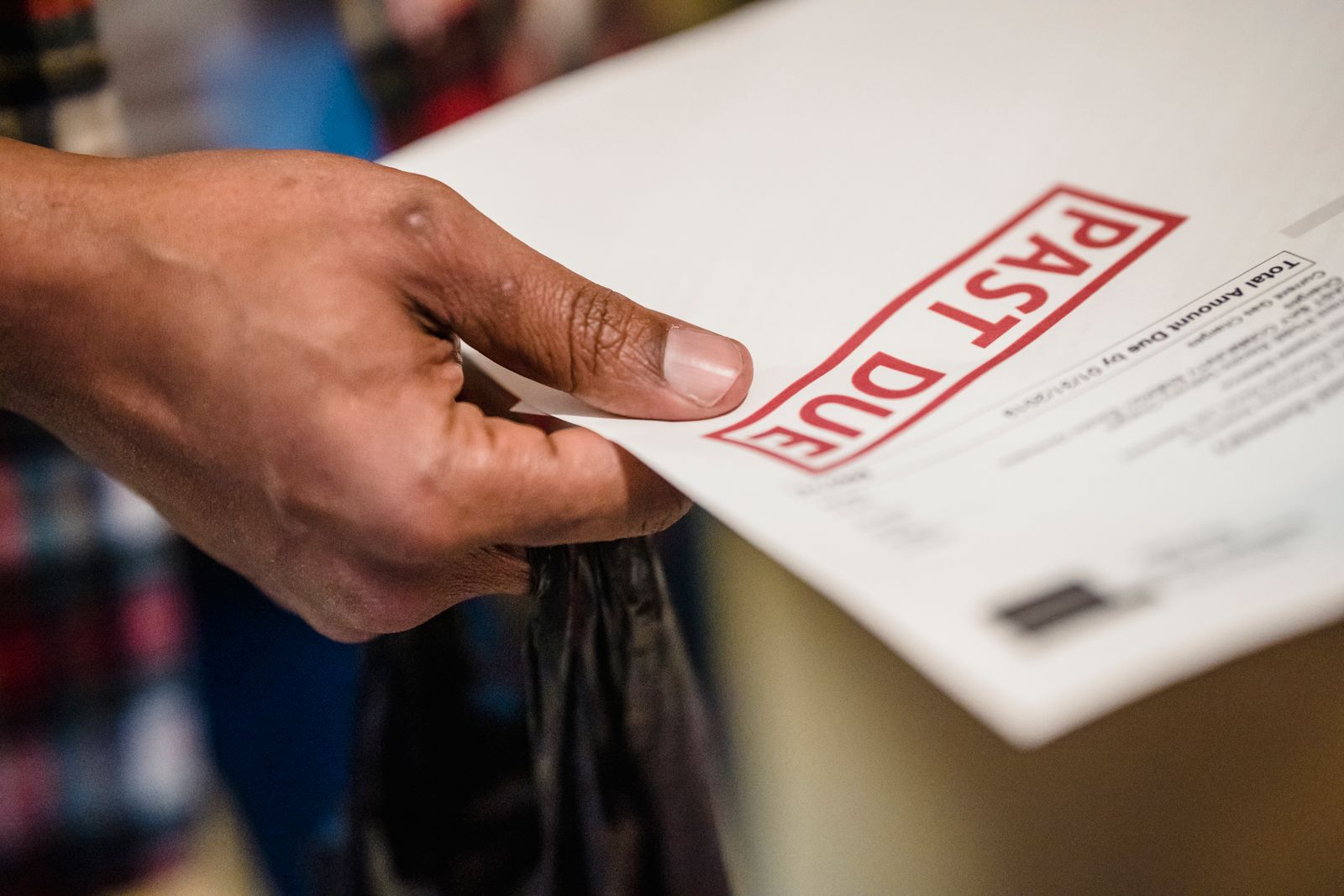
- DollarLedger Team
- 11 Nov, 2026
How to Negotiate Medical Bills in 2026 — Cut What You Owe Before You Pay a Dollar
A $4,800 emergency room bill lands in the mailbox, and the first instinct is to pay it fast or ignore it. Neither is a good plan. The number on a hospital bill is a starting price, not a final price. Hospitals set listed charges from an internal price list called a chargemaster, and a Health Affairs study found the typical hospital charged 3.4 times what Medicare allows. KFF estimates Americans owed at least $220 billion in medical debt in 2024. Yet most people who push back get somewhere: a LendingTree survey found 93% of negotiators got at least a partial reduction. The order matters: check the bill, ask for charity care, then negotiate. All figures were checked on November 11, 2026.Photo: A bill stamped "past due" is not the end of the story - the number on it is a starting price. (Photo: Pexels) What You Will LearnWhy the first bill is a starting price How to check an itemized bill for errors Charity care, and who qualifies Cash prices and prompt-pay discounts The $400 Good Faith Estimate dispute Payment plans and protecting your creditStep 1: Get the itemized bill and check every line What to do: Before you pay a dollar, ask the billing office for a fully itemized bill and go through it line by line. How: The first statement most hospitals send is a summary: a few categories and a total. You cannot check a total. Call the billing number and ask for the itemized version: every charge with its date, description, billing code, quantity, and amount. If you used insurance, compare it with your Explanation of Benefits (EOB). Look for the usual errors: a charge listed twice, a service on a day you were not there, or a drug you never received. When you find a wrong line, call billing, name the line and code, and ask for a written correction. Example: Maria's $4,800 bill listed the same $450 lab test twice. Billing removed it, and the balance fell to $4,350. Common mistake: Paying the summary total without ever seeing the itemized bill.Illustrative diagram - The six steps to negotiate a medical bill, in the order that saves the most. NOT a real hospital screenshot. Step 2: Ask for charity care before you negotiate What to do: Ask for the hospital's financial assistance application — charity care — before you haggle. How: Nonprofit hospitals — most US hospitals — must have a financial assistance policy under IRS Section 501(r), with income limits tied to the Federal Poverty Level (FPL). Many offer free care at or below 200% of the FPL and sliding-scale discounts up to 400% or more. For 2026, the FPL for one person in the 48 contiguous states and DC is $15,960: 200% is $31,920, 400% is $63,840. A family of four: $33,000, so $66,000 at 200% and $132,000 at 400%. You have at least 240 days from the first post-discharge bill to apply, and no extraordinary collections for 120 days. If you qualify, you pay no more than insured patients. Ask for the application even if you are unsure you qualify. Example: Maria earns $45,000 and lives alone — between 200% and 400% of the FPL — so her hospital's sliding scale cut her $4,350 balance in half, to $2,175. Common mistake: Assuming charity care is only for people with no income.Illustrative diagram - The listed charge is a starting price: the typical hospital charged 3.4 times the Medicare-allowable cost. NOT a real CMS screenshot.Photo: Work from the itemized bill, not the summary total - and keep every corrected statement. (Photo: Pexels)Illustrative diagram - 2026 charity care income cutoffs, from the HHS poverty guidelines. NOT a real IRS screenshot. Step 3: Ask for the cash price and compare it with Medicare What to do: Ask billing for the self-pay or cash price, then check it against Medicare's rate. How: Hospitals keep a separate, lower rate for cash patients, often reported at 40% to 70% below the listed charge. Ask: "What is the cash-pay rate for this bill?" Then look up the Medicare rate for the same procedure — search the procedure name plus "Medicare rate," or check the free FAIR Health Consumer tool. If your bill is several times the Medicare rate, that gap is your negotiating leverage. A cash price usually does not count toward your deductible or out-of-pocket maximum, so compare both routes first if you expect to meet your deductible this year. Example: Maria's $4,800 bill carried about $1,400 in Medicare-allowable cost at the typical 3.4-times markup — proof the charge was negotiable. Common mistake: Accepting the listed charge as the real price.Illustrative diagram - Maria's bill: $4,800 down to $1,740 in three steps. NOT a real hospital screenshot. Step 4: Negotiate the balance and ask for a prompt-pay discount What to do: Call billing with your corrected balance, name a lower number, and ask for a prompt-pay discount. How: Billing departments negotiate every day, and they would rather collect something now than sell the debt for cents on the dollar. Start by asking for 25% to 30% off the corrected balance, leaving room to settle lower. Then ask: "If I pay the full balance today, what discount can you offer?" Prompt-pay discounts are typically reported at 10% to 30% off for paying in full, often within 30 days. If you cannot pay in full, offer a lump sum you can afford. Get the deal in writing: the new balance, the discount, and that the account is settled in full. Example: Maria's balance after charity care was $2,175. Paying in full earned a 20% prompt-pay discount, taking it to $1,740 — $3,060 saved from $4,800, about 64%. Common mistake: Negotiating from the original billed total instead of the corrected balance.Photo: Name a number, ask for the prompt-pay discount, and get the deal in writing before you pay. (Photo: Pexels)Illustrative diagram - The federal dispute process for a bill $400 or more above your Good Faith Estimate. NOT a real CMS screenshot. Step 5: If you paid cash and the bill beat the estimate, dispute it What to do: If you paid cash and your final bill came in $400 or more above the written Good Faith Estimate, start the federal dispute process. How: Under the No Surprises Act, providers must give uninsured and self-pay patients a Good Faith Estimate before scheduled, non-emergency care. If one provider's final bill is $400 or more above that estimate, you can file a patient-provider dispute for a $25 fee. You have 120 calendar days from the bill date, and an independent arbitrator decides what you owe. While the dispute is pending, the provider cannot send the bill to collections or charge late fees. This is only for uninsured or self-pay patients — an insurance denial goes through an appeal. Example: A self-pay patient gets a $2,000 estimate for a scan and a $2,600 bill — $600 over, so the $400 rule is met and a dispute can be filed within 120 days for $25. Common mistake: Missing the 120-day window, or using this process for an insurance denial. Step 6: Set up a payment plan and protect your credit What to do: If you cannot pay the reduced balance in full, set up a written payment plan and keep the bill off your credit report. How: Hospital payment plans are usually interest-free, but some carry an acceleration clause: miss a payment and the whole balance falls due at once. Ask the monthly amount, the length, and the missed-payment rule — and get it in writing. Do not ignore the bill: at a nonprofit hospital, extraordinary collections cannot start for at least 120 days, but other providers can move faster, commonly in 30 to 90 days (reported). The three bureaus' own policies still apply in 2026: a medical collection cannot appear until 12 months after collections, paid collections are removed, and balances under $500 are excluded. These are voluntary bureau policies, not a federal ban: the CFPB rule banning all medical debt from reports was vacated in July 2025. Check your reports at AnnualCreditReport.com. Example: Maria took a 12-month, interest-free plan at $145 a month, in writing, with no acceleration clause. Common mistake: Paying by credit card, or ignoring the bill until collections.Illustrative diagram - Six mistakes that cost patients money. NOT a real CMS screenshot. ChecklistItemized bill requested, every line checked. Wrong charges corrected in writing before I pay. Financial assistance application requested, even if unsure I qualify. Cash price asked for, checked against the Medicare rate. Prompt-pay discount asked for, deal confirmed in writing. Payment plan in writing, interest-free. Credit reports checked at AnnualCreditReport.com.FAQ Can you really negotiate a medical bill?Yes. A LendingTree survey found 93% of negotiators got at least a partial reduction, and 38% of challengers in a Commonwealth Fund survey had their bill reduced or eliminated. What is charity care, and who qualifies?Charity care is financial assistance nonprofit hospitals must offer under IRS Section 501(r). Many offer free care at or below 200% of the Federal Poverty Level ($31,920 for one person in 2026) and discounts up to 400% ($63,840) — always ask for the application. What if my bill beats my Good Faith Estimate?If you were uninsured or self-pay and one provider's bill is $400 or more above the written estimate, you can start the federal dispute within 120 days for $25, and an independent arbitrator sets what you owe. How long before a medical bill hurts my credit?Under the bureaus' own policies, a medical collection cannot appear until 12 months after collections, paid collections are removed, and balances under $500 are excluded. I am retired on Social Security — does that change anything?A fixed income often puts you inside a hospital's charity care limits — ask for the application. See how Social Security benefits work in 2026. SourcesCMS, No Surprise Billing (opened live November 11, 2026): https://www.cms.gov/nosurprises IRS, Billing and Collections — Section 501(r)(6) (opened live November 11, 2026): https://www.irs.gov/charities-non-profits/billing-and-collections-section-501r6 HHS, Poverty Guidelines (opened live November 11, 2026): https://aspe.hhs.gov/topics/poverty-economic-mobility/poverty-guidelinesAll figures checked November 11, 2026, against CMS, the IRS, HHS, KFF, the Commonwealth Fund and LendingTree. Disclaimer: For education only, not medical, legal or financial advice. Policies and rules vary by provider and state.

- DollarLedger Team
- 11 Nov, 2026
Best Side Hustles to Make Extra Money in 2026 — What They Really Pay Per Hour
An app advertises $25 an hour. You drive three hours, earn $66, spend $18 on gas and wear, and keep $48 before tax. That is $16 an hour — and after setting money aside for tax, about $12 in your pocket. That gap is the whole story of side hustles in 2026. The surveys cannot agree what the typical side hustler earns: Bankrate's 2025 median is $200 a month, LendingTree's 2026 median is $400, and The Penny Hoarder's 2026 central figure is $1,275. Same country, three answers — because they asked different people. This guide ranks hustles by net hourly profit after expenses and tax. All figures were checked on November 11, 2026.Photo: The headline rate is not your pay — net hourly profit after costs and tax is. (Photo: Pexels) What You Will LearnHow to work out your real net hourly pay What skilled work, gig work and surveys pay per hour Why the three big surveys disagree A 30-day test that costs almost nothing The tax routine: what to set aside, which forms to expect When to scale, switch or stopStep 1: Work out your net hourly rate first What to do: Learn the one formula that judges every hustle: net hourly pay equals gross pay minus expenses minus platform fees, divided by every hour the work took. How: Count all the hours, not just the paid ones — waiting, driving, messaging, pitching, invoicing. A writer billing $50 an hour for four hours, plus two hours pitching and admin, earned $200 for six hours: $33 an hour before fees. For a benchmark, the Bureau of Labor Statistics puts the national mean hourly wage at $33.54 in May 2025 (median $24.51, reported). A hustle paying $16 an hour net is below the typical American wage — fine for extra cash, but not a replacement income. Example: Tom's $300 design job: $30 platform fee, $10 assets, six hours. Net: $260 divided by 6, about $43 an hour. Common mistake: Dividing your pay by billable hours only, and calling the answer your wage.Illustrative diagram - The six steps to a side hustle that actually pays. NOT a real IRS screenshot. Step 2: Pick a lane by what you already know What to do: Choose a hustle that uses a skill you already have — skilled work pays three to five times gig work per hour. How: The reported 2026 ranges tell the story. Freelance writing and design pay about $25 to $75 an hour, online tutoring about $18 to $45, and test preparation up to $50 to $150 (reported). Rideshare pays about $15 to $28 an hour net in peak hours, food delivery about $12 to $22 net, and paid surveys about $3 to $8 (reported). The top end takes longer: The Penny Hoarder reports its top 10% earning $3,000 to $8,000 a month from consulting, freelancing and established digital products (reported). Most hustles take months to reach steady income. Example: Priya, a teacher, tutors two students at $40 an hour for five hours a week — $200 gross. Her friend drives delivery fifteen hours a week at $16 an hour net and earns $240, for three times the hours. Common mistake: Picking the hustle with the biggest advertisement instead of the best rate for the skills you already have.Illustrative diagram - Net hourly pay by hustle in 2026 (reported ranges). NOT a real BLS screenshot.Photo: Delivery pays fast, but gas, wear and waiting time cut the hourly rate. (Photo: Pexels) Step 3: Test it for 30 days at five hours a week What to do: Run a small, cheap test before you spend money on equipment, courses or ads. How: Most side hustlers work very few hours: 54% spend under five hours a week (reported). Copy that. Give it five hours a week for four weeks, tracking every hour, mile and fee. Then use the Step 1 formula. Under $12 an hour net, change lanes or stop; over $25, you have something worth growing. Example: Maya tests tutoring: five hours a week at $30 an hour is $600 gross; her platform takes 18% ($108), so she nets $492 for 20 hours — $24.60 an hour. Common mistake: Buying equipment, paying for a course or cutting main-job hours before the 30-day test proves the hustle pays.Illustrative diagram - Three surveys, three answers: they sampled different hustlers. NOT a real survey screenshot. Step 4: Price your real costs honestly What to do: List every cost the hustle creates, then subtract it before you celebrate the pay. How: Take a delivery shift: three hours on the app pays $66 gross. Say you drive 60 miles at about 30 cents a mile for gas and wear: $18. Net: $48 for three hours, or $16 an hour. Set aside 25% for tax ($12), and your take-home is $36 — $12 an hour. Fees work the same way: Fiverr takes 20% of each order; tutoring platforms take roughly 18% to 33% (reported). Example: A driver counting only the $66 gross thinks she earns $22 an hour. After gas, wear and tax, she keeps $12 — nearly half the headline number. Common mistake: Calling gross pay your profit, and forgetting gas, fees, waiting time and tax.Illustrative diagram - A $22-an-hour delivery shift is $12 an hour after costs and tax. NOT a real app screenshot. Step 5: Set up the tax routine from the first dollar What to do: Treat every payment as partly the taxman's from the day it arrives, and keep it separate. How: All side income is taxable, even with no form — the IRS says report gig income even if part-time, paid in cash, or unreported. The 1099-K rule is about reporting, not tax: apps and marketplaces must send one only when your gross payments exceed $20,000 and you have more than 200 transactions in the year — both conditions (IRS 1099-K FAQs). Direct clients must send a 1099-NEC at $2,000 or more for 2026 payments. If your net self-employment earnings reach $400, you owe 15.3% self-employment tax on 92.35% of net earnings (Schedule SE; Social Security part up to $184,500 in 2026). The routine: a separate account, 25% to 30% of every payment moved in the day it arrives, estimated tax paid quarterly. For the full routine, see our guide to freelancer taxes in the USA in 2026. Example: You net $1,000 profit in a month. Self-employment tax is 15.3% of 92.35% of $1,000, or about $141; income tax at the 12% bracket adds about $120. Total: about $261 — so setting aside $250 to $300 was the right call. Common mistake: Spending the full payout, then finding a tax bill in April with no money set aside.Photo: Tutoring is skilled work — it pays more per hour than delivery, but the platform takes a cut. (Photo: Pexels)Illustrative diagram - Tax on $1,000 of net side hustle profit. NOT a real IRS screenshot. Step 6: Decide at 90 days — scale it, switch it, or stop it What to do: After three months, judge the hustle on its numbers and decide. How: Scale it if your net pay is above $25 an hour, clients come back, and you have a waiting list — raise your rate first, then add hours. Switch lanes if your net pay is still under $12 an hour, or if costs rise faster than pay. At $12 an hour take-home, ten hours a week is $120 a week, about $520 a month — useful, not life-changing. If your main job pays more per hour, keep the hustle a side income. Example: After 90 days, Maya's tutoring nets $26 an hour with three regular students, so she raises her rate to $40. Her brother's delivery work still nets $12 an hour, so he keeps it at five hours a week and stops trying to grow it. Common mistake: Quitting your job for a hustle that pays less per hour than your day job.Illustrative diagram - Six mistakes that shrink side hustle pay. NOT a real IRS screenshot. ChecklistMy net hourly pay. A lane that matches a skill I already have. A 30-day test, every hour and cost tracked. A separate account with 25% to 30% of every payment set aside. 1099 forms checked, and all income reported. A 90-day decision: scale, switch or stop.FAQ How much does the average side hustler actually earn?The surveys disagree: Bankrate's 2025 survey: average $885 a month, median $200. LendingTree's 2026 survey: average $1,242, median $400. The Penny Hoarder's 2026 survey: central figure $1,275 a month. What is the best-paying side hustle per hour?Skilled work: test prep is reported at $50 to $150 an hour, freelance writing and design at $25 to $75, online tutoring at $18 to $45. Rideshare and delivery pay about $12 to $28 an hour net, surveys about $3 to $8. Do I have to pay tax on side hustle income if I do not get a 1099?Yes. The IRS says all gig income is taxable even if no form arrives. The 1099-K threshold — over $20,000 and over 200 transactions — only decides whether a payment app must send you a form. How many hours a week do side hustlers work?Most work very few hours: 54% spend under five hours a week (reported). The Penny Hoarder's 2026 survey found its side hustlers working about 13 hours a week (reported). How do I start a side hustle with no money?Start with a skill you already have — writing, tutoring, design, driving — list yourself on free platforms, and test it for 30 days at five hours a week. Check the platform is real first: see our guide to how to find a legitimate remote job in the USA in 2026. SourcesInternal Revenue Service, Gig Economy Tax Center (opened live November 11, 2026): https://www.irs.gov/businesses/gig-economy-tax-center Internal Revenue Service, Form 1099-K FAQs: General information (opened live November 11, 2026): https://www.irs.gov/newsroom/form-1099-k-faqs-general-information U.S. Bureau of Labor Statistics, Occupational Employment and Wages, May 2025 — nationwide mean hourly wage $33.54 (opened live November 11, 2026): https://Data.Bls.gov/regions/southwest/news-release/2026/occupationalemploymentandwages_houston_20260813.htmAll figures checked November 11, 2026. Disclaimer: For education only, not tax or financial advice. Survey figures are reported by their publishers; your earnings will differ.

- DollarLedger Team
- 11 Nov, 2026
How to Save Money on Groceries in 2026 — A Realistic Budget That Actually Works
Your grocery bill feels high, and it is not your imagination. Grocery inflation is back near its historical norm of about 2.6% a year (reported), but the price level is still roughly 30% above 2019 (reported) — the rate came down, the prices never did. So the fix is knowing what your household should cost, then closing the gap. The USDA prices a nutritious diet every month: an official benchmark. Here are six steps that work on a real budget. All figures were checked on November 11, 2026.Photo: Start with the official benchmark, then close the gap step by step. (Photo: Pexels) What You Will LearnWhat the USDA says your household should spend on groceries What the average American household actually spends How to set your grocery target A weekly meal-plan routine that cuts waste What a family of four saves by moving down one planStep 1: Find your number first What to do: Look up the USDA benchmark for your household first. How: The USDA publishes four food plans every month, each pricing a nutritious diet at a different spending level: Thrifty, Low-Cost, Moderate-Cost and Liberal. The September 2026 report — the latest published — puts a reference family of four (two adults aged 20 to 50 and two children aged 6 to 8 and 9 to 11) at $1,024 a month on Thrifty, $1,127 on Low-Cost, $1,389 on Moderate-Cost and $1,682 on Liberal: about $2.81 per person per meal on Thrifty. A single adult aged 20 to 50 runs about $305 a month for a woman and $383 for a man on Thrifty, and about $404 to $478 on Moderate, after the USDA's 20% single-person adjustment. Add 10% for two people and 5% for three. Thrifty is also the basis for SNAP benefits — the FY2027 maximum for a family of four is $1,023 a month. Example: At $1,500 a month a family of four is above even the Liberal plan; at $1,100 it is already between Thrifty and Low-Cost. Common mistake: Picking a round number from a blog post. Your benchmark depends on who you feed.Illustrative diagram - The six steps to a realistic grocery budget. NOT a real USDA screenshot. Step 2: Track one real month What to do: Add up last month's food spending from receipts and statements — not memory. How: Split it into three piles: groceries (food at home), eating out (restaurants, takeout, delivery), and household items like cleaning products and toilet paper. The official numbers exclude that last pile — but many shoppers count it as groceries and then wonder why they are over budget. The BLS Consumer Expenditure Survey (latest full year: 2024) puts the average household at $6,224 a year on food at home — about $519 a month — plus $3,945 a year, about $329 a month, on food away from home. Total food: $10,169 a year, about $847 a month, or 12.9% of all spending. USDA numbers are modelled budgets; BLS numbers are actual spending, averaged across all sizes. Compare your grocery pile with the USDA benchmark and eating out with the $329 average. Example: Maya's statements show $640 on groceries, $210 on takeout and $55 on cleaning supplies. Her grocery pile is $640 — not $905. Common mistake: Counting a $200 Costco run as groceries when $60 was paper towels and a mop.Illustrative diagram - USDA September 2026: what a nutritious diet costs a family of four. NOT a real USDA screenshot.Photo: Compare your grocery pile — food at home only — with the USDA benchmark for your household size. (Photo: Pexels) Step 3: Set your target What to do: Pick one USDA plan level as your target. How: Above the Liberal plan? Aim for Moderate first. Already near Moderate? Aim for Low-Cost. The gap is real money: a family of four moving from Moderate ($1,389) to Low-Cost ($1,127) saves $262 a month, or $3,144 a year. Liberal ($1,682) to Thrifty ($1,024) saves $658 a month. A single adult moving from Moderate to Thrifty saves about $95 to $99 a month — roughly $1,140 to $1,190 a year. Never go below Thrifty: it is the floor for a nutritious diet. If the target still does not fit your pay, our guide to budgeting on a low income with the 50/30/20 rule shows how to adapt the percentages when needs take more than half your take-home pay. Example: The Patels spend $1,450 a month. Their target is Low-Cost at $1,127 — a $323 monthly cut. They aim for Moderate ($1,389) in month one, then Low-Cost by month three. Common mistake: Setting the target at Thrifty on day one and quitting in week two. A target you keep beats a perfect one you abandon.Illustrative diagram - Single-adult budgets and household-size adjustments, September 2026. NOT a real USDA screenshot.Illustrative diagram - Worked example: what moving down one USDA plan saves a family of four. NOT a real USDA screenshot. Step 4: Plan meals and shop the list What to do: Plan seven dinners before you shop. How: Once a week, take twenty minutes: check the pantry and fridge, plan meals around what is already there and what is on sale, then build the list in store order and stick to it. Three habits do most of the saving: store brands on staples like rice, beans, oats and canned tomatoes, where the recipe hides the label; seasonal produce, which is cheaper because it is plentiful; and one big batch — a pot of beans, a tray of roasted vegetables, a whole chicken — that becomes two or three meals. A list also kills the unplanned aisle. Example: Maya plans five dinners around chicken thighs on sale, pantry rice and beans, and seasonal squash. She spends $118 for the week instead of $165 — about $200 a month saved. Common mistake: Shopping hungry or without a list. The plan is written before the store, not in aisle three.Photo: One batch-cooked meal becomes two or three dinners — plan it before you shop. (Photo: Pexels) Step 5: Cut waste and use the freezer What to do: Treat food waste as money in the bin. How: Here is the part the benchmark hides: USDA plans assume food at home only — no restaurants, takeout or delivery — and near-zero waste with scratch cooking. Few households cook like that. The fix is a waste routine, not a stricter budget. First in, first out: new shopping goes behind what is in the fridge. Cook what spoils first — greens and berries before carrots and apples. Freeze bread, meat and cooked meals in portions the day you buy or cook them. Keep one "use it up" meal a week: a stir-fry, soup or frittata from whatever is left. Example: Maya freezes half a loaf and two portions of soup every Sunday, and her Friday use-it-up dinner clears the week's leftovers. Her weekly shop drops by about $20 — roughly $85 a month. Common mistake: Buying bulk for the lower unit price, then throwing half away. Food in the bin has an infinite unit price.Illustrative diagram - Where the average household's food money goes (BLS, 2024). NOT a real BLS screenshot. Step 6: Compare stores and lock the routine What to do: Price your ten most-bought items at two stores. How: The cheapest store for milk is rarely the cheapest for produce. Price your ten most-bought items — milk, eggs, bread, rice, chicken, coffee — at your usual store and one competitor, including a discount grocer if one is near you. Buy each item where it is cheapest, and keep the routine: same planning day, same list, same review. Once a month, compare actual spending with your Step 3 target. If you are over, find the leak — usually takeout, waste, or unplanned trips. If money is genuinely tight, check whether you qualify for food help: our guide to SNAP food stamps in 2026 explains who qualifies and how to apply — the Thrifty plan here is the same benchmark SNAP benefits are built on. Example: Maya's discount grocer beats her supermarket on produce by about 25% but loses on dairy. She buys produce there and dairy at her usual store, saving about $35 a month. Common mistake: Chasing sales across four stores and burning the savings on gas. Two stores, ten items, one routine.Illustrative diagram - Six mistakes that keep grocery bills high. NOT a real USDA screenshot. ChecklistI looked up my USDA benchmark. I tracked one real month, split into groceries, eating out and household items. I set a monthly target — one plan level down. I plan seven dinners and shop from a written list. I freeze portions and cook one use-it-up meal weekly. I priced my ten most-bought items at two stores.FAQ How much should a family of four spend on groceries?Thrifty $1,024, Low-Cost $1,127, Moderate $1,389, Liberal $1,682 a month (USDA, September 2026), all for food cooked at home. How much should one person spend on groceries a month?About $305 a month for a woman and $383 for a man on Thrifty, and about $404 to $478 on Moderate (USDA, September 2026, after the 20% single-person adjustment). Why is my grocery bill still so high?The inflation rate fell, not the price level. Grocery inflation is near its 2.6% norm (reported), but prices are still roughly 30% above 2019 (reported). Can I really save $3,000 a year on groceries?Yes, if the household follows the plan: $262 a month, or $3,144 a year, moving from Moderate to Low-Cost. A single adult saves about $95 to $99 a month. SourcesUSDA Food and Nutrition Service, USDA Food Plans (opened live November 11, 2026): https://www.fns.usda.gov/cnpp/usda-food-plans USDA Food and Nutrition Service, USDA Food Plans: Monthly Cost of Food Reports, September 2026 (opened live November 11, 2026): https://fns-prod.azureedge.us/research/cnpp/usda-food-plans/cost-food-monthly-reports U.S. Bureau of Labor Statistics, Consumer Expenditures — 2024 (opened live November 11, 2026): https://www.bls.gov/news.release/archives/cesan_12192025.htmAll figures checked November 11, 2026, against the USDA and the BLS. Disclaimer: For education only, not financial or nutrition advice. USDA plans and BLS averages are national benchmarks — your costs vary by household, location and diet.

- DollarLedger Team
- 10 Nov, 2026
How Much Down Payment Do You Need to Buy a House in 2026? The 20% Myth, in Dollars
Ask a first-time buyer how much they need to buy a house and most will say 20% down. On a $400,000 home that is $80,000 in cash. The 20% figure is real, but it is not a minimum. It is the point where private mortgage insurance drops off a conventional loan. You can buy in 2026 with 3% down conventional, 3.5% down FHA, or 0% down VA or USDA if you qualify. This guide turns each percent into dollars, prices the monthly cost, and adds closing costs. All figures were checked on November 10, 2026.Photo: The keys are the finish line - the number to save is the down payment plus closing costs. (Photo: Pexels) What You Will LearnMinimum down payment by loan type, in dollars What 3%, 10% and 20% down cost on a $400,000 home Closing costs, and the real cash-to-close number PMI and FHA insurance costs, and when they end Down payment assistance in your state A savings target you can reachStep 1: Pick your loan type first What to do: Find out which loan type fits you before you pick a down payment number. How: There is no single minimum. The CFPB says most buyers need at least 3% down, and many loans need 5% or more. Fannie Mae HomeReady and Freddie Mac Home Possible allow 3% down with a 620+ score and income at or below 80% of the area median income. A repeat buyer on a standard conventional loan usually starts at 5%. An FHA loan needs 3.5% down with a 580+ score, or 10% with a 500-579 score; HUD states the FHA minimum is 3.5% in most cases. VA loans need 0% down for eligible service members, veterans and some surviving spouses. USDA loans need 0% down for eligible rural or suburban homes, with income limits. Example: Maya has a 640 score and earns below 80% of her area median income, so HomeReady lets her buy with 3% down. Common mistake: Assuming every loan needs 20% down.Illustrative diagram - The six steps to your down payment number. NOT a real CFPB screenshot. Step 2: Turn the percent into dollars What to do: Multiply each down payment percent by the home price you are shopping for. How: On a $400,000 home, 3% down is $12,000, 3.5% is $14,000, 5% is $20,000, 10% is $40,000, and 20% is $80,000. The gap between the lowest conventional down payment and 20% is $68,000 in cash. NAR's 2025 Profile of Home Buyers and Sellers puts the first-time median at 10% - the highest since 1989 - repeat buyers at 23%, and all buyers at 19%. It covers buyers who purchased between July 2024 and June 2025. The first-time median was 6% in 2020 (reported), so 10% is a 2025 number, not a timeless rule. Example: At the 2025 first-time median of 10%, a buyer needs $40,000 on a $400,000 home. With a 3% HomeReady loan she needs $12,000. Common mistake: Comparing percents, not dollars: 3% sounds small until you see $12,000.Illustrative diagram - Minimum down payment by loan type on a $400,000 home. NOT a real CFPB screenshot.Photo: On a $400,000 home, the down payment ranges from $12,000 to $80,000 depending on the loan. (Photo: Pexels) Step 3: Add closing costs What to do: Add closing costs to your down payment before you set your savings target. How: Closing costs are lender fees, appraisal, title services and prepaid taxes and insurance. The CFPB says they typically run 2% to 5% of the purchase price, not including the down payment. On a $400,000 home that is $8,000 to $20,000. Cash to close is the down payment plus closing costs: with 3% down, $12,000 plus $8,000 to $20,000 is $20,000 to $32,000 in cash. Cash to close is often 50% to 100% more than the down payment alone. Your Loan Estimate, due within three business days of applying, shows your exact closing costs. To check what your income can support, see our guide to how much house you can afford in the USA in 2026. Example: Sara saves $12,000 for a 3% down payment. Her Loan Estimate shows $12,000 in closing costs, so she needs $24,000 in cash to close. Common mistake: Saving only the down payment, then finding the cash needed is nearly double.Illustrative diagram - What the percent means in dollars on a $400,000 home. NOT a real CFPB screenshot.Illustrative diagram - Cash to close with 3% down on a $400,000 home. NOT a real CFPB screenshot. Step 4: Price the mortgage insurance What to do: Work out what mortgage insurance adds to your monthly payment. How: Below 20% down on a conventional loan, you usually pay private mortgage insurance, or PMI. PMI protects the lender and typically costs 0.5% to 1% of the loan per year (reported). On a $388,000 loan - a $400,000 home with 3% down - that is about $162 to $323 a month. PMI ends: ask for cancellation at 80% of the original value, and it must end automatically at 78% if payments are current. FHA mortgage insurance, or MIP, has an upfront premium of 1.75% - $6,755 on a $386,000 loan - plus 0.55% a year, about $177 a month. With under 10% down, FHA MIP usually lasts the life of the loan (reported); at 10% or more it generally ends after 11 years (reported). Freddie Mac's survey put the average 30-year fixed rate at 7.18% for the week ending November 5, 2026, down from 7.24%. At 7.18% over 30 years, principal and interest on a $388,000 loan is $2,628 a month, so with PMI the payment is about $2,790 to $2,951 a month. On a $320,000 loan with 20% down it is $2,168 a month with no PMI. Example: Two buyers buy the same $400,000 home at 7.18%: 3% down pays $2,790 to $2,951 a month, 20% down pays $2,168. The first needs $68,000 less cash but pays $620 to $780 more a month until PMI ends. Common mistake: Choosing the smallest down payment without pricing PMI.Photo: Buying sooner with less down means a higher monthly payment - price it before you choose. (Photo: Pexels)Illustrative diagram - Monthly cost at 7.18% on a 30-year fixed loan. NOT a real Freddie Mac screenshot. Step 5: Check state assistance What to do: Look up your state housing finance agency before assuming you must save it all yourself. How: Most states run down payment assistance through their housing finance agency, and amounts and rules differ in every state. New Jersey is one example: its agency offers up to $15,000 toward down payment and closing costs in higher-cost counties, $10,000 elsewhere, as a 0% interest, no-monthly-payment loan, forgivable after five years (reported). A qualifying first-generation buyer can add $7,000, for up to $22,000 in total (reported). Other states offer grants, forgivable loans or low-interest second mortgages. Most require first-time-buyer status, income and price limits, a primary residence, and an approved lender. Example: A first-generation buyer in Bergen County, New Jersey, gets $15,000 plus $7,000 - $22,000 she does not repay if she stays five years (reported). Common mistake: Assuming your state matches New Jersey's $15,000, or that assistance is a grant, not a loan. Step 6: Set your target and save What to do: Pick a down payment you can reach, add closing costs, and save that total separately. How: Work out cash to close from your loan type: down payment plus 2% to 5% for closing costs. Keep the CFPB's recommended cushion - three to six months of expenses - as a separate emergency fund. If 20% is years away, compare waiting with PMI: two more years of rent may cost more than $162 to $323 a month of PMI. Already own a home? See whether you should refinance your mortgage in 2026. Get preapproved with two or three lenders, compare Loan Estimates, and ask what your payment looks like at 3%, 10% and 20% down. Example: A buyer with a 3% HomeReady loan saves $32,000 and keeps $15,000 in a separate emergency fund. Common mistake: Putting every dollar into the down payment, then facing a job loss with no cash left.Illustrative diagram - Six mistakes that cost first-time buyers money. NOT a real CFPB screenshot. Checklist☐ My loan type and its minimum down payment. ☐ Cash to close, including closing costs. ☐ PMI or MIP priced, and when it ends. ☐ State assistance checked. ☐ Emergency fund of three to six months kept separate. ☐ Loan Estimates compared from two or three lenders.FAQ Do I really need 20% down to buy a house in 2026? No. 20% is where PMI drops off a conventional loan, not the minimum. Conventional loans go as low as 3% down, FHA 3.5%, and VA and USDA 0% for eligible borrowers. How much is 3% down on a $400,000 house? $12,000. With closing costs of 2% to 5%, cash to close is $20,000 to $32,000. On the same home, 10% down is $40,000 and 20% down is $80,000. When does PMI go away? Ask for cancellation at 80% of the home's original value; it must end automatically at 78% if payments are current. FHA MIP usually lasts the life of the loan with less than 10% down (reported). What is the 30-year mortgage rate right now? Freddie Mac's survey put the average 30-year fixed rate at 7.18% for the week ending November 5, 2026. It is a national average, not a quote. Can down payment assistance cover my whole down payment? Sometimes. New Jersey offers up to $15,000 plus a $7,000 first-generation add-on (reported). Check your own state agency - amounts and rules differ everywhere. SourcesConsumer Financial Protection Bureau, Determine your down payment (opened live November 10, 2026): https://www.consumerfinance.gov/owning-a-home/prepare/determine-your-down-payment/ Fannie Mae, HomeReady Low Down Payment Mortgage (opened live November 10, 2026): https://yourhome.fanniemae.com/buy/homeready Freddie Mac, Primary Mortgage Market Survey (opened live November 10, 2026): https://www.freddiemac.com/pmmsAll figures checked November 10, 2026, against the CFPB, Fannie Mae, Freddie Mac, HUD and NAR. Disclaimer: For education only, not mortgage, tax or investment advice. Loan programs, rates and assistance rules change and vary by state and lender.

- DollarLedger Team
- 10 Nov, 2026
Debt Consolidation Loan in 2026 - When It Saves You Money and When It Does Not
A debt consolidation loan sounds like a fresh start: one loan pays off all your credit cards, leaving one monthly payment. It can save thousands - or cost more than doing nothing. The difference is one number: the new loan's APR against the average APR of the debts it replaces. If the new rate is meaningfully lower, consolidation wins. If not, you have re-arranged the same debt and paid a fee for it. Consolidation does not erase debt. The balance stays the same; only the rate and the payment change.Photo: Before you consolidate, the real work is done at the desk - adding up what you owe and at what rate. (Photo: Pexels) What You Will LearnWhat a consolidation loan does - and does not do How to work out your weighted average APR, the number to beat What rate your credit score gets you in November 2026 The $20,000 worked example: cards at 22% versus a loan at 12% When a 0% balance-transfer card beats a loanStep 1: Understand what a consolidation loan really does What to do: Learn the mechanics before you apply for anything. How: It is a personal loan used to pay off several debts at once, usually credit cards. The lender may pay your creditors directly. After that, the cards are at zero and you owe one fixed payment for 3 to 5 years. One payment instead of five, and a fixed end date - that is the appeal. The trap: the CFPB warns a lower payment can come from a longer term, and after fees and extra months you can pay more in total. The FTC adds that some loans use your home as collateral. Example: Maria takes a $20,000 loan and pays five cards to zero. One payment: $444.89 a month. The $20,000 did not disappear - it moved. Common mistake: Treating zero balances as money you can spend again.Illustrative diagram - The six steps to a debt consolidation loan in 2026. NOT a real bank or lender screenshot. Step 2: Work out your weighted average APR What to do: List every debt, its balance and its APR, and work out the weighted average. How: A simple average is wrong: a $8,000 card at 24% costs far more than a $5,000 card at 19%. Multiply each balance by its APR, add the results, and divide by the total. Three cards - $8,000 at 24%, $7,000 at 21%, $5,000 at 19% - give 192,000 + 147,000 + 95,000 = 434,000. Divide by $20,000: 21.7%, the bar. A loan only helps if it clears that bar by a clear margin - at least 4 to 5 points below it, so 16.7% or less here. The Fed's G.19 (November 6, 2026) puts the average card APR at 22.36% (August 2026). Example: Tom's cards average 21.7%. A lender offers 19% - only 2.7 points below, not worth the fee. Common mistake: Comparing the offer with your highest card rate, not the weighted average.Illustrative diagram - What rate you can get depends on your credit score. NOT a real bank or lender screenshot. Step 3: Check what rate you can actually get What to do: Pre-qualify with several lenders (soft pulls) and compare offers with your average. How: Your credit score decides your rate. NerdWallet (updated November 2, 2026) reports average personal loan APRs from pre-qualifications over the last 90 days: excellent (720-850) 15.06%, good (690-719) 19.65%, fair (630-689) 23.87%, bad (300-629) 27.42%. It also reports 19.91% for good-credit pre-qualifications, and 18.39% for good-credit consolidation loans (last 30 days). LendingTree Q3 2026: excellent (800+) 15.55%, very good (740-799) 17.87%, good (670-739) 23.01%, fair (580-669) 27.29%, poor (under 580) 30.18%. Do not blend them - they measure different borrowers. Both agree: excellent credit gets the mid-teens; fair credit pays more than the average card. If your score is fair or below, the loan is usually more expensive than your cards. Your bank and a federal credit union may be cheaper: the Fed puts the average 24-month bank personal loan at 11.90% (August 2026, G.19), and federal credit unions cap most loans at 18% through September 10, 2027 (NCUA). Pre-qualification uses a soft pull, so checking offers does not hurt your score. Example: Ana (735 score, 21.7% average) pre-qualifies at 14.5% with her credit union and 17.9% online - the credit union clears her bar by 7.2 points, the online offer by 3.8. Common mistake: Applying formally to one lender and accepting whatever rate comes back.Photo: The rate you are offered matters more than the rate you read about - pre-qualify and compare real offers. (Photo: Pexels) Step 4: Run the real math - the $20,000 example What to do: Before you sign, calculate total interest and the monthly payment, and subtract the fees. How: Use the same $20,000 over 5 years on both sides, so only the rate changes. At 22%, the payment is $552.38 a month and the interest is $13,143, for $33,143 repaid. At 12%, the payment is $444.89 and the interest is $6,693, for $26,693 repaid. The loan saves $6,449 in interest and $107.49 a month. Now subtract the fees. Origination fees run 1% to 10% (NerdWallet, November 2026). A 5% fee on $20,000 is $1,000, usually taken out before you see it. That eats about a sixth of the saving. A shorter term helps: at 12% over 3 years the interest is only $3,914, though the payment jumps to $664.29. A 7-year loan can cut the payment while raising total interest above the cards. Example: Ana takes 14.5% instead of 12%: about $8,548 interest over 5 years - $4,595 less than the cards, $1,855 more than at 12%. Common mistake: Comparing monthly payments instead of total interest.Illustrative diagram - The $20,000 worked example: 22% cards versus a 12% loan over 5 years. NOT a real bank or lender screenshot.Illustrative diagram - Your weighted average APR is the number the loan must beat. NOT a real bank or lender screenshot. Step 5: Compare the loan with the 0% balance-transfer card What to do: If you can clear the balance in 12 to 21 months, price the card before you take the loan. How: A 0% balance-transfer card charges no interest during the promo period, usually 12 to 21 months. Clear $20,000 in 18 months and the payment is $1,111.11 a month with zero interest - if you can afford it and finish before the promo ends. The catch is the transfer fee, often 3% to 5% (reported) - $600 to $1,000 on $20,000 - and the rate after the promo, which jumps to a normal card APR. Miss the window and the leftover debt earns card-rate interest again. It is a timetable question: under 21 months, the card usually wins; over 21 months, the loan wins; if the loan rate is above your average, neither wins. Our post on the best 0% APR balance transfer cards in 2026: </blog/best-0-apr-balance-transfer-cards-2026> Example: Ben owes $8,000 and can pay $500 a month. He clears it in 16 months on a 0% card, paying only the transfer fee, about $240 to $400 (reported). Common mistake: Paying only the minimum and watching the promo expire with most of the balance still there.Photo: Card or loan is a timetable question - divide the balance by the months you have, and the answer usually appears. (Photo: Pexels) Step 6: Take the loan the safe way and keep the cards at zero What to do: If the loan clears your bar, take it, pay the cards off the same week, and do not use them again. How: Choose the shortest affordable term, and prefer a no-fee lender, usually a bank or credit union. Ask whether the lender pays your creditors directly - no lump sum in your account to tempt you. Then deal with the cards: the most common failure is running them back up, leaving you owing the loan and the cards. Freeze or cut up the cards, and remove saved card numbers from shopping apps. If no loan beats your average, do not force it. The CFPB and FTC both point to the same free first step: a nonprofit credit counselor, who can review your budget and may set up a debt management plan. Our guide to paying off credit card debt fast: </blog/how-to-pay-off-credit-card-debt-fast-in> Example: Ana takes the $20,000 loan, the credit union pays her three cards directly, and she cuts two cards up. One payment: $475.80 a month. Common mistake: Using a zero-balance card for a holiday. It charges interest from day one.Illustrative diagram - Loan versus 0% balance-transfer card versus staying put. NOT a real bank or lender screenshot.Illustrative diagram - Six mistakes that make consolidation cost more. NOT a real bank or lender screenshot. Checklist☐ I worked out my weighted average APR. ☐ I pre-qualified with three lenders and compared offers with my average. ☐ The best offer is at least 4-5 points below my average, after the fee. ☐ I checked whether a 0% card beats the loan. ☐ I checked my bank and a credit union first.FAQ Does a debt consolidation loan erase my debt? No. $20,000 of card debt becomes a $20,000 loan. Only the rate and payment change. What credit score do I need for a good rate? Excellent credit (720+) averages 15.06%; good credit (690-719) 19.65%. Fair credit (630-689) averages 23.87% - above the average card rate of 22.36% - so consolidation rarely saves money there. How much lower must the new rate be? At least 4 to 5 points below your weighted average, after the fee. On a 21.7% average, that means 16.7% or less. Is a 0% balance-transfer card better than a loan? Usually yes, if you can clear it in 12 to 21 months - $1,111 a month clears $20,000 in 18 months with zero interest. Over 21 months, the loan wins. Watch the transfer fee (often 3-5%, reported) and the rate after the promo. SourcesFederal Reserve, Consumer Credit - G.19, released November 6, 2026: https://www.federalreserve.gov/releases/g19/current/ Consumer Financial Protection Bureau, What do I need to know about consolidating my credit card debt?: https://www.consumerfinance.gov/ask-cfpb/what-do-i-need-to-know-if-im-thinking-about-consolidating-my-credit-card-debt-en-1861/ Federal Trade Commission, How To Get Out of Debt: https://consumer.ftc.gov/articles/how-get-out-debt DollarLedger USA, Best 0% APR Balance Transfer Cards in 2026: </blog/best-0-apr-balance-transfer-cards-2026> DollarLedger USA, How to Pay Off Credit Card Debt Fast in 2026: </blog/how-to-pay-off-credit-card-debt-fast-in>All figures checked November 10, 2026. Disclaimer: For education only, not financial advice. Loan rates change daily - check current offers before you apply.

- DollarLedger Team
- 10 Nov, 2026
How to Build Credit from Scratch in 2026 - No Score, No Problem
Having no credit score is not the same as having a bad one. A bad score means lenders have seen you miss payments; no score means they have seen nothing at all - your file is blank. The CFPB's 2015 report put the number at about 26 million Americans with no credit file at all, plus another 19 million with files too thin to score. A June 2025 CFPB update revised the no-file figure down to about 7 million as of December 2020. Either way, millions of adults start from zero. Card terms were checked November 10, 2026 - check them again before you apply.Photo: Your first card is a tool, not a spending spree - the goal is a clean payment record. (Photo: Pexels) What You Will LearnHow to check whether you really have no credit file Which secured card to open first How to add a second account that reports How much of your limit to use When your first score appears, and how to protect itStep 1: Check your starting point first What to do: Pull your free credit reports before you apply for anything. How: Go to AnnualCreditReport.com, the only site federal law authorizes for free credit reports. You can check each bureau's report - Equifax, Experian and TransUnion - once a week for free; the FTC says the program is now permanent. You will need your name, address, Social Security number and date of birth. A credit report is not a credit score: it shows the accounts behind a score, not the score itself. You can also order by phone at 1-877-322-8228. Example: Maria has never had a card or a loan - but her Equifax report shows a store card opened in her name. Common mistake: Applying for cards blind. You may have no file, a thin file, or an error on your file - and each needs a different first move.Illustrative diagram - The six steps to building credit from scratch in 2026. NOT a real CFPB screenshot. Step 2: Open one secured card that reports to all three bureaus What to do: Open one secured card that reports to all three bureaus. How: A secured card works like a normal credit card, except you put down a refundable cash deposit first, and that deposit usually becomes your credit limit. The whole point is the reporting: every on-time payment is sent to the three bureaus, so confirm it reports to all three first. The usual starting picks: Discover it Secured Cash Back and Capital One Platinum Secured both ask for a $49, $99 or $200 deposit, charge no annual fee, need no credit score to apply, and report to all three bureaus. Capital One's purchase APR is 29.24% variable, so pay in full. The Chime Card needs no deposit and no credit check, charges no annual fee and no interest, and reports to all three - but needs a Chime Checking Account. Skip any secured card charging a $75 or higher annual fee. Compare first cards here: </blog/best-first-credit-card-in-usa-2026-no> Example: James opens the Capital One Platinum Secured with a $200 deposit, giving him a $200 limit. Common mistake: Trusting old Discover advice. The original card stopped taking applications in June 2026 and relaunched that October. The old seven-month automatic upgrade review is gone - reviews are now periodic, with no set schedule.Illustrative diagram - What builds credit, and what does not. NOT a real CFPB screenshot. Step 3: Add a second tradeline What to do: Once your card is open and reporting, add one more account that reports. How: The simplest second account is a credit-builder loan from a bank or credit union. The lender holds the loan - usually a few hundred dollars to about $1,500 (reported) - in a locked savings account, and you repay it over about six to 24 months. Each payment is reported, and when you finish, the money is yours. The other option is becoming an authorized user on a trusted family member's card with a long, clean history. Treat that as a boost, not your whole plan - authorized-user-only files are weaker on their own (reported). Add one second account, not three - each new application is a hard inquiry. Example: After three months, Ana takes a $1,000 credit-builder loan over 12 months at about $85 a month, and every payment is reported. Common mistake: Paying for a service that reports rent or utility payments as your only tradeline. Those reports do not replace a card or loan that reports to all three bureaus.Photo: One card, used lightly, is enough to start - the second account comes after it is reporting. (Photo: Pexels) Step 4: Use it lightly and pay in full every month What to do: Put one small bill on the card and pay the full balance every month. How: Put one small charge you already pay - a streaming subscription or a phone bill - on the card. The CFPB's guidance is to keep usage under 30% of your limit, and some experts say under 10% is better. On a $200 limit, $20 is 10% and $60 is 30% - the ceiling, not the target. Set up autopay for the full statement balance. Never carry a balance: at 29.24% variable APR, carrying $200 for a month costs about $5 in interest. Payment history is about 35% of a FICO score and amounts owed about 30% (reported) - together about two-thirds of it. The Chime Card is the exception: it reports no utilization. Example: James puts his $15 streaming bill on his $200-limit card and autopays in full: 7.5% of his limit, no interest. Common mistake: Spending up to the limit because the deposit covers it. The deposit is the issuer's collateral. Maxing out a $200 limit means 100% usage.Illustrative diagram - The $200 secured card worked example. NOT a real CFPB screenshot. Step 5: Wait for the score - and watch it grow What to do: Keep the habits going for six months, then check whether your first score has appeared. How: A FICO score needs at least one account open for six months or more, and at least one account reported within the past six months. Your first FICO score appears after about six months of reported history - no product produces one sooner. After that, steady on-time payments and low balances can put you in the 600s to 700s within a year or two (reported). A VantageScore can appear sooner (reported) - but most lenders use FICO. While you wait, pull your reports free each week and confirm your card is reporting to all three bureaus. Example: Ana opens her secured card in November 2026. Her first FICO score appears around May 2027, six months later. Common mistake: Checking your score every week and changing strategy when it moves slowly. A new score starts low and climbs in small steps. The first year is about the payment record, not the number.Illustrative diagram - Your first two years: what to expect. NOT a real CFPB screenshot.Photo: The first year is about the payment record, not the number - patience is part of the plan. (Photo: Pexels) Step 6: Protect the file you just built What to do: Guard your payment history above everything else, and keep your first card open. How: One payment reported 30 days late can drop a score in the 700s by 60 to 110 points (reported, from FICO's own simulations), and the late mark stays on your credit report for seven years. On a brand-new file, one late mark is a large share of everything the model knows about you. So set autopay for at least the minimum on the day you open the account. Keep your first card open after you graduate - length of history is about 15% of a FICO score (reported). Do not apply for a stack of new cards once your score appears: each application is a hard inquiry. To raise it faster, see our guide to improving your credit score: </blog/how-to-improve-your-credit-score-fast> Example: James graduates after a year and gets his $200 deposit back - but he keeps the account open. Common mistake: Closing the secured card the day the deposit comes back. You lose your oldest account and your available credit.Illustrative diagram - What a FICO score is made of. NOT a real CFPB screenshot.Illustrative diagram - Six mistakes that keep beginners stuck. NOT a real CFPB screenshot. Checklist☐ I checked my free reports and know my starting point. ☐ I opened one no-fee secured card that reports to all three bureaus. ☐ I added one second tradeline. ☐ I put one small bill on the card and autopay in full. ☐ I know my first FICO score needs about six months. ☐ I will never miss a payment, and I will keep my first card open.FAQ How long does it take to build credit from scratch? About six months for your first FICO score. Reaching the 600s to 700s usually takes a year or two of steady payments and low balances (reported). Do I need a secured credit card to build credit? It is the most direct route, but not the only one. A credit-builder loan or authorized-user status also reports payments to all three bureaus. Does checking my own credit report hurt my score? No. Checking your own reports is a soft inquiry and never affects your score. Only a lender's hard inquiry can lower it slightly. What if I have no bank account yet? Open a basic checking account first. The Chime Card requires a Chime Checking Account, and the others need a bank account to fund the deposit within 35 days of approval. SourcesCFPB, Ways to start or rebuild a good credit history (Nov 10, 2026): https://www.consumerfinance.gov/ask-cfpb/what-are-some-ways-to-start-or-rebuild-a-good-credit-history-en-2155/ AnnualCreditReport.com, the only federally authorized site for free credit reports (FTC page opened live Nov 10, 2026; site returned 403): https://www.annualcreditreport.com/index.action FTC, Free Credit Reports (Nov 10, 2026): https://consumer.ftc.gov/articles/free-credit-reports DollarLedger USA, Best First Credit Card in USA 2026: </blog/best-first-credit-card-in-usa-2026-no> DollarLedger USA, How to Improve Your Credit Score Fast: </blog/how-to-improve-your-credit-score-fast>All figures checked November 10, 2026. Disclaimer: For education only, not financial advice. Confirm current terms with the issuer.

- DollarLedger Team
- 10 Nov, 2026
Best Auto Loan Rates in 2026 - How to Get the Best Car Loan Before You Visit the Dealer
The best auto loan rate is decided before you visit the dealer, not at the dealer. Walk in without one and the dealer sets the terms. Walk in with a preapproval and the dealer has a rate to beat: on a $35,000 loan over 60 months, the median credit union rate costs about $2,017 less in interest than the average bank rate. All figures were checked on November 10, 2026. Warning: there is no single average auto loan rate - three sources give three different numbers, because each measures a different group of borrowers.Photo: The rate is decided before you get here - get preapproved first, then let the dealer try to beat it. (Photo: Pexels) What You Will LearnWhy the published averages disagree, and which one applies to you What rate your credit tier actually pays, new and used, and why a credit union usually beats a bank How to compare the dealer's offer, and the new car-loan interest tax deductionStep 1: Check your credit score and know your tier What to do: Check your credit score and find your tier before you apply anywhere. How: Your credit tier is the biggest single factor in your rate. Experian's Q2 2026 new-car averages (VantageScore 4.0) run from 4.41% for super prime (781 to 850) to 16.11% for deep subprime (300 to 500); prime 6.15%, near prime 9.71%, subprime 13.52%. Used cars run higher in every tier. Check your free reports at AnnualCreditReport.com for errors. Example: On a $30,000 new-car loan over 60 months, 4.41% costs about $558 a month and 16.11% costs about $731 a month - a gap of about $173 a month, or $10,394 overall. Common mistake: Applying first and checking your score after.Illustrative diagram - The six steps to the best auto loan rate. NOT a real lender screenshot. Step 2: Set your budget before you shop for cars What to do: Decide the total price and the monthly payment you can afford before you look at any car. How: In Q2 2026, Experian reported the average new-car loan was $43,610 at 6.35% APR ($765 a month) and the average used-car loan was $27,852 at 11.19% ($542 a month). Those are averages, not targets - your payment must fit your own budget after rent, bills, food, and savings. Insurance, tax, title, and registration come on top. A bigger down payment lowers the amount financed. Example: Maya can afford $600 a month for a car, all in. With insurance and tax, that means a loan payment of about $450, so she shops near $25,000, not $40,000. Common mistake: Shopping by monthly payment alone - a dealer can always cut it by stretching the loan.Illustrative diagram - Three averages, three different borrower groups. NOT a real lender screenshot. Step 3: Get preapproved at a bank or credit union first What to do: Apply for preapproval at your bank and one credit union before you visit any dealer. How: A preapproval states your rate, term, and maximum amount. The CFPB advises getting quotes from a bank or credit union before going to the dealership, because the dealer gets a "buy rate" from a lender and may add a markup as its pay for arranging the loan. Credit unions are usually cheapest: on November 10, 2026, the median new-car rate across 1,327 credit unions was 5.49% APR (reported, RateAPI), while the Federal Reserve's G.19 put the average 60-month new-car loan at commercial banks at 7.54% for August 2026. Keep all applications inside about 14 days, so the inquiries generally count as one (CFPB). Example: On a $35,000 loan over 60 months, the credit union median of 5.49% costs about $668 a month and the bank average of 7.54% costs about $702 a month - saving about $34 a month, or about $2,017 overall. Common mistake: Letting the dealer run your credit first, with no competing offer in hand.Photo: Get the keys with a preapproval already in hand. (Photo: Pexels) Step 4: Compare the dealer's offer line by line What to do: Make the dealer beat your preapproval on the same terms: compare APR, term, and amount financed, not just the payment. How: Show the dealer your preapproval and ask them to beat it in writing. Compare the APR first, because it includes interest plus lender fees. Then check the term and the amount financed match: a lower payment on a longer loan is not a better deal. Add-ons like warranties and gap insurance are optional - rolling them into the loan means paying interest on them for years. A manufacturer promotional rate that beats your preapproval is worth taking - unless it costs you a cash rebate. And never sign a deal that lets the dealer change the financing later (yo-yo financing). Example: The dealer offers 6.9% over 72 months at $595 a month; your credit union preapproval is 5.49% over 60 months at $668. The dealer loan costs about $2,740 more in interest - ask the dealer to match 5.49% and keep the 60-month term. Common mistake: Signing without reading the APR, term, and total of payments.Illustrative diagram - What your credit tier pays on a new car, Experian Q2 2026. NOT a real lender screenshot.Illustrative diagram - Credit union vs bank on a $35,000 loan over 60 months. NOT a real lender screenshot. Step 5: Pick the shortest term you can afford What to do: Choose the shortest term whose payment fits your budget; avoid 72- and 84-month loans unless you have no choice. How: A longer term cuts the payment but raises the total interest. At the November 4, 2026 new-car average of 5.984% (MonitorBankRates), a $35,000 loan costs $822 a month over 48 months ($4,443 interest), $676 over 60 months ($5,583), and $580 over 72 months ($6,745). The 72-month loan saves $96 a month against the 60-month loan but costs $1,162 more in interest, and $2,302 more than the 48-month loan. If the payment only works at 84 months, the car is too expensive. Example: Two buyers finance the same $35,000 car at 5.984%. The 48-month buyer pays $822 a month and $4,443 in interest. The 72-month buyer pays $580 a month and $6,745 in interest. Common mistake: Taking the 84-month loan to afford a pricier car, then owing more than it is worth.Photo: The dealer's offer has to beat your preapproval to win. (Photo: Pexels) Step 6: Check the new car-loan interest tax deduction What to do: Before you sign, check whether the new federal deduction for car loan interest applies to you - and do not count on it if it does not. How: For tax years 2025 through 2028, the IRS allows a deduction of up to $10,000 a year in qualified vehicle loan interest, whether or not you itemize. But the tests are strict: the vehicle must be new, with its original use beginning with you - used and leased vehicles do not qualify - and its final assembly must be in the United States. The loan must have been taken out after December 31, 2024, secured by a first lien, for personal use, on a vehicle under 14,000 pounds. The deduction phases out above $100,000 of modified adjusted gross income ($200,000 joint) and ends at $150,000 ($250,000 joint); you must report the VIN. It is a deduction for interest paid, not a refund of your payments - on a typical loan the interest in a year is far below $10,000. Example: Sam buys a new US-assembled SUV in 2026 on a January 2026 loan, with income under $100,000. He can deduct the interest he pays in 2026, up to $10,000. His brother buys the same model used - no deduction. Common mistake: Buying a pricier car for the $10,000 headline, then learning it does not qualify.Illustrative diagram - The longer the term, the more interest you pay. NOT a real lender screenshot.Illustrative diagram - The tax deduction checklist: every box must be ticked. NOT a real lender screenshot. Checklist☐ I checked my credit score and know my tier. ☐ I have a written preapproval before visiting the dealer. ☐ I compared the dealer's APR, term, and amount financed with my preapproval. ☐ I picked the shortest term I can afford, and checked the deduction rules.FAQ What is a good auto loan rate in 2026? It depends on your credit tier. In Q2 2026, Experian reported super prime borrowers averaged 4.41% on new cars and prime borrowers 6.15%, against 6.35% new and 11.19% used overall. A rate near your tier's average is a good result. Does shopping for an auto loan hurt my credit score? Only a little, and only if you spread it out. The CFPB says auto loan inquiries within 14 to 45 days of each other generally count as one inquiry, so do all your applications inside about two weeks. Should I finance at the dealer or at a bank? Get the bank or credit union offer first, then let the dealer try to beat it. Dealer-arranged financing can cost more because the dealer may add a markup to the lender's buy rate. Is a used-car loan always more expensive than a new-car loan? Almost always. On November 4, 2026, MonitorBankRates reported 5.984% for new cars and 6.741% for used cars, and Experian's Q2 2026 averages were 6.35% new against 11.19% used. Can I deduct my car loan interest on my taxes? Only if the loan qualifies: for tax years 2025 through 2028, up to $10,000 a year of interest may be deductible on a loan for a new, US-assembled vehicle for personal use, taken out after December 31, 2024, with phase-outs from $100,000 ($200,000 joint). Used cars, leases, and foreign-assembled cars do not qualify. SourcesFederal Reserve, G.19 Consumer Credit (release Nov 6, 2026; opened live Nov 10, 2026): https://www.federalreserve.gov/releases/g19/current/ Consumer Financial Protection Bureau, ways to buy or finance a car (opened live Nov 10, 2026): https://www.consumerfinance.gov/ask-cfpb/what-is-the-difference-between-dealer-arranged-and-bank-financing-en-759/ IRS, Working Families Tax Cuts, no tax on car loan interest (opened live Nov 10, 2026): https://www.irs.gov/newsroom/working-families-tax-cuts-individuals-and-workers DollarLedger USA, How to Get a Personal Loan in USA 2026: </blog/how-to-get-personal-loan-in-usa-2026>Disclaimer: For education only, not tax or investment advice. Rates change daily - confirm your own rate with the lender before you sign.

- DollarLedger Team
- 10 Nov, 2026
How to File Your Taxes for Free in 2026 - IRS Free File, and What Replaced Direct File
Free tax filing changed in two ways this year. First, the 2026 filing season - the one for your 2025 tax return - is over: IRS Free File closed on October 15, 2026, and the IRS page now says to check back in January 2027. Second, IRS Direct File is gone after running in 25 states in 2025. What is left is the map in this guide: IRS Free File guided software, Free File Fillable Forms, free VITA and TCE help, and MilTax for the military. This guide covers the 2026 tax year, the return you will file in early 2027, using the numbers on IRS.gov right now, checked November 10, 2026. The number that matters most is $95,000: if your adjusted gross income is $95,000 or less, guided software is free.Photo: Free filing starts with one number - your adjusted gross income. Get that right and the rest follows. (Photo: Pexels) What You Will LearnThe $95,000 AGI line and how to find your AGI Guided software without landing in a paid product What to use above $95,000 Free in-person help through VITA and TCE MilTax and Direct File's replacementStep 1: Find your AGI and check the $95,000 line What to do: Find your adjusted gross income first - it decides which free option you get. How: AGI is line 11 of Form 1040: total income minus adjustments such as retirement contributions, HSA contributions, student loan interest, and half of self-employment tax. The $95,000 limit applies to the return, not to each person: a joint return's combined AGI must be $95,000 or less. That is the cap for the 2026 tax year, filed in early 2027; last season it was $89,000. Your prior-year AGI is also one way to sign an e-filed return; first-time filers can enter $0. Example: Maria earns $58,000. She put $4,000 into her 401(k) and $1,500 into her HSA, so her AGI is $52,500 - guided software is free for her. A couple filing jointly with a combined AGI of $96,000 is over the line. Common mistake: Comparing your salary to $95,000 instead of your AGI - retirement and HSA contributions lower it.Illustrative diagram - The six steps to filing your taxes for free. NOT a real IRS screenshot. Step 2: Start at IRS.gov/freefile and pick a partner What to do: Go to IRS.gov/freefile and use the IRS partner tool to choose a guided software company. How: IRS Free File is a partnership between the IRS and the Free File Alliance, commercial tax software companies. For the 2026 season the lineup had 8 partners: 1040Now, 1040.com, ezTaxReturn, FileYourTaxes.com, On-Line Taxes, TaxAct, TaxHawk (FreeTaxUSA), and TaxSlayer (reported). Each partner sets its own extra rules on age, state, and filing status. Always start from the IRS page: going straight to a partner's own website can land you in its paid product. No upselling is allowed, the software's math is guaranteed, and customer service is free. Active-duty military get a free federal return with any guided partner within the threshold. Some partners include a free state return; some charge. The IRS will publish the new-season list in January 2027 - confirm it then. Example: A 25-year-old with an AGI of $52,500 is matched with a partner with no age limit. Common mistake: Searching a partner's name on Google and clicking the first result - that usually opens the company's commercial site, where the same software costs money.Illustrative diagram - Which free option fits you? Start with your AGI. NOT a real IRS screenshot. Step 3: Over the line - use Free File Fillable Forms What to do: If your AGI is over $95,000, use Free File Fillable Forms. How: Fillable Forms gives you electronic versions of the IRS forms themselves. There is no income cap, and it costs nothing. But it is do-it-yourself: no interview questions, no guidance on which tax benefits apply, and only basic calculations. You must know which forms and schedules you need. It prepares a current-year federal return only - no state return, and it cannot prepare an amended return. You need a 10-digit U.S. cell phone number for text messages, and a desktop or laptop is recommended. Like guided software, it is closed now and reopens in January 2027. If you are self-employed, check whether you need extra forms such as Schedule C - our freelancer taxes guide explains the quarterly-payment side. Example: A couple with a combined AGI of $96,000 uses Fillable Forms for their federal return and files their state return separately. Common mistake: Picking Fillable Forms when you qualify for guided software - it is the harder option, right only when your income is over the line.Photo: Fillable Forms is the electronic version of this paper - no interview questions, no guidance, just the forms. (Photo: Pexels) Step 4: Want a person to help - VITA and TCE What to do: If you would rather sit with a person than use software, find a VITA or TCE site near you. How: The IRS Volunteer Income Tax Assistance (VITA) program offers free basic tax preparation by IRS-certified volunteers, generally for people who make about $70,244 or less. The IRS sets no program-wide limit - sites may set their own - and the program focuses on people who meet the Earned Income Tax Credit income guidelines. Every return gets a quality review before filing. The Tax Counseling for the Elderly (TCE) program helps people age 60 and older with pensions and retirement questions; most TCE sites are run by AARP Tax-Aide. Use the VITA/TCE locator on IRS.gov or call 800-906-9887; for AARP Tax-Aide, call 888-227-7669. Check the IRS "what to bring" list first. Example: Robert, 67, lives on a $28,000 pension and Social Security. He books a TCE appointment at his library, and a volunteer prepares and e-files his returns free. Common mistake: Showing up without your documents, or assuming every site handles every return.Illustrative diagram - The season just ended, and the next one opens in January 2027. NOT a real IRS screenshot. Step 5: In the military - use MilTax What to do: If you are in the military community, use MilTax through Military OneSource. How: MilTax is free tax software built for military life, with no income limits. Eligible users can e-file a federal return and up to five state returns free, plus free consultations with tax professionals. It handles combat pay, multiple state moves, and non-taxable allowances, for active-duty members, Guard and Reserve members, families, survivors, and recent veterans up to 365 days from separation. MilTax software for the new season will be available January 15, 2027. Example: A service member stationed in two states in one year uses MilTax to file one federal return and two state returns, all free. Common mistake: Paying for software when MilTax covers the same return free.Illustrative diagram - Guided software vs Fillable Forms: the two Free File paths. NOT a real IRS screenshot.Photo: Guided software asks the questions and checks the math. Fillable Forms leaves both jobs to you. (Photo: Pexels) Step 6: File, confirm, and what if you missed the 2025 season What to do: File, wait for the acceptance email, and save your proof. If you still owe a 2025 return, file it another way. How: E-filing is not filing until the IRS accepts the return. After you submit, you get an email when it accepts it. If it is rejected, the message tells you what to correct, and you can usually fix it and resubmit before the deadline. Form 4868 extends filing to October 15, not payment: pay any balance due by April 15 to avoid penalties. If you still owe a 2025 return, Free File cannot help - it only handles current-year returns. File by mail or with paid software even if you cannot pay in full: penalties and interest grow the longer you wait. An amended return can be filed with the same guided software; Fillable Forms cannot prepare one. Example: A filer e-files in February and is rejected because the prior-year AGI she entered does not match the IRS record. She corrects it and resubmits. Common mistake: Assuming "e-filed" means "filed" - until the acceptance email arrives, the return is not in.Illustrative diagram - The AGI example: $52,500 qualifies, $96,000 does not. NOT a real IRS screenshot.Illustrative diagram - Six mistakes that turn a free return into a paid one. NOT a real IRS screenshot. Checklist☐ I found my AGI (line 11 of Form 1040) and checked it against $95,000. ☐ I will start at IRS.gov/freefile. ☐ If I am over $95,000, I will use Fillable Forms. ☐ If I want in-person help, I will book a VITA or TCE site. ☐ If I am in the military community, I will use MilTax. ☐ I will wait for the IRS acceptance email and save it.FAQ What is the IRS Free File income limit for the 2026 tax year? $95,000 adjusted gross income or less for guided software; $89,000 for the 2025 tax year, the season that just closed. Fillable Forms has no income limit. Is IRS Free File open right now? No - the IRS page says to check back in January 2027, when both guided software and Fillable Forms reopen. What happened to IRS Direct File? It ended. Direct File was a pilot in 2024, expanded to 25 states in 2025, and accepted 296,531 returns (reported). On November 3, 2025, the IRS told the states it will not run for Filing Season 2026. Can I file for free if I earn more than $95,000? Yes. Fillable Forms has no income cap, though you do the forms yourself. VITA generally serves people making about $70,244 or less, and MilTax has no income limit for the military community. When is the filing deadline for the 2026 tax year? Not published yet. The deadline is usually April 15 - April 15, 2027 is a Thursday - and the IRS will confirm it when the season opens in January 2027. SourcesIRS Free File page (checked live Nov. 10, 2026): https://www.irs.gov/filing/free-file-do-your-federal-taxes-for-free Free File Fillable Forms (checked live Nov. 10, 2026): https://www.freefilefillableforms.com/home/default.php IRS VITA/TCE page (checked live Nov. 10, 2026): https://www.irs.gov/individuals/free-tax-return-preparation-for-qualifying-taxpayers DollarLedger USA, Freelancer Taxes in USA 2026: </blog/freelancer-taxes-in-usa-2026-self>All figures checked November 10, 2026, against the IRS pages above. Disclaimer: For education only, not tax advice - check IRS.gov before you file.

- DollarLedger Team
- 09 Nov, 2026
529 College Savings Plan in 2026 - How It Works, What It Pays For, and the Roth Rollover
A 529 plan is the account most American families use to save for college. You put money in after tax, it grows tax-free, and withdrawals are federal-tax-free for qualified education costs. What changed in 2026 is what counts as a qualified cost: the K-12 limit doubled to $20,000, the K-12 list got much longer, and a new kind of post-secondary credential now qualifies. Unused money has an escape hatch - the rollover into a Roth IRA, capped at $35,000. This guide explains it in plain language, with 2026 numbers checked against the IRS on November 9, 2026. Warning: most older guides still show the old $10,000 K-12 limit.Photo: A 529 plan is built for this day - but the 2026 rules also cover K-12 costs and job credentials. (Photo: Pexels) What You Will LearnThe two types of 529 plan How much you can put in, and the gift-tax rules What the money pays for in 2026 - college, K-12, credentials The $35,000 Roth rollover if college does not happen The FAFSA effect and the state-tax trapStep 1: Understand what a 529 plan is What to do: Learn the two types of plan before you open anything. How: A 529 plan is a qualified tuition program, the legal name the IRS uses. An education savings plan is an investment account: you contribute, choose from the plan's options - often age-based portfolios - and the balance can rise or fall with the market. A prepaid tuition plan lets you buy tuition credits at today's prices, usually for public, in-state colleges. Every state sponsors at least one type, and you can use any state's plan. The account owner controls the money, and you can name almost anyone as beneficiary. There are no income restrictions. Example: Priya opens an education savings plan the month her daughter is born and picks the age-based portfolio. Common mistake: Opening a prepaid plan and assuming the credits transfer cleanly to an out-of-state college.Illustrative diagram - The six steps to a 529 college savings plan in 2026. NOT a real IRS screenshot. Step 2: Pick the right plan and check the fees What to do: Compare your own state's plan with at least one out-of-state plan, and check the fees. How: Start with your own state's plan: many states offer a tax deduction or credit, but only for their own plan. Some offer none. Then compare costs: enrollment, maintenance, program and asset management fees, plus sales loads on broker-sold plans. Direct-sold plans usually cost less, and some waive fees for automatic contributions or electronic documents. The SEC warns that fees lower your returns, so read the offering circular. Age-based portfolios suit most families, but money for near-term K-12 costs may belong in a less volatile option. Example: A family compares their home plan at 0.30% a year with an out-of-state direct-sold plan at 0.10%: on $50,000 the gap is $100 a year. Common mistake: Picking a broker-recommended plan without checking a cheaper direct-sold plan from another state.Illustrative diagram - What a 529 plan pays for in 2026. NOT a real IRS screenshot. Step 3: Decide how much to put in What to do: Set a monthly amount you can sustain, and know the gift-tax lines before a large one-time deposit. How: There is no federal annual contribution limit. Each state sets its own lifetime cap per beneficiary - roughly $235,000 to over $600,000 (reported). The practical limit is the gift tax: in 2026 the annual gift-tax exclusion is $19,000 per donor per beneficiary, or $38,000 for a married couple. Go above that for one beneficiary and you generally need to file a gift tax return. The special rule is superfunding: a donor can front-load five years of exclusions at once - up to $95,000, or $190,000 for a couple - and elect on Form 709 to treat it as five equal yearly gifts. That uses up the exclusion for that beneficiary for five years. Example: Grandparents start a 529 for their grandson with $95,000 in 2026 and elect the five-year treatment on Form 709. Common mistake: Superfunding, then giving the same grandchild birthday money on top of it - those gifts count against the same five-year room.Photo: The tax-free growth only matters if the money stays invested long enough - starting early is the biggest lever. (Photo: Pexels) Step 4: Know what the money can pay for in 2026 What to do: Match every planned withdrawal to the IRS list of qualified expenses. How: For college, qualified expenses include tuition and fees, books, supplies and equipment, and room and board for a half-time student. The 2026 changes are in two places. First, K-12: you can now withdraw up to $20,000 a year per student, up from $10,000, and the list now covers tuition, curriculum, books, tutoring, test fees, AP and college admission exams, dual enrollment, and educational therapies for students with disabilities. The cap is per beneficiary, across all of that student's 529 accounts. Second, credentialing: expenses for recognized credential programs now qualify. Apprenticeships also qualify, and up to $10,000 per person can repay qualified student loans. Example: A family pays $15,000 in private high school tuition, $2,000 for tutoring, and $500 in AP exam fees - $17,500 in total, within the $20,000 limit. Common mistake: Spending 529 money on K-12 costs that are not on the list - uniforms, transport, or extracurricular fees. The $20,000 cap does not cover them.Illustrative diagram - The growth example: $250 a month for 18 years. NOT a real IRS screenshot. Step 5: Plan the exit if your child does not go to college What to do: Know your options before you need them. How: First, change the beneficiary to another eligible family member, such as a sibling. Second, use it for another qualified path: K-12 costs, an apprenticeship, a credential program, or up to $10,000 of student loan repayment. Third, roll the leftover into the beneficiary's Roth IRA. Under SECURE 2.0, up to $35,000 can roll over the beneficiary's lifetime, but only if the 529 has been open at least 15 years, the rollover goes directly to the Roth custodian, and the money was contributed more than five years earlier. Each year's rollover counts against that year's Roth IRA limit - $7,500 for 2026 under 50 - and the beneficiary needs matching earned income. A non-qualified withdrawal is the bad option: the earnings are taxed as ordinary income, plus a 10% federal penalty. Example: A 529 opened when Emma was born has $40,000 left after college, and she earns $30,000 a year. Her parents roll $7,500 a year into her Roth IRA for four years, then $5,000 in year five - $35,000 in total, all federal-tax-free. Common mistake: Trying to roll over money contributed in the last five years - it is not eligible.Illustrative diagram - The K-12 worked example: $17,500 inside the $20,000 limit. NOT a real IRS screenshot.Photo: If the money is not needed for college, the Roth rollover gives it a second life - with strict rules. (Photo: Pexels) Step 6: Check the FAFSA effect and the state-tax trap What to do: Before you open the account, check how your state treats it - federal and state rules are not the same. How: On the FAFSA, a parent-owned 529 for a dependent student counts as a parent asset. Parent assets are assessed at up to 5.64% of their value (reported), so a $50,000 balance can raise the index by up to $2,820. A grandparent-owned 529 is not reported as an asset at all, and since the 2024-25 FAFSA, its distributions are no longer reported as student income. The bigger trap is state tax. The 2026 federal expansions do not automatically match state tax rules. A state may still tax a withdrawal that federal law treats as qualified. About a dozen states do not conform to the federal K-12 provision at all (reported). Before taking a K-12 withdrawal, check how your state treats it. Example: A family in a non-conforming state withdraws $15,000 for private high school tuition - federal-tax-free, but taxed by their state. Common mistake: Assuming the $20,000 K-12 limit is tax-free everywhere. It is a federal limit only.Illustrative diagram - The $35,000 Roth rollover takes five years at the 2026 annual limit. NOT a real IRS screenshot.Illustrative diagram - Six mistakes that cost 529 savers money. NOT a real IRS screenshot. ChecklistI compared my state's plan with a direct-sold out-of-state plan and checked fees. I set a monthly contribution I can sustain and know the $19,000 gift-tax exclusion. I matched my spending to the IRS qualified-expense list. I checked whether my state follows the federal K-12 rules. I know the Roth rollover rules - 15 years, five-year seasoning, $35,000 lifetime, $7,500 a year.FAQ How much can I put in a 529 plan in 2026?There is no federal annual limit. Each state sets a lifetime cap per beneficiary, roughly $235,000 to over $600,000 (reported). The practical limit is the gift tax: $19,000 per donor in 2026, or $38,000 for a married couple, with superfunding up to $95,000 on Form 709. What is the K-12 529 limit in 2026?$20,000 a year per student, up from $10,000. It covers tuition, curriculum, books, tutoring, test fees, dual enrollment, and educational therapies, per beneficiary across all of their 529 accounts. Can I roll a 529 into a Roth IRA?Yes, up to $35,000 over the beneficiary's lifetime, if the 529 has been open at least 15 years and the money was contributed more than five years earlier, with a direct transfer to the Roth custodian. Each year's rollover counts against the Roth IRA limit - $7,500 for 2026 under 50. Does a 529 hurt financial aid?A parent-owned 529 counts as a parent asset, assessed at up to 5.64% of its value (reported). A grandparent-owned 529 is not reported as an asset at all. SourcesIRS Topic No. 313, Qualified Tuition Programs (opened live November 9, 2026) SEC Investor Bulletin, An Introduction to 529 Plans (November 9, 2026) DollarLedger USA, Roth IRA Contribution Limits 2026All figures checked November 9, 2026, against IRS Topic No. 313 and the SEC bulletin. Disclaimer: For education only, not tax or investment advice. 529 rules vary by state.

- DollarLedger Team
- 09 Nov, 2026
How to Budget for Christmas Without Going Into Debt in 2026
Christmas does not break most budgets in December. It breaks them in November, one unplanned purchase at a time, and the bill arrives in January on a credit card. The National Retail Federation forecasts $1.013 trillion in November and December retail sales for 2026, up 4.2% from $972 billion in 2025, the first time the total has passed $1 trillion. That is not a target for your household. Your job is smaller: pick one number, split it by person, and pay cash.Photo: The gifts under the tree are the fun part. The budget that pays for them should be decided before the shopping starts. (Photo: Pexels) What You Will LearnWhy the survey averages are context, not a target How to set one number and split it What carrying Christmas on a card costs at 22.36% APR How to fund the season from November paychecksStep 1: Set one number before you make a list What to do: Decide the total you will spend on the whole season, gifts, travel, food, hosting and decor, before you write a single gift list. How: Look at what you can pay for in cash. Add up what you can set aside from November paychecks plus any Christmas savings you already have. Deloitte's 2026 Holiday Retail Survey puts the average household plan at $1,654, up 4% from $1,595 in 2025. But that average mixes households earning under $50,000, who plan about $693, with households earning over $200,000, who plan about $3,607. Remember: every figure here is planned spending, not receipts. Example: The Ramirez family sets $800 for the whole season, because that is what they can pay for without a card. Common mistake: Starting with the gift list and adding up the prices at the end. A list has no ceiling. The number comes first, and the list fits inside it.Illustrative diagram - The six steps to a debt-free Christmas in 2026. NOT a real NRF screenshot. Step 2: Read the survey numbers the right way What to do: Use the big survey figures as background, and never compare two of them as if they measured the same thing. How: Each survey asks a different question, so each one gives a different answer. The National Retail Federation forecasts $1.013 trillion in total November and December retail sales. Deloitte asks households about everything, gifts plus travel and entertaining, and gets $1,654 per household: $988 for retail goods and $666 for holiday activities. NerdWallet asks individual spenders about everything and gets $2,525 per spender, and $879 on gifts alone, down 21% from $1,107 in 2025. PwC asks about gifts only and gets $708 per consumer, down 2% from $721. The $2,525 figure includes flights and parties, the $708 figure is gifts only. Example: A reader sees "$2,525" in one article and "$708" in another. The first is one person buying gifts, travel, food and party supplies. The second is gifts only. Common mistake: Treating the average as a target and spending up to it. Averages describe other people. Your budget describes your money.Illustrative diagram - Four surveys, four different answers, because each one measures something different. NOT a real NRF screenshot.Photo: A per-person cap turns gift shopping into a matching game: find something good inside the number, not above it. (Photo: Pexels) Step 3: Split the number by person, then by bucket What to do: Divide your total two ways, first by person, then by type of spending, and write both splits down. How: Start with people. List every person you buy for, then give each one a cap, not a gift idea. A cap of $60 for eight people is $480. Caps need not be equal, but every person needs one. Then split by bucket: gifts, travel, food and hosting, decor and cards. Deloitte's split is a useful check: $988 for goods, $666 for activities. But your split should match your life. Write the buckets down and keep them with you when you shop. Example: The Ramirez family splits their $800: gifts $480, travel $150, food and hosting $120, decor and cards $50. Their gift bucket covers eight people at $60 each. Common mistake: Budgeting only for gifts and forgetting the rest. Travel, food, hosting, decor and cards are real Christmas spending too. If they have no bucket, they get paid for with a card.Illustrative diagram - One $800 budget, split four ways. Gifts are the biggest bucket, but not the only one. NOT a real Deloitte screenshot. Step 4: Know what carrying it on a card really costs What to do: Before you charge anything, run the interest math on your own total, at your own card's rate. How: The trap is carrying them on a card into 2027. The Federal Reserve's G.19 release puts the average credit card APR at 22.36% on accounts assessed interest, in August 2026. At 22.36% APR, interest adds about 1.86% to your balance every month. LendingTree's survey after the 2025 season found that 37% of consumers took on holiday debt, averaging $1,223. Put $1,223 on a card at 22.36% APR and pay $100 a month, and it takes 15 months to clear, costs about $178 in interest, and totals about $1,401. Pay only $50 a month and it takes 33 months, almost three years, and costs about $425 in interest, for a total of about $1,648. The ICSC survey found the same pattern: 49% of adults expected to borrow for purchases they could not pay off in full, and 23% expected to still be paying in 2027. Example: The Ramirez family charges $480 of gifts at 22.36% APR and pays $100 a month. It takes about 6 months and costs about $28 in interest. Common mistake: Thinking a 0% intro offer solves this. A 0% card only helps if the balance is gone before the promo ends and no new charges go on it.Illustrative diagram - The same $1,223 of Christmas spending, three different totals. The slower you pay, the more the gifts cost. NOT a real Federal Reserve screenshot.Photo: The best part of Christmas morning is free: a gift that was chosen with care, not bought with worry. (Photo: Pexels) Step 5: Fund it in November, before December starts What to do: Move the money aside in November, in weekly chunks, so December shopping spends saved money, not borrowed money. How: Take your total from Step 1 and divide it by the four weeks of November. The Ramirez family's $800 becomes $200 a week. Move $200 each week into a separate savings account, or into a labeled envelope if you use cash. Shop in waves: buy known gifts early and leave the last week for the rest. If a deal tempts you to buy something that is not on your list, it comes out of someone's cap, or it does not get bought. If November is tight, $100 a week is still $400 by December 1, and a $400 Christmas paid in cash beats an $800 Christmas paid on a card. Example: The Ramirez family moves $200 each week in November. By December 1 they have $800. Common mistake: Waiting until December to find the money. By then the only money left is the credit card.Illustrative diagram - Four weeks, $200 a week, $800 saved before December starts. NOT a real bank screenshot. Step 6: Track it in real time and stop at your number What to do: Keep a running total as you shop, check it after every purchase, and stop when the bucket is empty. How: A budget you do not track is a wish. Use a notes app, a notebook, or a spreadsheet. After every purchase, write down the amount and subtract it from the right bucket. When the gift bucket hits zero, gift shopping is done. When you find a gift that costs more than the cap for that person, pick a cheaper version, make something, or move money from another person's cap. If you overshoot, rebalance the same day. Example: Halfway through shopping, the Ramirez family checks the notes app: gifts $310 of $480 spent, food $60 of $120 spent. Common mistake: Checking the total only after Christmas. By then the number is a surprise, and surprises get paid for with interest.Illustrative diagram - Six mistakes that turn Christmas into debt. All six are easy to avoid. NOT a real NRF screenshot. ChecklistI set one total Christmas number before making any gift list. I split the number by person, with a cap for every name. I split the number by bucket: gifts, travel, food, decor and cards. I know my card's APR. I moved the money aside in November. I track every purchase and stop when a bucket hits zero.FAQ How much should I budget for Christmas in 2026?There is no right number for everyone. Deloitte puts the average household plan at $1,654, PwC puts the average gift budget at $708, and NerdWallet puts gift spending at $879. What is the average American spending on Christmas in 2026?It depends on what you count. Per household, Deloitte reports a planned $1,654. Per gift buyer, NerdWallet reports $879 and PwC reports $708. Is it bad to put Christmas gifts on a credit card?Only if you carry the balance. At 22.36% APR, a $1,223 holiday balance paid at $100 a month takes 15 months and costs about $178 in interest. How can I afford Christmas on a low income?Set a smaller number and protect it. Even $100 a week set aside in November is $400 by December 1. Give every person a cap. What if I already put Christmas on a credit card?Stop adding charges first. On a $1,223 balance at 22.36% APR, $100 a month clears it in about 15 months, while $50 a month takes about 33 months and costs about $425 in interest. SourcesNational Retail Federation, "NRF Forecasts 2026 Holiday Sales Growth as Consumers Remain Resilient" (Oct. 15, 2026) Deloitte, "Holiday Spending Set to Increase 4% While Shoppers Focus on Value" (Oct. 15, 2026) Federal Reserve, G.19 Consumer Credit (release Nov. 6, 2026) DollarLedger USA, "How to Budget on Low Income in USA"All figures checked November 9, 2026, against NRF, Deloitte, PwC, NerdWallet, ICSC, LendingTree and Federal Reserve sources. Survey figures are planned spending, not receipts. Interest examples are DollarLedger arithmetic at 22.36% APR. Disclaimer: For education only, not financial advice. Your card's APR may differ. Check your statement before doing the math on your own balance.

- DollarLedger Team
- 09 Nov, 2026
How Much House Can I Afford in USA 2026? The 28/36 Rule, Worked Out
A lender will approve you for more house than you can comfortably afford. That is the trap in this question: the biggest number on your pre-approval letter is not your budget. The comfortable number is the 28/36 rule - keep total housing costs at or under 28% of your gross monthly income, and all monthly debts, housing included, at or under 36%. The rate used here is 7.18% for a 30-year fixed loan, the Freddie Mac Primary Mortgage Market Survey average for the week ending November 5, 2026. The national median existing-home price is $417,500, the National Association of Realtors figure for September 2026.Photo: The lender's maximum is not your budget - run the 28/36 rule first. (Photo: Pexels) What You Will LearnThe 28/36 rule, and why it is stricter than a lender's limit Your two caps: housing, and all debts together A worked example: what $100,000 a year buys at 7.18% The forgotten costs: taxes, insurance, PMI, HOA, maintenance What income the $417,500 median home needsStep 1: Learn the 28/36 rule What to do: Use two percentages of your gross monthly income as your ceiling. How: Gross monthly income is your pay before taxes and deductions, divided by 12. The 28% front-end rule caps your total monthly housing cost at 28% of it: principal and interest, property taxes, homeowners insurance, mortgage insurance (PMI) if you pay it, and HOA dues. The 36% back-end rule caps your housing cost plus every other monthly debt - car loan, student loan, minimum credit card payments, personal loan - at 36% of the same income. The CFPB calls this the debt-to-income ratio, or DTI. Its Your Money, Your Goals worksheet uses the same 28% and 36% guidelines (reported). It is a planning guideline, not a law. Example: On $100,000 a year, gross monthly income is $8,333 - a $2,333 housing cap and a $3,000 total-debt cap. Common mistake: Treating the lender's approval as a budget. A lender checks debts on your credit report, not your real life.Illustrative diagram - The six steps to how much house you can afford in 2026. NOT a real Freddie Mac screenshot. Step 2: Work out your two caps What to do: Turn your annual income into two monthly caps, then find which one binds. How: Divide your gross annual income by 12. Multiply by 0.28 for the housing cap and by 0.36 for the total-debt cap. Then subtract your other monthly debt payments from the total-debt cap. The lower of the two is your real housing budget. Example: On $100,000 a year, the caps are $2,333 for housing and $3,000 for all debt. With no other debts, your budget is $2,333. With $900 a month of car and student loan payments, the back-end cap leaves $2,100 for housing - lower than $2,333, so it binds. Common mistake: Using take-home pay. The rule is built on gross income.Illustrative diagram - The 28/36 rule: two caps on the same income. NOT a real Freddie Mac screenshot.Photo: Before you sign anything, run the two caps on your own income - not the lender's maximum. (Photo: Pexels) Step 3: Turn the housing cap into a home price What to do: Turn your monthly housing budget into the most expensive home it can carry. How: A monthly housing payment has four parts: principal and interest, property taxes, homeowners insurance, and PMI or HOA if they apply. At 7.18% on a 30-year loan, each $1,000 of loan costs about $6.77 a month in principal and interest. This worked example assumes 20% down, a property tax rate of 1.1% of the home price a year, and $1,800 a year of homeowners insurance. Those last two are assumptions - use local quotes. The same method gives a rough price for any income - see the chart in Diagram 3. Example: On $100,000 a year, the housing cap is $2,333 a month. A $344,000 home with 20% down ($68,800) leaves a $275,200 loan. Principal and interest come to $1,864 a month, property tax to $315, and insurance to $150. The total is $2,329 a month, just under the $2,333 cap. Common mistake: Pricing from the loan payment alone. Taxes and insurance add roughly $465 a month here.Illustrative diagram - What home price fits your income under the 28/36 rule. NOT a real Freddie Mac screenshot. Step 4: Add the forgotten costs What to do: Add the five costs outside principal and interest before you decide a price is safe. How: First, property tax: about 1.1% of the price a year here. Second, homeowners insurance: $1,800 a year here. Third, PMI: with less than 20% down, lenders usually require private mortgage insurance, roughly 0.3% to 1% of the loan a year (reported). On a $344,000 home with 10% down, a $309,600 loan at 0.5% a year adds about $129 a month, inside the 28%. Fourth, HOA dues: say $250 a month in this example, also inside the 28%. Fifth, maintenance: the common rule of thumb is 1% of home value a year (reported), about $287 a month here. Maintenance sits outside the 28% rule - that slack pays for the roof and the furnace. Example: Take the $344,000 home from Step 3 with 10% down instead of 20%. PMI adds about $129 a month, so the payment rises to about $2,458, above the $2,333 cap. The same house is no longer inside the rule. Common mistake: Budgeting for the mortgage and forgetting the house. These five costs together can exceed $800 a month.Illustrative diagram - The worked example: $100,000 income buys about a $344,000 home. NOT a real Freddie Mac screenshot.Photo: Taxes, insurance, PMI, HOA and maintenance are part of the real monthly cost - add them before you offer. (Photo: Pexels) Step 5: Check the median home against your income What to do: Compare your number with the national median, then your region's median. How: The National Association of Realtors reported a median existing-home price of $417,500 for September 2026, up 1.3% from a year earlier. At 7.18% with 20% down, that home costs about $2,796 a month: $2,263 of principal and interest, $383 of tax at 1.1%, and $150 of insurance. To keep that inside the 28% rule you need about $120,000 a year of gross income. Regional medians in September 2026: Northeast $523,600, Midwest $329,600, South $361,000, West $613,600. Example: A household earning $90,000 has a housing cap of $2,100 a month and an affordable price near $308,000 - about $110,000 below the national median. Shop below the median, look at smaller markets, or raise the down payment. Common mistake: Treating the national median as the entry price. It is the middle of what sold, not the cheapest home in your town.Illustrative diagram - The lender's ceiling is not your target. NOT a real Freddie Mac screenshot. Step 6: Shop below your max and get pre-approval What to do: Set your search ceiling below the 28/36 number, then get pre-approved. How: Fannie Mae's Selling Guide sets a maximum total DTI of 36% for manually underwritten loans, rising to 45% when the borrower meets its credit-score and reserve requirements, and 50% for loans approved through its Desktop Underwriter system (reported). On $100,000 a year, 50% DTI allows a housing payment of $4,167 a month, which at 7.18% buys about a $634,000 home - nearly double the $344,000 the 28/36 rule supports. Get pre-approved anyway: sellers take pre-approved offers seriously. Treat the pre-approval as the lender's ceiling and your 28/36 number as your budget. If you already own and rates fall later, refinancing is a separate decision - see our guide. Example: Two buyers both earn $100,000. One buys the $344,000 home and keeps $1,834 a month of slack. The other buys at the ceiling and has none when the furnace fails in year two. Common mistake: Shopping at the pre-approval amount. Search $20,000 to $50,000 below your 28/36 price.Illustrative diagram - The forgotten costs, and six mistakes to avoid. NOT a real Freddie Mac screenshot. ChecklistI worked out my 28% housing cap and 36% total-debt cap from my gross income. I subtracted my other debts from the 36% cap and took the lower cap as my budget. I turned the housing budget into a home price at the current 30-year rate. I added PMI, HOA and maintenance on top of principal and interest. I compared my number with my region's median price. I will shop below my 28/36 price and get pre-approved before I offer.FAQ How much house can I afford on $100,000 a year in 2026?About a $344,000 home with 20% down at 7.18% on a 30-year loan, keeping housing at $2,333 a month. With $900 a month of other debts, about $308,000. What is the 28/36 rule?Keep housing costs - principal, interest, taxes, insurance, PMI and HOA - at or under 28% of gross monthly income, and all monthly debts at or under 36%. The CFPB's Your Money, Your Goals worksheet uses the same guidelines (reported). What income do I need to buy the median home in 2026?About $120,000 a year. The median was $417,500 in September 2026, costing about $2,796 a month at 7.18% with 20% down. Will a lender approve me for more than the 28/36 rule allows?Yes. Fannie Mae allows up to 50% total DTI through Desktop Underwriter (reported). On $100,000 a year that approves about a $634,000 home, but the payment leaves no room for saving. What is the 30-year mortgage rate right now?Freddie Mac's Primary Mortgage Market Survey averaged 7.18% for the week ending November 5, 2026, down from 7.24% the week before. Check the latest survey before you lock. SourcesConsumer Financial Protection Bureau, "What is a debt-to-income ratio?" Freddie Mac, "Mortgage Rates - Primary Mortgage Market Survey" (30-year fixed 7.18%, week ending November 5, 2026) National Association of Realtors, "Existing-Home Sales Increased 1.5% in September" (median $417,500, September 2026)All figures checked November 9, 2026, against the Freddie Mac PMMS page, the CFPB debt-to-income page and the NAR September 2026 release. The 28/36 guideline, Fannie Mae DTI limits, PMI range and 1% maintenance rule are reported claims. Home prices are the author's calculations from the stated assumptions. Disclaimer: For education only, not mortgage advice. Get a written quote and a pre-approval before you make an offer.

- DollarLedger Team
- 09 Nov, 2026
How to Pay Off Credit Card Debt Fast in 2026 - Avalanche vs Snowball, With Real Math
Americans owed $1.263 trillion on credit cards at the end of June 2026, according to the Federal Reserve Bank of New York. The average borrower with a bank credit card carried $6,610 in the second quarter of 2026, according to TransUnion (reported). The price is steep: the Federal Reserve's G.19 release puts the average rate on accounts charged interest at 22.36% for Q3 2026, preliminary, released November 6, 2026. At that rate, the minimum payment can stretch a $6,610 balance over more than 20 years.Photo: The average borrower with a bank credit card carried $6,610 in the second quarter of 2026. (Photo: Pexels) What You Will LearnThe minimum-payment trap: over $11,000 of interest on an average balance Avalanche vs snowball, with real numbers on three cards What $150, $200 or $250 a month does to your payoff When a 0% balance transfer helps - and when it hurts What to do if you cannot make the minimumsStep 1: List every card - balance, APR, and minimum What to do: Write down every card you owe money on, with three numbers each: balance, APR, and minimum payment. How: Open each statement or app and copy the numbers into one list. Sort it twice: by balance, smallest to largest, and by APR, highest to lowest - you need both orders in Step 3. Add up the balances for your total debt, and the minimums for the floor you must pay each month. Example: Maya has three cards: A, $800 at 19%; B, $2,200 at 26%; C, $3,610 at 22%. Her total is $6,610, the average balance. By balance the order is A, B, C; by APR it is B, C, A. Her minimums add up to about $190 a month. Common mistake: Picking a payoff method before listing the cards. You cannot pick a target card until you can see all of them.Illustrative diagram - The six steps to pay off credit card debt in 2026. NOT a real Federal Reserve screenshot. Step 2: Stop adding new charges What to do: Freeze new spending on every card you are paying off until the balance is zero. How: Take the cards out of your wallet and your phone. Remove saved card numbers from shopping apps and websites, and turn off one-click checkout. Pay for daily spending with a debit card or cash, and move automatic bills to your debit card or bank account. Without this step the other five do not work: every new charge is new debt at 22.36%. Example: Maya's streaming, food delivery and ride-share apps all had Card C saved. She removed it from all three and moved two subscriptions to her debit card. Her Card C balance stopped growing the same week. Common mistake: Paying extra on one card while charging on another. That is not paying off debt - it is moving it around.Illustrative diagram - The minimum-payment trap: what each payment level costs on a $6,610 balance at 22.36% APR. NOT a real Federal Reserve screenshot.Photo: Run your own numbers before you pick a payment - the difference between the minimum and a fixed payment is thousands of dollars. (Photo: Pexels) Step 3: Pick your method - avalanche or snowball What to do: Choose one target card. Pay the minimum on every card, and put every extra dollar on that one card until it is gone, then move to the next. How: Avalanche targets the highest APR first and saves the most interest. Snowball targets the smallest balance first and gives the fastest win. Both follow the same rule: minimums everywhere, all extra money on ONE card. Kellogg research, published in the Journal of Consumer Research, found concentrating repayment on one account improves follow-through (reported). Example: Maya can pay $450 a month in total. Snowball: Card A ($800) is gone in month 3, all three clear in 18 months, $1,220 of interest. Avalanche: the first card goes in month 8, all three clear in 18 months, $1,168 of interest. Avalanche saves $52; snowball gives a first win five months sooner. Common mistake: Splitting the extra money across all cards. That feels fair, but no card gets paid off early, and no win arrives to keep you going.Illustrative diagram - Avalanche vs snowball on a $6,610 balance: same finish line, different first win. NOT a real Federal Reserve screenshot. Step 4: Set a fixed monthly payment - and see what it buys What to do: Replace the shrinking minimum with a fixed payment you send every month. How: The minimum shrinks as the balance shrinks, which is exactly why it takes so long. Pick a fixed number you can hold: $150, $200 or $250 a month. The math below uses the average $6,610 balance at 22.36% APR from the Federal Reserve's G.19 release, with no new charges. The minimum-only row assumes a typical minimum of the month's interest plus 1% of the balance. Example: Minimums only: 259 months - 21.6 years - and $11,241 in interest, more than the balance itself. $150 a month: 94 months (7.8 years), $7,373. $200: 52 months (4.3 years), $3,754. $250: 37 months (3.1 years), $2,579. Every $50 step up saves years and thousands of dollars. Common mistake: Thinking the balance is falling fast. Early on, most of the minimum is interest: the first minimum on $6,610 is about $189, and about $123 of it is interest.Illustrative diagram - The worked example: minimums vs $250 a month on a $6,610 balance. NOT a real Federal Reserve screenshot.Photo: A fixed payment beats a shrinking minimum every time - pick a number and hold it. (Photo: Pexels) Step 5: Use a balance transfer only with a payoff plan - or call your issuer What to do: Before you move a balance, work out the fee, the payment that clears it before the promo ends, and what happens if it does not. How: A balance transfer card typically offers 0% APR for 12 to 21 months, with a fee of 3% to 5% of the amount moved (reported). On $6,610, a 4% fee is $264, so $6,874 must be repaid. Clearing that in 18 months takes $382 a month, every month. If the balance is still there when the promo ends, the rate jumps to the regular APR, often above 20%. Only transfer an amount you can clear inside the promo. Our guide to 0% APR balance transfer cards explains how to compare offers. Example: Maya moves $2,200 from Card B (26%) to a 0% card for 18 months, pays an $88 fee at 4%, and clears it at $128 a month. She does not move the whole $6,610: $382 a month is more than she can hold. Common mistake: Treating a balance transfer as a payoff. It is a pause on interest, not a payment: without the monthly plan, the debt is still there when the rate jumps.Illustrative diagram - Balance transfer math: the fee is real, and the promo clock is real. NOT a real Federal Reserve screenshot. Step 6: Automate it, track it, and know what to do if you cannot pay What to do: Automate the fixed payment for the day after payday, and act early if the minimums become impossible. How: Set an automatic payment, and check the balance on the first of each month. If you cannot make a minimum, call the issuer BEFORE you miss the payment and ask for a lower APR or a hardship program. The Federal Trade Commission says creditors may be willing to negotiate. A nonprofit credit counselor can set up a debt management plan, often with lower rates. Avoid for-profit debt settlement companies that tell you to stop paying: the FTC warns they can leave you owing more, with a damaged credit score. Example: Maya's issuer cut Card B's APR from 26% to 18% for 12 months when she asked early. Common mistake: Waiting until you have already missed payments. Missed minimums for 4 to 6 months can lead to a charge-off, which hurts your credit score badly - and the debt is still owed.Illustrative diagram - Six mistakes that keep credit card debt alive. NOT a real Federal Reserve screenshot. ChecklistI listed every card with its balance, APR and minimum. I removed saved cards from apps and stopped new charges. I picked one target card and put all extra money on it. I set a fixed monthly payment and know my payoff date. If I used a balance transfer, I know the fee and promo end date. I automated the payment and check monthly.FAQ How fast can I pay off $6,610 of credit card debt?At 22.36% APR (Federal Reserve G.19, Q3 2026), $250 a month clears it in 37 months with $2,579 of interest. At $200 it takes 52 months and $3,754. Minimums only: 259 months and $11,241 in interest. Is avalanche or snowball better?Avalanche saves the most interest: it targets the highest APR first. Snowball gives the fastest first win: it targets the smallest balance first. On three cards totaling $6,610 at $450 a month, both finish in 18 months; avalanche saves $52, snowball clears the first card in month 3 instead of month 8. Does a balance transfer really save money?Only with a payoff plan. A 0% offer for 12 to 21 months usually charges a 3% to 5% fee (reported). On $6,610 at 4%, that is $264, and $382 a month clears $6,874 in 18 months. If you cannot hold that, transfer less. What happens if I only pay the minimum?Very slowly: most of the minimum is interest. On $6,610 at 22.36%, minimums only take 21.6 years and cost $11,241 in interest - more than the original balance. What should I do if I cannot make the minimum payment?Call the issuer before you miss it and ask for a lower APR or a hardship program. The FTC advises calling creditors early to work out a payment plan. A nonprofit credit counselor can also help. SourcesFederal Reserve, "Consumer Credit - G.19" (November 6, 2026 release): https://www.federalreserve.gov/releases/g19/current/ Federal Reserve Bank of New York, Household Debt and Credit Report, Q2 2026 (August 11, 2026): https://www.newyorkfed.org/newsevents/news/research/2026/20260811 Federal Trade Commission, "How To Get Out of Debt": https://consumer.ftc.gov/articles/how-get-out-debt DollarLedger USA, "Best 0% APR Balance Transfer Cards in 2026": </blog/best-0-apr-balance-transfer-cards-2026>All figures checked November 9, 2026, against the G.19 release (November 6, 2026), the New York Fed Q2 2026 report, and the FTC. Payoff figures are DollarLedger's own math on the stated inputs. Disclaimer: For education only, not financial advice. Your APR and terms depend on your issuer - check your own statements.

- DollarLedger Team
- 09 Nov, 2026
HSA vs FSA in 2026 - Which One Saves You More, and When to Pick Each
Open enrollment is the one time of year when this choice is real. Pick the wrong account and you either leave tax savings on the table or watch your own money expire on December 31. An HSA (Health Savings Account) and an FSA (Flexible Spending Arrangement) both pay for medical care with pre-tax dollars. That is where the similarity ends. An HSA belongs to you, rolls over forever, and can even be invested. An FSA mostly belongs to your employer, and most of what you do not spend disappears. The 2026 limits below were checked against IRS Publication 969 and Revenue Procedure 2025-32 on November 9, 2026. The real decision is three questions: can you have an HSA, will you spend the money in time, and does it follow you when you change jobs?Photo: An HSA and an FSA both pay for medical care with pre-tax dollars - but the rules after that are very different. (Photo: Pexels) What You Will LearnThe HDHP test that decides whether an HSA is open to you The 2026 limits for the HSA and both kinds of FSA Rollover vs use-it-or-lose-it, and the cost of getting it wrong The pairing rules: when an FSA blocks your HSA A worked example: the tax saving on a family HSA How to enroll, and the deadlines that matterStep 1: Check whether you can even have an HSA What to do: Find out whether your health plan is a high deductible health plan (HDHP). No HDHP, no HSA. How: For 2026, an HDHP needs a minimum annual deductible of $1,700 for self-only coverage or $3,400 for family, and out-of-pocket costs - not premiums - capped at $8,500 or $17,000. You also cannot be enrolled in Medicare or be claimed as a dependent. New for 2026, bronze and catastrophic plans bought as individual coverage through an Exchange count as HDHPs even if they miss those numbers (IRS Notice 2026-5), and a direct primary care arrangement up to $150 a month for one person, or $300 for more than one, no longer blocks HSA eligibility. Example: Priya buys a bronze plan on her state's Exchange. Its deductible is below $1,700, so under the old rules it would not be an HDHP. Under the 2026 change it counts. Common mistake: Assuming any high-deductible plan qualifies. A $1,500 deductible fails the 2026 test - unless it is a bronze or catastrophic Exchange plan.Illustrative diagram - The six steps to choosing between an HSA and an FSA in 2026. NOT a real IRS screenshot. Step 2: Compare the 2026 limits What to do: Write down the three limits that apply to you before you elect an amount. How: For 2026, you can contribute up to $4,400 to an HSA with self-only coverage, or $8,750 with family coverage - plus $1,000 if you are 55 or older by year-end. A health FSA caps at $3,400 per employee. A dependent care FSA caps at $7,500 per household, or $3,750 if married filing separately - up from $5,000, the first increase since 1986. The HSA family limit is shared between spouses; the health FSA limit is per employee. Example: A couple who both work can elect $3,400 each in health FSAs, for $6,800 between them. On one family HDHP, their HSA limit is $8,750 - and it rolls over. Common mistake: Comparing only the headline limits. What matters more is what happens to unspent money - Step 3.Illustrative diagram - The 2026 limits for the HSA, the health FSA and the dependent care FSA. NOT a real IRS screenshot.Photo: The limits decide how much you can shelter - the rollover rules decide how much you keep. (Photo: Pexels) Step 3: Weigh rollover against use-it-or-lose-it What to do: Ask one question about each account: what happens to the money I do not spend this year? How: HSA money rolls over in full, year after year, with no deadline. It stays yours when you change jobs, and you can invest it. A health FSA is generally use-it-or-lose-it: your plan may let up to $680 carry over, or give you a grace period of up to 2.5 months - one or the other, never both, and anything above the carryover is forfeited. A dependent care FSA has no carryover. When you leave a job, the health FSA usually ends with it; the HSA goes with you. Example: You put $3,400 in each account and spend $2,000. The HSA keeps $1,400 for next year. The FSA keeps $680 and forfeits $720. Same contribution, same spending, $720 apart. Common mistake: Electing the full $3,400 into an FSA, then scrambling in December to spend it. Elect only what you can predict.Illustrative diagram - Same contribution, same spending: the HSA keeps $1,400, the FSA loses $720. NOT a real IRS screenshot. Step 4: Learn the pairing rules What to do: Check whether the accounts you already have block each other - the rule that surprises people most. How: A general-purpose health FSA blocks HSA contributions in any month it covers you. Three arrangements can sit next to an HSA: a limited-purpose FSA for dental and vision only, a post-deductible FSA, and a dependent care FSA for childcare. If your spouse's general-purpose health FSA covers you, that blocks your HSA too. Example: Dan has an HDHP and an HSA, and his wife's health FSA covers him. If she elects the general-purpose version, Dan cannot contribute to his HSA. If she elects the limited-purpose version, his HSA stays open. Common mistake: Enrolling in both, then learning at tax time that the HSA contributions were not allowed.Illustrative diagram - The 2026 HDHP test, and the new bronze and catastrophic plan rule. NOT a real IRS screenshot.Photo: A dependent care FSA pays for childcare so you can work - and it can run alongside an HSA. (Photo: Pexels) Step 5: Run the numbers on your own situation What to do: Work out the tax saving for your household, then match the account to your spending pattern. How: Both save tax the same way in year one: money goes in pre-tax, so you skip federal income tax and, through payroll, payroll tax too. A family contributing the full $8,750 to an HSA saves $1,925 at a 22% rate, plus $669 of payroll tax - $2,594 a year. The same $3,400 through a health FSA saves the same kind of tax in year one, but only the HSA balance is still there next year. Steady, predictable costs fit an FSA; low or uncertain costs, or a wish to build a medical cushion, fit an HSA. Example: Maya, 34, rarely sees a doctor and has a family HDHP. She puts $8,750 in the HSA, spends $900, and keeps $7,850. Tom, 41, will spend $3,000 on dental work and $7,000 on daycare, so he elects a $3,400 health FSA and a $7,000 dependent care FSA. Common mistake: Picking the HSA and leaving the money in cash, or picking the FSA for costs you only hope to have. Match the account to costs you can predict.Illustrative diagram - The worked example: a family HSA saves $2,594 a year in tax. NOT a real IRS screenshot. Step 6: Enroll and set it up right What to do: Elect during open enrollment, then manage the account through the year. How: Your FSA election is locked for the year; you can only change it after a qualifying life event such as a marriage, a birth or a job change. HSA contributions can be raised or lowered during the year. Contribute through payroll when you can, to save the payroll tax as well as income tax. HSA contributions for 2026 can be made until the tax filing deadline, April 15, 2027. Keep receipts for every HSA withdrawal. If a health shock hits, your emergency fund is the backstop - see our guide to building one on a $40,000 salary. Example: Ana elects a $2,400 health FSA in November for prescriptions she already takes. In March she raises her HSA contribution after a raise - allowed mid-year. Common mistake: Treating the FSA election like the HSA. Once open enrollment closes, the FSA amount is fixed.Illustrative diagram - Six mistakes that cost people HSA and FSA money. NOT a real IRS screenshot. ChecklistMy plan is an HDHP: deductible at least $1,700 or $3,400, out-of-pocket capped at $8,500 or $17,000. I know my 2026 limits: HSA $4,400 or $8,750, health FSA $3,400, dependent care FSA $7,500. I know whether my plan offers a carryover (up to $680) or a grace period. No general-purpose health FSA covers me or my spouse before I fund an HSA. I matched the account to costs I can predict and will keep receipts for HSA withdrawals.FAQ Can I have an HSA and an FSA at the same time?With a limited-purpose FSA (dental and vision only), a post-deductible FSA, or a dependent care FSA. Not with a general-purpose health FSA in any month it covers you. Which saves more, an HSA or an FSA?In year one, the same dollar for dollar. Over time the HSA wins: unspent money rolls over in full, while the FSA forfeits anything above the $680 carryover. What is the HSA contribution limit for 2026?$4,400 for self-only coverage and $8,750 for family, plus $1,000 if you are 55 or older by year-end. The health FSA limit is $3,400 per employee. What happens to my FSA if I leave my job?A health FSA usually ends when you leave the job, and unspent money is generally lost. An HSA is portable - it stays with you. Did HSA rules change for 2026?Yes. Bronze and catastrophic Exchange plans now count as HDHPs, and a direct primary care arrangement up to $150 a month ($300 for more than one) no longer blocks HSA eligibility (IRS Notice 2026-5). SourcesIRS Publication 969, "Health Savings Accounts and Other Tax-Favored Health Plans": https://www.irs.gov/publications/p969 IRS Revenue Procedure 2025-32, 2026 health FSA limit ($3,400) and maximum carryover ($680): https://www.irs.gov/pub/irs-drop/rp-25-32.pdf DollarLedger USA, "How to Build an Emergency Fund on a $40,000 Salary": </blog/how-to-build-emergency-fund-on-40000>All figures checked November 9, 2026, against IRS Publication 969, Revenue Procedure 2025-32, Publication 15-B (2026) and Notice 2026-5. Disclaimer: For education only, not tax or benefits advice. Confirm your HDHP status and FSA options with your benefits administrator before enrolling.

- DollarLedger Team
- 08 Nov, 2026
SNAP Food Stamps in 2026 — Who Qualifies, How Much You Get, and How to Apply
SNAP — the Supplemental Nutrition Assistance Program, still called food stamps — helps about 40 million Americans buy groceries every month. Yet many people who qualify never apply: the rules look complicated, with two income tests, a benefit formula, and asset limits. This guide explains each piece in plain language. One warning: last year's numbers are all over the internet. The USDA's fiscal year 2027 began on October 1, 2026, so the FY2027 figures below are the ones in force now, through September 30, 2027. Last year's figures are stale.Photo: SNAP benefits load onto an EBT card and spend like a debit card at grocery stores and markets. (Photo: Pexels) What You Will LearnThe two income tests and the FY2027 limits How much you can get: the maximums and the 30% benefit formula A worked example: a family of four gets $423 The asset test, and why most states do not apply it How to applyStep 1: Check the two income tests What to do: Compare your household's monthly income with the two federal limits — most must pass both. How: Gross income is all income before deductions. For FY2027, in the 48 states and D.C., the gross limit is 130% of the poverty level: $1,729 a month for one person, $2,345 for two, $2,960 for three, and $3,575 for four, plus $616 per additional person. The net limit is 100% of poverty: $1,330, $1,804, $2,277 and $2,750 for one to four people, plus $474 per additional person. Alaska, Hawaii, Guam and the Virgin Islands have higher limits. Households with a member 60 or older, or disabled, skip the gross test. Example: A family of four earns $3,400 a month before deductions — under the $3,575 gross limit. After deductions their net income is $2,600 — under the $2,750 net limit. They pass both. Common mistake: Checking only the gross limit and giving up — deductions often pull net income under the line.Illustrative diagram — The six steps to SNAP food stamps in 2026. NOT a real USDA screenshot. Step 2: Work out how much you would get What to do: Find your household's maximum allotment and subtract 30% of your net income — that is your monthly benefit. How: SNAP assumes a household can spend about 30% of its net income on food, and covers the rest of the Thrifty Food Plan, the USDA's low-cost food budget. So: monthly benefit = maximum allotment − 30% of net income. The FY2027 maximums for the 48 states and D.C.: $306 for one person, $562 for two, $808 for three, $1,023 for four, $1,217 for five, $1,463 for six, $1,616 for seven, and $1,841 for eight, plus $225 per additional person up to 17 people, with households of 18 or more capped at $3,887. The minimum benefit is $25 a month for one- and two-person households. Example: A family of four with $2,000 a month of net income: 30% of $2,000 is $600, so $1,023 − $600 = $423 a month. With no net income they would get the full $1,023; with $3,000, $123. Common mistake: Assuming the maximum is what everyone gets — most get less, because the formula subtracts 30% of net income.Illustrative diagram — The two income tests, FY2027. NOT a real USDA screenshot.Photo: The maximum allotment is a ceiling, not a promise — your benefit depends on your net income. (Photo: Pexels) Step 3: Check the asset test — and your state's rules What to do: Check the federal resource limit, then check whether your state even applies it — the federal numbers are a floor, not the final answer. How: Under the federal rules, countable resources — cash and bank accounts — must be $3,000 or less, or $4,750 if someone in the household is 60 or older or disabled. Your home and retirement accounts do not count (reported). But most states use broad-based categorical eligibility (BBCE): about 46 states have adopted it, letting them raise the gross ceiling to 200% of poverty and waive the asset test in most cases. A proposed federal rule could narrow BBCE, so check your state's current policy (reported). Example: A single mother in a BBCE state earns $2,400 a month gross — above the $1,729 federal limit — but her state allows up to 200% of poverty, so she qualifies, and her $5,000 savings does not disqualify her. Common mistake: Not applying because you have savings — if your state uses BBCE, the asset test may not apply at all.Illustrative diagram — Maximum monthly SNAP allotments by household size, FY2027. NOT a real USDA screenshot. Step 4: Use deductions to lower your net income What to do: List every deduction SNAP allows — deductions can turn a failing gross income into a passing net income. How: Net income is gross income minus deductions. The FY2027 standard deduction is $217 a month for households of one to three people, $229 for four, $268 for five, and $308 for six or more. On top of that, 20% of earned income is deducted, plus dependent care, child support paid, medical expenses for elderly or disabled members, and shelter costs up to the $769-a-month excess shelter cap for the 48 states and D.C. Keep the paperwork: a lease, utility bills, childcare receipts, and pay stubs. Example: A family of four has a member aged 60, so the gross test does not apply. Their deductions — $229 standard, 20% of earnings, shelter costs — pull net income well under the $2,750 limit. Common mistake: Forgetting the shelter deduction — rent is usually the biggest cost, and often the deduction that brings net income under the limit.Illustrative diagram — The worked example: a family of four gets $423 a month. NOT a real USDA screenshot.Photo: SNAP can be used at grocery stores and many farmers markets, not just supermarkets. (Photo: Pexels) Step 5: Apply through your state agency What to do: Apply to the SNAP agency in your state — there is no single national application. How: Find your state agency by searching your state name plus "SNAP" or "food assistance". You can usually apply online, by phone, by mail, or in person, with ID, pay stubs, proof of rent and utilities, and bank statements. The agency then schedules an interview, usually by phone, and must decide within 30 days. Households with very little or no income may qualify for expedited service, with benefits in about 7 days (reported). If approved, the benefit loads monthly onto an EBT card, which works like a debit card at grocery stores and farmers markets. It buys food — not alcohol, tobacco, hot prepared foods, or non-food items. Example: Maria applies online on Monday, uploads her pay stubs and lease the same day, and does her phone interview on Thursday. Her state approves her in 18 days, and her first $423 loads the next month. Common mistake: Waiting until the money runs out — the 30-day clock starts when you apply.Illustrative diagram — How to apply: SNAP is run by your state. NOT a real USDA screenshot. Step 6: Keep your benefits — report changes and know the work rules What to do: Once approved, report changes on time, renew when asked, and know the work rules. How: Report changes in income, household size or address — late reports can mean overpayments to pay back. Benefits are recertified every 6 to 12 months. On work rules: adults without dependents generally must work or train about 80 hours a month. Under the One Big Beautiful Bill Act (Public Law 119-21, July 4, 2025), work requirements now reach adults aged 55 to 64 and parents whose youngest child is 14 or older (reported). The same law narrowed eligibility from October 1, 2026, to U.S. citizens, lawful permanent residents, Cuban/Haitian entrants, and Compact of Free Association nationals (reported). If a rule affects you, your state agency is the authority. Example: Tom's hours rise from 25 to 40 a week. He reports the change the same month, his benefit drops from $423 to $180, and he gets no overpayment notice. Common mistake: Ignoring the recertification letter — benefits stop if you miss renewal, and reapplying takes another 30 days.Illustrative diagram — Six mistakes that cost people SNAP benefits. NOT a real USDA screenshot. Checklist ☐ I checked my household against both income tests (FY2027 limits). ☐ I worked out my benefit with the 30% formula. ☐ I checked the asset test and whether my state uses BBCE. ☐ I listed my deductions and gathered my documents — ID, pay stubs, rent and utility bills, bank statements. ☐ I applied, did the interview, and will report changes on time. FAQ How much SNAP can a family of four get in 2026? Up to $1,023 a month, the FY2027 maximum for the 48 states and D.C. With $2,000 of net income, a family of four gets $423; with no net income, the full $1,023. What is the income limit for SNAP in 2026? For a family of four: gross income $3,575 a month or less, net income $2,750 or less. Many states allow more, up to 200% of poverty — check your state's limit. Can I get SNAP if I have savings? Maybe. The federal limit is $3,000, or $4,750 if a member is 60 or older or disabled. But most states waive the asset test, and your home and retirement accounts do not count (reported). How long does it take to get SNAP after applying? The agency must decide within 30 days. Households with very little or no income may qualify for expedited service, in about 7 days (reported). Did SNAP rules change in 2026? Yes. The FY2027 adjustment raised the limits and maximums. The One Big Beautiful Bill Act also extended work requirements to adults 55 to 64 and parents whose youngest child is 14 or older, and narrowed eligibility from October 1, 2026 (reported). SourcesUSDA Food and Nutrition Administration, "SNAP Cost-of-Living Adjustment (COLA) Information" (FY2027) USDA Food and Nutrition Administration, "SNAP — Fiscal Year 2027 Cost-of-Living Adjustments" (Aug 21, 2026 memo) DollarLedger USA, "How to Build an Emergency Fund on a $40,000 Salary"All figures checked November 8, 2026, against USDA FY2027 COLA sources. Disclaimer: For education only, not benefits advice. SNAP rules vary by state — confirm eligibility with your state agency before applying.

- DollarLedger Team
- 08 Nov, 2026
How Much Does Unemployment Pay in USA 2026? Weekly Amounts, Weeks and How to Apply
Losing a job is stressful enough without a second shock: the unemployment check is much smaller than your old paycheck — and how much smaller depends on where you live. The same worker earning $1,000 a week could get about $500 a week in one state and only $235 in another. There is no single national amount — each state sets its own formula, maximum, and weeks. The average benefit actually paid in April to June 2026 was $500.61 a week, according to Labor Department data. Below: how your amount is worked out, what each state pays, and how long it lasts.Photo: The first step after a layoff is paperwork, not panic — file the claim, then plan the budget. (Photo: Pexels) What You Will LearnHow your weekly amount is calculated State maximums: $235 in Mississippi to $1,208 in Washington The worked example: $1,000 of pay, about $500 of benefit How many weeks you can collect — the average is 15.8 weeks How to file, certify weekly, and meet the job-search rule Six mistakes that cost people benefitsStep 1: Check you qualify before you file What to do: Confirm the three tests — you lost the job through no fault of your own, you earned enough last year, and you are able and available to work. How: It covers workers laid off or who lost a job through no fault of their own. Quitting or being fired for misconduct usually disqualifies you. Your state also checks earnings in a "base period" — usually the first four of the last five quarters — where you must have earned a minimum amount. Self-employed workers and freelancers are usually not eligible — they have not paid into the program. Example: Maria was laid off when her warehouse closed and earned $52,000 last year — she passes. Her colleague, who quit the same week to travel, does not. Common mistake: Assuming you do not qualify and never filing. The state decides eligibility — not your old employer.Illustrative diagram — The six steps to your unemployment check in 2026. NOT a real government screenshot. Step 2: File your claim fast, with the state where you worked What to do: File as soon as you lose work, with the agency in the state where you worked — online or by phone — and have your documents ready. How: Find your state agency through the Labor Department's CareerOneStop Unemployment Benefits Finder. You will usually need your Social Security number, employer details, and earnings history. File in the state where you worked, even if you now live elsewhere. Never pay anyone to file for you — no program charges a fee. It generally takes two to three weeks to receive your first check, the Labor Department reports, and most states have an unpaid waiting week first. Example: James is laid off on a Friday and files online on Monday, pay stub in hand; his claim is approved in two weeks. His friend waits a month — and that month is gone for good. Common mistake: Filing late — claims are rarely backdated, so every week you wait is a week you will never be paid for.Illustrative diagram — How your weekly unemployment amount is worked out. NOT a real government screenshot.Photo: Gather your pay stubs and employer details before you file — the form asks for them. (Photo: Pexels) Step 3: Work out what you will get — the formula and the state caps What to do: Estimate your benefit from your best quarter, then check your state's maximum — the cap decides it for most higher earners. How: Most states take your best quarter's wages and divide by 26 — roughly half your past weekly pay. Washington is different: it pays 3.85% of the average of your two highest quarters. Whatever the formula gives, your state maximum caps it. Under state laws in effect in July 2026, maximums ran from $235 in Mississippi and $275 in Florida, to $450 in California, $869 in New York, $1,105 in Massachusetts — plus $25 per dependent — and $1,208 in Washington, the highest in the country. Washington's maximum rose from $1,152 to $1,208 for claims opened on or after July 5, 2026; the minimum rose from $366 to $383. The maximum is a ceiling, not a promise — the average actually paid was $500.61 a week. Example: Two workers each earned $1,000 a week. In California the formula gives about $500, but the $450 cap cuts it to $450; in Mississippi the same $500 is cut to $235. Common mistake: Budgeting on the state maximum — the lower of your formula amount and your state's cap is your benefit.Illustrative diagram — Maximum weekly benefits under state laws in effect July 2026 (DOL). These are caps, not what most people receive. NOT a real government screenshot. Step 4: Run the numbers — the $1,000-a-week worked example What to do: Take your best quarter, divide by 26, apply your state's cap, and multiply by the weeks you can collect — that is what the claim is worth. How: Say you earned $1,000 a week. Your best quarter is 13 weeks at $1,000 — $13,000. Divide by 26 and you get $500 a week; over 26 weeks, about $13,000 in total. Now apply the cap: in New York, $500 is below the $869 maximum, so you receive the full $500. In Mississippi, the $235 cap cuts it to $235 — about $6,110 over 26 weeks. In Washington, the $1,208 cap does not bite. Example: Priya earned $1,000 a week in Texas, where the formula gives about $500. She budgets on $500 a week for six months. Common mistake: Treating 26 weeks of payments as guaranteed. You are only paid for weeks you certify.Illustrative diagram — The worked example: $1,000 a week of pay becomes about $500 a week of benefit. NOT a real government screenshot.Photo: File your weekly certification on time — a missed week can stop your payment. (Photo: Pexels) Step 5: Certify every week and prove you are looking for work What to do: Certify every week you want to be paid, report earnings, and log every job you apply for. How: Most states require you to certify each week — confirming you are still unemployed, able and available to work. Many states also require a set number of job-search activities per week, and they can ask for the records. Keep a log: date, employer, job title, and how you applied. If you pick up part-time work, report the earnings — most states reduce your benefit for that week, but unreported earnings are treated as fraud and can mean repayment and penalties. Some states also require you to register with the state job bank or your local American Job Center. Even if a payment is late, keep certifying. Example: Alex certifies every Sunday and logs four applications a week. When his state asks for proof in week six, he has it ready. Common mistake: Skipping a week because you were busy. A missed certification can stop your payment, and some states will not pay for the missed week.Illustrative diagram — Duration varies by state, and most people collect far fewer than the maximum weeks. NOT a real government screenshot. Step 6: Plan for the end — weeks run out and the money is taxable What to do: Budget as if the benefit ends early, set money aside for tax, and build an emergency fund. How: Most states pay up to 26 weeks, but Florida pays as few as 12, Alabama up to 14, and Massachusetts up to 30. In practice, people collect far less: on average, claimants collected for 15.8 weeks in April to June 2026, and about 39% used up every week allowed. When benefits end, there is no automatic extension — the federal Extended Benefits program only switches on in high unemployment, and no state had triggered it as of September 2026. The money is also taxable: benefits must be reported as income on your federal return, and in most states on your state return too. You can ask your state to withhold federal tax — usually 10%. Example: Sam's benefit is $500 a week. He asks for 10% withholding, so $450 lands each week, and he plans on 16 weeks of payments — not 26. Common mistake: Treating 26 weeks as guaranteed income. Plan for the average and keep the job search going from week one.Illustrative diagram — Six mistakes that cost people their unemployment benefits. NOT a real government screenshot. Checklist ☐ I filed with the state where I worked, as soon as I lost the job. ☐ I know my state's formula and maximum. ☐ I worked out my weekly amount from my best quarter. ☐ I certify every week and log every job application. ☐ I report part-time earnings the week I earn them. ☐ I asked for tax withholding and planned for under 26 weeks. FAQ How much does unemployment pay in the USA in 2026? On average, $500.61 a week was paid in April to June 2026. Your amount depends on your past wages and your state: maximums run from $235 in Mississippi to $1,208 in Washington. How is the weekly unemployment amount calculated? Most states divide your best quarter's wages by 26 — roughly half your past weekly pay — then cap it at the state maximum. Washington uses 3.85% of the average of your two highest quarters. How many weeks can you collect unemployment? Most states pay up to 26 weeks; Florida as few as 12, Alabama up to 14, Massachusetts up to 30. The average collected was 15.8 weeks. How long until the first unemployment check? Generally two to three weeks after you file, the Labor Department reports — and most states have an unpaid waiting week first. Is unemployment income taxable? Yes — report benefits as income on your federal return, and in most states on your state return too. You can ask for 10% federal tax withholding. SourcesU.S. Department of Labor, Significant Provisions of State UI Laws (effective July 2026) CareerOneStop (U.S. Department of Labor), Unemployment Benefits Help Page DollarLedger USA, "How to Build an Emergency Fund on a $40,000 Salary"All figures checked November 8, 2026, against the U.S. Department of Labor. Disclaimer: For education only, not benefits or tax advice. Amounts and rules vary by state — confirm current figures with your state agency.

- DollarLedger Team
- 08 Nov, 2026
How to Ask for a Raise in 2026 — What a Good Raise Looks Like and How to Negotiate It
Most people ask for a raise the wrong way: they walk in, say they work hard and need more money, and hope the manager agrees. That is a plea, and pleas get sympathy and a 3% adjustment. A raise is a negotiation, and negotiations run on numbers: what employers are budgeting, what your role pays, and one clear ask. This guide covers what a good raise looks like in 2026, the dollar math on $60,000, the exact script, the right moment, and what to do if the answer is no. All figures checked November 8, 2026.Photo: A raise conversation is a negotiation with numbers — not a plea. Come with evidence, not just effort. (Photo: Pexels) What You Will LearnWhat a good raise looks like in 2026 — the benchmarks and the official figures How to find your market rate for your exact role and city The dollar math: what each percentage is worth on $60,000 The four-sentence script for the meeting When to ask — and when to wait What to trade for if the answer is noStep 1: Know the benchmark — what a good raise looks like in 2026 What to do: Learn what employers are budgeting before you name a number. How: Mercer’s September 2025 QuickPulse survey of 1,157 US compensation leaders put 2026 total salary budgets at 3.5% on average, including 3.3% for merit. WorldatWork (3.6% mean) and WTW (3.5%) agree. Promotions pay more: Mercer’s October 2025 survey of 1,013 organisations reported about 8.7% on average for a one-level promotion, with about 9% of workers expected to be promoted in 2026. The official figures agree: the BLS Employment Cost Index shows private-industry wages rose 3.1% over the year ending September 2026, but after inflation wages fell 0.6% — prices (CPI-U) were up 3.7%. Example: That is why 3.5% is the floor, not the target: on $60,000 it is $2,100 a year, and with prices up 3.7% it barely keeps your buying power flat. A strong performer should ask for 5% or more. Common mistake: Asking for “a raise” with no number. Without one, your manager picks — and it will be the budget average.Illustrative diagram — The six steps to asking for a raise in 2026. NOT a real employer screenshot. Step 2: Check your market rate — what your exact role pays What to do: Find what employers pay right now for your title, city and level. How: Use three sources. First, salary sites such as Glassdoor, Payscale and Salary.com — filter by your city and experience, not the national average. Second, live job postings: the listed range is what the market will pay today, and several US states now require ranges. Third, your own company’s listings — if your employer is hiring your role above your pay, that is your strongest evidence. One number from one site is weak; a range from three is a case. Example: Priya earns $60,000 as a customer success specialist in Austin. Three postings list $68,000 to $76,000, and Payscale shows a median of $71,000. She is paid about $11,000 below the market median — a raise to $68,000 is a correction, not a favour. Common mistake: Quoting a national average for another city or a senior title. Your manager will check, and one wrong number undermines the case.Illustrative diagram — What a good raise looks like in 2026: the survey averages and the official BLS figures. NOT a real employer screenshot.Photo: The goal is an agreement both sides can live with — your evidence makes that possible. (Photo: Pexels) Step 3: Do the dollar math — what each percentage is worth What to do: Turn your percentage into dollars per year and per paycheck before the meeting. How: Take your salary and multiply. On $60,000, the average merit increase of 3.3% is $1,980 a year, about $76 per biweekly paycheck before tax. The average total budget of 3.5% is $2,100 a year, about $81 per paycheck. A strong ask of 5% is $3,000 a year, about $115 per paycheck. A promotion at the 8.7% average is $5,220 a year, about $201 per paycheck. Your own numbers work the same way: salary times percentage, divided by 26 for a biweekly paycheck or by 12 for a month. Example: Marcus earns $60,000 and asks for 5% — $3,000 a year, roughly $190 to $200 a month after tax. He worked it out at home, not on the spot. Common mistake: Asking for a percentage you never converted into dollars.Illustrative diagram — The dollar math on a $60,000 salary, before tax. NOT a real employer screenshot. Step 4: Learn the script — four sentences, then stop talking What to do: Memorise four sentences: the win, the market, the number, the pause. How: One, open with your strongest win: “I’d like to talk about my pay. This year I shipped the new onboarding flow, which cut support tickets by 30%.” Two, name the market: “The market rate for this role is now around $70,000, and my pay is below it.” Three, state one number — never a range, because the employer will pick the bottom: “I’m asking for $70,000, based on that work and the market.” Four is silence. Stop talking and let your manager answer — people who keep talking after the ask talk their own number down. If your manager says “let me think about it”, agree a date and send a one-page summary the same day. Example: Ana used this script: her manager said “I need to check the budget”, they met again in two weeks, and the raise was approved at the number she named. Common mistake: Apologising, or listing every task. One win with a number beats ten tasks with none.Illustrative diagram — The script: four sentences, then stop talking. NOT a real employer screenshot.Photo: Write the script down and practise it once out loud — the meeting is not the time to find the words. (Photo: Pexels) Step 5: Time the ask — after a win, before budgets are set What to do: Pick the week, not just the day. How: The best moments are right after a visible win, during the review cycle, or after taking on a bigger role. The best window is two to four weeks before salary budgets are set — ask your manager when that happens, because a raise agreed after budgets are locked has to wait a year. If the review cycle is months away, ask for an off-cycle review. The bad moments are just as clear: during layoffs or a hiring freeze, right after a missed target, in a group meeting, or by email. Example: Ben shipped a project that saved his team a contractor’s fee in October; budgets are set in November. He booked the last week of October, while the win was fresh. His colleague waited until February and was told to wait until next year. Common mistake: Asking the week you are frustrated, or the day after a bad review.Illustrative diagram — Timing: when to ask, and when to wait. NOT a real employer screenshot. Step 6: If the answer is no — trade the raise for something else What to do: A “no” starts a second negotiation — leave with something of value and a date. How: Ask what it would take to get there, then trade: a promotion, which averages about 8.7%; a one-time bonus now; a title change, which raises your market value; flexibility; or a learning budget — a course the company pays for. Get the most important part in writing: a revisit date. “Let’s review this again on March 1” is a commitment; “we’ll see” is not. Example: Sofia’s manager said there was no budget until the next cycle. She left with a $2,000 bonus, a title change, and a written review date of March 1. At that review she got the raise — and the new title raised her market rate too. Common mistake: Quitting on the spot, or threatening to leave without another offer. A threat you cannot carry out destroys trust.Illustrative diagram — If the answer is no: trade the raise for something else. NOT a real employer screenshot. Checklist☐ I know the 2026 benchmarks: 3.5% total, 3.3% merit, about 8.7% for a promotion. ☐ I have my market range from three sources, with city and level. ☐ I can state my ask in dollars and per paycheck. ☐ I have the script in four sentences — and I will stop talking after the number. ☐ I know the budget date and have booked the ask before it. ☐ I have a second ask ready if the answer is no.FAQ What is a good raise in 2026? About 3.5% in total salary budgets, with 3.3% for merit, per Mercer’s surveys reported by WorldatWork. But prices rose 3.7% over the year ending September 2026, so 3.5% barely keeps your buying power flat. A good raise for a strong performer is 5% or more; a promotion averages 8.7%. How much is a 5% raise on $60,000? $3,000 a year before tax — about $115 per biweekly paycheck, or $250 a month. After tax, roughly $190 to $200 a month. Should I give a salary range when I ask? No. Name one number — if you say “$65,000 to $70,000”, your manager will hear $65,000. When is the best time to ask for a raise? Right after a visible win, during the review cycle, and ideally two to four weeks before salary budgets are set. What should I do if my boss says no to a raise? Ask what it would take, then negotiate for something else: a promotion, a bonus, a title change, flexibility, or a paid course. Get a revisit date in writing. SourcesWorldatWork, “Mercer Forecasts 3.5% Total Salary Increase Budgets for 2026”: https://worldatwork.org/publications/workspan-daily/mercer-forecasts-3-5-total-salary-increase-budgets-for-2026 U.S. Bureau of Labor Statistics, “Employment Cost Index Summary — September 2026”: https://www.bls.gov/news.release/eci.nr0.htm DollarLedger USA, “How to Build an Emergency Fund on a $40,000 Salary”: </blog/how-to-build-emergency-fund-on-40000>All figures checked November 8, 2026, against the WorldatWork Mercer summary and the BLS releases. Survey figures are reported employer averages. Disclaimer: This article is for education only, not career or financial advice. Pay varies by employer and location — confirm current figures with the sources above.

- DollarLedger Team
- 07 Nov, 2026
Freelancer Taxes in USA 2026 — Self-Employment Tax, Quarterly Payments and Deductions
Nobody withholds tax from a freelancer’s invoice. That freedom is also the trap: the first year freelancing, many people spend the full payment, then discover in April that they owe thousands in tax — plus a penalty for paying late. The fix is a simple routine: set aside money from every payment, pay four times a year, and claim the deductions the IRS allows. This guide walks through self-employment tax, the quarterly payment calendar, and a worked example on $100,000 of freelance income — all figures checked November 7, 2026, against IRS pages.Photo: Freelancing means you are the payroll department now — including the tax part. (Photo: Pexels) What You Will LearnWhat self-employment tax is — and why it is 15.3% The $100,000 example: about $22,365 total federal tax The four quarterly due dates for 2026 — and the safe harbour The deductions that cut the bill: half SE tax, QBI, home office, health insurance How to set up the routine Six mistakes first-year freelancers makeStep 1: Understand the two taxes inside every freelance dollar What to do: Learn the difference between income tax and self-employment tax — you owe both. How: When you work for an employer, Social Security and Medicare taxes are split 7.65% and 7.65%. When you work for yourself, you pay both halves. That combined tax is called self-employment (SE) tax: 15.3% — 12.4% for Social Security and 2.9% for Medicare. It applies to 92.35% of your net earnings — your business profit after expenses. The 12.4% Social Security part only applies up to the 2026 base of $184,500 of combined wages and net earnings; the 2.9% Medicare part has no cap. You must pay SE tax and file Schedule SE if your net earnings were $400 or more. On top of SE tax comes ordinary income tax. Example: Lena earns $60,000 in net freelance profit. Her SE tax base is $55,410, and 15.3% of that is about $8,478 — before a single dollar of income tax. Common mistake: Thinking the 15.3% is your whole tax bill. It is not — it sits on top of income tax.Illustrative diagram — The six steps to freelancer taxes in 2026. NOT a real IRS screenshot. Step 2: Set aside 25–30% of every payment, the day it arrives What to do: Open a separate savings account for tax, and move 25–30% of every payment into it the day the money lands. How: The percentage is a rule of thumb: at $100,000 of net income the total federal bill is about 22% (see Step 3), so 25% covers federal tax with a cushion, and 30% covers it if you also owe state tax. Move the money immediately — willpower fails by April. Keep the tax account separate. If a client pays late, the set-aside waits with it. Example: Omar is paid $4,000 in January and moves $1,000 (25%) to his tax account the same day — by April 15 he has set aside enough for his first quarterly payment. Common mistake: Setting aside a percentage of gross invoices instead of net profit — or nothing at all.Illustrative diagram — The 15.3% self-employment tax, and what it applies to. NOT a real IRS screenshot.Photo: The worked example below uses real 2026 IRS figures — check your own numbers with Form 1040-ES. (Photo: Pexels) Step 3: Work out your number — the $100,000 example What to do: Run the calculation once for your own income, using the same steps as this example. How: Take a single filer with $100,000 of net freelance income in 2026, no other income, taking the standard deduction. First, SE tax: 92.35% of $100,000 is $92,350, and 15.3% of that is $14,130. Second, half the SE tax ($7,065) is deductible, so adjusted gross income is $92,935. Third, the QBI deduction — up to 20% of qualified business income — is about $15,367 here, after the IRS limit. Fourth, the 2026 standard deduction for a single filer is $16,100 (IRS Revenue Procedure 2025-32), so taxable income is $61,468. Fifth, income tax at the 2026 brackets (10% to $12,400, 12% to $50,400, 22% to $105,700) is about $8,235. Total federal tax: about $22,365 — roughly 22% of the $100,000, or about $5,591 a quarter. Example: Compare that with an employee earning $100,000: their payroll tax is about half the SE tax, and their employer pays the other half. The freelancer’s extra cost is real — but so are the deductions an employee cannot claim. Common mistake: Using last year’s tax bill as this year’s estimate when your income doubled. The safe harbour protects you — but only if you pay it.Illustrative diagram — The $100,000 example: single filer, standard deduction, full QBI deduction. Illustration, not tax advice. NOT a real IRS screenshot. Step 4: Pay four times a year — and know the safe harbour What to do: Pay estimated tax in four instalments using Form 1040-ES. How: If you expect to owe $1,000 or more after withholding and credits, estimated payments are required. For 2026 income the due dates are April 15, June 15 and September 15, 2026, and January 15, 2027 — the quarters are uneven. The Form 1040-ES worksheet turns your expected annual bill into four equal payments. The safe harbour: pay at least 100% of last year’s total tax (110% if your prior-year AGI was over $150,000), in four equal instalments, and no penalty applies even if you owe more. Example: Nadia owed $12,000 last year and expects to owe $20,000 this year. She pays $3,000 a quarter — 100% of last year’s tax — and owes the remaining $8,000 at filing time with no penalty, because she met the safe harbour. Common mistake: Missing the June 15 payment because the “quarter” feels wrong — it covers only April and May. Set a reminder for all four dates in January.Illustrative diagram — The four 2026 estimated tax due dates, and the safe harbour rule. NOT a real IRS screenshot.Photo: Track every expense as it happens — reconstructing a year of receipts in April is how deductions get lost. (Photo: Pexels) Step 5: Claim the deductions that cut the bill What to do: Track every deductible expense, and claim the big above-the-line deductions. How: Business expenses go on Schedule C — software, a laptop, phone, travel, and part of your internet bill. The home office deduction covers a space used regularly and exclusively for business: $5 per square foot up to 300 square feet ($1,500 maximum) under the simplified method, or actual expenses under the regular method. Health insurance premiums for the self-employed are deductible above the line, as is half of your SE tax. The QBI deduction lets most freelancers deduct up to 20% of qualified business income — phasing above $201,750 single and $403,500 married filing jointly in 2026. And retirement savings cut the bill twice: a SEP IRA allows up to 25% of compensation, and a Solo 401(k) allows up to $24,500 for 2026 plus an employer contribution. Example: Ben’s net profit is $100,000. He claims a $1,500 home office, $6,000 in health insurance, and puts $10,000 into a Solo 401(k). Those deductions cut his taxable income by $17,500 before the standard deduction and QBI — worth roughly $3,850 at his 22% marginal rate. Common mistake: Deducting personal expenses as business ones — the family holiday, the whole phone bill when half is personal.Illustrative diagram — The deductions that cut a freelancer’s bill. NOT a real IRS screenshot. Step 6: File with Schedules C and SE — and fix the routine for next year What to do: File with Schedule C and Schedule SE, then adjust your set-aside for next year. How: Schedule C reports your business income and expenses; Schedule SE calculates the SE tax on the net profit. Your SE tax and income tax go on Form 1040, and half the SE tax goes on Schedule 1. If you received a Form 1099-NEC — required when a client pays you $600 or more — check it against your records; income is taxable whether or not you received a 1099. After filing, compare your actual bill with what you set aside and adjust the percentage. Example: Zoe set aside 25% all year and her actual bill came to 22% — she gets a small refund. Her friend set aside nothing, owes $18,000, and pays it on a credit card at 24% APR. Common mistake: Treating the refund as free money. A big refund means you lent the IRS your money all year interest-free.Illustrative diagram — Six mistakes first-year freelancers make. NOT a real IRS screenshot. Checklist☐ I opened a separate tax account and set up the 25–30% rule. ☐ I track income and expenses every week. ☐ I estimated my annual bill with Form 1040-ES. ☐ I paid all four quarterly instalments on time. ☐ I claimed the home office, health insurance, half SE tax and QBI. ☐ I filed Schedules C and SE, and adjusted my set-aside.FAQ How much tax do freelancers pay in the USA? Roughly 22% of net income in federal tax at $100,000 for a single filer claiming the standard deduction and QBI — about $14,130 in SE tax and $8,235 in income tax. Your rate depends on income, filing status and deductions; state tax is extra. What is the self-employment tax rate for 2026? 15.3% — 12.4% for Social Security and 2.9% for Medicare — applied to 92.35% of net earnings. The Social Security part only applies up to $184,500 in 2026. When are quarterly estimated taxes due in 2026? April 15, June 15 and September 15, 2026, and January 15, 2027. What happens if I do not pay quarterly taxes? You may owe an underpayment penalty — interest on the amount paid late. Paying 100% of last year’s tax (110% if your prior-year AGI was over $150,000) in four equal instalments avoids the penalty. SourcesIRS, “Self-Employment Tax (Social Security and Medicare Taxes)”: https://www.irs.gov/businesses/small-businesses-self-employed/self-employment-tax-social-security-and-medicare-taxes DollarLedger USA, “How to Budget on Low Income in USA — The 50/30/20 Rule”: </blog/how-to-budget-on-low-income-in-usa> DollarLedger USA, “How to Build an Emergency Fund on a $40,000 Salary”: </blog/how-to-build-emergency-fund-on-40000>All figures checked November 7, 2026, against IRS pages and Revenue Procedure 2025-32. Disclaimer: This article is for education only, not tax advice. Tax situations vary — confirm current figures with the IRS or a qualified tax professional before filing.

- DollarLedger Team
- 07 Nov, 2026
Term vs Whole Life Insurance in USA 2026 — Which Is Better for You?
Life insurance asks one question: if you died tomorrow, who would run out of money — and how much would they need? Term life covers you for a set number of years and is cheap. Whole life covers you for life, builds a cash value, and costs roughly ten times as much for the same death benefit. Both are real products — but most families buy the wrong one, or the right one in the wrong amount, because the sales pitch hides the math. This guide shows the cost gap with October 2026 rates, the “buy term and invest the difference” calculation, and the cases where whole life genuinely wins — all figures checked November 7, 2026.Photo: Life insurance is not about you — it is about who depends on your income. (Photo: Pexels) What You Will LearnTerm vs whole life — what you actually buy The real cost gap: $321 vs $3,180 a year for the same $500,000 “Buy term and invest the difference” — the 20-year numbers How much cover your family needs: the 5–8× rule How whole life cash value really works Six mistakes that leave families underinsuredStep 1: Work out who needs the money — before you shop for a policy What to do: List who depends on your income, and what they would need if it stopped tomorrow. How: If nobody depends on your income, you may not need any. If someone does, add up income replacement until the youngest child is grown, the mortgage and other debts, and college costs — then subtract your savings, retirement accounts and any work policy. The NAIC notes that some experts suggest five to eight times your current income, but says it is better to work it out from your family’s actual needs. Example: Rachel earns $80,000 and has two young children and a $300,000 mortgage. Five to eight times her income is $400,000 to $640,000 — before the mortgage. Her needs-based number is closer to $750,000. Common mistake: Buying a round number — $250,000 or $500,000 — because it sounds like a lot. It is a lot until it has to replace a salary for ten years.Illustrative diagram — The six steps to buying life insurance in 2026. NOT a real insurer screenshot. Step 2: Understand the two products — protection vs protection plus savings What to do: Learn the difference cold — the sales pitch depends on you not knowing it. How: Term life covers a fixed period — typically 10, 20 or 30 years — and pays only if you die during it. It has no savings element, which is why the NAIC says it “generally offers the largest insurance protection for your premium dollar.” Level term keeps the same benefit and premium; decreasing term pays a shrinking benefit, often used for a mortgage. Most term policies can be renewed at a higher premium, and many can be converted to a permanent policy without a new medical exam. Whole life is cash value insurance: it lasts for your whole life as long as premiums are paid, part of each premium builds a cash value that grows tax-deferred, and you can borrow against it. Example: David, 40, buys a 20-year term policy to cover the years until his children are grown and the mortgage is paid. If he dies at 55, his family gets $500,000. If he outlives the term, the cover ends. Common mistake: Thinking whole life is an investment. It is insurance with a savings account attached — and the savings earn a low, insurer-set return while costing ten times the premium of term.Illustrative diagram — Same $500,000 death benefit, roughly ten times the price (NerdWallet, October 2026). NOT a real insurer screenshot.Photo: Term cover is for the years your children depend on you — not forever. (Photo: Pexels) Step 3: Look at the real cost gap — then do the “invest the difference” math What to do: Price both options for your age, then calculate what happens if you buy term and invest the difference. How: NerdWallet’s October 2026 rates (LifeStein data, healthy nonsmokers) put a $500,000 20-year term policy for a 40-year-old at $321 a year for a man and $278 for a woman. The same $500,000 as whole life costs $3,180 a year for a man and $2,849 for a woman. Over 20 years, the man pays about $6,420 for term and about $63,600 for whole life. Invest that $2,859 a year at a 7% average annual return for 20 years and it grows to about $117,000 — an illustration, not a promise. Example: Mark, 40, buys the $321-a-year term policy and puts the $2,859 difference into his Roth IRA every year. If he dies at 55, his family still gets $500,000. If he lives to 60, he has roughly $117,000 invested. Common mistake: Comparing monthly premiums instead of 20-year totals. $27 versus $265 a month sounds like a small gap. $6,420 versus $63,600 does not.Illustrative diagram — Buy term and invest the difference: the 20-year numbers. Illustration, not a guaranteed return. NOT a real insurer screenshot. Step 4: Pick the right amount and the right term length What to do: Set the amount from your family’s needs, and the term from the years those needs last. How: Start with the needs method from Step 1, then check it against the 5–8× rule. A family earning $80,000 should usually be looking at $400,000 to $640,000 at minimum — and often more once the mortgage is counted. Then match the term to the need: 20 years for a baby, 15 for a five-year-old, 30 if you want the mortgage and college both covered. Example: The Khans earn $90,000 combined and owe $280,000 on their mortgage. Their needs number is $700,000 for 20 years. Instead of one $700,000 policy, they buy $400,000 for 20 years and $300,000 for 10 years — full cover while the children are small, lower cost later. Common mistake: Buying a 30-year term “just in case” when a 20-year term covers every real need. The extra years cost real money every month for a risk that mostly does not exist.Illustrative diagram — Start with 5–8× income, then adjust for your mortgage, college and savings. NOT a real insurer screenshot.Photo: A new baby is the moment most families first need life insurance. (Photo: Pexels) Step 5: Know the genuine cases for whole life — they exist What to do: Check whether your situation is one of the few where whole life is the right tool. How: Whole life makes sense when the need never ends: a lifelong dependent who will always need support, or estate liquidity — if your estate owes tax, a whole life payout gives your heirs cash without selling property. And for final expenses, a small whole life policy guarantees money is there whenever death comes. If none of these apply, term plus investing is almost always the better use of the same money. Example: The Okafors have a son with a lifelong disability who will need support after they are gone. They buy a $250,000 whole life policy — not as an investment, but as a guaranteed payout whenever they die. Common mistake: Buying whole life because an agent called it an investment, a retirement plan, or a college fund. It is none of those — it is expensive insurance with a low-return savings account.Illustrative diagram — Where a whole life premium goes: insurance cost, cash value, and fees. NOT a real insurer screenshot. Step 6: Buy it right — and review it every year What to do: Get quotes from three insurers, check the conversion option, buy the policy — then review it when life changes. How: Prices vary widely between insurers, so compare at least three quotes for the same amount and term. Buy from a financially strong insurer and confirm two features: a conversion rider, which lets you turn some or all of the term policy into permanent cover without a new medical exam, and a waiver of premium, which keeps the policy in force if you become disabled. Review the cover when you marry, have a child, buy a house, or get a raise — and reduce it when the mortgage is paid and the children are independent. Example: Sofia compares three insurers for $500,000 of 20-year term and finds quotes from $23 to $41 a month — nearly double for the same cover. She buys the $23 policy with a conversion rider, names her husband as beneficiary and her sister as contingent, and sets a yearly review reminder. Common mistake: Buying from the first agent who calls, and never reviewing the policy again. Your needs shrink as children grow and the mortgage falls.Illustrative diagram — Six mistakes that leave families underinsured or overpaying. NOT a real insurer screenshot. Checklist☐ I listed who depends on my income. ☐ I worked out the amount from needs. ☐ I compared term and whole life prices for my age. ☐ I did the “invest the difference” math before choosing. ☐ I got three quotes and checked the conversion rider. ☐ I named beneficiaries and set a yearly review.FAQ Is term or whole life better? For most families, term — it buys the most protection per dollar, and the money saved can be invested. Whole life fits needs that never end. How much does term life insurance cost? A healthy 40-year-old pays about $27 a month for a man and $23 for a woman for a $500,000, 20-year term policy, based on NerdWallet’s October 2026 rates. Younger buyers pay less; smokers pay roughly three to four times more. What happens to whole life cash value when I die? Your beneficiaries receive the death benefit, not the death benefit plus the cash value — the insurer keeps the cash value. Can I borrow against my whole life policy? Yes — policy loans are a standard feature. But an unpaid loan reduces the death benefit, and if the policy lapses with a loan outstanding, the loan can become taxable. SourcesNational Association of Insurance Commissioners, “What Type of Life Insurance Is Right for You?” (October 12, 2026): https://content.naic.org/insurance-topics/life-insurance NerdWallet, “Average Life Insurance Rates for 2026” (updated October 1, 2026): https://www.nerdwallet.com/insurance/life/learn/average-life-insurance-rates?trk_channel=web&trk_copy=Average%20Life%20Insurance%20Rates%20for%20August%202024&trk_element=hyperlink&trk_elementPosition=2&trk_location=PostList&trk_subLocation=image-list DollarLedger USA, “How Much Should You Save for Retirement by Age in 2026?”: </blog/how-much-should-you-save-for-retirement>All figures checked November 7, 2026. Premium examples are averages of the lowest quotes for healthy nonsmokers. This article is for education only, not financial advice. Insurance needs are personal — confirm quotes and policy terms with the insurer and your state insurance department before buying.

- DollarLedger Team
- 07 Nov, 2026
Student Loan Forgiveness in 2026 — Who Qualifies Now (SAVE Is Over)
If your student loans were on the SAVE plan, the ground has moved under you. A court order ended the SAVE Plan in March 2026, and every borrower on it must now choose a different repayment plan — or be placed on one automatically. Forgiveness itself is not over: PSLF still works, income-driven repayment still leads to discharge, and a new plan, RAP, is available. But the wrong choice can cost you years of progress, and from 2026, forgiven balances under income-driven plans are generally taxable again. This guide explains who qualifies now and what to do before your deadline — all figures checked November 7, 2026, against Federal Student Aid’s own pages.Photo: Graduation is the start of repayment — and the rules changed in 2026. (Photo: Pexels) What You Will LearnWhy SAVE ended — and what happens if you do nothing Your deadline: 90 days from your notice, then a final 30 days The four income-driven plans left: IBR, PAYE, ICR and RAP How PSLF still works — and which plans count Why forgiven debt is taxable again from 2026 Six mistakes that cost years of progressStep 1: Check your plan and your deadline today What to do: Log in to StudentAid.gov, check your plan, and find your servicer’s notice. How: A court order ended the SAVE Plan in March 2026. Servicers started sending transition notices on July 1, 2026. From your notice date, you have 90 days to choose another plan you are eligible for. Miss that and you get a final 30-day notice. Still do nothing and you are automatically enrolled in a fixed-payment plan: Standard if none of your loans were disbursed on or after July 1, 2026, or Tiered Standard if any were. Your clock runs from your servicer’s notice. Example: Ana’s notice arrived July 1, 2026, so her deadline was September 29. Ben’s arrived October 15, so his 90 days run to mid-January 2027. Common mistake: Assuming nothing changes if you ignore the letters. Doing nothing is itself a choice — and it lands you on a fixed plan that may not count toward forgiveness.Illustrative diagram — The six steps to switching off SAVE in 2026. NOT a real government screenshot. Step 2: Understand what ended — and what did not What to do: Separate three facts: SAVE is gone, past progress is kept, and forbearance months do not count. How: SAVE is no longer available and will not return. But changing plans does not erase the qualifying payments you made before the SAVE forbearance — Federal Student Aid confirms those still count toward PSLF and income-driven discharge. What does not count is the forbearance itself: those months earn no credit, and interest has been accruing on SAVE balances since August 1, 2025. Example: Carlos made 60 qualifying PSLF payments before SAVE, then spent 14 months in forbearance. He still has 60 payments — but he needs 60 more. Common mistake: Believing the forbearance months count because no payment was due. They do not — get onto a qualifying plan now.Illustrative diagram — The SAVE wind-down timeline, from Federal Student Aid guidance. NOT a real government screenshot.Photo: Your loan type and disbursement dates decide which plans you can choose. (Photo: Pexels) Step 3: Compare the four income-driven plans — and pick by your loan dates What to do: Use the Repayment Calculator, then match your loans to the plan table — your dates decide what you can choose. How: Income-Based Repayment (IBR) charges 15% of discretionary income — 10% for new borrowers whose first loan came on or after July 1, 2014 — and forgives the balance after 25 years, or 20 for new borrowers. It applies to Direct and FFEL loans disbursed before July 1, 2026. Pay As You Earn (PAYE) charges 10% with forgiveness after 20 years; Income-Contingent Repayment (ICR) charges the lesser of 20% or a 12-year fixed payment, with forgiveness after 25 years. Both end by July 1, 2028. The new Repayment Assistance Plan (RAP) charges 1% to 10% of adjusted gross income, minus $50 a month per dependent, with a $10 minimum and forgiveness after 30 years. RAP is the only income-driven option for Direct Loans disbursed on or after July 1, 2026. Example: Dana earns $55,000 and her loans were disbursed in 2019. IBR at 10% is likely her lowest payment with the shortest road to discharge. Her brother, whose first loan was disbursed in September 2026, cannot choose IBR, PAYE or ICR — his choice is RAP. Common mistake: Picking the plan with the lowest monthly payment without checking its forgiveness clock. A 30-year plan costs far more in interest than a 20-year one.Illustrative diagram — The four income-driven plans left after SAVE. Check your loan dates first. NOT a real government screenshot. Step 4: If you want PSLF, get on a qualifying plan now What to do: If you work in public service, switch to an income-driven plan that counts toward PSLF. How: PSLF forgives the remaining balance on Direct Loans after 120 qualifying monthly payments while you work full-time for a qualifying employer — a government body or a 501(c)(3) nonprofit. The 120 payments do not have to be consecutive. The qualifying plans are all the income-driven plans: IBR, ICR, PAYE and RAP. Tiered Standard payments do not count — if you are auto-enrolled there, your PSLF clock stops. Parent PLUS loans are not eligible for any income-driven plan, and only Direct Loans qualify — FFEL and Perkins loans must be consolidated first. Use the PSLF Help Tool to confirm your employer qualifies, and submit a form each year. Example: Elena, a teacher with 84 qualifying payments, was on SAVE. She switches to IBR within her 90 days and keeps building toward 120 — if she had been auto-enrolled in Tiered Standard, her next payments would not count. Common mistake: Assuming any federal plan counts toward PSLF. It does not — Standard, Graduated, Extended and Tiered Standard payments do not count; only income-driven plans and the 10-year Standard Plan do.Illustrative diagram — PSLF in one picture: 120 payments, Direct Loans, qualifying employer, qualifying plan. NOT a real government screenshot.Photo: Forgiveness is still real in 2026 — but only on the right plan. (Photo: Pexels) Step 5: Plan for the tax bill — IDR forgiveness is taxable again in 2026 What to do: If your discharge is coming under an income-driven plan, set money aside for the tax. How: From 2021 through 2025, the American Rescue Plan kept most forgiven federal student debt out of taxable income. That exclusion ended on December 31, 2025. The IRS Taxpayer Advocate Service states plainly: if your loan balance is forgiven under an income-driven plan in 2026 or later, the amount forgiven is generally taxable income, and you will receive a Form 1099-C to report on that year’s return. PSLF, Teacher Loan Forgiveness, and death or disability discharges stay tax-free. Example: Marcus reaches IDR discharge in 2026 with $30,000 forgiven. At a 22% marginal rate, that is roughly $6,600 in federal tax. If the same $30,000 had been forgiven under PSLF, the tax would be zero. Common mistake: Spending the forgiven balance mentally before the tax year ends. A $30,000 discharge can mean a four-figure tax bill the following April.Illustrative diagram — The tax rule changed in 2026: IDR forgiveness is taxable again, PSLF is not. NOT a real government screenshot. Step 6: Apply on StudentAid.gov — and set up autopay What to do: Apply for your new plan, confirm the approval, and enrol in autopay. How: Use the IDR application at StudentAid.gov/idr. Consenting to import your tax information from the IRS speeds the process; otherwise you provide pay stubs or a tax return. While an application is pending, your servicer may place the loans in a processing forbearance of up to 60 days. Once you are on the new plan, enrol in autopay: borrowers who enrol by December 31, 2026, get a 1% interest rate reduction through June 30, 2028. Then recertify your income every year — miss it and your payment can jump to the standard amount. Help from your servicer is free — never pay a company to manage your loans. Example: Fatima applies for IBR on November 10, consents to the IRS data import, and is approved in three weeks. She enrols in autopay and sets a reminder to recertify next November. Common mistake: Applying and then forgetting the plan exists. IDR plans need yearly recertification, and the servicer’s reminder is easy to miss — set your own.Illustrative diagram — Six mistakes that cost borrowers years of forgiveness progress. NOT a real government screenshot. Checklist☐ I checked my plan and deadline on StudentAid.gov. ☐ I compared IBR, PAYE, ICR and RAP. ☐ I picked a plan that counts toward PSLF if I want PSLF. ☐ I applied through the IDR application. ☐ I enrolled in autopay before December 31, 2026. ☐ I set a yearly reminder to recertify my income.FAQ What happens if I miss my 90-day deadline? Your servicer sends a final 30-day notice. After that, you are automatically enrolled in the Standard Repayment Plan, or the Tiered Standard Plan if you received a loan on or after July 1, 2026 — and Tiered Standard payments do not count toward PSLF. Does my time on SAVE still count toward forgiveness? Payments you made before the SAVE forbearance still count. Time in the forbearance does not count toward PSLF or IDR discharge — though you may be able to buy back some months once you have 120 months of qualifying employment. Which plan should PSLF borrowers choose? Any income-driven plan — IBR, ICR, PAYE or RAP — counts toward PSLF. IBR is the most stable choice for most borrowers with pre-July 2026 loans, since PAYE and ICR end by July 1, 2028. Is forgiven student debt taxable in 2026? Generally yes, if it is forgiven under an income-driven plan — the 2021–2025 exclusion ended December 31, 2025. PSLF, Teacher Loan Forgiveness, and death or disability discharges remain tax-free. SourcesFederal Student Aid, “SAVE Plan Borrowers: FAQs About Choosing a Different Repayment Plan”: https://studentaid.gov/articles/save/#when-to-change IRS, “Topic No. 431, Canceled Debt — Is It Taxable or Not?”: https://www.irs.gov/taxtopics/tc431 DollarLedger USA, “What Is Compound Interest? How Your Money Grows Over Time in 2026”: </blog/what-is-compound-interest-how-your>All figures checked November 7, 2026, against Federal Student Aid and IRS pages. Disclaimer: This article is for education only, not financial or tax advice. Student loan rules change — confirm current figures with StudentAid.gov and a tax professional before acting.

- DollarLedger Team
- 07 Nov, 2026
Should You Refinance Your Mortgage in 2026? Rates, Break-Even Math and When It Pays Off
Mortgage rates have fallen for three straight weeks — but should you refinance? The answer is not the rate on the news. It is a simple calculation: how much you save each month, how much the refinance costs, and how long you will stay. Get those three numbers right and refinancing can save you tens of thousands. This guide works through the break-even math with today's rates, explains rate-and-term versus cash-out, and shows when a 15-year loan beats a 30-year payment — all figures checked November 7, 2026.Photo: A lower rate only helps if you stay long enough to recover the closing costs. (Photo: Pexels) What You Will LearnWhere mortgage rates stand in November 2026 The break-even formula A $350,000 example: $197 a month saved, 36 months to break even Rate-and-term vs cash-out refinancing When a 15-year mortgage beats a 30-year payment Six mistakes that turn a refinance into a lossStep 1: Check where rates are — and what the number means What to do: Start with the week's benchmark, then get your own quote. How: Freddie Mac's Primary Mortgage Market Survey, released November 5, 2026, put the average 30-year fixed mortgage at 7.18%, down from 7.24% the week before, 7.32% on October 22 and 7.40% on October 15. The 15-year fixed averaged 6.57%, down from 6.60%. A year earlier the 30-year averaged 6.22% — still nearly a full point lower than today. The survey covers conventional, conforming purchase loans for borrowers who put 20% down and have excellent credit. It is a national average, not a quote — your rate depends on your score, down payment, loan size, property type and discount points. Example: The survey says 7.18%, but a borrower with a 720 score and 10% equity might be quoted 7.50%, and one with a 780 score and 25% equity might be quoted 7.05%. Common mistake: Refinancing because a headline says rates fell. A 0.06-point dip saves about $12 a month on a $300,000 loan — far less than the closing costs.Illustrative diagram — The six steps to deciding on a refinance in 2026. NOT a real lender screenshot. Step 2: Get three quotes on the same day What to do: Ask three lenders for a Loan Estimate on the same day. How: Rates move daily, so quotes from different days are not comparable. Give every lender the same facts: loan amount, home value, credit score band, and term. Ask each one for the rate, the lender credits or discount points, and the total closing costs. Most lenders want a minimum score around 620, and the best rates generally go to scores of 740 or higher. Your current servicer may offer a streamlined refinance with less paperwork — get that quote too. Example: On the same morning, Lender A quotes 7.18% with $6,800 in closing costs; Lender B quotes 7.05% with $9,500 — a lower rate bought with discount points. Which is cheapest depends on how long you stay, which is Step 3. Common mistake: Comparing a rate with points to a rate without points as if they were the same offer. A lower rate that costs $3,000 in points is prepaid interest.Illustrative diagram — The 30-year fixed average fell three weeks in a row to 7.18% on November 5, 2026 (Freddie Mac). NOT a real lender screenshot.Photo: Refinancing replaces your mortgage with a new one — new rate, new term, new closing costs. (Photo: Pexels) Step 3: Do the break-even math — the only calculation that matters What to do: Divide your closing costs by your monthly saving. That is your break-even in months — refinance only if you will stay well past it. How: Closing costs commonly run 2% to 6% of the loan amount — lender fees, appraisal, title and recording fees. Take a $350,000 loan at 8.00% on a 30-year term: the payment is about $2,568 a month. Refinance to 7.18% and it falls to about $2,371 — a saving of about $197 a month. With $7,000 closing costs, the break-even is $7,000 divided by $197, or about 36 months. Stay ten years and you save about $16,600 after costs; move after two years and you lose about $2,300. The rule of thumb — refinance when the rate drops 0.5 to 1 point — only works if the break-even is shorter than your stay. Example: Sarah owes $350,000 at 8.00% and plans to stay seven years. Her break-even is 36 months, so she refinances and saves roughly $197 a month for the four years after break-even — about $9,400. Common mistake: Forgetting that a new 30-year loan restarts the clock. If you have already paid ten years, a new 30-year loan means 40 years of payments in total. Ask for a 25-year or 20-year term that matches the years you have left.Illustrative diagram — Break-even months equal closing costs divided by monthly saving. NOT a real lender screenshot. Step 4: Choose rate-and-term or cash-out — they are different loans What to do: Decide what the refinance is for: a lower rate, or cash from your equity. How: A rate-and-term refinance replaces your mortgage with a new one at a better rate or a different term, with the loan amount about the same. A cash-out refinance replaces it with a bigger loan and hands you the difference in cash. Cash-out costs more: the rate is usually higher, and the CFPB warns that turning unsecured debt into mortgage debt puts your home at risk of foreclosure if payments become unaffordable. Cash-out for a home improvement that adds value can make sense; cash-out to pay off a car loan or fund a holiday rarely does — you turn a five-year debt into a thirty-year one secured by your house. Example: The Patels refinance $350,000 at 7.18% to cut their rate — rate-and-term, clean and simple. The Nguyens refinance into a $400,000 loan and take $50,000 cash for a kitchen: their payment rises, their equity falls, and the kitchen is financed over 30 years. Common mistake: Taking cash out to pay off credit cards, then running the cards back up. The house now carries the debt and the cards are full again.Illustrative diagram — Rate-and-term lowers your cost; cash-out raises your loan. NOT a real lender screenshot.Photo: Your equity is the difference between the home's value and what you owe — cash-out spends it. (Photo: Pexels) Step 5: Check the 15-year option before you sign a 30-year What to do: Price a 15-year loan on the same day, even if the payment looks too high. How: On a $350,000 loan, the 30-year at 7.18% costs about $2,371 a month, and the total interest over 30 years is about $503,600. The 15-year at 6.57% costs about $3,063 a month, and the total interest is about $201,300 — about $692 more a month, but about $302,000 less interest, and the debt clears in half the time. If the 15-year payment is too high, a 20-year term is a middle path: a lower rate and five fewer years of payments. The right term is the shortest one you can afford — not the one with the smallest payment. Example: Tom and Aisha can afford $3,063 a month, but the 30-year payment of $2,371 feels safer. They choose a 20-year term: a payment near $2,800 and about $170,000 less interest. Common mistake: Picking the 30-year because the payment is lowest, then never paying extra. That choice costs about $300,000 more interest for flexibility you may never use.Illustrative diagram — The 15-year costs about $692 more a month but saves about $302,000 in interest. NOT a real lender screenshot. Step 6: Apply, lock, and watch the closing disclosure What to do: Once the math works, apply, lock your rate in writing, and check the Closing Disclosure. How: A rate lock holds your quoted rate for 30 to 60 days — get it in writing, with the expiry date and the cost of extending it. The lender orders an appraisal, verifies income and checks title. Three days before closing you receive the Closing Disclosure: compare every fee with the Loan Estimate, and ask for any unexplained jump to be corrected. Keep your emergency fund intact — closing costs come from savings, not a credit card. Example: Luis locks 7.18% for 45 days. His Closing Disclosure shows a $450 appraisal fee that was $400 on the Loan Estimate — a small, explained change — and he signs. Common mistake: Letting the lock expire while the lender is slow. An expired lock can mean a higher rate or an extension fee — ask weekly where the file stands.Illustrative diagram — Six mistakes that turn a refinance into a loss. NOT a real lender screenshot. Checklist☐ I checked the Freddie Mac survey — and got my own quotes too. ☐ I got three Loan Estimates on the same day. ☐ I worked out the break-even. ☐ My break-even is well shorter than how long I will stay. ☐ I chose rate-and-term or cash-out on purpose. ☐ I priced a 15-year and a 20-year term first.FAQ How much lower does my rate need to be to refinance? A common rule of thumb is 0.5 to 1 point — but the break-even is the real test. A 0.5-point drop on a large loan with low costs can pay off; a 1-point drop with $10,000 in costs and a move in two years will not. What are typical refinance closing costs? Commonly 2% to 6% of the loan amount — on a $350,000 loan that is $7,000 to $21,000. Always get the total in writing on the Loan Estimate. What is a no-cost refinance? There is no free refinance. “No closing costs” usually means a higher rate, with the extra interest covering the costs, or the costs rolled into the loan balance. It can still be worth it if you will move soon. Can I refinance with a low credit score? Most conventional lenders want a score around 620 or higher, and the best rates go to scores of 740 or higher. FHA and VA loans have streamlined refinance options with looser rules. SourcesFreddie Mac, “Mortgage Rates Decline for Third Consecutive Week to 7.18%” (Primary Mortgage Market Survey, November 5, 2026): https://www.globenewswire.com/news-release/2026/11/05/3396882/0/en/mortgage-rates-decline-for-third-consecutive-week-to-7-18.html Consumer Financial Protection Bureau, “Cash-Out Refinances and Paydown Behavior of Non-Mortgage Debt Balances” (January 2025): https://files.consumerfinance.gov/f/documents/cfpb_cash-out-refinances-and-paydown-behavior-of-non-mortgage-debt-balances_2025-01.pdf DollarLedger USA, “How to Build an Emergency Fund on a $40,000 Salary”: </blog/how-to-build-emergency-fund-on-40000>All figures checked November 7, 2026. The Freddie Mac survey is a national average for borrowers with excellent credit and 20% down. Disclaimer: This article is for education only, not financial advice. Rates, fees and rules change — confirm current figures with your lender before refinancing.

- DollarLedger Team
- 07 Nov, 2026
How to Get a Personal Loan in USA 2026 — Rates, Requirements and Mistakes to Avoid
A personal loan is one of the simplest ways to borrow a fixed sum in the USA — one lump sum, one fixed monthly payment, and a clear end date. The Consumer Financial Protection Bureau (CFPB) describes a personal installment loan exactly that way: you borrow a sum of money and pay it back in fixed amounts called installments. The catch is the price: advertised rates start near 7% APR for excellent credit and climb past 35% for weak credit, and the difference on a $10,000 loan can be more than $5,000 in interest. This guide shows how to compare loans properly — all figures checked November 7, 2026.Photo: Read the terms before you sign — the cheapest-looking loan is not always the cheapest. (Photo: Pexels) What You Will LearnWhat a personal loan is — and what it is not How APR works, and why it beats the interest rate alone What APR your credit score is likely to get you How prequalification protects your credit score The total-cost math on a $10,000 loan Six mistakes that turn a useful loan into an expensive oneStep 1: Check whether a personal loan is the right tool What to do: Before comparing rates, decide whether a personal loan fits the job. How: A personal loan is an unsecured installment loan — no collateral, fixed payments, and a fixed term, usually 2 to 7 years. It fits a one-time cost you can repay steadily: consolidating credit card debt, a home repair, a medical bill. It does not fit a purchase that loses value fast, like a holiday. It is also a poor way to pay off federal student loans: the CFPB warns that refinancing federal debt can mean losing income-driven repayment and forgiveness protections. Example: Maria owes $8,000 across three credit cards at 24% APR. A personal loan at 11% APR over 3 years cuts her interest by thousands — and one payment replaces three. Common mistake: Borrowing because the money is easy to get. A personal loan is still debt.Illustrative diagram — The six steps to getting a personal loan in 2026. NOT a real lender screenshot. Step 2: Check your credit and your debt-to-income ratio first What to do: Pull your credit reports and work out your debt-to-income ratio (DTI) first. How: The CFPB says most lenders weigh your credit score and reports, your income, your debts, the amount and length of the loan, and the rates your state permits. Many lenders accept scores from about 580, according to Experian, and a score above 700 often qualifies for the best terms. Your DTI is your monthly debt payments divided by your gross monthly income — lenders generally prefer it under 36%. Fix report errors first: you can dispute them free at AnnualCreditReport.com. Example: James earns $5,000 a month before tax and pays $1,500 a month in rent, car loan and card minimums — a DTI of 30%. Add a $300 loan payment and it becomes 36% — still acceptable. Common mistake: Applying cold, with no idea what your score is. A surprise denial still leaves a hard inquiry on your report.Illustrative diagram — APR is the true cost: interest plus fees. Always compare APRs, not interest rates. NOT a real lender screenshot.Photo: Prequalify online first — a soft check shows your rate without touching your credit score. (Photo: Pexels) Step 3: Prequalify with three lenders — a soft pull, not a hard one What to do: Get real rate quotes from three lenders by prequalifying — a soft credit check that does not affect your score. How: Prequalification asks for basic information — income, debts, loan amount — and returns an estimated APR and monthly payment. The formal application is the step that triggers a hard inquiry, which can temporarily dip your score. So the order matters: prequalify widely, then apply once, to the best offer. Compare online lenders, your bank, and a credit union — federal credit unions cap personal loan rates at 18% (National Credit Union Administration ceiling, extended through September 10, 2027). Ask each lender for the same three numbers: APR, origination fee, and monthly payment. Example: Priya prequalifies for $10,000 over 36 months. Lender A offers 10.99% APR with no fee; Lender B offers 9.49% with a 4% origination fee ($400). The headline rate says B — the total cost says A, as Step 4 shows. Common mistake: Taking the first offer because it arrived fastest. Rates for the same borrower can differ by several percentage points between lenders.Illustrative diagram — Same $10,000, same 3 years: the APR decides whether you pay about $1,100 or about $6,500 in interest. NOT a real lender screenshot. Step 4: Compare the total cost, not the monthly payment What to do: Rank offers by total cost — interest plus fees — not by the monthly payment or the advertised rate. How: The interest rate is only the cost of borrowing the money. The APR adds origination fees and other charges, so it is the number to compare. On a $10,000 loan over 36 months, using rates reported in November 2026: at 7% APR, about $309 a month and $1,106 total interest; at 12%, $332 and $1,956; at 24%, $392 and $4,123; at 36%, $458 and $6,484. The same loan costs nearly six times as much interest at the top rate as at the bottom one. Then add the origination fee: a 5% fee on $10,000 is $500, usually taken out before you see it — you borrow $10,000, receive $9,500, and pay interest on the full $10,000. Example: Back to Priya's offers. Lender A at 10.99% with no fee: about $328 a month, about $1,808 total interest. Lender B at 9.49% with a $400 fee: about $320 a month, about $1,520 interest plus the $400 fee — about $1,920 total. Lender A wins, even though its APR is higher. Common mistake: Choosing the smallest monthly payment by stretching the term to 5 or 7 years. On $10,000 at 12%, a 60-month term costs about $3,346 in interest versus $1,956 over 36 months.Illustrative diagram — A 5% origination fee means you receive $9,500 but repay $10,000 plus interest. NOT a real lender screenshot.Photo: The handshake is the easy part — the paperwork is where the money is. (Photo: Pexels) Step 5: Apply once, to the best offer — then read every line What to do: Apply once, to the lender with the lowest total cost — then read the agreement before you sign. How: The application asks for identity, income proof (pay stubs or bank statements), and permission for a hard credit pull. Approval is often same-day, with funding the next business day. Before you sign, check five things: the APR, the origination fee and how it is charged, the monthly payment and due date, any late fee and prepayment penalty, and whether the rate is fixed or adjustable — a fixed rate means the payment never changes. Example: Daniel is approved at 11.49% APR with no fee, $10,000 over 36 months, $330 a month. The agreement matches the quote and the rate is fixed. He signs. Common mistake: Signing without checking the fee section. Fees live in the fine print — they are the difference between the loan you were quoted and the loan you got.Illustrative diagram — Prequalify with a soft pull, apply once with a hard pull. NOT a real lender screenshot. Step 6: Repay on autopay — and pay extra when you can What to do: Set up autopay for at least the minimum, and send extra money at the principal when you can. How: A personal loan has a fixed end date, and every extra payment shortens it. Many lenders also offer a small autopay discount — often 0.25% off the APR. If money gets tight, call the lender before you miss a payment: the CFPB says options may include deferment, forbearance or a payment plan, and a missed payment can be reported to the credit bureaus. Paying extra is usually free — check there is no prepayment penalty first — and $50 extra a month on a $10,000 loan at 12% cuts about five months and about $300 in interest off a 36-month loan. Example: Ana's loan is $330 a month. She adds $50 from a side gig each month, so her 36-month loan ends in about 31 months and saves roughly $300 in interest. Common mistake: Missing a payment because autopay was set to the wrong account or date. Set it for the day after payday, and check the first two payments went through.Illustrative diagram — Six mistakes that turn a useful personal loan into an expensive one. NOT a real lender screenshot. Checklist☐ I checked whether a personal loan fits the job — not a holiday or a depreciating purchase. ☐ I checked my credit reports and my debt-to-income ratio before applying. ☐ I prequalified with at least three lenders using soft checks. ☐ I compared total cost (APR plus fees), not just the monthly payment. ☐ I read the agreement: APR, fees, late fee, prepayment penalty. ☐ I set up autopay for the day after payday.FAQ What credit score do I need for a personal loan? Many lenders accept scores from about 580, according to Experian, but the best rates go to scores above 700, and rates near 7% APR need excellent credit, usually 740 or higher. Does prequalifying hurt my credit score? No. Prequalification uses a soft credit check, which does not affect your score. Only the formal application triggers a hard inquiry, which can lower your score by a few points — one reason to prequalify widely and apply once. What is the difference between the interest rate and the APR? The interest rate is the cost of borrowing the money. The APR adds origination fees and other charges, so it shows the true yearly cost — always compare APRs. How much does a $10,000 personal loan cost? It depends on your APR. Over 36 months, about $1,106 in interest at 7% APR, about $1,956 at 12%, about $4,123 at 24%, and about $6,484 at 36% — before any origination fee. SourcesConsumer Financial Protection Bureau, “What is a personal installment loan?”: https://www.consumerfinance.gov/ask-cfpb/what-is-a-personal-installment-loan-en-2114/ DollarLedger USA, “How to Improve Your Credit Score Fast in 2026”: </blog/how-to-improve-your-credit-score-fast> DollarLedger USA, “Best 0% APR Balance Transfer Cards 2026”: </blog/best-0-apr-balance-transfer-cards-2026>All figures checked November 7, 2026. Rate ranges are snapshots from lender round-ups dated November 1, 2026 — confirm the current rate on the lender's own page before you apply. Disclaimer: This article is for education only, not financial advice. Rates, fees and requirements change — confirm current figures with the lender before borrowing.

- DollarLedger Team
- 06 Nov, 2026
How to Build a Diversified Portfolio in 2026 — A Beginner's Guide
A diversified portfolio is not a pile of random stocks — it is a simple plan that spreads your money so no single company or sector can sink you. The SEC puts it plainly: diversification means spreading your money among various investments in the hope that if one loses money, the others will more than make up for those losses. You do not need a dozen stocks or a finance degree — three low-cost index funds can give you thousands of companies and bonds for stability, in one afternoon — all figures checked November 6, 2026.Photo: You do not need to watch charts all day — a diversified portfolio is built once, then checked once a year. (Photo: Pexels) What You Will LearnWhat diversification really means — and what it does not The four building blocks: US stocks, international stocks, bonds, and cash How to pick your stocks-vs-bonds mix by age How to build it with three low-cost index funds How to rebalance once a year Six mistakes that wreck a diversified portfolioStep 1: Set your goal and time horizon What to do: Before you buy anything, write down what the money is for and when you need it. How: Investor.gov says the right mix depends on two things: your time horizon and your risk tolerance. Your time horizon is how many years until you need the money. Money for retirement in 30 years can ride out swings — you have decades to recover. Money for a house deposit in two years cannot; a crash right before you need it would be a disaster. If a 20% fall lasting two years would make you panic, you need more bonds. Example: Daniel, 28, invests for retirement at 65 — a 37-year horizon — so he can accept big swings. His sister, 30, saves for a house deposit in three years, so her money stays in a high-yield savings account. Common mistake: Copying someone else's portfolio. A 60-year-old near retirement and a 25-year-old just starting out need opposite mixes.Illustrative diagram — The six steps to a diversified portfolio in 2026. NOT a real brokerage screenshot. Step 2: Pick your stocks-vs-bonds mix What to do: Decide what percentage goes in stocks (growth) and in bonds (stability). How: Stocks have historically had the greatest risk and the highest returns of the major asset categories, according to Investor.gov — large company stocks have lost money on average about one year in three. Bonds are generally less volatile but offer more modest returns; cash is safest but pays the least. A widely reported rule of thumb: "110 minus your age in stocks" — 85/15 at 25, 70/30 at 40, 45/55 at 65. If market drops keep you awake at night, shift 10% toward bonds. Example: Maya, 35, gets 75/25 from the rule of thumb, but she is nervous about crashes, so she moves to 70/30 — a mix she will not abandon in a crash. Common mistake: Going 100% stocks because someone online called bonds "dead money." Bonds are not there to make you rich — they are there so you have something steady to sell when stocks fall.Illustrative diagram — A common beginner mix: 70% US stocks, 20% international stocks, 10% bonds. NOT a real brokerage screenshot.Photo: Your mix is a simple calculation — age, goal, and how much risk you can actually live with. (Photo: Pexels) Step 3: Build it with three low-cost index funds What to do: Buy one fund per slice: US stocks, international stocks, and bonds. How: This is the Bogleheads three-fund portfolio: a US total market fund, a total international fund, a total US bond fund. A total US market fund owns thousands of companies — Vanguard's VTI, for example, is commonly reported to track an index of roughly 3,900 companies — and a total international fund can cover around 8,000 companies in more than 50 countries. Keep costs low: these index funds are commonly reported to charge roughly 0.03% to 0.10% a year, against roughly 0.5% to 1.0% for many actively managed funds — on $10,000, about $3 to $10 versus $50 to $100. Example: Alex, 30, has $6,000 and a 90/10 target: $4,200 into a US total market fund, $1,200 international, $600 bonds. Three funds, one afternoon, done. Common mistake: Buying two funds that track the same index — VOO and FXAIX both follow the S&P 500. That is not diversification; it is the same portfolio twice.Illustrative diagram — Stocks vs bonds by age, using the "110 minus your age" rule of thumb. NOT a real brokerage screenshot. Step 4: Put it in the right account and fund it monthly What to do: Hold your three funds in a tax-advantaged account first, and add money every month automatically. How: Where you hold the portfolio matters as much as what is in it. For most beginners the order is: first, a 401(k) up to the full employer match — free money. Second, a Roth IRA, where money grows and comes out tax-free. For 2026 the Roth IRA limit is $7,500 under 50 ($8,600 at 50+) and the 401(k) limit is $24,500 — see our Roth IRA and 401(k) limits guides. Third, a taxable brokerage account for the rest. Keep three to six months of expenses in savings first. Example: Priya earns $60,000 and her employer matches 4% of pay. She contributes 4% to her 401(k) for the match, then puts $200 a month into a Roth IRA split 70/20/10 — $2,400 a year in each, plus $2,400 from her employer. Common mistake: Building the perfect portfolio in a taxable account while ignoring the 401(k) match. A 100% return on your match beats any fund choice.Illustrative diagram — One bad company cannot sink a 500-stock fund. Equal-weight illustration, not real returns. NOT a real brokerage screenshot. Step 5: Rebalance once a year What to do: Once a year, bring your portfolio back to the percentages from Step 2. How: Your mix drifts on its own. After a strong year for US stocks, 70/20/10 can quietly become 78/15/7 — riskier than you planned. Rebalancing means selling a little of what grew and buying a little of what lagged, back to your target. Pick one date a year. Inside a 401(k) or IRA, direct new contributions to whichever fund is underweight — you rebalance without selling anything. Investor.gov notes investors may rebalance every six or twelve months — once a year is enough for most beginners. Example: After a strong year, Maya's portfolio drifts to 78% US stocks. She directs her next three contributions to bonds and international funds until she is back at 70/20/10. No selling, no tax bill. Common mistake: Rebalancing every week, or never. Weekly rebalancing adds trading and taxes; never rebalancing lets your risk quietly grow until a crash hurts far more.Photo: Rebalancing is a once-a-year job — not a daily one. (Photo: Pexels)Illustrative diagram — Rebalance once a year back to your target mix. NOT a real brokerage screenshot. Step 6: Leave it alone — and avoid the six traps What to do: Once your portfolio is built and automated, stop tinkering — and watch for the traps. How: The hardest part is doing nothing. Markets fall about one year in three — and every fall brings headlines telling you to sell. Selling in a crash locks in the loss; the winners kept buying through it. Watch fees, too: $10,000 at 7% a year becomes about $76,100 after 30 years, but at 6% — the same return minus a 1% fee — about $57,400. That fee quietly eats roughly a quarter of your final balance. Keeping it simple works: SPIVA is reported to show 92.9% of actively managed large-cap funds trailed the S&P 500 over 20 years to December 31, 2025. Example: In a market drop, Alex's $6,000 portfolio falls to $4,800. He does nothing — his automatic $200 keeps buying. A year later the market recovers, and the cheap shares he bought are worth more than the ones bought at the top. Common mistake: Chasing last year's hottest sector. By the time a sector makes headlines, most of the gains are gone — and you are buying high.Illustrative diagram — Six mistakes that wreck a diversified portfolio. NOT a real brokerage screenshot. ChecklistI wrote down my goal and time horizon. I picked my mix (110 minus my age). I bought three funds: US stocks, international stocks, bonds. I checked that no two funds track the same index. I hold them in a 401(k) or Roth IRA first. I set up automatic investing and a yearly rebalance reminder.FAQ How many funds do I really need to be diversified? Three is enough: a US total market fund, a total international fund, and a total bond fund — together thousands of companies and bonds. More funds usually add overlap and fees, not safety. Is the S &P 500 diversified enough on its own? It is a good start — about 500 of the largest US companies, roughly 80% of the US market — but US-only and stocks-only. International stocks and bonds spread your risk across countries and asset classes. How much money do I need to start? Many brokerages let you start with $0 minimums and buy fractional shares, so even $50 or $100 a month builds a portfolio. Consistency matters more than the amount. What if I only have a 401(k) with limited fund choices? Pick the closest match: a US stock index fund, an international fund if offered, and a bond fund. Without an international option, a target-date fund works as a one-fund answer. Does diversification guarantee I will not lose money? No. It reduces the risk from any single company or sector, but it cannot remove market risk — in a broad crash, nearly everything falls together. It keeps one bad bet from wiping you out. SourcesSEC, Investor.gov — Beginners' Guide to Asset Allocation, Diversification, and Rebalancing DollarLedger USA — Roth IRA Contribution Limits 2026 DollarLedger USA — 401(k) Contribution Limits 2026All figures checked November 6, 2026. Disclaimer: This article is for education only, not financial advice. Limits, tax rules, and fund details change — confirm current figures with the IRS and your provider before investing.

- DollarLedger Team
- 06 Nov, 2026
What Is Compound Interest? How Your Money Grows Over Time in 2026
Put $10,000 in an account earning 7% a year, leave it alone for 30 years, and it grows to about $76,100 — without you adding another dollar. That is compound interest: your money earns returns, and then those returns earn returns of their own. It is the single most important idea in investing, and the reason credit card debt is so hard to escape.Photo: Like a plant, your money grows on what it has already grown. (Photo: Pexels) What You Will LearnWhat compound interest is, in one simple sentence How $10,000 grows at 7% — and why simple interest cannot keep up The Rule of 72: how to estimate doubling time in your head Why starting at 25 beats starting at 35, even with double the money The three levers that control your growth — and which one matters most How to use compounding — and how card debt turns it against youStep 1: Learn the definition — your returns earn returns What to do: Understand the one sentence: compound interest is interest earned on your original money and on past interest. How: Invest $1,000 at 7%. After year one you have $1,070. In year two the 7% applies to the whole $1,070, so you earn about $75; in year three, about $80 on $1,145. What you earn grows every year though the rate never changes. Simple interest pays only on your original deposit — $70 a year, forever. Example: Two friends invest $1,000 at 7%: Ana's account compounds, Ben's pays simple interest. After ten years Ana has about $1,967, Ben $1,700. After thirty years Ana has about $7,612, Ben $3,100. Common mistake: Thinking the rate matters most: a 7% account that compounds beats a 7% simple-interest account by more than double over 30 years. Always check that returns compound.Illustrative diagram — The six steps to put compound interest to work. NOT a real bank screenshot. Step 2: See it with real numbers — one $10,000 deposit What to do: Run the numbers on a single deposit. How: Invest $10,000 once at a steady hypothetical 7% a year, with no new contributions, before taxes and fees. After 10 years: about $19,700. After 20: about $38,700. After 30: about $76,100. Each decade roughly doubles your money — slow at first, then fast. With simple interest at the same 7%, the same $10,000 reaches only $31,000 after 30 years. The gap, about $45,000, is all returns earning returns. Example: Maya invests $10,000 once at 30. At a hypothetical steady 7%, she has about $19,700 at 40 and about $76,100 at 60. Her brother waits until 40 to invest the same $10,000; at 60 he has only about $38,700 — half as much. Common mistake: Expecting fast growth early: in the first five years your $10,000 grows to only about $14,000, and most people quit right before the curve bends.Illustrative diagram — Compound vs simple interest on one $10,000 deposit at 7%. NOT a real bank screenshot.Photo: Run your own numbers before you invest a dollar. (Photo: Pexels) Step 3: Use the Rule of 72 to estimate doubling time What to do: Learn the shortcut: divide 72 by your yearly return. How: The Rule of 72 estimates how many years it takes your money to double. At 7%, that is 72 divided by 7, or about 10 years. At 4%, 72 divided by 4, or 18 years. At 10%, 72 divided by 10, or about 7 years. The SEC's Investor.gov teaches the same shortcut, giving the example that at 9% your money doubles in about 8 years. The rule is an estimate — the true doubling time at 7% is about 10.2 years — but close enough for comparisons. Example: Sara's $5,000 at 4% doubles in about 18 years; at a hypothetical 7%, in about 10 years. Same $5,000, eight years faster. Common mistake: Using the rule on a rate that will not last — a 0% introductory card rate, a one-year CD rate, or one great year in the stock market.Illustrative diagram — The Rule of 72: divide 72 by your return to estimate doubling time. NOT a real bank screenshot. Step 4: Start early — time beats money What to do: Start now, even with a small amount — the years matter more than the dollars. How: Compare two savers investing at a hypothetical steady 7% a year with monthly compounding, until age 65. Ana starts at 25 and invests $100 a month. By 65 she has put in $48,000 and her balance is about $264,000. Ben starts at 35 and invests the same $100 a month. By 65 he has put in $36,000 for a balance of about $122,700 — less than half of Ana's. Give Ben double — $200 a month from 35 — and he puts in $72,000 yet still ends with about $245,400, behind Ana. Ten extra years beat doubling the monthly amount. Example: At 28, $50 a month is enough: at a hypothetical 7% it grows to about $105,000 by 65. Waiting until 38 to invest $100 a month reaches only about $96,000. The smaller, earlier habit wins. Common mistake: Waiting for a "real" amount. There is no minimum — $25 a month started today beats $100 a month started in ten years.Illustrative diagram — Starting at 25 beats starting at 35, even with double the money. NOT a real bank screenshot. Step 5: Pull the three levers — amount, return, time What to do: Control the three things that decide your balance: how much you put in, what it earns, and how long it compounds. How: First, the amount: every extra dollar each month compounds for decades, so $150 a month instead of $100 scales your ending balance the same way. Second, the return: a higher return doubles your money faster — 7% in about 10 years versus 18 at 4% — but no investment guarantees 7% every year. Third, time — the biggest lever, and the only one you cannot buy back: $100 a month at 7% grows to about $17,400 after 10 years but about $52,400 after 20. The balance grows by roughly $35,000 in the second decade, only $12,000 of it new money. Example: Priya invests $100 a month: after 10 years about $17,400 ($12,000 paid in, about $5,400 growth); after 20 years about $52,400 ($24,000 paid in, about $28,400 growth). In the second decade, growth added more than four times what it did in the first. Common mistake: Chasing a higher return while ignoring time: switching investments for an extra 1% is worth far less than starting five years earlier.Photo: Every dollar you add is a dollar that compounds for decades. (Photo: Pexels)Illustrative diagram — Amount, return and time: time is the lever you cannot buy back. NOT a real bank screenshot. Step 6: Automate it, reinvest it, and don't interrupt it What to do: Set up a monthly automatic investment, reinvest dividends and interest, and leave the account alone — while paying off card debt first. How: First, automate: move $50, $100 or $200 into your investment account on payday — a Roth IRA or 401(k) if you have one. Second, reinvest dividends and interest so they buy more shares instead of sitting as cash. Third, don't interrupt it: market drops are normal, and selling in a dip locks in the loss. Finally, clear the other side of the ledger — compounding works against you too: the Federal Reserve's G.19 release reports card accounts assessed interest averaged 22.36% in August 2026. A $1,000 balance left unpaid costs about $224 of interest in a year, and the unpaid interest earns interest too — so pay the card first. Example: Lena sets up $100 a month into a Roth IRA on payday with dividend reinvestment on. In a dip, her automatic $100 keeps buying shares at lower prices — shares that compound when the market recovers. Common mistake: Raiding your investment account: every withdrawal is not just the money you take out, it is twenty years of compounding that money would have done. Keep a separate emergency fund in a high-yield savings account.Illustrative diagram — Three mistakes that break compounding, including card debt at 22.36%. NOT a real bank screenshot. ChecklistI can explain compound interest: returns earn returns. I ran my own numbers on Investor.gov's calculator. I know my doubling time (Rule of 72). I started, even with $25 or $50 a month. My contributions are automatic on payday. Dividends and interest are set to reinvest. I pay off card debt before investing beyond a 401(k) match.FAQ What is compound interest in simple words? Interest earned on your original money, plus interest on the interest already earned. Your returns earn returns of their own, so your balance grows faster every year. How much will $10,000 grow to in 30 years? At a hypothetical steady 7% a year, about $76,100, with no new contributions and before taxes and fees. With simple interest, only about $31,000. Is 7% a realistic return? It is a common long-run planning assumption for a diversified stock portfolio, roughly the historical average stock market return after inflation. Real returns vary and no investment guarantees 7%. How does the Rule of 72 work? Divide 72 by your annual return to estimate doubling time: about 10 years at 7%, 18 at 4%, 7 at 10%. The SEC's Investor.gov uses the same shortcut; the exact doubling time at 7% is about 10.2 years. Can compound interest work against me? Yes — that is exactly how credit card debt grows. The Federal Reserve reports card accounts assessed interest averaged 22.36% in August 2026, and unpaid interest is added to your balance and charged interest itself. SourcesSEC Investor.gov — Compound Interest Calculator and the Rule of 72 Federal Reserve, G.19 Consumer Credit (release of Nov 6, 2026) — average card APR 22.36%, accounts assessed interest, Aug 2026 DollarLedger USA, "Best High-Yield Savings Accounts in the USA 2026" — where to keep your emergency fundAll figures checked November 6, 2026. Disclaimer: This article is for education only, not financial advice. All growth figures are hypothetical illustrations at an assumed steady 7% return, before taxes, fees and inflation.

- DollarLedger Team
- 06 Nov, 2026
How to Invest in the S&P 500 in 2026 — A Beginner's Step-by-Step Guide
Ask ten personal finance writers where a beginner should put their first dollars and most will answer: a low-cost S&P 500 index fund. It is the simplest way to own a slice of about 500 of America's largest companies — Apple, Microsoft, Nvidia, Amazon and hundreds more — for a fee so small it is almost hard to believe. You do not need to pick stocks, time the market, or have thousands of dollars. Here are the six steps, in the right order — all figures checked November 6, 2026.Photo: One S &P 500 index fund buys you a slice of about 500 large American companies at once. (Photo: Pexels) What You Will LearnWhat the S&P 500 is — and why you buy a fund Which account to use first: 401(k) match, Roth IRA, or brokerage How to pick a fund by its expense ratio How to buy your first shares, even with $1 How to automate monthly investing and reinvest dividends What to do when the market fallsIllustrative diagram — The six steps to invest in the S &P 500 in 2026. NOT a real brokerage screenshot. Step 1: Pick the account first What to do: Pick the account first — it decides your tax bill. How: Use this order. First, if your job offers a 401(k) match, contribute enough to get all of it — free money no investment can beat. The 2026 401(k) limit is $24,500 of your own pay, not counting the match. Second, open a Roth IRA: up to $7,500 for 2026, tax-free growth, tax-free qualified withdrawals in retirement. Third, once the Roth IRA is full, use a brokerage account — no yearly limit, but you pay tax on dividends and gains. Example: Daniel earns $60,000; his employer matches 100% of the first 4% of his pay. He contributes 4% ($2,400 a year), gets another $2,400 free, then adds $300 a month to a Roth IRA in an S&P 500 fund. Common mistake: Buying in a taxable brokerage account while leaving a 401(k) match unclaimed. The match is worth more than any fund choice.Illustrative diagram — Where to invest first: match, then Roth IRA, then brokerage. NOT a real brokerage screenshot. Step 2: Pick a low-cost S&P 500 fund What to do: Choose one S&P 500 fund with a tiny expense ratio. How: You cannot buy the S&P 500 itself — an index is a list, not something you can own. You buy an index fund holding the same 500 stocks in the same proportions. Investor.gov, the SEC's education site, explains that an index fund aims for approximately the same return as its index before fees. Since every S&P 500 fund holds nearly the same stocks, the fee is the main difference. The cheapest well-known options, as reported in October 2026, are Fidelity's FXAIX at 0.015% ($1.50 a year per $10,000), Schwab's SWPPX at 0.02% ($2), Vanguard's VOO at 0.03% ($3), Vanguard's VFIAX at 0.04% ($4) and the older SPY at 0.0945% ($9.45). VOO's 0.03% was verified on Vanguard's fund page on November 6, 2026. Any fund under 0.05% is fine — do not pay 1% for the same stocks. Example: Sara holds $10,000 in VOO: $3 a year. Her coworker pays 1% — $100 a year — for almost the same stocks. Common mistake: Paying a high fee because the fund came with an advisor or a fancy brand. The stocks are the same.Illustrative diagram — Same index, very different fees. A 1% fee costs $100 a year on $10,000. NOT a real brokerage screenshot. Step 3: Open the account and buy your first shares What to do: Open the account and place your first buy. How: Go to the provider's website — Fidelity, Vanguard, or Charles Schwab — choose "Open an account" and pick the account type. You will need your Social Security number, a photo ID, and your bank details. Then search for your fund's ticker — VOO, FXAIX, or SWPPX — and buy. One VOO share cost about $674 in early November 2026, but fractional shares at most major brokers let you start with $1. FXAIX or SWPPX take any dollar amount with no minimum at their home broker. Either way, you now own a slice of about 500 companies. Example: Maya opens a Roth IRA at Fidelity with $100 and buys $100 of FXAIX — no minimum, no trading fee. Common mistake: Opening the account and leaving the money as cash. Until you buy the fund, your money sits idle.Photo: Opening an account takes about 15 minutes online — then buy the fund the same day. (Photo: Pexels) Step 4: Automate it — invest the same amount every month What to do: Set up an automatic monthly investment on payday. How: This is dollar-cost averaging — the beginner's best defence against bad timing. When prices are high, $200 buys fewer shares; when prices fall, it buys more. Over time you pay less than the average price. Pick an amount you can sustain — $100, $200, or $500 a month — and set the transfer for the day after payday. The habit matters more than the amount: $200 a month is $2,400 a year — $24,000 in 10 years before growth. Example: Alex invests $200 a month. At $100 a share he gets 2 shares; at $50, 4 shares; at $75, 2.67 shares. He spent $600 for 8.67 shares — $69.23 a share, below the $75 average price. Common mistake: Waiting for a "good time" to invest. Every month you wait is a month your money is not working.Illustrative diagram — The same $200 buys more shares when prices fall. NOT a real brokerage screenshot. Step 5: Turn on dividend reinvestment and let compounding work What to do: Turn on dividend reinvestment and give it time. How: The 500 companies pay dividends — a share of their profits, usually every quarter. Your fund collects them and passes them to you. With dividend reinvestment on, those dividends automatically buy more shares instead of landing as cash, so your money compounds: your dividends earn dividends. Dividends have supplied roughly a third of the index's long-run total return, reported. Now the honest part: the long-run average return is reported at about 10% a year before inflation (roughly 10% compounded from 1928 through 2025), or about 7% after inflation. That is an average, not a promise — in one year the market can rise 25% or fall 20%. For example, $10,000 at a steady 10% a year would reach about $174,494 in 30 years; at 7%, about $76,123; at 4%, about $32,434 — before fees and taxes. Example: Warren Buffett's instruction for his wife's money (2013 Berkshire letter, reported): 90% in a very low-cost S&P 500 index fund, 10% in short-term government bonds. Common mistake: Taking dividends as cash and spending them. Every dollar paid out stops compounding for you.Illustrative diagram — Hypothetical growth of $10,000 over 30 years. NOT a real brokerage screenshot, and not a promise of future returns. Step 6: Leave it alone — especially when the market falls What to do: Check once a year; do not sell in a crash. How: The S&P 500 falls hard sometimes. It lost more than half its value from its 2007 peak to its 2009 low, and fell about 19% in 2022 — both reported. Sellers locked in losses; steady investors bought cheap shares and were there for the recovery. Set two rules now. First, only invest money you will not need for five years — money you need soon belongs in a high-yield savings account, not stocks. Second, a falling market means your $200 buys more shares, not that it is time to sell. Example: In 2022 the index fell about 19%. Priya kept her $200 a month going all year and her account recovered with the market instead of locking in a loss. Common mistake: Checking your balance every day and selling after a bad week. Daily prices are noise; the plan works over decades.Photo: Markets fall as well as rise — the plan is built for decades, not days. (Photo: Pexels)Illustrative diagram — Three mistakes that cost new S &P 500 investors. NOT a real brokerage screenshot. ChecklistI picked my account in the right order: 401(k) match, then Roth IRA, then brokerage. I chose one S&P 500 fund with an expense ratio under 0.05%. I opened the account and bought the fund — no cash sitting idle. I set up an automatic monthly investment on payday. I turned on dividend reinvestment. I will only invest money I do not need for five years, and I will not sell in a crash.FAQ Can I buy the S &P 500 directly? No — the S&P 500 is an index, a list of about 500 large US companies, not something you can buy. You buy a fund that tracks it, such as VOO, FXAIX, or SWPPX. How much money do I need to start investing in the S &P 500? As little as $1 at many brokers, thanks to fractional shares. FXAIX and SWPPX have no minimum at their home broker. Is the S &P 500 a safe investment? It is diversified across about 500 companies, so no single company can sink it — but it is not safe in the short term. It can fall 20% or more in a bad year. Only invest money you will not need for five years. ETF or mutual fund — which S &P 500 fund should I choose? Both hold the same stocks — pick by account. In a 401(k) or IRA, a mutual fund like FXAIX or SWPPX is simplest. In a taxable account, an ETF like VOO is slightly more tax-efficient. Keep the fee under 0.05%. SourcesSEC Investor.gov — "Index Fund": what an index fund is: https://www.investor.gov/introduction-investing/investing-basics/glossary/index-fund Vanguard — VOO: tracks the S&P 500 Index, expense ratio 0.03% as of April 28, 2026: https://advisors.vanguard.com/investments/products/VOO DollarLedger USA, "Roth IRA Contribution Limits 2026" — the $7,500 limit in Step 1: </blog/roth-ira-contribution-limits-2026-how>All figures checked November 6, 2026. This article is for education only, not financial advice. Investing involves risk, including losing money. Confirm current fees and limits on the provider's page before investing.

- DollarLedger Team
- 06 Nov, 2026
Index Funds vs ETFs: Which Is Better for Beginners in 2026
Should you buy an index fund or an ETF? The two names sound like rival products. Here is the honest answer: for most beginners, either one works, because they are usually the same investment in a different wrapper. An index fund is a strategy — it tracks a market index. An ETF is a structure — a way of buying and selling that tracks on a stock exchange. This guide walks you through six steps to pick the right one — all figures checked November 6, 2026.Photo: Index funds let you own the whole market without watching charts all day. (Photo: Pexels) What You Will LearnThe real difference between an index fund and an ETF Which index to start with: the S&P 500 or the total US market How to compare expense ratios, and why 1% is so expensive How pricing works: once-a-day NAV vs trading all day Which wrapper fits a taxable account, an IRA or a 401(k) How to buy your first fund and automate itStep 1: Learn the difference — strategy vs wrapper What to do: Learn what each word means — they are not opposite choices. How: An index fund follows a market index — a list of companies, such as the S&P 500 — instead of letting a manager pick stocks. The SEC calls this a passive strategy: the fund seeks about the same return as its index. An ETF is a structure: a fund whose shares trade on a stock exchange like a stock. The two ideas overlap. VOO is both. VFIAX is an index fund but not an ETF: a mutual fund tracking the same S&P 500. So the question is never "index fund or ETF?" It is two questions: which index, and which wrapper? Example: Maya learns VOO and VFIAX both track the S&P 500, so she compares costs, not names. Common mistake: Buying a fund because "ETF" is in its name. Some ETFs are actively managed — check the prospectus.Illustrative diagram — The six steps to pick your first index fund in 2026. NOT a real brokerage screenshot. Step 2: Pick an index — S&P 500 or total US market What to do: Choose the index first. For most beginners, the choice is between the S&P 500 and the total US stock market. How: The S&P 500 holds about 500 of the largest US companies — Apple, Microsoft, Nvidia, Amazon and hundreds more. Vanguard's page for VOO lists 505 holdings as of September 30, 2026. The total US market goes wider: a fund like VTI or its mutual-fund twin VTSAX holds roughly 3,500 or more US stocks of every size. Over long periods the two have performed very similarly, because the S&P 500 already covers about 80% of the total US market by value. Example: James, 27, picks the S&P 500 because he can name its biggest companies. Common mistake: Picking a narrow sector or theme index as a first fund. A broad index is the beginner default.Illustrative diagram — Same holdings, two wrappers: VOO and VFIAX track the same index. NOT a real brokerage screenshot.Photo: Compare the expense ratio before you buy — it is the one cost you can control. (Photo: Pexels) Step 3: Compare the expense ratio — the cost you can control What to do: Compare the expense ratio — the yearly fee, as a percentage of your money — of the specific funds you are choosing between. How: The expense ratio is deducted from the fund's returns, so you never see a bill — but you pay it every year. For the big S&P 500 funds, the numbers checked in November 2026 are tiny: Fidelity's FXAIX 0.015% a year, Schwab's SWPPX 0.02%, Vanguard's VOO 0.03% (confirmed on Vanguard's fund page), and Vanguard's VFIAX 0.04%. On $10,000, that is $1.50 a year for FXAIX, $3 for VOO, $4 for VFIAX — and $100 a year for a fund charging 1%. The gap compounds: $10,000 at a steady 7% a year for 30 years reaches about $75,500 after a 0.03% fee, but only about $57,400 after a 1% fee. Example: Priya moves $10,000 from a 1% fund to VOO at 0.03% and saves about $97 a year. Common mistake: Paying 1% for a fund that holds almost the same stocks as the index. Check the fee before you buy.Illustrative diagram — What the expense ratio costs you on $10,000 a year. NOT a real brokerage screenshot. Step 4: Understand how pricing works What to do: Learn the one practical difference that confuses beginners most: when you find out the price you paid. How: A mutual fund prices once a day: the SEC explains you buy or sell at the net asset value (NAV), calculated at the end of the business day — usually 4 PM Eastern. You can order any time, but you learn the price only after the close. An ETF works the other way: you buy and sell on the exchange at the market price, all day, and you see the price before you trade. For a long-term investor this barely matters — you buy the same fund either way. One practical difference: a mutual fund takes a dollar amount, say $100; an ETF takes whole shares, or fractional shares if your broker offers them. One share of VOO cost about $674 at the November 5, 2026 close. Example: Alex orders $200 of a mutual fund at 10 AM and learns his price only after 4 PM. Common mistake: Watching an ETF's price move during the day and trading on it. Intraday pricing is for traders.Illustrative diagram — How pricing works: once a day vs all day. NOT a real brokerage screenshot.Photo: ETFs trade all day like stocks; mutual funds price once a day. Either way, you own the same companies. (Photo: Pexels) Step 5: Choose the wrapper for your account What to do: Match the wrapper — ETF or mutual fund — to where the money sits: a taxable brokerage account, an IRA, or a 401(k). How: Start with the account, not the fund. Inside a 401(k) or IRA, the SEC says there is no tax difference between an ETF and a mutual fund — pick whichever is cheaper or easier to automate. In a taxable account, the ETF usually wins on tax: the SEC explains ETFs typically have fewer capital gains distributions than mutual funds, because they trade securities in in-kind exchanges rather than for cash. A mutual fund can hand you a tax bill even in a year you sold nothing. Minimums: VFIAX asks for $3,000, as reported in October 2026, while FXAIX and SWPPX have a $0 minimum, and many brokers offer fractional ETF shares, so $10 is enough. On automation, mutual funds usually win: most brokers auto-invest a fixed amount every payday. Example: Lena uses her Roth IRA, so she picks the mutual fund version and automates $200 a month. Common mistake: Holding a mutual fund in a taxable account and getting a surprise year-end tax bill.Illustrative diagram — Which wrapper fits your situation? Follow the flowchart. NOT a real brokerage screenshot. Step 6: Buy it and automate — then leave it alone What to do: Buy the fund, automate it, and build a simple portfolio around it. How: Open a brokerage account if you do not have one — you need one to hold ETF shares, and most brokers now offer $0-commission trades. Buy your fund: one share (or a fractional share) of the ETF, or a dollar amount of the mutual fund. Then turn on automatic investing — $100 a month is a strong start. At a steady 7% a year, $100 a month for 30 years would be roughly $117,000 before fees. As a beginner default, use the three-fund portfolio: a total US market index fund, a total international index fund, and a total bond index fund. If your employer offers a 401(k) match, grab that first — free money beats any fund choice. Example: Sara auto-invests $150 a month into a total US market index fund. Common mistake: Selling in the first market drop. A 20% fall is normal — selling locks in the loss.Illustrative diagram — Three mistakes that cost new index investors. NOT a real brokerage screenshot. ChecklistI know the difference: index fund is the strategy, ETF is the wrapper. I picked an index — S&P 500 or total US market. I compared expense ratios of the two specific funds. I matched the wrapper to my account — ETF for taxable, either for an IRA or 401(k). I bought the fund and set up automatic monthly investing. I will check my balance once a year, not once a day.FAQ Is an ETF better than an index fund? Neither is better in general. An index fund tracks an index; an ETF is a wrapper that trades on an exchange. VOO is both. Compare expense ratios, and match the wrapper to your account. Can I lose money in an index fund? Yes. An index fund owns stocks, and stocks fall — the S&P 500 has dropped 20% or more before. How much money do I need to start? Very little. Many index mutual funds have a $0 minimum, and many brokers offer fractional ETF shares, so $10 or $50 is enough. VFIAX is an exception at $3,000. Are ETFs more tax-efficient than mutual funds? In a taxable account, usually yes — the SEC explains ETFs typically have fewer capital gains distributions. Inside an IRA or 401(k), there is no tax difference. What is the simplest portfolio for a beginner? The three-fund portfolio: a total US market index fund, a total international index fund, and a total bond index fund. SourcesSEC Investor.gov, "Characteristics of Mutual Funds and Exchange-Traded Funds (ETFs)" — Investor Bulletin on pricing, trading and tax differences. Vanguard, "VOO — Vanguard S&P 500 ETF" — 0.03% expense ratio, 505 holdings, S&P 500 tracking (checked November 6, 2026). DollarLedger USA, "Roth IRA Contribution Limits 2026" — why an IRA removes the ETF-vs-mutual-fund tax question.All figures checked November 6, 2026. This article is for education only, not financial advice. Expense ratios, minimums and prices change — confirm current figures on the fund's own page before investing.

- DollarLedger Team
- 06 Nov, 2026
How to Start Investing with $100 a Month in 2026 — A Beginner's Guide
You do not need $10,000 to start investing, and you do not need to pick winning stocks. What you need is $100 a month, the right order of steps, and patience. At a steady 7% average annual return — an illustration, not a promise — $100 a month grows to about $17,300 in 10 years, $52,100 in 20, and $122,000 in 30, from only $36,000 of your own money. The catch is the order: invest before clearing debt or building a cushion, and the first emergency ends the plan. This guide fixes that — all figures checked November 6, 2026.Photo: No trading desk needed — $100 a month in a low-cost fund is enough. (Photo: Pexels) What You Will LearnWhy order matters more than amount How a $1,000 starter fund protects your plan How to grab the full 401(k) match How to open a Roth IRA and pick a fund What $100 a month grows to in 10, 20 and 30 years How to automate it on paydayIllustrative diagram — The six steps, in this order. NOT a real bank screenshot. Step 1: Kill high-interest debt first What to do: Pay off credit card debt and any debt charging double-digit interest before investing a dollar. How: List every debt with its rate, then attack the highest first while paying the minimum on the rest. Many cards charge over 20% a year, some 24% or more, and no fund averaging 7% can outrun that. A mortgage at 6% can wait. High-interest debt is a guaranteed loss — clear it first. Example: An $800 card balance at 24% costs about $192 a year — more than a year of returns on $100 a month at 7%. Common mistake: Investing while carrying a card balance "because the market might go up." The market might — the card interest definitely will. Step 2: Build a $1,000 starter emergency fund What to do: Save $1,000 in a separate high-yield savings account first. How: Open a high-yield savings account, separate from checking, and fill it to $1,000 — $100 a month gets you there in 10. This money is for the car repair or the broken phone. Bankrate's 2026 Emergency Savings Report reports that only 47% of Americans have enough liquidity to cover a $1,000 emergency, so most people who invest without a cushion sell at the worst moment when life happens. Later, build it toward three to six months of expenses. Example: Sofia saves $100 a month for 10 months; when her car needs a $600 repair, she pays from the fund. Common mistake: Skipping the cushion because $1,000 "is not real investing." It is the wall that keeps emergencies away.Photo: Small and steady beats big and occasional. (Photo: Pexels) Step 3: Grab the full 401(k) match What to do: If your employer offers a 401(k) match, contribute enough to get all of it before opening a Roth IRA. How: Check your benefits portal for the match formula — a common one is 100% of the first 3% of pay, plus 50% of the next 2%. On $50,000, putting in 5% ($2,500 a year) gets $2,000 from your employer: an instant 80% return. The 2026 401(k) limit is $24,500 (IRS notice IR-2025-111) — but you only need the match percentage, usually 3% to 6% of pay. No 401(k) at your job? Skip to step 4. Example: James earns $60,000 and his employer matches 100% of the first 4%: he puts in $200 a month, his employer adds $200. Common mistake: Contributing 2% when the full match needs 5% — free money left on the table every payday.Illustrative diagram — Debt, cushion, match, then Roth IRA. NOT a real bank screenshot. Step 4: Open a Roth IRA and pick a broad low-cost index fund What to do: Open a Roth IRA at a low-cost broker and invest your $100 a month in one broad index fund. How: A Roth IRA is the best first investing account for most beginners. In 2026 you can contribute up to $7,500 a year if you are under 50, or $8,600 if you are 50 or older, according to IRS notice IR-2025-111, with tax-free growth and tax-free withdrawals in retirement. Open it online at Fidelity, Vanguard or Charles Schwab — all commonly reported to offer $0 commission trades, $0 minimums, and fractional shares from $1, so $100 buys a slice even when one share costs hundreds of dollars. Then choose one low-cost index fund, such as a total US market or S&P 500 fund. The cheap one wins: Fidelity's ZERO funds charge 0.00% and Vanguard's S&P 500 ETF charges 0.03% (reported, late 2026). A 1% fund looks small, but on $10,000 growing at 7% for 30 years it leaves about $57,400 instead of about $75,500 — roughly $18,000 gone to fees. Example: Lena opens a Roth IRA at Fidelity and puts her first $100 into a total market index fund charging 0.00% — thousands of companies in one click. Common mistake: Funding the account but never choosing an investment — until you buy the fund, your money sits as cash.Illustrative diagram — Fees alone cost about $18,000 over 30 years. NOT a real bank screenshot. Step 5: Automate $100 a month on payday What to do: Set up an automatic $100 transfer into your Roth IRA the day after payday, with auto-investing on. How: Set a recurring $100 transfer from checking for the day after payday, then turn on automatic investing so it buys your index fund on arrival. Do it on payday, not at month's end — money you never see is money you never miss. If $100 feels tight, start with $50 — $50 a month still grows to about $61,000 in 30 years at the same 7% illustration. If your pay is irregular, set the transfer for the 1st and treat it like a bill. Example: Maya's $100 leaves the day after payday and she never notices. After a year she has invested $1,200 without a single decision. Common mistake: Waiting until month's end to invest "whatever is left." What is left is usually nothing.Photo: Your phone can run the whole plan. (Photo: Pexels)Illustrative diagram — $100 a month at 7%: about $122,000 in 30 years. NOT a real bank screenshot. Step 6: Raise it over time and review once a year What to do: Raise your monthly amount with every raise, and check in once a year — not once a day. How: Every time your pay rises, raise your investing amount before the extra money becomes lifestyle. Set two reminders: every January, check the new IRS limit; on your birthday, check your expense ratio and balance. Do not check your balance daily: markets fall 10% or 20% in a normal year, and the losers are usually the sellers. Your $100 buys more shares when prices are low — that is the bargain. Example: When Carlos gets a $200-a-month raise, he lifts his investing from $100 to $150 the same week. Common mistake: Keeping it at $100 forever while your income doubles. The plan should grow with your pay.Illustrative diagram — Set it once on payday, then let it run. NOT a real bank screenshot.Illustrative diagram — Five mistakes that cost new investors. NOT a real bank screenshot. ChecklistHigh-interest card debt paid off. $1,000 starter emergency fund in a separate high-yield savings account. 401(k) contribution gets the full employer match (or no 401(k) at my job). Roth IRA opened, broad low-cost index fund chosen. Automatic $100 transfer the day after payday, with auto-investing on. January reminder for the new IRS limit; raise-day reminder to increase my amount.FAQ Is $100 a month really enough to start investing? Yes. At a steady 7% average annual return — an illustration, not a promise — $100 a month grows to about $17,300 in 10 years and about $122,000 in 30 years. Should I invest if I still have credit card debt? No. A card charging 24% costs far more than a 7% investment can make back. Clear the expensive debt, build the $1,000 cushion, then invest. Do I need a lot of money to buy an index fund? No. Major brokers are commonly reported to offer fractional shares from $1, so $100 buys a slice of a fund even when one share costs hundreds of dollars. Roth IRA or regular brokerage account — which first? A Roth IRA first: up to $7,500 a year in 2026 (or $8,600 at 50+), growing and coming out tax-free in retirement, per the IRS. Use a regular brokerage account only after the Roth IRA is full. What if the market crashes right after I start? A crash early on is good for a monthly investor: your $100 buys more shares at lower prices. Keep the transfer running and check your balance once a year. SourcesIRS, IR-2025-111 — 2026 IRA and 401(k) limits DollarLedger USA, Roth IRA Contribution Limits 2026 — limits and phase-outs DollarLedger USA, Best High-Yield Savings Accounts in the USA 2026 — where to keep the fundAll figures checked November 6, 2026. Disclaimer: This article is for education only, not financial advice. Returns are never guaranteed — confirm current figures with the IRS before contributing.

- DollarLedger Team
- 04 Nov, 2026
How to Open a Roth IRA in 2026 — A Beginner's Step-by-Step Guide
A Roth IRA is the best first retirement account for most young Americans — and opening one is far easier than most people think. You do not need a financial advisor, a big lump sum, or a visit to a bank branch. In 2026 you can put in up to $7,500 a year (or $8,600 if you are 50 or older), your money grows tax-free, and in retirement you withdraw it tax-free too. This guide walks you through the six steps — all figures checked November 4, 2026.Photo: Opening a Roth IRA takes about 15 minutes online — no branch visit needed. (Photo: Pexels) What You Will LearnWhether you are eligible to open a Roth IRA in 2026 How to pick a provider — and what $0 minimums really mean What you need to open the account in about 15 minutes How to fund it: lump sum or $625 a month What to invest in first — the beginner default explained How to automate it so you never miss a yearStep 1: Check you are eligible — the three-part test What to do: Confirm all three before you apply. How: You need earned income, income under the limit, and you must be 18 or older. Earned income means wages, salary, tips, or self-employment income. It does not include gifts, an allowance, or investment income. You must have at least as much earned income as you contribute. The income limits for 2026 are $156,000 if you file single, phasing out to $171,000, and $246,000 if you are married filing jointly, phasing out to $256,000. If you earn over the limit, you cannot contribute directly. A backdoor Roth IRA exists but is advanced — seek professional advice before trying it. Anyone under 18 needs a custodial Roth IRA opened by a parent or guardian. You will need a Social Security number and a valid photo ID. Example: Maya is 24, earns $52,000 as a teacher, and is single. Her income is well under the $156,000 limit, and she has earned income — so she passes all three parts of the test. Common mistake: Assuming you are too young or too poor to open a Roth IRA. There is no minimum age for a custodial Roth IRA, and most providers let you start with $0.Illustrative diagram — The six steps to open a Roth IRA in 2026. NOT a real bank screenshot. Step 2: Pick a provider — start with the big three What to do: Choose one of the large low-cost brokerages. How: Fidelity, Vanguard, and Charles Schwab all offer $0 minimums to open a Roth IRA, $0 commissions on US stocks and ETFs, and a good range of low-cost index funds. Compare the target-date fund expense ratio — under 0.15% is good. Fidelity Freedom Index 2065 is 0.12% and Vanguard Target Retirement 2065 is 0.08%. Check whether the app is easy to use, and whether there is local support if you want it. Avoid providers charging account fees, high expense ratios, or pushing you into expensive managed portfolios. If you are still deciding where to park your emergency fund while you open the account, see our high-yield savings guide. Example: Priya opens with Fidelity because the app is simple and the Freedom Index 2065 fund costs 0.12% a year — $12 on a $10,000 balance. Common mistake: Spending weeks comparing providers instead of opening the account. The differences between the big three are small, and any of them beats waiting another year.Illustrative diagram — The eligibility check: earned income, income limits, and ID. NOT a real bank screenshot.Photo: Have your ID, Social Security number and bank details ready before you start. (Photo: Pexels) Step 3: Open the account — it takes about 15 minutes What to do: Apply online and have your details ready first. How: You will need your Social Security number, a photo ID (driver's licence or passport), your employer's name and address, and your bank account and routing numbers for funding. The application asks for your personal details, employment status, and your beneficiary — the person who inherits the account. Choose your beneficiary now (a spouse, parent or sibling) — it takes 30 seconds and saves your family a legal headache later. You can change it any time. No branch visit is needed — the whole process is online, and your account number usually arrives the same day. Example: Jamal opens his Roth IRA on a Tuesday lunch break — ID, Social Security number, bank details — and gets his account number by email before dinner. Common mistake: Leaving the beneficiary blank. If you skip it, your estate decides who gets the money, which can take months.Illustrative diagram — $625 a month reaches the full $7,500 for 2026. NOT a real bank screenshot. Step 4: Fund it — $625 a month reaches $7,500 What to do: Move money in, either as a lump sum or monthly. How: You can contribute up to $7,500 in 2026 if you are under 50, or $8,600 if you are 50 or older. The deadline for 2026 contributions is April 15, 2027 — you can still contribute for 2026 in early 2027. There are two ways to fund it: a lump sum — transfer the full $7,500 at once, if you have it; or monthly — $625 a month for 12 months. Monthly is easier on a normal budget, and you can raise it when you get a pay rise. Link your bank account for a free electronic transfer (ACH) — it takes 1–3 business days to arrive. Example: Alex earns $60,000 and sets up $625 a month — about 12% of take-home pay. By December, he has hit the full $7,500 without ever feeling the pinch. Common mistake: Funding the account but never investing the money (see Step 5) — a funded but uninvested Roth IRA earns almost nothing.Illustrative diagram — A target-date fund does the rebalancing for you. NOT a real bank screenshot. Step 5: Choose your first investment — the beginner default What to do: Put the money in a target-date fund. How: A target-date fund is a single fund that holds a mix of US stocks, international stocks, and bonds, and automatically shifts toward bonds as you get closer to retirement. Pick the fund with the year closest to when you turn 65 — so a 25-year-old in 2026 would pick a 2065 fund. Why it works for beginners: you get instant diversification across thousands of companies, no stock-picking, and automatic rebalancing. Cost: look for an expense ratio under 0.15% (Fidelity Freedom Index 2065 is 0.12%, Vanguard Target Retirement 2065 is 0.08%). Do not leave the money sitting in the cash settlement fund — it earns almost nothing, and your Roth IRA will not grow. Example: At 25, Sofia picks the Fidelity Freedom Index 2065 fund. She does not need to choose individual stocks — the fund holds over 3,000 of them for her. Common mistake: Leaving your contribution in cash because you are afraid of picking the wrong investment. A target-date fund is the safe default — indecision is the real mistake.Photo: Set it and forget it — automate your contributions on payday. (Photo: Pexels)Illustrative diagram — Automate $625 on payday and you will never miss a month. NOT a real bank screenshot. Step 6: Automate it — and set a calendar reminder What to do: Set up an automatic transfer and a yearly reminder. How: Set up an automatic transfer of $625 a month from your bank to your Roth IRA, timed for payday. Then set a calendar reminder for every January to check two things: whether the IRS has raised the limit (for 2026 it is $7,500), and whether your monthly amount still hits the new limit. If you get a pay rise, raise your contribution by 1% — you will not miss it. You can change, pause or stop the automatic transfer at any time with no penalty. Example: After setting up $625 a month on payday, Lena never thinks about her Roth IRA again — but by age 30 she has over $40,000 invested. Common mistake: Setting up automation and never checking the limit again. If the IRS raises the limit to $8,000 and you are still sending $625, you will miss out on $500 a year.Illustrative diagram — The four mistakes that cost new Roth IRA owners the most. NOT a real bank screenshot. Checklist☐ I checked all three parts of the eligibility test ☐ I picked a low-cost provider — Fidelity, Vanguard, or Schwab ☐ I opened the account with my ID, Social Security number, and bank details ☐ I funded it — lump sum or $625 a month toward $7,500 ☐ I invested in a target-date fund, not cash ☐ I automated the transfer and set a January reminderFAQ How much can I put in a Roth IRA in 2026? $7,500 if you are under 50, or $8,600 if you are 50 or older, according to the IRS. You also need earned income at least equal to your contribution, and income below the phase-out range. Can I open a Roth IRA if I already have a 401(k)? Yes — having one does not block the other, and many people use both. The two limits are independent. What happens if I contribute too much? The IRS charges a 6% penalty on the excess every year until you fix it. Withdraw the extra amount before the tax deadline, and keep records. Can I withdraw my Roth IRA money before retirement? Your contributions can come out any time, tax- and penalty-free. But the earnings are locked until age 59½, unless you qualify for an exception. Is a target-date fund a safe choice for a beginner? It is the most common beginner default — one fund, instant diversification, automatic rebalancing, and a cost under 0.15% a year. SourcesIRS, "401(k) limit increases to $24,500 for 2026, IRA limit increases to $7,500" (IR-2025-111) — 2026 limits: https://www.irs.gov/newsroom/401k-limit-increases-to-24500-for-2026-ira-limit-increases-to-7500 IRS, "Roth IRA contribution and income limits for 2026" — phase-out ranges: https://www.irs.gov/retirement-plans/roth-ira-contribution-and-income-limits Fidelity, "Roth IRA contribution limits for 2026" — $7,500 limit and income phase-outs: https://www.fidelity.com/learning-center/smart-money/roth-ira-contribution-limitsAll figures checked November 4, 2026. This article is for education only, not financial advice. Contribution limits and tax rules change — confirm current figures with the IRS or a qualified tax professional before acting.

- DollarLedger Team
- 04 Nov, 2026
How Much Should You Save for Retirement by Age in 2026?
"How much should I have saved by now?" is one of the most searched retirement questions in America — and the honest answer starts with a simple yardstick. Fidelity, one of the largest retirement plan providers in the USA, publishes a widely quoted guideline: aim to have saved 1x your annual salary by age 30, 3x by 40, 6x by 50, 8x by 60, and 10x by 67. These are aspirational milestones, not requirements — and most Americans are behind them. This guide turns those milestones into real dollar amounts, checked November 4, 2026.Photo: 1x your salary by 30, 10x by 67 — the milestones are a guide, not a grade. (Photo: Pexels) What You Will LearnFidelity's retirement milestones: 1x by 30, 3x by 40, 6x by 50, 8x by 60, 10x by 67 What those milestones mean in dollars on a $60,000 and a $100,000 salary The 15% rule that powers the milestones — and what it assumes What to do if you are behind in your 20s, 30s, 40s, 50s or 60s The 4% rule: turning your nest egg into yearly retirement income A realistic catch-up plan, including catch-up contributions after 50Step 1: Learn Fidelity's milestones — 1x, 3x, 6x, 8x, 10x What to do: Compare your current retirement savings to the milestone for your age. How: Fidelity's guideline, published on its retirement viewpoints pages, says to aim for retirement savings equal to 1x your salary by 30, 3x by 40, 6x by 50, 8x by 60, and 10x by 67. The guideline assumes you start saving at 25, save 15% of your income every year including any employer match, invest mostly in stocks, and retire at 67. Example: If you earn $60,000 at 30, the milestone is $60,000 saved. At 40, on the same $60,000 salary, it is $180,000. Common mistake: Treating the milestones as a pass-or-fail test. They are planning targets built on optimistic assumptions — a steady career, no long gaps, no big withdrawals. Being behind is normal.Illustrative diagram — Fidelity's retirement savings milestones by age. NOT a real bank screenshot. Step 2: Turn the milestones into real dollars What to do: Multiply your salary by the milestone for your age to get your personal target. How: On a $60,000 salary, the targets are $60,000 by 30, $180,000 by 40, $360,000 by 50, $480,000 by 60, and $600,000 by 67. On a $100,000 salary, they become $100,000 by 30, $300,000 by 40, $600,000 by 50, $800,000 by 60, and $1,000,000 by 67. Example: Two friends both earn $100,000 at 50. One has $600,000 saved and is on track. The other has $200,000 — but still has 17 years to catch up. Common mistake: Comparing your savings to someone else's salary multiple. A person earning $150,000 "should" have far more saved than a person earning $50,000 — the multiple is personal, not a league table.Illustrative diagram — What the milestones mean in dollars on a $60,000 salary. NOT a real bank screenshot.Photo: Your target follows your salary — check it against your own pay, not someone else's. (Photo: Pexels) Step 3: Follow the 15% rule — the engine behind the milestones What to do: Aim to save 15% of your gross income for retirement every year, including your employer match. How: The 15% rule is the engine that makes Fidelity's milestones work: save 15% of your pay from age 25, including the employer match, invest mostly in stocks, and the milestones roughly follow. On a $60,000 salary, 15% is $9,000 a year, or $750 a month. If your employer matches 3% of pay, you only need to contribute 12% yourself to reach 15% in total. If 15% is out of reach today, start at the full match and raise your rate by 1% a year. Example: Maria earns $60,000, contributes 10% ($6,000), and her employer matches 3% ($1,800) — 13% in total, or $7,800 a year. Raising her own rate by 1% a year gets her to 15% in two years. Common mistake: Saving 15% of take-home pay instead of gross pay.Illustrative diagram — The 15% rule: save 15% of gross pay, including the match. NOT a real bank screenshot. Step 4: Know what to do if you are behind — decade by decade What to do: Find your decade below and take the one action that matters most right now. How: In your 20s, the single best move is to start and grab the full employer match — time is worth more than the amount. In your 30s, raise your rate by 1% every year and automate it so lifestyle creep does not eat your raises. In your 40s, check your milestone and cut the biggest recurring costs. In your 50s, use catch-up contributions — in 2026 workers 50 and over can add an extra $8,000 to a 401(k), and ages 60 to 63 can add $11,250. In your 60s, delay Social Security, work a few extra years, and cut spending — each extra year of work is one more year of saving and one fewer year of withdrawals. Example: A 45-year-old with $100,000 saved on a $90,000 salary is at about 1.1x. Raising savings from 8% to 15% can add hundreds of thousands by 67. Common mistake: Giving up because the milestone looks unreachable. Being at half the milestone with 20 years left is fixable; saving nothing because the target feels too big is not.Illustrative diagram — What to do if you are behind, decade by decade. NOT a real bank screenshot. Step 5: Use the 4% rule to turn savings into income What to do: Multiply your target nest egg by 4% to see the yearly income it could provide. How: The 4% rule is a commonly used guideline: withdraw about 4% of your portfolio in your first year of retirement, then adjust that amount for inflation each year, and the money should last roughly 30 years. So $600,000 times 4% is $24,000 a year. One million dollars times 4% is $40,000 a year. Example: You retire at 67 with $600,000 and $24,000 a year from Social Security. The 4% rule adds $24,000 from savings — $48,000 a year, or 80% of a $60,000 salary. Common mistake: Planning to live on 4% of your savings while ignoring taxes, health care, and inflation. Run the numbers after tax, and budget health care separately.Photo: Retirement income is savings plus Social Security — plan for both together. (Photo: Pexels)Illustrative diagram — The 4% rule: your nest egg times 4% is your yearly income. NOT a real bank screenshot. Step 6: Build your catch-up plan — starting today What to do: Write down your milestone, your current savings, the gap, and the one change you will make this month. How: Start with three numbers: your salary, your milestone for your age, and your current retirement balance. The gap is your target minus your balance. Then pick the lever that fits your decade: raise your 401(k) rate by 1%, open or fund an IRA (the 2026 IRA limit is $7,500, with a $1,100 catch-up at 50+), or automate an extra transfer on payday. Before you raise retirement savings, make sure your emergency fund is solid — see our emergency fund guide. Example: You are 52, earn $85,000, and have $150,000 saved. Your 50s milestone is 6x, or $510,000 — a $360,000 gap. Saving 15% ($12,750 a year) plus the $8,000 catch-up, with growth, can close most of it by 67. Common mistake: Raiding retirement savings for a house, a car, or a child's college fund. Every withdrawal resets years of compounding and can trigger tax and a 10% penalty before age 59½.Illustrative diagram — Your catch-up plan: measure the gap, then close it step by step. NOT a real bank screenshot. Checklist☐ I know my milestone: 1x by 30, 3x by 40, 6x by 50, 8x by 60, 10x by 67. ☐ I turned the milestone into dollars using my own current salary. ☐ I know my savings rate — and whether it is near 15% including the match. ☐ I picked the one catch-up action for my decade. ☐ I used the 4% rule to see what my nest egg would pay each year. ☐ I wrote down my gap and the change I will make this month.FAQ How much should I have saved for retirement by age 30? 1x your annual salary by 30 — $60,000 saved on a $60,000 salary. It is aspirational, not a requirement. What is the 15% retirement savings rule? Save 15% of your gross income for retirement each year, including your employer match, starting around age 25. It is the savings rate behind Fidelity's milestones. What is the 4% rule for retirement? Withdraw about 4% of your portfolio in your first year of retirement, then adjust for inflation yearly. On $600,000 that is $24,000 a year — a rough guide for a retirement of about 30 years. I am 50 and far behind — can I still catch up? Yes. Workers 50 and over can make catch-up contributions — an extra $8,000 to a 401(k) in 2026, or $11,250 at ages 60 to 63 — and delaying retirement by a few years is one of the most powerful levers available. Are Fidelity's milestones realistic for most people? They assume steady saving of 15% from age 25 with no long gaps. Average balances lag far behind — what matters is the direction you are moving. SourcesFidelity, "How much do I need to retire?" — the 1x/3x/6x/8x/10x milestones and the 15% savings guideline: https://www.fidelity.com/viewpoints/retirement/how-much-do-i-need-to-retire IRS, "401(k) limit increases to $24,500 for 2026, IRA limit increases to $7,500" (IR-2025-111) — 2026 catch-up limits: https://www.irs.gov/newsroom/401k-limit-increases-to-24500-for-2026-ira-limit-increases-to-7500All figures checked November 4, 2026. Disclaimer: This article is for education only, not financial advice. Savings guidelines and tax rules change — confirm current figures with the IRS or a qualified financial professional before acting.

- DollarLedger Team
- 04 Nov, 2026
401(k) Contribution Limits 2026 — How Much Can You Save?
Your 401(k) is the biggest retirement account most Americans will ever own — and the IRS sets a hard ceiling on how much of your own pay you can put in each year. For 2026, that ceiling rises to $24,500, up from $23,500 in 2025, according to IRS announcement IR-2025-111. Older workers can put in more, a new rule changes how high earners make catch-up contributions, and your employer's match does not count against your limit at all. This guide explains the 2026 limits in plain English, checked November 4, 2026.Photo: The 2026 401(k) limit is $24,500 — here is how to use every dollar of it. (Photo: Pexels) What You Will LearnThe 2026 401(k) limit: $24,500, and what counts toward it Catch-ups by age: $8,000 at 50+, $11,250 at 60–63 The new 2026 Roth catch-up rule for earners over $150,000 Why your employer match is free money outside your cap How much to contribute each month — with real dollar math Roth vs traditional 401(k), and what happens if you over-contributeStep 1: Know the 2026 limit — $24,500 of your own pay What to do: Find out the 2026 elective deferral limit and set your contribution rate to match your goal. How: The IRS announced in IR-2025-111 that the 2026 401(k) elective deferral limit is $24,500, up $1,000 from $23,500 in 2025. This limit covers only the money you defer from your own paycheck — pre-tax or Roth contributions. It does not include your employer's matching contributions or any profit-sharing your employer adds. The combined employee-plus-employer cap for 2026 is $72,000. Example: On $80,000, a 10% deferral is $8,000 a year — well under the limit. To hit the full $24,500 on $80,000, you would need a rate of about 31%. Common mistake: Thinking the $24,500 limit includes your employer's match. It does not — the match sits on top, which is why maxing out a 401(k) can put far more than $24,500 into your account each year.Illustrative diagram — The 2026 401(k) elective deferral limit is $24,500. NOT a real bank screenshot. Step 2: Add catch-up contributions if you are 50 or older What to do: If you turn 50 or older in 2026, add the catch-up contribution on top of the $24,500. How: Workers age 50 and over can contribute an extra $8,000 in 2026, bringing their total to $32,500. Workers ages 60 to 63 get an even bigger "super catch-up" of $11,250 instead of the standard $8,000, for a total of $35,750 — but only while they are 60, 61, 62 or 63. Once you turn 64, you go back to the standard $8,000 catch-up. Example: A 61-year-old earning $90,000 who defers $35,750 puts away nearly 40% of her pay. Common mistake: Assuming the super catch-up applies at any age over 60. It stops at 63 — at 64 you are back to the standard $8,000 catch-up.Illustrative diagram — Catch-up contributions by age in 2026. NOT a real bank screenshot.Photo: Your 401(k) enrollment form is where the limit becomes real — pick your rate carefully. (Photo: Pexels) Step 3: Understand the new 2026 Roth catch-up rule What to do: If you earned more than $150,000 from your employer in 2025, plan for your 2026 catch-up contributions to go into a Roth account. How: Starting in 2026, a new rule applies: if your wages from your employer in the prior year were more than $150,000, your catch-up contributions must be made as Roth (after-tax) contributions, not pre-tax. You pay tax on that money now, and qualified withdrawals in retirement are tax-free. The rule applies only to catch-up contributions — your regular $24,500 can still go in pre-tax. Example: A 55-year-old who earned $170,000 in 2025 wants the full $32,500 in 2026. Her first $24,500 can be pre-tax, but the $8,000 catch-up must go into the Roth side of her 401(k). Common mistake: Thinking the whole $32,500 must be Roth. Only the catch-up portion is affected — and only if you crossed the $150,000 wage threshold last year.Illustrative diagram — The employer match sits on top of your $24,500 limit. NOT a real bank screenshot. Step 4: Grab the full employer match — it is free money What to do: Contribute at least enough to get your employer's full match, before anything else. How: Many employers match a percentage of your pay — a common formula is 50 cents per dollar on the first 6% of pay, or dollar-for-dollar on the first 3% to 5%. The match does not count toward your $24,500 deferral limit, so it is genuinely extra money. Example: You earn $70,000 and your employer matches 100% of the first 4% of pay. Contribute 4% ($2,800) and your employer adds $2,800 — your account gets $5,600. Contribute only 2% and you leave $1,400 of free money on the table every year. Common mistake: Contributing 1% or 2% "to start" while your employer offers a 6% match. Start at the full-match percentage, then raise it from there.Illustrative diagram — Maxing out $24,500 means about $2,042 a month. NOT a real bank screenshot. Step 5: Do the monthly math — and be honest about the percentage What to do: Turn the annual limit into a monthly number and check what percentage of your pay it really is. How: The full $24,500 divided by 12 months is about $2,042 a month. On a $70,000 salary, that is roughly 35% of gross pay — far more than most people can afford, and that is normal. On $100,000 it is about 24.5%; on $150,000 it is about 16%. Start at the full match, then raise your rate by 1% every year or every time you get a raise. The IRS also lets you contribute to an IRA on top of your 401(k): the 2026 IRA limit is $7,500, and the two limits are separate — up to $24,500 in a 401(k) and $7,500 in an IRA in the same year, $32,000 combined before catch-ups. Build your safety net first — see our emergency fund guide — then raise retirement savings. Example: On a $70,000 salary, 10% is $7,000 a year, or about $583 a month. Add a 3% employer match ($2,100) and your account grows by $9,100 a year. Common mistake: Setting a contribution rate that leaves you short on cash, then raiding the 401(k) early. Early withdrawals before age 59½ usually trigger income tax plus a 10% penalty.Photo: $2,042 a month is the max — but any steady percentage beats waiting. (Photo: Pexels)Illustrative diagram — Roth 401(k) vs traditional 401(k): pay tax now or later. NOT a real bank screenshot. Step 6: Choose Roth vs traditional — and fix over-contributions fast What to do: Pick the tax treatment that fits your income now versus retirement, and correct any excess contribution before the tax deadline. How: A traditional 401(k) lowers your taxable income today — you pay tax when you withdraw in retirement. A Roth 401(k) is taxed now, and qualified withdrawals are tax-free later. Rule of thumb: early in your career or in a low tax bracket, Roth usually wins; in your peak earning years, traditional usually wins. Unlike a Roth IRA, a Roth 401(k) has no income limit. If you change jobs mid-year, your total deferrals across all employers must stay under $24,500 (plus catch-ups). If you go over, tell your plan administrator right away: the excess must be returned, typically by April 15 of the following year, or you risk being taxed twice. Example: A 28-year-old in the 12% bracket chooses Roth; a 55-year-old in the 32% bracket chooses traditional. Common mistake: Contributing to two 401(k)s in one year without adding them up. The limit is per person, not per plan.Illustrative diagram — How much to contribute: match first, then raise steadily. NOT a real bank screenshot. Checklist☐ I know the 2026 limit is $24,500 — the match does not count toward it. ☐ I checked my catch-up room: $8,000 at 50+, $11,250 at 60–63. ☐ I checked whether the new Roth catch-up rule applies to me ($150,000+ wages in 2025). ☐ I contribute at least enough to get the full employer match. ☐ I turned the annual limit into a monthly number I can afford. ☐ I know whether Roth or traditional fits my tax bracket.FAQ What is the 401(k) contribution limit for 2026? $24,500 for employee elective deferrals, per IRS announcement IR-2025-111. The combined employee-plus-employer cap is $72,000. How much extra can I contribute if I am over 50? An extra $8,000 in 2026, for a total of $32,500. Ages 60 to 63 can add $11,250 instead, for a total of $35,750. Does the employer match count toward the $24,500 limit? No. The match sits on top of your limit. Only your own deferrals — pre-tax or Roth — count toward $24,500. What is the new Roth catch-up rule for 2026? If you earned over $150,000 from your employer in 2025, your 2026 catch-ups must be Roth. Your regular $24,500 can still be pre-tax. Can I contribute to a 401(k) and an IRA in the same year? Yes. The limits are separate: up to $24,500 to a 401(k) and up to $7,500 to an IRA in 2026 — $32,000 combined before catch-ups. SourcesIRS, "401(k) limit increases to $24,500 for 2026, IRA limit increases to $7,500" (IR-2025-111) — 2026 limits, catch-ups and the Roth catch-up rule: https://www.irs.gov/newsroom/401k-limit-increases-to-24500-for-2026-ira-limit-increases-to-7500All limits checked November 4, 2026. Disclaimer: This article is for education only, not financial advice. Contribution limits and tax rules change — confirm current figures with the IRS or a qualified tax professional before acting.

- DollarLedger Team
- 04 Nov, 2026
Roth IRA Contribution Limits 2026 — How Much Can You Contribute?
A Roth IRA is one of the most powerful retirement accounts in the United States because the money grows tax-free and comes out tax-free in retirement. You pay tax on the money before it goes in, and then you never pay tax on the growth or the withdrawals, as long as you follow the rules. But you cannot put in an unlimited amount, and you cannot contribute at all if your income is too high. This guide explains the Roth IRA contribution limits for 2026, checked November 4, 2026: who can contribute, how the income phase-outs work, the deadline, and what to do if you put in too much.Photo: The 2026 Roth IRA limit is $7,500 — but your income decides how much of it you can use. (Photo: Pexels) What You Will LearnThe 2026 Roth IRA limit: $7,500 under age 50, $8,600 at age 50 and over Why you need earned income to contribute The income phase-outs for single filers and married couples Why the $7,500 limit is shared across all your IRAs, not per account How to turn the yearly limit into a simple monthly amount What happens if you over-contribute, and how to fix itStep 1: Know the 2026 limit — $7,500, or $8,600 if you are 50 or older What to do: Learn the exact limit that applies to you before you contribute a single dollar. How: The IRS announced the 2026 limits in news release IR-2025-111, published November 13, 2025. For most people under 50, the limit is $7,500. If you turn 50 during the year, your limit is $8,600 — the extra $1,100 is called a "catch-up contribution". The limit applies to the total across all your IRAs, not to each account separately. Example: Maya is 34 and earns $60,000 a year, so her 2026 limit is $7,500. Her father Robert is 55, so his limit is $8,600. Common mistake: Thinking the limit is $7,500 per account. The total across all your IRAs together is still $7,500, or $8,600 if you are 50 or older.Illustrative diagram — The 2026 IRA limit: $7,500, or $8,600 with the age-50 catch-up. NOT a real bank screenshot. Step 2: Check you have earned income — no earned income, no contribution What to do: Confirm you have enough earned income in 2026 before you contribute. How: A Roth IRA contribution must come from earned income: wages, salary, tips, bonuses, commissions, or self-employment income. The IRS does not count pensions, Social Security, interest, dividends, capital gains or gifts as earned income. A student with a part-time job can contribute; a person living only on investment income cannot. Example: Daniel earned $3,200 from a part-time campus job in 2026, so he can contribute up to $3,200. Common mistake: Contributing $7,500 from savings when you only earned $2,000 that year. The extra $5,500 is an excess contribution, and the 6% penalty applies until it is fixed.Illustrative diagram — Single filers: full $7,500 below $153,000, partial up to $168,000, none above it. NOT a real bank screenshot.Photo: Married couples get a higher income range — but the phase-out still applies. (Photo: Pexels) Step 3: Work out the income phase-out for single filers What to do: Check your modified adjusted gross income, known as MAGI, against the 2026 phase-out range. How: Even with earned income, the IRS reduces how much you can contribute directly once your income passes certain levels. These levels are called the income phase-outs. If your MAGI is below the range, you can contribute the full $7,500 (or $8,600). If your MAGI is in the range, you can contribute a reduced amount. If your MAGI is above the range, you cannot contribute directly at all — but a "backdoor Roth IRA" may still be possible, and we explain it in a separate guide. Example: Elena is single, age 40, with a MAGI of $160,000 in 2026. She is roughly halfway through the phase-out range, so she can contribute roughly half of her limit — about $3,750. Common mistake: Using your salary instead of your MAGI. A bonus or freelance income can push your MAGI into the phase-out range, even if your salary looks fine.Illustrative diagram — Married filing jointly: full amount below $242,000, partial up to $252,000, none above it. NOT a real bank screenshot. Step 4: Work out the income phase-out for married couples What to do: If you are married, check the higher phase-out range for couples filing jointly, and the lower range if you file separately. How: For 2026, married couples filing jointly can contribute the full amount if their combined MAGI is below $242,000, a reduced amount between $242,000 and $252,000, and nothing above $252,000. A married person filing separately can contribute a reduced amount only between $0 and $10,000 of MAGI. Example: Priya and Arjun file jointly with a combined MAGI of $247,000 in 2026. They are halfway through the phase-out range, so they can contribute roughly half of their combined limit. Common mistake: Assuming the married limit applies per person, based on each spouse's own salary. The phase-out applies to the couple's combined MAGI, not to each salary separately.Illustrative diagram — Earned income only: your contribution cannot exceed what you earned. NOT a real bank screenshot. Step 5: Turn the yearly limit into a monthly habit What to do: Divide your limit by 12 and set up an automatic monthly contribution, so you reach the full limit without noticing it. How: The full $7,500 limit works out to $625 a month, or about $717 a month for the $8,600 limit at age 50 and over. Set up an automatic transfer on payday so the money moves before you can spend it. Build an emergency fund first — our emergency fund guide explains how to build one on a $40,000 salary. If you cannot afford $625 a month, even $100 a month adds up to $1,200 a year, and that is a strong start. Example: Carlos is 29 and earns $55,000 a year. He sets up a $625 monthly transfer, and by December he has contributed the full $7,500. Common mistake: Waiting until December and then trying to find $7,500 all at once. Most people cannot do that, so they miss the limit entirely.Photo: $625 a month adds up to the full $7,500 — small steps beat one big scramble. (Photo: Pexels)Illustrative diagram — The monthly math: what the 2026 limit looks like per month. NOT a real bank screenshot. Step 6: Know the deadline — and how to fix an over-contribution What to do: Remember you have until the tax filing deadline to contribute for 2026, and act fast if you put in too much. How: You can make 2026 Roth IRA contributions until the tax filing deadline, April 15, 2027 — three and a half months after the year ends. If you contribute too much, you can fix it by withdrawing the excess, plus any earnings on it, before April 15, 2027. If you leave the excess in place, the IRS charges 6% tax on it for every year it stays there. Example: Tom contributed $7,500 in January 2026, but a bonus pushed his MAGI to $175,000, above the $168,000 limit for single filers. He withdraws the excess before April 15, 2027, and avoids the 6% tax. Common mistake: Discovering the excess contribution on your tax return and doing nothing about it. The 6% tax then applies every year until the excess is removed.Illustrative diagram — Fix an over-contribution before the deadline, or pay 6% every year. NOT a real bank screenshot. Checklist☐ My 2026 limit is $7,500, or $8,600 if I am 50 or older. ☐ I have enough earned income in 2026 to cover it. ☐ I checked my MAGI against the phase-out. ☐ I counted all my IRAs together — one combined limit. ☐ I set up a monthly contribution ($625 a month). ☐ I know the April 15, 2027 deadline and the excess fix.FAQ How much can I contribute to a Roth IRA in 2026? Up to $7,500 if you are under 50, or $8,600 if you are 50 or older, according to the IRS. You also need earned income at least equal to your contribution, and your income must be below the phase-out range. Can I contribute to a Roth IRA if I earn over $168,000 as a single filer? Not directly. Above $168,000, a single filer cannot contribute directly to a Roth IRA. A "backdoor Roth IRA" is a different route: you contribute to a traditional IRA first, then convert it. It has extra rules, so check with a tax professional first. What is the deadline for 2026 Roth IRA contributions? April 15, 2027, the tax filing deadline. You can contribute for 2026 at any time during 2026, and up to April 15, 2027. What happens if I contribute too much to my Roth IRA? The excess amount is taxed at 6% for every year it stays in the account. Withdraw the excess, plus any earnings on it, before April 15, 2027, to avoid the tax. Can I contribute to both a Roth IRA and a traditional IRA in the same year? Yes, but the $7,500 limit (or $8,600 if you are 50 or older) is shared across both accounts. For example, $4,000 in a Roth IRA and $3,500 in a traditional IRA is fine, but not $7,500 in each. Do I need earned income to contribute? Yes. You cannot contribute more than you earned in the year, and you cannot contribute at all if you had no earned income. Pensions and investment income do not count. SourcesIRS, "401(k) limit increases to $24,500 for 2026, IRA limit increases to $7,500" (IR-2025-111, Nov 13, 2025) — 2026 IRA limits, income phase-outs and the Saver's Credit: https://www.irs.gov/newsroom/401k-limit-increases-to-24500-for-2026-ira-limit-increases-to-7500All limits and phase-outs checked November 4, 2026. Disclaimer: This article is for education only, not financial advice. Tax rules change often — confirm current limits with the IRS or a tax professional before contributing.

- DollarLedger Team
- 04 Nov, 2026
Best First Credit Card in USA 2026 — No Credit History
No credit history? No card. No card? No history. That is the trap every first-time cardholder in the USA runs into. The best first credit cards in 2026 are built for exactly this: secured, student and no-deposit starter cards that report to the bureaus from month one. This guide compares the best options, checked November 3, 2026.Photo: Your first card builds credit. (Photo: Pexels) What You Will LearnWhat "no credit history" means The three kinds of first card The best first cards in 2026 How on-time payments and low utilization build your score What to avoid: fees and closing your card earlyStep 1: Understand what "no credit history" means What to do: Find out where you stand before you apply. How: Having no credit history means the three credit bureaus — Equifax, Experian and TransUnion — have no file on you. You are "credit invisible", which is not bad credit: nobody has reported you missing payments. A FICO score generally needs one account open for six months — most people get their first score then, if the card reports to the bureaus. Example: Priya, 22, has a job but never had a loan or a card. One secured card gives her a score in six months. Common mistake: Applying for five regular cards only adds hard inquiries.Illustrative diagram — no history is not bad credit. NOT a real bank screenshot. Step 2: Pick your card type — secured, student or starter What to do: Match the card type to your situation. How: A secured card asks for a refundable deposit, usually $200, which becomes your credit limit — the easiest card to get with no history, and you get the deposit back when you graduate or close the account in good standing. A student card is for college students: no deposit, but you typically need your own income. A no-deposit starter card starts with a small limit and a high APR — pay in full every month. Check first: does it report to all three bureaus? Example: Rohan, a student with a part-time job, fits a student card. Arjun, 26 and working full-time, fits a secured card. Common mistake: Picking a card for its welcome bonus instead of its fees.Illustrative diagram — Three kinds of first card. NOT a real bank screenshot.Photo: The deposit is refundable — not a fee. (Photo: Pexels) Step 3: Compare the best first cards in 2026 What to do: Compare the three best beginner cards, then pick one. How: Terms checked November 3, 2026 — confirm with the issuer first. Discover it® Secured Cash Back is the strongest secured option: a refundable deposit as low as $49, $99 or $200 for a credit line of at least $200; 5% cash back in rotating quarterly categories (up to $1,500 per quarter, activation required), 1% on everything else, with first-year Cashback Match; $0 annual fee; and it reports to all three bureaus. Discover reviews accounts periodically for an upgrade, with your deposit returned — no set date promised. Chase Freedom Rise® is the best no-deposit starter: no deposit, $0 annual fee, 1.5% cash back on all purchases — no credit profile needed. For students, the Capital One Savor Student card earns unlimited 3% cash back on groceries, dining, entertainment and streaming — $0 annual fee, no deposit. Example: If you can spare a refundable deposit, Discover pays you while you build credit. If not, Chase Freedom Rise needs no deposit. Common mistake: Paying a fee for a "credit builder" card when $0-fee options exist.Illustrative diagram — The three best first cards, compared. NOT a real bank screenshot. Step 4: Use the card the right way — on time, and under 30% What to do: Make two habits automatic: pay on time, and keep your balance low. How: Repayment history is the number one factor in most credit scores, says the CFPB — so pay on time every time, and set up autopay for at least the minimum. The second habit is utilization — how much of your limit you use. Keep it under 30%. You need no balance to build credit — paying in full gives the best scores and lowest interest. Bureaus see the balance on your statement closing date, not the due date — so pay most of it off before the statement closes. Payment history is ~35% of a FICO score, utilization ~30%. Example: Arjun's $200-limit card: he spends $60, pays $50 before the statement closes, and the bureaus see $10 — 5% utilization. Common mistake: Maxing out a small limit because you pay in full. The bureaus saw it first.Illustrative diagram — $20 is 10%, $190 is 95%. NOT a real bank screenshot. Step 5: Build your score month by month for six months What to do: Follow a simple six-month routine. How: Month 1: use the card for one small purchase and set up autopay for the full statement balance. Months 2–3: keep spending under 30% of your limit, ideally under 10%, and pay before the statement closing date. Month 4: check your credit reports free at AnnualCreditReport.com. Month 6: your first FICO score should appear. Saving too? Park it in a high-yield savings account — see our best high-yield savings accounts in the USA — and budget with the 50/30/20 budget on a low income. Example: Priya spends $40 a month on her $200-limit card, paid off before the statement closes. At month six she has a score. Common mistake: Opening three starter cards at once. One card, used well, is better.Photo: One card, used well for six months, is enough to start. (Photo: Pexels)Illustrative diagram — Your first six months with a first card. NOT a real bank screenshot. Step 6: Graduate, upgrade — and what never to do What to do: Move up without throwing away the history you built. How: After six to twelve months of on-time payments and low balances, ask whether your secured card can graduate — upgrading the same account keeps its history on your report, and your deposit is refunded. If not, keep it open and apply for one better card. Never do these three things: close your first card in its first year — you lose its history and your available credit shrinks; pay an annual fee for a card you have outgrown — ask to switch it to a no-fee card; or carry a balance to "prove" yourself — the CFPB is clear you need no outstanding debt for a good score. Example: After eight months, Arjun's Discover card graduates and his deposit comes back — same account, same history. Common mistake: Closing your first card the day you get a better one.Illustrative diagram — Graduate, don't close: keep your first card's history. NOT a real bank screenshot. Checklist☐ I know my type: secured, student or starter. ☐ I picked a $0-fee card reporting to all three bureaus. ☐ I set up autopay for the minimum payment. ☐ I keep spending under 30%. ☐ I pay before the statement closing date. ☐ I checked my credit reports. ☐ I will not close my first card in its first year.FAQ Can I get a credit card with no credit history at all? Yes. Secured, student and no-deposit starter cards are made for this — Discover it Secured and Chase Freedom Rise both accept people with no credit profile. How much deposit does a secured card need? It depends on the card. Discover it Secured asks for a refundable $49, $99 or $200 for a credit line of at least $200. You get it back on graduation or closure in good standing. How long does it take to get a credit score? About six months. A FICO score generally needs an account open for six months — if the card reports to the bureaus and you pay on time. Does a secured card build credit as fast as a regular card? Yes, if it reports to all three bureaus — on-time payments count the same on any card. Should I close my first card once I get a better one? Usually no, at least not in the first year. Closing it removes your oldest account's history and shrinks your available credit — ask to switch it to a no-fee card instead. SourcesConsumer Financial Protection Bureau, "How do I get and keep a good credit score?": https://www.consumerfinance.gov/ask-cfpb/how-do-i-get-and-keep-a-good-credit-score-en-318/ NerdWallet, "Discover it Secured Card Unveils New Deposit Requirements, Improved Rewards" (Oct 6, 2026) — $49 deposit, 5% categories: https://www.nerdwallet.com/credit-cards/news/discover-it-secured-new-rewards-deposit-requirements NerdWallet, "Chase Freedom Rise: As Good As A Credit-Builder Gets" (updated Sep 22, 2026) — no deposit, 1.5% cash back: https://www.nerdwallet.com/credit-cards/reviews/chase-freedom-rise?trk_channel=web&trk_copy=Chase+Freedom+Rise%3A+As+Good+As+A+Credit-Builder+Card+Gets&trk_element=hyperlink&trk_elementPosition=6&trk_location=PostList&trk_subLocation=tilesAll card terms checked November 3, 2026. This article is for education only, not financial advice. Confirm the current terms with the issuer before applying.

- DollarLedger Team
- 04 Nov, 2026
Cash Back vs Travel Rewards: Which Credit Card Is Better for You in 2026
Every dollar you spend can come back as cash — or a trip. A flat 2% cash-back card pays $240 a year on $1,000 a month, with no annual fee and nothing to track. A travel card earning 2 miles per dollar can pay the same $240 — or $480, if you redeem the miles well — but it usually charges a $95 fee and takes effort. Which wins? It depends on how much you travel, and how much work you will do for your rewards. This guide compares cash back and travel rewards in 2026, checked November 3, 2026, with break-even math on $1,000 a month.Photo: Cash back or a free trip — it depends on how you travel. (Photo: free stock) What You Will LearnHow cash back works, and what it is worth How travel points gain and lose value The break-even math on $1,000 a month When travel wins, and when cash wins How to pick your card — and pay no interestStep 1: How cash back works What to do: Learn what cash back is worth — one cent per point, every time. How: A cash-back card pays you dollars, not points. The simplest is a flat-rate card: the Wells Fargo Active Cash Card earns 2% on every purchase, no annual fee, no categories to track. Spend $1,000, get $20 back. Category cards pay more in some places, less in others: the Freedom Unlimited earns 5% on Chase travel, 3% on dining and drugstores, 1.5% on everything else — also no annual fee. Redeem it as a statement credit or bank deposit — one dollar is always worth one dollar. No blackout dates. Example: You spend $1,000 a month on the Active Cash : $20 back a month, $240 a year. Common mistake: Chasing a 5% category you rarely use — it only pays if your spending matches.Illustrative diagram — Cash back fixed, points vary. NOT a real bank screenshot. Step 2: How travel points work What to do: Learn how points get their value — and how they lose it. How: A travel card pays in points or miles, whose value depends on how you redeem them. The Capital One Venture Rewards Card earns 2 miles per dollar, with a reported $95 fee. Through the issuer's portal they are usually worth about 1 cent each — like cash. Transfer them to a partner and they can be worth more — NerdWallet reports Capital One miles to Wyndham at 2.3 cents. Example: 24,000 miles a year: $240 at 1 cent each, $480 at 2 cents. Common mistake: Hoarding points for "someday." Programs change prices, so a point you never use is worth zero.Illustrative diagram — Same miles, two values. NOT a real bank screenshot.Photo: Cash back is money in your pocket the month you earn it. (Photo: free stock) Step 3: The $1,000-a-month break-even What to do: Run the numbers before you pick a side. How: Take $1,000 a month — $12,000 a year.Flat 2% cash back (Active Cash): $20 a month, $240 a year, no fee — net $240. Category card (Freedom Unlimited — $700 everyday at 1.5%, $200 dining at 3%, $100 drugstores at 3%): $19.50 a month, $234 a year — net $234. Travel miles (Venture, 2 miles per $1): 24,000 miles a year. At 1 cent: $240 – $95 = $145 net. At 1.5 cents: $360 – $95 = $265. At 2 cents: $480 – $95 = $385.Break-even: miles must be worth about 1.4 cents each to beat the free 2% card. Below that, cash wins; above it, travel wins — if you redeem them that well. Example: You fly twice a year and redeem at 2 cents a mile — your $1,000 a month returns $385 a year after the fee. Common mistake: Comparing earn rates, not net value. Two miles per dollar sounds better than 2% cash back — until the $95 fee and a 1-cent redemption eat it.Illustrative diagram — Break-even: miles must be worth about 1.4 cents each. NOT a real bank screenshot. Step 4: When travel rewards win What to do: Check whether your travel habits clear the bar. How: Travel rewards win when three things are true. You travel at least twice a year. You redeem through transfer partners or a travel portal above about 1.4 cents per mile — the break-even from Step 3. And you use the perks: the Sapphire Preferred includes a $100 annual hotel credit, up to $120 toward TSA PreCheck every four years, and no foreign transaction fees — perks that can cover the $95 fee alone. Its reported 75,000-point welcome bonus after $5,000 in the first 3 months can be worth a flight by itself. Example: Three trips a year at 2 cents a mile, plus the $100 hotel credit — travel beats cash by hundreds. Common mistake: Paying a $95 fee, then redeeming points for cash at 1 cent each.Illustrative diagram — Three checks that say travel will win for you. NOT a real bank screenshot. Step 5: When cash back wins What to do: Be honest about how much you travel. How: Cash back wins when you travel rarely, or not at all. A point you never redeem is worth zero; cash back lands the month you earn it. Cash back also wins on simplicity: no award charts, no blackout dates, no partners to learn, no annual fee. Watch the foreign transaction fee: Active Cash and Freedom Unlimited both charge 3% on foreign purchases, wiping out the 2% reward. Sapphire Preferred charges none. Example: One trip a year: a flat 2% card returns $240 a year. Common mistake: Picking a travel card for the bonus, then never travelling. The bonus is one-time; the fee comes back every year.Photo: If you rarely travel, the simplest card wins. (Photo: free stock)Illustrative diagram — Three checks that say cash will win. NOT a real bank screenshot. Step 6: Pick your card — and use it without paying interest What to do: Match the card to your life, then pay it in full. How: How much do I travel? If rarely, take the free 2% card. Will I redeem points well? If not, take the cash. Can Ipay in full every month? This matters most: at roughly 19% to 29% APR, carrying a balance wipes out a 2% reward in a month. Rewards only pay when the balance is zero. If you do travel, pair the cards: Freedom Unlimited for everyday spending, Sapphire Preferred for travel and dining, then move Freedom points to Sapphire. Our budgeting guide keeps the balance at zero; our saving $1,000 guide shows what to do with cash back. Example: You spend $1,000 a month and pay in full: the Active Cash returns $240 a year. Common mistake: Carrying a balance for rewards. A 2% reward never beats 19% interest.Illustrative diagram — Pick your card by how you travel. NOT a real bank screenshot. Checklist☐ I know how much I travel each year. ☐ Net yearly value: rewards minus the annual fee. ☐ Miles worth more than 1.4 cents each. ☐ Foreign transaction fee checked. ☐ No annual fee unless the perks cover it. ☐ Balance paid in full every month.FAQ Is cash back or travel rewards better? For most people, cash back — NerdWallet calls it the clear winner for many, because it is cheaper and more flexible. Travel wins only if you travel often, redeem points above 1 cent each, and use the perks. How much must I travel for a travel card to win? Roughly twice a year or more, with redemptions above about 1.4 cents per mile. Below that, a free 2% card returns more after the $95 fee. Can I have both a cash-back and a travel card? Yes. Use a flat 2% card for everyday spending and a travel card for trips, or pair the Freedom Unlimited with the Sapphire Preferred. Do not pay two fees for perks you never use. Do travel points expire? It depends on the program. Points on most general travel cards do not expire while the account stays open, but airline and hotel miles can expire, and programs can change a point's value. Redeem regularly instead of hoarding. SourcesNerdWallet, "Cash Back vs. Travel Rewards: How to Choose" — cash back vs points: https://www.nerdwallet.com/credit-cards/learn/cash-back-vs-travel-how-to-choose-your-credit-card-rewards NerdWallet, "Freedom Unlimited vs. Sapphire Preferred" — $95 fee, bonus, point values, perks: https://www.nerdwallet.com/credit-cards/learn/freedom-unlimited-vs-sapphire-preferred Upgraded Points, "Freedom Unlimited vs. Active Cash [2026]" — 2% flat vs category rates: https://upgradedpoints.com/credit-cards/freedom-unlimited-card-vs-wells-fargo-active-cash-card/All figures checked November 3, 2026. This article is for education only, not financial advice. Confirm current terms with the card issuer before applying.

- DollarLedger Team
- 04 Nov, 2026
Best 0% APR Balance Transfer Cards 2026
A 0% APR balance transfer card is a pause button on credit card interest. You move a balance to a new card at 0% for up to 21 months, so every dollar you pay cuts the balance — not interest. The average American carries about $6,610 in card debt, Motley Fool Money reports — at around 22% APR, roughly $120 a month goes to interest. But it is not free: a 3% to 5% fee, a deadline, and a regular APR of roughly 17% to 29% on anything left when the window ends. This guide compares the best 0% APR balance transfer cards of 2026 — checked November 3, 2026 — with a payoff plan to clear the balance before the interest returns.Photo: A balance transfer pauses interest — with a payoff plan. (Photo: free stock) What You Will LearnHow a balance transfer works, and what it costs Which cards offer the longest 0% window in 2026 — up to 21 months The fee math on a $5,000 balance A monthly payoff plan that ends at zero The traps that cancel the savingsStep 1: Understand how a balance transfer works What to do: Learn the mechanics. How: A balance transfer moves debt to a new card that charges 0% APR on the transferred balance. The new card pays off your old card. Two rules: you cannot transfer between two cards from the same issuer, and a transfer takes five days to six weeks — keep paying your old card until it moves. Example: Priya owes $5,000 on a store card at 24% APR. She transfers it to a 0% card, and for 21 months her payments cut the balance. Common mistake: Stopping payments on the old card the day you apply. A missed payment while it processes means a late fee and a credit score ding.Illustrative diagram — How a balance transfer works. NOT a real bank screenshot. Step 2: Compare the longest 0% windows What to do: Pick the longest window you can use — more months means a smaller monthly payment. How: The longest 0% offers in 2026 run 21 months; all six cards below have no annual fee. Figures are reported offers checked November 3, 2026 — confirm current terms first.Citi Diamond Preferred — 0% for 21 months on transfers (12 months on purchases). Fee 3% ($5 min) in the first 4 months, then 5%; then 16.74%–27.49% variable. Wells Fargo Reflect — 0% for 21 months on purchases and transfers (within 120 days). Fee 5% ($5 min); then 17.74%, 24.24% or 28.49% variable. Chase Slate — 0% for 21 months on purchases and transfers. Fee 5% ($5 min); then 18.49%–28.49% variable. Discover it Balance Transfer — 0% for 18 months on balance transfers, 3% intro fee. Citi Double Cash — 0% for 18 months on transfers only, plus2% cash back. Fee 3% intro, then 5%; then 18.49%–28.74% variable. Chase Freedom Unlimited — 0% for 15 months on purchases and transfers, plus 1.5%–5% cash back. Fee 3% ($5 min) in the first 60 days, then 5%; then 18.49%–27.99% variable.Example: On $5,000, Citi's 3% fee is $150; a 5% fee is $250 — the same 21 months. Common mistake: Picking the longest window and ignoring the fee. A 3% fee beats a 5% fee on a small balance.Illustrative diagram — The longest 0% windows in 2026. NOT a real bank screenshot.Photo: The fee is the real price of 0%. (Photo: free stock) Step 3: Do the fee math — is the transfer worth it? What to do: Compare the fee with the interest of staying put. How: The fee is a percentage of the amount transferred, usually 3% to 5%, with a $5 minimum. On $5,000, a 3% fee is $150 and a 5% fee is $250. At 22% APR, $5,000 paid at $250 a month takes about two years and costs roughly $1,200 in interest — so the $150–$250 fee for 21 months at 0% saves you roughly $1,000. Example: You transfer $5,000 at 3%. Your new balance is $5,150 — the fee is added to what you owe. Common mistake: Transferring a small balance. On $500 you could pay it off in two months anyway.Illustrative diagram — Fee vs interest avoided on $5,000. NOT a real bank screenshot. Step 4: Build a payoff plan that ends at zero What to do: Divide what you owe — balance plus fee — by the 0% months, and pay that every month. How: A $5,000 transfer to the Citi Diamond Preferred at 3% means you owe $5,150 over 21 months — about $245 a month. On the Wells Fargo Reflect at 5%, $5,250 — exactly $250 a month. Set up autopay. If you cannot afford that, move only the part you can clear in time. Our emergency fund guide shows how to free up cash. Example: Maria transfers $4,200 at a 3% fee, so she owes $4,326 over 21 months — $206 a month. Common mistake: Paying only the minimum. On $5,000 at 22% APR, minimum payments alone can take over 16 years.Illustrative diagram — Your monthly payoff number. NOT a real bank screenshot. Step 5: Avoid the traps that cancel your savings What to do: Watch the fine print that turns a 0% deal expensive. How: Four traps do the most damage. New purchases: the CFPB warns you lose the grace period and pay interest until the whole balance is paid in full — so do not shop on this card. Late payments: more than 60 days late, and the issuer can raise your rate on all balances. Deadlines: Citi's 3% fee needs the first 4 months, Reflect's 0% needs 120 days, Freedom Unlimited's 3% fee needs 60 days. Re-borrowing: paying off the old card frees up its limit — many run it back up. See our budgeting guide. Example: James transfers $5,000, then charges a $600 repair to the same card — that $600 earns interest at once. Common mistake: Closing the old card after the transfer. Keeping it open protects your utilization and credit history.Illustrative diagram — Four traps that cancel the savings. NOT a real bank screenshot. Step 6: Apply, transfer, and finish on time What to do: Apply for one card, move the balance inside the deadline, and put the end date on your calendar. How: Check your score first — the best 0% offers need good to excellent credit, around 670 or higher. Apply for one card only; each application can lower your score. Once approved, request the transfer right away to land inside the fee deadline — you cannot transfer from a card issued by the same bank. Set up autopay and a reminder for one month before the intro ends. Example: David checks his score (712) and transfers $5,000 in week one — locking in the 3% fee. Common mistake: Applying for three cards at once. Multiple applications can lower your score and reduce your chances.Photo: Put the end of your 0% window on the calendar. (Photo: free stock)Illustrative diagram — Your 21-month timeline to debt-free. NOT a real bank screenshot. Checklist☐ I compared the 0% window AND the transfer fee. ☐ My credit score is 670 or higher. ☐ My old card is from a different issuer. ☐ Payoff: (balance + fee) ÷ months. ☐ Autopay set for at least that amount. ☐ Calendar reminder set before the 0% ends.FAQ Is a 0% balance transfer really free? No. The 0% rate applies to interest, but almost every card charges a 3% to 5% fee — $150 to $250 on $5,000, added to what you owe. What happens if I don't pay it off before the 0% period ends? Any remaining balance earns interest at the regular variable APR — roughly 17% to 29%. That is why the Step 4 payoff plan matters more. Can I transfer a balance between two cards from the same bank? No. Issuers do not let you transfer between two of their own cards. Will a balance transfer hurt my credit score? It can dip slightly at first — applying triggers a hard inquiry. Over time it usually helps: a new card lowers your utilization. SourcesMotley Fool Money, "Save $1,000+ on Interest: My 5 Favorite Balance Transfer Cards Available Now" — 21-month offers, fees and APRs: https://www.fool.com/money/credit-cards/articles/save-1000-on-interest-my-5-favorite-balance-transfer-cards-available-now/ CFPB, "What do I need to know about consolidating my credit card debt?" — grace-period warning, 60-day rule: https://www.consumerfinance.gov/ask-cfpb/what-do-i-need-to-know-if-im-thinking-about-consolidating-my-credit-card-debt-en-1861/All rates and fees checked November 3, 2026. This article is for education only, not financial advice. Confirm current terms with the card issuer before applying.

- DollarLedger Team
- 04 Nov, 2026
How to Improve Your Credit Score Fast in 2026
Your credit score decides what you pay for a car loan, a mortgage, even an apartment — a higher score means a lower rate. The fastest lever is utilization — how much of your limit you use — and the fix is to pay your card down before the statement closing date. This guide shows the six fastest steps, checked November 3, 2026.Photo: Your credit score is built by everyday habits. (Photo: Pexels) What You Will LearnWhat your FICO score is made of — and which two factors matter most The utilization trick: pay before the statement closes How to find and dispute errors on your credit reports How a higher limit can lift your score Why to keep old cards open — and when to become an authorized user A realistic 30-day plan, and what not to expectStep 1: Know what your score is made of What to do: Learn the five FICO factors before you try to fix your score. How: FICO scores come from your credit report: payment history, 35%; amounts owed, 30%; length of history, 15%; new credit, 10%; credit mix, 10%. Payment history is the largest factor; amounts owed is mostly utilization. Example: Two people both pay on time every month. One uses 8% of her credit limit; the other uses 85%. Same payment history, same on-time record — but the low-utilization borrower usually scores much higher, because amounts owed is 30% of the score. Common mistake: Chasing the small factors first. Opening a new account for "credit mix" while carrying a maxed-out card is working on the wrong end.Illustrative diagram — What makes up your FICO score. NOT a real bank screenshot. Step 2: Cut your utilization — the fastest lever What to do: Get your utilization under 30%, ideally under 10%. How: Utilization is your balance divided by your credit limit. NerdWallet's rule: use less than 30% of your limit — the highest scorers often use less than 10%. On a $1,000 limit, keep it under $300. Pay the highest-utilization card first. Example: Sara has a $2,000 limit and a $1,700 balance — 85% utilization. She pays $1,400, leaving $300 — 15%. Her score can rise. Common mistake: Thinking a $0 balance is the goal. A $0 reported balance is fine, but it is not better than a small balance — lenders like to see the card used a little. Under 10% is the sweet spot.Illustrative diagram — Utilization: the same card, a very different score. NOT a real bank screenshot. Step 3: Pay before the statement closing date What to do: Find your statement closing date — and pay before it. How: Most issuers report your balance to the bureaus at the end of your billing cycle — the statement closing date. Charge $900 on a $1,000-limit card and pay it off on the due date, and the bureaus still saw 90% utilization. Pay it down a few days before closing, and they see the low number instead. Example: Tom's statement closes on the 30th. He used to pay on his due date, the 24th — too late. Now he pays on the 27th, and his utilization dropped from 60% to under 10%. Common mistake: Paying on time but only on the due date, then wondering why the score never moves.Illustrative diagram — Pay before the statement closes, not just by the due date. NOT a real bank screenshot.Photo: Check each card's closing date — it is the date the bureaus actually see. (Photo: Pexels) Step 4: Check your reports and dispute errors What to do: Get your free credit reports and dispute anything wrong. How: Start at AnnualCreditReport.com — the only federally authorized site for free reports from Equifax, Experian and TransUnion. Look for late payments you paid on time, accounts that are not yours, and negative items that should have been removed. Dispute each error with that bureau. Bureaus have 30 to 45 days to investigate. Example: Lena found a $400 collections account on her Experian report for a medical bill her insurance had paid. She disputed it with proof, and her score rose 40 points. Common mistake: Paying a "credit repair" company to dispute accurate information. Only errors can be removed — and you can dispute them yourself.Illustrative diagram — How to dispute a credit report error. NOT a real bank screenshot. Step 5: Ask for a higher limit and keep old cards open What to do: Raise your available credit and protect your history length. How: A higher limit lowers utilization without paying down a dollar — the same balance over a bigger limit is a smaller percentage. Call your issuer and ask for an increase. Keep your oldest card open: closing it shortens your average account age and cuts your available credit. Example: David has a $500 balance on a $1,000 limit — 50% utilization. His issuer raises his limit to $2,000, so the same $500 is now 25%. Common mistake: Closing your oldest card after paying it off. It can cut your available credit and your history length.Photo: A higher limit and an older card both help — closing the old one can hurt twice. (Photo: Pexels)Illustrative diagram — A limit increase lowers utilization without paying down debt. NOT a real bank screenshot. Step 6: Build the habit — and set a realistic timeline What to do: Automate on-time payments and give it 30 days. How: Payment history is 35% of your score, so never miss a payment: set up autopay. Ask a trusted family member with a long, clean card history to add you as an authorized user. Timeline: a 100-point jump in one month is possible but uncommon — aim for 30 to 60 points in a month. If money is tight, see our budget guide. Example: Maria's score was 640. In one month she cut her $1,200 balance to $150 before the statement closed, disputed a wrong late payment, and set up autopay. Her score rose 45 points. Common mistake: Expecting a 100-point jump from one trick, or paying for a service that promises it. There is no quick fix.Illustrative diagram — Your 30-day credit score plan. NOT a real bank screenshot. Checklist☐ I know my FICO factors: payment history 35%, amounts owed 30%. ☐ My utilization is under 30% on each card — under 10% if I can. ☐ I pay before my statement closing dates. ☐ I checked all three reports at AnnualCreditReport.com. ☐ I disputed every error I found. ☐ I asked for a limit increase and kept my oldest card. ☐ Autopay is on for at least the minimum.FAQ How fast can I improve my credit score? Fixing utilization can show results within one billing cycle, and removing an error can lift your score within 30 to 45 days. What is a good credit utilization rate? Under 30% is the rule of thumb, and under 10% is better. Keep it low on each card, and watch your overall utilization too — the bureaus look at both the per-card number and the total across all your cards. Does paying my card in full help my credit score? Yes — but timing matters. Paying in full by the due date protects your payment history, but the bureaus see the balance on the statement closing date. How long do late payments stay on my credit report? Late payments can stay on your reports for seven years, but their impact fades. Pay the account current as soon as possible. Is AnnualCreditReport.com really free? Yes — it is the only site authorized by federal law for free credit reports from Equifax, Experian and TransUnion. SourcesNerdWallet, "9 Real Ways to Build Your Credit Fast" — updated Oct 7, 2026: https://www.nerdwallet.com/finance/learn/raise-credit-score-fast myFICO, "What's in your credit score?" — FICO weights (35/30/15/10/10): https://www.myfico.com/credit-education/whats-in-your-credit-score Consumer Financial Protection Bureau, "Credit reports and scores" — check reports at least once a year for errors: https://www.consumerfinance.gov/consumer-tools/credit-reports-and-scores/All facts checked November 3, 2026. This article is for education only, not financial advice. Credit scoring rules change — confirm the current process with the bureau or your lender.

- DollarLedger Team
- 04 Nov, 2026
Best Credit Cards for Groceries in USA 2026
Food is the biggest household budget item outside housing and transport — and the easiest place to earn cash back. The best credit cards for groceries in the USA pay 3% to 6% back at the supermarket. A 3% card on $100 a week puts back more than $150 a year, per NerdWallet. This guide compares the best grocery cards of 2026, checked November 3, 2026 — with the $95-fee break-even math and the superstore trap.Photo: Groceries are your biggest everyday spend — the right card pays you back. (Photo: Pexels) What You Will LearnWhat counts as a "supermarket" — and what does not The three best grocery cards: fees, rates and caps The break-even math on the $95 annual fee The Walmart, Target and Costco trap — and what to use instead What $5,000 a year earns on each card How to pick your card and pay no interestStep 1: Learn what counts as a supermarket What to do: Check how your card defines "grocery" before you apply. How: Rewards follow the merchant category code — each store's label. A 6% "U.S. supermarkets" card pays it at Kroger, Safeway, Publix and most regional chains. The same card usually pays only 1% at stores coded differently, even if you buy food there. Example: You buy $200 of food at Kroger with the Blue Cash Preferred and earn $12. The same $200 at Walmart earns $2 — it is coded as a superstore. Common mistake: Assuming every place selling food counts as a grocery store.Illustrative diagram — What counts as a supermarket for card rewards. NOT a real bank screenshot. Step 2: Compare the three best grocery cards What to do: Compare the top three cards — rate, fee, cap and extras. How: Checked November 3, 2026 — confirm rates first.Blue Cash Preferred® Card — 6% back at U.S. supermarkets up to $6,000/yr, then 1%. $0 first year, then $95. 0% intro APR 12 mo, then 19.74%–28.74% APR. Capital One Savor Card — 3% back at grocery stores (excl. superstores like Walmart and Target), 3% on dining, entertainment, streaming. $0 annual fee, no cap. 0% intro APR 12 mo, then 18.74%–28.74% APR. Blue Cash Everyday® Card — 3% back at U.S. supermarkets up to $6,000/yr, then 1%. $0 annual fee. 0% intro APR 15 mo, then 19.74%–28.74% APR.Example: On $5,000 a year: Preferred $300, Savor $150, Everyday $150 — before the Preferred's $95 fee. Common mistake: Picking the 6% card without checking the cap. After $6,000 a year, it drops to 1%.Illustrative diagram — The three best grocery cards compared, Nov 3, 2026. NOT a real bank screenshot.Photo: The card you use at the checkout matters as much as what is in the cart. (Photo: Pexels) Step 3: Do the break-even math on the $95 fee What to do: Work out whether the 6% card beats a free 3% card. How: The Preferred pays 6% at supermarkets; the free cards pay 3%. To cover the $95 fee with the extra 3%, spend $95 ÷ 0.03 = $3,167 a year — about $61 a week. At $6,000 a year, the Preferred nets $265 after the fee, versus $180 on a free card. Example: Priya spends $3,000 a year: Preferred $85 after the fee, Savor $90. Her brother spends $6,000 a year: Preferred $265, Savor $180. Common mistake: Counting the whole 6% against the fee. Only the extra 3% over a free card counts.Illustrative diagram — Break-even: $3,167 a year of supermarket spending covers the $95 fee. NOT a real bank screenshot. Step 4: Avoid the superstore and warehouse-club trap What to do: Check where you buy your groceries — then pick a card that rewards that store. How: Most grocery cards exclude Walmart, Target, Costco and Sam's Club. If that is where you shop most, a 6% card pays only 1%. Use a flat 2% card instead. Or try the Chase Freedom Flex: 5% at grocery stores in Q4 2026, up to $1,500 per quarter, $0 fee — activate the category each quarter. Example: The Martinez family spends $600 a month at Walmart and Costco: about 1% on a supermarket card — $72 a year. On a flat 2% card, $144 a year, double. Common mistake: Getting the 6% card, shopping at Costco all year, and wondering why the cash back never arrives.Illustrative diagram — The superstore trap: where you shop decides what you earn. NOT a real bank screenshot. Step 5: Work out what $5,000 a year earns on each card What to do: Turn the percentages into real dollars. How: What $5,000 a year of supermarket spending earns, checked November 3, 2026: Preferred 6% = $300, minus $95 = $205 net ($300 in year one). Savor 3% = $150, no fee. Everyday 3% = $150, no fee. Welcome offers add up to $300, $200 and $200 in year one. Example: A family spending $5,000 a year keeps $205 with the Preferred after the fee, $150 with either free card. Over five years, about $1,025 versus $750. Common mistake: Choosing a card for the welcome bonus alone. A $200 bonus is nice once; a better rate pays every year.Photo: Add up a year of grocery trips — the cash back adds up too. (Photo: Pexels)Illustrative diagram — What $5,000 a year of groceries earns on each card. NOT a real bank screenshot. Step 6: Pick your card and use it without paying interest What to do: Match the card to your store and your spending — then pay the balance in full every month. How: Supermarket spend over $3,167 a year? Take the Blue Cash Preferred. Spend less, or eat out a lot? Take the Savor. Shop mostly at Walmart, Target or Costco? Take a flat 2% card. Cash back only helps if you pay in full: at 18.74% to 28.74% APR after the intro period, one month of interest wipes out months of rewards. Autopay the full balance, and bank it — see our HYSA guide. Example: Ana picks the Savor, spends $400 a month on groceries and dining, and earns about $144 a year. She pays in full, so the $144 is pure gain. Common mistake: Carrying a balance to "earn more rewards." At 24% APR, a $1,000 balance costs $20 a month in interest.Illustrative diagram — Pick your grocery card by where you shop and how much you spend. NOT a real bank screenshot. Checklist☐ I know whether my main grocery store counts as a supermarket. ☐ I compared the 6% card, the free 3% cards and the flat 2% option. ☐ I did the break-even math ($3,167 a year covers the $95 fee). ☐ I checked the $6,000-a-year cap on the Amex cards. ☐ I checked the APR after the intro period. ☐ I set up autopay for the full balance every month.FAQ Do Walmart and Target count as grocery stores for credit card rewards? Usually not. Most cards code Walmart and Target as superstores and Costco and Sam's Club as wholesale clubs, so food spending there earns only 1%. Is the Blue Cash Preferred worth the $95 annual fee? Spend more than $3,167 a year at U.S. supermarkets, and the extra 3% over a free 3% card covers the fee — the first year is free. Below $3,167, a $0-fee 3% card earns more. What is the $6,000 cap on the Amex Blue Cash cards? Both pay their supermarket rate only on the first $6,000 of U.S. supermarket purchases each year. After that, both drop to 1%. Can I earn grocery rewards on delivery orders? Often yes — in some cases the rewards rate applies to grocery delivery too, NerdWallet notes. It depends on how the delivery service is coded, so check your first statement. Will a grocery card hurt my credit score? Applying for any card causes a small, temporary dip from the hard inquiry. Used well, a grocery card helps your score over time. SourcesNerdWallet, "Best Credit Cards for Groceries of November 2026" — card rates, fees and the superstore exclusion, updated Nov 2, 2026: https://www.nerdwallet.com/credit-cards/best/groceries American Express, Blue Cash Preferred® Card — 6% at U.S. supermarkets up to $6,000 a year, $0 intro fee then $95: https://www.americanexpress.com/us/credit-cards/card/blue-cash-preferred/All rates and fees checked November 3, 2026. This article is for education only, not financial advice. Rates and fees change often — confirm current terms with the issuer before applying.

- DollarLedger Team
- 03 Nov, 2026
Cash Stuffing Method: Does It Really Work in 2026?
Scroll TikTok for ten minutes and you will see it: someone sliding twenty-dollar bills into labelled envelopes. It is called cash stuffing, and the main hashtag had over 3.5 billion views by early 2026, according to SoFi. But it is not new: it is the envelope system your grandparents used, given a new name and a camera. So does it really work in 2026, in a world of online shopping and tap-to-pay? The honest answer: yes, for some people, for some spending, for a while — but it has real risks the videos rarely show.Photo: Cash stuffing is the old envelope system with a new name. (Photo: Pexels) What You Will LearnWhat cash stuffing is, and how to set it up Why it works: cash is harder to spend than cards Who it helps most The risks: lost cash, no interest, no FDIC protection A safer hybridStep 1: How cash stuffing works What to do: Understand the system before you withdraw a dollar. How: On payday, withdraw your variable spending money in cash — groceries, gas, eating out, fun — and divide it into labelled envelopes, one per category. Spend only from the envelope for that category; when it is empty, spending stops until next payday. Fixed bills stay on autopay, never in envelopes. Example: Paid every two weeks? Withdraw $400: $200 groceries, $75 gas, $75 dining out, $50 fun. Rent and bills stay in the bank. Common mistake: Stuffing every dollar, including rent money, into envelopes. Rent cannot be paid from an envelope.Illustrative diagram — How cash stuffing works. NOT a real bank screenshot. Step 2: Set up your envelopes What to do: Pick five or six categories, give each a realistic amount, and stuff them on payday. How: Look at what you actually spent last month, not what you wish you spent. Most people start with groceries, gas, dining out, fun and personal care. Use real numbers: if you spent $450 on groceries last month, do not stuff $200 and expect a miracle. Six to eight categories is enough — more becomes a chore. Example: Stuff $800 for the month: groceries $400, gas $150, dining out $100, fun $100, personal $50. If groceries run out, cook what is in the kitchen — do not borrow from gas. Common mistake: Making twenty envelopes on day one — a binder of tiny categories takes an hour to stuff and a week to abandon.Photo: Withdraw only your variable spending money, not your whole paycheck. (Photo: Pexels)Illustrative diagram — Example: $800 of variable spending, stuffed. NOT a real bank screenshot. Step 3: Why it works — and who it helps What to do: Use the psychology on purpose — and check whether it helps you. How: Cash stuffing works because of the "pain of paying": handing over physical money feels like a loss in a way tapping a card does not. You see the envelope getting thinner, so you stop. The empty envelope is a hard stop: no swiping past the limit, no overdraft fee, no credit card interest. It helps most if you overspend without noticing. Example: Jasmine Taylor, a Texas woman profiled by FOX Business, paid off $70,000 of debt in about two years using cash stuffing. Her story is real, not a promise. Common mistake: Thinking cash stuffing fixes a budget that does not exist. If rent and bills already take your whole paycheck, envelopes cannot create money.Illustrative diagram — What cash stuffing fixes, and what it does not. NOT a real bank screenshot. Step 4: Know the risks What to do: Before you keep hundreds of dollars at home, understand what you give up. How: Cash at home has no FDIC protection. Money in an FDIC-insured bank is protected up to $250,000 per depositor, per bank, per ownership category. Cash stolen, lost or destroyed is usually gone forever, and most home insurance covers only a small amount of stolen cash, often around $200. Cash also earns nothing: $1,000 in an envelope earns $0 in a year, while the same $1,000 in a high-yield account at 4.40% APY earns about $44. Cash also misses card rewards and purchase protection, and cannot pay online. Example: You keep a $2,000 emergency fund in cash because it feels safer to see it. In a year it earns $0 instead of about $88 in a high-yield account — and a break-in may cost you all but $200 of it. Common mistake: Keeping your whole emergency fund in cash. Cash stuffing is a spending tool, not a savings tool — your emergency fund belongs in the bank. Our guide to how a high-yield savings account works explains why.Photo: Cash has no paper trail. A bank account gives records, protection and interest. (Photo: Pexels)Illustrative diagram — $1,000 for one year: envelope vs high-yield account. NOT a real bank screenshot. Step 5: Use sinking funds What to do: Give irregular bills their own envelopes, so they never surprise you. How: A sinking fund is an envelope for a bill you know is coming but do not pay every month: car insurance, registration, holiday gifts, a yearly subscription. Divide the yearly total by 12 and stuff that much monthly. When the bill arrives, the money is there — surprises become plans. Example: Car insurance $600 a year: stuff $50 a month. Car registration $300 a year: $25 a month. Holiday gifts $240 a year: $20 a month. That is $95 a month — and no more surprise bills. Common mistake: Stuffing sinking funds in cash and forgetting them for a year. Money in an envelope for eleven months earns nothing and can be lost.Illustrative diagram — Sinking funds: small monthly amounts, no surprises. NOT a real bank screenshot. Step 6: Try the safer hybrid What to do: Keep the discipline of envelopes, but keep most money where it is safe and growing. How: Let your paycheck arrive by direct deposit. Keep fixed bills on autopay. Send savings straight to a high-yield savings account — the best accounts pay around 4% APY or more in 2026, and your money is FDIC-insured. Withdraw cash for spending only, one week at a time, so you never carry more than a few hundred dollars. If you overspend in one envelope, move money from another — in the open — instead of quietly swiping a card. Example: On $3,000 a month take-home, Maya sends $600 to her high-yield account on payday, pays $1,800 of bills by autopay, and withdraws $150 a week for groceries and fun. After three months she has $1,800 saved, earning interest. Common mistake: Treating the hybrid as a failure of "real" cash stuffing. Videos show full binders because binders look good on camera — your goal is spending less than you earn, without risking your savings.Illustrative diagram — The safer hybrid: cash for spending, bank for savings. NOT a real bank screenshot. ChecklistI know last month's real spending before stuffing anything I started with five or six envelopes, not twenty Rent and fixed bills stay on autopay — never in envelopes I never keep more than a week or two of cash at home My emergency fund is in an FDIC-insured bank account I will review after one month and drop what does not workFAQ Does cash stuffing really work?It can work for flexible costs like groceries, dining out and fun — the empty envelope is a hard limit cards do not give you. It does not work for online shopping or autopay bills, and no study shows it saves a set amount for everyone. How much cash should I stuff each month?Only variable spending — groceries, gas, dining out and fun. Most beginners stuff $200 to $500 a week. Never stuff rent money or your emergency fund. If unsure, start with groceries for one month. Is cash stuffing safe?It carries real risk: cash at home can be stolen, lost or destroyed, with no FDIC protection and only small insurance cover, often around $200. Keep only a week or two of spending cash at home. Can I do cash stuffing without cash?Yes — that is digital envelope budgeting. Apps let you set the same category limits on cards and accounts. You lose the "pain of paying" feeling, but you keep the limits, records and FDIC protection. Is cash stuffing better than the 50/30/20 rule?They do different jobs. The 50/30/20 rule decides how much goes to needs, wants and savings; cash stuffing controls spending inside those buckets. Use both: 50/30/20 for the plan, envelopes for the spending. SourcesSoFi, "Cash Stuffing: What Is It and Why Is It So Popular?" — #cashstuffing over 3.5 billion views as of early 2026: https://www.sofi.com/learn/content/cash-stuffing/ CNBC Select, "Cash Stuffing: What's Wrong with TikTok's Viral Budgeting Trend" — benefits and trade-offs: https://www.cnbc.com/select/cash-stuffing-whats-wrong-with-tiktoks-viral-budgeting-trend/ FDIC, Deposit Insurance at a Glance — $250,000 per depositor, per bank, per ownership category: https://www.fdic.gov/consumer-resource-center/deposit-insurance-glanceJasmine Taylor is a FOX Business profile — one person's story, not a guarantee. The 4.40% APY figure is from our guide to the best high-yield savings accounts in 2026, checked November 2, 2026. Disclaimer: This article is for education only, not financial advice. Cash stuffing is not right for everyone — keep savings in an FDIC-insured account.

- DollarLedger Team
- 03 Nov, 2026
How Much Does It Cost to Live in Texas in 2026? Real Monthly Breakdown
Texas is one of the cheaper big states, with no state income tax — but "cheap Texas" is not the same price everywhere. A one-bedroom costs about $957 a month in San Antonio and about $1,209 in Dallas, a gap of about $3,000 a year. This guide gives a real monthly breakdown for one single person in Texas in 2026. Every number is a range from a named source, checked in November 2026.Photo: Austin is the priciest of the big four Texas cities. (Photo: Pexels) What You Will LearnOne-bedroom rents in Houston, Dallas, Austin and San Antonio A full monthly budget for one person, in ranges Texas taxes: no income tax, but higher sales and property taxes The wage needed to cover the basics Fitting Texas costs into a 50/30/20 budgetStep 1: Start with rent What to do: Find the median one-bedroom rent in your city first. How: Apartment List's September 2026 figures put the median one-bedroom rent at $957 a month in San Antonio, $1,120 in Houston, $1,174 in Austin and $1,209 in Dallas. Statewide, the median is $1,230 across all sizes and $1,091 for a one-bedroom. Example: Same salary, same apartment size: about $957 a month in San Antonio, about $1,209 in Dallas — about $3,000 more a year. Common mistake: Budgeting with a statewide average — rents in Texas cities are hundreds of dollars apart.Illustrative diagram — One-bedroom rent: same state, different city. NOT a real bank screenshot. Step 2: Add up everything else What to do: Price the five costs after rent, in ranges, not single guesses. How: Groceries: the USDA's September 2026 food plans put a home-cooked diet for one adult at about $305–$383 a month (Thrifty) or $404–$478 (Moderate), after the 20% adjustment for living alone — budget $300 to $480. Utilities and internet: $150 to $250 a month; Numbeo lists basic utilities for a Houston apartment at about $197. Transport: $200 to $400 a month driving, or a transit pass at about $75 in Houston and $126 in Dallas. Health insurance varies most: about $120 a month for the average worker's share of employer cover (KFF data), or about $625 for a benchmark marketplace silver plan for a 40-year-old, before subsidies. Add $150 to $300 for phone, clothes and fun. Example: Take the middle of each range — rent $1,091, groceries $400, utilities $200, transport $300, health cover $300, phone and fun $225. That is about $2,516 a month, before taxes. Common mistake: Forgetting the small bills: a $60 phone plan, a $40 streaming bundle and a $50 gym membership add $150 a month.Illustrative diagram — Monthly budget in Texas: ranges, not exact prices. NOT a real bank screenshot. Step 3: Understand the Texas tax trade-off What to do: Work out what "no state income tax" saves you — and what Texas charges instead. How: Texas charges 0% state income tax on wages, so your paycheck is bigger than in a high-tax state. But Texas makes up the difference: state sales tax is 6.25%, and with local taxes the average total is around 8.2%. Property taxes are high too, around 1.6% of a home's value a year. Federal income tax still applies everywhere — Texas only skips the state part. Example: You earn $60,000 a year. A 5% state income tax would cost about $3,000 a year; in Texas you pay $0. But a $350,000 house carries about $5,600 a year in property tax at around 1.6%. Common mistake: Thinking "no income tax" means "low tax". Texas is usually cheaper for a middle-income renter — but for a homeowner in an expensive house, property tax can wipe out the saving.Illustrative diagram — The Texas tax trade-off. NOT a real bank screenshot.Photo: Rent is your biggest bill — and the easiest to change by choosing your city. (Photo: Pexels) Step 4: Check the wage you need What to do: Compare your pay with the living wage — the hourly rate covering basics for one adult. How: The MIT Living Wage Calculator, updated in February 2026, puts the living wage for a single adult in Texas at $21.77 an hour — about $45,282 a year full-time. In the Austin metro area it is $23.71 an hour. The Texas minimum wage is $7.25 an hour, about $15,080 a year — far below the living wage, which covers basics only. Example: At $18 an hour full-time, about $37,440 a year before tax, you are above the minimum wage but below the living wage — so the Step 2 budget will feel tight, especially in Dallas or Austin. Common mistake: Judging a salary by the number alone: $50,000 a year means something different in San Antonio than in Austin.Illustrative diagram — What it takes to cover the basics in Texas. NOT a real bank screenshot. Step 5: Fit it into a 50/30/20 budget What to do: Split your take-home pay into needs, wants and savings. How: The 50/30/20 rule puts 50% of take-home pay on needs (rent, groceries, utilities, transport, insurance), 30% on wants and 20% on savings. On $3,500 a month take-home, that is $1,750 for needs, $1,050 for wants and $700 for savings. Our mid-range Texas budget from Step 2 is about $2,516 a month — so needs take about 60%, not 50%. That is normal in an expensive city: aim for 60/25/15 instead. Example: Maya takes home $3,500 a month in Houston. Rent, groceries, utilities, transport and health cover come to $2,140 — 61% on needs. She keeps wants at $660 and still saves $700 a month by cooking at home. Common mistake: Forcing the split when rent alone breaks it. If needs take 65%, cut a want instead — or look for cheaper rent.Photo: Groceries are your second-biggest flexible cost. (Photo: Pexels)Illustrative diagram — Try the 50/30/20 rule on $3,500 a month. Example only. NOT a real bank screenshot. Step 6: Build your budget and a safety net What to do: Turn these ranges into your budget, then save one month of expenses. How: Write down your real numbers: the rent you would actually pay, last month's grocery spending, your car or transit cost, and your health insurance premium. Add them up, add federal tax, and compare with your take-home pay. Then save one month of expenses first — about $2,500 on our mid-range budget — in a high-yield savings account, where it earns around 4% APY instead of almost nothing. Our emergency-fund guide shows how to grow it to three, then six, months. Example: You move to Houston on $4,000 a month take-home. Rent, groceries, utilities, transport, health cover, phone and fun come to $2,365. Save $700 a month, and your one-month buffer is built in under four months. Common mistake: Building the budget once and never looking at it again. A $100 rent rise or a summer electricity bill can break a budget that was fine in January.Illustrative diagram — Build your Texas budget in 5 steps. NOT a real bank screenshot. ChecklistI priced rent in my city, not the Texas average. I added up groceries, utilities, transport, health cover and phone. I know the total range: roughly $1,900 to $3,300 a month before taxes. I checked the Texas tax trade-off: renter or buyer. I compared my pay with the $21.77-an-hour living wage. I have a one-month buffer saved, in a high-yield account.FAQ How much does a single person need to live in Texas in 2026?Roughly $1,900 to $3,300 a month before taxes. A typical mid-range budget is about $2,500. Is Texas cheaper than other states?Yes, mostly: no state income tax, and the Texas median rent is about 11.5% below the US median (Apartment List). But property taxes are high and summer electricity bills can spike. What salary do you need to live comfortably in Texas?The MIT living wage is $21.77 an hour, about $45,282 a year, and covers basics only. For comfort plus real savings, most single people need roughly $55,000 to $65,000 a year in Houston or San Antonio, and more in Austin or Dallas. Why is rent so different between Texas cities?Jobs and demand. Dallas and Austin have strong job markets, so rents are higher; San Antonio and Houston have more housing supply, so rents are lower. Do I pay state income tax if I work remotely for a company in another state?No. If you live and work in Texas you pay no state income tax on wages, wherever your employer is based. You still pay federal income tax. SourcesMIT Living Wage Calculator, Texas — single adult $21.77/hour, Austin metro $23.71/hour, updated February 15, 2026: http://livingwage.mit.edu/states/48 Apartment List, Cost of Living in Texas (2026) — statewide median rent $1,230, one-bedroom $1,091: https://www.apartmentlist.com/renter-life/cost-of-living-texas USDA, Official Food Plans, September 2026 — Thrifty and Moderate plans, one-person +20% adjustment: https://fns-prod.azureedge.us/sites/default/files/resource-files/CostofFoodSep2026LowModLib.pdf Numbeo, Cost of Living in Dallas — utilities, transit, gasoline: https://www.numbeo.com/cost-of-living/in/DallasAll figures checked November 2, 2026. Confirm current figures before signing a lease or choosing a plan. Disclaimer: This article is for education only, not financial advice. Costs vary by city, neighbourhood and lifestyle — confirm current prices before making a decision.

- DollarLedger Team
- 03 Nov, 2026
Best Budgeting Apps in USA 2026: Free vs Paid
The best budgeting app is not the one with the most features. It is the one you will actually open every week — at a price you are happy to pay. That choice got harder in 2024, when Intuit shut down Mint, the free app millions of Americans used. Today the best-known apps cost $75 to $109 a year, but free plans still exist. This guide compares them, with prices checked November 2, 2026.Photo: A budgeting app should make the weekly check faster — not more expensive. (Photo: Pexels) What You Will LearnWhat the best apps cost per year, free vs paid Why paying month by month costs $70 to $136 more a year The two kinds of apps — planners and trackers What happened to Mint, and what replaced it Which app fits your style, and how to try it freeStep 1: Look at the yearly price first What to do: Compare what each app costs for a full year, not one month. How: Monthly prices hide the real cost. Yearly prices, checked November 2, 2026: YNAB $109 ($14.99 a month). Goodbudget Premium $80 ($10 a month). EveryDollar Premium $79.99 ($17.99 a month). PocketGuard Plus $74.99 ($12.99 a month), or $149.99 once for life. Rocket Money Premium: you choose $7–14 a month ($84–168 a year). Free plans cost $0: Rocket Money, Goodbudget and EveryDollar. Example: YNAB costs $109 a year; PocketGuard Plus $74.99 — about $34 less. But the cheaper app is not better if you never open it. Common mistake: Comparing monthly prices only. $14.99 a month sounds small; $179.88 a year — what twelve payments really cost — does not.Illustrative diagram — What the best budgeting apps cost per year. NOT a real bank screenshot. Step 2: Never pay month by month What to do: If you pay for an app, pay yearly — monthly billing is the most expensive way to subscribe. How: Monthly billing costs far more than the yearly plan. YNAB: $14.99 a month is $179.88 a year, $70.88 more than the $109 annual plan. EveryDollar Premium: $17.99 a month is $215.88 a year, $135.89 more than the $79.99 annual plan. PocketGuard Plus: $12.99 a month is $155.88 a year, $80.89 more than the $74.99 annual plan. Goodbudget Premium: $10 a month is $120 a year, $40 more than the $80 annual plan. Example: Sara, from our $1,000-in-30-days example, tries YNAB for a month at $14.99, likes it, and switches to annual: $109 instead of $179.88, saving $70.88. Common mistake: Staying on monthly billing "just for now" and forgetting it. Twelve payments quietly pass, and you have paid $70 to $136 extra for nothing. Switch to annual on day one.Illustrative diagram — Monthly billing costs much more than annual billing. NOT a real bank screenshot. Step 3: Know the two kinds of budgeting apps What to do: Learn the two kinds of apps, then pick the kind that matches you. How: Planners make you decide where every dollar goes before you spend it: YNAB and EveryDollar use zero-based budgeting, where every dollar gets a job; Goodbudget uses digital envelopes — one for groceries, one for fun. Trackers watch your spending: Rocket Money and PocketGuard link to your bank and sort it, and PocketGuard shows one "safe to spend" number. Rocket Money also finds forgotten subscriptions. Neither kind is better. A simple split is the 50/30/20 rule: 50% needs, 30% wants, 20% saving — any of these apps can track it. Example: Priya plans every dollar on Sunday night, so she picks YNAB. Her brother just wants to know if he can afford lunch, so he picks PocketGuard. Common mistake: Picking the app with the most features. Features do not matter if you stop opening the app after two weeks. Pick the kind you will use.Illustrative diagram — Two kinds of budgeting apps. NOT a real bank screenshot.Photo: Ten minutes a week is enough — if the app matches how you think. (Photo: Pexels) Step 4: Do not go looking for Mint What to do: If an old guide tells you to download Mint, ignore it — Mint is gone. How: Intuit shut down Mint on March 23, 2024, after 17 years, and moved users to Credit Karma. Credit Karma tracks spending and credit, but it is not a full budgeting app — it has no category budgets like Mint did. Mint's budgets and history were deleted. The closest dashboard replacement is Monarch Money ($99.99 a year), but it has no free plan. Example: A 2023 article calling Mint "the best free budgeting app" is out of date. The free options that still work are Rocket Money, Goodbudget and EveryDollar (Step 5). Common mistake: Downloading an app called "Mint" from an app store in 2026. It is not the real Mint. Only download from official websites or app stores, and check the developer name.Illustrative diagram — Mint shut down on March 23, 2024. NOT a real bank screenshot. Step 5: Pick the app that fits your style What to do: Match the app to your style, not to someone else's top-ten list. How: To plan every dollar, try YNAB ($109 a year, 34-day trial, no free plan) or EveryDollar (free for manual entry; Premium $79.99 a year adds bank sync). For envelopes with no bank linking, try Goodbudget (free, 20 envelopes; Premium $80 a year). For one "safe to spend" number, try PocketGuard Plus ($74.99 a year, 7-day trial). To cancel forgotten subscriptions, try Rocket Money (free plan; Premium $7–14 a month). YNAB covers up to six people on one plan. Example: A couple could share YNAB Together on one $109 plan. A student could use Goodbudget free or EveryDollar free and pay nothing. Five forgotten subscriptions could cost more than any paid app. Common mistake: Paying before trying the free plan or trial. Every paid app here has one. Use it for two full weeks — including one payday — before you spend a dollar.Illustrative diagram — Pick the app that fits your style. NOT a real bank screenshot.Photo: The app is only a tool — the saving is still done by you. (Photo: Pexels) Step 6: Try before you pay — and set a cancel reminder What to do: Use the free trial properly, and set a reminder. How: Trials are short, so use them well: YNAB gives 34 days free with no card required on its website; EveryDollar Premium 14 days; PocketGuard Plus 7 days. Goodbudget and Rocket Money have free plans with no end date. Link your bank, set up categories, and use the app for two full weeks, including one payday. Then decide. Set a phone reminder for the day before the trial ends, so a forgotten trial never becomes a charge you did not want. Example: Mark starts YNAB on the 1st, sets a reminder for the 30th, and uses it daily. On the 30th he checks: did it change how he spends? If yes, he pays $109 for the year. If no, he cancels and tries Goodbudget free. The reminder is what makes the trial free — without it, it is just a delayed bill. Common mistake: Starting a trial, opening the app twice, and forgetting it. If you have not opened it in two weeks, cancel it.Illustrative diagram — Try before you pay. NOT a real bank screenshot. ChecklistI know the yearly price of every app I am considering. I know if I want a planner or a tracker. I did not download Mint — it shut down March 23, 2024. I picked one app that fits my style and know its trial length. I will use it two full weeks, including one payday, before paying. I set a reminder for the day before any trial ends.FAQ Is a paid budgeting app worth $109 a year?Only if you use it. YNAB at $109 a year is about $9 a month. If it helps you save $30 a month you would otherwise have spent, it pays for itself. If you open it twice and forget it, it is $109 wasted. Can I budget for free in 2026?Yes. Rocket Money, Goodbudget and EveryDollar all have free plans with no end date. A spreadsheet also costs nothing. Paying buys convenience — bank syncing and sorting — not the budget itself. Do budgeting apps move my money?No. These apps use read-only bank connections: they can see balances and transactions, but cannot move money or make payments. Which app is best for couples or families?YNAB covers up to six people on one $109 plan. Goodbudget Premium covers five devices. If you share money, pick an app that shares too. What happened to Mint?Intuit shut down Mint on March 23, 2024, after 17 years, and moved users to Credit Karma — which tracks spending and credit, but is not a full budgeting app. SourcesThe Modern Wallet, "Best Budgeting Apps of 2026" — prices and free plans for all five apps: https://www.themodernwallet.com/roundup/best-budgeting-apps/ FinanceFeeds, "Best Budgeting Apps 2026" — prices checked on each provider's own site, September 7, 2026: https://financefeeds.com/the-best-budgeting-apps-of-2026/ Consumer Financial Protection Bureau, "Budgeting: How to create a budget and stick with it": https://www.consumerfinance.gov/archive/blog/budgeting-how-to-create-a-budget-and-stick-with-it/ DollarLedger USA, Best High-Yield Savings Accounts in USA 2026 — where to keep the money you save: </blog/best-high-yield-savings-accounts-in-usa>Prices checked November 2, 2026; they change — confirm the current price on the app's own website before you subscribe. Disclaimer: This article is for education only, not financial advice. Prices change often — confirm the current price on the app's own website before you subscribe.

- DollarLedger Team
- 03 Nov, 2026
How I Saved $1,000 in 30 Days in USA — Real Breakdown
Saving $1,000 in 30 days sounds impossible on a normal salary. It is not — if you break it into small pieces and write the math down. This guide shows a worked example, not a real person's story. Meet Sara, a made-up example: 28, rents an apartment, takes home $3,200 a month after tax. In 30 days she saves $1,000 — $710 from spending cuts and $290 from extra income. Copy the steps with your own numbers.Photo: A savings jar is a good start — a written plan fills it in 30 days. (Photo: Pexels) What You Will LearnHow $1,000 in 30 days breaks into $250 a week How to audit one month of spending The seven cuts that add to exactly $1,000 How to earn $290 extra in a month without a second job Where to keep the $1,000Step 1: Set the weekly number — $250 a week What to do: Turn the big goal into a small weekly target. How: Divide $1,000 by 4 weeks: $250 a week. Sara is paid every two weeks, so she moves $500 from each paycheck. A weekly target works because one bad day costs $20, not the whole month. Example: Sara writes "$250 a week" on a sticky note on her fridge. Week 1 she saves $260, week 2 $240 — still on track, because the target is weekly, not daily. Common mistake: Never dividing the goal up. "1,000 in a month" feels huge; "250 this week" is the same goal, and it feels doable.Illustrative diagram — $250 a week, four weeks, $1,000. NOT a real bank screenshot. Step 2: Audit one month of spending and find the money What to do: Before you cut anything, see where last month's money went. How: Open your bank app and sort last month's spending into two lists: fixed costs (rent, utilities, car, phone, insurance) and flexible spending (food, fun, subscriptions, rides). The Consumer Financial Protection Bureau suggests the same first move: track spending before you budget. Example: Fixed costs, $1,625 a month: rent $1,100, utilities $140, car $220, phone $55, insurance $110. Flexible spending, $1,385: groceries $480, eating out $320, coffee and snacks $140, subscriptions $95, shopping and fun $220, rideshare and delivery $130. Total: $3,010 out of $3,200 take-home pay. The $1,000 comes from that $1,385, plus a little extra income. Common mistake: Trying to cut fixed costs. Rent and the car payment cannot change this month — the flexible $1,385 is where the money hides.Illustrative diagram — $710 in cuts plus $290 extra income equals $1,000. NOT a real bank screenshot. Step 3: Cook at home — the biggest single cut What to do: Cut eating out first: the biggest flexible cost, and the easiest to replace. How: Sara spent $320 a month eating out — about four restaurant meals a week. For 30 days she eats out once a week and cooks the rest: five simple dinners, one weekly shop with a list, store brands. Her grocery bill drops from $480 to $400, because planned shopping wastes less food. Example: Eating out falls from $320 to $90 (saves $230); groceries from $480 to $400 (saves $80). Together: $310 — almost a third of the $1,000. Common mistake: Cooking every meal from scratch on day one and quitting by Wednesday. Cook five simple dinners, repeat them, keep one takeout night a week.Photo: Cooking at home is the biggest single cut — $310 of the $1,000. (Photo: Pexels)Illustrative diagram — Eating out: $320 down to $90. NOT a real bank screenshot. Step 4: Pause the small leaks — subscriptions, coffee, shopping, rides What to do: Cut the four smaller leaks: small alone, $400 together. How: Subscriptions: $95 to $25 (saves $70). Coffee at home: $140 to $40 (saves $100). Fun shopping capped at $70, not $220 (saves $150). Walking short trips, no delivery fees: $130 to $50 (saves $80). None of this is forever — it is 30 days. Example: $70 + $100 + $150 + $80 = $400. With Step 3's $310, cuts total $710. Spending falls from $3,010 to $2,300, with $190 of slack left. Common mistake: Cancelling a subscription you will just rejoin next month. Pause it instead, where the app allows it, and set a reminder for the day the pause ends.Illustrative diagram — Spending falls by $710 in one month. NOT a real bank screenshot. Step 5: Add $290 of extra income and move the money on payday What to do: Cuts alone give Sara $710. She earns the other $290, then moves the money before she can spend it. How: Sara sells three unused things — old phone $90, bike $50, clothes $30 — $170. One Saturday helping a neighbour move and gig work earns $120. Total: $290. Then the key move: on each payday she transfers $500 to a separate savings account the same day the pay arrives. Example: $710 in cuts plus $290 in extra income is exactly $1,000. Sara's two paychecks are $1,600 each: $500 moves to savings on payday, $1,100 stays for bills and spending. Common mistake: Waiting until month-end to "save what is left." There is never anything left. Pay yourself first — move the money on payday.Photo: Every dollar moved on payday is a dollar that cannot be spent by accident. (Photo: Pexels)Illustrative diagram — Move the money the same day you get paid. NOT a real bank screenshot. Step 6: Day 30 — count it, park it where it earns, and keep going What to do: On day 30, count the money and move it somewhere it earns interest. How: Sara checks her savings account: $1,000. She moves it into a high-yield account paying around 4.40% APY, where it earns about $44 in a year. At the national average of 0.38% APY it earns about $3.80. Same money, same safety, about $40 more a year. Example: Compare current rates in our guide to the best high-yield savings accounts in the USA for 2026, and read how a high-yield savings account works if the idea is new to you. Common mistake: Leaving the $1,000 in checking and slowly spending it. Move it the day you count it.Illustrative diagram — Same $1,000, about $40 more a year. NOT a real bank screenshot. ChecklistI wrote down my weekly target: $250 a week. I audited last month: fixed costs vs flexible spending. I listed my cuts with dollar amounts. I set up a payday transfer so the money moves first. I found my extra income: items to sell or hours of work. On day 30, I counted the money and moved it to a high-yield account.FAQ Is saving $1,000 in 30 days realistic on a $3,200 monthly income? Yes — $710 from cutting flexible spending, $290 from extra income, not from skipping rent or bills. On a lower income, allow more time: $500 in 30 days, or $1,000 in 60 days. Do I have to cut everything fun for a whole month? No. Sara keeps one streaming service, one takeout night a week, and a $70 fun-shopping limit. Cutting everything usually ends in a blowout weekend. What if I cannot earn extra income this month? Save what the cuts alone give you — $710 here — and call that the win. Or stretch the plan to 45 days. Should I pay off debt before saving $1,000? Paying down high-interest debt, such as a credit card, usually saves you more than a savings account earns. Many people do both: save a $500 starter cushion first, then attack the debt. Where should I keep the $1,000? In a separate high-yield savings account, away from everyday checking. At around 4.40% APY it earns about $44 a year, versus about $3.80 at the 0.38% national average. Confirm the bank is FDIC-insured. SourcesConsumer Financial Protection Bureau, "Budgeting: How to create a budget and stick with it": https://www.consumerfinance.gov/archive/blog/budgeting-how-to-create-a-budget-and-stick-with-it/ Motley Fool, "Best High-Yield Savings Accounts Today, Nov. 2, 2026" — 4.40% APY top rate, 0.38% national average: https://www.fool.com/money/banks/articles/top-savings-account-rates-today-nov-2-2026/ FDIC, Deposit Insurance at a Glance — $250,000 per depositor, per bank: https://www.fdic.gov/consumer-resource-center/deposit-insurance-glance DollarLedger USA, Best High-Yield Savings Accounts in USA 2026: </blog/best-high-yield-savings-accounts-in-usa>Rates checked November 2, 2026; they change — confirm the current rate with the bank. The Sara example uses made-up numbers. Disclaimer: This article is for education only, not financial advice. Confirm the current rate with the bank before opening an account.

- DollarLedger Team
- 03 Nov, 2026
How to Budget on a Low Income in USA: 50/30/20 Rule Explained
Budgeting on a low income feels impossible when money runs out before the month does. The problem is usually not that you are bad with money — nobody gave you a simple plan. The 50/30/20 rule is that plan: 50% of take-home pay for needs, 30% for wants, 20% for savings and extra debt payments. This guide explains it in plain English, works it out on a real paycheck, and shows how to adapt it when 50% for needs is not enough — which, on a low income, it often is not.Photo: A budget starts with a notebook and one honest month of spending. (Photo: Pexels) What You Will LearnWhat the 50/30/20 rule is, and where it comes from How to sort your spending into needs, wants, and savings A worked example on $2,800 take-home How to adapt it to 60/25/15 when money is tight A low-income example on $2,200 a month, and a routine to keep it goingStep 1: Understand the three buckets What to do: Learn the rule first. How: The rule was popularised by Elizabeth Warren and Amelia Warren Tyagi in "All Your Worth" (2005). It is a rule of thumb, not a law, and it works on after-tax income — your take-home pay. The buckets: 50% needs, what you must pay to live and work; 30% wants, what makes life enjoyable; 20% savings and extra debt payments — emergency fund, retirement, payments above the minimums. Minimum debt payments count as needs. Example: Maya takes home $2,800 a month: $1,400 needs, $840 wants, $560 savings. Every dollar has a job before the month starts. Common mistake: Doing the maths on gross salary. On a $40,000 salary, gross pay is $3,333 a month — but take-home is about $2,860.Illustrative diagram — The 50/30/20 rule: three buckets. NOT a real bank screenshot. Step 2: Sort every expense into needs or wants What to do: Take one real month of statements — not memory — and put every expense into a bucket. How: Needs: rent, groceries, utilities, phone, transport, insurance, childcare, minimum debt payments. Wants: eating out, streaming, holidays, concerts, hobbies, gifts, extra clothes. Savings: emergency fund, retirement, extra debt payments. The tricky part: the same item can sit in either bucket — basic groceries are a need, lobster is a want. Example: Maya's statements show needs $1,800, wants $565, savings $350. Needs are 64% of her $2,800 take-home — needs are eating the savings bucket. Common mistake: Calling everything a need. If you could pause it for three months without losing your home, your health, or your credit rating, it is a want.Photo: Groceries are a need — a list keeps them in the needs bucket. (Photo: Pexels)Illustrative diagram — Needs vs wants: sort every expense. NOT a real bank screenshot. Step 3: Work the rule out on your own pay What to do: Multiply your take-home pay by 50%, 30%, and 20%. How: Start with monthly take-home pay. Paid every two weeks? Add up a full year and divide by 12 — two months a year have three paychecks. Then multiply: on $2,800, needs 50% ($1,400), wants 30% ($840), savings 20% ($560). Check: $1,400 + $840 + $560 = $2,800. Example: Maya's needs are $1,800 against a $1,400 limit — a $400 gap. Wants ($565) and savings ($350) are under their limits. Her fixed costs are too high, not her fun spending. Common mistake: Forcing your spending to fit on day one. If your needs are over 50%, do not pretend otherwise — adapt the rule instead.Illustrative diagram — Worked example: $2,800 a month. NOT a real bank screenshot. Step 4: Adapt the rule when 50% is not enough What to do: If your needs are over 50% of take-home pay, change the percentages — do not abandon the budget. How: When rent and bills take more than half your pay, try 60/25/15: 60% needs, 25% wants, 15% savings. This is our adaptation — NerdWallet notes the percentages can be changed to fit. On $2,800: $1,680 needs, $700 wants, $420 savings. Smaller, but not zero — $420 a month still builds a $1,000 starter fund in under three months. Example: Maya switches to 60/25/15. Her $1,800 of needs is above the $1,680 limit, but the gap is now $120. She drops one streaming service and cooks two more dinners a week, saving $110 — and the budget balances. Common mistake: Keeping 50/30/20 numbers while your life needs 60/25/15. A budget you can keep beats a perfect budget you quit.Photo: Thirty minutes with your statements shows where the money goes. (Photo: Pexels)Illustrative diagram — The 60/25/15 adaptation for tight budgets. NOT a real bank screenshot. Step 5: See it work on a lower income What to do: Check the rule works on $2,200 take-home pay a month. How: At 60/25/15 on $2,200 take-home pay: needs $1,320, wants $550, savings $330. That $330 builds a $1,000 starter emergency fund in about three months. After that, it can go to extra debt payments or toward three months of expenses — the CFPB and NerdWallet suggest three to six months. Our emergency fund guide works through those targets with real numbers. If $330 feels out of reach, check three common leaks: forgotten subscriptions, food delivery, bank fees. Example: Jordan takes home $2,200 a month. Rent $800 with a roommate, groceries $300, utilities $110, transport $60, phone $50 — needs $1,320, exactly 60%. Wants are $550, savings are $330, and the first $1,000 goes to a high-yield savings account earning around 4% APY instead of 0.38%. Three months later, Jordan has a $1,000 cushion. Common mistake: Skipping savings "until things get better." Without a small fund, the next $300 surprise goes on a credit card. Save something, even $25 a week.Illustrative diagram — Low income example: $2,200 a month. NOT a real bank screenshot. Step 6: Automate it, then review it once a month What to do: Make the budget run itself, and check it monthly. How: Set up an automatic transfer for payday: savings moves to a separate high-yield savings account the day after payday, before you can spend it. Our guide to how a high-yield savings account works explains why it belongs there, not in checking. Once a month, ask: did needs stay inside their limit, did wants, and did the savings transfer happen? If a bucket went over, move money between buckets — or change the percentages. Example: Maya sets a $420 transfer for the day after payday, with a reminder on the first Sunday of the month. In month two, her car insurance rises $30. She moves $30 from wants to needs, and the budget still balances. Common mistake: Setting up the budget once and never looking at it again. Prices change, pay changes, life changes. A monthly review is the whole secret.Illustrative diagram — Your monthly budget routine. NOT a real bank screenshot. Checklist☐ I know my monthly take-home pay. ☐ I sorted one real month of spending. ☐ I wrote down my three numbers. ☐ I set up an automatic savings transfer for the day after payday. ☐ My savings go to a separate high-yield savings account. ☐ I set a monthly reminder to review the budget for 30 minutes.FAQ What is the 50/30/20 rule? Spend 50% of after-tax income on needs, 30% on wants, 20% on savings and extra debt payments. Popularised by Elizabeth Warren and Amelia Warren Tyagi in "All Your Worth" (2005). A rule of thumb you can adjust. Does the 50/30/20 rule work on a low income? Yes, with adaptation. On a low income, needs often take more than 50% — rent alone can do that. Use 60/25/15: 60% needs, 25% wants, 15% savings. The savings bucket is smaller, but it stays alive. What counts as a need and what counts as a want? Needs are what you must pay to live and work: rent, groceries, utilities, transport, insurance, minimum debt payments. Wants are eating out, streaming, holidays, concerts, extra clothes. The same item can be either — basic groceries are a need, lobster is a want. What should I save for first? An emergency fund. Build a $1,000 starter fund first, then three months of essential expenses, then six. It stops the next surprise from becoming credit card debt. How often should I review my budget? Once a month, for about thirty minutes. Check each bucket stayed inside its limit, move money if needed, and adjust when pay or bills change. SourcesNerdWallet, "Monthly Budget Calculator" — 50/30/20 on take-home pay: https://www.nerdwallet.com/finance/learn/nerdwallet-budget-calculator NerdWallet, "How to Make a Monthly Budget" — 50/30/20 as a guide, adjust to fit: https://www.nerdwallet.com/finance/learn/monthly-budget CFPB, "An essential guide to building an emergency fund": https://www.consumerfinance.gov/an-essential-guide-to-building-an-emergency-fund/ NerdWallet, "Emergency Fund Calculator: How Much Should I Have?": https://www.nerdwallet.com/banking/learn/emergency-fund-calculator DollarLedger USA, "How Does a High-Yield Savings Account Work? Explained for Beginners": </blog/how-does-high-yield-savings-account> DollarLedger USA, "How to Build an Emergency Fund on a $40,000 Salary in 2026": </blog/how-to-build-emergency-fund-on-40000>All figures are worked examples on stated take-home pay. Do the same maths with your own pay and bills. Disclaimer: This article is for education only, not financial advice. Rates change often — confirm the current rate with the bank before opening an account.

- DollarLedger Team
- 03 Nov, 2026
How to Build an Emergency Fund on a $40,000 Salary in 2026
One car repair can wipe out a whole month of pay. On a $40,000 salary, a $900 bill can turn into credit card debt that takes a year to pay off. An emergency fund stops that: cash set aside for unplanned expenses — car repairs, medical bills, a broken appliance, job loss. The Consumer Financial Protection Bureau (CFPB) says even a small amount set aside can provide some financial security. This guide shows how to build one in 2026, with real numbers.Photo: A piggy bank is the idea — a high-yield account is the same idea, earning interest. (Photo: Pexels) What You Will LearnWhat your $40,000 salary is worth after tax How to add up your essentials Your 3- and 6-month fund targets How much to save each month, and how long it takes Where to keep the fund so it earns interestStep 1: Work out your real take-home pay What to do: Find out what actually lands in your bank account each month. How: A $40,000 salary is $3,333 a month before tax. For a single filer in 2026, the IRS standard deduction is $16,100, so taxable income is $23,900. Federal tax is $2,620: 10% of the first $12,400 plus 12% of the rest. Payroll taxes add $2,480 (Social Security) and $580 (Medicare) — $5,680 in total. Take-home pay is $34,320 a year — $2,860 a month, $1,320 every two weeks. Example: Alex earns $40,000: gross pay looks like $3,333 a month, but the pay stub shows about $2,860. Common mistake: Budgeting from gross salary. Plan around $3,333 and every plan is about $470 short.Illustrative diagram — Your $40,000 salary, after federal tax and payroll tax. NOT a real bank screenshot. Step 2: Add up your essential monthly expenses What to do: List the bills you would still have to pay if your income stopped tomorrow. How: Add up one month of essentials from your statements: rent, utilities, groceries, transport, phone, insurance, minimum debt payments. Leave out things you could pause — eating out, streaming, holidays, new clothes. The CFPB and NerdWallet both suggest three to six months of essential expenses, not everything you spend. Example: Alex's essentials are $2,000 a month: rent $950, groceries $350, transport $200, utilities $150, insurance $120, minimum debt $170, phone $60. Alex spends about $2,860 most months, but only $2,000 is essential — counting the full $2,860 makes the six-month target $5,160 bigger than needed. Common mistake: Setting the target from income. If you lost your job, income would be gone — but rent and bills would still be there.Illustrative diagram — Essentials only: $2,000 a month. NOT a real bank screenshot. Step 3: Set your target — starter, 3 months, then 6 months What to do: Turn your essentials into three targets, one at a time. How: Multiply essentials by three and six: on $2,000, three months is $6,000, six months $12,000. Start with a $1,000 starter fund — NerdWallet suggests $500 as a first goal, and $1,000 covers more. Three months suits stable jobs; six fits single earners, the self-employed, variable income. Example: Alex writes three targets on the fridge: $1,000, then $6,000, then $12,000. The $1,000 already handles the most common emergencies. Common mistake: Staring at the six-month target and giving up. Nobody saves $12,000 in a month.Illustrative diagram — Build your emergency fund in steps. NOT a real bank screenshot. Step 4: Pick a monthly amount you can keep — then automate it What to do: Choose a fixed monthly amount, and set it to move on its own on payday. How: $250 a month is a good starting point: the $1,000 starter fund takes 4 months, the $6,000 target 24 months, the $12,000 target 48 months. Set up an automatic transfer for the day after payday — about $115 per paycheck. Our 50/30/20 budget guide shows how to find the $250 in your budget. Example: Alex sets up a $250 transfer for the day after payday. By month four the starter fund is done; by month twelve there is $3,000 in the account. Common mistake: Saving "whatever is left" at month's end. There is almost never anything left. Pay yourself first, automatically.Photo: Count your money once, set the transfer, then let payday do the work. (Photo: Pexels)Illustrative diagram — $250 a month, on autopilot. NOT a real bank screenshot. Step 5: Put the fund in a high-yield savings account What to do: Keep the fund in a separate high-yield savings account (HYSA) — safe, reachable in a day or two, and earning real interest. How: The national average savings rate is just 0.38% APY, according to the FDIC. A high-yield account pays around 4% APY or more. On $6,000, 0.38% earns about $23 a year; at 4.40% APY — a real November 2026 rate, no minimum — the same $6,000 earns about $264. On $12,000: about $46 vs about $528. Make sure it is FDIC- or NCUA-insured (up to $250,000 per depositor, per bank). Our guides to the best high-yield savings accounts in USA 2026 and how a high-yield savings account works explain them. Example: Alex moves the $1,000 starter fund from 0.38% to 4.40% APY. It is still there when the car breaks down — but while it waits, it earns about $44 a year instead of about $4. Common mistake: Keeping the fund in checking, where it gets spent, or in an old account earning almost nothing.Photo: A car repair is the classic emergency fund moment — the bill arrives with no warning. (Photo: Pexels)Illustrative diagram — Same fund, very different interest. NOT a real bank screenshot. Step 6: Set the rules — when to use it, and how to rebuild it What to do: Write down what counts as an emergency — and what does not. How: An emergency is unplanned and necessary: a car repair, a medical bill, a broken heater, a loss of income. It is not a holiday, a sale, a new phone, or concert tickets. The CFPB's advice: set guidelines, but do not be afraid to use the fund. Using it is not a failure — just rebuild it: restart the transfer, even at a smaller amount. Keep it off your credit card — the CFPB notes credit can make a one-time bill grow much larger through interest and fees. Example: Alex's car needs a $700 repair in month nine. The fund holds $2,250. Alex pays cash — then keeps the $250 transfer running and is back above $2,250 within three months. Common mistake: Treating the fund like a second checking account. Every dip for a non-emergency is a hole in the safety net.Illustrative diagram — Emergency or not? Decide before it happens. NOT a real bank screenshot. Checklist☐ I know my take-home pay (about $2,860 a month on $40,000, before state tax). ☐ I added up my essential expenses — my number, not the example's. ☐ I wrote down my three targets: $1,000 starter, then 3 months, then 6 months. ☐ I set up an automatic transfer for the day after payday. ☐ My fund is in a separate FDIC- or NCUA-insured high-yield account. ☐ I wrote my "emergency or not" rules down.FAQ How much emergency fund do I need on a $40,000 salary? It depends on your essentials, not your salary. On $2,000 a month, aim for $6,000 (3 months), then $12,000 (6 months). Start with $1,000. Is $1,000 enough for an emergency fund? It is a good start, not the finish line. It covers the most common surprises — a car repair, a medical bill, a broken appliance — without debt. Then build toward three months, then six. Where should I keep my emergency fund? In a separate high-yield savings account at an FDIC- or NCUA-insured bank or credit union — safe, reachable in one to three business days, earning around 4% APY or more instead of 0.38%. Do not invest it. What if I can only save $50 a month? Save the $50. A $1,000 starter fund takes 20 months at that rate — but $300 after six months beats nothing. Raise it whenever your pay rises or a bill ends. Should I pay off debt first or build an emergency fund first? Both, in order: build a $1,000 starter fund first, then attack high-interest debt, then build the fund to three and six months. Without the starter fund, the next surprise goes on a credit card. SourcesCFPB, "An essential guide to building an emergency fund": https://www.consumerfinance.gov/an-essential-guide-to-building-an-emergency-fund/ NerdWallet, "Emergency Fund Calculator: How Much Should I Have?": https://www.nerdwallet.com/banking/learn/emergency-fund-calculator IRS, "Tax inflation adjustments for tax year 2026" (IR-2025-103): https://www.irs.gov/newsroom/irs-releases-tax-inflation-adjustments-for-tax-year-2026-including-amendments-from-the-one-big-beautiful-bill Motley Fool, "Best High-Yield Savings Accounts, Nov. 2, 2026": https://www.fool.com/money/banks/articles/top-savings-account-rates-today-nov-2-2026/ DollarLedger USA, "Best High-Yield Savings Accounts in USA 2026": </blog/best-high-yield-savings-accounts-in-usa> DollarLedger USA, "How Does a High-Yield Savings Account Work? Explained for Beginners": </blog/how-does-high-yield-savings-account> DollarLedger USA, "How to Budget on a Low Income in USA: 50/30/20 Rule Explained": </blog/how-to-budget-on-low-income-in-usa>Rates checked November 2, 2026; confirm the current rate with the bank. The take-home example is a federal-only estimate for a single filer. Disclaimer: This article is for education only, not financial advice. Rates change often — confirm the current rate with the bank before opening an account.

- DollarLedger Team
- 03 Nov, 2026
HYSA vs Money Market Account vs CD — Which Is Best for You?
You have cash to save, and three accounts all promise interest: a high-yield savings account (HYSA), a money market account, and a certificate of deposit (CD). The top rates are close — HYSA 4.40% APY, money market 4.05%, 1-year CD 4.60% — so the rate alone will not decide it. What matters is access: how fast you can get your money, and what it costs to take it early. This guide compares all three, in plain English.Photo: Three accounts, three jobs. (Photo: Pexels) What You Will LearnWhat a HYSA, a money market account and a CD each do The top rate for each account, and what $10,000 earns in a year How access works: withdrawals, cards, or locked money Which account fits an emergency fund, bills, and long-term savings How to decide in 60 secondsStep 1: Meet the three accounts What to do: Learn what each account is. How: A high-yield savings account (HYSA) is a normal savings account that pays much more interest — the best pay around 4.40% APY, against a national average of 0.38% APY. You can withdraw any time, but the rate is variable. A money market account mixes savings and checking: it pays interest, and many come with a debit card and checks. The best pay around 4.05% APY, also variable. A certificate of deposit (CD) is a fixed deal: you lock money away for 1, 3 or 5 years, and the bank locks your rate. The best 1-year CD pays 4.60% APY. All three are FDIC-insured up to $250,000 per depositor. Example: A HYSA is a jar you can open any day. A money market account is a jar with a card attached. A CD is a jar with a lid that only opens on a set date. Common mistake: Mixing up a money market account with a money market fund. The account is a bank deposit, FDIC-insured. The fund is an investment, and is not FDIC-insured.Illustrative diagram — The three accounts, side by side, Nov 2, 2026. NOT a real bank screenshot. Step 2: Compare access — the real difference What to do: Ask how fast you can get your money out. How: A HYSA lets you withdraw any time — transfers take 1 to 3 business days. A money market account adds a debit card and checks, so you can pay a bill straight from the account. A CD locks your money until the term ends, and taking it out early costs a penalty. The CD pays the highest rate, but only if you can leave the money alone. Example: Your car breaks down: a $900 repair. From a HYSA or money market account, you move the money the same day. From a CD, you pay a penalty to break it early. Common mistake: Picking the CD for the highest rate, then needing the money early — the penalty can wipe out months of extra interest.Illustrative diagram — Access vs return: what you give up for the extra rate. NOT a real bank screenshot. Step 3: Compare what $10,000 earns in one year What to do: Turn each rate into dollars. How: At the top rate for each account, checked November 2, 2026, $10,000 earns in one year: HYSA 4.40% APY, about $440; money market 4.05% APY, about $405; 1-year CD 4.60% APY, about $460. The gap is $55 a year — real money, but small next to access. Averages are far lower: savings 0.38%, 1-year CD 2.11%. Example: Sarah keeps $10,000 as her emergency fund in a HYSA at 4.40% and earns about $440 in a year. A 1-year CD at 4.60% would pay about $20 more — but lock the money away for a year. Common mistake: Chasing a $20 or $55 difference while ignoring minimums: Bank5 Connect pays 4.00% APY with a $100 minimum; Zynlo Bank pays 4.05% APY with no minimum.Photo: Plan first, then pick. (Photo: Pexels)Illustrative diagram — $10,000 for one year: what each account pays. NOT a real bank screenshot. Step 4: Match each account to its job What to do: Give each pile of money the account that fits its job. How: An emergency fund — three to six months of expenses — belongs in a HYSA: a strong rate, reachable any day. Bills and spending money belong in a money market account: the debit card and checks let you pay from it directly while it earns interest. Money you will not touch for a year or more — a house deposit, a car, a wedding — belongs in a CD, where the locked rate pays extra. See our guides to the best high-yield savings accounts and how a HYSA works. Example: James keeps $9,000 in a HYSA as his emergency fund, $2,000 in a money market account for bills, and $5,000 in a CD for a car in 18 months. Common mistake: Keeping everything in one account. One account means one trade-off for all your money.Illustrative diagram — Who is each account for? NOT a real bank screenshot. Step 5: Know how each rate can change What to do: Understand variable versus fixed rates. How: HYSA and money market rates are variable — they usually follow the Federal Reserve's benchmark rate (3.75% to 4.00% in September 2026). When the Fed cuts rates, HYSA and money market rates usually fall too. A CD rate is fixed for the whole term. So a CD wins when you think rates will fall, and a HYSA wins when you think they will rise. Re-check every six months — a 1% gap on $10,000 is $100 a year. Example: If the Fed cuts rates again, a HYSA paying 4.40% today might pay 4.00% next year, while a 1-year CD keeps paying 4.60% until it matures. Common mistake: Opening a HYSA and never looking at it again. Last year's best rate may be this year's average rate.Photo: Each goal gets the account that fits it. (Photo: Pexels)Illustrative diagram — Variable vs fixed: what happens when rates move. NOT a real bank screenshot. Step 6: Decide in 60 seconds What to do: Answer four questions in order. How: 1. Might you need this money any day? Yes — a HYSA: your emergency fund. 2. Do you want to spend from the account with checks or a debit card? Yes — a money market account. 3. Will you not touch it for a year or more? Yes — a CD, and pick the term that matches the date. 4. Not sure? Split it: part in a HYSA for flexibility, part in a CD for the locked rate. Open the account with a photo ID and your Social Security number, and check the bank is FDIC- or NCUA-insured. Example: Maria has $15,000: $5,000 she might need any day in a HYSA, $3,000 for bills in a money market account, $7,000 for a house deposit in a CD. Common mistake: Treating the choice as permanent. You can move money any time a better rate appears — the only cost is the CD penalty.Illustrative diagram — Pick in 60 seconds: four questions. NOT a real bank screenshot. Checklist☐ I know what each pile of money is for, and when I need it. ☐ I compared the top rate for each account. ☐ I checked minimums, fees, and the debit card. ☐ I checked the CD's penalty before locking money away. ☐ I checked every bank is FDIC- or NCUA-insured. ☐ I set a reminder to re-check rates in 6 months.FAQ Which is best: HYSA, money market account, or CD? There is no single best account — only the best one for your money's job. A HYSA wins for emergency money, a money market account for spending money, and a CD for money you will not touch for a year or more. Many people use all three. Is a money market account safe? Yes, if it is a bank deposit account at an FDIC-insured bank: deposits are protected up to $250,000 per depositor, per bank, per ownership category. Can I lose money in a money market account or HYSA? No. Both are deposit accounts, not investments, so your balance never drops with the market. A CD can only lose money through its early-withdrawal penalty. Do money market accounts have monthly fees? Some do, some do not. The best right now have no monthly fees — Zynlo Bank's money market account at 4.05% APY has no minimum and no monthly fee. Check the fee and minimum first. Which pays the most interest right now? As of November 2, 2026: top 1-year CD 4.60% APY, top HYSA 4.40% APY, top money market account 4.05% APY. But the CD locks your money too, while the other two let you withdraw any time. SourcesBankrate, "Best Money Market Account Rates of November 2026 — Up to 4.05%" — Zynlo Bank 4.05%, Bank5 Connect 4.00%, Ally 3.20%: https://www.bankrate.com/banking/money-market/rates/ Bankrate, "Best CD Rates of November 2026 — Up to 5.00%" — top 1-year CD 4.60% APY, Nov 2, 2026: https://www.bankrate.com/banking/cds/cd-rates/ FDIC, Deposit Insurance at a Glance — $250,000 per depositor, per bank, per ownership category: https://www.fdic.gov/consumer-resource-center/deposit-insurance-glance Motley Fool, "Best High-Yield Savings Accounts Today, Nov. 2, 2026" — top HYSA rates, national average 0.38% APY: https://www.fool.com/money/banks/articles/top-savings-account-rates-today-nov-2-2026/All rates checked November 2, 2026. Disclaimer: This article is for education only, not financial advice. Rates change often — confirm the current rate with the bank before opening an account.
- DollarLedger Team
- 03 Nov, 2026
Best CD Rates in 2026: 1-Year, 3-Year and 5-Year Compared
A certificate of deposit, or CD, is the simplest deal in banking: you lend money to a bank for a fixed time, and the bank pays you a fixed rate. The best CD rates in the USA right now reach 4.60% APY for one year, 4.85% for three years, and 5.00% for five years. The catch: your money is locked away for the term. This guide compares the best 1-year, 3-year and 5-year CD rates, checked November 2, 2026, and shows you how to pick your term.Photo: A CD is a fixed deal — a set rate for a set time. (Photo: Pexels) What You Will LearnWhat a CD is, and how it differs from a savings account The best 1-year, 3-year and 5-year CD rates right now What $10,000 earns in each term What an early-withdrawal penalty costs, in real dollars How to pick your term, and how a CD ladder worksStep 1: Understand what a CD is What to do: Learn the deal before you compare rates. How: A CD is a deposit account with a fixed term — usually three months to five years — and a fixed rate. You deposit once, and withdrawing early costs a penalty. The rate is locked: even if the Federal Reserve cuts rates, your CD keeps paying the same APY until it matures. CDs at FDIC-insured banks are insured up to $250,000 per depositor, per bank, per ownership category; credit union CDs are covered by the NCUA. Example: You open a 1-year CD at 4.60% APY with $10,000 and know in advance you will earn about $460. Common mistake: Thinking a CD is an investment. It is not — your balance cannot drop, but it cannot grow faster than the rate you locked in.Illustrative diagram — How a CD works: four steps, one locked rate. NOT a real bank screenshot. Step 2: Compare the best rates by term What to do: Compare the top rate for each term with the national average. How: The best CD rates in the USA, checked November 2, 2026. Rates are fixed for the term; averages are from Bankrate's survey, also as of November 2, 2026.1-year CD — best 4.60% APY (Popular Direct); E*TRADE 4.55%, Barclays 4.50%, Quorum FCU 4.50% ($100 min), Marcus 4.40% ($500 min); average 2.11% APY. 3-year CD — best 4.85% APY (Popular Direct, $10,000 min); E*TRADE 4.80%, Sallie Mae 4.60% ($2,500 min), Bread Financial 4.60%; average 1.73% APY. 5-year CD — best 5.00% APY (Popular Direct, Sallie Mae); Synchrony 4.75%, Bread Financial 4.70%, Ally 4.50%; average 1.78% APY.Example: The best 1-year rate (4.60%) pays more than twice the average (2.11%) — about $460 instead of about $211 on $10,000. Common mistake: Taking the first rate your own bank offers. Big banks usually pay close to the average — the top rates are at online banks and credit unions.Illustrative diagram — Top CD rates vs national average, Nov 2, 2026. NOT a real bank screenshot.Photo: A CD is a trade of time for money — the longer you wait, the more you earn. (Photo: Pexels) Step 3: Work out what you actually earn What to do: Turn the APY into dollars. How: What $10,000 earns at the best rate for each term: 1-year CD at 4.60% APY, about $460 in one year. 3-year CD at 4.85% APY, about $1,527 over three years. 5-year CD at 5.00% APY, about $2,763 over five years. 1-year CD at the national average of 2.11% APY, about $211 — less than half the best rate. A high-yield savings account pays around 4.40% APY but lets you withdraw any time — see our best s and how a HYSA works. Example: Maria needs $10,000 for a house deposit in one year. A 1-year CD at 4.60% earns her about $460; a 5-year CD would lock it away too long. Common mistake: Comparing a 5-year total ($2,763) with a 1-year total ($460). Always compare the same length of time.Illustrative diagram — What $10,000 earns in a top CD. NOT a real bank screenshot. Step 4: Know the early-withdrawal penalty before you lock in What to do: Read the penalty terms before you lock in. How: Taking money out before maturity costs an early-withdrawal penalty — usually 90 to 365 days of interest, depending on the term. Longer terms carry bigger penalties: Ally Bank charges 60 days on a 1-year CD, 90 days on a 3-year CD, and 150 days on a 5-year CD. If you have not earned enough interest to cover the penalty, the bank takes the rest from your deposit. Example: You put $10,000 in a 1-year CD at 4.40% APY, then break it after three months: a 90-day penalty costs about $108 — wiping out what you earned. Common mistake: Locking away money you might need. Emergency money belongs in a .Illustrative diagram — The early-withdrawal penalty: longer term, bigger penalty. NOT a real bank screenshot. Step 5: Plan for maturity — grace periods and CD ladders What to do: Decide in advance what happens at maturity — and consider a ladder. How: At maturity, most banks give you a 7 to 10 day grace period to withdraw or change the term. Do nothing, and many auto-renew it at the current rate — which may be lower. Set a calendar reminder. A ladder fixes the locked-money problem: split $10,000 into five $2,000 CDs of 1, 2, 3, 4 and 5 years, so one matures every year. Example: James builds a $10,000 ladder with five $2,000 CDs. From year two on, a CD matures every year — he is never more than a year away from cash. Common mistake: Forgetting the maturity date and letting a CD auto-renew at a lower rate.Photo: Put the maturity date on your calendar. (Photo: Pexels)Illustrative diagram — A CD ladder: money frees up every year. NOT a real bank screenshot. Step 6: Pick your term and open the CD What to do: Match the term to the date you will need the money. How: Ask one question: when will I spend this money? Under a year — do not lock it up; use a high-yield savings account or a short CD. About one year — a 1-year CD at up to 4.60% APY. About three years — up to 4.85%. Five years or more — up to 5.00%. Not sure? Pick the shorter term, or build a ladder. Apply on the bank's website with a photo ID and your Social Security number, fund it with a transfer, and check the bank is FDIC- or NCUA-insured. Check the minimum deposit: some top rates need $10,000; E*TRADE and Barclays need none. Example: David has $5,000 for a car he will buy in about a year. He picks a 1-year CD at 4.55% APY and earns about $228. Common mistake: Chasing 5.00% with money you need in a year, or a $10,000 minimum when you only have $5,000.Illustrative diagram — Pick your term by when you need the money. NOT a real bank screenshot. Checklist☐ I picked a term matching when I need the money. ☐ I compared the top rate with the national average. ☐ I checked the minimum deposit for the rate I want. ☐ I read the early-withdrawal penalty for my term. ☐ I checked the bank is FDIC- or NCUA-insured. ☐ I set a calendar reminder for the maturity date.FAQ Is a CD better than a high-yield savings account? It depends on when you need the money. A CD locks your rate, so it wins if rates fall — but your money is locked too. A high-yield savings account pays around 4.40% APY and lets you withdraw any time, but its rate can change. For an emergency fund, a savings account usually wins. What happens when my CD matures? You get your deposit back plus all the interest. Most banks give you a 7 to 10 day grace period to withdraw or change the term; do nothing, and many auto-renew it at the current rate. Can I lose money in a CD? Almost never — your deposit is FDIC-insured up to $250,000. The only risk is the early-withdrawal penalty: break the CD before earning enough interest to cover it, and the bank takes the rest from your deposit. Are CD rates going up or down? CD rates usually follow the Federal Reserve's benchmark rate. When the Fed cuts rates, new CD rates usually fall too, which is why locking in can pay off. Check the current rate before you open a CD. Do I pay tax on CD interest? Yes — interest is taxable income in the year you earn it, even if the CD has not matured yet. Your bank sends a Form 1099-INT if you earn $10 or more in a year. Early-withdrawal penalties are tax-deductible. SourcesBankrate, "Best CD Rates of November 2026 — Up to 5.00%" — top rates, Nov 2, 2026: https://www.bankrate.com/banking/cds/cd-rates/ Bankrate, "What Is a CD (Certificate of Deposit)?" — penalties of 90 to 365 days of interest: https://www.bankrate.com/banking/cds/what-is-a-cd/ Bankrate, "Here's When an Early Withdrawal From a CD Is Worth It" — penalty examples by bank: https://www.bankrate.com/banking/cds/cd-early-withdrawal-can-come-at-a-high-price/ FDIC, Deposit Insurance at a Glance — $250,000 per depositor, per bank, per ownership category: https://www.fdic.gov/consumer-resource-center/deposit-insurance-glanceAll rates checked November 2, 2026. Disclaimer: This article is for education only, not financial advice. Rates change often — confirm the current rate with the bank before opening an account.

- DollarLedger Team
- 02 Nov, 2026
How Does a High-Yield Savings Account Work? Explained for Beginners
You have probably heard of a "high-yield savings account", or HYSA. Here is the simple version: it is a normal savings account that pays much more interest. The national average savings rate in the USA is just 0.38% APY. A high-yield account pays around 4% APY or more — same kind of account, same safety, about ten times the interest. This guide explains it step by step, in plain English.Photo: A plant grows from a jar of coins — your money grows the same way, a little every month. (Photo: Pexels) What You Will LearnWhat a high-yield savings account is, and how it differs from a regular one Where the interest comes from: banks lend your deposits How compounding grows your money year after year How much you earn: the math on $1,000, $5,000 and $10,000 What to check before you open an account: fees, limits, FDIC safety The small routine that keeps it growingStep 1: Check your rate — is it really high-yield? What to do: Find out what your savings account pays right now. How: Log in to your bank app or website and look for "APY" on your savings account. APY is annual percentage yield: the interest you earn in one year. If it shows 0.38% APY, that is the national average. A high-yield account pays around 4% APY or more. Example: If you have $6,000 in a regular savings account at 0.38% APY, it earns about $23 in a year. At 4.40% APY, the same $6,000 would earn about $264 — $241 more, just for moving it. Common mistake: Assuming your bank pays a good rate. Most big banks pay the average, or less.Illustrative diagram — Check the APY on your savings account first. NOT a real bank screenshot. Step 2: See where the interest comes from What to do: Understand why a bank pays you interest. How: A bank lends your deposits to other people as loans, and to businesses. It earns interest on those loans, keeps a part, and pays you the rest. That is why a high-yield account pays more: online banks have fewer costs, so they share more with you. Example: Think of it as a flow: your deposits become loans, loans pay interest, the bank keeps a cut and pays you interest. No magic, no risk to your deposit. Common mistake: Thinking the bank pays interest from thin air. Interest comes from lending. A bank that pays much more than others must earn it somewhere — check the terms.Photo: This is how most people check their rate — a phone, a laptop, and five minutes. (Photo: Pexels)Illustrative diagram — How interest flows: deposits become loans, loans pay interest. NOT a real bank screenshot. Step 3: Do the math — $1,000, $5,000 and $10,000 What to do: Calculate what you would earn at 4.40% APY. How: Multiply your balance by 0.044. That is one year's interest, before tax. At the national average 0.38% APY, multiply by 0.0038. Example: On $5,000, a high-yield account at 4.40% earns about $220 in a year. At 0.38%, it earns about $19. Common mistake: Comparing monthly interest instead of yearly APY. Always use APY — it already includes compounding.Illustrative diagram — On $5,000, 4.40% APY earns $220 a year. NOT a real bank screenshot.Photo: A high-yield account works the same way at an online bank or a local bank — the rate is what differs. (Photo: Pexels) Step 4: Know that your rate can change What to do: Learn why high-yield rates move, and what to do about it. How: High-yield rates are variable. They follow the Federal Reserve: when the Fed lowers its rate, banks lower theirs. The rate you see today is not a promise for next year. Example: The Fed's rate is 4.25% today. In 2022, high-yield rates were under 1%. They rose when the Fed raised its rate — and they will fall when the Fed cuts. Common mistake: Thinking a rate is locked. It is not a fixed deposit. Check your rate every six months.Illustrative diagram — High-yield rates follow the Federal Reserve. NOT a real bank screenshot. Step 5: Keep an emergency fund in it What to do: Use your high-yield account for your emergency fund. How: Financial experts suggest keeping three to six months of expenses in savings. Put that money in a high-yield account so it grows while it waits. Example: If your monthly expenses are $3,000, aim for $9,000 to $18,000 in savings. At 4.40%, $12,000 earns about $528 in a year. Common mistake: Keeping your emergency fund in a checking account earning nothing, or investing it and risking a loss.Illustrative diagram — Build your emergency fund one step at a time. NOT a real bank screenshot. Step 6: The 10-minute, six-month routine What to do: Check your rate twice a year and move your money if needed. How: Every six months, take 10 minutes: check your rate, compare it with the top rates, and if a better account pays more and has no fees, open it and move the money. Keep the old account open until the transfer clears. Example: You started at 4.40%. Six months later, your bank has dropped to 3.80% while another pays 4.60%. You move the money and earn $80 more per year on $10,000. Common mistake: Setting it and forgetting it for years. Banks lower rates quietly — a 10-minute check twice a year protects you.Illustrative diagram — A 10-minute check every six months keeps your money growing. NOT a real bank screenshot. Checklist☐ I found my current APY in my bank app. ☐ I know the difference between APY and interest rate. ☐ I calculated what I earn at 4.40% APY. ☐ I know my rate is variable and follows the Federal Reserve. ☐ My emergency fund is in a high-yield account. ☐ I have a calendar reminder to check my rate in six months.FAQ Is a high-yield savings account safe?Yes. If it is with an FDIC-insured bank, your deposits are protected up to $250,000 per depositor, per bank, per ownership category. A high-yield account is as safe as a regular savings account. Can I withdraw my money any time?Yes. A savings account is not locked. You can withdraw when you need it. Transfers to a linked bank usually take 1 to 3 business days. Why do online banks pay more?They have fewer branches and lower costs. They pass part of those savings to you as a higher rate. Do I need a minimum balance?Some accounts need one, some do not. Pibank and EverBank have no minimum deposit. Others have conditions — check before you open one. Is the interest taxable?Yes. Interest is taxable income. Your bank sends a Form 1099-INT if you earn $10 or more in a year. SourcesMotley Fool, “Best High-Yield Savings Accounts Today, Nov. 2, 2026” — rates, national average 0.38% APY, FDIC $250,000 limit: https://www.fool.com/money/banking/savings-accounts/ Federal Reserve, Federal Open Market Committee — target range for the federal funds rate, 4.25%: https://www.federalreserve.gov/monetarypolicy/fomccalendars.htm FDIC, Deposit Insurance at a Glance — $250,000 per depositor, per bank, per ownership category: https://www.fdic.gov/resources/deposit-insurance/ DollarLedger USA, Best High-Yield Savings Accounts in USA 2026: </blog/best-high-yield-savings-accounts-in-usa>All rates were checked November 2, 2026. Rates are variable and change without notice — confirm the current rate on the bank's website before opening an account. Disclaimer: This article is for education only, not financial advice. Rates change often — confirm the current rate with the bank before opening an account.

- DollarLedger Team
- 02 Nov, 2026
Best High-Yield Savings Accounts in USA 2026
Your savings account might be earning almost nothing, and you would never know unless you check. The national average savings rate in the USA is just 0.38% APY, so $10,000 in an average account earns about $38 in a whole year. The best high-yield savings accounts pay around 4% APY or more right now: same $10,000, same safety, about $440 a year instead of $38. Online banks cost less to run, so they pay more interest. This guide lists the best high-yield savings accounts in the USA for 2026, checked November 2, 2026, with the real conditions for each rate.Photo: Saving starts small — a high-yield account makes every dollar work harder. (Photo: Pexels) What You Will LearnWhat APY means, and why it beats the interest rate The best high-yield savings accounts in the USA right now, with their conditions How much more $10,000 earns at 4.40% APY vs 0.38% APY How FDIC and NCUA insurance protect your money up to $250,000 How to pick the right account in six simple stepsStep 1: Understand APY before you compare rates What to do: Learn the one number that makes comparisons fair: APY. How: APY stands for annual percentage yield. It is the real return you earn in one year, including compounding. It is the only number you need for a fair comparison. The interest rate is just the headline number. Example: An account paying 4.40% APY earns $440 on $10,000 in one year. At 0.38% APY, the same money earns $38. That $402 difference is the whole point. Common mistake: Chasing the biggest number in an ad without checking whether it is an APY or a promotional rate.Illustrative diagram — Same $10,000, a very different year. NOT a real bank screenshot. Step 2: See what compounding does to your money What to do: Understand compounding — the reason a high APY wins by more than it looks. How: When a bank compounds monthly, it adds interest to your balance every month. Next month, you earn interest on that interest too. Most high-yield accounts compound daily or monthly. Example: Take $1,000 at 4.40% for one year: simple interest earns $44.00, monthly compounding earns $44.90. Small over a year, but over 10 years it turns into $551.96 instead of $440.00. Common mistake: Thinking 90 cents does not matter. On $10,000 over five years, the difference is about $100.Illustrative diagram — Interest earns interest. NOT a real bank screenshot. Step 3: Compare the best rates right now What to do: Compare the highest APYs, then read the conditions. How: The best high-yield savings accounts in the USA, checked November 2, 2026. National average is 0.38% APY (FDIC). All rates below are variable and can change. Check the conditions before you choose:Axos ONE — up to 5.00% APY. New customers, first 6 months. Needs $1,500 in Axos checking plus $1,500 in direct deposit each month. GO2bank — up to 4.50% APY. On vault balances up to $5,000; checking must be active. St. Mary's Credit Union — 4.50% APY. On balances up to $50,000. Pibank — 4.40% APY. No minimum deposit and no special requirements. Elevault — 4.34% APY. No minimum, on balances up to $500,000. Peak Bank — 4.27% APY. On balances up to $500,000. EverBank — 4.20% APY. No minimum deposit.Example: At Pibank, $10,000 at 4.40% APY earns about $440 in a year, with no minimums. At Axos ONE, the same $10,000 earns about $500 — but only for six months, and only if you hold $1,500 in their checking account and receive $1,500 in direct deposits each month. Common mistake: Picking the highest number without reading the cap. GO2bank pays 4.50% only up to $5,000 in the vault; above that, the rate drops. Always ask what balance the rate covers.Illustrative diagram — Top rates, Nov 2, 2026. All rates are variable. NOT a real bank screenshot.Photo: Comparing rates takes ten minutes on a laptop. Check the conditions, not just the headline number. (Photo: Pexels) Step 4: Check safety — FDIC and NCUA insurance What to do: Before opening any account, confirm your money is insured. How: The FDIC insures deposits up to $250,000 per depositor, per insured bank, per ownership category. Credit unions have the same protection from the NCUA. If the bank fails, your money is safe up to that limit. Example: You have $200,000 in a single account at one FDIC-insured bank: all of it is insured. Add a second bank and you have $250,000 of cover at each bank. Common mistake: Assuming every money app is a bank. Some apps are not banks. Your money is only protected when the app holds it at an FDIC-insured bank.Illustrative diagram — FDIC insurance: $250,000 per depositor, per bank, per ownership category. NOT a real bank screenshot. Step 5: Read the fine print — teaser rates, caps and fees What to do: Read the conditions that decide what you earn. How: Check four things: how long the rate lasts, what balance it covers, what you must do to keep it, and what the rate falls to after that. The best accounts have no monthly fees and no minimum balance — but some have a fee if you do not meet their terms. Example: Axos ONE pays up to 5.00% APY for six months only, and only with $1,500 in checking and $1,500 monthly direct deposits. After that it falls to the standard rate. Common mistake: Opening an account for a teaser rate and forgetting it. Set a reminder for the month the rate drops, then re-check.Photo: A savings jar is a good habit. A high-yield account is the same habit, with interest. (Photo: Pexels)Illustrative diagram — Teaser rates end. NOT a real bank screenshot. Step 6: Open the account and set it up right What to do: Pick the account that fits you, open it, fund it, automate it. How: Apply on the bank's website with a photo ID, your Social Security number, and a transfer from your old account. Online banks ask the same questions as a local bank. Then set up an automatic transfer for every payday, so you save without thinking. Example: Sarah moves $5,000 from her old 0.38% account to a 4.40% account, plus a $200 transfer every payday. After one year she earns about $220 from the new account, plus her regular deposits. In the old account she would have earned just $19 on the $5,000. Common mistake: Closing your old account before the first transfer clears, or opening the new account without checking the teaser period first.Illustrative diagram — Pick the account that fits you, not just the biggest number. NOT a real bank screenshot. Checklist☐ I compared APY with APY. ☐ I read the conditions: caps, teaser length, direct deposit rules. ☐ I checked the bank is FDIC- or NCUA-insured. ☐ I know what I earn after any teaser rate ends. ☐ I set up an automatic transfer for every payday. ☐ I set a reminder to re-check my rate in 6 months.FAQ What is a good APY for a savings account in 2026?The national average is 0.38% APY. Top accounts pay around 4% to 5% APY. Anything above 4% is strong — and it is about ten times the average. Is my money safe in an online bank?Yes, if the bank is FDIC-insured. Deposits are protected up to $250,000 per depositor, per bank, per ownership category. Can I lose money in a high-yield savings account?No. A savings account is not an investment, so your balance never drops with the market. It only grows. How fast can I get my money out?Transfers to a linked bank usually take 1 to 3 business days. Keep a little money in checking for same-day needs. Do I pay tax on the interest I earn?Yes. Interest is taxable income. Your bank sends a Form 1099-INT if you earn $10 or more in a year. SourcesMotley Fool, “Best High-Yield Savings Accounts Today, Nov. 2, 2026” — rates, national average 0.38% APY, FDIC $250,000 limit: https://www.fool.com/money/banking/savings-accounts/ Motley Fool, Best Savings Accounts of November 2026 — top accounts and rate tables: https://www.fool.com/money/banking/savings-accounts/best-savings-accounts/ FDIC, Deposit Insurance at a Glance — $250,000 per depositor, per bank, per ownership category: https://www.fdic.gov/resources/deposit-insurance/ Bankrate, average savings interest rates — Bankrate survey average 0.59% APY as of Nov 2, 2026 (different from the FDIC national average of 0.38%): https://www.bankrate.com/banking/savings/average-savings-interest-rates/ DollarLedger USA, Welcome postAll rates were checked November 2, 2026. Rates are variable and change without notice — confirm the current rate on the bank's website before opening an account. Disclaimer: This article is for education only, not financial advice. Rates change often — confirm the current rate with the bank before opening an account.