How to Pay for College Without Student Loans in 2026 — Grants, Scholarships and Cheaper Paths
 DollarLedger Team
- 12 Nov, 2026

A college degree does not have to come with a loan balance. In 2023–24, 47% of bachelor’s degree recipients graduated with debt, averaging $29,560 among borrowers (College Board). But the sticker price is not what most students pay: after grants, the average in-state student at a public four-year college pays about $2,300 a year in tuition, not $11,950. Stack free money first, earn money second, cut the price third. All figures were checked on November 12, 2026.
Photo: The goal is a degree and a cap toss — not a loan balance that follows you for a decade. (Photo: Pexels)
What You Will Learn
- The FAFSA first — and the deadline that matters
- Free money: Pell up to $7,395, FSEOG up to $4,000
- Scholarships: hunt them, never pay to apply
- Work-study and employer help
- Cheaper paths that cut the price
- Savings and ROTC — when a loan is the last resort
Step 1: File the FAFSA first — it unlocks everything
What to do: Submit the FAFSA at studentaid.gov as early as you can, even if you doubt you will qualify.
How: The FAFSA is the gateway to federal grants, work-study, federal loans and much state and college aid, and filing is always free. For 2026–27, the federal deadline is June 30, 2027, at 11:59 p.m. Central time. But your state and each college set earlier deadlines, and some aid is first come, first served. The form uses 2024 tax information and covers up to 20 schools.
Example: File in October and campus-based aid is still there. File in June and it is usually gone.
Common mistake: Skipping the FAFSA because “my family earns too much.” File and let the calculation decide.
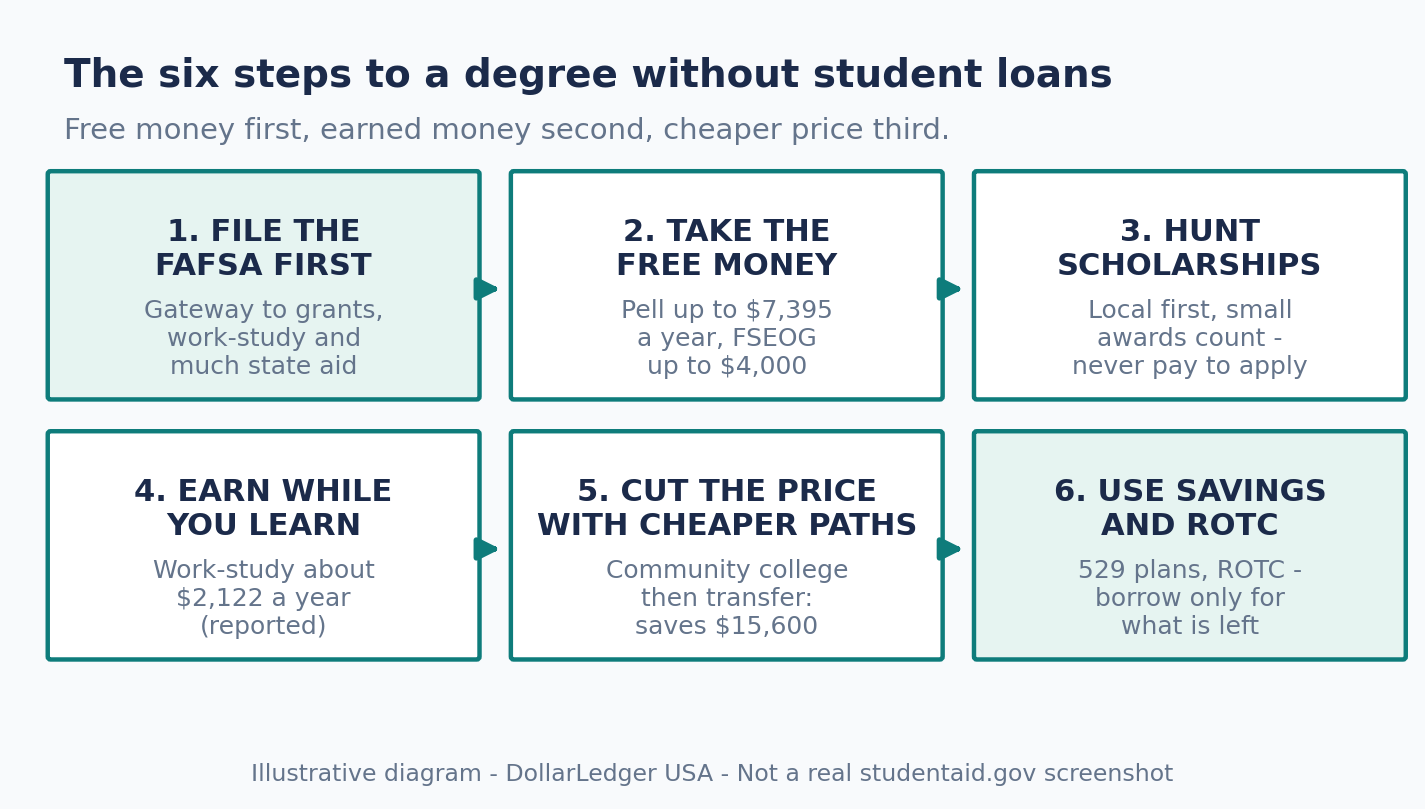
Illustrative diagram - The six steps to a degree without student loans. NOT a real studentaid.gov screenshot.
Step 2: Take the free money — Pell, FSEOG and state grants
What to do: Claim every grant you qualify for — grants are money you do not repay.
How: For 2026–27, the maximum Federal Pell Grant is $7,395 a year and the minimum is $740 — the amount depends on your Student Aid Index, enrolment and cost of attendance. Pell is for undergraduates with financial need, and you can receive it for about six years. Some students can get up to 150% in one year by taking a summer term. The Federal Supplemental Educational Opportunity Grant (FSEOG) adds $100 to $4,000 a year for exceptional need — but it is campus-based, each school gets a fixed pot, and Pell recipients get first priority. Check your state and college too for their own grants.
Example: A student on the maximum Pell Grant gets $7,395 a year — $29,580 over four years — before any scholarship or loan.
Common mistake: Thinking Pell is only for very low incomes. Family size and income decide together.
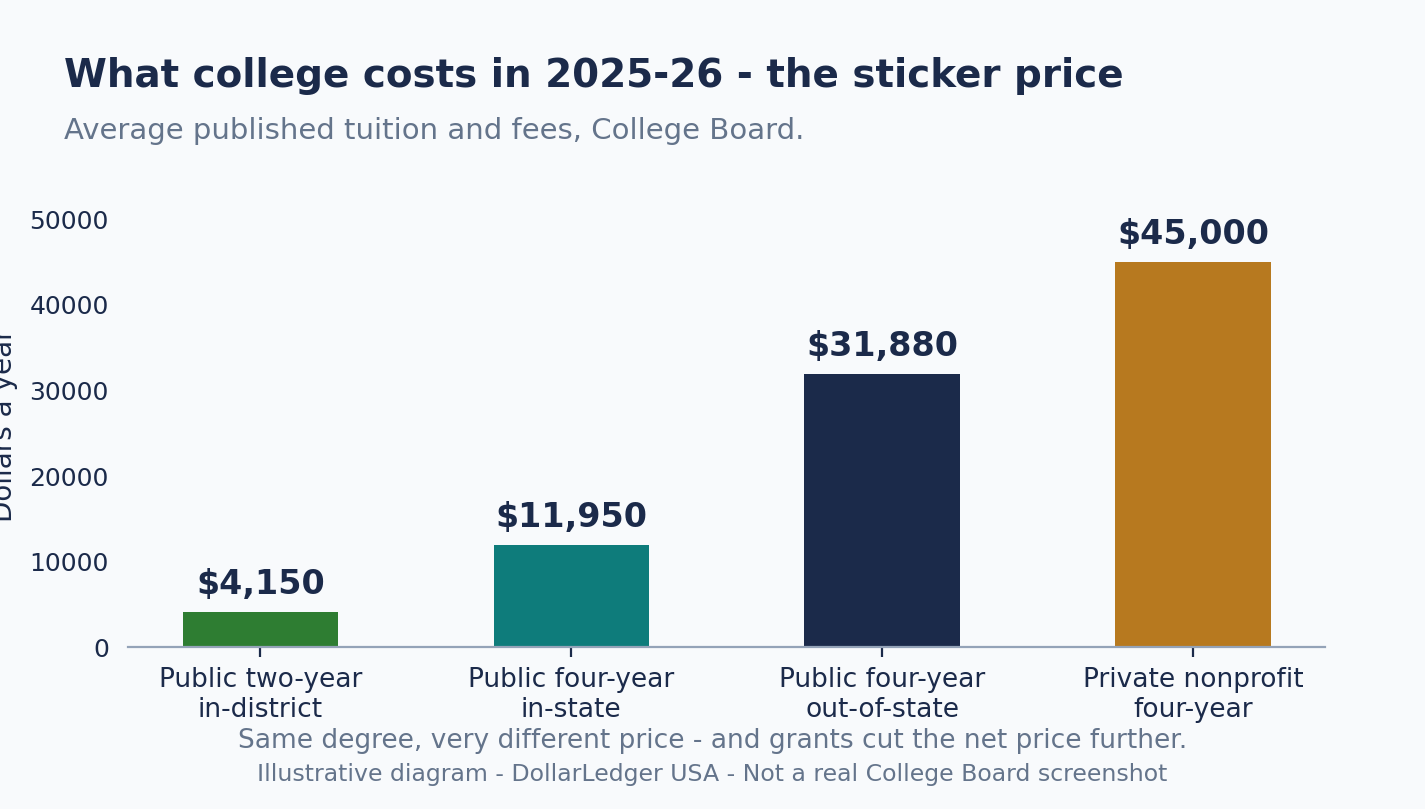
Illustrative diagram - The sticker price by school type, 2025-26 (College Board). NOT a real College Board screenshot.

Photo: Grants and scholarships are free money — but the limited pots go to the students who file early. (Photo: Pexels)
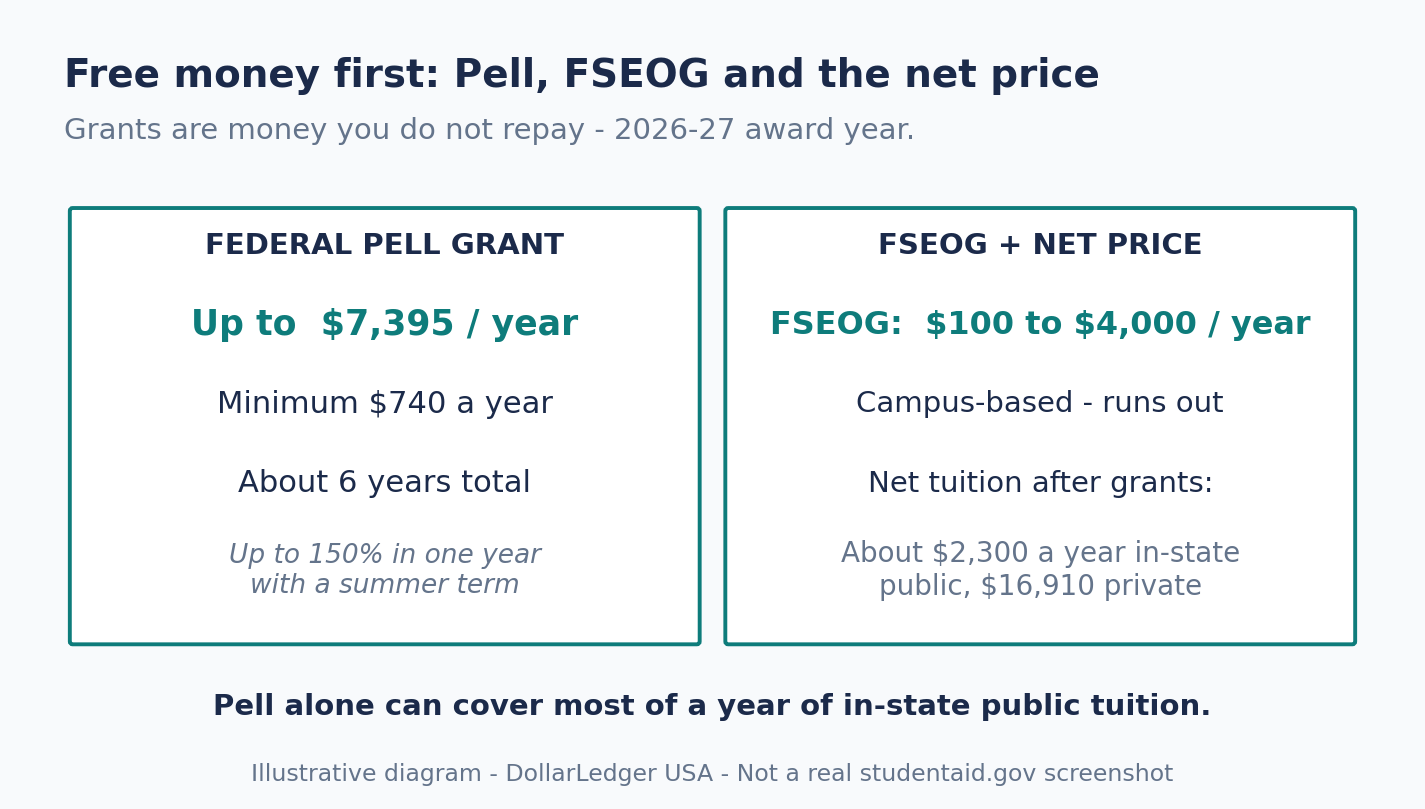
Illustrative diagram - Free money first: Pell, FSEOG and the net price after grants. NOT a real studentaid.gov screenshot.
Step 3: Hunt scholarships like a job — and never pay to apply
What to do: Apply for scholarships every week, starting with the ones closest to home.
How: Scholarships are money you do not repay, and there are thousands beyond the big national names. Start with your financial aid office, then local sources — community foundations, employers, churches and clubs — where the applicant pool is small. Then use free search tools and your colleges’ scholarship pages. Keep one master essay, track every deadline, and apply for small awards too. Never pay to apply: legitimate scholarships charge no fee, and a “guaranteed scholarship” that asks for money up front is a scam.
Example: Win four of 20 scholarships at $500 to $2,000 each and you have $2,000 to $8,000 — a year of in-state tuition at many public colleges.
Common mistake: Chasing only the famous national scholarships with 100,000 applicants, and ignoring the $1,000 local award with 40.
Step 4: Earn while you learn — work-study, part-time work and employer help
What to do: Earn while you study, so loans are not the only way to cover costs.
How: Federal Work-Study gives part-time, usually on-campus jobs to students with financial need — apply through the FAFSA. Sallie Mae’s 2025 How America Pays for College report puts average work-study earnings at $2,122 for the school year (reported), and jobs must pay at least the federal minimum wage of $7.25 an hour. The earnings are not counted against you on next year’s FAFSA (reported). A regular part-time job works too — 10 to 15 hours a week. If you already work, ask about educational assistance: under a written Section 127 plan, an employer can pay up to $5,250 a year toward tuition and books tax-free (IRS, 2025 and 2026).
Example: Work-study at $2,122 a year for four years is $8,488 earned — and $5,250 a year from an employer covers about 44% of a year of in-state tuition.
Common mistake: Turning down work-study because the award lists a maximum, not a paycheque.
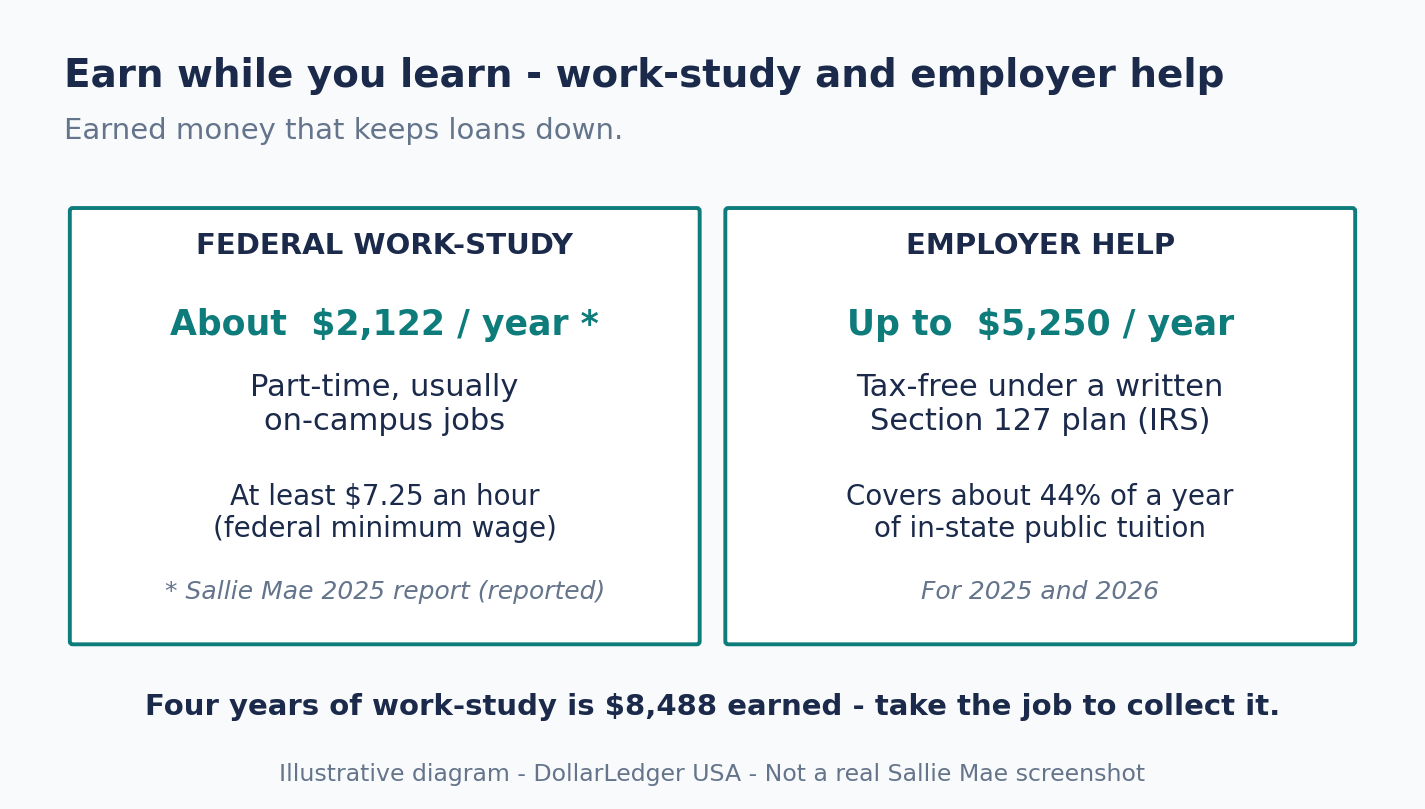
Illustrative diagram - Earned money: work-study plus employer help. NOT a real Sallie Mae screenshot.
Step 5: Cut the price before you enrol — cheaper paths
What to do: Choose the cheapest route to the same degree.
How: For 2025–26, College Board puts average published tuition and fees at $4,150 a year at a public two-year college, $11,950 in-state at a public four-year college, $31,880 out-of-state, and $45,000 at a private nonprofit. Two years at a community college, then transferring, is the biggest saving most students can make. Staying in-state is the next biggest: out-of-state tuition costs nearly three times as much. In high school, AP and dual-enrolment classes can earn college credit cheaply, sometimes free. Always compare the net price, not the sticker: after grants, the average in-state student pays about $2,300 a year in tuition at a public four-year college, and about $16,910 at a private nonprofit.
Example: Two years at a community college costs $8,300 in tuition and fees, against $23,900 for the first two years at a public four-year college — a $15,600 saving.
Common mistake: Choosing a college on sticker price, without comparing the net price.

Photo: Two years at a community college, then transfer — the same degree for about $15,600 less in tuition. (Photo: Pexels)
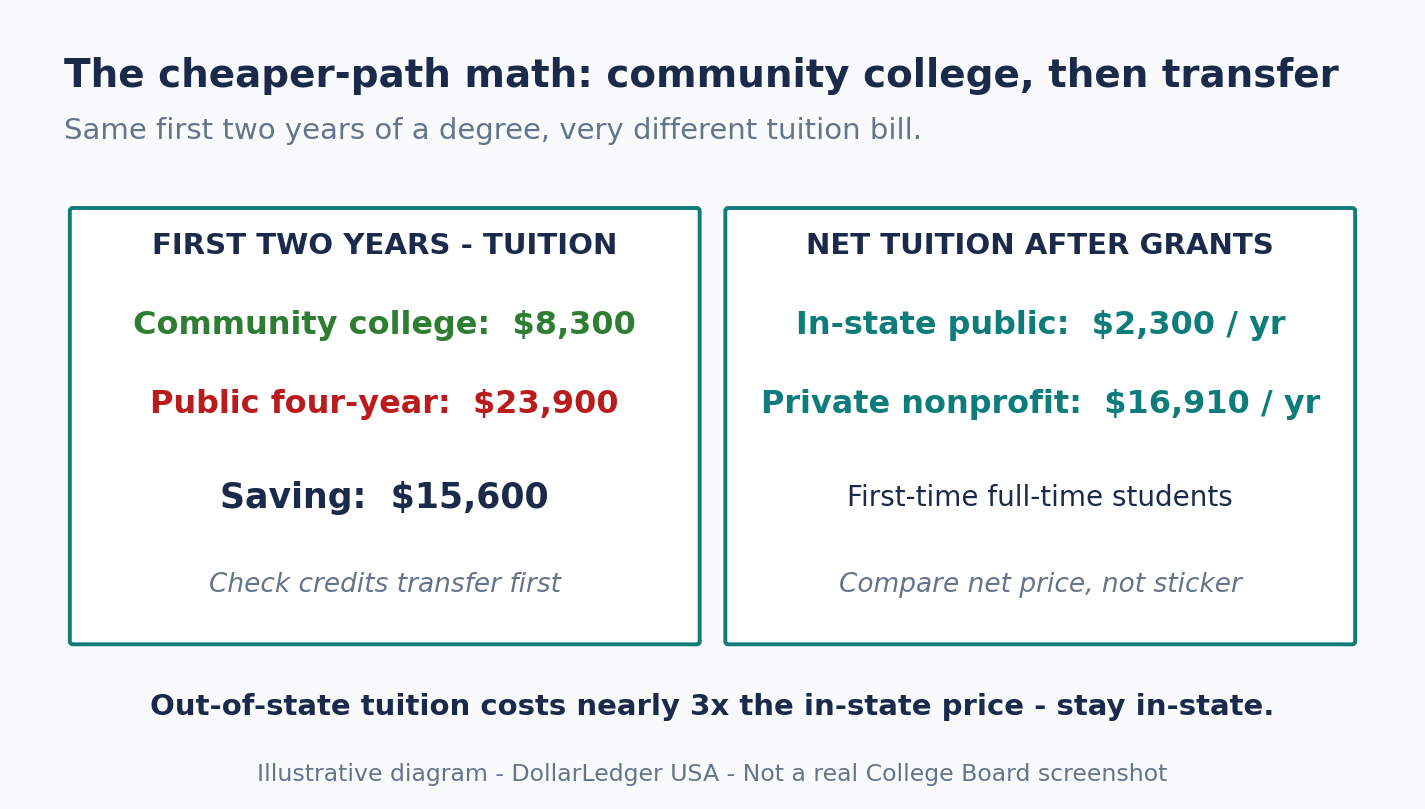
Illustrative diagram - The cheaper-path math: community college, then transfer. NOT a real College Board screenshot.
Step 6: Use savings and service — 529 plans and ROTC — before any loan
What to do: Spend saved and service-earned money before borrowing.
How: If your family has a 529 plan, the money grows tax-free and comes out tax-free for qualified expenses — see our 529 college savings plan guide for 2026. Since 2024, unused 529 money can roll into the beneficiary’s Roth IRA, up to a $35,000 lifetime limit, if the account has been open at least 15 years and the money is more than five years old. ROTC is the other big lever: Army and Navy ROTC scholarships can cover full tuition and fees, and Air Force ROTC covers full tuition for its top tier and up to $18,000 a year for the next, plus a stipend and book allowance — in exchange for serving as an officer after graduation. If a loan is still needed, borrow federal first — and read the forgiveness rules in our guide to student loan forgiveness in 2026 before you sign.
Example: $10,000 in a 529 plan plus a $7,395 Pell Grant and $2,122 of work-study is $19,517 toward an $11,950 tuition bill — tuition covered.
Common mistake: Leaving 529 money untouched “for later” while taking out loans now.
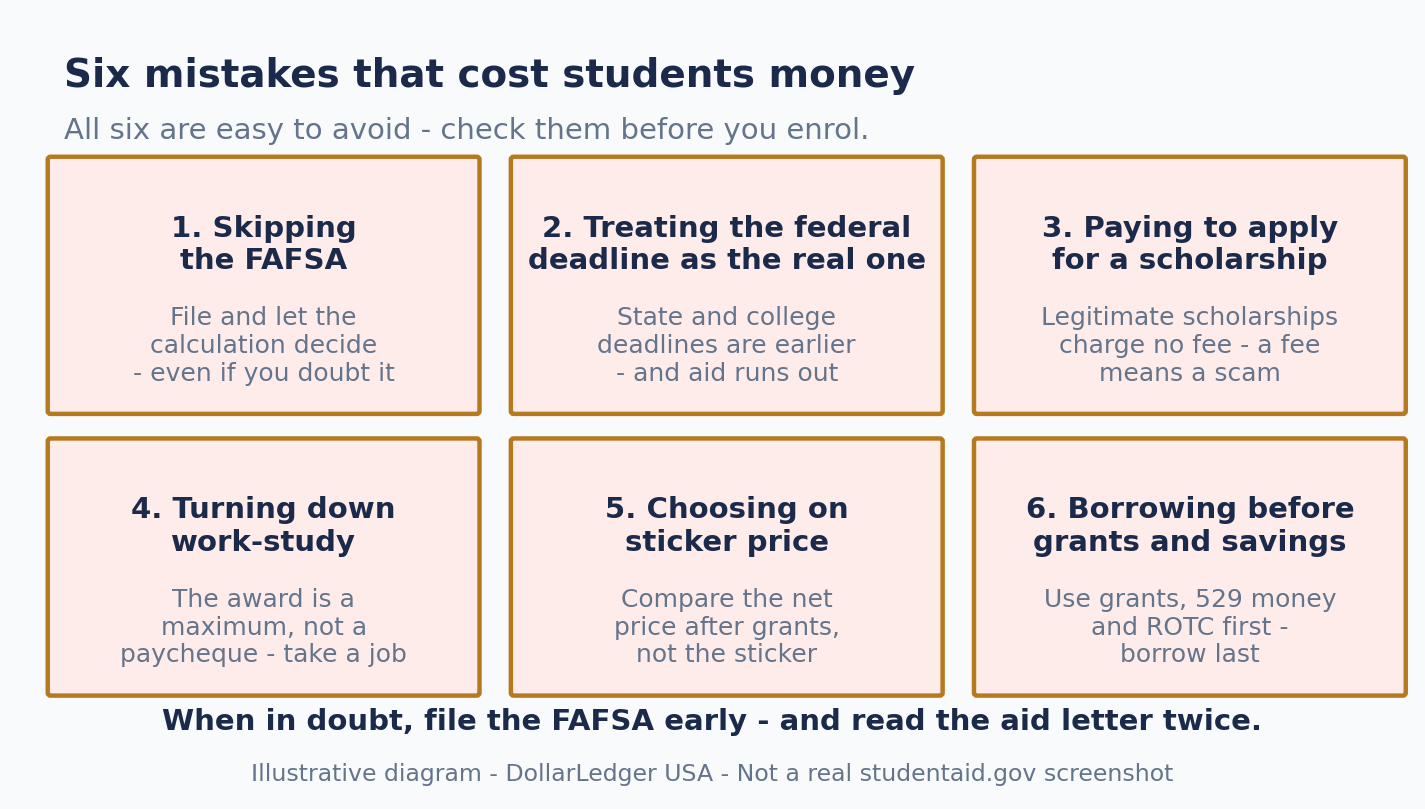
Illustrative diagram - Six mistakes that cost students money. NOT a real studentaid.gov screenshot.
Checklist
☐ FAFSA filed — state and college deadlines noted, not just June 30, 2027.
☐ Pell amount checked on the FAFSA Submission Summary.
☐ FSEOG asked about — it runs out.
☐ Scholarships going out weekly, local first, none paid for.
☐ Work-study job taken, or employer help lined up.
☐ Net price compared; transfer checked.
☐ 529 and ROTC weighed before any loan is signed.
FAQ
Can you really pay for college without student loans?
For many students, yes — by stacking sources. A maximum Pell Grant ($7,395 a year), a few scholarships, work-study (about $2,122 a year, reported) and community college can cover the full tuition bill at a public college.
What is the FAFSA deadline for 2026–27?
The federal deadline is June 30, 2027, at 11:59 p.m. Central time — but your state and colleges set earlier deadlines, and campus-based aid such as FSEOG is first come, first served. File early; the federal date is a last resort.
How much is the Pell Grant in 2026–27?
The maximum is $7,395 a year and the minimum is $740, for 2026–27 (studentaid.gov). It depends on your Student Aid Index, enrolment and cost of attendance, and you can receive Pell for about six years.
Is community college really that much cheaper?
Yes. For 2025–26, average tuition and fees are $4,150 a year at a public two-year college against $11,950 in-state at a public four-year college (College Board). Two years at a community college, then transferring, saves about $15,600 — if the credits transfer.
Should I ever take a student loan?
Only for what is left after grants, scholarships, earnings, savings and cheaper paths. If you do borrow, federal loans come first — and read the forgiveness rules before you sign.
Sources
- Federal Student Aid, Don’t Miss Out on Federal Pell Grants (opened live November 12, 2026): https://studentaid.gov/articles/dont-miss-out-on-pell-grants/
- IRS, 529 Plans: Questions and answers (opened live November 12, 2026): https://www.irs.gov/newsroom/529-plans-questions-and-answers
- College Board, Trends in College Pricing (opened live November 12, 2026): https://research.collegeboard.org/trends/college-pricing
All figures checked November 12, 2026, against studentaid.gov, the IRS and the College Board.
Disclaimer: For education only, not financial, tax or investment advice. Aid rules and amounts change by year, state and school — confirm the current figures on studentaid.gov before you decide.