401(k) Contribution Limits 2026 — How Much Can You Save?
 DollarLedger Team
- 04 Nov, 2026

Your 401(k) is the biggest retirement account most Americans will ever own — and the IRS sets a hard ceiling on how much of your own pay you can put in each year. For 2026, that ceiling rises to $24,500, up from $23,500 in 2025, according to IRS announcement IR-2025-111. Older workers can put in more, a new rule changes how high earners make catch-up contributions, and your employer’s match does not count against your limit at all. This guide explains the 2026 limits in plain English, checked November 4, 2026.
Photo: The 2026 401(k) limit is $24,500 — here is how to use every dollar of it. (Photo: Pexels)
What You Will Learn
- The 2026 401(k) limit: $24,500, and what counts toward it
- Catch-ups by age: $8,000 at 50+, $11,250 at 60–63
- The new 2026 Roth catch-up rule for earners over $150,000
- Why your employer match is free money outside your cap
- How much to contribute each month — with real dollar math
- Roth vs traditional 401(k), and what happens if you over-contribute
Step 1: Know the 2026 limit — $24,500 of your own pay
What to do: Find out the 2026 elective deferral limit and set your contribution rate to match your goal.
How: The IRS announced in IR-2025-111 that the 2026 401(k) elective deferral limit is $24,500, up $1,000 from $23,500 in 2025. This limit covers only the money you defer from your own paycheck — pre-tax or Roth contributions. It does not include your employer’s matching contributions or any profit-sharing your employer adds. The combined employee-plus-employer cap for 2026 is $72,000.
Example: On $80,000, a 10% deferral is $8,000 a year — well under the limit. To hit the full $24,500 on $80,000, you would need a rate of about 31%.
Common mistake: Thinking the $24,500 limit includes your employer’s match. It does not — the match sits on top, which is why maxing out a 401(k) can put far more than $24,500 into your account each year.
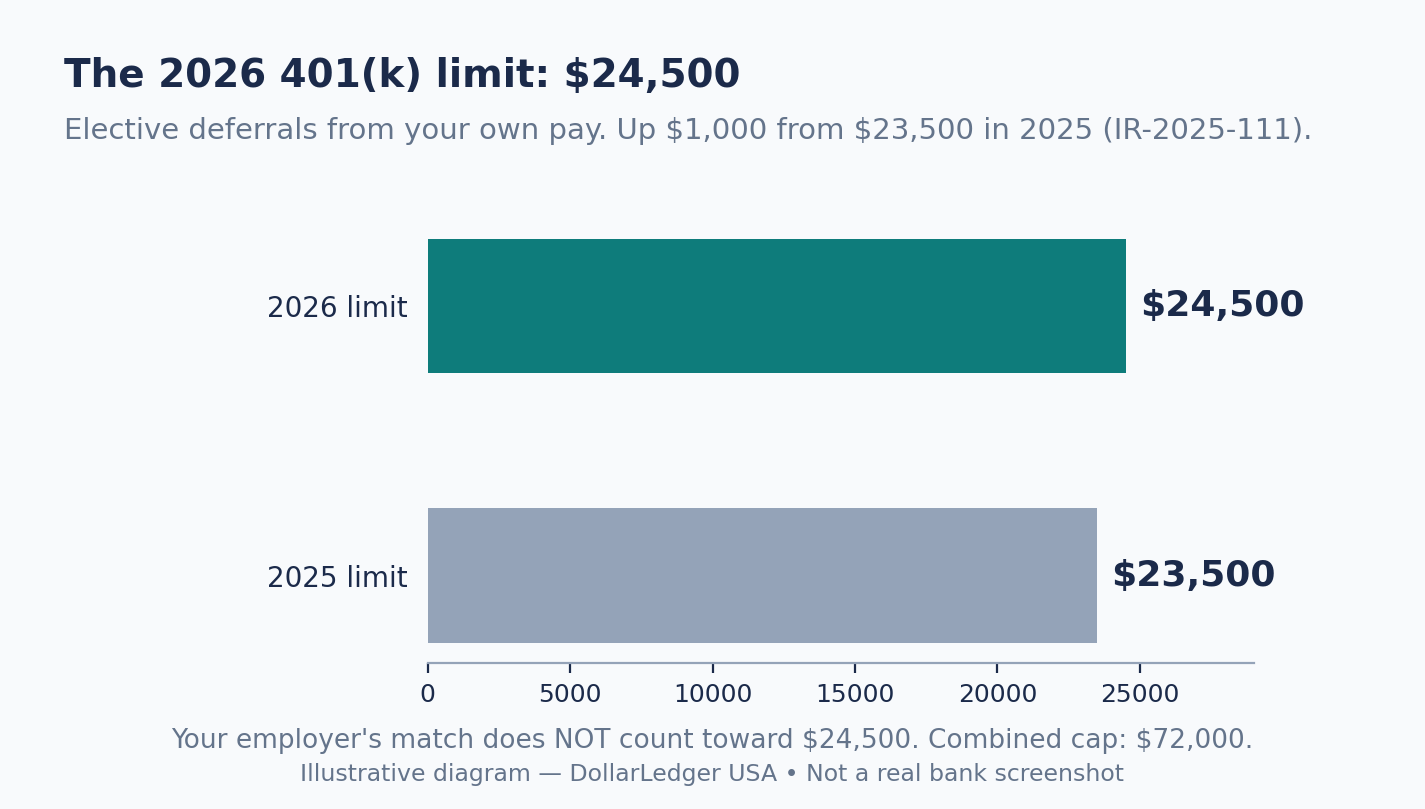
Illustrative diagram — The 2026 401(k) elective deferral limit is $24,500. NOT a real bank screenshot.
Step 2: Add catch-up contributions if you are 50 or older
What to do: If you turn 50 or older in 2026, add the catch-up contribution on top of the $24,500.
How: Workers age 50 and over can contribute an extra $8,000 in 2026, bringing their total to $32,500. Workers ages 60 to 63 get an even bigger “super catch-up” of $11,250 instead of the standard $8,000, for a total of $35,750 — but only while they are 60, 61, 62 or 63. Once you turn 64, you go back to the standard $8,000 catch-up.
Example: A 61-year-old earning $90,000 who defers $35,750 puts away nearly 40% of her pay.
Common mistake: Assuming the super catch-up applies at any age over 60. It stops at 63 — at 64 you are back to the standard $8,000 catch-up.
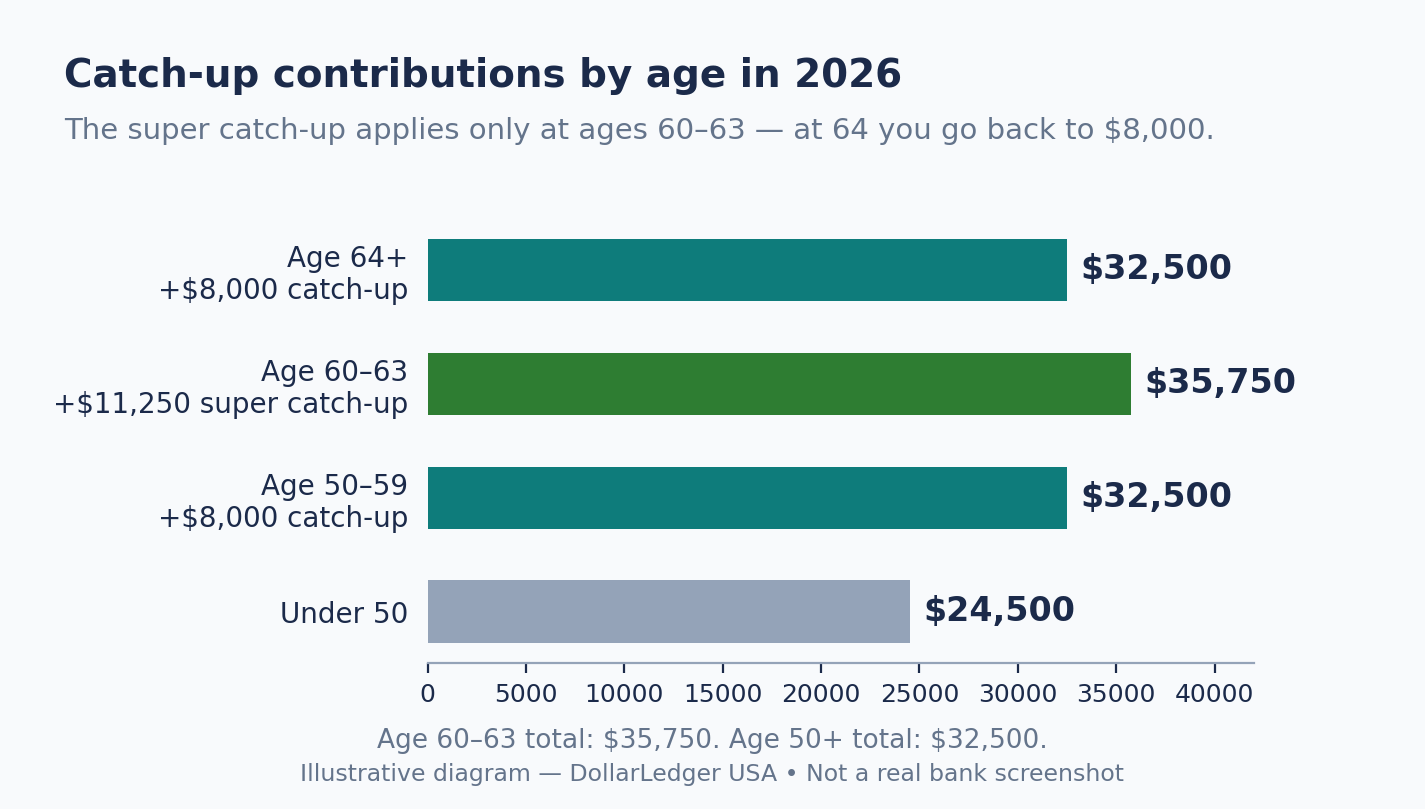
Illustrative diagram — Catch-up contributions by age in 2026. NOT a real bank screenshot.

Photo: Your 401(k) enrollment form is where the limit becomes real — pick your rate carefully. (Photo: Pexels)
Step 3: Understand the new 2026 Roth catch-up rule
What to do: If you earned more than $150,000 from your employer in 2025, plan for your 2026 catch-up contributions to go into a Roth account.
How: Starting in 2026, a new rule applies: if your wages from your employer in the prior year were more than $150,000, your catch-up contributions must be made as Roth (after-tax) contributions, not pre-tax. You pay tax on that money now, and qualified withdrawals in retirement are tax-free. The rule applies only to catch-up contributions — your regular $24,500 can still go in pre-tax.
Example: A 55-year-old who earned $170,000 in 2025 wants the full $32,500 in 2026. Her first $24,500 can be pre-tax, but the $8,000 catch-up must go into the Roth side of her 401(k).
Common mistake: Thinking the whole $32,500 must be Roth. Only the catch-up portion is affected — and only if you crossed the $150,000 wage threshold last year.
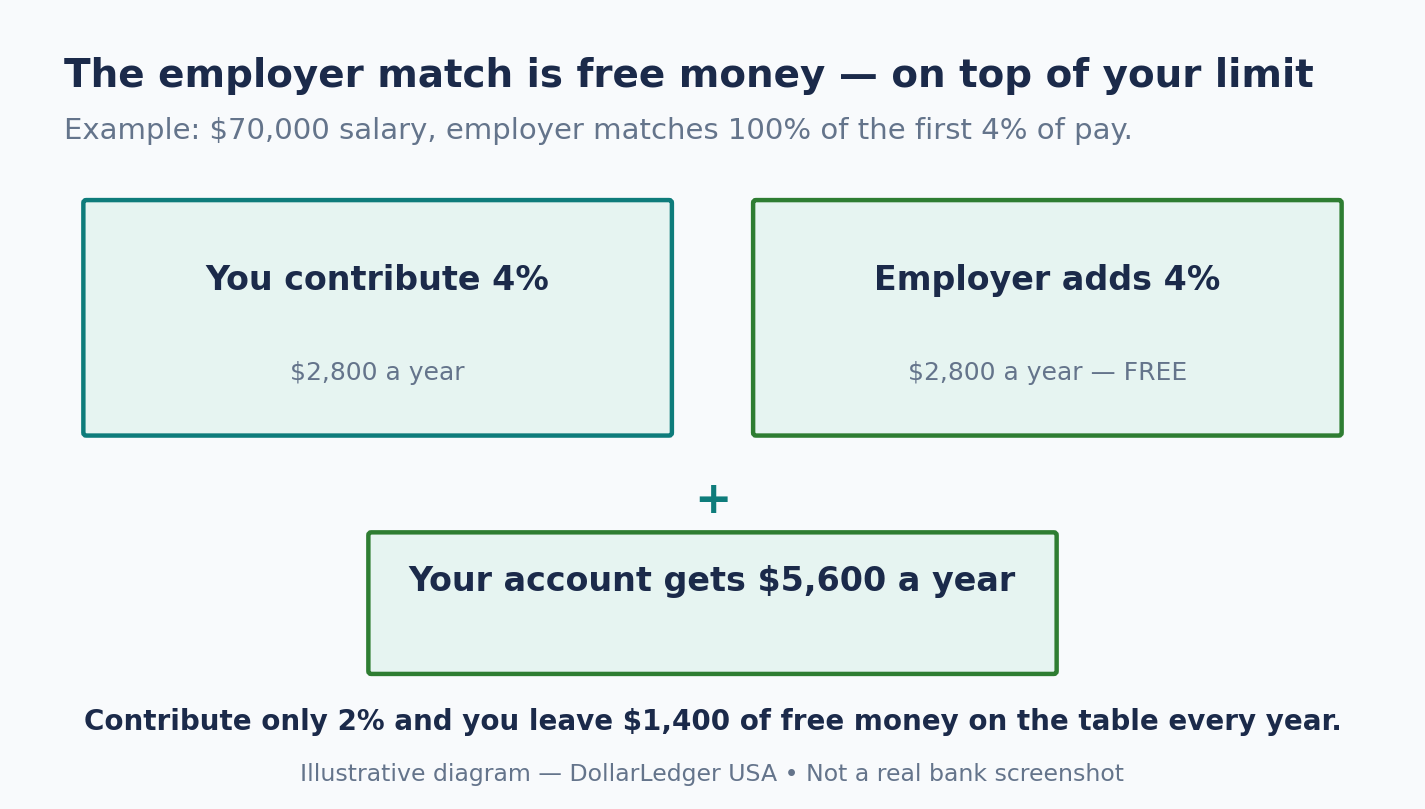
Illustrative diagram — The employer match sits on top of your $24,500 limit. NOT a real bank screenshot.
Step 4: Grab the full employer match — it is free money
What to do: Contribute at least enough to get your employer’s full match, before anything else.
How: Many employers match a percentage of your pay — a common formula is 50 cents per dollar on the first 6% of pay, or dollar-for-dollar on the first 3% to 5%. The match does not count toward your $24,500 deferral limit, so it is genuinely extra money.
Example: You earn $70,000 and your employer matches 100% of the first 4% of pay. Contribute 4% ($2,800) and your employer adds $2,800 — your account gets $5,600. Contribute only 2% and you leave $1,400 of free money on the table every year.
Common mistake: Contributing 1% or 2% “to start” while your employer offers a 6% match. Start at the full-match percentage, then raise it from there.
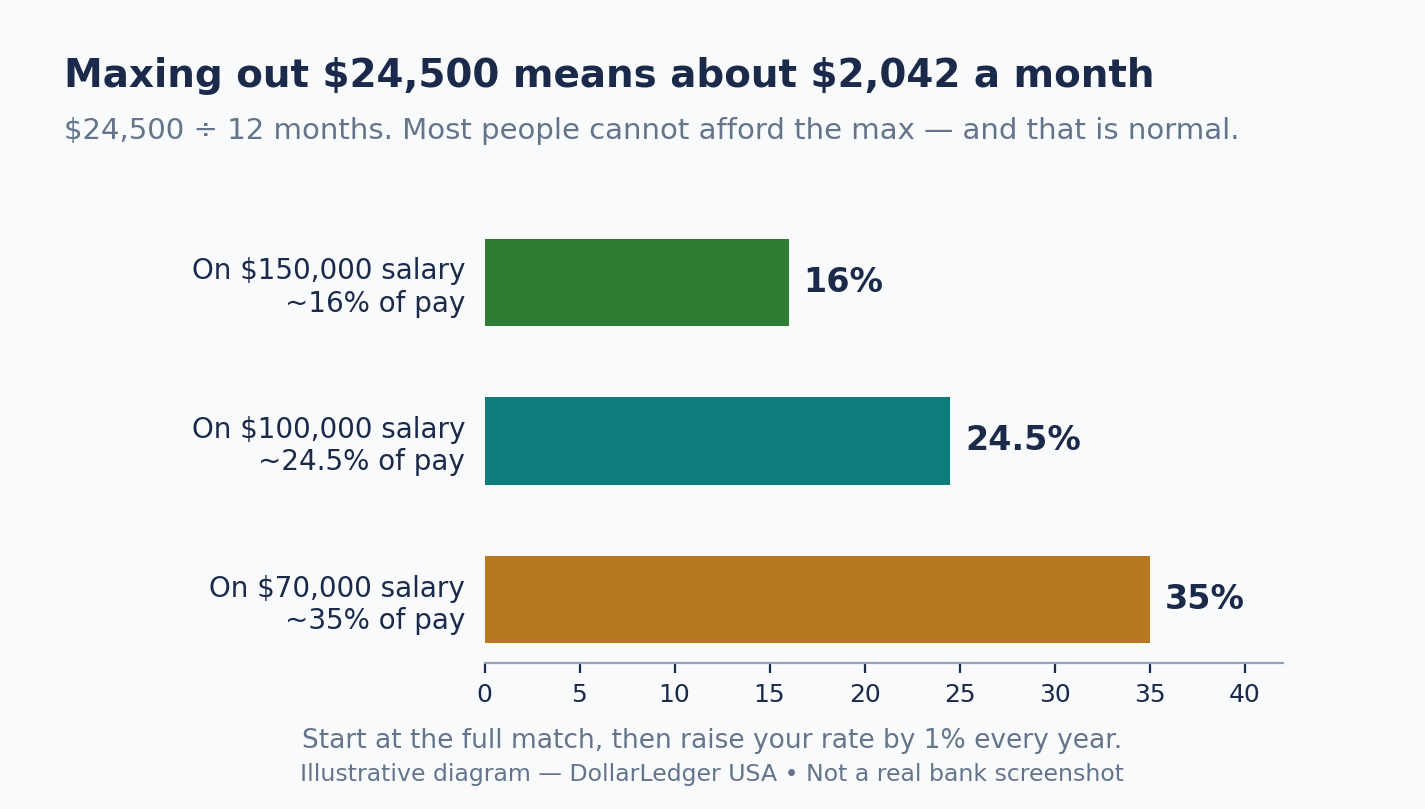
Illustrative diagram — Maxing out $24,500 means about $2,042 a month. NOT a real bank screenshot.
Step 5: Do the monthly math — and be honest about the percentage
What to do: Turn the annual limit into a monthly number and check what percentage of your pay it really is.
How: The full $24,500 divided by 12 months is about $2,042 a month. On a $70,000 salary, that is roughly 35% of gross pay — far more than most people can afford, and that is normal. On $100,000 it is about 24.5%; on $150,000 it is about 16%. Start at the full match, then raise your rate by 1% every year or every time you get a raise. The IRS also lets you contribute to an IRA on top of your 401(k): the 2026 IRA limit is $7,500, and the two limits are separate — up to $24,500 in a 401(k) and $7,500 in an IRA in the same year, $32,000 combined before catch-ups. Build your safety net first — see our emergency fund guide — then raise retirement savings.
Example: On a $70,000 salary, 10% is $7,000 a year, or about $583 a month. Add a 3% employer match ($2,100) and your account grows by $9,100 a year.
Common mistake: Setting a contribution rate that leaves you short on cash, then raiding the 401(k) early. Early withdrawals before age 59½ usually trigger income tax plus a 10% penalty.

Photo: $2,042 a month is the max — but any steady percentage beats waiting. (Photo: Pexels)
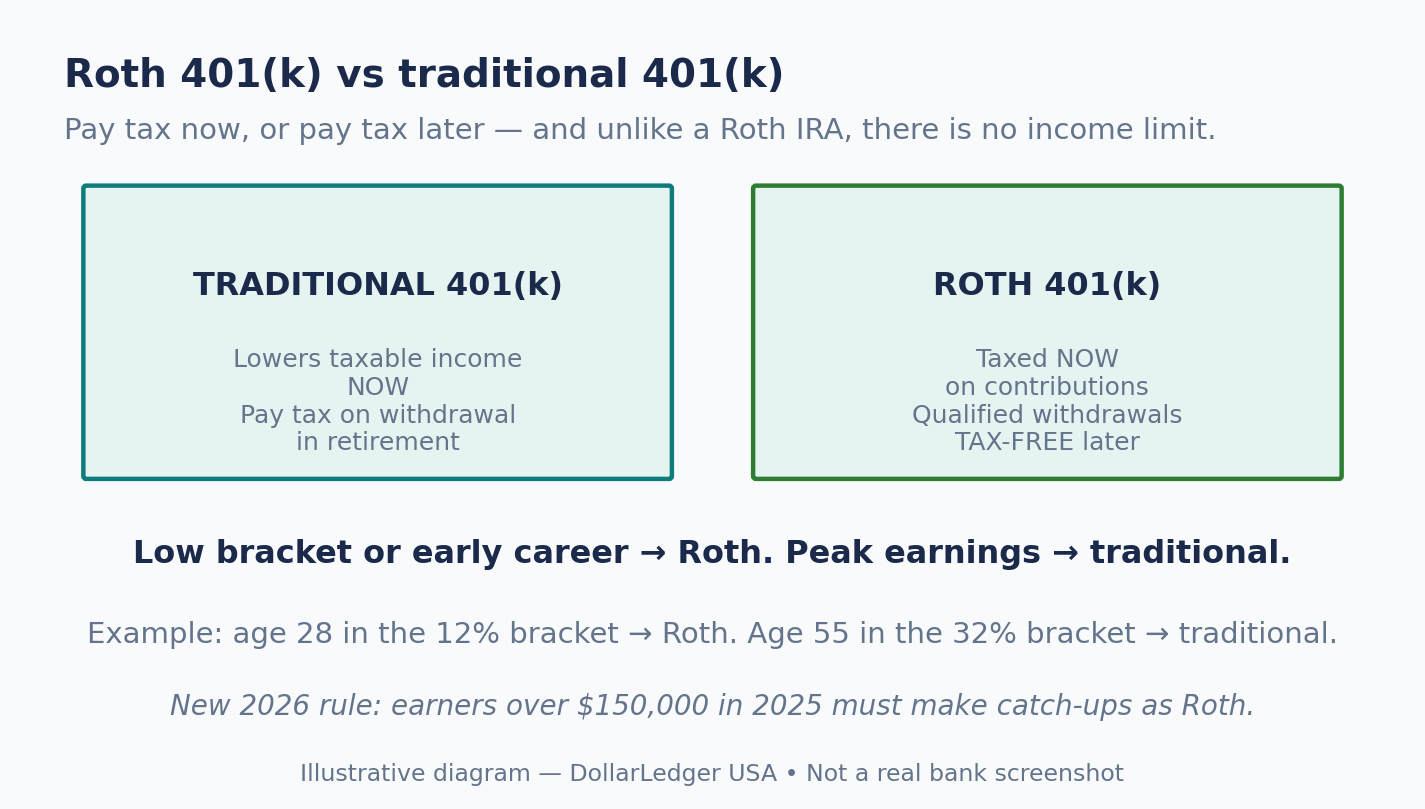
Illustrative diagram — Roth 401(k) vs traditional 401(k): pay tax now or later. NOT a real bank screenshot.
Step 6: Choose Roth vs traditional — and fix over-contributions fast
What to do: Pick the tax treatment that fits your income now versus retirement, and correct any excess contribution before the tax deadline.
How: A traditional 401(k) lowers your taxable income today — you pay tax when you withdraw in retirement. A Roth 401(k) is taxed now, and qualified withdrawals are tax-free later. Rule of thumb: early in your career or in a low tax bracket, Roth usually wins; in your peak earning years, traditional usually wins. Unlike a Roth IRA, a Roth 401(k) has no income limit. If you change jobs mid-year, your total deferrals across all employers must stay under $24,500 (plus catch-ups). If you go over, tell your plan administrator right away: the excess must be returned, typically by April 15 of the following year, or you risk being taxed twice.
Example: A 28-year-old in the 12% bracket chooses Roth; a 55-year-old in the 32% bracket chooses traditional.
Common mistake: Contributing to two 401(k)s in one year without adding them up. The limit is per person, not per plan.
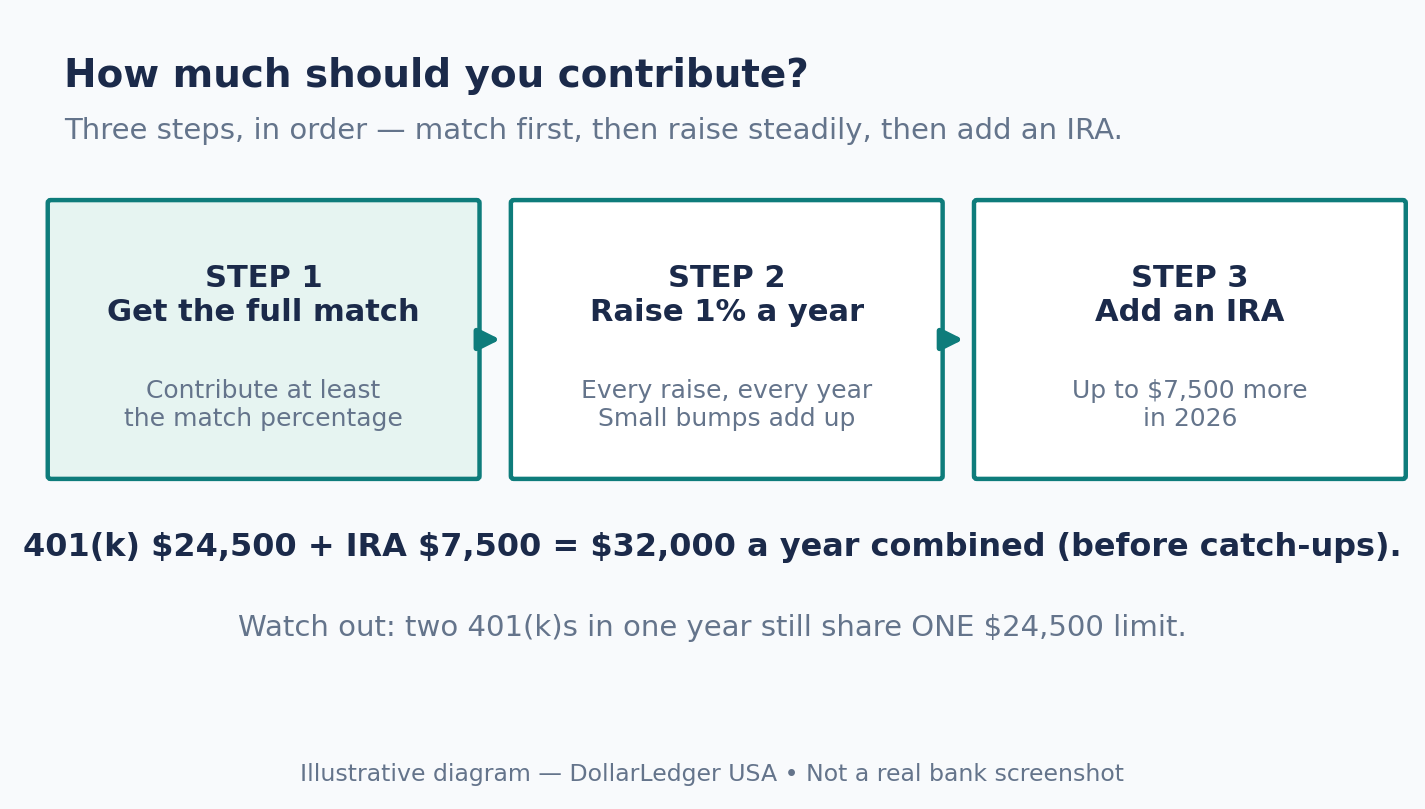
Illustrative diagram — How much to contribute: match first, then raise steadily. NOT a real bank screenshot.
Checklist
- ☐ I know the 2026 limit is $24,500 — the match does not count toward it.
- ☐ I checked my catch-up room: $8,000 at 50+, $11,250 at 60–63.
- ☐ I checked whether the new Roth catch-up rule applies to me ($150,000+ wages in 2025).
- ☐ I contribute at least enough to get the full employer match.
- ☐ I turned the annual limit into a monthly number I can afford.
- ☐ I know whether Roth or traditional fits my tax bracket.
FAQ
What is the 401(k) contribution limit for 2026?
$24,500 for employee elective deferrals, per IRS announcement IR-2025-111. The combined employee-plus-employer cap is $72,000.
How much extra can I contribute if I am over 50?
An extra $8,000 in 2026, for a total of $32,500. Ages 60 to 63 can add $11,250 instead, for a total of $35,750.
Does the employer match count toward the $24,500 limit?
No. The match sits on top of your limit. Only your own deferrals — pre-tax or Roth — count toward $24,500.
What is the new Roth catch-up rule for 2026?
If you earned over $150,000 from your employer in 2025, your 2026 catch-ups must be Roth. Your regular $24,500 can still be pre-tax.
Can I contribute to a 401(k) and an IRA in the same year?
Yes. The limits are separate: up to $24,500 to a 401(k) and up to $7,500 to an IRA in 2026 — $32,000 combined before catch-ups.
Sources
- IRS, “401(k) limit increases to $24,500 for 2026, IRA limit increases to $7,500” (IR-2025-111) — 2026 limits, catch-ups and the Roth catch-up rule: https://www.irs.gov/newsroom/401k-limit-increases-to-24500-for-2026-ira-limit-increases-to-7500
All limits checked November 4, 2026.
Disclaimer: This article is for education only, not financial advice. Contribution limits and tax rules change — confirm current figures with the IRS or a qualified tax professional before acting.