Best Credit Cards for Groceries in USA 2026
 DollarLedger Team
- 04 Nov, 2026
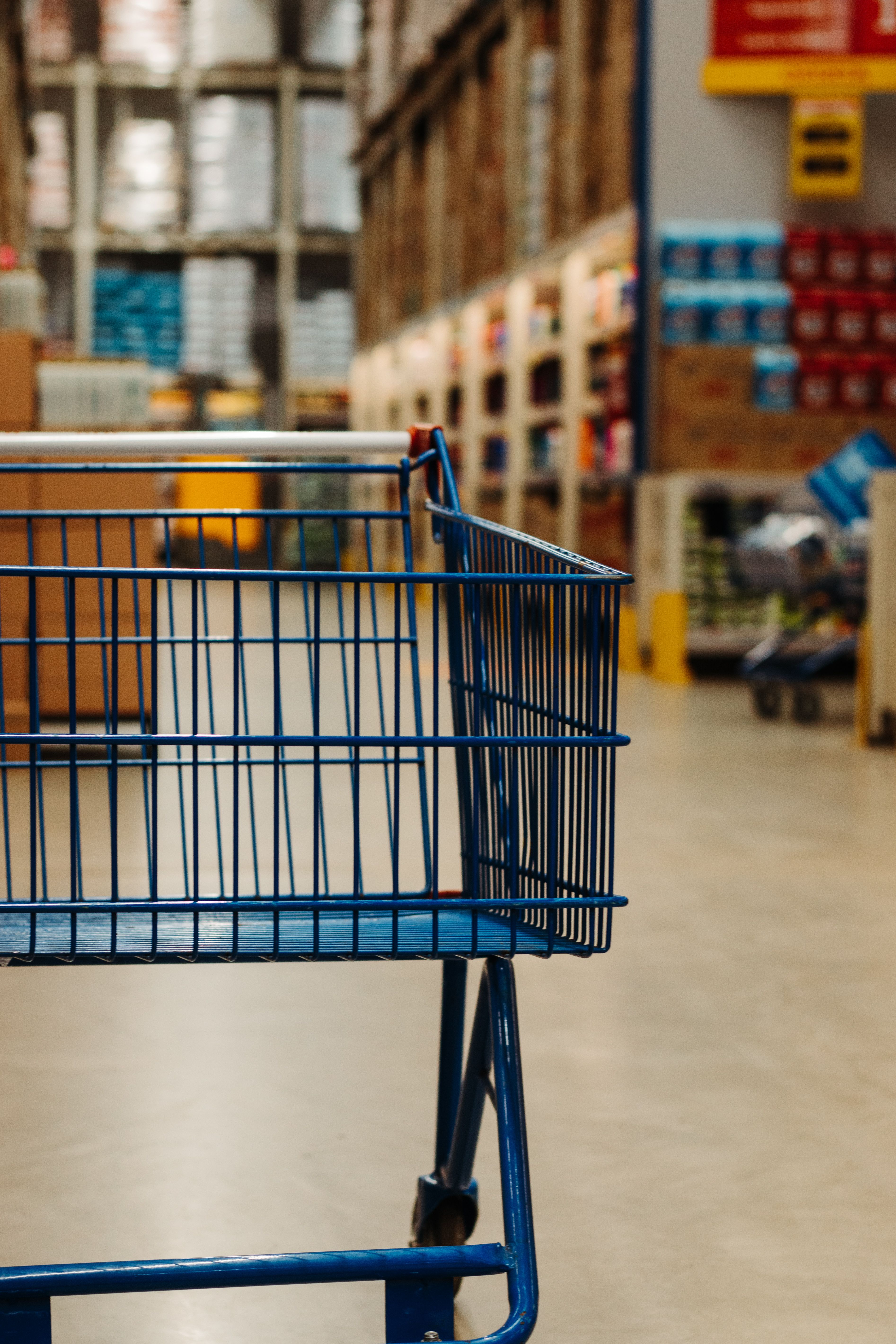
Food is the biggest household budget item outside housing and transport — and the easiest place to earn cash back. The best credit cards for groceries in the USA pay 3% to 6% back at the supermarket. A 3% card on $100 a week puts back more than $150 a year, per NerdWallet. This guide compares the best grocery cards of 2026, checked November 3, 2026 — with the $95-fee break-even math and the superstore trap.
Photo: Groceries are your biggest everyday spend — the right card pays you back. (Photo: Pexels)
What You Will Learn
- What counts as a “supermarket” — and what does not
- The three best grocery cards: fees, rates and caps
- The break-even math on the $95 annual fee
- The Walmart, Target and Costco trap — and what to use instead
- What $5,000 a year earns on each card
- How to pick your card and pay no interest
Step 1: Learn what counts as a supermarket
What to do: Check how your card defines “grocery” before you apply.
How: Rewards follow the merchant category code — each store’s label. A 6% “U.S. supermarkets” card pays it at Kroger, Safeway, Publix and most regional chains. The same card usually pays only 1% at stores coded differently, even if you buy food there.
Example: You buy $200 of food at Kroger with the Blue Cash Preferred and earn $12. The same $200 at Walmart earns $2 — it is coded as a superstore.
Common mistake: Assuming every place selling food counts as a grocery store.
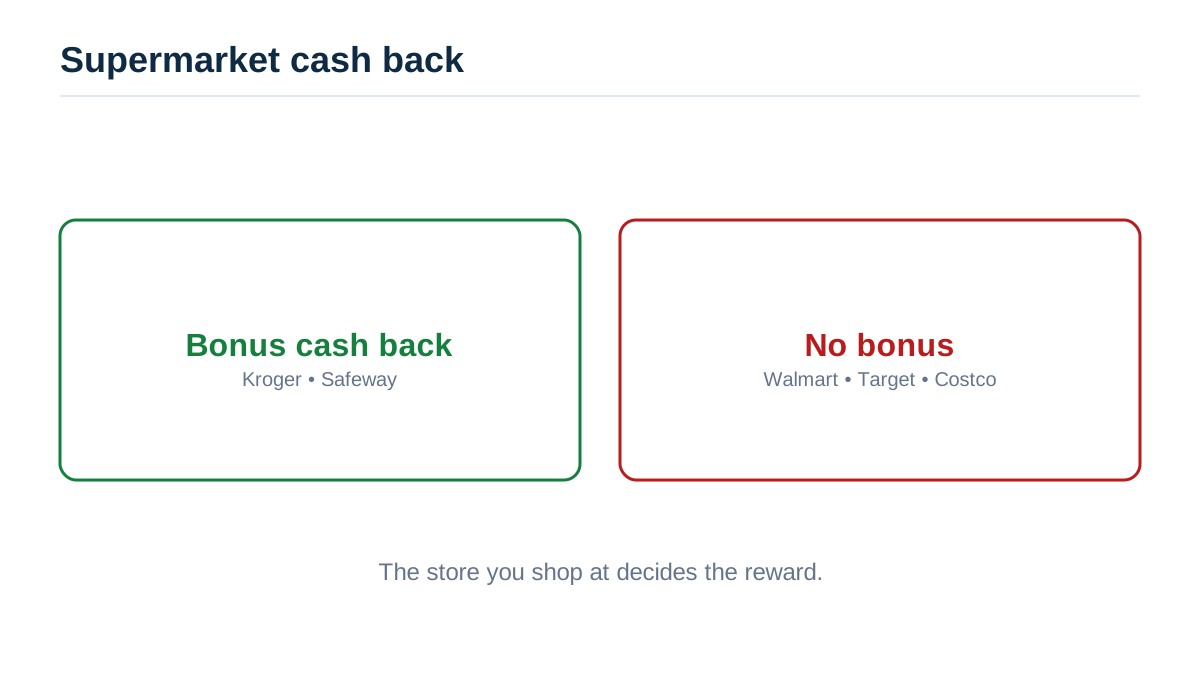
Illustrative diagram — What counts as a supermarket for card rewards. NOT a real bank screenshot.
Step 2: Compare the three best grocery cards
What to do: Compare the top three cards — rate, fee, cap and extras.
How: Checked November 3, 2026 — confirm rates first.
- Blue Cash Preferred® Card — 6% back at U.S. supermarkets up to $6,000/yr, then 1%. $0 first year, then $95. 0% intro APR 12 mo, then 19.74%–28.74% APR.
- Capital One Savor Card — 3% back at grocery stores (excl. superstores like Walmart and Target), 3% on dining, entertainment, streaming. $0 annual fee, no cap. 0% intro APR 12 mo, then 18.74%–28.74% APR.
- Blue Cash Everyday® Card — 3% back at U.S. supermarkets up to $6,000/yr, then 1%. $0 annual fee. 0% intro APR 15 mo, then 19.74%–28.74% APR.
Example: On $5,000 a year: Preferred $300, Savor $150, Everyday $150 — before the Preferred’s $95 fee.
Common mistake: Picking the 6% card without checking the cap. After $6,000 a year, it drops to 1%.
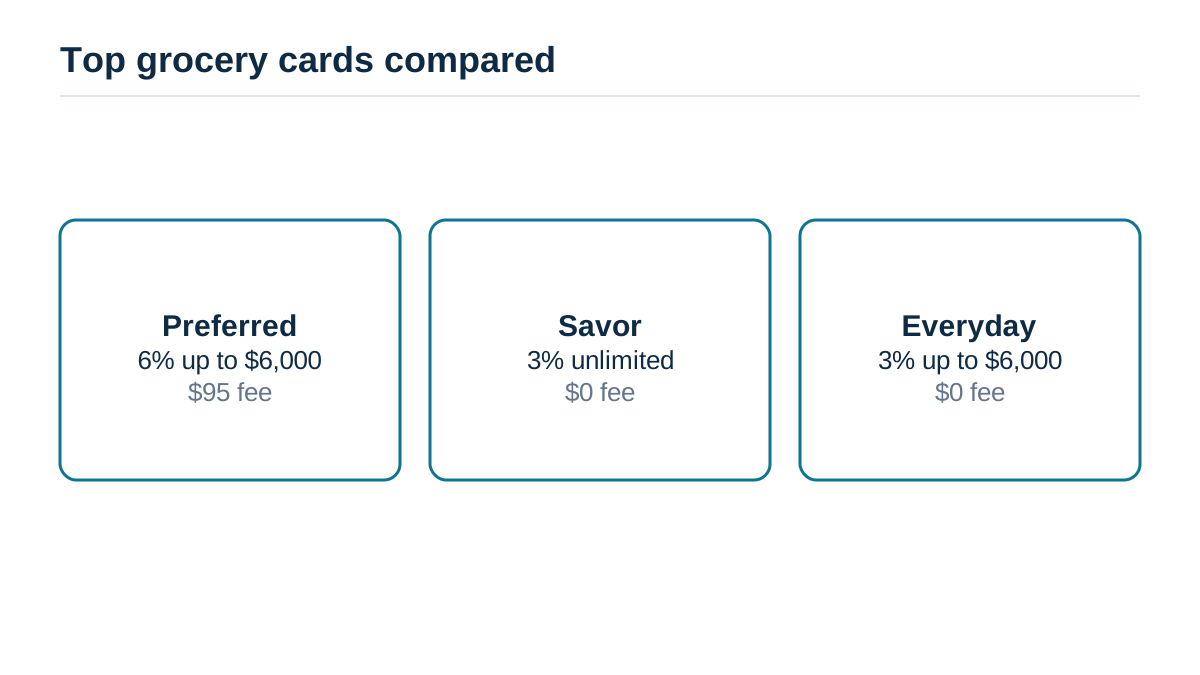
Illustrative diagram — The three best grocery cards compared, Nov 3, 2026. NOT a real bank screenshot.

Photo: The card you use at the checkout matters as much as what is in the cart. (Photo: Pexels)
Step 3: Do the break-even math on the $95 fee
What to do: Work out whether the 6% card beats a free 3% card.
How: The Preferred pays 6% at supermarkets; the free cards pay 3%. To cover the $95 fee with the extra 3%, spend $95 ÷ 0.03 = $3,167 a year — about $61 a week. At $6,000 a year, the Preferred nets $265 after the fee, versus $180 on a free card.
Example: Priya spends $3,000 a year: Preferred $85 after the fee, Savor $90. Her brother spends $6,000 a year: Preferred $265, Savor $180.
Common mistake: Counting the whole 6% against the fee. Only the extra 3% over a free card counts.
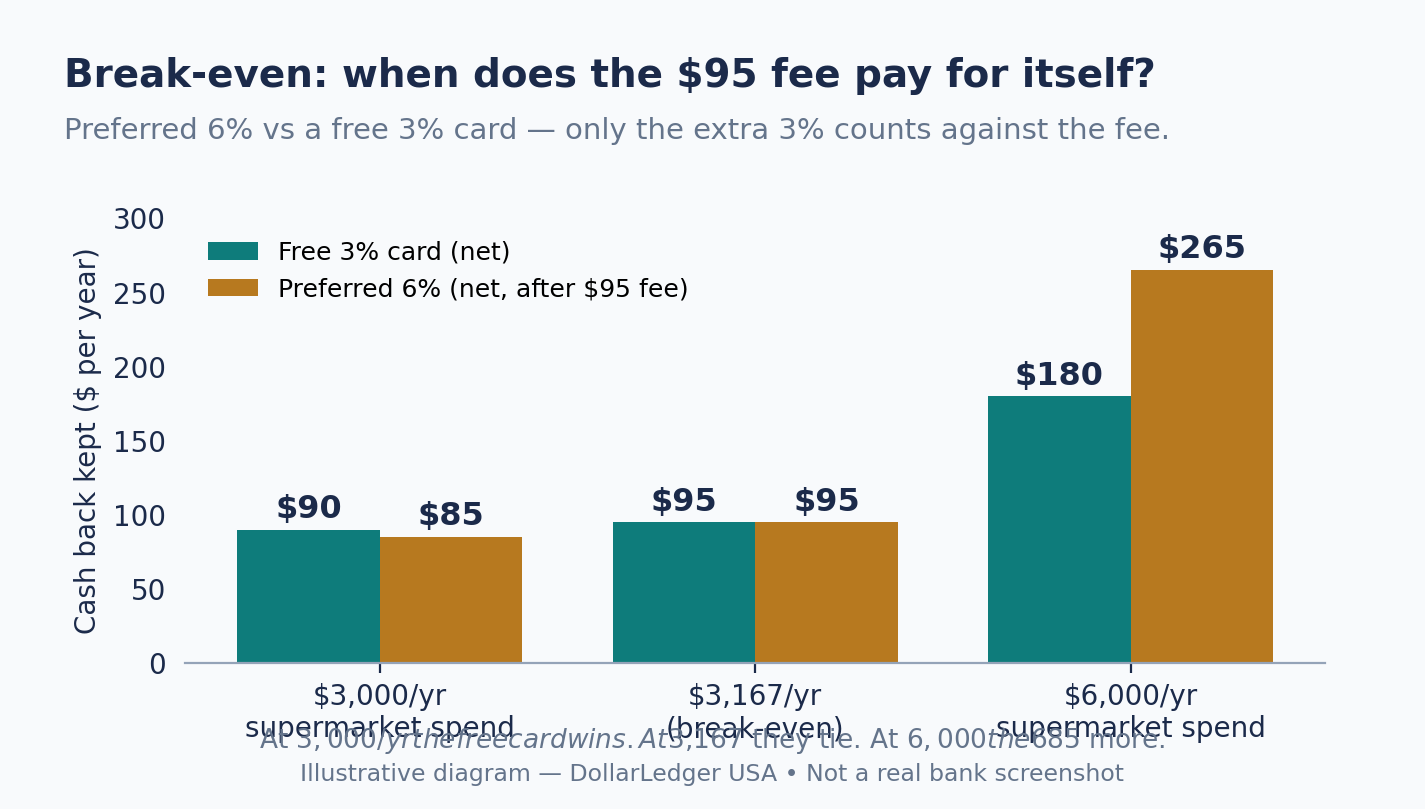
Illustrative diagram — Break-even: $3,167 a year of supermarket spending covers the $95 fee. NOT a real bank screenshot.
Step 4: Avoid the superstore and warehouse-club trap
What to do: Check where you buy your groceries — then pick a card that rewards that store.
How: Most grocery cards exclude Walmart, Target, Costco and Sam’s Club. If that is where you shop most, a 6% card pays only 1%. Use a flat 2% card instead. Or try the Chase Freedom Flex: 5% at grocery stores in Q4 2026, up to $1,500 per quarter, $0 fee — activate the category each quarter.
Example: The Martinez family spends $600 a month at Walmart and Costco: about 1% on a supermarket card — $72 a year. On a flat 2% card, $144 a year, double.
Common mistake: Getting the 6% card, shopping at Costco all year, and wondering why the cash back never arrives.
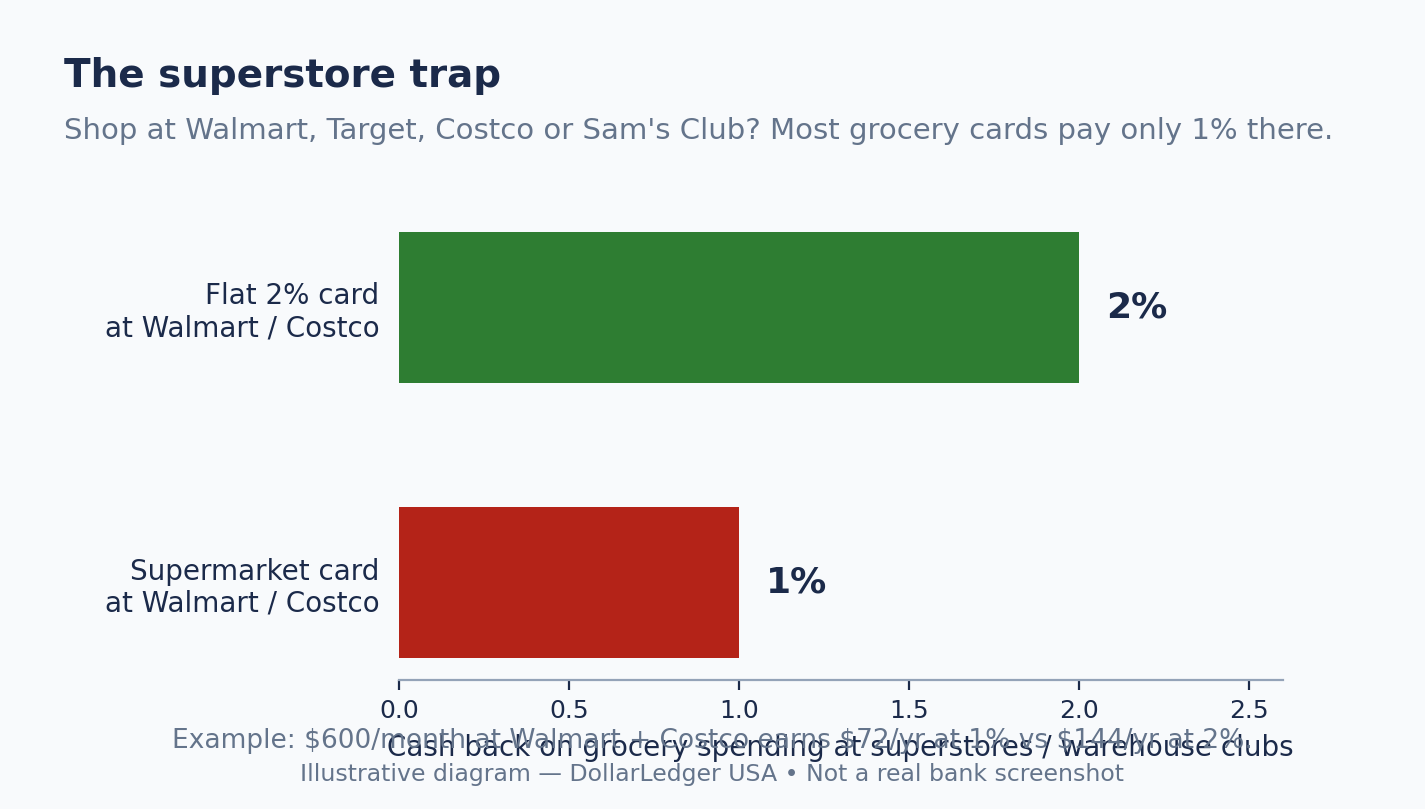
Illustrative diagram — The superstore trap: where you shop decides what you earn. NOT a real bank screenshot.
Step 5: Work out what $5,000 a year earns on each card
What to do: Turn the percentages into real dollars.
How: What $5,000 a year of supermarket spending earns, checked November 3, 2026:
Preferred 6% = $300, minus $95 = $205 net ($300 in year one). Savor 3% = $150, no fee. Everyday 3% = $150, no fee. Welcome offers add up to $300, $200 and $200 in year one.
Example: A family spending $5,000 a year keeps $205 with the Preferred after the fee, $150 with either free card. Over five years, about $1,025 versus $750.
Common mistake: Choosing a card for the welcome bonus alone. A $200 bonus is nice once; a better rate pays every year.
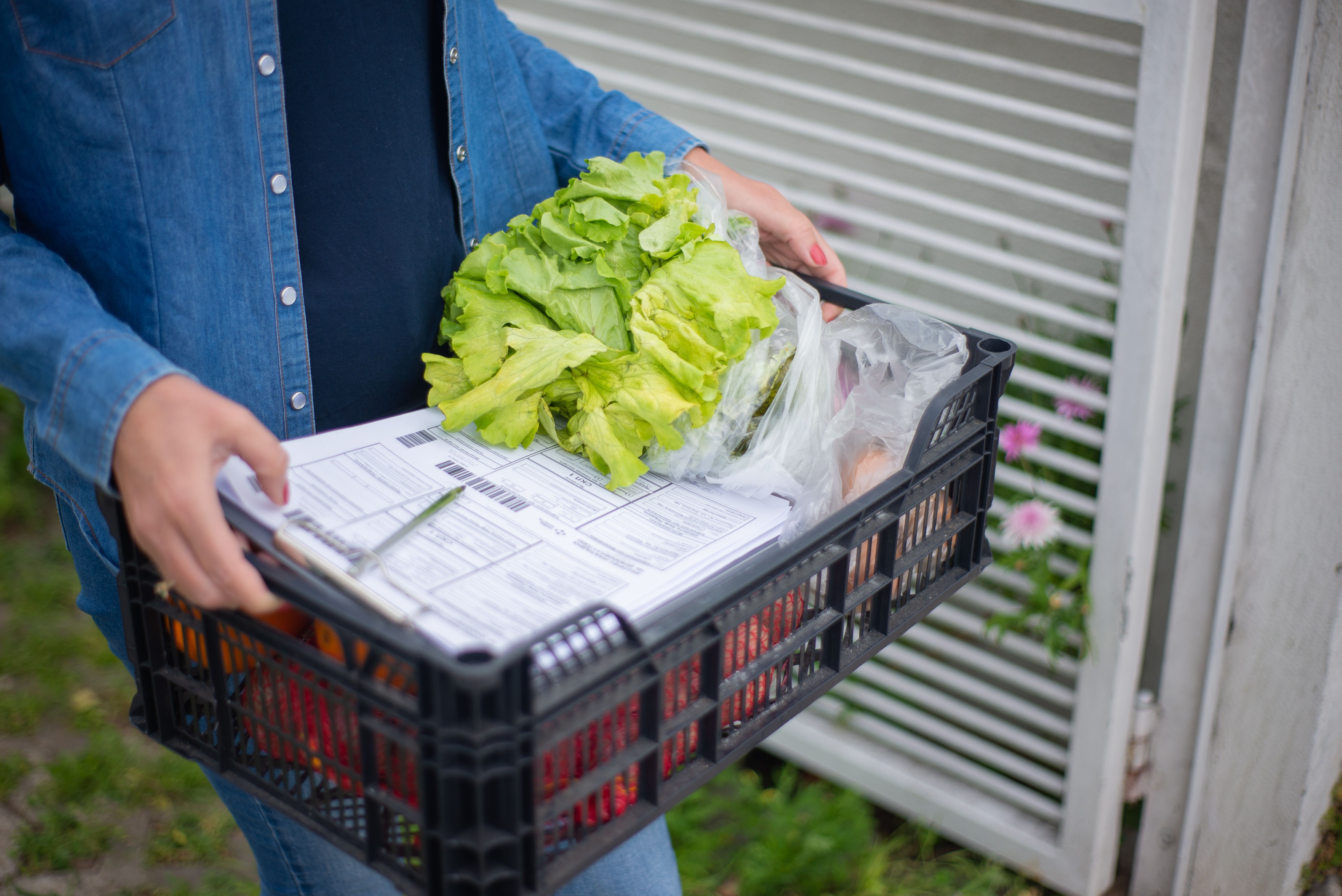
Photo: Add up a year of grocery trips — the cash back adds up too. (Photo: Pexels)
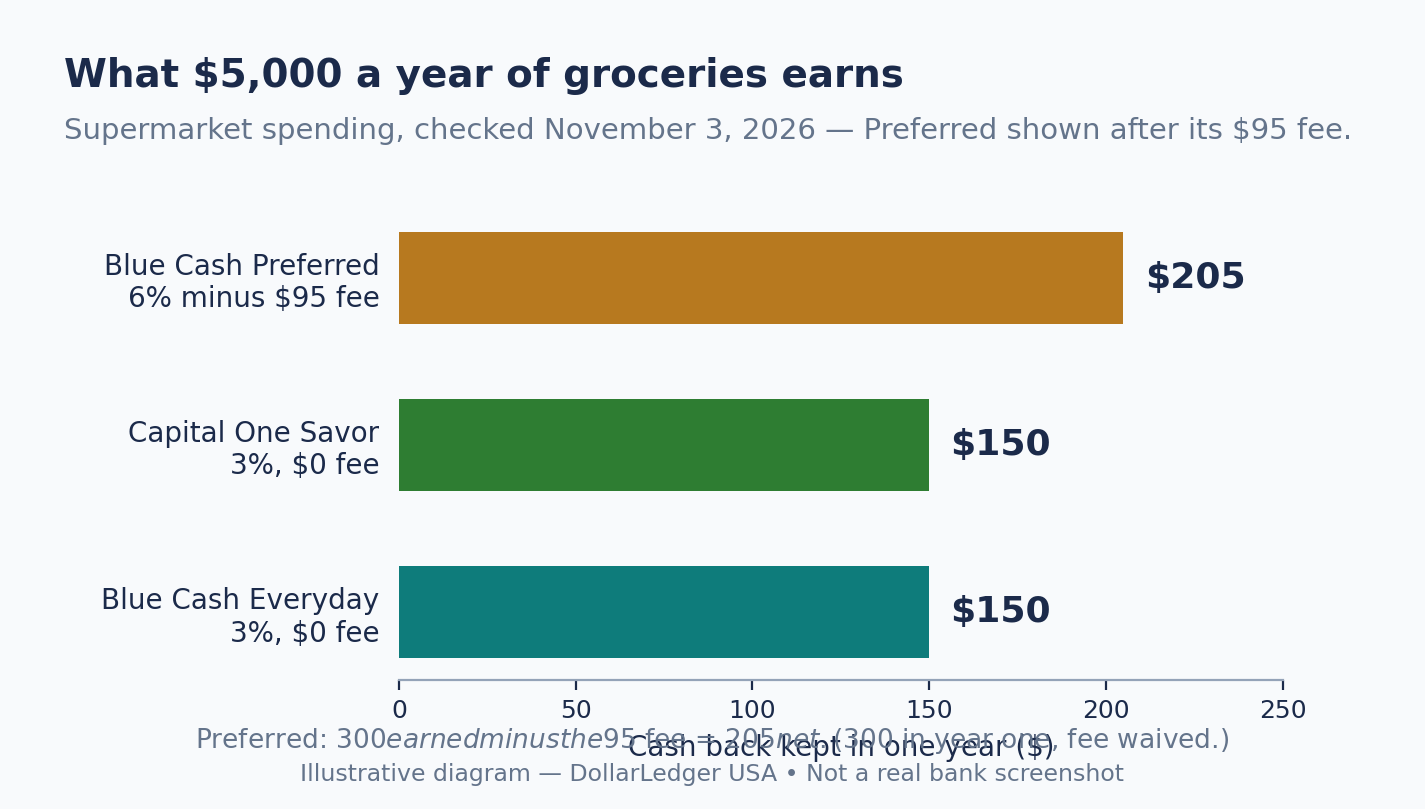
Illustrative diagram — What $5,000 a year of groceries earns on each card. NOT a real bank screenshot.
Step 6: Pick your card and use it without paying interest
What to do: Match the card to your store and your spending — then pay the balance in full every month.
How: Supermarket spend over $3,167 a year? Take the Blue Cash Preferred. Spend less, or eat out a lot? Take the Savor. Shop mostly at Walmart, Target or Costco? Take a flat 2% card. Cash back only helps if you pay in full: at 18.74% to 28.74% APR after the intro period, one month of interest wipes out months of rewards. Autopay the full balance, and bank it — see our HYSA guide.
Example: Ana picks the Savor, spends $400 a month on groceries and dining, and earns about $144 a year. She pays in full, so the $144 is pure gain.
Common mistake: Carrying a balance to “earn more rewards.” At 24% APR, a $1,000 balance costs $20 a month in interest.
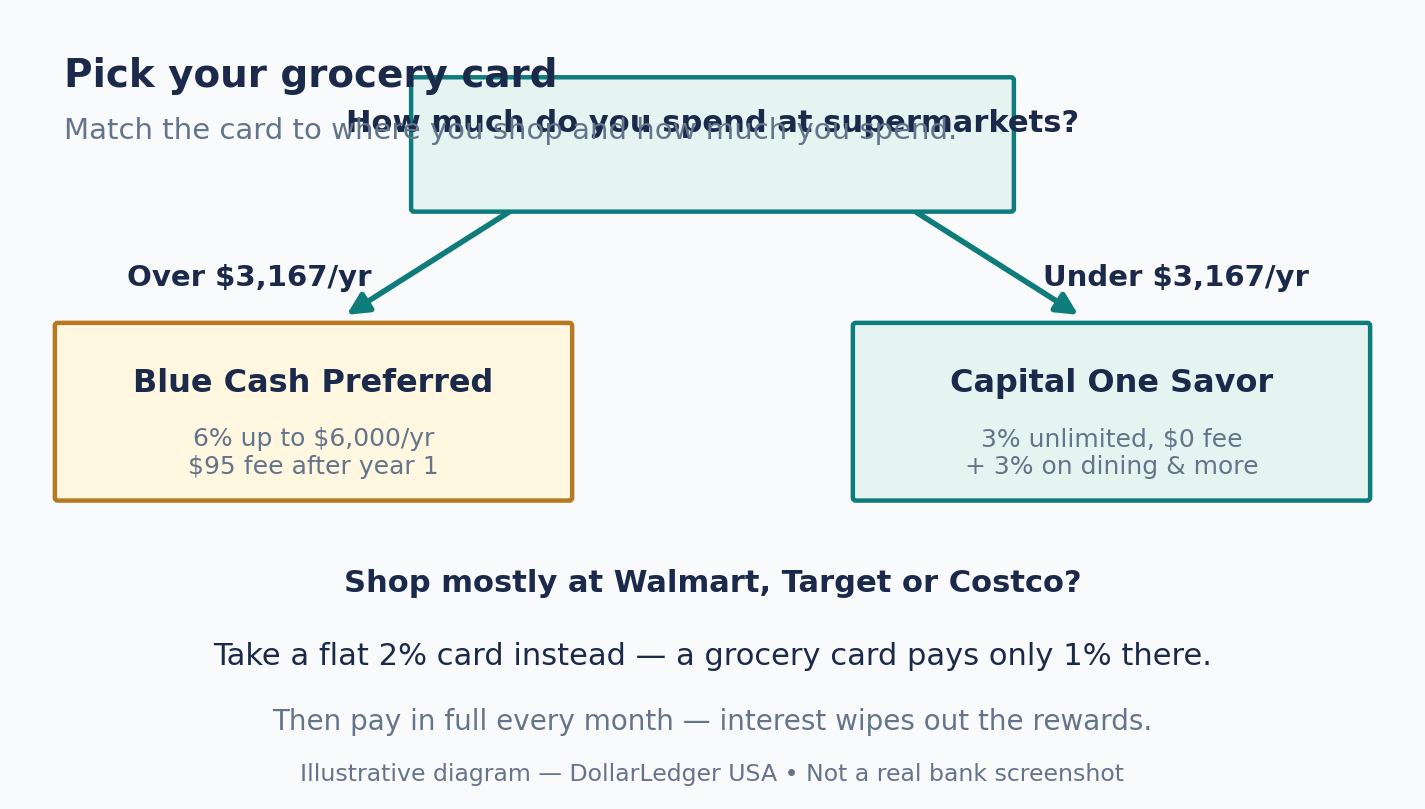
Illustrative diagram — Pick your grocery card by where you shop and how much you spend. NOT a real bank screenshot.
Checklist
- ☐ I know whether my main grocery store counts as a supermarket.
- ☐ I compared the 6% card, the free 3% cards and the flat 2% option.
- ☐ I did the break-even math ($3,167 a year covers the $95 fee).
- ☐ I checked the $6,000-a-year cap on the Amex cards.
- ☐ I checked the APR after the intro period.
- ☐ I set up autopay for the full balance every month.
FAQ
Do Walmart and Target count as grocery stores for credit card rewards? Usually not. Most cards code Walmart and Target as superstores and Costco and Sam’s Club as wholesale clubs, so food spending there earns only 1%.
Is the Blue Cash Preferred worth the $95 annual fee? Spend more than $3,167 a year at U.S. supermarkets, and the extra 3% over a free 3% card covers the fee — the first year is free. Below $3,167, a $0-fee 3% card earns more.
What is the $6,000 cap on the Amex Blue Cash cards? Both pay their supermarket rate only on the first $6,000 of U.S. supermarket purchases each year. After that, both drop to 1%.
Can I earn grocery rewards on delivery orders? Often yes — in some cases the rewards rate applies to grocery delivery too, NerdWallet notes. It depends on how the delivery service is coded, so check your first statement.
Will a grocery card hurt my credit score? Applying for any card causes a small, temporary dip from the hard inquiry. Used well, a grocery card helps your score over time.
Sources
- NerdWallet, “Best Credit Cards for Groceries of November 2026” — card rates, fees and the superstore exclusion, updated Nov 2, 2026: https://www.nerdwallet.com/credit-cards/best/groceries
- American Express, Blue Cash Preferred® Card — 6% at U.S. supermarkets up to $6,000 a year, $0 intro fee then $95: https://www.americanexpress.com/us/credit-cards/card/blue-cash-preferred/
All rates and fees checked November 3, 2026.
This article is for education only, not financial advice. Rates and fees change often — confirm current terms with the issuer before applying.