How to Open a Roth IRA in 2026 — A Beginner's Step-by-Step Guide
 DollarLedger Team
- 04 Nov, 2026

A Roth IRA is the best first retirement account for most young Americans — and opening one is far easier than most people think. You do not need a financial advisor, a big lump sum, or a visit to a bank branch. In 2026 you can put in up to $7,500 a year (or $8,600 if you are 50 or older), your money grows tax-free, and in retirement you withdraw it tax-free too. This guide walks you through the six steps — all figures checked November 4, 2026.
Photo: Opening a Roth IRA takes about 15 minutes online — no branch visit needed. (Photo: Pexels)
What You Will Learn
- Whether you are eligible to open a Roth IRA in 2026
- How to pick a provider — and what $0 minimums really mean
- What you need to open the account in about 15 minutes
- How to fund it: lump sum or $625 a month
- What to invest in first — the beginner default explained
- How to automate it so you never miss a year
Step 1: Check you are eligible — the three-part test
What to do: Confirm all three before you apply.
How: You need earned income, income under the limit, and you must be 18 or older. Earned income means wages, salary, tips, or self-employment income. It does not include gifts, an allowance, or investment income. You must have at least as much earned income as you contribute. The income limits for 2026 are $156,000 if you file single, phasing out to $171,000, and $246,000 if you are married filing jointly, phasing out to $256,000. If you earn over the limit, you cannot contribute directly. A backdoor Roth IRA exists but is advanced — seek professional advice before trying it. Anyone under 18 needs a custodial Roth IRA opened by a parent or guardian. You will need a Social Security number and a valid photo ID.
Example: Maya is 24, earns $52,000 as a teacher, and is single. Her income is well under the $156,000 limit, and she has earned income — so she passes all three parts of the test.
Common mistake: Assuming you are too young or too poor to open a Roth IRA. There is no minimum age for a custodial Roth IRA, and most providers let you start with $0.
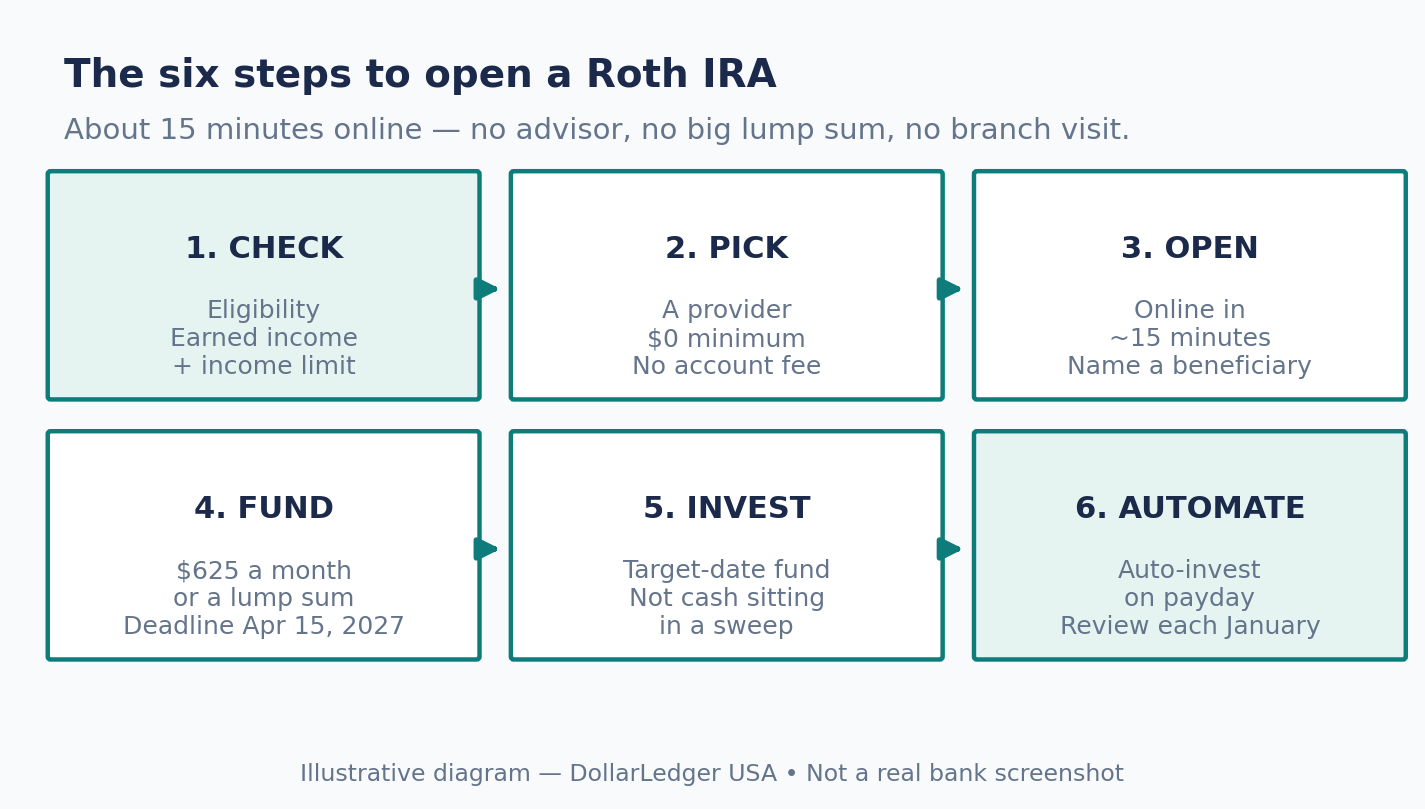
Illustrative diagram — The six steps to open a Roth IRA in 2026. NOT a real bank screenshot.
Step 2: Pick a provider — start with the big three
What to do: Choose one of the large low-cost brokerages.
How: Fidelity, Vanguard, and Charles Schwab all offer $0 minimums to open a Roth IRA, $0 commissions on US stocks and ETFs, and a good range of low-cost index funds. Compare the target-date fund expense ratio — under 0.15% is good. Fidelity Freedom Index 2065 is 0.12% and Vanguard Target Retirement 2065 is 0.08%. Check whether the app is easy to use, and whether there is local support if you want it. Avoid providers charging account fees, high expense ratios, or pushing you into expensive managed portfolios. If you are still deciding where to park your emergency fund while you open the account, see our high-yield savings guide.
Example: Priya opens with Fidelity because the app is simple and the Freedom Index 2065 fund costs 0.12% a year — $12 on a $10,000 balance.
Common mistake: Spending weeks comparing providers instead of opening the account. The differences between the big three are small, and any of them beats waiting another year.
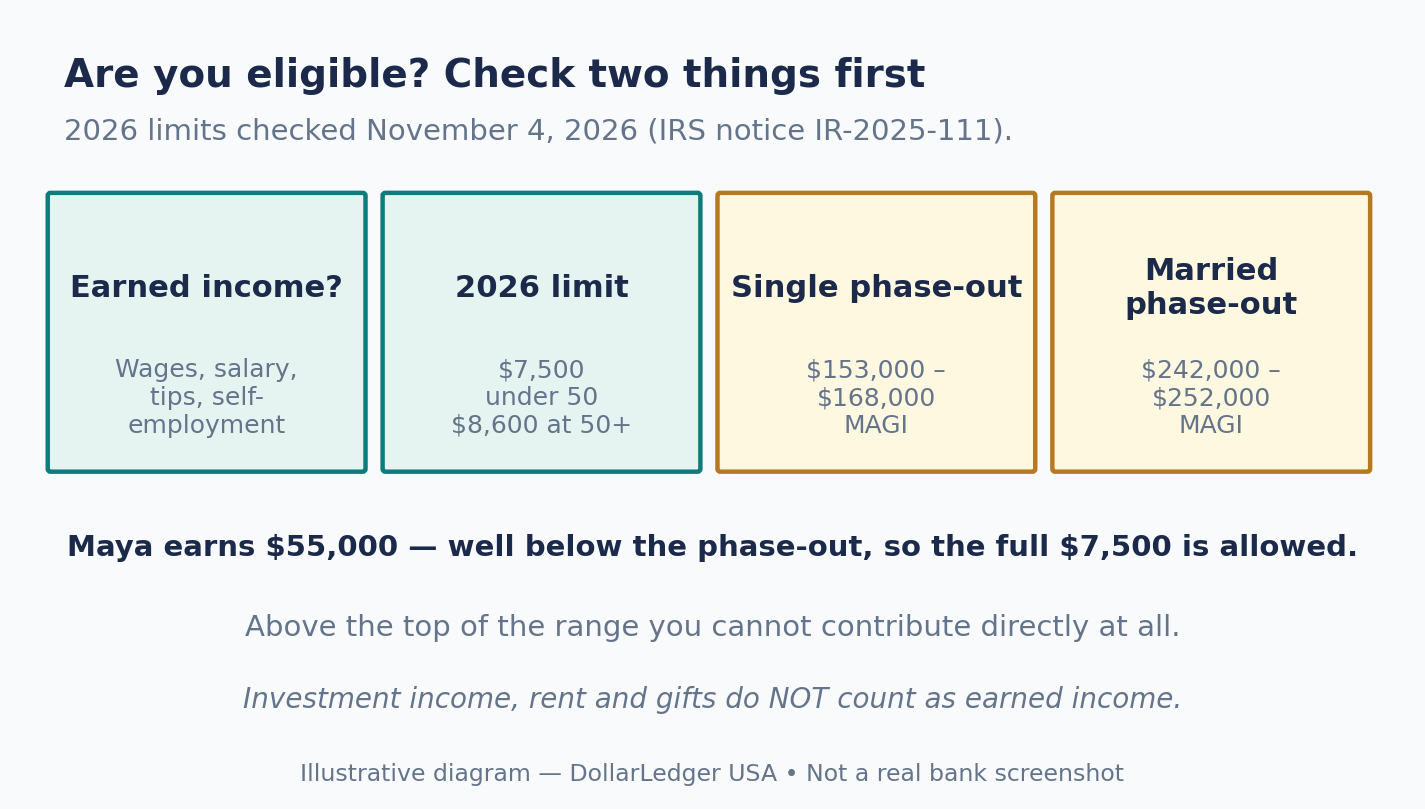
Illustrative diagram — The eligibility check: earned income, income limits, and ID. NOT a real bank screenshot.

Photo: Have your ID, Social Security number and bank details ready before you start. (Photo: Pexels)
Step 3: Open the account — it takes about 15 minutes
What to do: Apply online and have your details ready first.
How: You will need your Social Security number, a photo ID (driver’s licence or passport), your employer’s name and address, and your bank account and routing numbers for funding. The application asks for your personal details, employment status, and your beneficiary — the person who inherits the account. Choose your beneficiary now (a spouse, parent or sibling) — it takes 30 seconds and saves your family a legal headache later. You can change it any time. No branch visit is needed — the whole process is online, and your account number usually arrives the same day.
Example: Jamal opens his Roth IRA on a Tuesday lunch break — ID, Social Security number, bank details — and gets his account number by email before dinner.
Common mistake: Leaving the beneficiary blank. If you skip it, your estate decides who gets the money, which can take months.
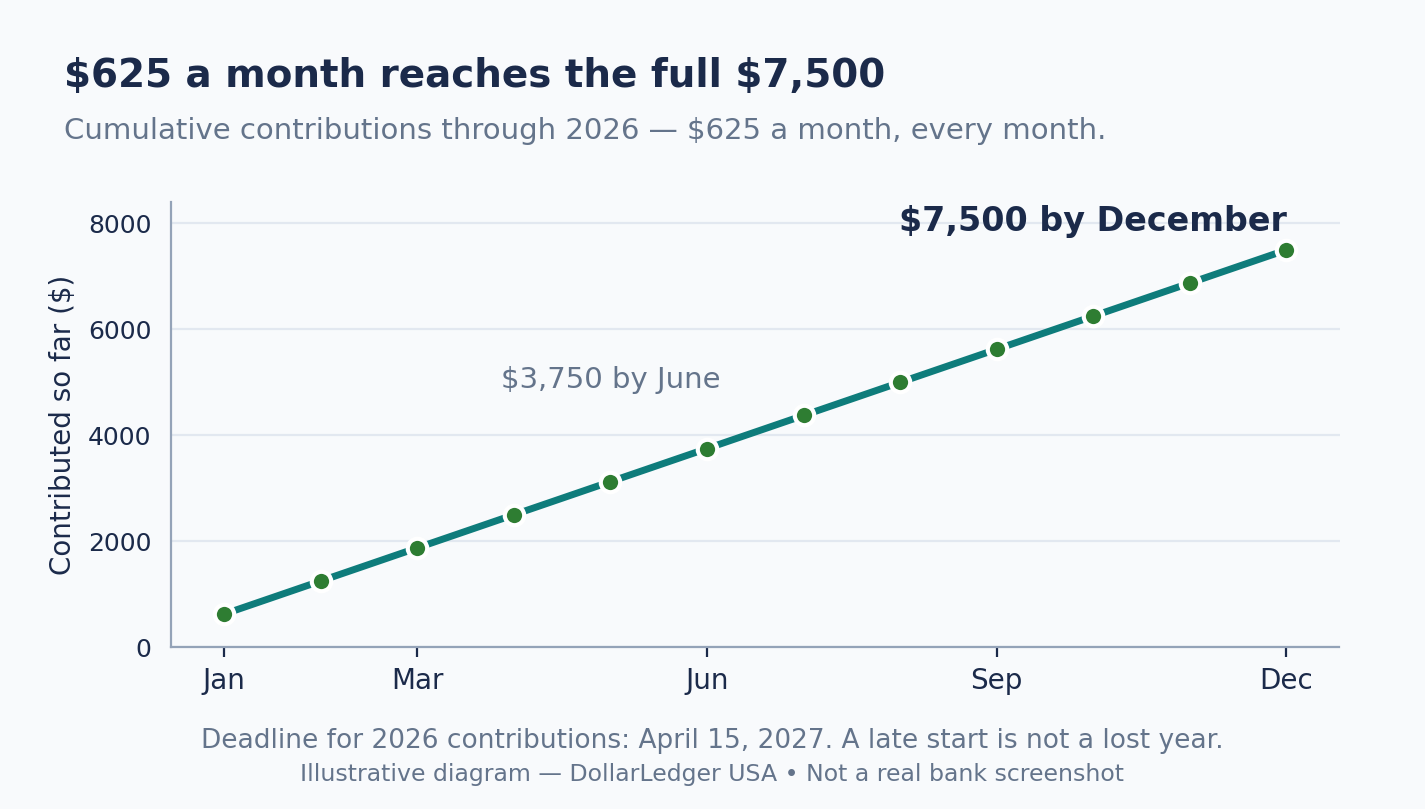
Illustrative diagram — $625 a month reaches the full $7,500 for 2026. NOT a real bank screenshot.
Step 4: Fund it — $625 a month reaches $7,500
What to do: Move money in, either as a lump sum or monthly.
How: You can contribute up to $7,500 in 2026 if you are under 50, or $8,600 if you are 50 or older. The deadline for 2026 contributions is April 15, 2027 — you can still contribute for 2026 in early 2027. There are two ways to fund it: a lump sum — transfer the full $7,500 at once, if you have it; or monthly — $625 a month for 12 months. Monthly is easier on a normal budget, and you can raise it when you get a pay rise. Link your bank account for a free electronic transfer (ACH) — it takes 1–3 business days to arrive.
Example: Alex earns $60,000 and sets up $625 a month — about 12% of take-home pay. By December, he has hit the full $7,500 without ever feeling the pinch.
Common mistake: Funding the account but never investing the money (see Step 5) — a funded but uninvested Roth IRA earns almost nothing.
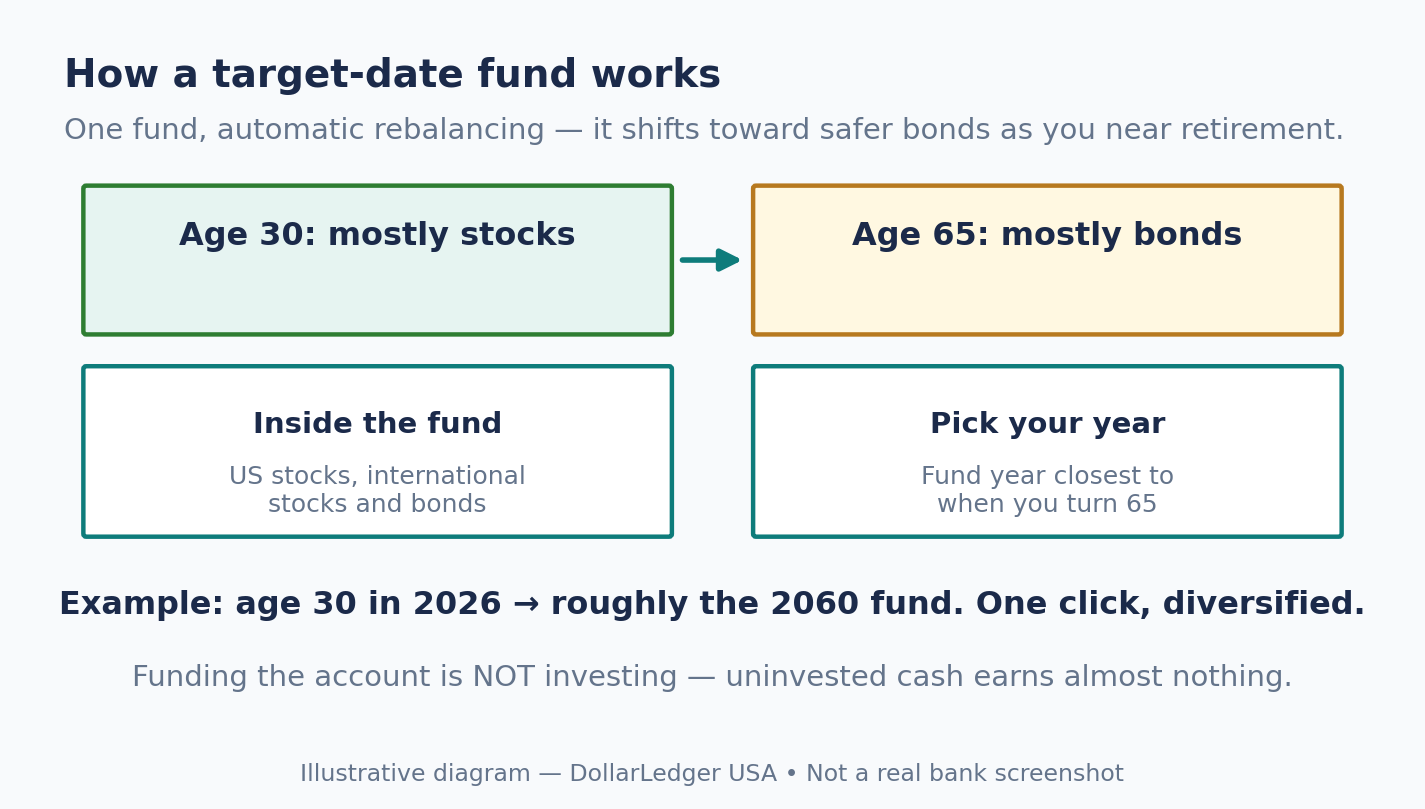
Illustrative diagram — A target-date fund does the rebalancing for you. NOT a real bank screenshot.
Step 5: Choose your first investment — the beginner default
What to do: Put the money in a target-date fund.
How: A target-date fund is a single fund that holds a mix of US stocks, international stocks, and bonds, and automatically shifts toward bonds as you get closer to retirement. Pick the fund with the year closest to when you turn 65 — so a 25-year-old in 2026 would pick a 2065 fund. Why it works for beginners: you get instant diversification across thousands of companies, no stock-picking, and automatic rebalancing. Cost: look for an expense ratio under 0.15% (Fidelity Freedom Index 2065 is 0.12%, Vanguard Target Retirement 2065 is 0.08%). Do not leave the money sitting in the cash settlement fund — it earns almost nothing, and your Roth IRA will not grow.
Example: At 25, Sofia picks the Fidelity Freedom Index 2065 fund. She does not need to choose individual stocks — the fund holds over 3,000 of them for her.
Common mistake: Leaving your contribution in cash because you are afraid of picking the wrong investment. A target-date fund is the safe default — indecision is the real mistake.

Photo: Set it and forget it — automate your contributions on payday. (Photo: Pexels)
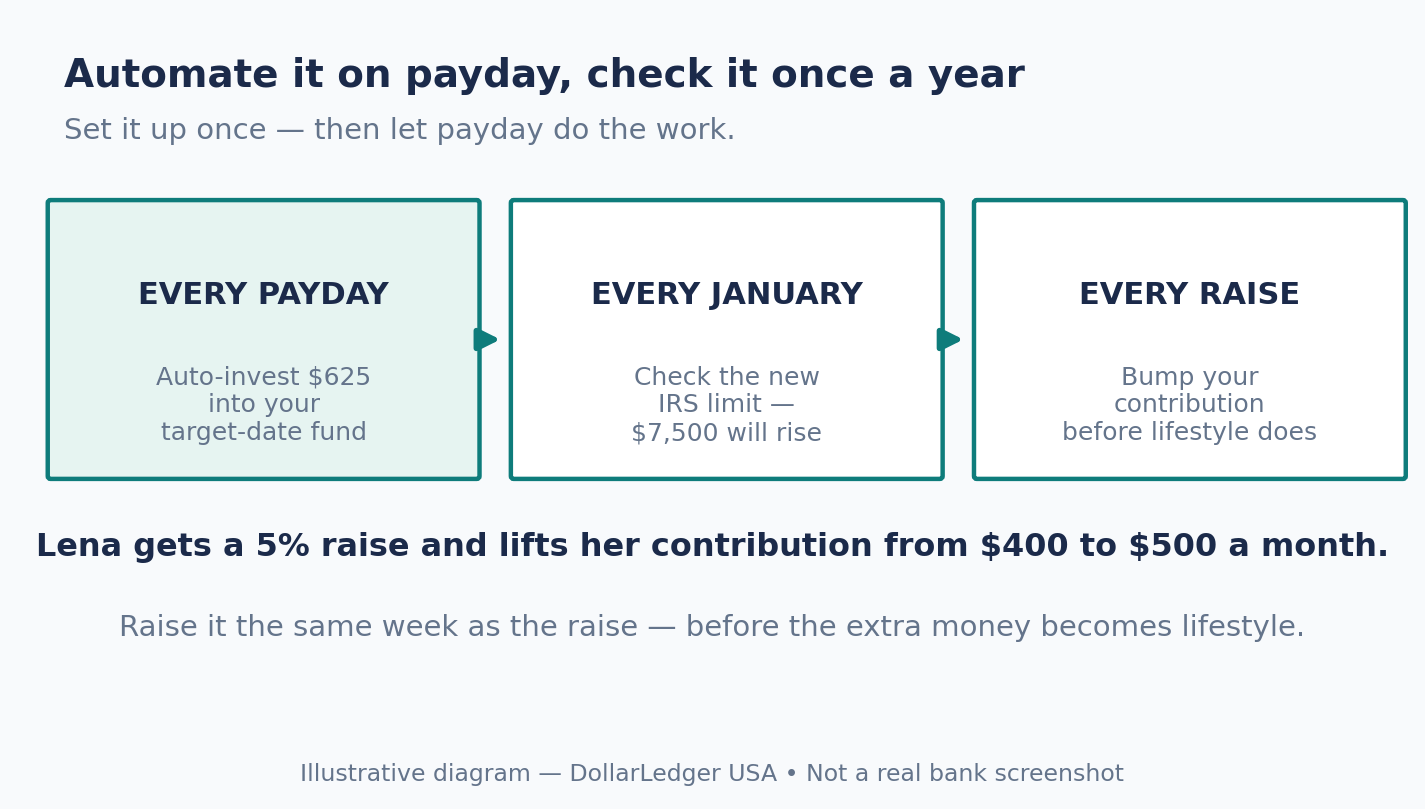
Illustrative diagram — Automate $625 on payday and you will never miss a month. NOT a real bank screenshot.
Step 6: Automate it — and set a calendar reminder
What to do: Set up an automatic transfer and a yearly reminder.
How: Set up an automatic transfer of $625 a month from your bank to your Roth IRA, timed for payday. Then set a calendar reminder for every January to check two things: whether the IRS has raised the limit (for 2026 it is $7,500), and whether your monthly amount still hits the new limit. If you get a pay rise, raise your contribution by 1% — you will not miss it. You can change, pause or stop the automatic transfer at any time with no penalty.
Example: After setting up $625 a month on payday, Lena never thinks about her Roth IRA again — but by age 30 she has over $40,000 invested.
Common mistake: Setting up automation and never checking the limit again. If the IRS raises the limit to $8,000 and you are still sending $625, you will miss out on $500 a year.
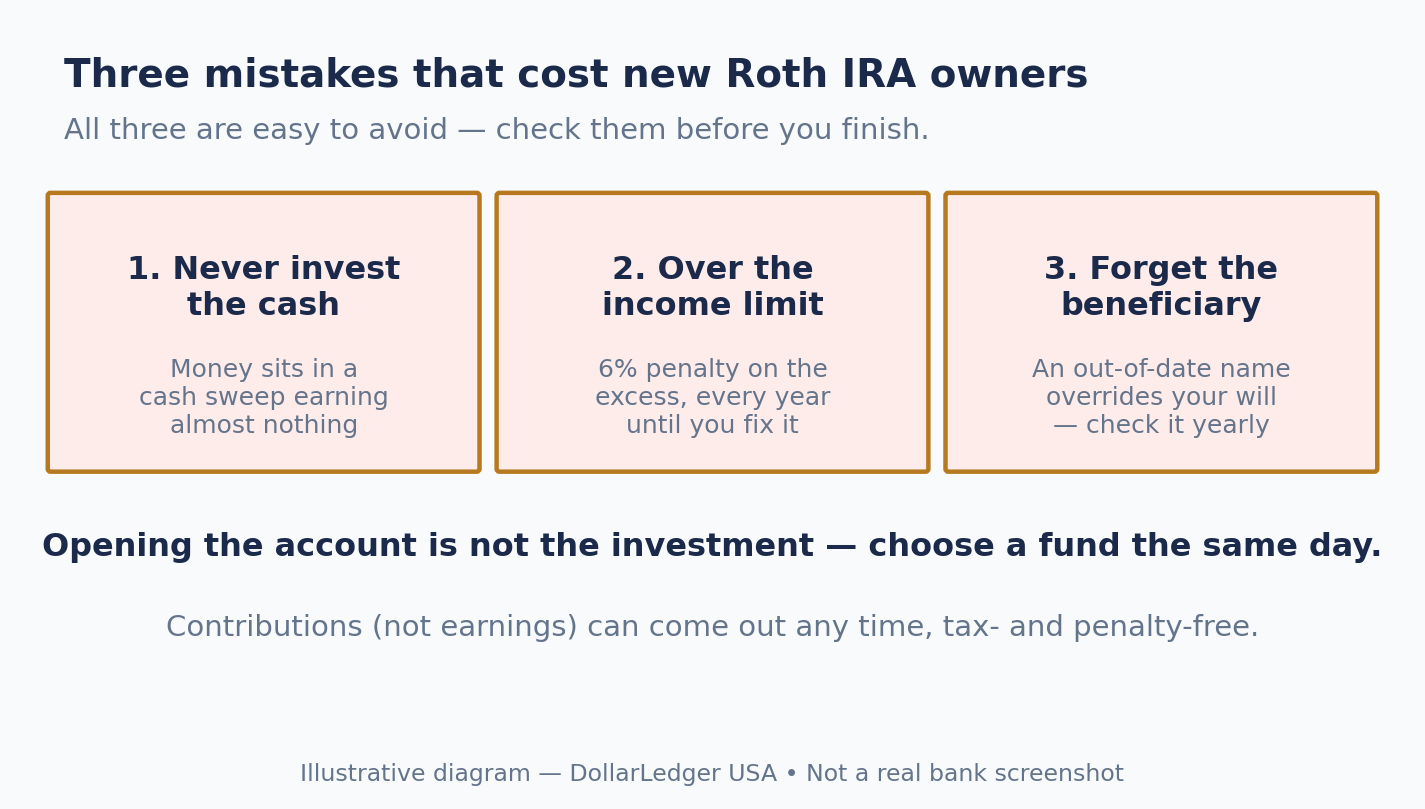
Illustrative diagram — The four mistakes that cost new Roth IRA owners the most. NOT a real bank screenshot.
Checklist
- ☐ I checked all three parts of the eligibility test
- ☐ I picked a low-cost provider — Fidelity, Vanguard, or Schwab
- ☐ I opened the account with my ID, Social Security number, and bank details
- ☐ I funded it — lump sum or $625 a month toward $7,500
- ☐ I invested in a target-date fund, not cash
- ☐ I automated the transfer and set a January reminder
FAQ
How much can I put in a Roth IRA in 2026?
$7,500 if you are under 50, or $8,600 if you are 50 or older, according to the IRS. You also need earned income at least equal to your contribution, and income below the phase-out range.
Can I open a Roth IRA if I already have a 401(k)?
Yes — having one does not block the other, and many people use both. The two limits are independent.
What happens if I contribute too much?
The IRS charges a 6% penalty on the excess every year until you fix it. Withdraw the extra amount before the tax deadline, and keep records.
Can I withdraw my Roth IRA money before retirement?
Your contributions can come out any time, tax- and penalty-free. But the earnings are locked until age 59½, unless you qualify for an exception.
Is a target-date fund a safe choice for a beginner?
It is the most common beginner default — one fund, instant diversification, automatic rebalancing, and a cost under 0.15% a year.
Sources
- IRS, “401(k) limit increases to $24,500 for 2026, IRA limit increases to $7,500” (IR-2025-111) — 2026 limits: https://www.irs.gov/newsroom/401k-limit-increases-to-24500-for-2026-ira-limit-increases-to-7500
- IRS, “Roth IRA contribution and income limits for 2026” — phase-out ranges: https://www.irs.gov/retirement-plans/roth-ira-contribution-and-income-limits
- Fidelity, “Roth IRA contribution limits for 2026” — $7,500 limit and income phase-outs: https://www.fidelity.com/learning-center/smart-money/roth-ira-contribution-limits
All figures checked November 4, 2026.
This article is for education only, not financial advice. Contribution limits and tax rules change — confirm current figures with the IRS or a qualified tax professional before acting.