Year-End Tax Moves to Make Before 31 Dec 2026 — The 12-Move Checklist
 DollarLedger Team
- 14 Nov, 2026

Most 2026 tax moves die at midnight on December 31. No extension, no grace period — once the year turns, the move is gone. This post is a deadline checklist: twelve moves, each with the date it expires. And 2026 is not last year’s tax year — the first fully shaped by the One Big Beautiful Bill Act, signed July 4, 2025. Charitable rules, SALT and the standard deduction all changed. All figures were checked on November 13, 2026, against IRS pages.
Caption: Photo: Twelve moves, one deadline — most of them die at midnight on 31 December. (Photo: Pexels)
What You Will Learn
- Your RMD — how much, and the timing choice
- Roth conversions: the 31 Dec deadline, and sizing
- Tax-loss harvesting and the 0% capital-gains bracket
- Which accounts die on 31 Dec — and which wait until 15 Apr
- Giving under the new 2026 rules, and the $19,000 gift exclusion
- The itemize test, and fixing your withholding
Step 1: Take your RMD — and make the first-RMD choice
What to do: If you are 73 or older, take your 2026 required minimum distribution by December 31. First RMD year? Choose: this year, or April 1, 2027.
How: The IRS requires withdrawals from traditional IRAs and 401(k)s from age 73. Your RMD is the balance on December 31 of the previous year divided by a factor from the IRS Uniform Lifetime Table — 26.5 at age 73. A $500,000 balance means a 2026 RMD of $18,868. Miss it and the penalty is a 25% excise tax on the shortfall — 10% if you correct it within two years. If 2026 is the year you turned 73, your first RMD can wait until April 1, 2027 — but then two RMDs land in 2027.
Example: Take $18,868 by December 31, 2026, and your 2027 RMD comes separately. Wait until April 1, 2027, and you take both in the same year.
Common mistake: Thinking April 1 applies every year — it is for your first RMD only.
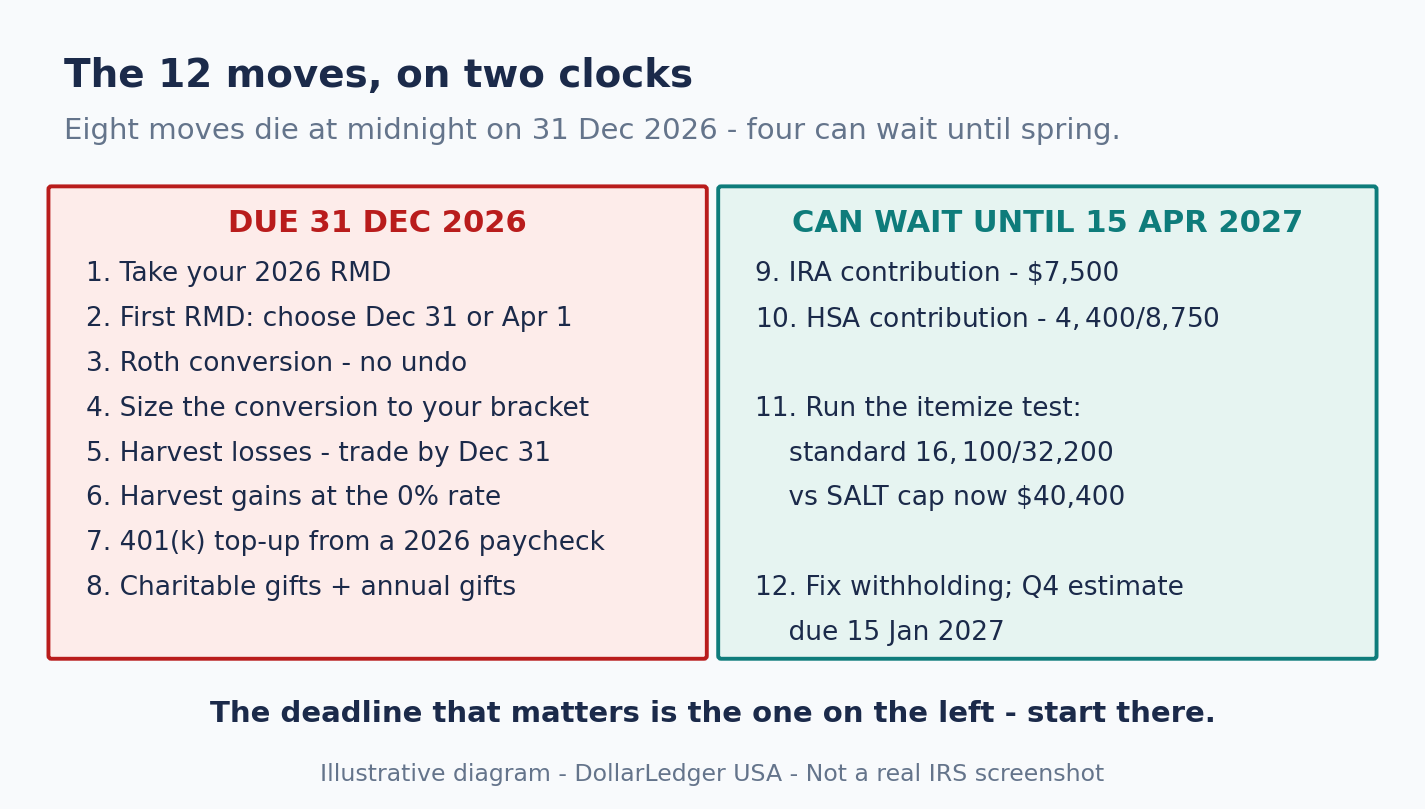
Caption: Illustrative diagram - The 12 moves, on two clocks. NOT a real IRS screenshot.
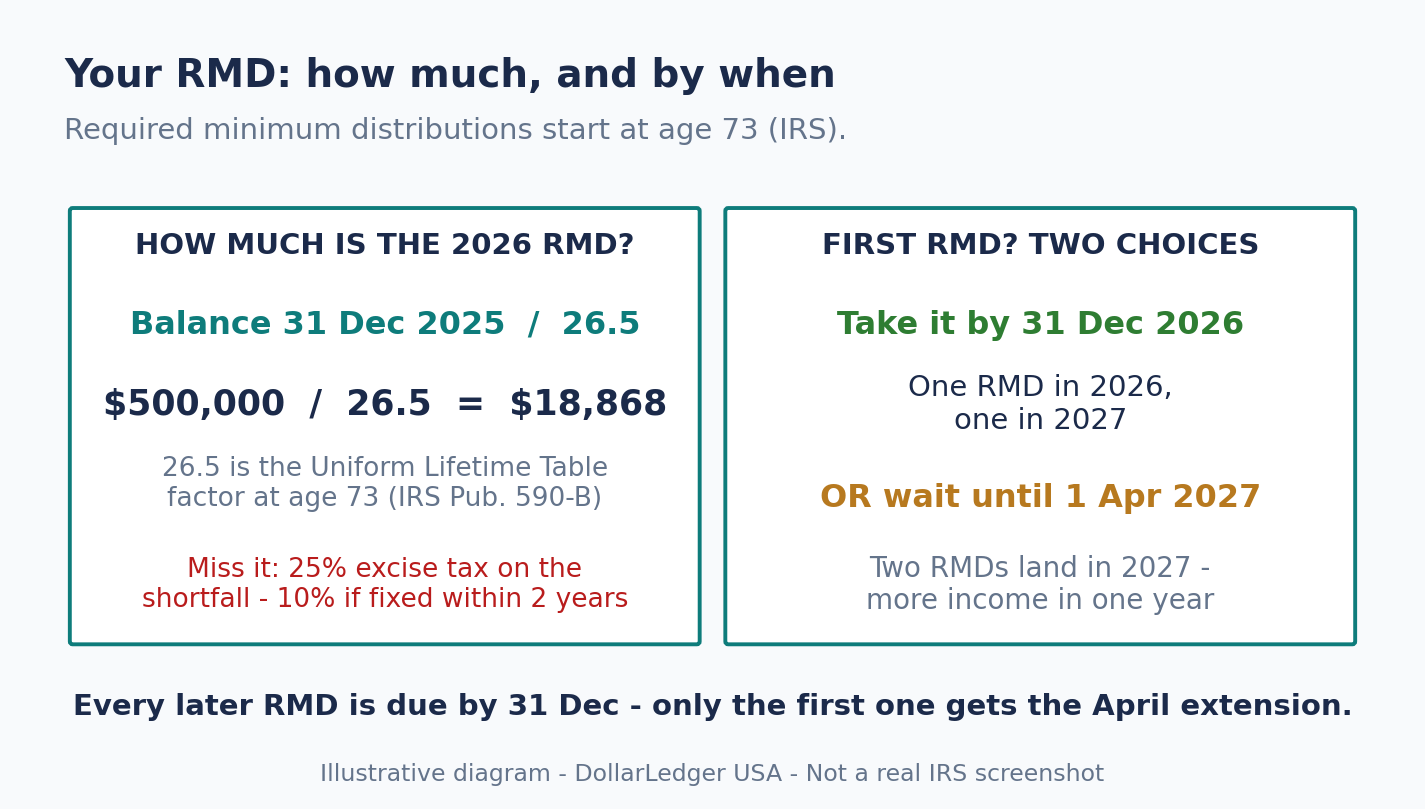
Caption: Illustrative diagram - Your RMD: how much, and by when. NOT a real IRS screenshot.
Step 2: Do your Roth conversion before 31 December — and size it
What to do: If you plan a Roth conversion for 2026, complete it by December 31 — and convert only enough to fill your target bracket.
How: A conversion moves money from a pre-tax IRA or 401(k) into a Roth IRA, taxed as ordinary income that year. No April extension: a March 2027 conversion is 2027 income. Since 2018, conversions cannot be undone. A conversion never satisfies your RMD, and RMD dollars cannot be converted. For 2026, the 12% bracket for a single filer ends at $50,400 of taxable income, and the standard deduction is $16,100.
Example: You are single with $40,000 of other income. After the $16,100 standard deduction, taxable income is $23,900 — leaving $26,500 of room to the top of the 12% bracket. Convert $26,500 and the tax is $3,180; convert $36,500 and the extra $10,000 is taxed at 22%.
Common mistake: Converting in the last week of December without checking for late income — a year-end bonus can push it into the next bracket.

Caption: Photo: The conversion deadline is the calendar, not the tax return — 31 December, no extensions. (Photo: Pexels)
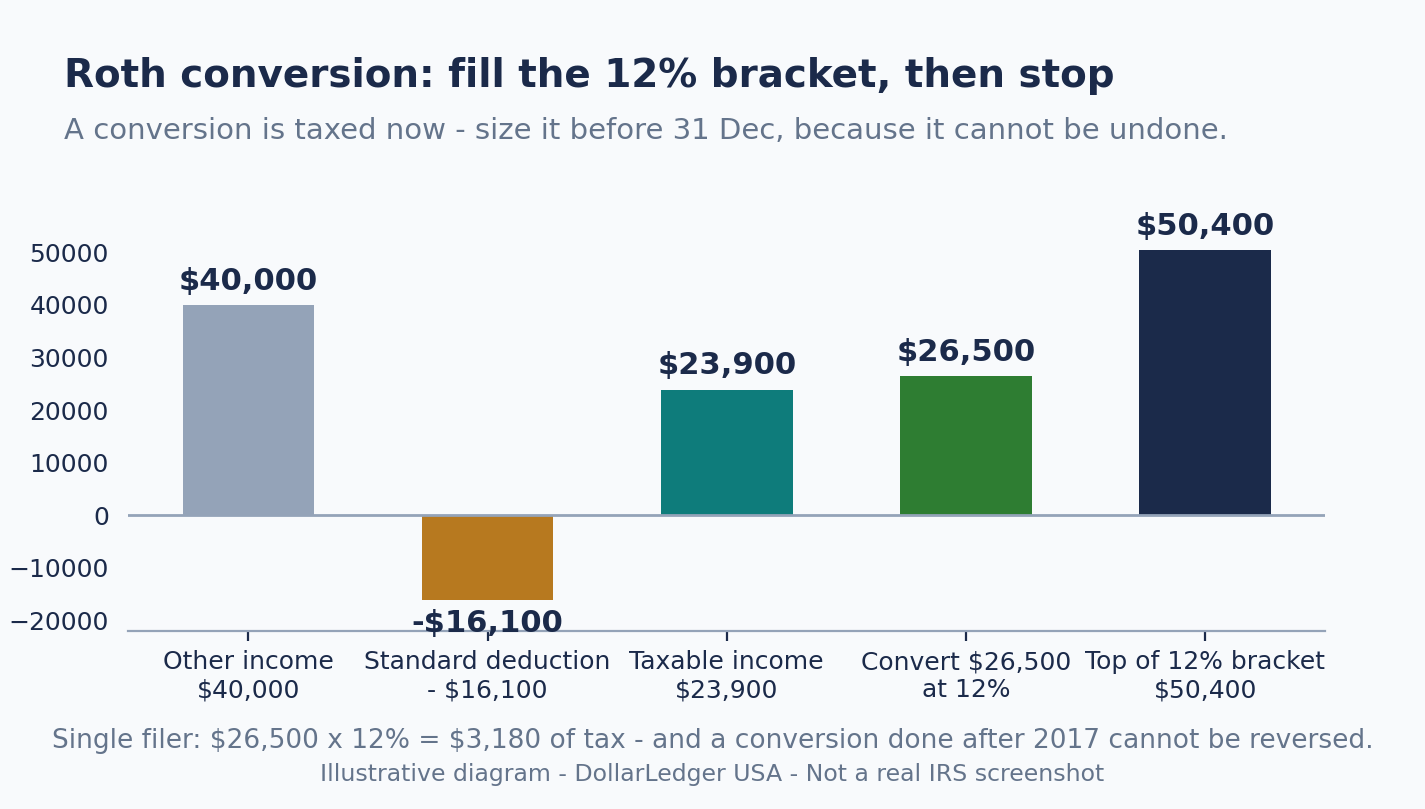
Caption: Illustrative diagram - Roth conversion: fill the 12% bracket, then stop. NOT a real IRS screenshot.
Step 3: Harvest your losses — and your gains at 0%
What to do: Sell losing investments by December 31 to lock in the loss for 2026, and check whether long-term gains can be taken at 0%.
How: A loss offsets capital gains dollar for dollar. Leftover losses cut up to $3,000 a year ($1,500 married filing separately) off ordinary income; the rest carries forward. The trade date counts, not the settlement date — a December 31, 2026 sale counts for 2026 even if it settles in January 2027. The trap is the wash-sale rule: buy the same security back within 30 days either side of the sale — a 61-day window — and the loss is disallowed; IRA buys count too. Long-term gains are taxed at 0% up to $49,450 taxable income single, $98,900 joint, in 2026.
Example: Shares bought for $28,000, sold for $20,000: an $8,000 loss. With no gains, $3,000 cuts 2026 ordinary income, $5,000 carries forward.
Common mistake: Selling December 31 and buying it back January 5 — inside the 61-day window, the loss is disallowed.
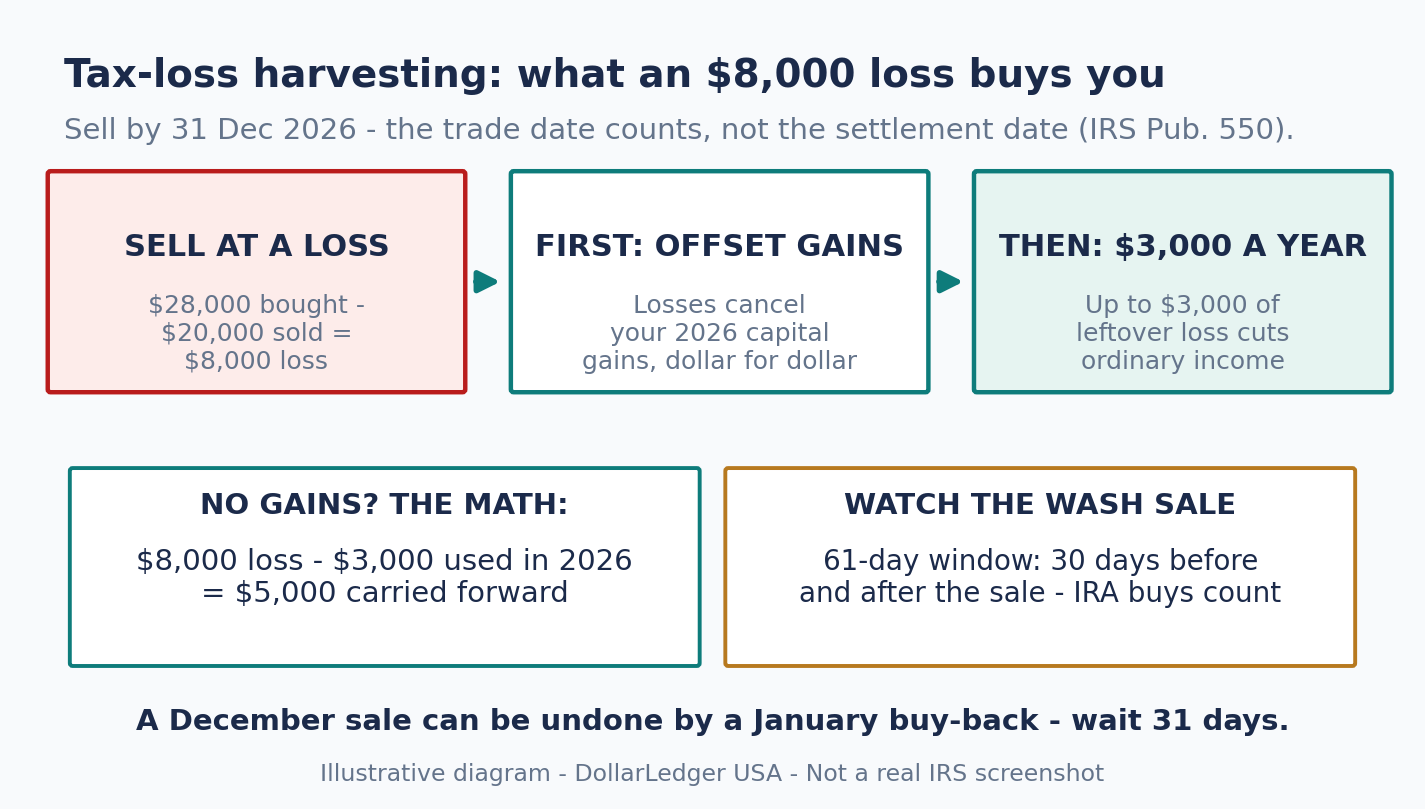
Caption: Illustrative diagram - Tax-loss harvesting: what an $8,000 loss buys you. NOT a real IRS screenshot.
Step 4: Top up the accounts — on the right clock
What to do: Push your 401(k) to the 2026 limit from your last paychecks — IRA and HSA contributions for 2026 can wait until April 15, 2027.
How: 2026 limits: 401(k) $24,500, plus $8,000 at age 50+ ($32,500) or $11,250 instead at ages 60-63 ($35,750). But 401(k) money comes only from a paycheck — no April top-up. IRA: $7,500 (+$1,100 at 50+); HSA: $4,400 self-only or $8,750 family (+$1,000 at 55+). Both can be funded until April 15, 2027 — tell the custodian it is for 2026, or it counts for 2027. Full 401(k) tables: our 401(k) contribution limits guide for 2026.
Example: You are 52 and have put $20,000 into your 401(k) in 2026. Your limit is $32,500 — $12,500 of room — but only your remaining 2026 paychecks can fill it. Your IRA can still take $8,600 until April 15, 2027.
Common mistake: Assuming April 15 covers everything — it covers IRA and HSA only.

Caption: Photo: The 401(k) is the only account that truly dies on 31 December — the IRA and HSA can wait until Tax Day. (Photo: Pexels)
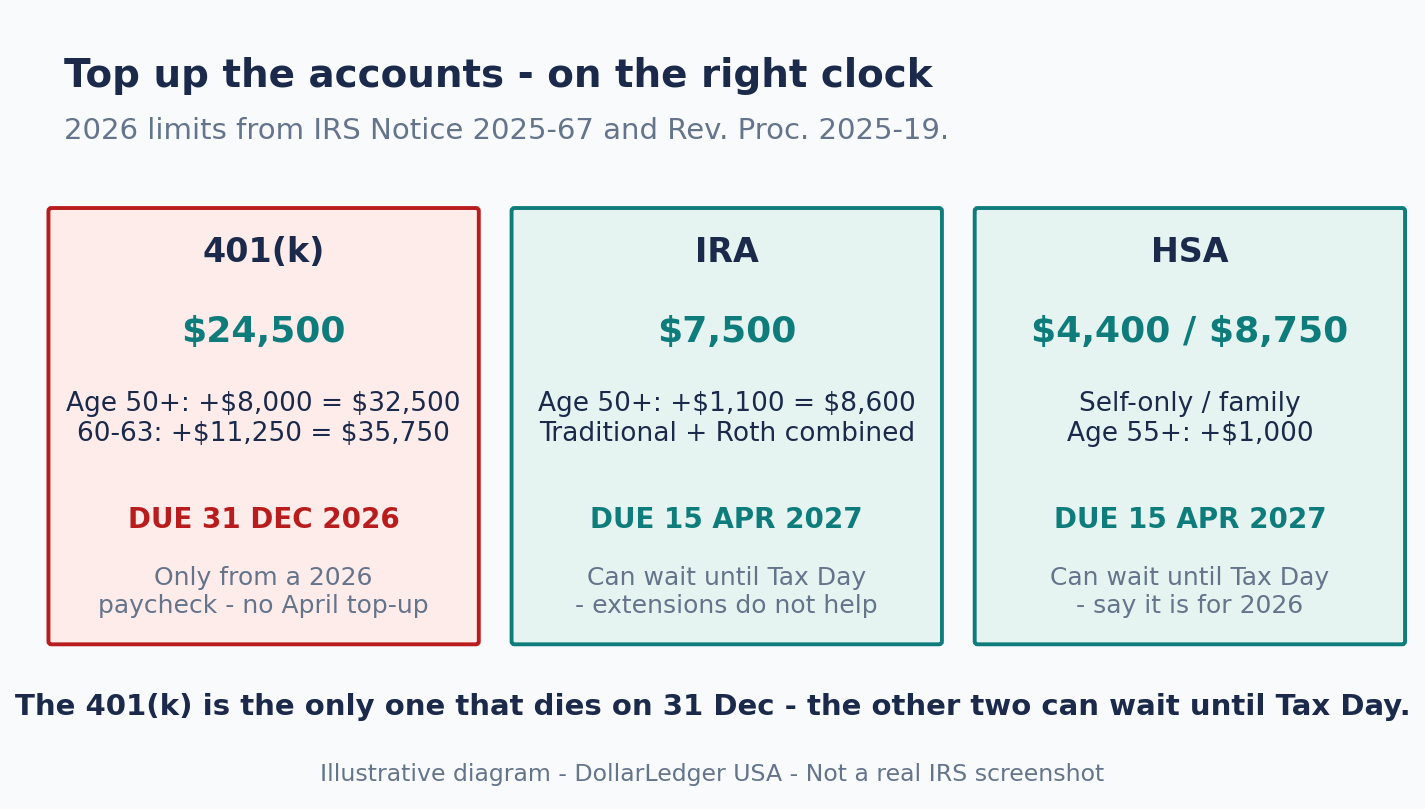
Caption: Illustrative diagram - Top up the accounts, on the right clock. NOT a real IRS screenshot.
Step 5: Give before midnight — the rules changed in 2026
What to do: Make your charitable and annual family gifts by December 31, under the new 2026 rules.
How: The One Big Beautiful Bill Act rewrote charitable giving in both directions. If you take the standard deduction, you can now also deduct up to $1,000 of cash gifts — $2,000 on a joint return — a break non-itemizers lacked before 2026. Cash only; gifts to donor-advised funds do not qualify. If you itemize, a new floor applies: only gifts above 0.5% of your adjusted gross income are deductible. The annual gift-tax exclusion is $19,000 per recipient for 2026; a couple can give $38,000 per recipient.
Example: Your AGI is $200,000 and you give $5,000. The 0.5% floor is $1,000, so $4,000 is deductible if you itemize. On the standard deduction, up to $1,000 of that gift ($2,000 joint) is deductible on top.
Common mistake: Giving in January and expecting it on the 2026 return — a gift counts in the year it is made.
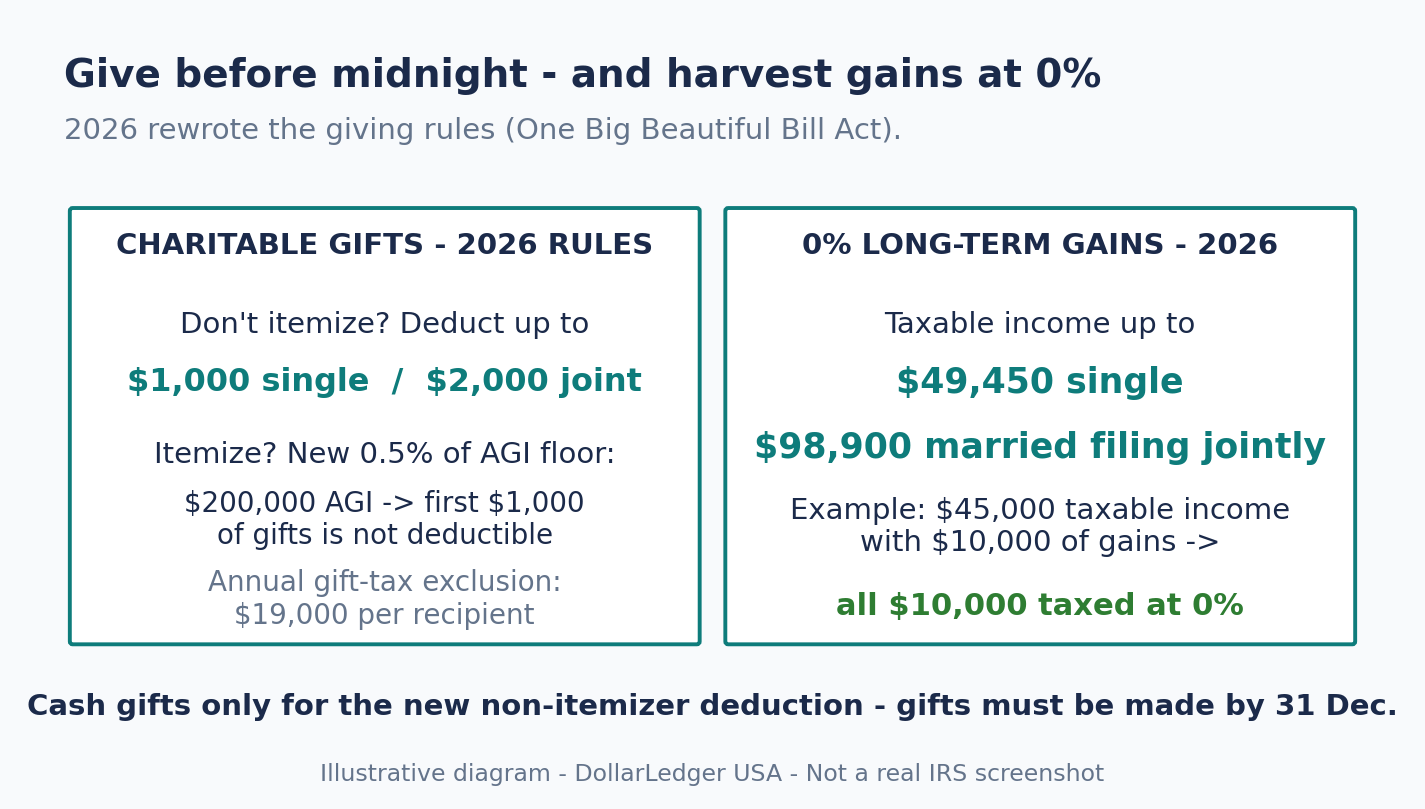
Caption: Illustrative diagram - Give before midnight, and harvest gains at 0%. NOT a real IRS screenshot.
Step 6: Run the itemize test — and fix your withholding
What to do: Before the year ends, add up your itemized deductions under the new 2026 rules, and check your withholding so you owe no penalty in April.
How: The 2026 standard deduction is $16,100 single, $32,200 married filing jointly. Itemizing only wins if your deductions beat that — and the math changed in 2026, because the SALT cap jumped from $10,000 to $40,400. State and local tax, property tax, mortgage interest and gifts can now add up to far more. Then check your withholding: the year’s moves may have pushed your income above what was withheld. The Q4 estimated tax payment is due January 15, 2027. Freelancers: see our freelancer taxes guide for 2026.
Example: You are married, paid $18,000 in state income tax and $12,000 in property tax, and gave $5,000 to charity. Under the old $10,000 SALT cap, your total was $15,000 — below the $32,200 standard deduction. Under the 2026 cap of $40,400, it is $35,000 — $2,800 above.
Common mistake: Running the test with the old $10,000 SALT cap, when the new $40,400 cap flips the answer.
Checklist
- 2026 RMD taken — or first-RMD choice made (31 Dec vs 1 Apr).
- Roth conversion done by 31 Dec, sized to the bracket.
- Losing investments sold by 31 Dec; wash-sale window checked.
- Gains checked against the 0% thresholds ($49,450 / $98,900).
- 401(k) deferral raised for the last 2026 paychecks.
- IRA and HSA top-ups planned by 15 Apr 2027.
- Charitable gifts made by 31 Dec — cash only.
- Annual gifts up to $19,000 per recipient by 31 Dec.
- Itemize test run with the 2026 SALT cap ($40,400).
- Withholding checked; Q4 estimate ready for 15 Jan 2027.
- Receipts filed — gifts over $250 need written acknowledgment.
- Broker and custodian cut-offs confirmed — theirs can be earlier.
FAQ
What must be done by 31 December 2026?
RMDs, Roth conversions, tax-loss harvesting, charitable and annual gifts, and 401(k) contributions from a 2026 paycheck. IRA and HSA contributions can wait until April 15, 2027.
Can I undo a Roth conversion if I converted too much?
No. Since 2018, conversions cannot be undone — the tax is owed on the amount converted. Size it first.
Must I sell losing investments by December 31?
Yes. The trade date controls, not the settlement date — a December 31, 2026 sale counts even though it settles in January 2027. Do not buy the same security back within 30 days either side.
Can I deduct charitable gifts if I do not itemize?
Yes, new for 2026: up to $1,000 of cash gifts ($2,000 joint) on top of the standard deduction. Donor-advised funds do not qualify, and only cash counts.
Sources
- IRS, 401(k) limit increases to $24,500 for 2026, IRA limit increases to $7,500 (IR-2025-111, Notice 2025-67) (opened live November 13, 2026): https://www.irs.gov/newsroom/401k-limit-increases-to-24500-for-2026-ira-limit-increases-to-7500
- IRS, Tax inflation adjustments for tax year 2026, including amendments from the One, Big, Beautiful Bill (IR-2025-103, Rev. Proc. 2025-32) (opened live November 13, 2026): https://www.irs.gov/newsroom/irs-releases-tax-inflation-adjustments-for-tax-year-2026-including-amendments-from-the-one-big-beautiful-bill
- IRS, Retirement topics — Required minimum distributions (RMDs) (opened live November 13, 2026): https://www.irs.gov/retirement-plans/plan-participant-employee/retirement-topics-required-minimum-distributions-rmds
All figures checked November 13, 2026, against the IRS pages above, IRS Publication 550 / Topic 409 and IRS Rev. Proc. 2025-19.
Disclaimer: For education only, not financial, tax or investment advice. Tax rules change — confirm the current figures on irs.gov before you decide.