I Bonds in 2026 — The New 5.51% Rate, and Whether They Beat a Savings Account
 DollarLedger Team
- 11 Nov, 2026
On November 1, 2026, the U.S. Treasury set a new rate for Series I savings bonds: 5.51%. The headline is real — but it is not the whole story. The 5.51% lasts for six months only. The number that matters long term is the 1.40% fixed rate inside it, the highest fixed rate on an I bond since November 2006. That part stays with your bond for its whole life, up to 30 years. This guide splits the rate in two, works out what $10,000 earns, and tests I bonds against a savings account and a CD. All figures were checked on November 11, 2026.
Photo: The 5.51% headline is real — but only the 1.40% fixed part lasts. (Photo: Pexels)
What You Will Learn
- How the 5.51% rate is built
- What $10,000 earns in the first six months
- The $10,000 limit, the 12-month lock-up and the penalty
- How to buy through TreasuryDirect
- Whether an I bond beats a savings account or a CD
- When I bonds are the wrong place for your cash
Step 1: Split the 5.51% into its two parts
What to do: Before you buy, learn which part of the rate is permanent and which part changes.
How: An I bond’s rate has two parts. The fixed rate is set when you buy and never changes for the life of the bond. For bonds issued November 1, 2026 to April 30, 2027, the fixed rate is 1.40% — the highest since November 2006, when it was also 1.40%. The inflation rate changes every six months, based on the CPI-U (Consumer Price Index for All Urban Consumers). For this window it is 2.04% for six months, or 4.08% annualised. Treasury combines them with a formula: 1.40% + (2 x 2.04%) + (1.40% x 2.04%) = 5.51%. The composite rate has a 0% floor, so it can never go below zero. The next rates are announced on May 1, 2027.
Example: A buyer who bought in May 2026 has a 0.90% fixed rate, so from May 2027 her bond earns 0.90% plus inflation. The November 2026 buyer keeps 1.40% plus inflation for the bond’s life.
Common mistake: Treating 5.51% as locked in — only the 1.40% fixed part is permanent.
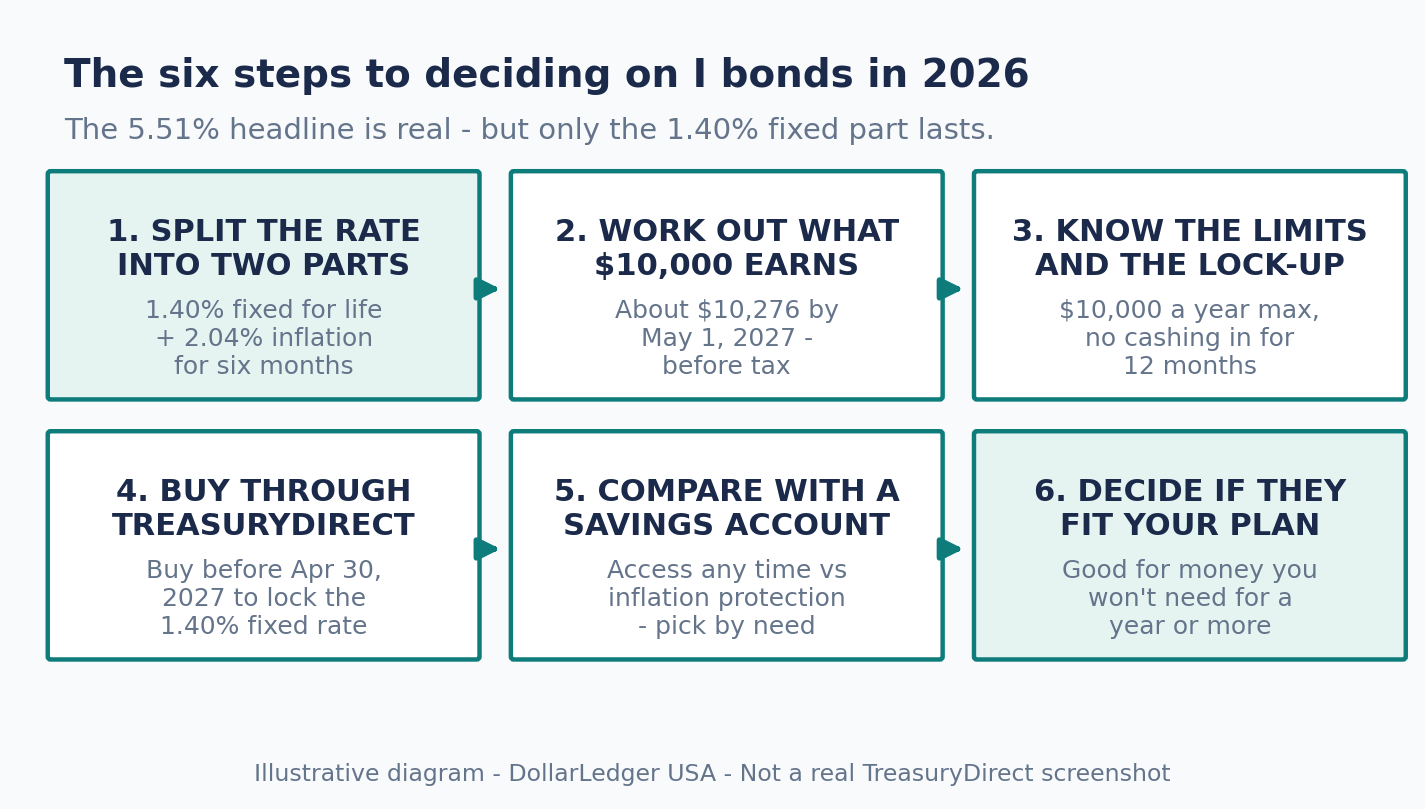
Illustrative diagram - The six steps to deciding on I bonds in 2026. NOT a real TreasuryDirect screenshot.
Step 2: Work out what $10,000 actually earns
What to do: Turn the annual rate into dollars for the first six months, and stop there — the second half of the year is not set yet.
How: The 5.51% is an annual rate that applies for six months, so $10,000 bought in November 2026 earns 2.755%, or $275.50 — about $10,276 by May 1, 2027, before tax. Interest compounds semiannually. What happens after May 1, 2027 is not set yet — nobody can promise 5.51% for a full year. Older bonds benefit too: I bonds bought from May to October 2026 carry a 0.90% fixed rate, and with the new 2.04% inflation rate they now earn 5.00% this period, so $10,000 of those grows to about $10,250 in six months. Each bond picks up new rates on its own six-month anniversary, not on the announcement date.
Example: Sara buys $10,000 of I bonds on November 20, 2026. Her bond is dated November 1 and is worth about $10,276 by May 1, 2027, before tax.
Common mistake: Doubling the first six months and calling it a 5.51% year.
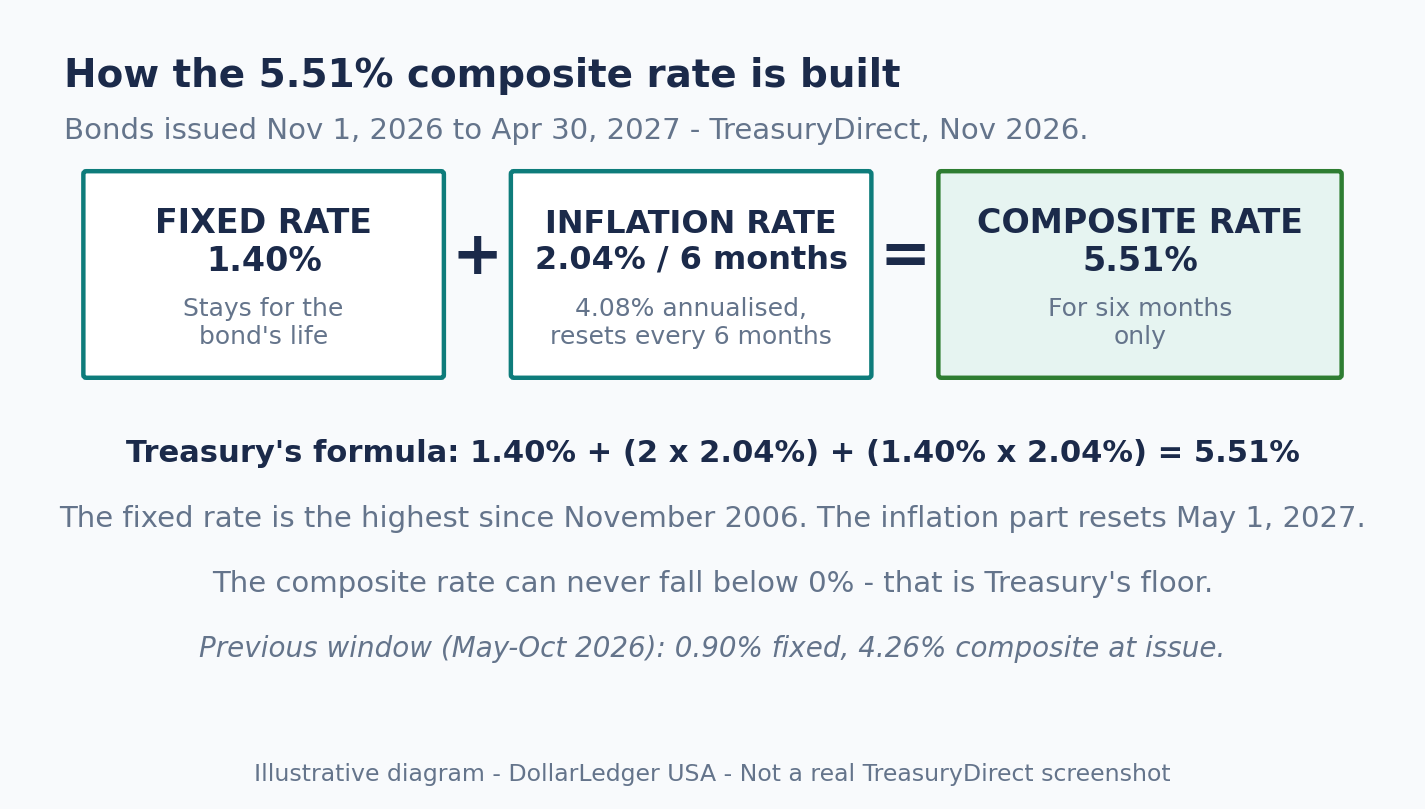
Illustrative diagram - How the 5.51% composite rate is built from its two parts. NOT a real TreasuryDirect screenshot.
Photo: $10,000 in I bonds grows to about $10,276 in the first six months — before tax. (Photo: Pexels)
Step 3: Know the limits and the lock-up
What to do: Check the purchase cap and the holding rules before you move any money.
How: I bonds cost from $25 up to $10,000 per person per calendar year, electronic only, through TreasuryDirect. The limit applies per Social Security Number, so a married couple can buy $10,000 each. You cannot cash in an I bond for the first 12 months at all. If you cash in before five years, you lose the last three months of interest. I bonds earn interest for up to 30 years. You pay no state or local tax on the interest; federal tax can be deferred until you cash in. Series EE bonds, the Treasury’s other savings bond, earn a fixed 2.90% in the same window and are guaranteed to double in 20 years.
Example: Tom buys $10,000 in November 2026. The earliest he can cash in is November 2027, and cashing in at 18 months keeps 15 months of interest.
Common mistake: Putting money you might need in the next 12 months into I bonds.
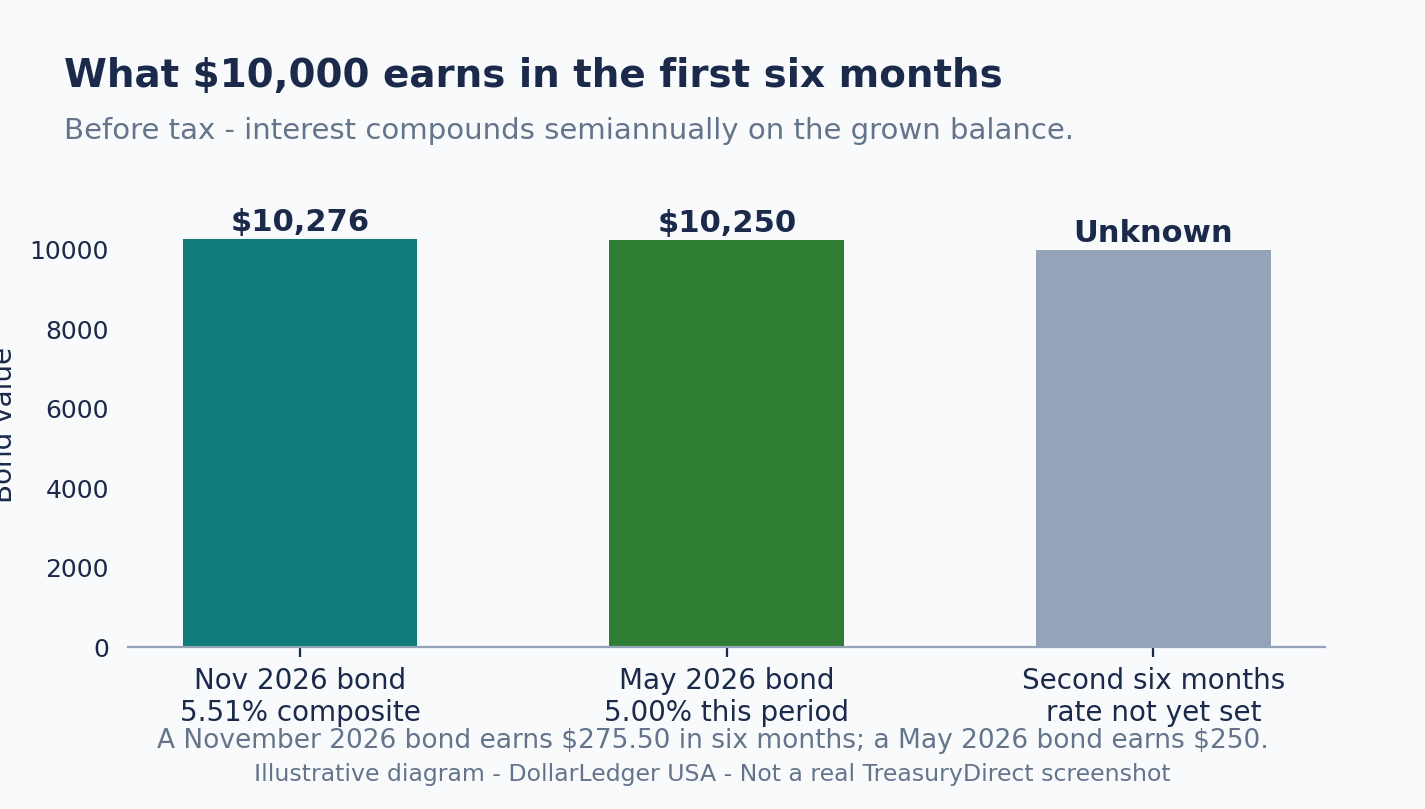
Illustrative diagram - What $10,000 earns in the first six months at the new rates. NOT a real TreasuryDirect screenshot.
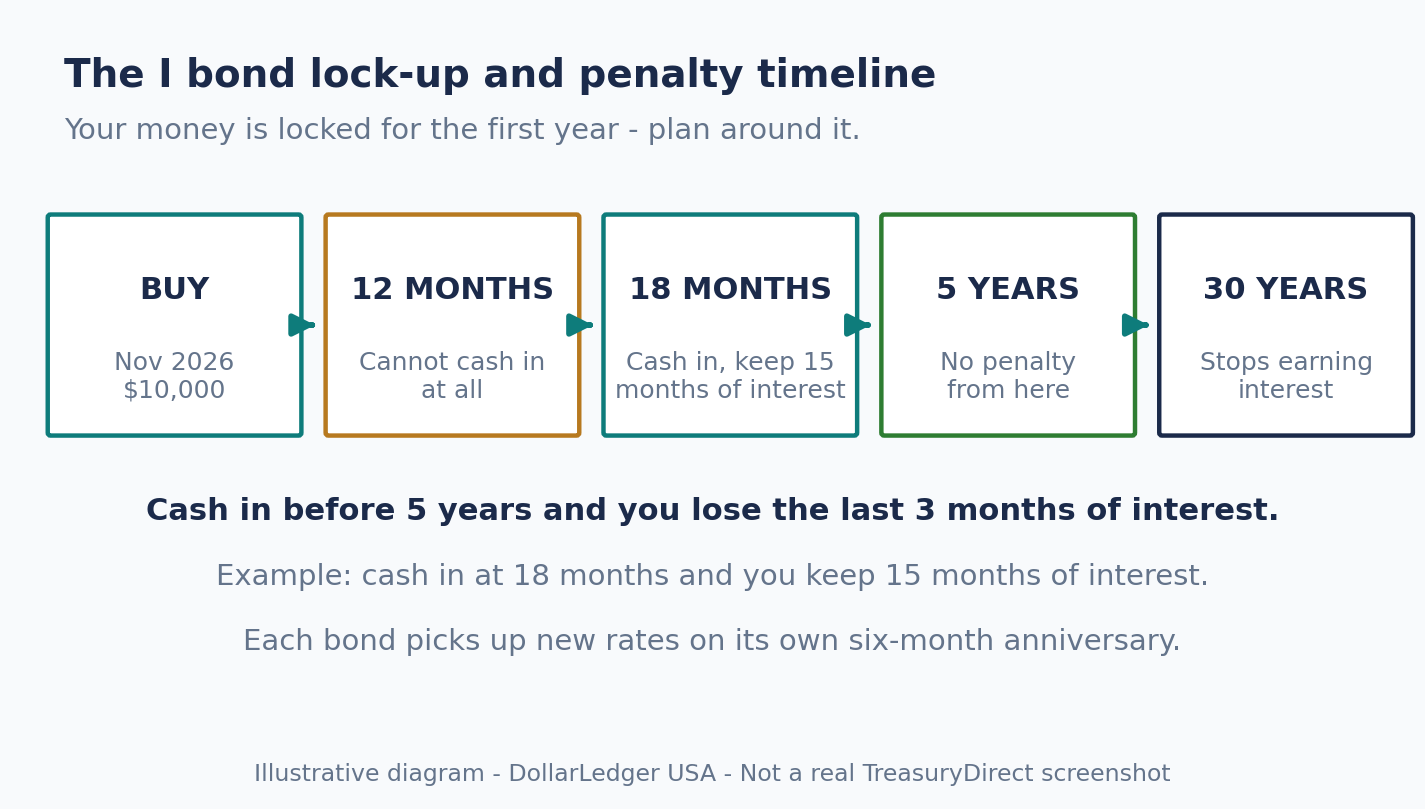
Illustrative diagram - The I bond lock-up and penalty timeline. NOT a real TreasuryDirect screenshot.
Step 4: Buy through TreasuryDirect
What to do: Open a TreasuryDirect account and buy before April 30, 2027 to lock in the 1.40% fixed rate.
How: I bonds are sold only through TreasuryDirect, the Treasury’s own site — no bank or broker sells them. Set up your account first — since October 28, 2026, TreasuryDirect logins require ID.me verification (reported). Buy near the end of the month: I bonds earn interest from the first day of the month you buy them, so a November 28 purchase still earns all of November. Buy before April 30, 2027 to get the 1.40% fixed rate; bonds bought from May 1, 2027 get whatever fixed rate Treasury sets that day, which could be lower.
Example: Alex opens a TreasuryDirect account in mid-November and buys $10,000 on November 27. His bond is dated November 1 and carries the 1.40% fixed rate for life.
Common mistake: Waiting until May and missing the 1.40% fixed rate.
Photo: Compare the whole deal — rate, access, tax and limits — not just the headline number. (Photo: Pexels)
Step 5: Compare with a savings account and a CD
What to do: Judge the I bond on access, tax and inflation protection, not on the headline rate alone.
How: A high-yield savings account pays a variable rate that can fall at any time, but your money is available the same day and there is no yearly cap — it is the right home for an emergency fund. See our guide to the best high-yield savings accounts in the USA in 2026. A CD locks your rate for a fixed term, but early cash-in costs a penalty and its rate does not rise with inflation. See our guide to the best CD rates in 2026. An I bond is different: its 1.40% fixed rate is a real return above inflation, locked for life, with no state or local tax and federal tax deferred until you cash in. The price is a $10,000 yearly cap and a 12-month lock-up.
Example: Priya keeps $10,000 in a high-yield savings account as her emergency fund, and puts a separate $10,000 she will not need for two years into I bonds.
Common mistake: Moving your emergency fund into I bonds, then needing the cash in month six and finding it locked.
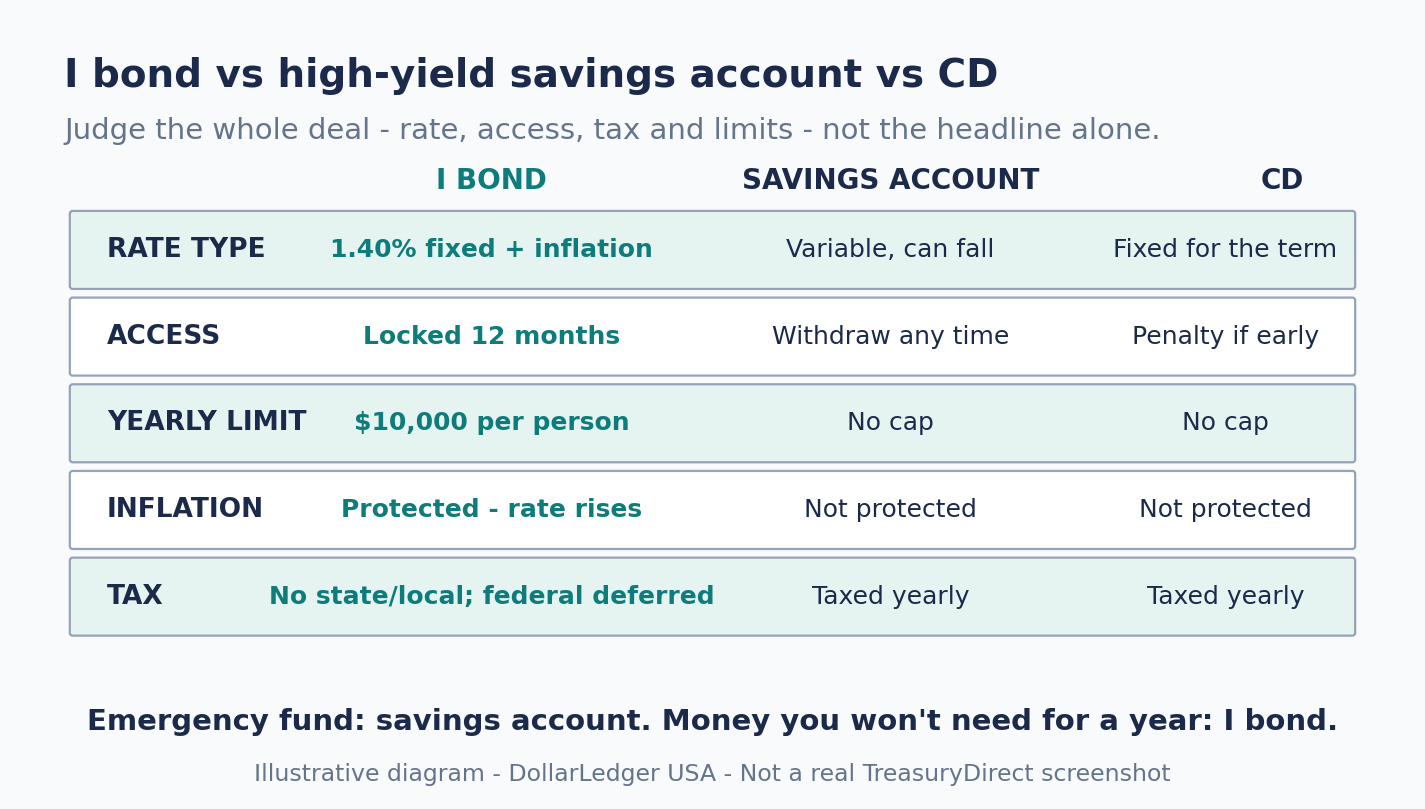
Illustrative diagram - I bond vs savings account vs CD at a glance. NOT a real TreasuryDirect screenshot.
Step 6: Decide whether I bonds fit your plan
What to do: Buy I bonds only for money you will not need for at least a year, and only up to the $10,000 cap.
How: I bonds fit money you are saving for a goal one to five years away, or long-term savings you want protected from inflation — the 1.40% fixed rate means your money should beat inflation by that much for the bond’s life. They also fit education savings: used for qualified higher education expenses, the earnings may be federal-tax-free, subject to income limits. They do not fit an emergency fund, a house down payment due in six months, or any amount above $10,000 a year — the cap means a $50,000 saver moves only $10,000 a year in.
Common mistake: Buying the maximum with no plan for the 12 locked months.
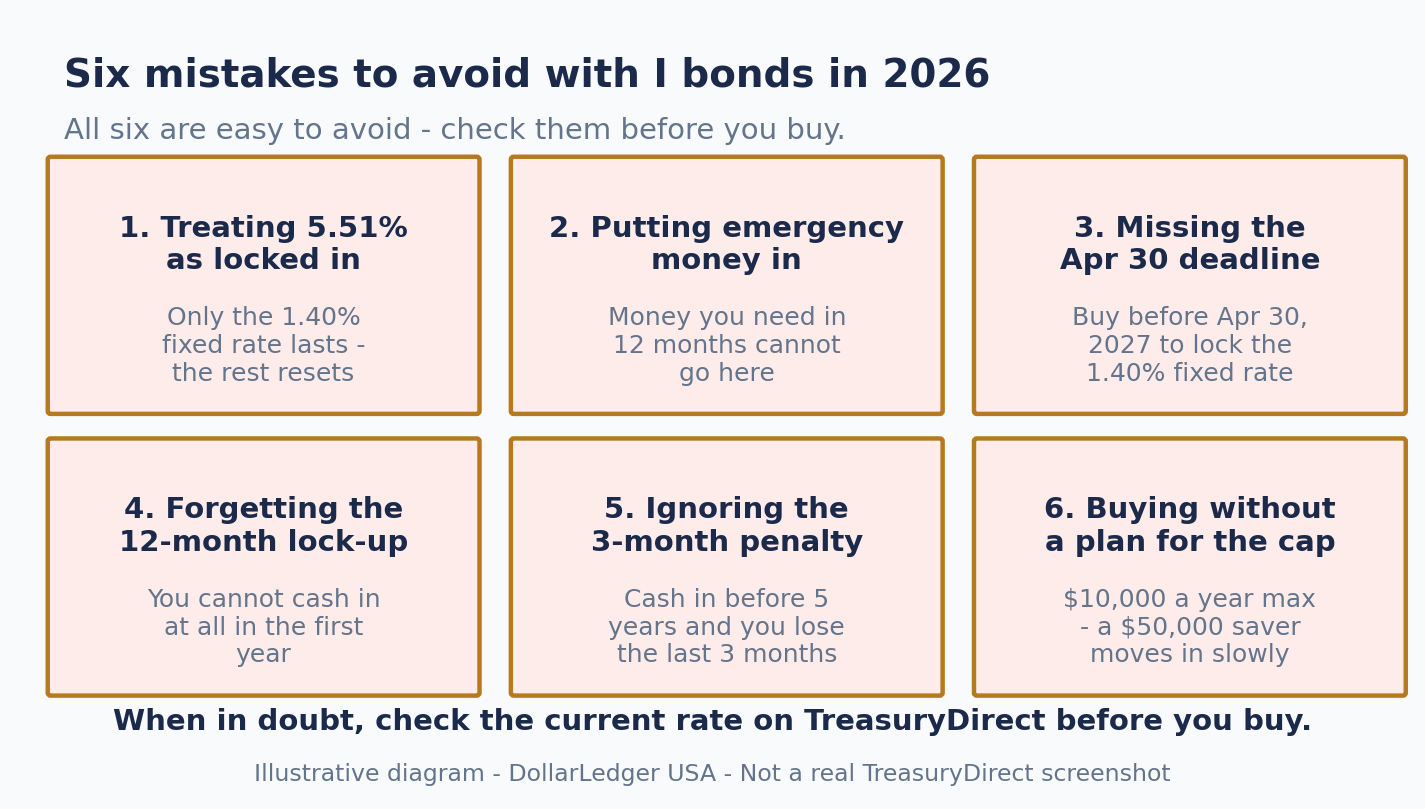
Illustrative diagram - Six mistakes to avoid with I bonds in 2026. NOT a real TreasuryDirect screenshot.
Checklist
- Only the 1.40% fixed rate is permanent; 5.51% lasts six months.
- $10,000 earns about $10,276 in six months, before tax.
- My money will not be needed for at least 12 months.
- TreasuryDirect account set up before I buy.
- Buy before April 30, 2027 to lock in the 1.40% fixed rate.
- My emergency fund stays in a savings account, not in I bonds.
FAQ
What is the I bond rate right now?
I bonds issued November 1, 2026 to April 30, 2027 earn a 5.51% composite rate for their first six months: a 1.40% fixed rate plus a 2.04% semiannual inflation rate. The next rates are announced May 1, 2027.
Does the 5.51% rate last?
No. Only the 1.40% fixed rate is permanent. The inflation part resets every six months on each bond’s own anniversary, and the composite rate never falls below 0%.
Can I cash in my I bonds after a year?
Yes, after 12 months. Cash in before five years and you lose the last three months of interest; after five years there is no penalty, and the bond earns for up to 30 years.
How much can I buy in I bonds each year?
Up to $10,000 per person per calendar year through TreasuryDirect, from $25.
Are I bonds better than a savings account?
For money you will not need for at least a year, yes — 1.40% above inflation, locked for life, with no state or local tax. For an emergency fund, no — a savings account lets you withdraw the same day.
Sources
- TreasuryDirect, I bonds interest rates (live, Nov 11, 2026): https://www.treasurydirect.gov/savings-bonds/i-bonds/i-bonds-interest-rates/
- TreasuryDirect, I bonds — purchase limits, redemption rules and taxes (live, Nov 11, 2026): https://www.treasurydirect.gov/savings-bonds/i-bonds/
- U.S. Treasury, Fiscal Service Announces New Savings Bonds Rates (Nov 2, 2026): https://acc.treasurydirect.gov/news/2026/release-11-01-rates/
All figures checked November 11, 2026, against TreasuryDirect.
Disclaimer: For education only, not tax or investment advice. I bond rates, limits and tax rules change; check TreasuryDirect before you buy.