How I Saved $1,000 in 30 Days in USA — Real Breakdown
 DollarLedger Team
- 03 Nov, 2026
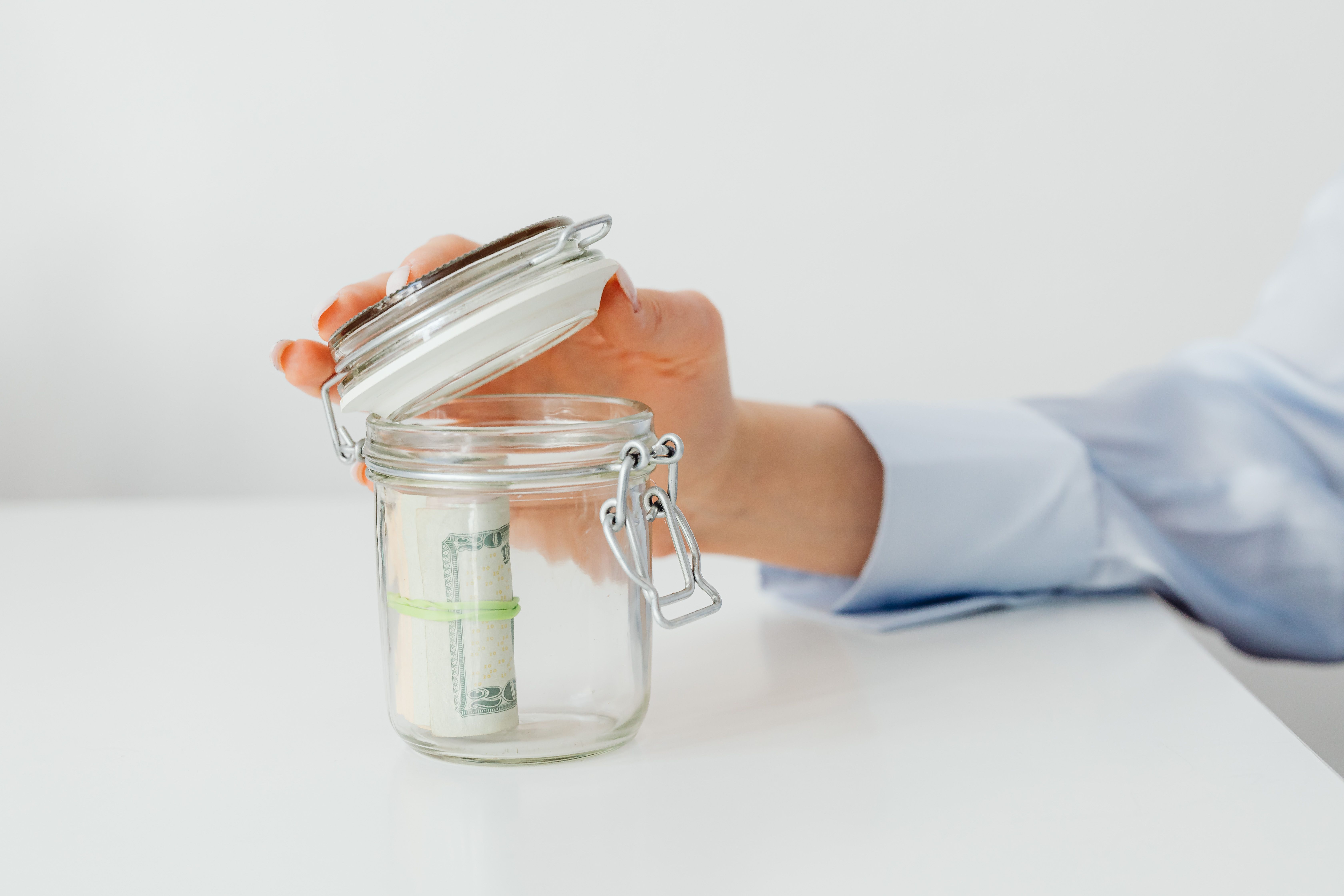
Saving $1,000 in 30 days sounds impossible on a normal salary. It is not — if you break it into small pieces and write the math down. This guide shows a worked example, not a real person’s story. Meet Sara, a made-up example: 28, rents an apartment, takes home $3,200 a month after tax. In 30 days she saves $1,000 — $710 from spending cuts and $290 from extra income. Copy the steps with your own numbers.
Photo: A savings jar is a good start — a written plan fills it in 30 days. (Photo: Pexels)
What You Will Learn
- How $1,000 in 30 days breaks into $250 a week
- How to audit one month of spending
- The seven cuts that add to exactly $1,000
- How to earn $290 extra in a month without a second job
- Where to keep the $1,000
Step 1: Set the weekly number — $250 a week
What to do: Turn the big goal into a small weekly target.
How: Divide $1,000 by 4 weeks: $250 a week. Sara is paid every two weeks, so she moves $500 from each paycheck. A weekly target works because one bad day costs $20, not the whole month.
Example: Sara writes “$250 a week” on a sticky note on her fridge. Week 1 she saves $260, week 2 $240 — still on track, because the target is weekly, not daily.
Common mistake: Never dividing the goal up. “1,000 in a month” feels huge; “250 this week” is the same goal, and it feels doable.
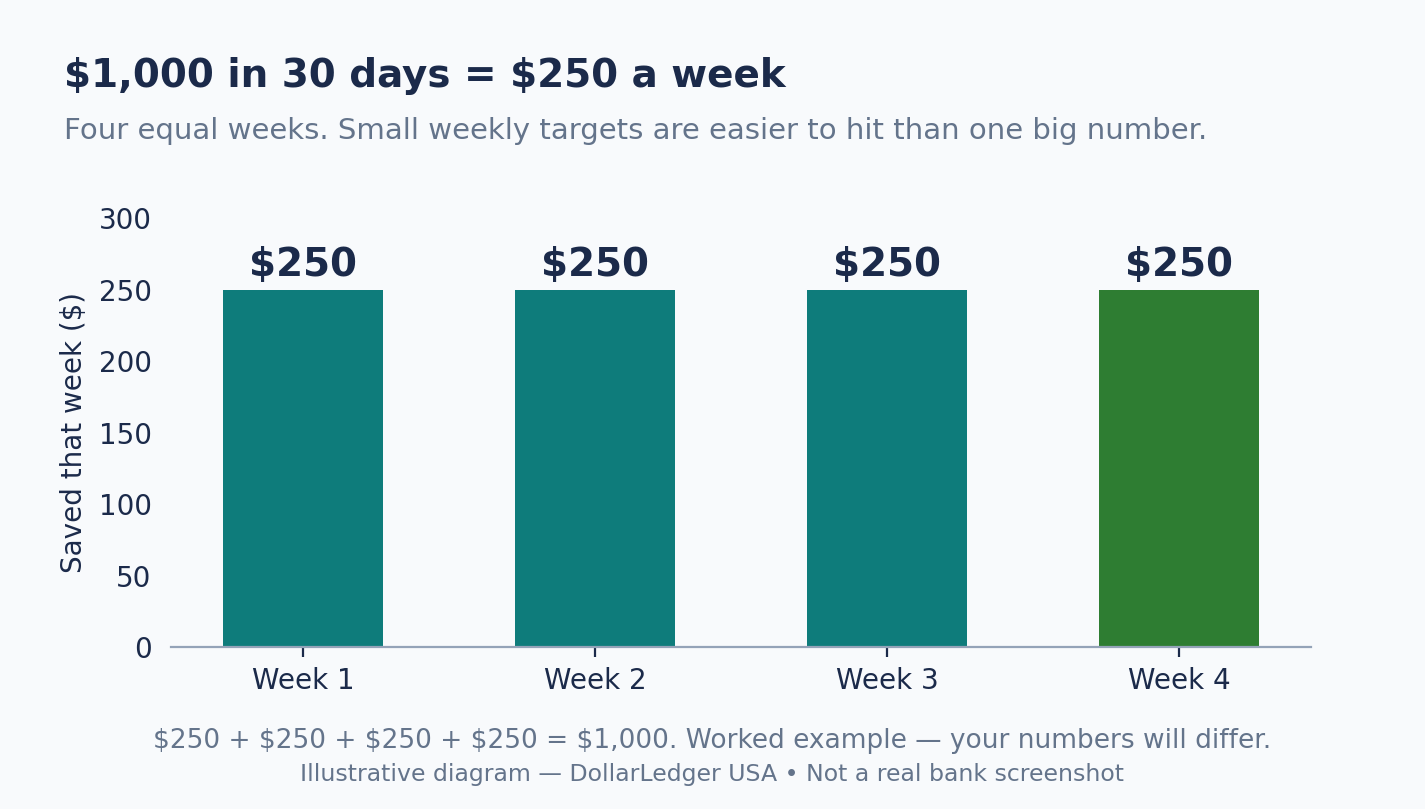
Illustrative diagram — $250 a week, four weeks, $1,000. NOT a real bank screenshot.
Step 2: Audit one month of spending and find the money
What to do: Before you cut anything, see where last month’s money went.
How: Open your bank app and sort last month’s spending into two lists: fixed costs (rent, utilities, car, phone, insurance) and flexible spending (food, fun, subscriptions, rides). The Consumer Financial Protection Bureau suggests the same first move: track spending before you budget.
Example: Fixed costs, $1,625 a month: rent $1,100, utilities $140, car $220, phone $55, insurance $110. Flexible spending, $1,385: groceries $480, eating out $320, coffee and snacks $140, subscriptions $95, shopping and fun $220, rideshare and delivery $130. Total: $3,010 out of $3,200 take-home pay. The $1,000 comes from that $1,385, plus a little extra income.
Common mistake: Trying to cut fixed costs. Rent and the car payment cannot change this month — the flexible $1,385 is where the money hides.
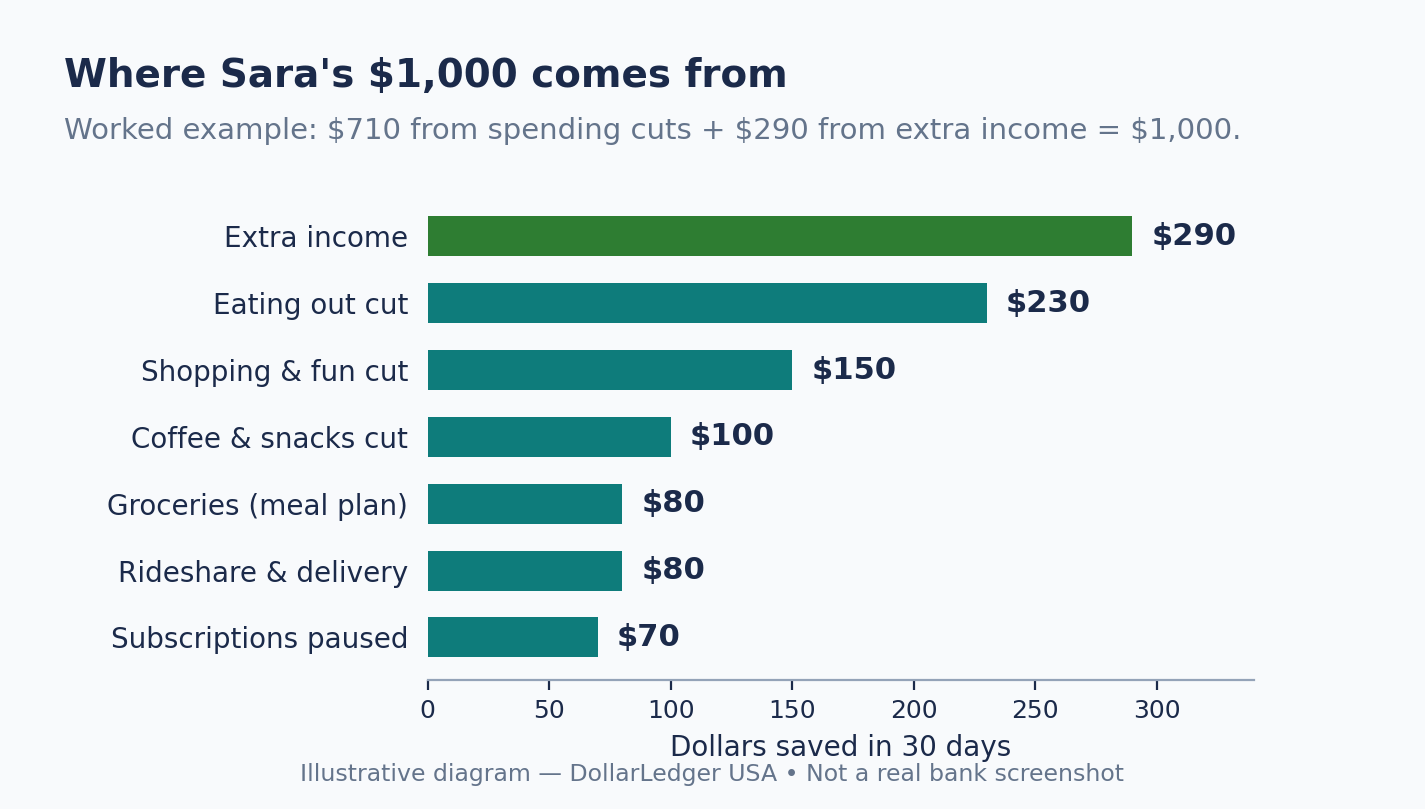
Illustrative diagram — $710 in cuts plus $290 extra income equals $1,000. NOT a real bank screenshot.
Step 3: Cook at home — the biggest single cut
What to do: Cut eating out first: the biggest flexible cost, and the easiest to replace.
How: Sara spent $320 a month eating out — about four restaurant meals a week. For 30 days she eats out once a week and cooks the rest: five simple dinners, one weekly shop with a list, store brands. Her grocery bill drops from $480 to $400, because planned shopping wastes less food.
Example: Eating out falls from $320 to $90 (saves $230); groceries from $480 to $400 (saves $80). Together: $310 — almost a third of the $1,000.
Common mistake: Cooking every meal from scratch on day one and quitting by Wednesday. Cook five simple dinners, repeat them, keep one takeout night a week.
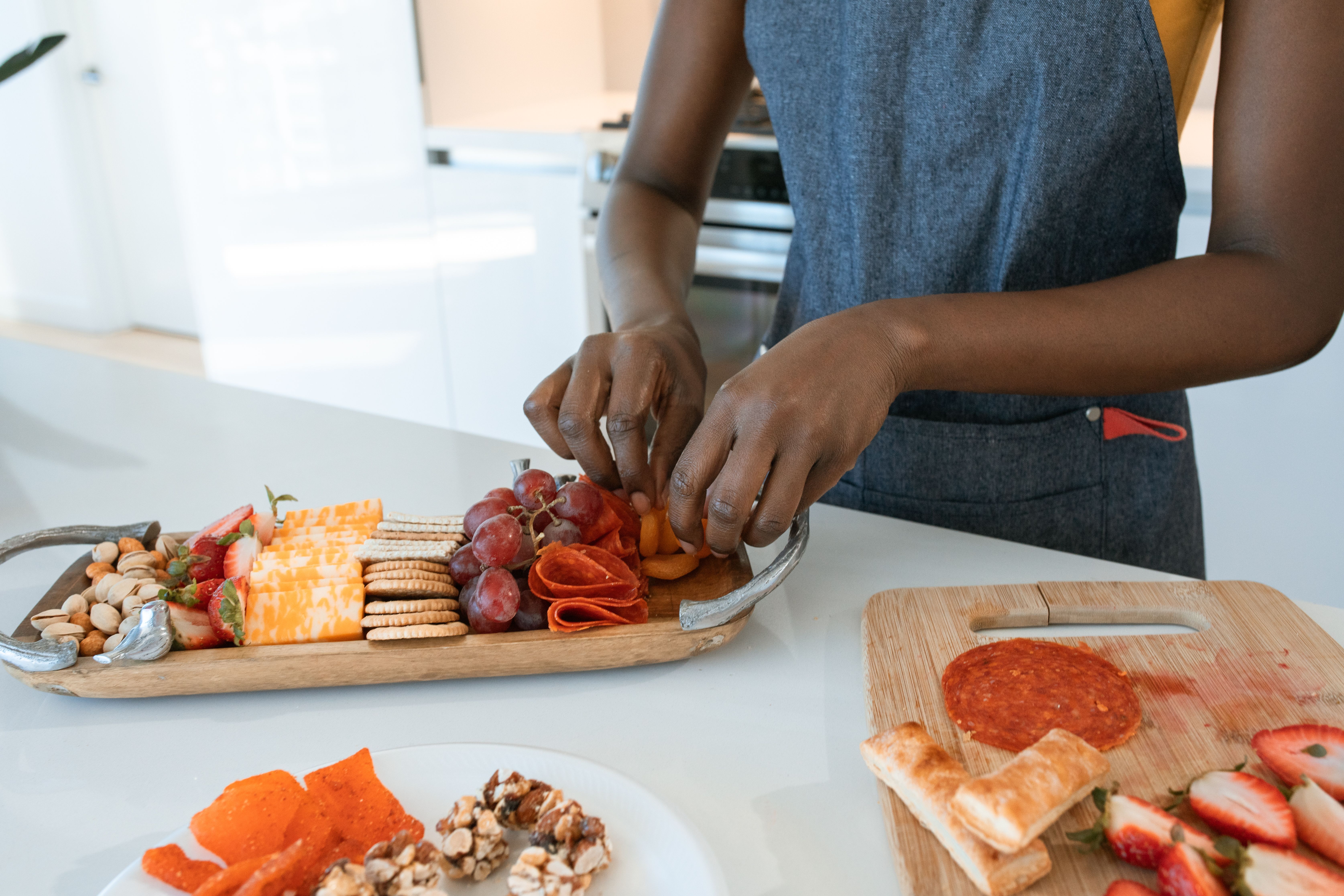
Photo: Cooking at home is the biggest single cut — $310 of the $1,000. (Photo: Pexels)
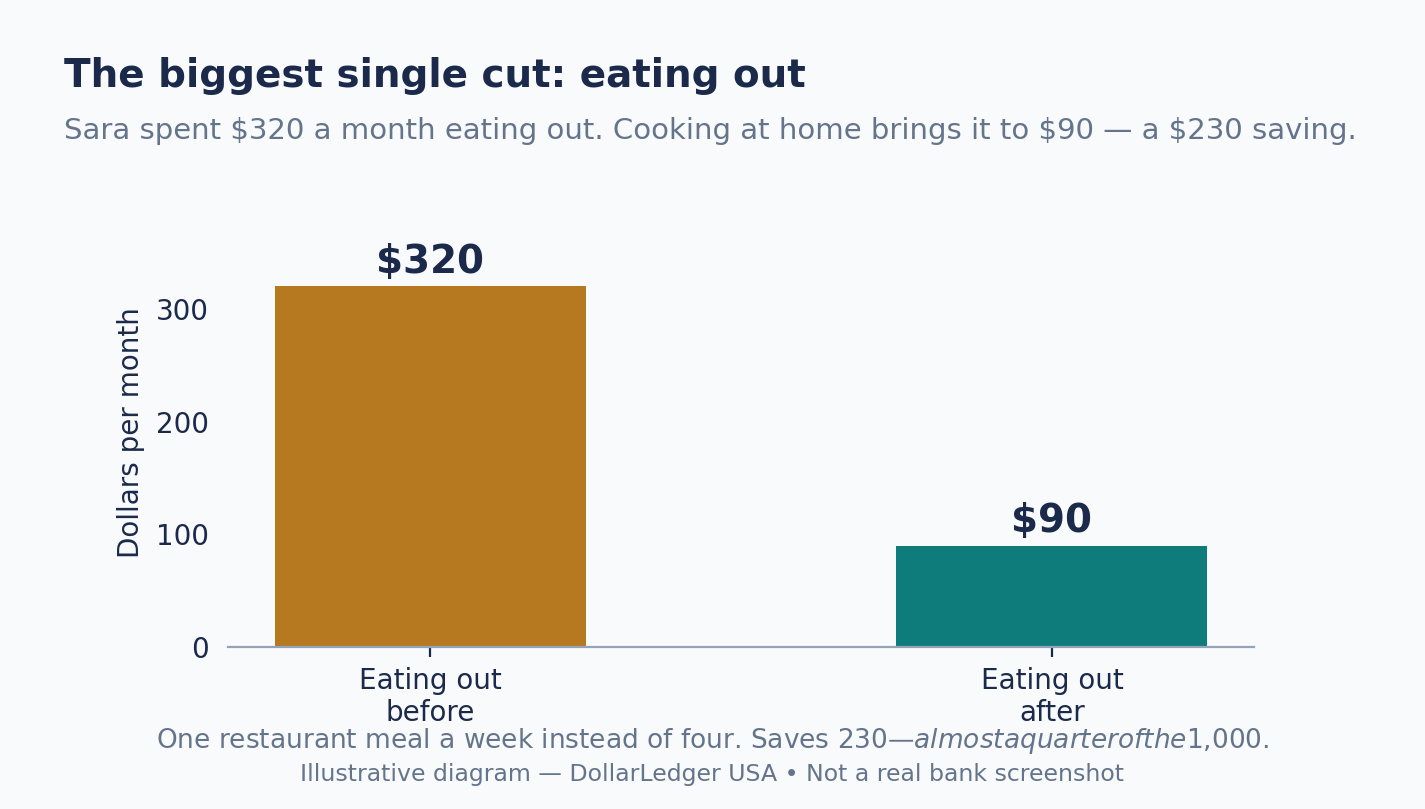
Illustrative diagram — Eating out: $320 down to $90. NOT a real bank screenshot.
Step 4: Pause the small leaks — subscriptions, coffee, shopping, rides
What to do: Cut the four smaller leaks: small alone, $400 together.
How: Subscriptions: $95 to $25 (saves $70). Coffee at home: $140 to $40 (saves $100). Fun shopping capped at $70, not $220 (saves $150). Walking short trips, no delivery fees: $130 to $50 (saves $80). None of this is forever — it is 30 days.
Example: $70 + $100 + $150 + $80 = $400. With Step 3’s $310, cuts total $710. Spending falls from $3,010 to $2,300, with $190 of slack left.
Common mistake: Cancelling a subscription you will just rejoin next month. Pause it instead, where the app allows it, and set a reminder for the day the pause ends.
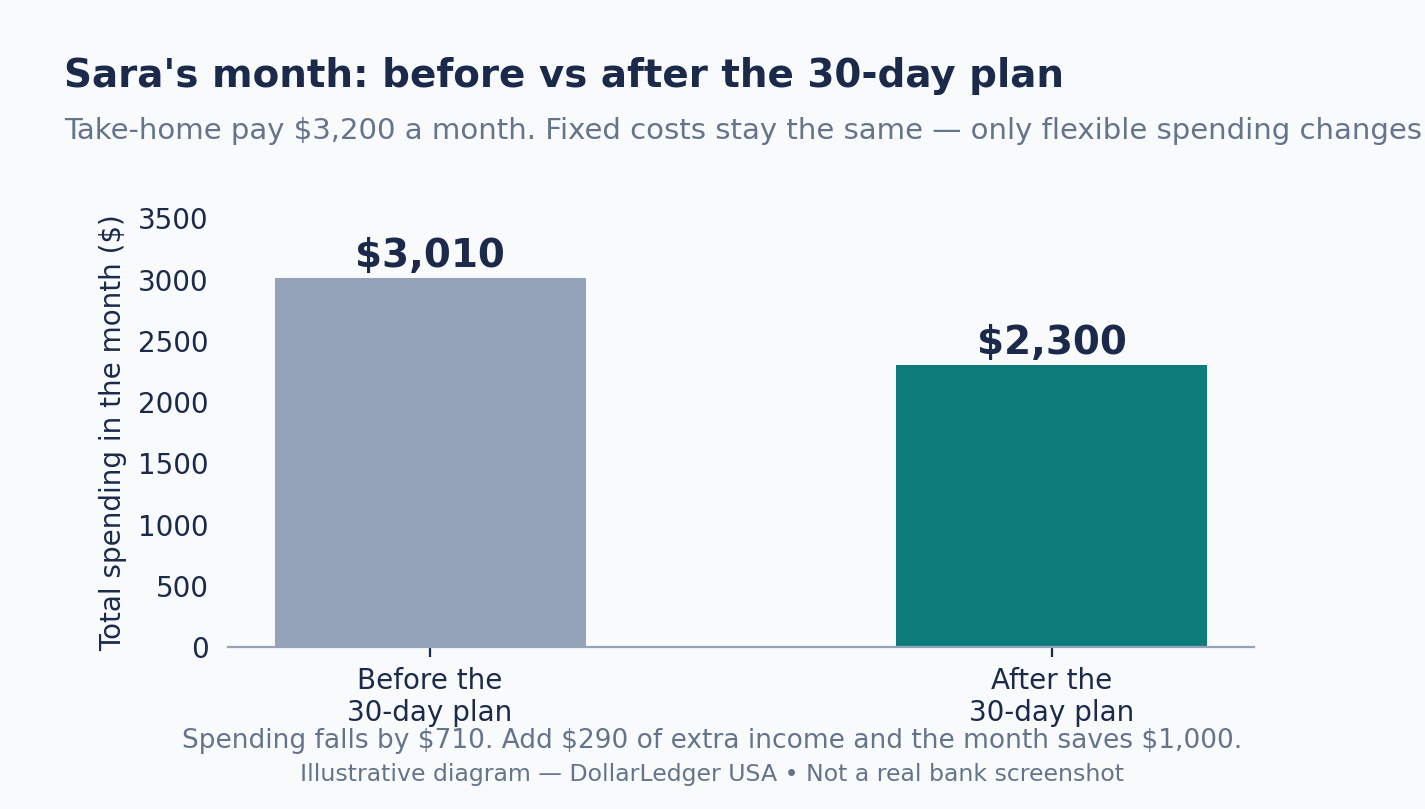
Illustrative diagram — Spending falls by $710 in one month. NOT a real bank screenshot.
Step 5: Add $290 of extra income and move the money on payday
What to do: Cuts alone give Sara $710. She earns the other $290, then moves the money before she can spend it.
How: Sara sells three unused things — old phone $90, bike $50, clothes $30 — $170. One Saturday helping a neighbour move and gig work earns $120. Total: $290. Then the key move: on each payday she transfers $500 to a separate savings account the same day the pay arrives.
Example: $710 in cuts plus $290 in extra income is exactly $1,000. Sara’s two paychecks are $1,600 each: $500 moves to savings on payday, $1,100 stays for bills and spending.
Common mistake: Waiting until month-end to “save what is left.” There is never anything left. Pay yourself first — move the money on payday.
Photo: Every dollar moved on payday is a dollar that cannot be spent by accident. (Photo: Pexels)
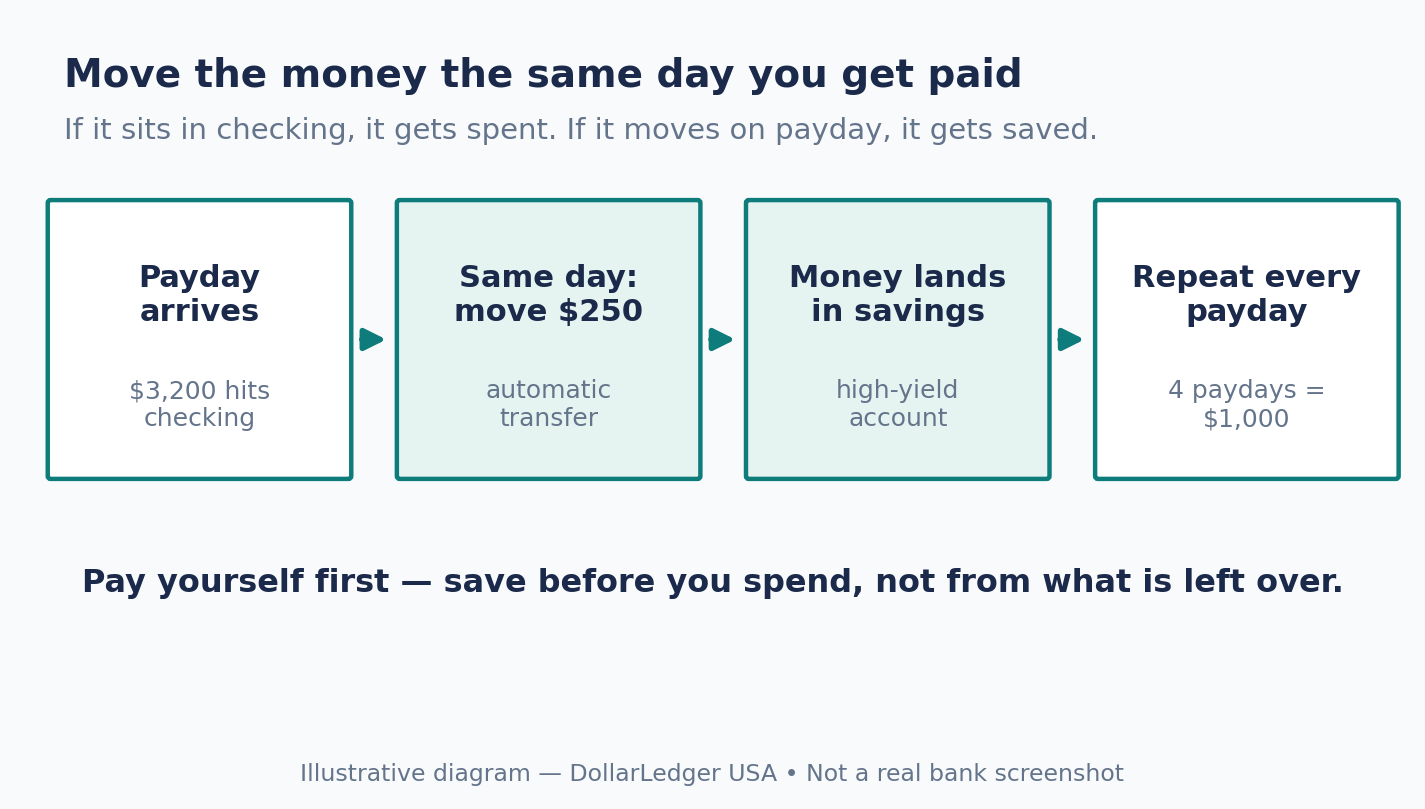
Illustrative diagram — Move the money the same day you get paid. NOT a real bank screenshot.
Step 6: Day 30 — count it, park it where it earns, and keep going
What to do: On day 30, count the money and move it somewhere it earns interest.
How: Sara checks her savings account: $1,000. She moves it into a high-yield account paying around 4.40% APY, where it earns about $44 in a year. At the national average of 0.38% APY it earns about $3.80. Same money, same safety, about $40 more a year.
Example: Compare current rates in our guide to the best high-yield savings accounts in the USA for 2026, and read how a high-yield savings account works if the idea is new to you.
Common mistake: Leaving the $1,000 in checking and slowly spending it. Move it the day you count it.
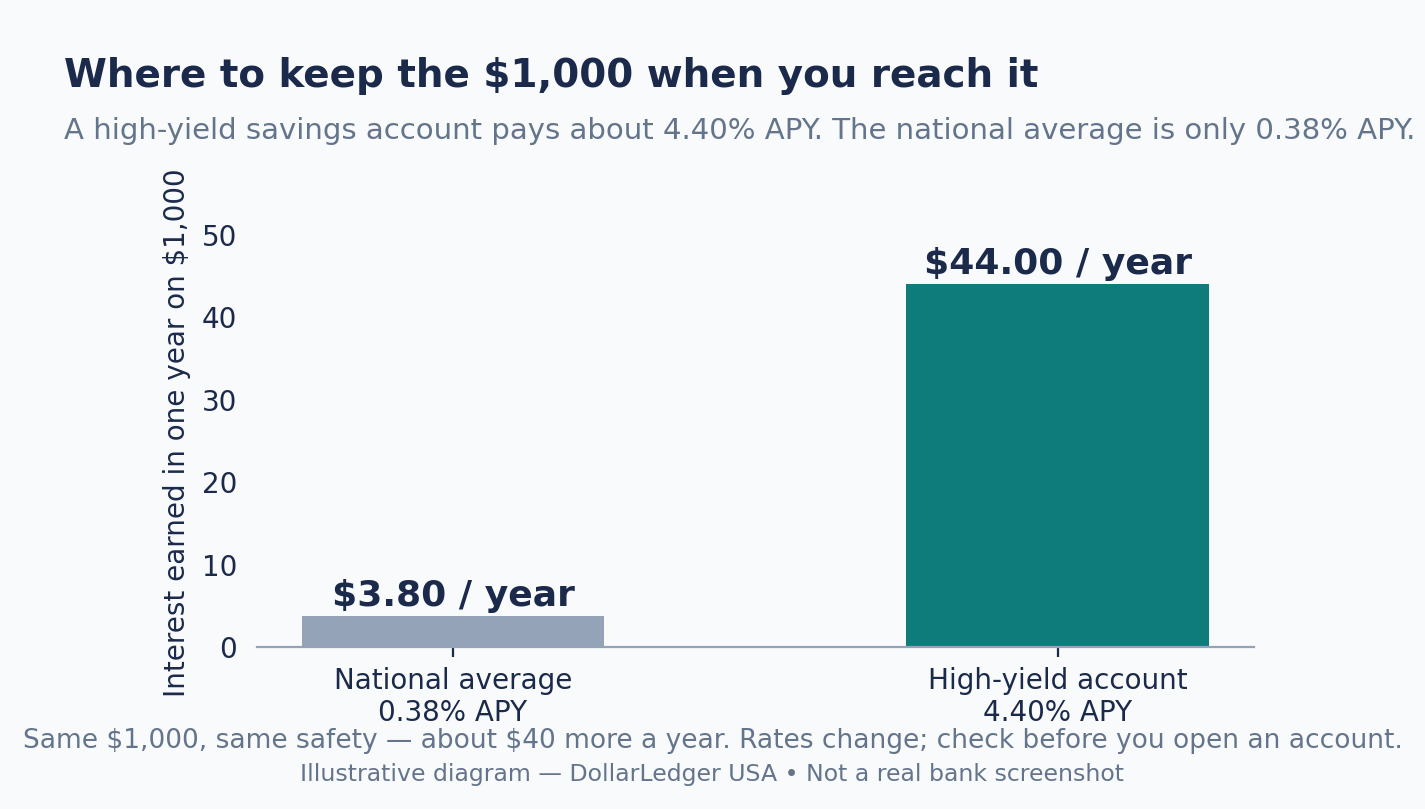
Illustrative diagram — Same $1,000, about $40 more a year. NOT a real bank screenshot.
Checklist
- I wrote down my weekly target: $250 a week.
- I audited last month: fixed costs vs flexible spending.
- I listed my cuts with dollar amounts.
- I set up a payday transfer so the money moves first.
- I found my extra income: items to sell or hours of work.
- On day 30, I counted the money and moved it to a high-yield account.
FAQ
Is saving $1,000 in 30 days realistic on a $3,200 monthly income? Yes — $710 from cutting flexible spending, $290 from extra income, not from skipping rent or bills. On a lower income, allow more time: $500 in 30 days, or $1,000 in 60 days.
Do I have to cut everything fun for a whole month? No. Sara keeps one streaming service, one takeout night a week, and a $70 fun-shopping limit. Cutting everything usually ends in a blowout weekend.
What if I cannot earn extra income this month? Save what the cuts alone give you — $710 here — and call that the win. Or stretch the plan to 45 days.
Should I pay off debt before saving $1,000? Paying down high-interest debt, such as a credit card, usually saves you more than a savings account earns. Many people do both: save a $500 starter cushion first, then attack the debt.
Where should I keep the $1,000? In a separate high-yield savings account, away from everyday checking. At around 4.40% APY it earns about $44 a year, versus about $3.80 at the 0.38% national average. Confirm the bank is FDIC-insured.
Sources
- Consumer Financial Protection Bureau, “Budgeting: How to create a budget and stick with it”: https://www.consumerfinance.gov/archive/blog/budgeting-how-to-create-a-budget-and-stick-with-it/
- Motley Fool, “Best High-Yield Savings Accounts Today, Nov. 2, 2026” — 4.40% APY top rate, 0.38% national average: https://www.fool.com/money/banks/articles/top-savings-account-rates-today-nov-2-2026/
- FDIC, Deposit Insurance at a Glance — $250,000 per depositor, per bank: https://www.fdic.gov/consumer-resource-center/deposit-insurance-glance
- DollarLedger USA, Best High-Yield Savings Accounts in USA 2026: </blog/best-high-yield-savings-accounts-in-usa>
Rates checked November 2, 2026; they change — confirm the current rate with the bank. The Sara example uses made-up numbers.
Disclaimer: This article is for education only, not financial advice. Confirm the current rate with the bank before opening an account.