How to Budget on a Low Income in USA: 50/30/20 Rule Explained
 DollarLedger Team
- 03 Nov, 2026

Budgeting on a low income feels impossible when money runs out before the month does. The problem is usually not that you are bad with money — nobody gave you a simple plan. The 50/30/20 rule is that plan: 50% of take-home pay for needs, 30% for wants, 20% for savings and extra debt payments. This guide explains it in plain English, works it out on a real paycheck, and shows how to adapt it when 50% for needs is not enough — which, on a low income, it often is not.
Photo: A budget starts with a notebook and one honest month of spending. (Photo: Pexels)
What You Will Learn
- What the 50/30/20 rule is, and where it comes from
- How to sort your spending into needs, wants, and savings
- A worked example on $2,800 take-home
- How to adapt it to 60/25/15 when money is tight
- A low-income example on $2,200 a month, and a routine to keep it going
Step 1: Understand the three buckets
What to do: Learn the rule first.
How: The rule was popularised by Elizabeth Warren and Amelia Warren Tyagi in “All Your Worth” (2005). It is a rule of thumb, not a law, and it works on after-tax income — your take-home pay. The buckets: 50% needs, what you must pay to live and work; 30% wants, what makes life enjoyable; 20% savings and extra debt payments — emergency fund, retirement, payments above the minimums. Minimum debt payments count as needs.
Example: Maya takes home $2,800 a month: $1,400 needs, $840 wants, $560 savings. Every dollar has a job before the month starts.
Common mistake: Doing the maths on gross salary. On a $40,000 salary, gross pay is $3,333 a month — but take-home is about $2,860.
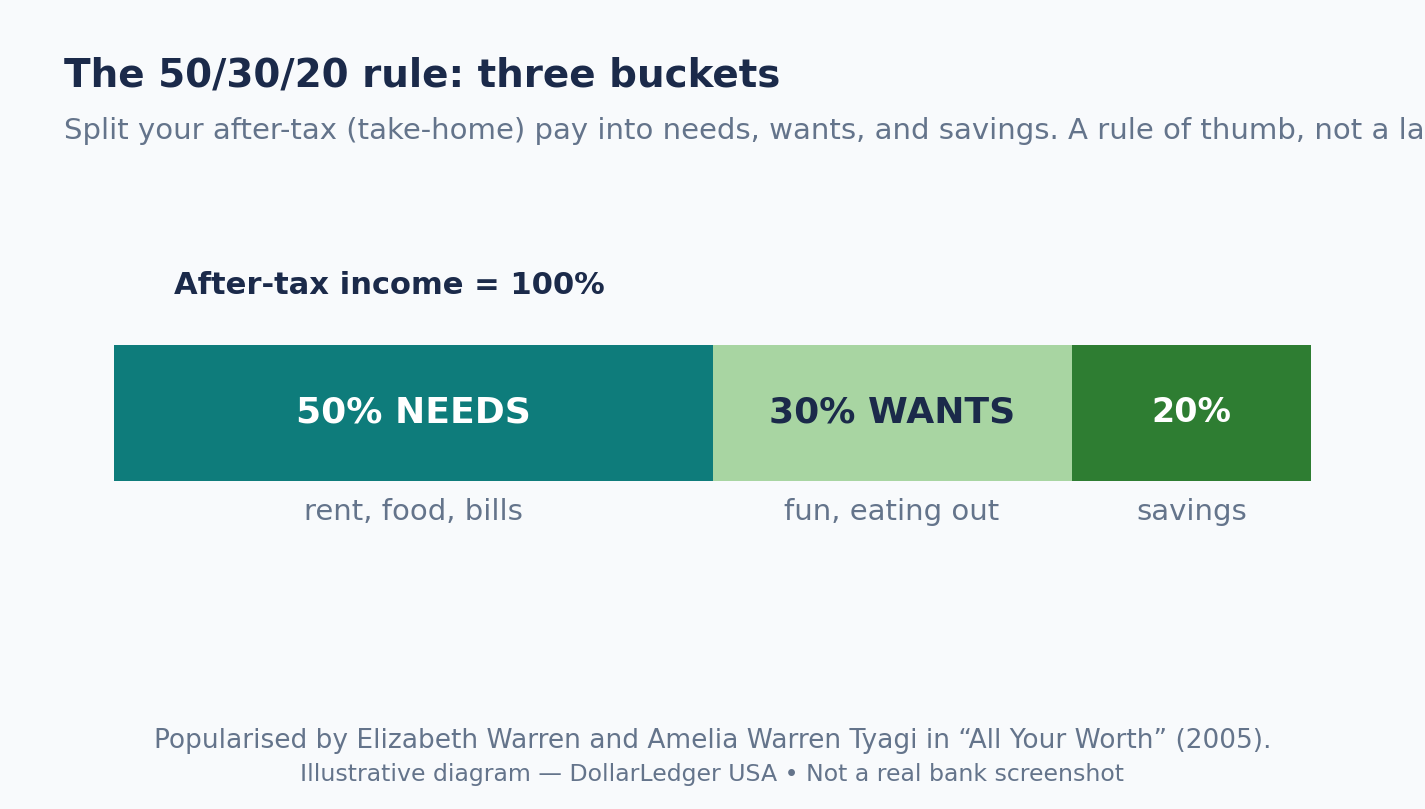
Illustrative diagram — The 50/30/20 rule: three buckets. NOT a real bank screenshot.
Step 2: Sort every expense into needs or wants
What to do: Take one real month of statements — not memory — and put every expense into a bucket.
How: Needs: rent, groceries, utilities, phone, transport, insurance, childcare, minimum debt payments. Wants: eating out, streaming, holidays, concerts, hobbies, gifts, extra clothes. Savings: emergency fund, retirement, extra debt payments. The tricky part: the same item can sit in either bucket — basic groceries are a need, lobster is a want.
Example: Maya’s statements show needs $1,800, wants $565, savings $350. Needs are 64% of her $2,800 take-home — needs are eating the savings bucket.
Common mistake: Calling everything a need. If you could pause it for three months without losing your home, your health, or your credit rating, it is a want.

Photo: Groceries are a need — a list keeps them in the needs bucket. (Photo: Pexels)
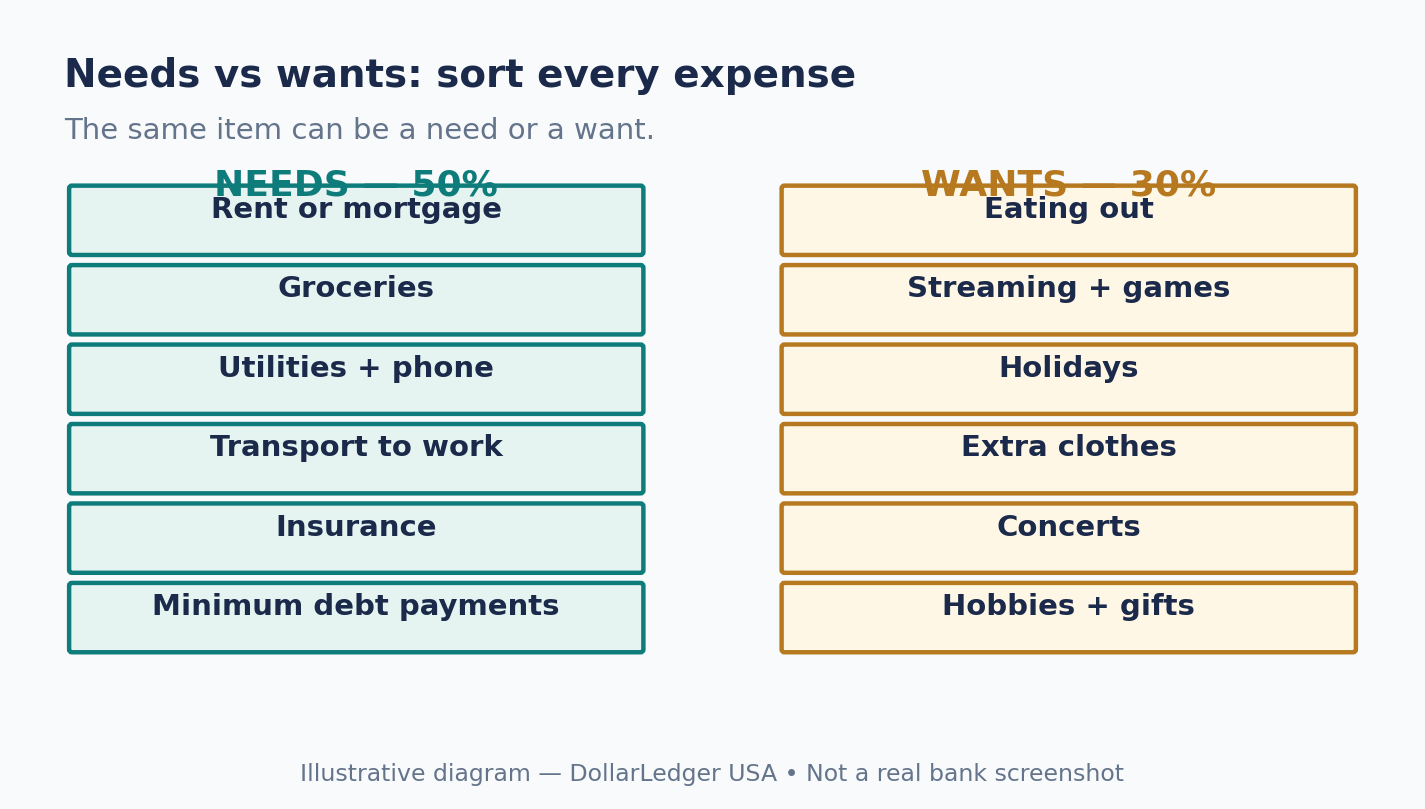
Illustrative diagram — Needs vs wants: sort every expense. NOT a real bank screenshot.
Step 3: Work the rule out on your own pay
What to do: Multiply your take-home pay by 50%, 30%, and 20%.
How: Start with monthly take-home pay. Paid every two weeks? Add up a full year and divide by 12 — two months a year have three paychecks. Then multiply: on $2,800, needs 50% ($1,400), wants 30% ($840), savings 20% ($560). Check: $1,400 + $840 + $560 = $2,800.
Example: Maya’s needs are $1,800 against a $1,400 limit — a $400 gap. Wants ($565) and savings ($350) are under their limits. Her fixed costs are too high, not her fun spending.
Common mistake: Forcing your spending to fit on day one. If your needs are over 50%, do not pretend otherwise — adapt the rule instead.
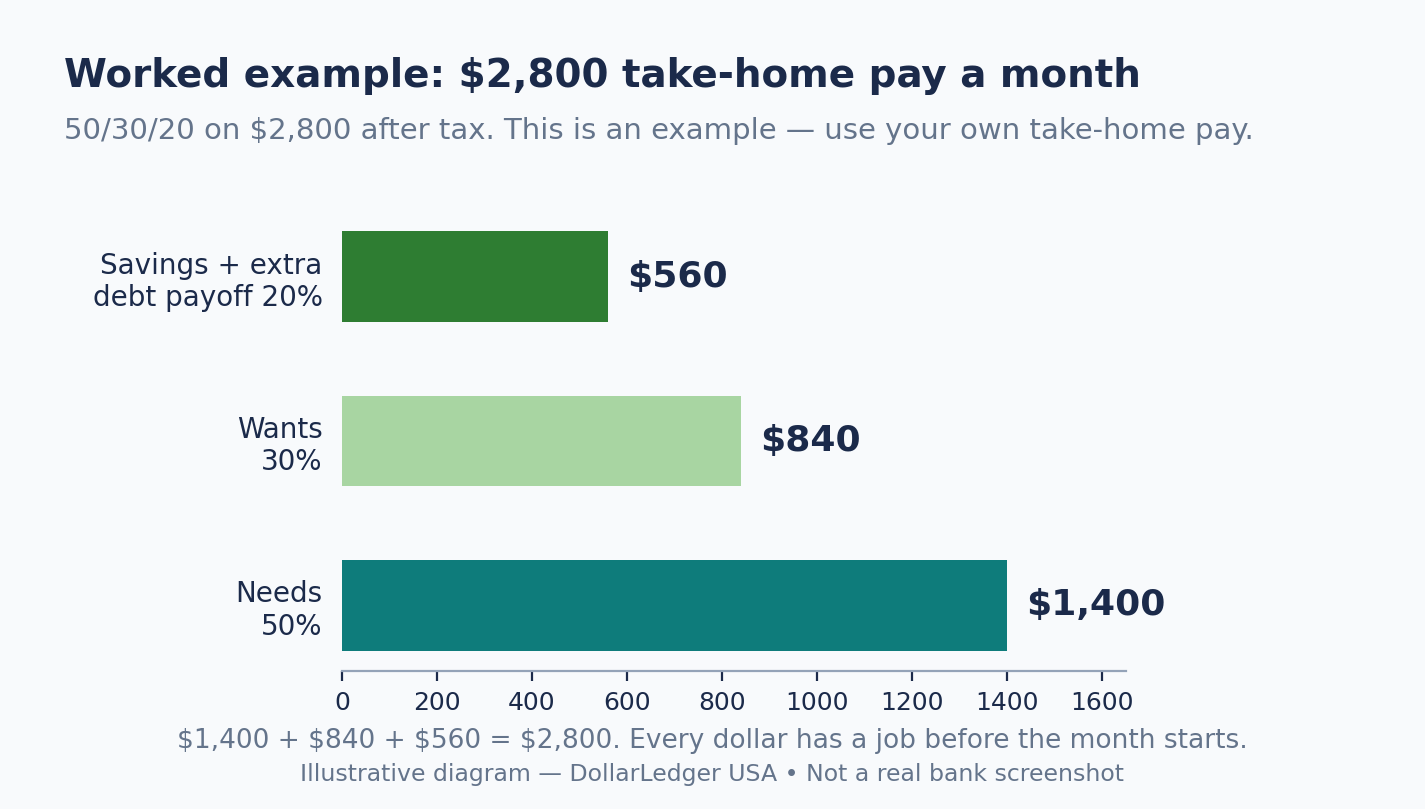
Illustrative diagram — Worked example: $2,800 a month. NOT a real bank screenshot.
Step 4: Adapt the rule when 50% is not enough
What to do: If your needs are over 50% of take-home pay, change the percentages — do not abandon the budget.
How: When rent and bills take more than half your pay, try 60/25/15: 60% needs, 25% wants, 15% savings. This is our adaptation — NerdWallet notes the percentages can be changed to fit. On $2,800: $1,680 needs, $700 wants, $420 savings. Smaller, but not zero — $420 a month still builds a $1,000 starter fund in under three months.
Example: Maya switches to 60/25/15. Her $1,800 of needs is above the $1,680 limit, but the gap is now $120. She drops one streaming service and cooks two more dinners a week, saving $110 — and the budget balances.
Common mistake: Keeping 50/30/20 numbers while your life needs 60/25/15. A budget you can keep beats a perfect budget you quit.

Photo: Thirty minutes with your statements shows where the money goes. (Photo: Pexels)
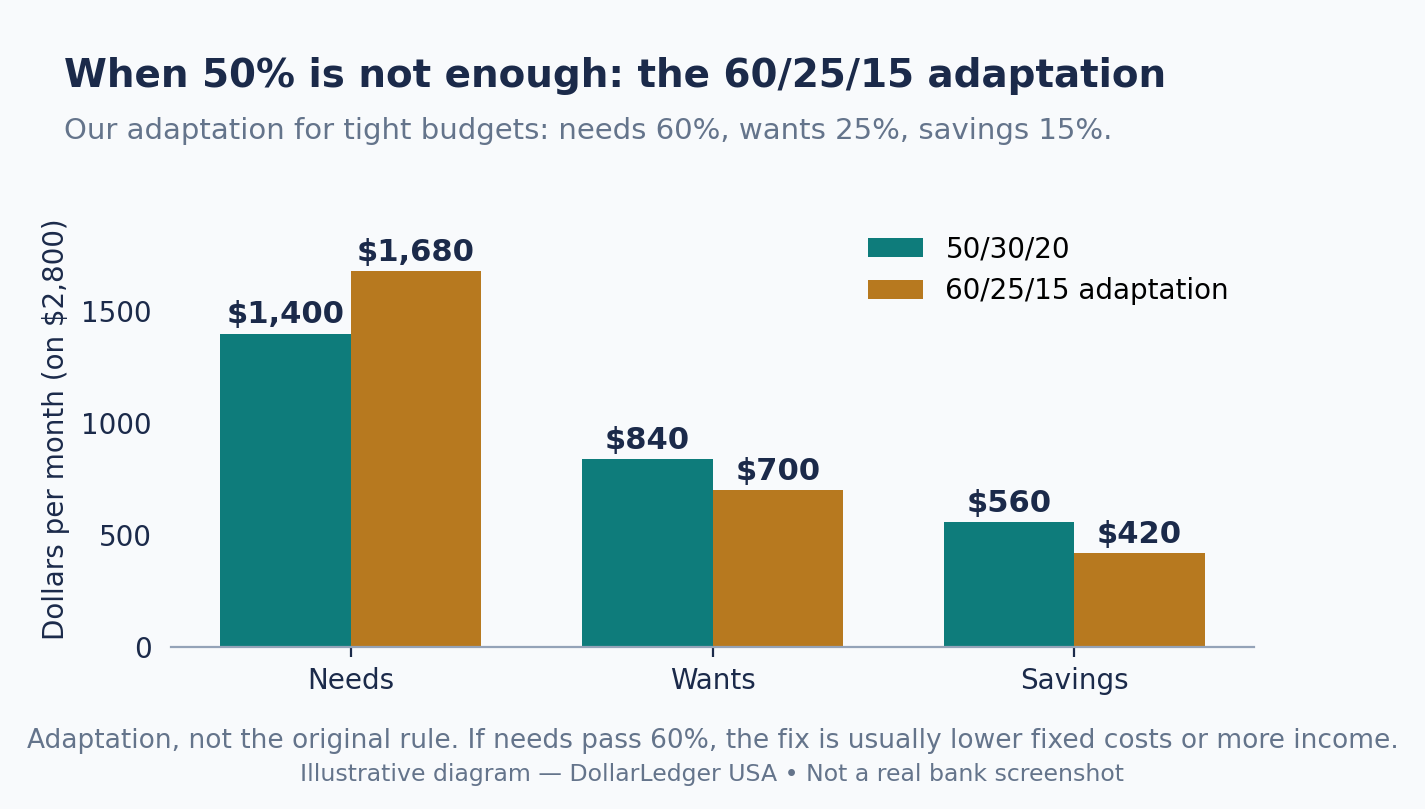
Illustrative diagram — The 60/25/15 adaptation for tight budgets. NOT a real bank screenshot.
Step 5: See it work on a lower income
What to do: Check the rule works on $2,200 take-home pay a month.
How: At 60/25/15 on $2,200 take-home pay: needs $1,320, wants $550, savings $330. That $330 builds a $1,000 starter emergency fund in about three months. After that, it can go to extra debt payments or toward three months of expenses — the CFPB and NerdWallet suggest three to six months. Our emergency fund guide works through those targets with real numbers. If $330 feels out of reach, check three common leaks: forgotten subscriptions, food delivery, bank fees.
Example: Jordan takes home $2,200 a month. Rent $800 with a roommate, groceries $300, utilities $110, transport $60, phone $50 — needs $1,320, exactly 60%. Wants are $550, savings are $330, and the first $1,000 goes to a high-yield savings account earning around 4% APY instead of 0.38%. Three months later, Jordan has a $1,000 cushion.
Common mistake: Skipping savings “until things get better.” Without a small fund, the next $300 surprise goes on a credit card. Save something, even $25 a week.
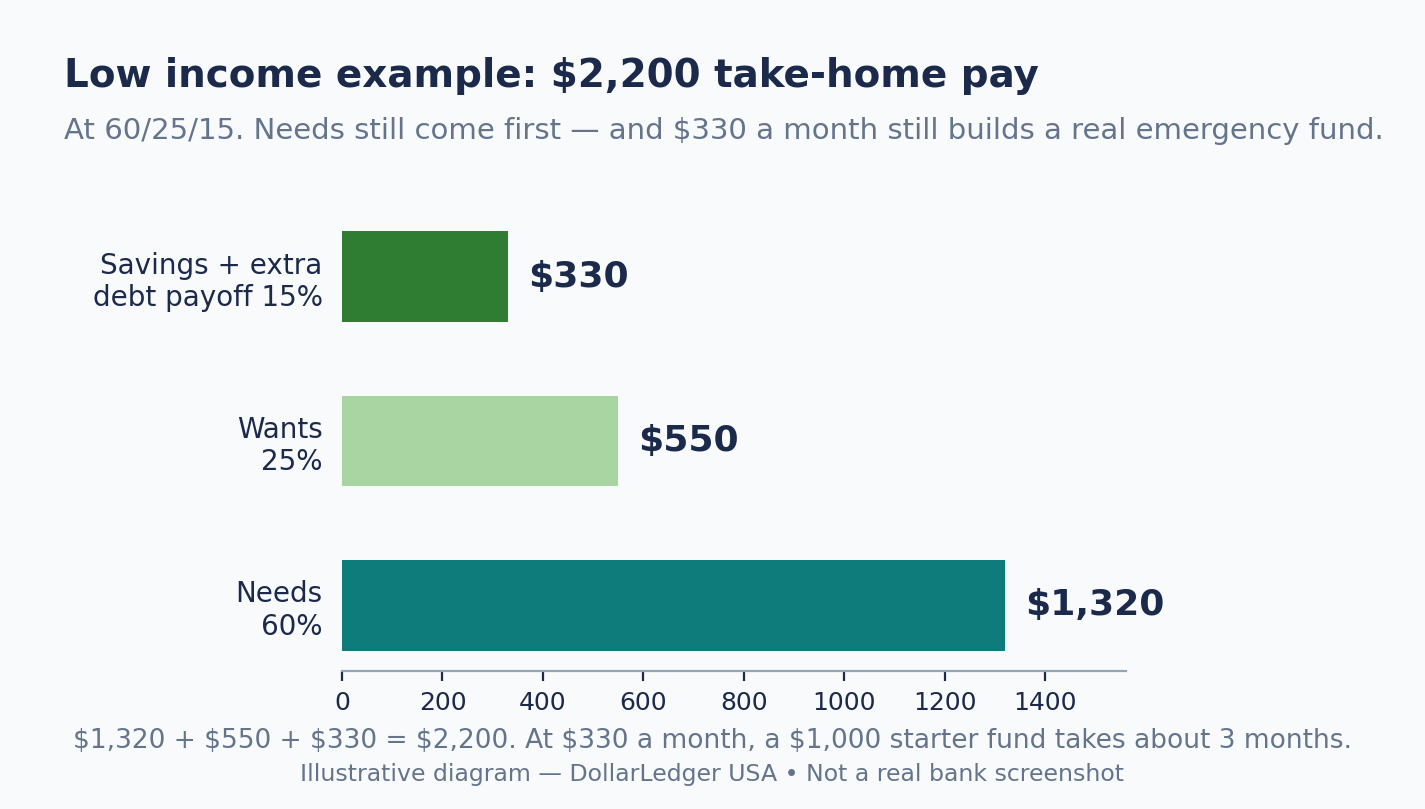
Illustrative diagram — Low income example: $2,200 a month. NOT a real bank screenshot.
Step 6: Automate it, then review it once a month
What to do: Make the budget run itself, and check it monthly.
How: Set up an automatic transfer for payday: savings moves to a separate high-yield savings account the day after payday, before you can spend it. Our guide to how a high-yield savings account works explains why it belongs there, not in checking. Once a month, ask: did needs stay inside their limit, did wants, and did the savings transfer happen? If a bucket went over, move money between buckets — or change the percentages.
Example: Maya sets a $420 transfer for the day after payday, with a reminder on the first Sunday of the month. In month two, her car insurance rises $30. She moves $30 from wants to needs, and the budget still balances.
Common mistake: Setting up the budget once and never looking at it again. Prices change, pay changes, life changes. A monthly review is the whole secret.
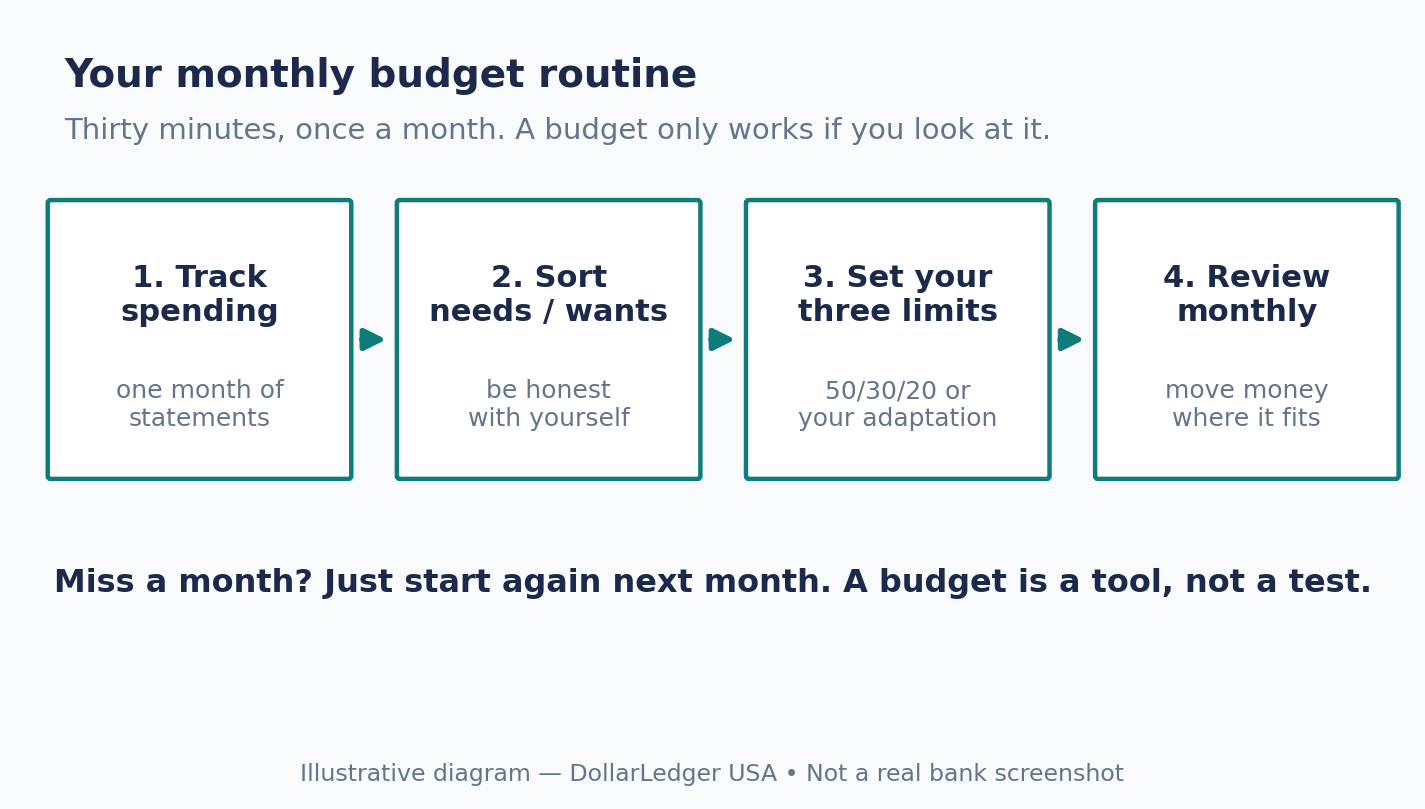
Illustrative diagram — Your monthly budget routine. NOT a real bank screenshot.
Checklist
- ☐ I know my monthly take-home pay.
- ☐ I sorted one real month of spending.
- ☐ I wrote down my three numbers.
- ☐ I set up an automatic savings transfer for the day after payday.
- ☐ My savings go to a separate high-yield savings account.
- ☐ I set a monthly reminder to review the budget for 30 minutes.
FAQ
What is the 50/30/20 rule?
Spend 50% of after-tax income on needs, 30% on wants, 20% on savings and extra debt payments. Popularised by Elizabeth Warren and Amelia Warren Tyagi in “All Your Worth” (2005). A rule of thumb you can adjust.
Does the 50/30/20 rule work on a low income?
Yes, with adaptation. On a low income, needs often take more than 50% — rent alone can do that. Use 60/25/15: 60% needs, 25% wants, 15% savings. The savings bucket is smaller, but it stays alive.
What counts as a need and what counts as a want?
Needs are what you must pay to live and work: rent, groceries, utilities, transport, insurance, minimum debt payments. Wants are eating out, streaming, holidays, concerts, extra clothes. The same item can be either — basic groceries are a need, lobster is a want.
What should I save for first?
An emergency fund. Build a $1,000 starter fund first, then three months of essential expenses, then six. It stops the next surprise from becoming credit card debt.
How often should I review my budget?
Once a month, for about thirty minutes. Check each bucket stayed inside its limit, move money if needed, and adjust when pay or bills change.
Sources
- NerdWallet, “Monthly Budget Calculator” — 50/30/20 on take-home pay: https://www.nerdwallet.com/finance/learn/nerdwallet-budget-calculator
- NerdWallet, “How to Make a Monthly Budget” — 50/30/20 as a guide, adjust to fit: https://www.nerdwallet.com/finance/learn/monthly-budget
- CFPB, “An essential guide to building an emergency fund”: https://www.consumerfinance.gov/an-essential-guide-to-building-an-emergency-fund/
- NerdWallet, “Emergency Fund Calculator: How Much Should I Have?”: https://www.nerdwallet.com/banking/learn/emergency-fund-calculator
- DollarLedger USA, “How Does a High-Yield Savings Account Work? Explained for Beginners”: </blog/how-does-high-yield-savings-account>
- DollarLedger USA, “How to Build an Emergency Fund on a $40,000 Salary in 2026”: </blog/how-to-build-emergency-fund-on-40000>
All figures are worked examples on stated take-home pay. Do the same maths with your own pay and bills.
Disclaimer: This article is for education only, not financial advice. Rates change often — confirm the current rate with the bank before opening an account.