How Much Does It Cost to Live in Texas in 2026? Real Monthly Breakdown
 DollarLedger Team
- 03 Nov, 2026
Texas is one of the cheaper big states, with no state income tax — but “cheap Texas” is not the same price everywhere. A one-bedroom costs about $957 a month in San Antonio and about $1,209 in Dallas, a gap of about $3,000 a year. This guide gives a real monthly breakdown for one single person in Texas in 2026. Every number is a range from a named source, checked in November 2026.
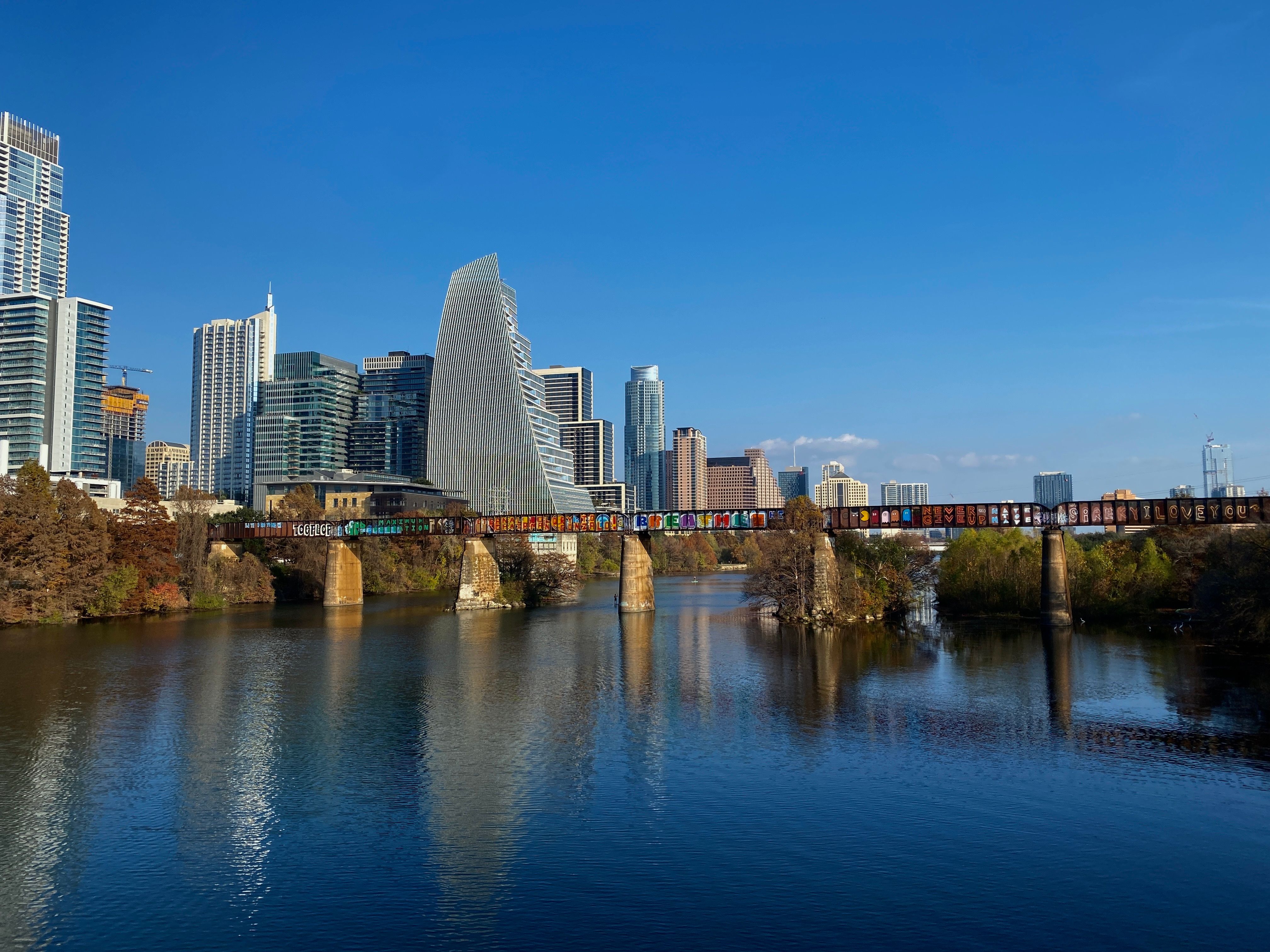
Photo: Austin is the priciest of the big four Texas cities. (Photo: Pexels)
What You Will Learn
- One-bedroom rents in Houston, Dallas, Austin and San Antonio
- A full monthly budget for one person, in ranges
- Texas taxes: no income tax, but higher sales and property taxes
- The wage needed to cover the basics
- Fitting Texas costs into a 50/30/20 budget
Step 1: Start with rent
What to do: Find the median one-bedroom rent in your city first.
How: Apartment List’s September 2026 figures put the median one-bedroom rent at $957 a month in San Antonio, $1,120 in Houston, $1,174 in Austin and $1,209 in Dallas. Statewide, the median is $1,230 across all sizes and $1,091 for a one-bedroom.
Example: Same salary, same apartment size: about $957 a month in San Antonio, about $1,209 in Dallas — about $3,000 more a year.
Common mistake: Budgeting with a statewide average — rents in Texas cities are hundreds of dollars apart.
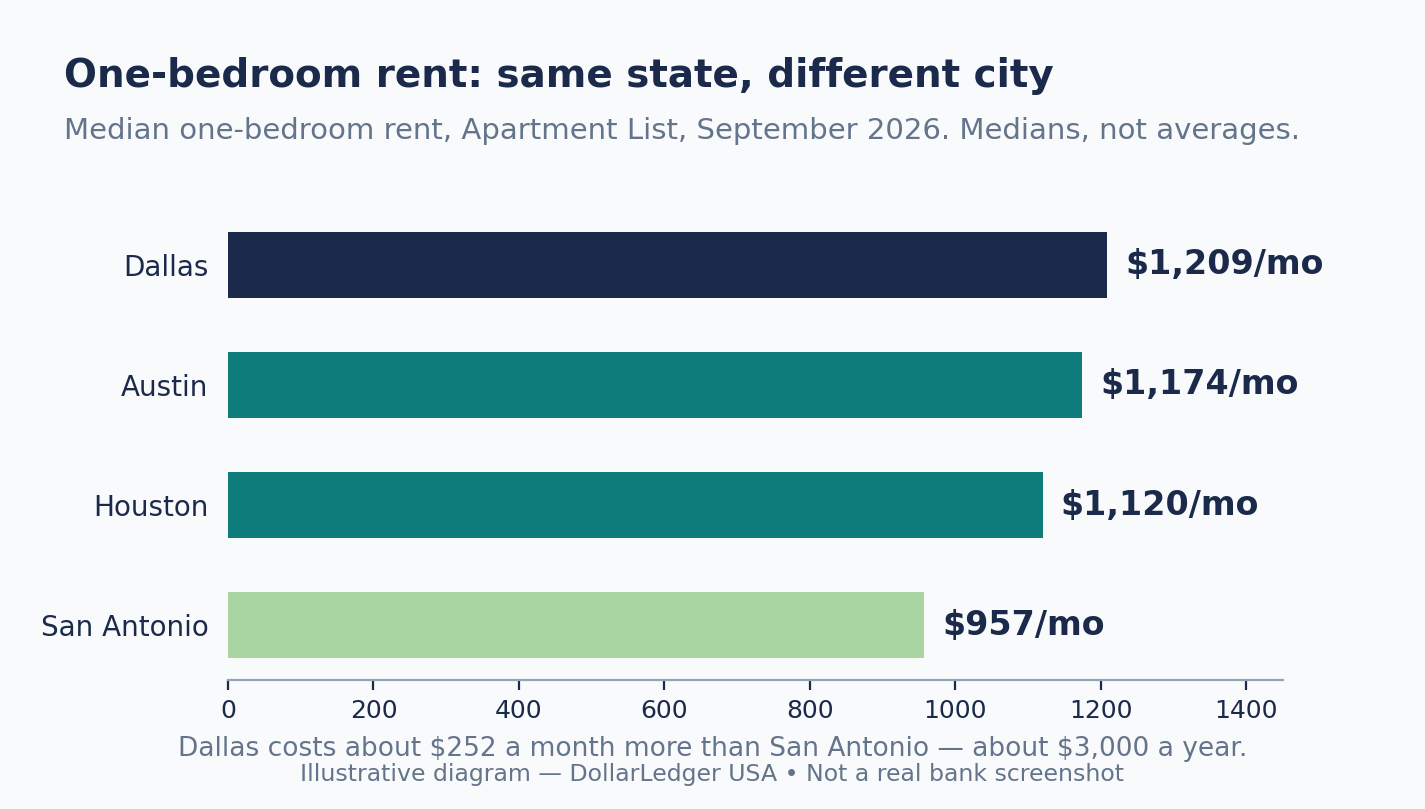
Illustrative diagram — One-bedroom rent: same state, different city. NOT a real bank screenshot.
Step 2: Add up everything else
What to do: Price the five costs after rent, in ranges, not single guesses.
How: Groceries: the USDA’s September 2026 food plans put a home-cooked diet for one adult at about $305–$383 a month (Thrifty) or $404–$478 (Moderate), after the 20% adjustment for living alone — budget $300 to $480. Utilities and internet: $150 to $250 a month; Numbeo lists basic utilities for a Houston apartment at about $197. Transport: $200 to $400 a month driving, or a transit pass at about $75 in Houston and $126 in Dallas. Health insurance varies most: about $120 a month for the average worker’s share of employer cover (KFF data), or about $625 for a benchmark marketplace silver plan for a 40-year-old, before subsidies. Add $150 to $300 for phone, clothes and fun.
Example: Take the middle of each range — rent $1,091, groceries $400, utilities $200, transport $300, health cover $300, phone and fun $225. That is about $2,516 a month, before taxes.
Common mistake: Forgetting the small bills: a $60 phone plan, a $40 streaming bundle and a $50 gym membership add $150 a month.
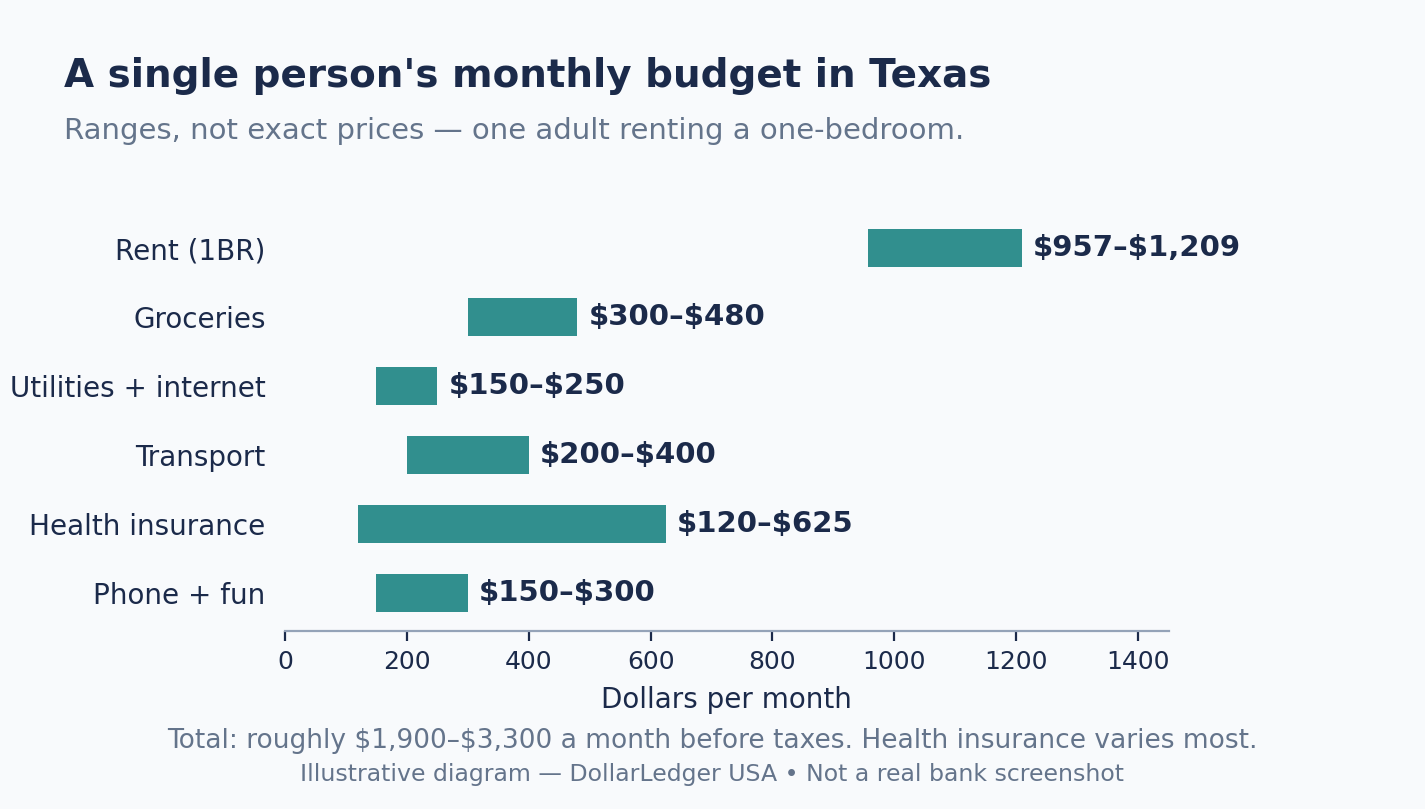
Illustrative diagram — Monthly budget in Texas: ranges, not exact prices. NOT a real bank screenshot.
Step 3: Understand the Texas tax trade-off
What to do: Work out what “no state income tax” saves you — and what Texas charges instead.
How: Texas charges 0% state income tax on wages, so your paycheck is bigger than in a high-tax state. But Texas makes up the difference: state sales tax is 6.25%, and with local taxes the average total is around 8.2%. Property taxes are high too, around 1.6% of a home’s value a year. Federal income tax still applies everywhere — Texas only skips the state part.
Example: You earn $60,000 a year. A 5% state income tax would cost about $3,000 a year; in Texas you pay $0. But a $350,000 house carries about $5,600 a year in property tax at around 1.6%.
Common mistake: Thinking “no income tax” means “low tax”. Texas is usually cheaper for a middle-income renter — but for a homeowner in an expensive house, property tax can wipe out the saving.
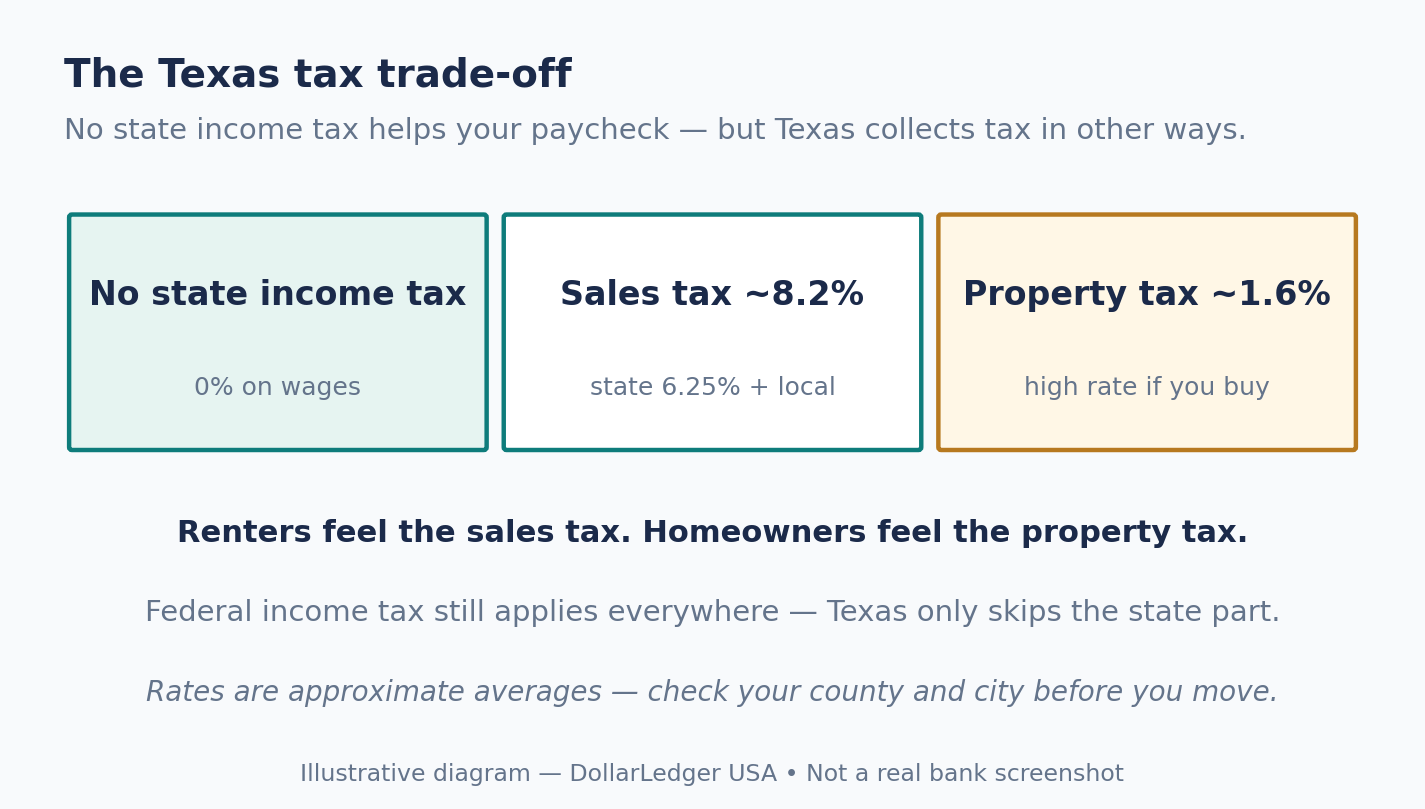
Illustrative diagram — The Texas tax trade-off. NOT a real bank screenshot.
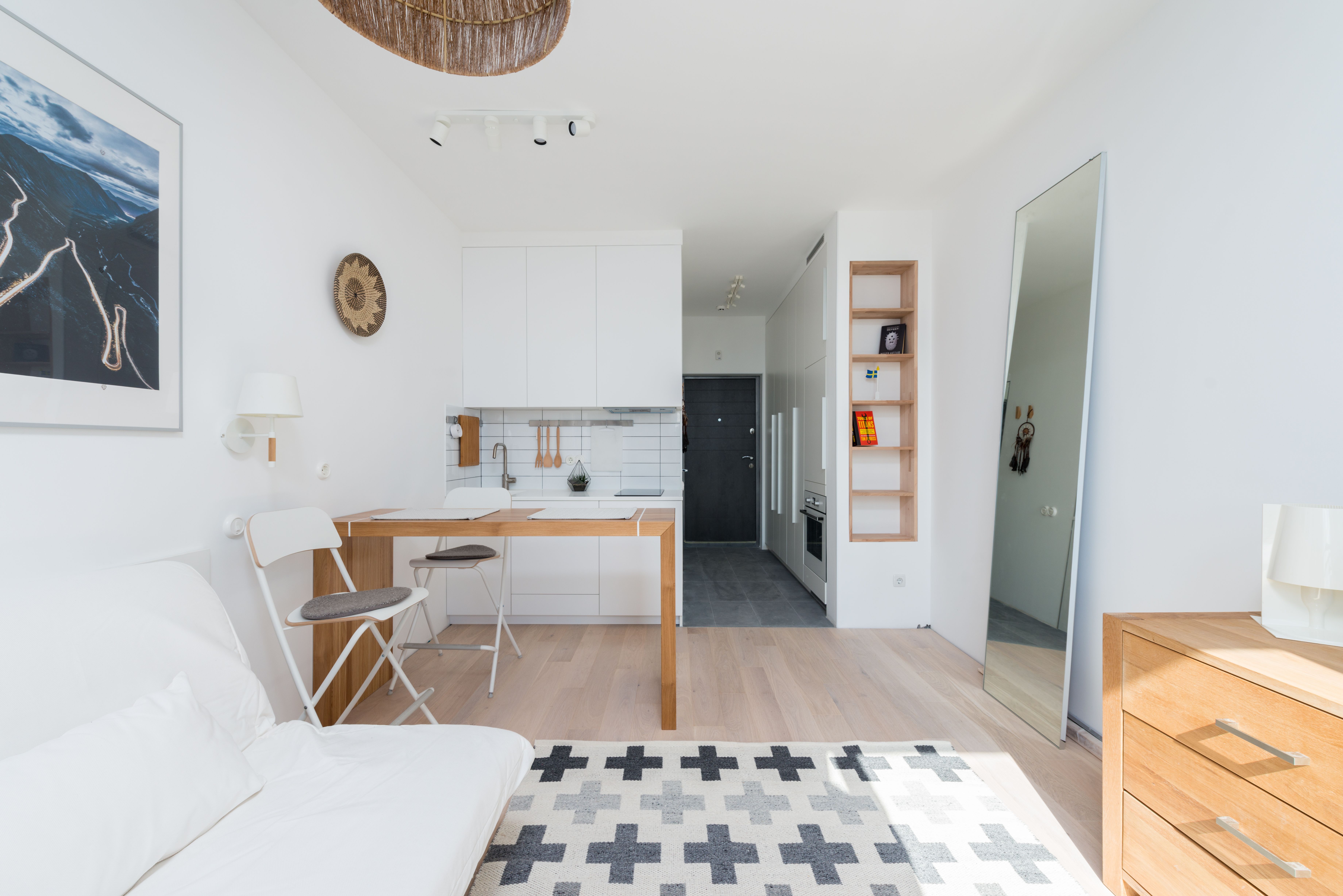
Photo: Rent is your biggest bill — and the easiest to change by choosing your city. (Photo: Pexels)
Step 4: Check the wage you need
What to do: Compare your pay with the living wage — the hourly rate covering basics for one adult.
How: The MIT Living Wage Calculator, updated in February 2026, puts the living wage for a single adult in Texas at $21.77 an hour — about $45,282 a year full-time. In the Austin metro area it is $23.71 an hour. The Texas minimum wage is $7.25 an hour, about $15,080 a year — far below the living wage, which covers basics only.
Example: At $18 an hour full-time, about $37,440 a year before tax, you are above the minimum wage but below the living wage — so the Step 2 budget will feel tight, especially in Dallas or Austin.
Common mistake: Judging a salary by the number alone: $50,000 a year means something different in San Antonio than in Austin.
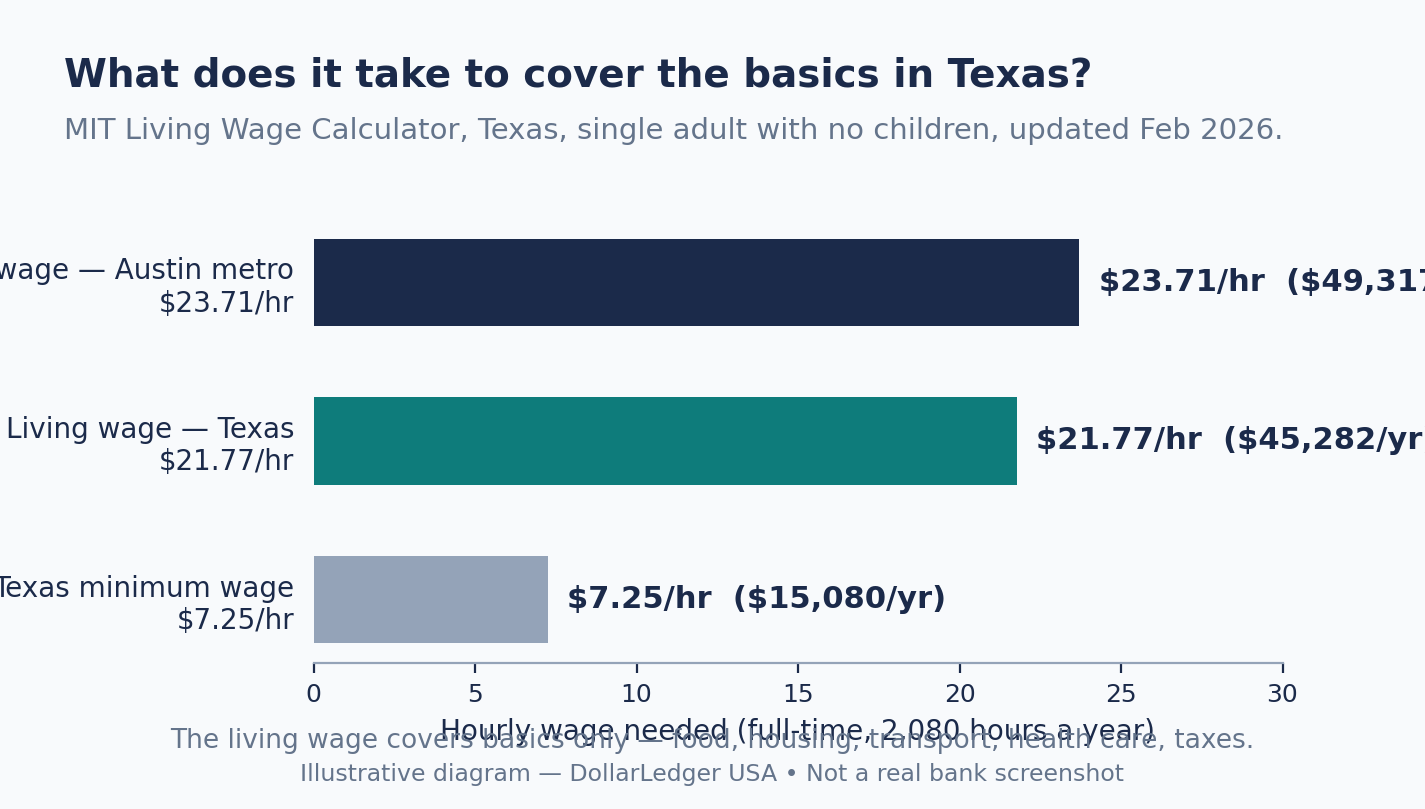
Illustrative diagram — What it takes to cover the basics in Texas. NOT a real bank screenshot.
Step 5: Fit it into a 50/30/20 budget
What to do: Split your take-home pay into needs, wants and savings.
How: The 50/30/20 rule puts 50% of take-home pay on needs (rent, groceries, utilities, transport, insurance), 30% on wants and 20% on savings. On $3,500 a month take-home, that is $1,750 for needs, $1,050 for wants and $700 for savings. Our mid-range Texas budget from Step 2 is about $2,516 a month — so needs take about 60%, not 50%. That is normal in an expensive city: aim for 60/25/15 instead.
Example: Maya takes home $3,500 a month in Houston. Rent, groceries, utilities, transport and health cover come to $2,140 — 61% on needs. She keeps wants at $660 and still saves $700 a month by cooking at home.
Common mistake: Forcing the split when rent alone breaks it. If needs take 65%, cut a want instead — or look for cheaper rent.

Photo: Groceries are your second-biggest flexible cost. (Photo: Pexels)
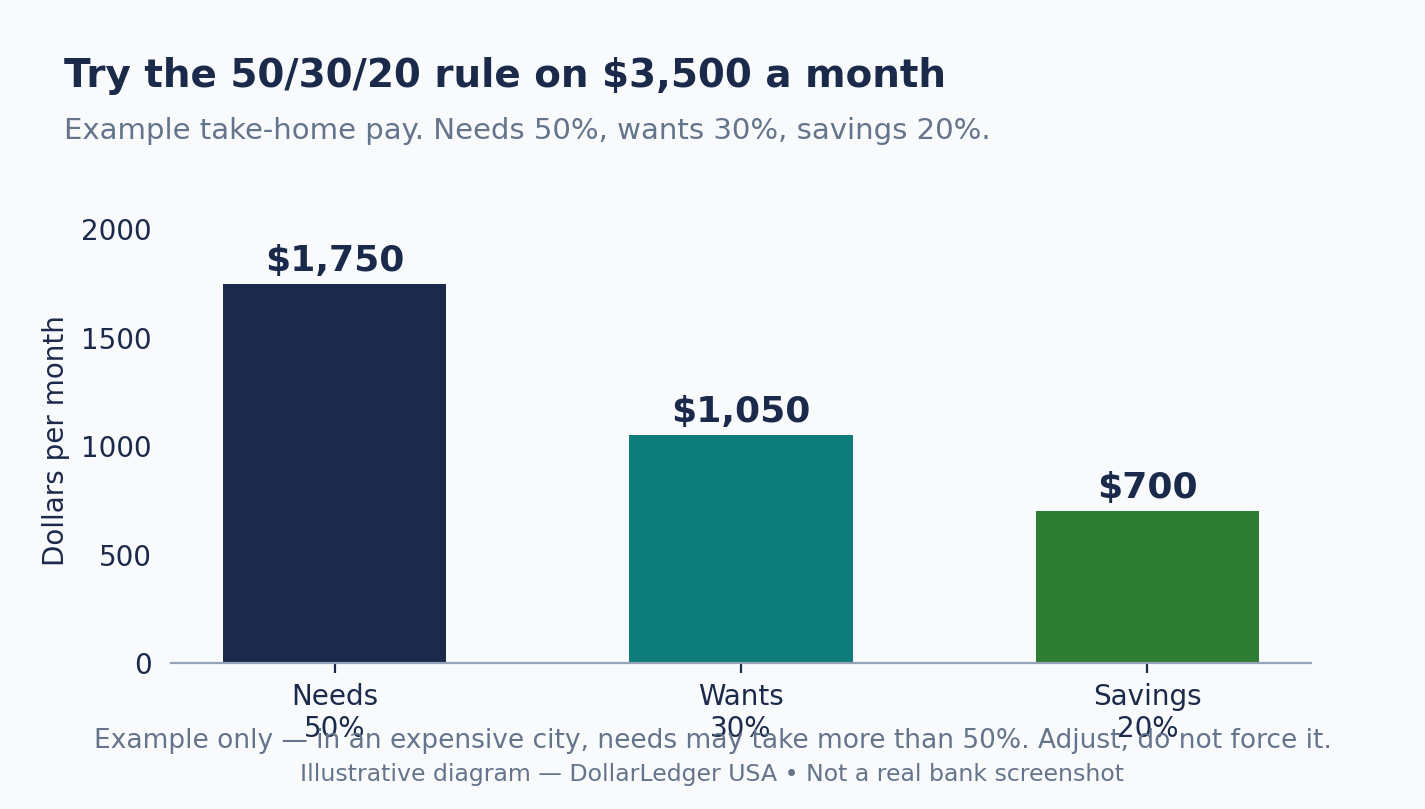
Illustrative diagram — Try the 50/30/20 rule on $3,500 a month. Example only. NOT a real bank screenshot.
Step 6: Build your budget and a safety net
What to do: Turn these ranges into your budget, then save one month of expenses.
How: Write down your real numbers: the rent you would actually pay, last month’s grocery spending, your car or transit cost, and your health insurance premium. Add them up, add federal tax, and compare with your take-home pay. Then save one month of expenses first — about $2,500 on our mid-range budget — in a high-yield savings account, where it earns around 4% APY instead of almost nothing. Our emergency-fund guide shows how to grow it to three, then six, months.
Example: You move to Houston on $4,000 a month take-home. Rent, groceries, utilities, transport, health cover, phone and fun come to $2,365. Save $700 a month, and your one-month buffer is built in under four months.
Common mistake: Building the budget once and never looking at it again. A $100 rent rise or a summer electricity bill can break a budget that was fine in January.
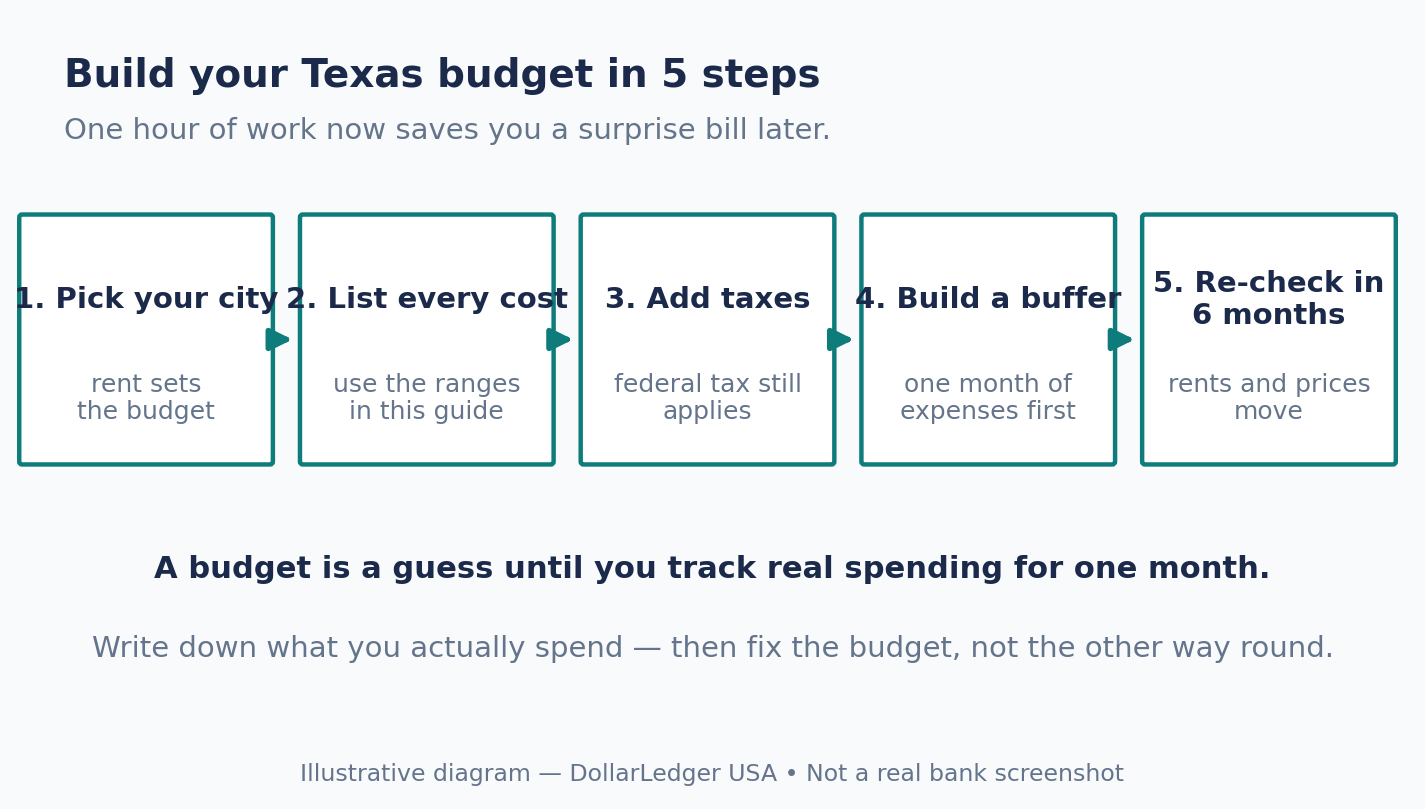
Illustrative diagram — Build your Texas budget in 5 steps. NOT a real bank screenshot.
Checklist
- I priced rent in my city, not the Texas average.
- I added up groceries, utilities, transport, health cover and phone.
- I know the total range: roughly $1,900 to $3,300 a month before taxes.
- I checked the Texas tax trade-off: renter or buyer.
- I compared my pay with the $21.77-an-hour living wage.
- I have a one-month buffer saved, in a high-yield account.
FAQ
How much does a single person need to live in Texas in 2026?
Roughly $1,900 to $3,300 a month before taxes. A typical mid-range budget is about $2,500.
Is Texas cheaper than other states?
Yes, mostly: no state income tax, and the Texas median rent is about 11.5% below the US median (Apartment List). But property taxes are high and summer electricity bills can spike.
What salary do you need to live comfortably in Texas?
The MIT living wage is $21.77 an hour, about $45,282 a year, and covers basics only. For comfort plus real savings, most single people need roughly $55,000 to $65,000 a year in Houston or San Antonio, and more in Austin or Dallas.
Why is rent so different between Texas cities?
Jobs and demand. Dallas and Austin have strong job markets, so rents are higher; San Antonio and Houston have more housing supply, so rents are lower.
Do I pay state income tax if I work remotely for a company in another state?
No. If you live and work in Texas you pay no state income tax on wages, wherever your employer is based. You still pay federal income tax.
Sources
- MIT Living Wage Calculator, Texas — single adult $21.77/hour, Austin metro $23.71/hour, updated February 15, 2026: http://livingwage.mit.edu/states/48
- Apartment List, Cost of Living in Texas (2026) — statewide median rent $1,230, one-bedroom $1,091: https://www.apartmentlist.com/renter-life/cost-of-living-texas
- USDA, Official Food Plans, September 2026 — Thrifty and Moderate plans, one-person +20% adjustment: https://fns-prod.azureedge.us/sites/default/files/resource-files/CostofFoodSep2026LowModLib.pdf
- Numbeo, Cost of Living in Dallas — utilities, transit, gasoline: https://www.numbeo.com/cost-of-living/in/Dallas
All figures checked November 2, 2026. Confirm current figures before signing a lease or choosing a plan.
Disclaimer: This article is for education only, not financial advice. Costs vary by city, neighbourhood and lifestyle — confirm current prices before making a decision.