Best Side Hustles to Make Extra Money in 2026 — What They Really Pay Per Hour
 DollarLedger Team
- 11 Nov, 2026

An app advertises $25 an hour. You drive three hours, earn $66, spend $18 on gas and wear, and keep $48 before tax. That is $16 an hour — and after setting money aside for tax, about $12 in your pocket. That gap is the whole story of side hustles in 2026. The surveys cannot agree what the typical side hustler earns: Bankrate’s 2025 median is $200 a month, LendingTree’s 2026 median is $400, and The Penny Hoarder’s 2026 central figure is $1,275. Same country, three answers — because they asked different people. This guide ranks hustles by net hourly profit after expenses and tax. All figures were checked on November 11, 2026.
Photo: The headline rate is not your pay — net hourly profit after costs and tax is. (Photo: Pexels)
What You Will Learn
- How to work out your real net hourly pay
- What skilled work, gig work and surveys pay per hour
- Why the three big surveys disagree
- A 30-day test that costs almost nothing
- The tax routine: what to set aside, which forms to expect
- When to scale, switch or stop
Step 1: Work out your net hourly rate first
What to do: Learn the one formula that judges every hustle: net hourly pay equals gross pay minus expenses minus platform fees, divided by every hour the work took.
How: Count all the hours, not just the paid ones — waiting, driving, messaging, pitching, invoicing. A writer billing $50 an hour for four hours, plus two hours pitching and admin, earned $200 for six hours: $33 an hour before fees. For a benchmark, the Bureau of Labor Statistics puts the national mean hourly wage at $33.54 in May 2025 (median $24.51, reported). A hustle paying $16 an hour net is below the typical American wage — fine for extra cash, but not a replacement income.
Example: Tom’s $300 design job: $30 platform fee, $10 assets, six hours. Net: $260 divided by 6, about $43 an hour.
Common mistake: Dividing your pay by billable hours only, and calling the answer your wage.
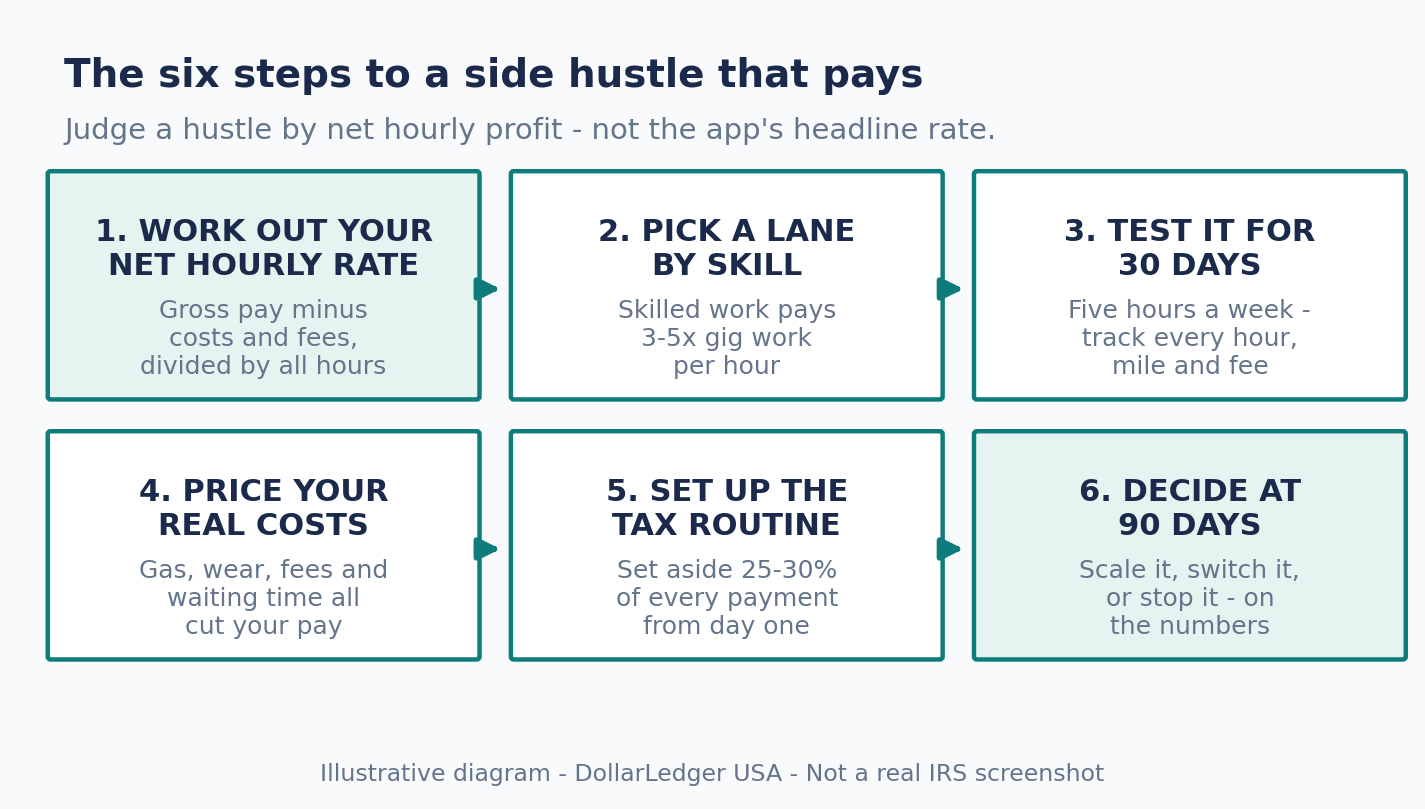
Illustrative diagram - The six steps to a side hustle that actually pays. NOT a real IRS screenshot.
Step 2: Pick a lane by what you already know
What to do: Choose a hustle that uses a skill you already have — skilled work pays three to five times gig work per hour.
How: The reported 2026 ranges tell the story. Freelance writing and design pay about $25 to $75 an hour, online tutoring about $18 to $45, and test preparation up to $50 to $150 (reported). Rideshare pays about $15 to $28 an hour net in peak hours, food delivery about $12 to $22 net, and paid surveys about $3 to $8 (reported). The top end takes longer: The Penny Hoarder reports its top 10% earning $3,000 to $8,000 a month from consulting, freelancing and established digital products (reported). Most hustles take months to reach steady income.
Example: Priya, a teacher, tutors two students at $40 an hour for five hours a week — $200 gross. Her friend drives delivery fifteen hours a week at $16 an hour net and earns $240, for three times the hours.
Common mistake: Picking the hustle with the biggest advertisement instead of the best rate for the skills you already have.
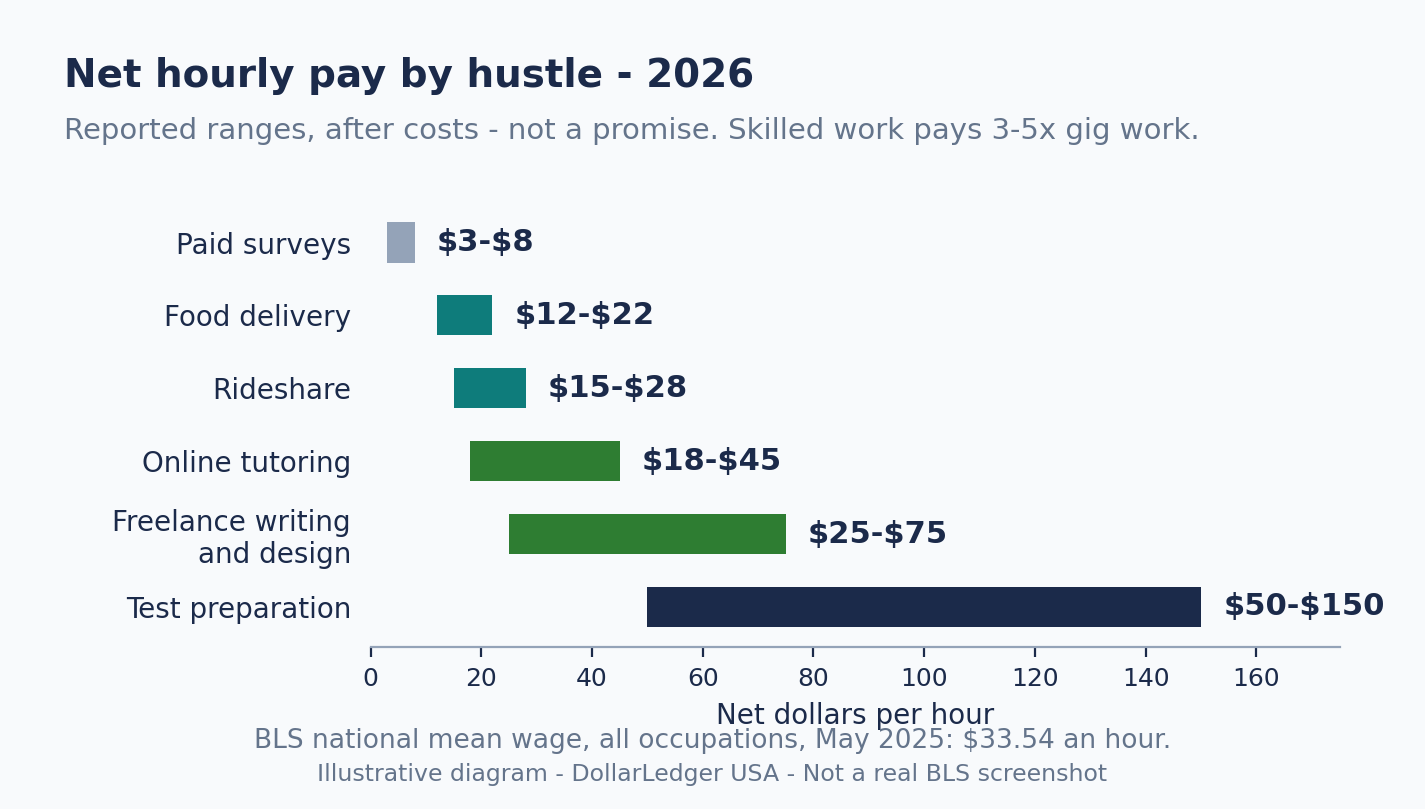
Illustrative diagram - Net hourly pay by hustle in 2026 (reported ranges). NOT a real BLS screenshot.
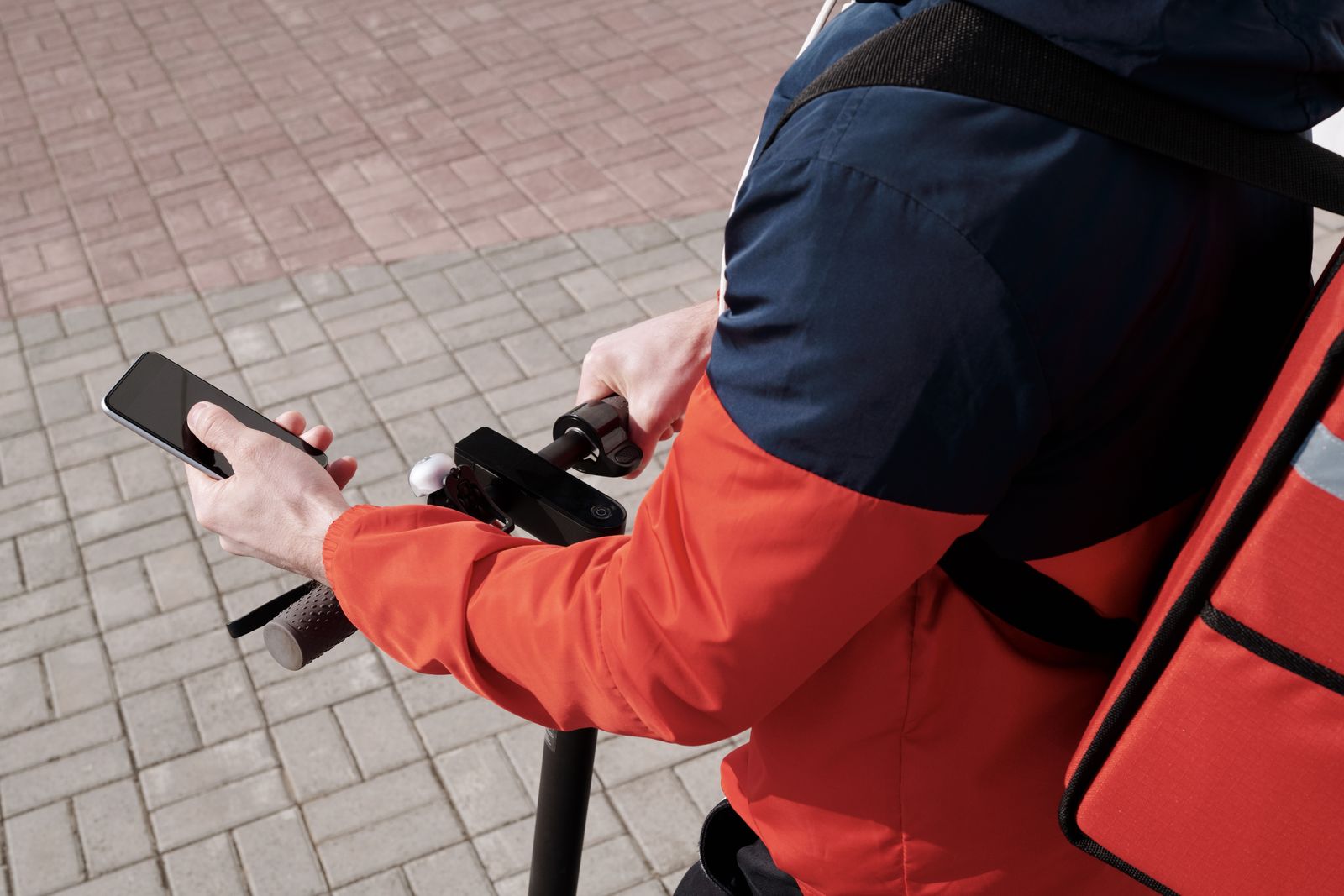
Photo: Delivery pays fast, but gas, wear and waiting time cut the hourly rate. (Photo: Pexels)
Step 3: Test it for 30 days at five hours a week
What to do: Run a small, cheap test before you spend money on equipment, courses or ads.
How: Most side hustlers work very few hours: 54% spend under five hours a week (reported). Copy that. Give it five hours a week for four weeks, tracking every hour, mile and fee. Then use the Step 1 formula. Under $12 an hour net, change lanes or stop; over $25, you have something worth growing.
Example: Maya tests tutoring: five hours a week at $30 an hour is $600 gross; her platform takes 18% ($108), so she nets $492 for 20 hours — $24.60 an hour.
Common mistake: Buying equipment, paying for a course or cutting main-job hours before the 30-day test proves the hustle pays.
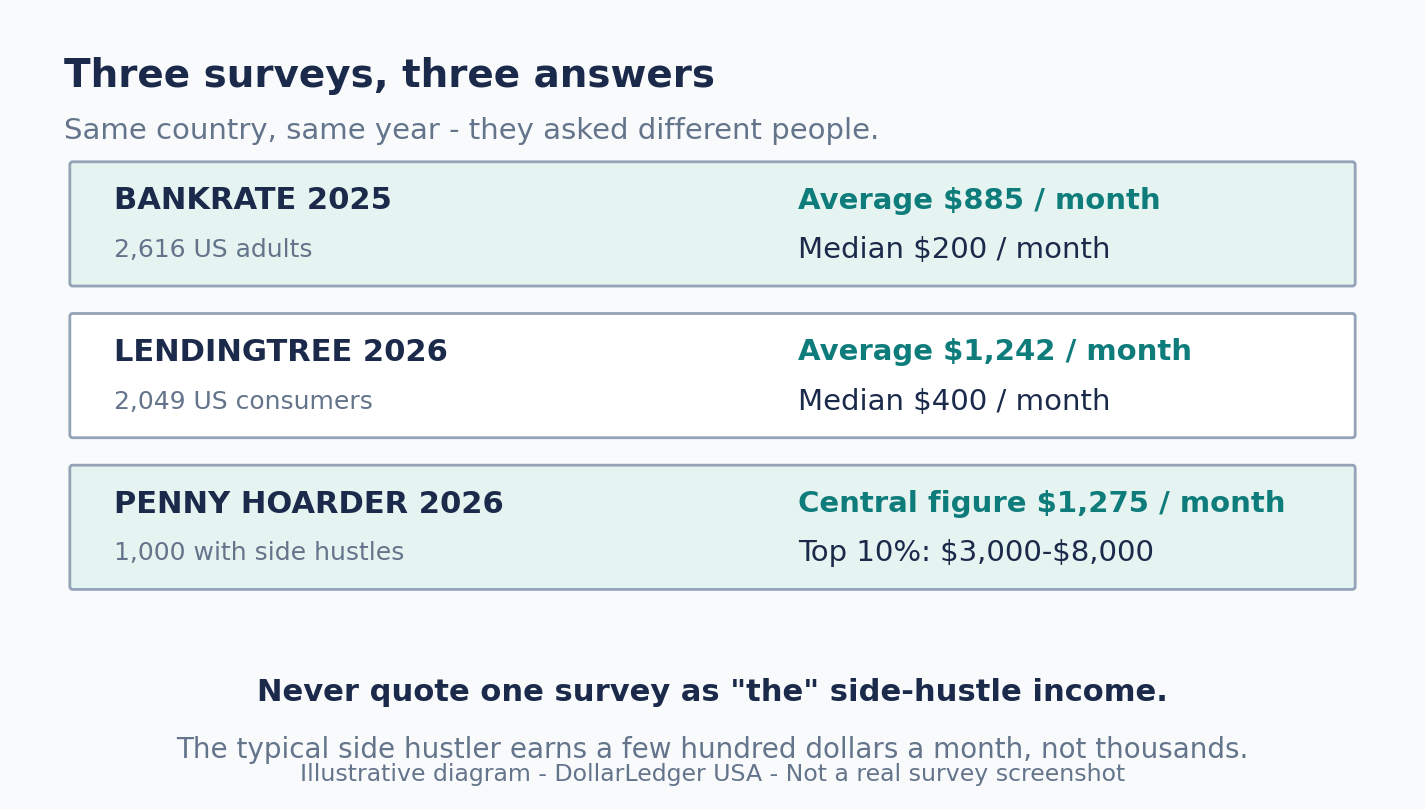
Illustrative diagram - Three surveys, three answers: they sampled different hustlers. NOT a real survey screenshot.
Step 4: Price your real costs honestly
What to do: List every cost the hustle creates, then subtract it before you celebrate the pay.
How: Take a delivery shift: three hours on the app pays $66 gross. Say you drive 60 miles at about 30 cents a mile for gas and wear: $18. Net: $48 for three hours, or $16 an hour. Set aside 25% for tax ($12), and your take-home is $36 — $12 an hour. Fees work the same way: Fiverr takes 20% of each order; tutoring platforms take roughly 18% to 33% (reported).
Example: A driver counting only the $66 gross thinks she earns $22 an hour. After gas, wear and tax, she keeps $12 — nearly half the headline number.
Common mistake: Calling gross pay your profit, and forgetting gas, fees, waiting time and tax.
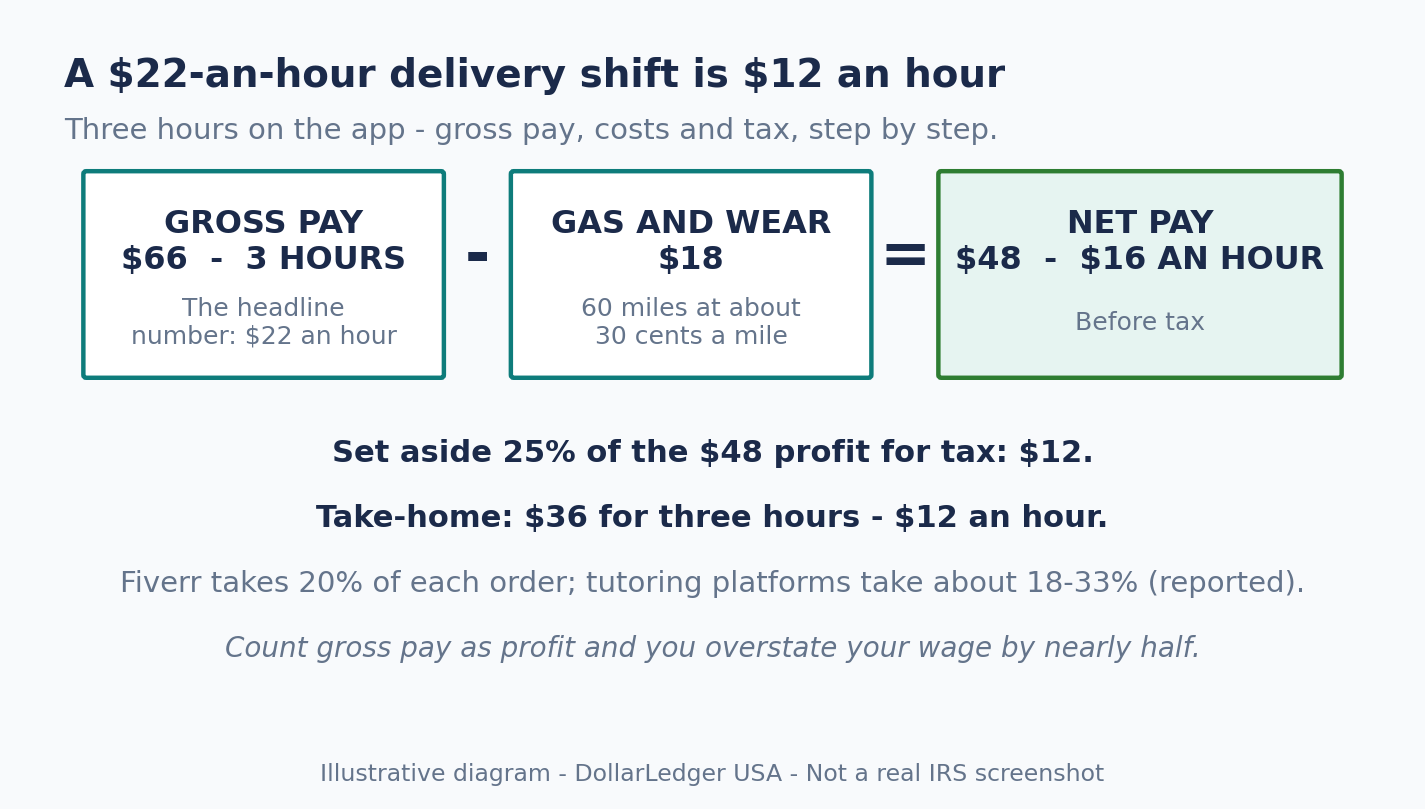
Illustrative diagram - A $22-an-hour delivery shift is $12 an hour after costs and tax. NOT a real app screenshot.
Step 5: Set up the tax routine from the first dollar
What to do: Treat every payment as partly the taxman’s from the day it arrives, and keep it separate.
How: All side income is taxable, even with no form — the IRS says report gig income even if part-time, paid in cash, or unreported. The 1099-K rule is about reporting, not tax: apps and marketplaces must send one only when your gross payments exceed $20,000 and you have more than 200 transactions in the year — both conditions (IRS 1099-K FAQs). Direct clients must send a 1099-NEC at $2,000 or more for 2026 payments. If your net self-employment earnings reach $400, you owe 15.3% self-employment tax on 92.35% of net earnings (Schedule SE; Social Security part up to $184,500 in 2026). The routine: a separate account, 25% to 30% of every payment moved in the day it arrives, estimated tax paid quarterly. For the full routine, see our guide to freelancer taxes in the USA in 2026.
Example: You net $1,000 profit in a month. Self-employment tax is 15.3% of 92.35% of $1,000, or about $141; income tax at the 12% bracket adds about $120. Total: about $261 — so setting aside $250 to $300 was the right call.
Common mistake: Spending the full payout, then finding a tax bill in April with no money set aside.

Photo: Tutoring is skilled work — it pays more per hour than delivery, but the platform takes a cut. (Photo: Pexels)
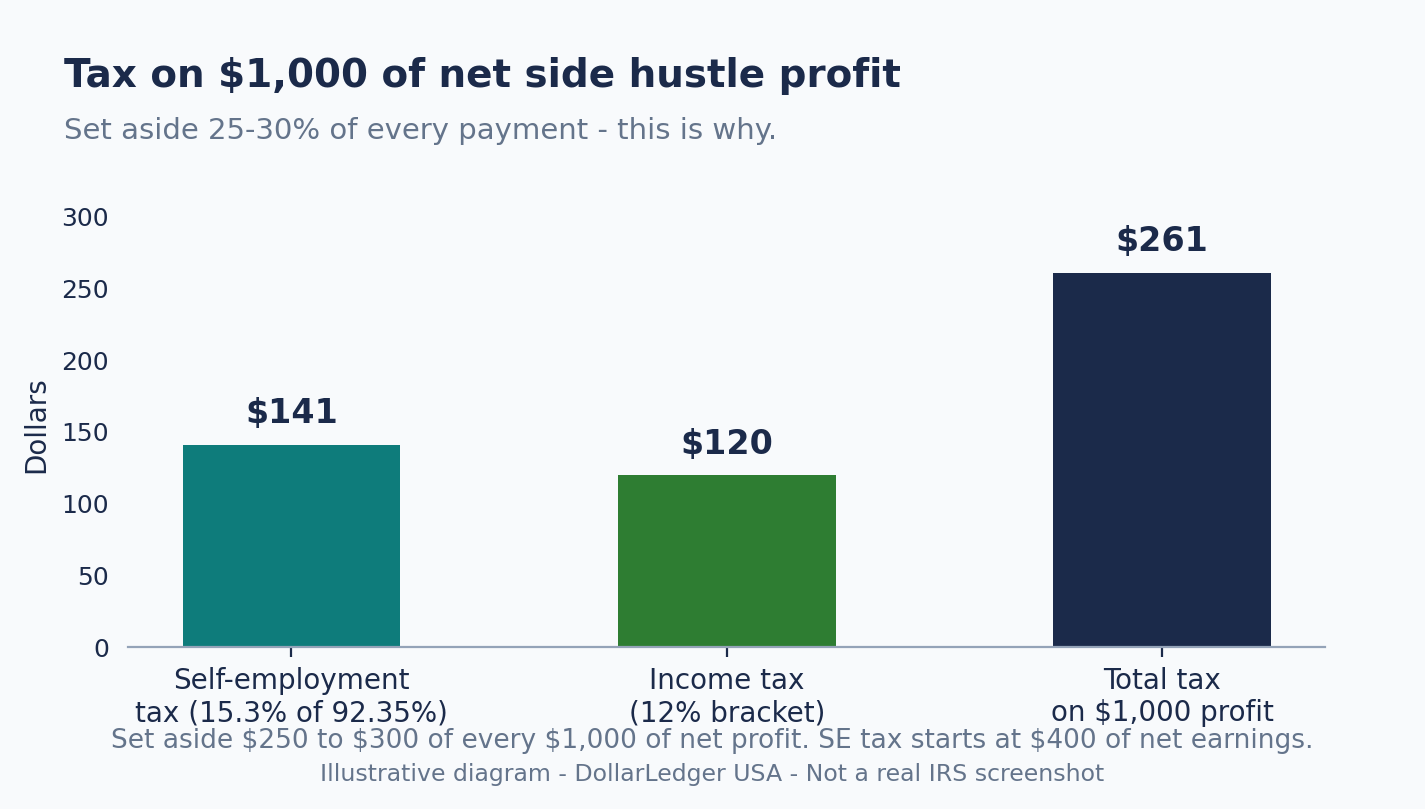
Illustrative diagram - Tax on $1,000 of net side hustle profit. NOT a real IRS screenshot.
Step 6: Decide at 90 days — scale it, switch it, or stop it
What to do: After three months, judge the hustle on its numbers and decide.
How: Scale it if your net pay is above $25 an hour, clients come back, and you have a waiting list — raise your rate first, then add hours. Switch lanes if your net pay is still under $12 an hour, or if costs rise faster than pay. At $12 an hour take-home, ten hours a week is $120 a week, about $520 a month — useful, not life-changing. If your main job pays more per hour, keep the hustle a side income.
Example: After 90 days, Maya’s tutoring nets $26 an hour with three regular students, so she raises her rate to $40. Her brother’s delivery work still nets $12 an hour, so he keeps it at five hours a week and stops trying to grow it.
Common mistake: Quitting your job for a hustle that pays less per hour than your day job.

Illustrative diagram - Six mistakes that shrink side hustle pay. NOT a real IRS screenshot.
Checklist
- My net hourly pay.
- A lane that matches a skill I already have.
- A 30-day test, every hour and cost tracked.
- A separate account with 25% to 30% of every payment set aside.
- 1099 forms checked, and all income reported.
- A 90-day decision: scale, switch or stop.
FAQ
How much does the average side hustler actually earn?
The surveys disagree: Bankrate’s 2025 survey: average $885 a month, median $200. LendingTree’s 2026 survey: average $1,242, median $400. The Penny Hoarder’s 2026 survey: central figure $1,275 a month.
What is the best-paying side hustle per hour?
Skilled work: test prep is reported at $50 to $150 an hour, freelance writing and design at $25 to $75, online tutoring at $18 to $45. Rideshare and delivery pay about $12 to $28 an hour net, surveys about $3 to $8.
Do I have to pay tax on side hustle income if I do not get a 1099?
Yes. The IRS says all gig income is taxable even if no form arrives. The 1099-K threshold — over $20,000 and over 200 transactions — only decides whether a payment app must send you a form.
How many hours a week do side hustlers work?
Most work very few hours: 54% spend under five hours a week (reported). The Penny Hoarder’s 2026 survey found its side hustlers working about 13 hours a week (reported).
How do I start a side hustle with no money?
Start with a skill you already have — writing, tutoring, design, driving — list yourself on free platforms, and test it for 30 days at five hours a week. Check the platform is real first: see our guide to how to find a legitimate remote job in the USA in 2026.
Sources
- Internal Revenue Service, Gig Economy Tax Center (opened live November 11, 2026): https://www.irs.gov/businesses/gig-economy-tax-center
- Internal Revenue Service, Form 1099-K FAQs: General information (opened live November 11, 2026): https://www.irs.gov/newsroom/form-1099-k-faqs-general-information
- U.S. Bureau of Labor Statistics, Occupational Employment and Wages, May 2025 — nationwide mean hourly wage $33.54 (opened live November 11, 2026): https://Data.Bls.gov/regions/southwest/news-release/2026/occupationalemploymentandwages_houston_20260813.htm
All figures checked November 11, 2026.
Disclaimer: For education only, not tax or financial advice. Survey figures are reported by their publishers; your earnings will differ.