How Does a High-Yield Savings Account Work? Explained for Beginners
 DollarLedger Team
- 02 Nov, 2026
You have probably heard of a “high-yield savings account”, or HYSA. Here is the simple version: it is a normal savings account that pays much more interest. The national average savings rate in the USA is just 0.38% APY. A high-yield account pays around 4% APY or more — same kind of account, same safety, about ten times the interest. This guide explains it step by step, in plain English.
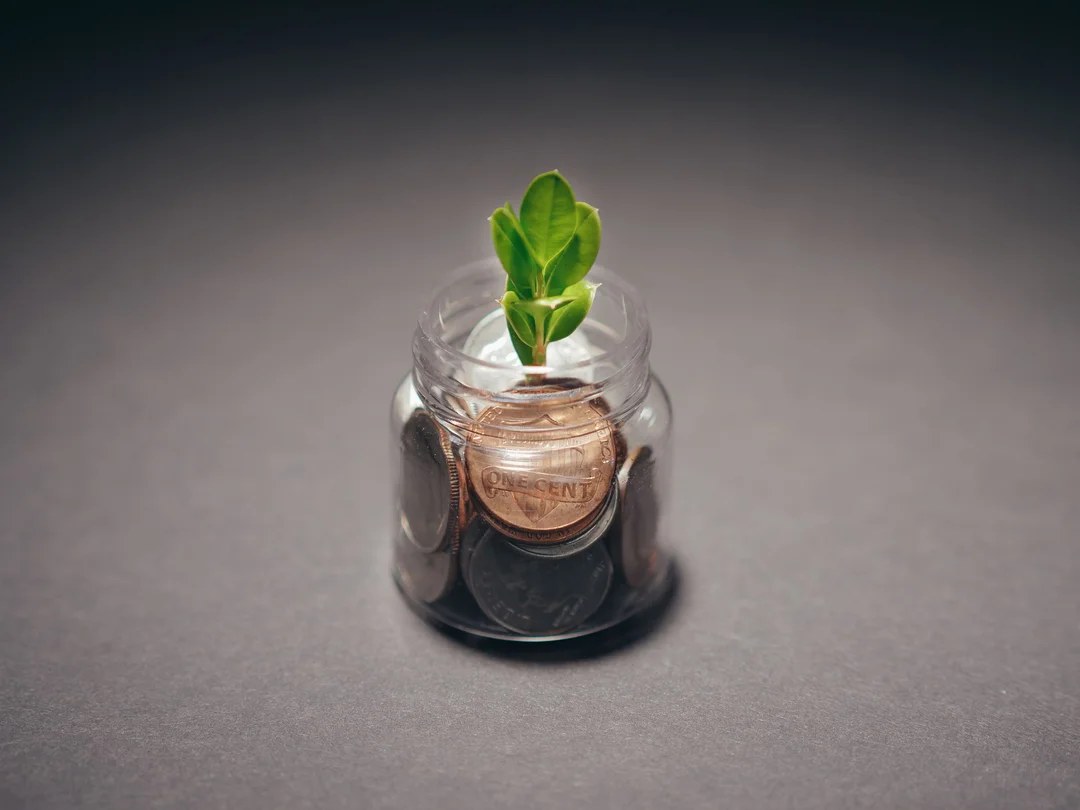
Photo: A plant grows from a jar of coins — your money grows the same way, a little every month. (Photo: Pexels)
What You Will Learn
- What a high-yield savings account is, and how it differs from a regular one
- Where the interest comes from: banks lend your deposits
- How compounding grows your money year after year
- How much you earn: the math on $1,000, $5,000 and $10,000
- What to check before you open an account: fees, limits, FDIC safety
- The small routine that keeps it growing
Step 1: Check your rate — is it really high-yield?
What to do: Find out what your savings account pays right now.
How: Log in to your bank app or website and look for “APY” on your savings account. APY is annual percentage yield: the interest you earn in one year. If it shows 0.38% APY, that is the national average. A high-yield account pays around 4% APY or more.
Example: If you have $6,000 in a regular savings account at 0.38% APY, it earns about $23 in a year. At 4.40% APY, the same $6,000 would earn about $264 — $241 more, just for moving it.
Common mistake: Assuming your bank pays a good rate. Most big banks pay the average, or less.
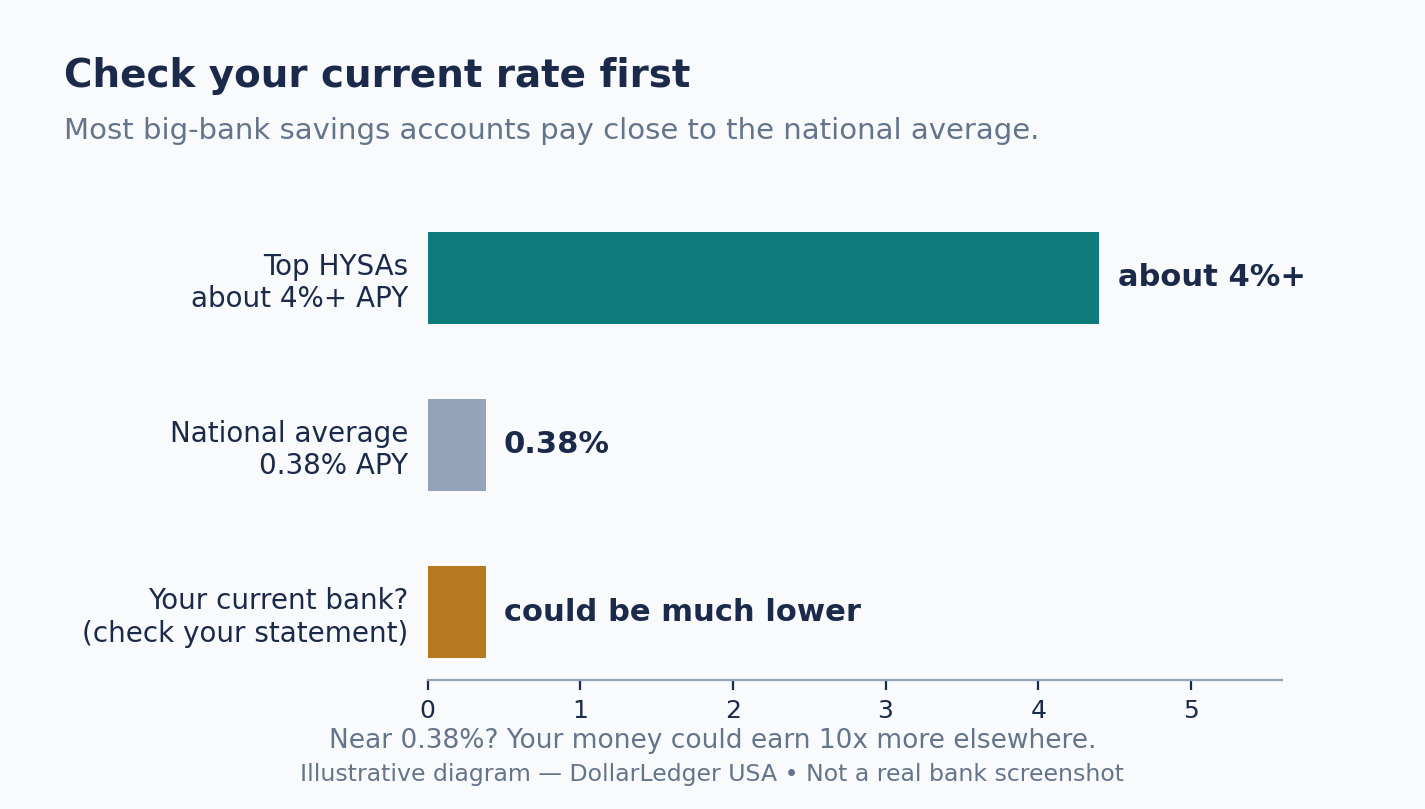
Illustrative diagram — Check the APY on your savings account first. NOT a real bank screenshot.
Step 2: See where the interest comes from
What to do: Understand why a bank pays you interest.
How: A bank lends your deposits to other people as loans, and to businesses. It earns interest on those loans, keeps a part, and pays you the rest. That is why a high-yield account pays more: online banks have fewer costs, so they share more with you.
Example: Think of it as a flow: your deposits become loans, loans pay interest, the bank keeps a cut and pays you interest. No magic, no risk to your deposit.
Common mistake: Thinking the bank pays interest from thin air. Interest comes from lending. A bank that pays much more than others must earn it somewhere — check the terms.

Photo: This is how most people check their rate — a phone, a laptop, and five minutes. (Photo: Pexels)
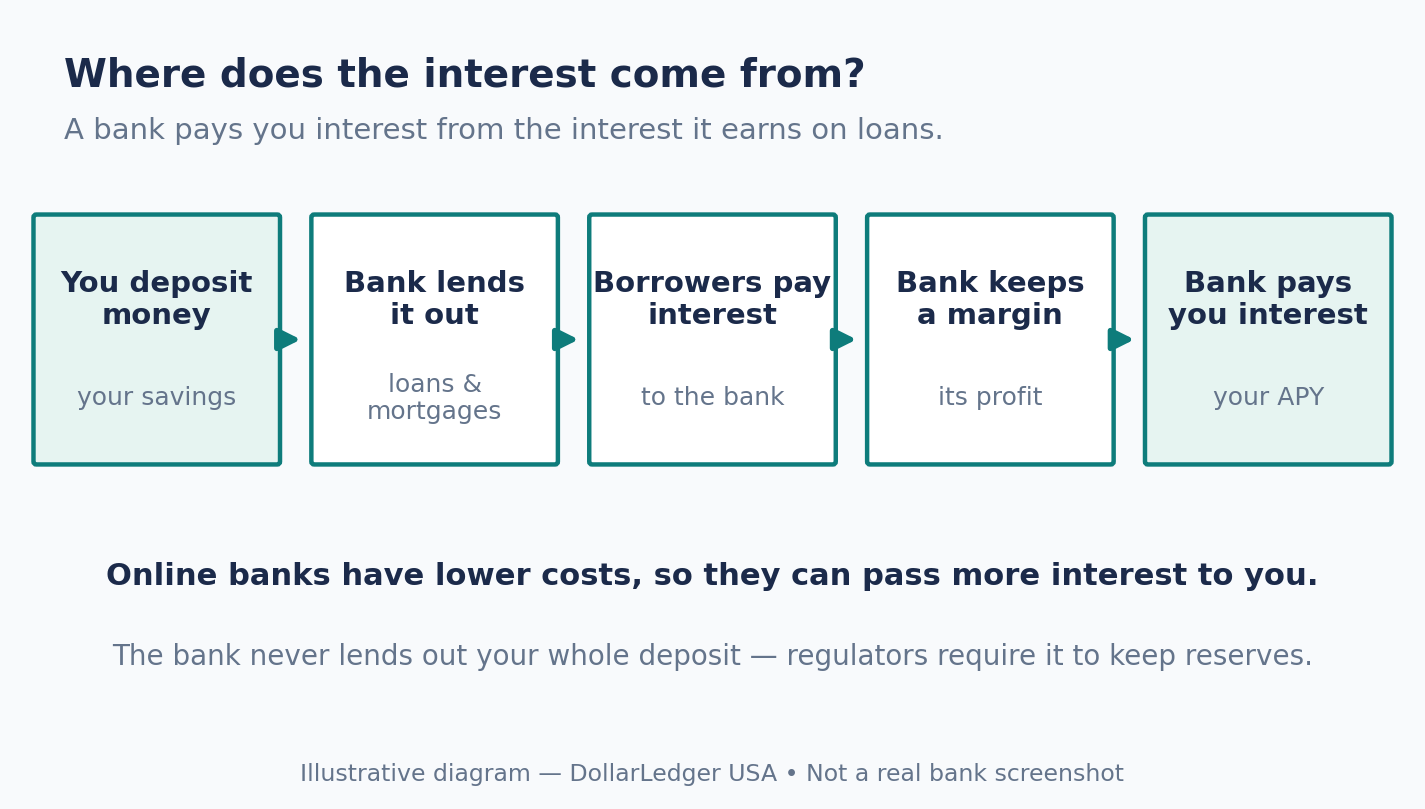
Illustrative diagram — How interest flows: deposits become loans, loans pay interest. NOT a real bank screenshot.
Step 3: Do the math — $1,000, $5,000 and $10,000
What to do: Calculate what you would earn at 4.40% APY.
How: Multiply your balance by 0.044. That is one year’s interest, before tax. At the national average 0.38% APY, multiply by 0.0038.
Example: On $5,000, a high-yield account at 4.40% earns about $220 in a year. At 0.38%, it earns about $19.
Common mistake: Comparing monthly interest instead of yearly APY. Always use APY — it already includes compounding.
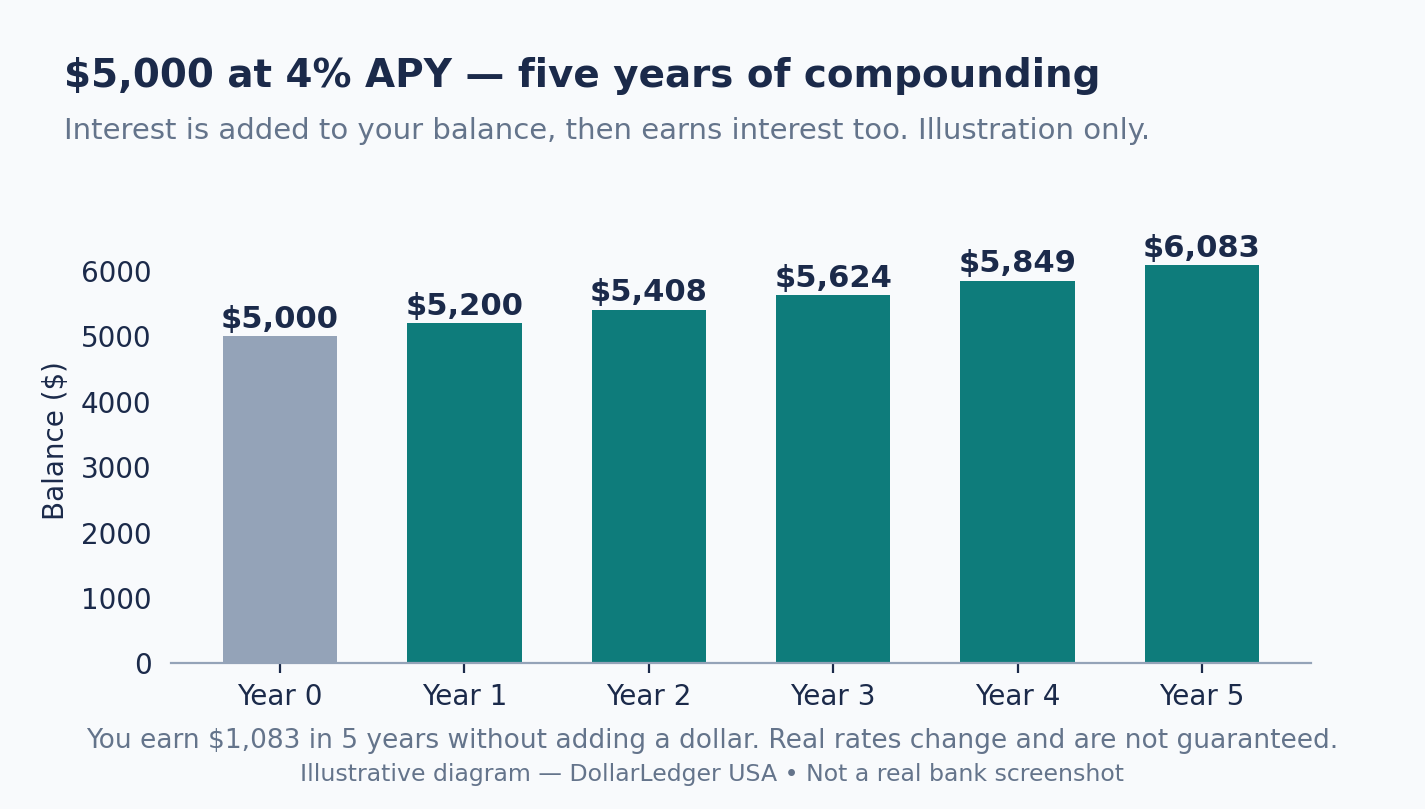
Illustrative diagram — On $5,000, 4.40% APY earns $220 a year. NOT a real bank screenshot.
Photo: A high-yield account works the same way at an online bank or a local bank — the rate is what differs. (Photo: Pexels)
Step 4: Know that your rate can change
What to do: Learn why high-yield rates move, and what to do about it.
How: High-yield rates are variable. They follow the Federal Reserve: when the Fed lowers its rate, banks lower theirs. The rate you see today is not a promise for next year.
Example: The Fed’s rate is 4.25% today. In 2022, high-yield rates were under 1%. They rose when the Fed raised its rate — and they will fall when the Fed cuts.
Common mistake: Thinking a rate is locked. It is not a fixed deposit. Check your rate every six months.
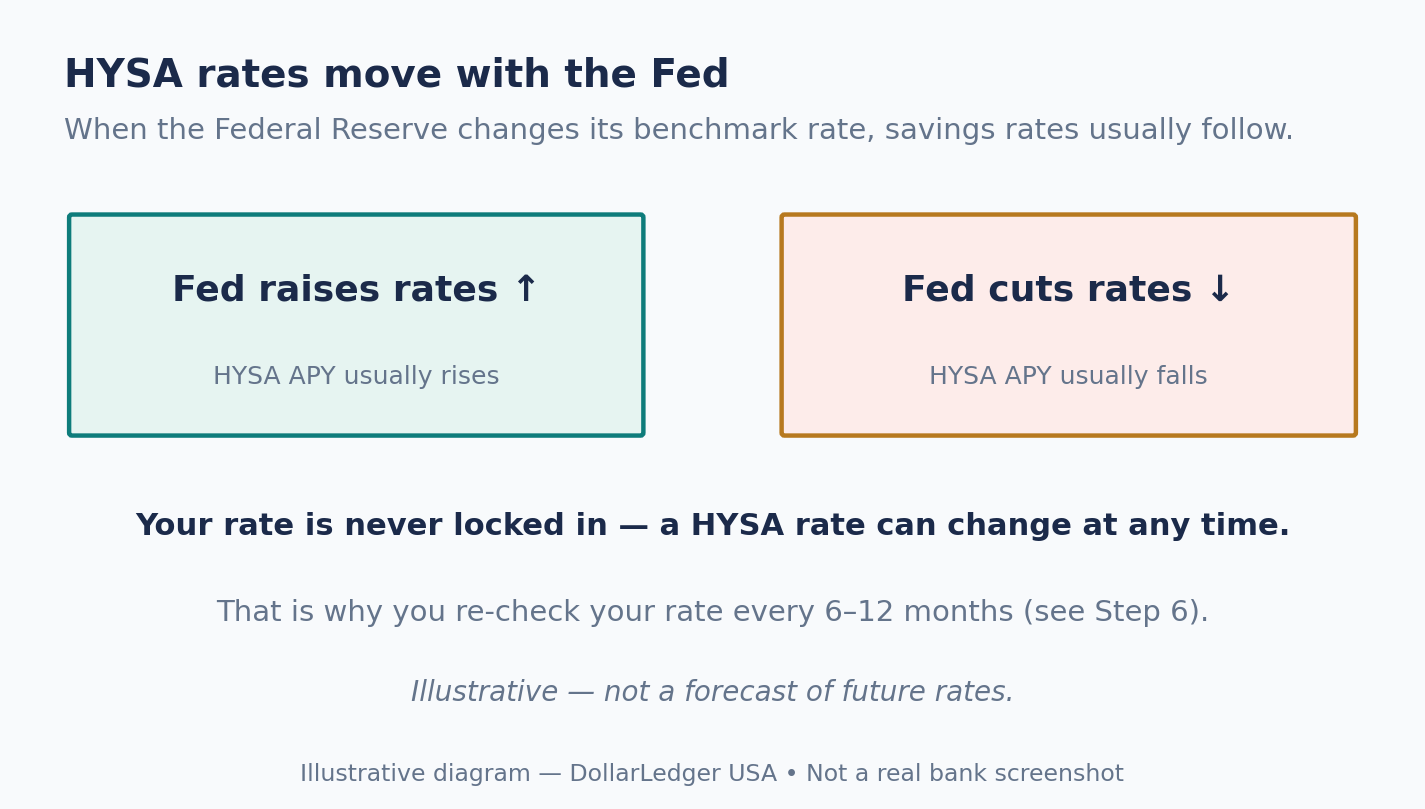
Illustrative diagram — High-yield rates follow the Federal Reserve. NOT a real bank screenshot.
Step 5: Keep an emergency fund in it
What to do: Use your high-yield account for your emergency fund.
How: Financial experts suggest keeping three to six months of expenses in savings. Put that money in a high-yield account so it grows while it waits.
Example: If your monthly expenses are $3,000, aim for $9,000 to $18,000 in savings. At 4.40%, $12,000 earns about $528 in a year.
Common mistake: Keeping your emergency fund in a checking account earning nothing, or investing it and risking a loss.
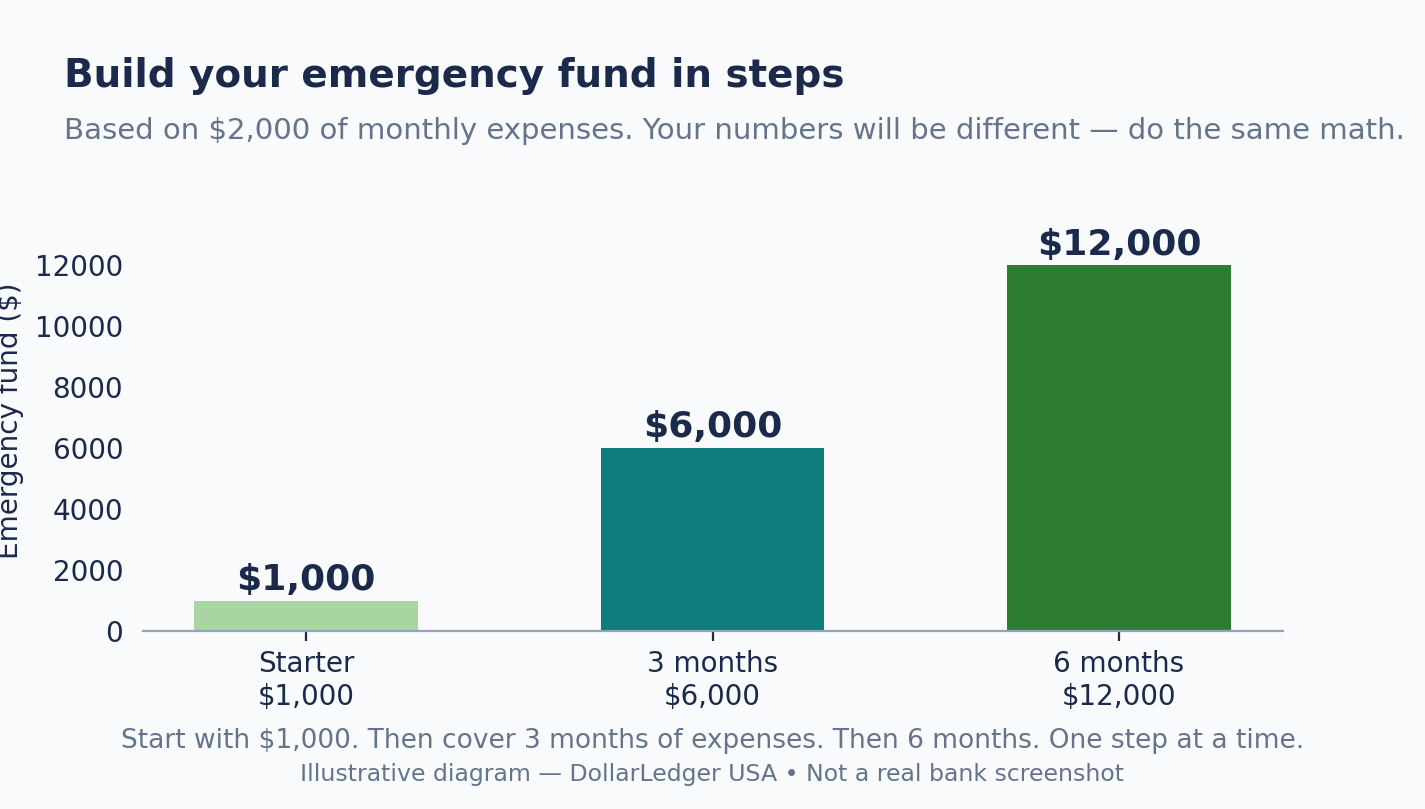
Illustrative diagram — Build your emergency fund one step at a time. NOT a real bank screenshot.
Step 6: The 10-minute, six-month routine
What to do: Check your rate twice a year and move your money if needed.
How: Every six months, take 10 minutes: check your rate, compare it with the top rates, and if a better account pays more and has no fees, open it and move the money. Keep the old account open until the transfer clears.
Example: You started at 4.40%. Six months later, your bank has dropped to 3.80% while another pays 4.60%. You move the money and earn $80 more per year on $10,000.
Common mistake: Setting it and forgetting it for years. Banks lower rates quietly — a 10-minute check twice a year protects you.
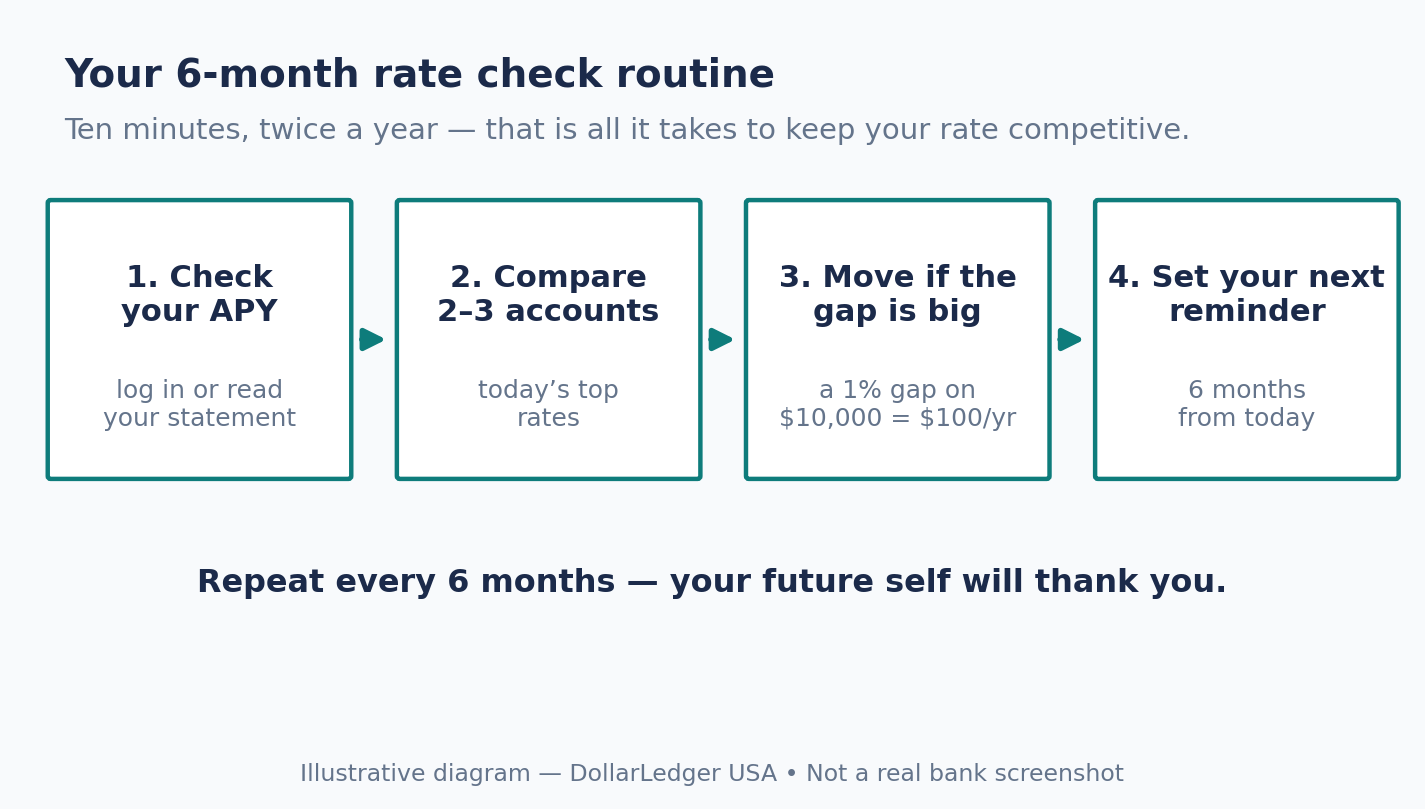
Illustrative diagram — A 10-minute check every six months keeps your money growing. NOT a real bank screenshot.
Checklist
- ☐ I found my current APY in my bank app.
- ☐ I know the difference between APY and interest rate.
- ☐ I calculated what I earn at 4.40% APY.
- ☐ I know my rate is variable and follows the Federal Reserve.
- ☐ My emergency fund is in a high-yield account.
- ☐ I have a calendar reminder to check my rate in six months.
FAQ
Is a high-yield savings account safe?
Yes. If it is with an FDIC-insured bank, your deposits are protected up to $250,000 per depositor, per bank, per ownership category. A high-yield account is as safe as a regular savings account.
Can I withdraw my money any time?
Yes. A savings account is not locked. You can withdraw when you need it. Transfers to a linked bank usually take 1 to 3 business days.
Why do online banks pay more?
They have fewer branches and lower costs. They pass part of those savings to you as a higher rate.
Do I need a minimum balance?
Some accounts need one, some do not. Pibank and EverBank have no minimum deposit. Others have conditions — check before you open one.
Is the interest taxable?
Yes. Interest is taxable income. Your bank sends a Form 1099-INT if you earn $10 or more in a year.
Sources
- Motley Fool, “Best High-Yield Savings Accounts Today, Nov. 2, 2026” — rates, national average 0.38% APY, FDIC $250,000 limit: https://www.fool.com/money/banking/savings-accounts/
- Federal Reserve, Federal Open Market Committee — target range for the federal funds rate, 4.25%: https://www.federalreserve.gov/monetarypolicy/fomccalendars.htm
- FDIC, Deposit Insurance at a Glance — $250,000 per depositor, per bank, per ownership category: https://www.fdic.gov/resources/deposit-insurance/
- DollarLedger USA, Best High-Yield Savings Accounts in USA 2026: </blog/best-high-yield-savings-accounts-in-usa>
All rates were checked November 2, 2026. Rates are variable and change without notice — confirm the current rate on the bank’s website before opening an account.
Disclaimer: This article is for education only, not financial advice. Rates change often — confirm the current rate with the bank before opening an account.