Best CD Rates in 2026: 1-Year, 3-Year and 5-Year Compared
 DollarLedger Team
- 03 Nov, 2026
A certificate of deposit, or CD, is the simplest deal in banking: you lend money to a bank for a fixed time, and the bank pays you a fixed rate. The best CD rates in the USA right now reach 4.60% APY for one year, 4.85% for three years, and 5.00% for five years. The catch: your money is locked away for the term. This guide compares the best 1-year, 3-year and 5-year CD rates, checked November 2, 2026, and shows you how to pick your term.
Photo: A CD is a fixed deal — a set rate for a set time. (Photo: Pexels)
What You Will Learn
- What a CD is, and how it differs from a savings account
- The best 1-year, 3-year and 5-year CD rates right now
- What $10,000 earns in each term
- What an early-withdrawal penalty costs, in real dollars
- How to pick your term, and how a CD ladder works
Step 1: Understand what a CD is
What to do: Learn the deal before you compare rates.
How: A CD is a deposit account with a fixed term — usually three months to five years — and a fixed rate. You deposit once, and withdrawing early costs a penalty. The rate is locked: even if the Federal Reserve cuts rates, your CD keeps paying the same APY until it matures. CDs at FDIC-insured banks are insured up to $250,000 per depositor, per bank, per ownership category; credit union CDs are covered by the NCUA.
Example: You open a 1-year CD at 4.60% APY with $10,000 and know in advance you will earn about $460.
Common mistake: Thinking a CD is an investment. It is not — your balance cannot drop, but it cannot grow faster than the rate you locked in.
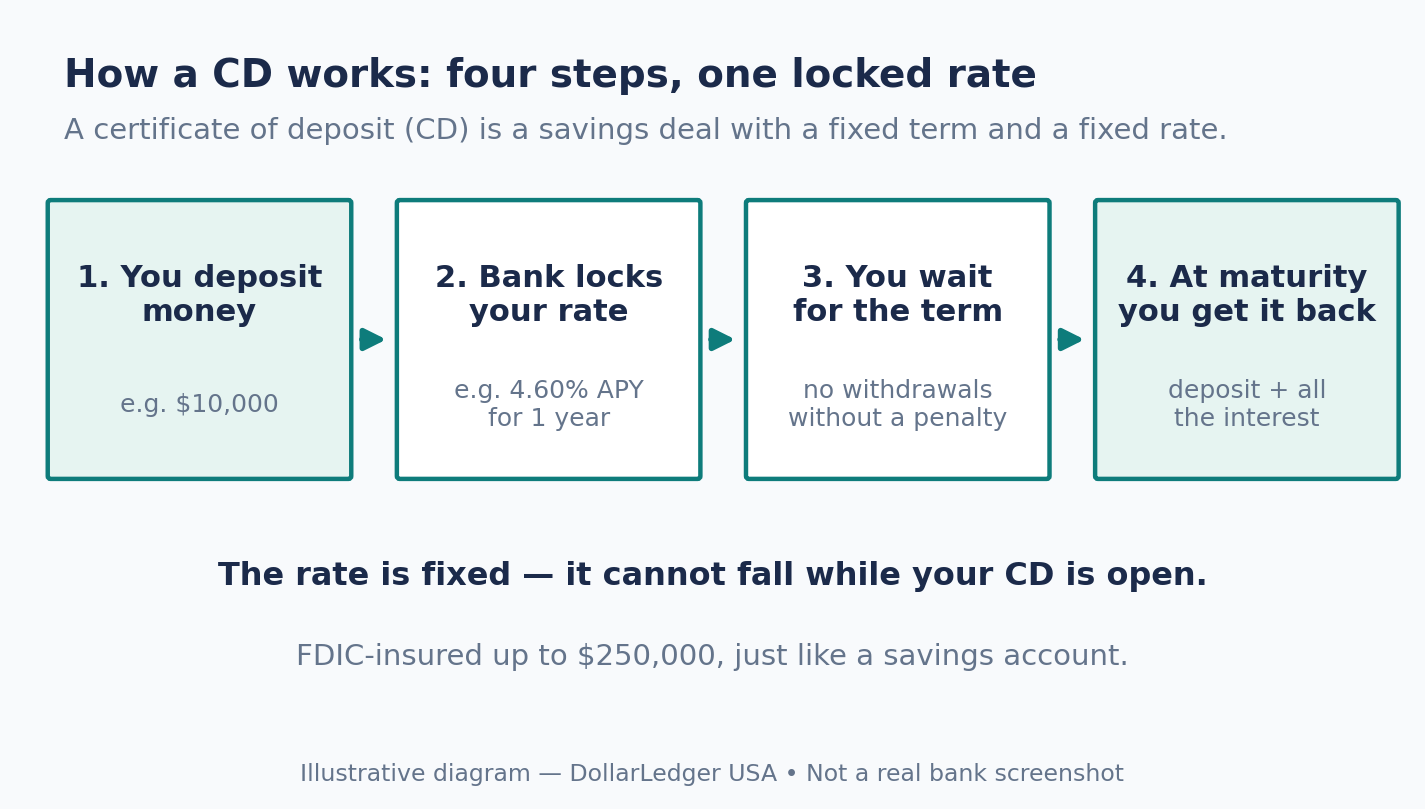
Illustrative diagram — How a CD works: four steps, one locked rate. NOT a real bank screenshot.
Step 2: Compare the best rates by term
What to do: Compare the top rate for each term with the national average.
How: The best CD rates in the USA, checked November 2, 2026. Rates are fixed for the term; averages are from Bankrate’s survey, also as of November 2, 2026.
- 1-year CD — best 4.60% APY (Popular Direct); E*TRADE 4.55%, Barclays 4.50%, Quorum FCU 4.50% ($100 min), Marcus 4.40% ($500 min); average 2.11% APY.
- 3-year CD — best 4.85% APY (Popular Direct, $10,000 min); E*TRADE 4.80%, Sallie Mae 4.60% ($2,500 min), Bread Financial 4.60%; average 1.73% APY.
- 5-year CD — best 5.00% APY (Popular Direct, Sallie Mae); Synchrony 4.75%, Bread Financial 4.70%, Ally 4.50%; average 1.78% APY.
Example: The best 1-year rate (4.60%) pays more than twice the average (2.11%) — about $460 instead of about $211 on $10,000.
Common mistake: Taking the first rate your own bank offers. Big banks usually pay close to the average — the top rates are at online banks and credit unions.
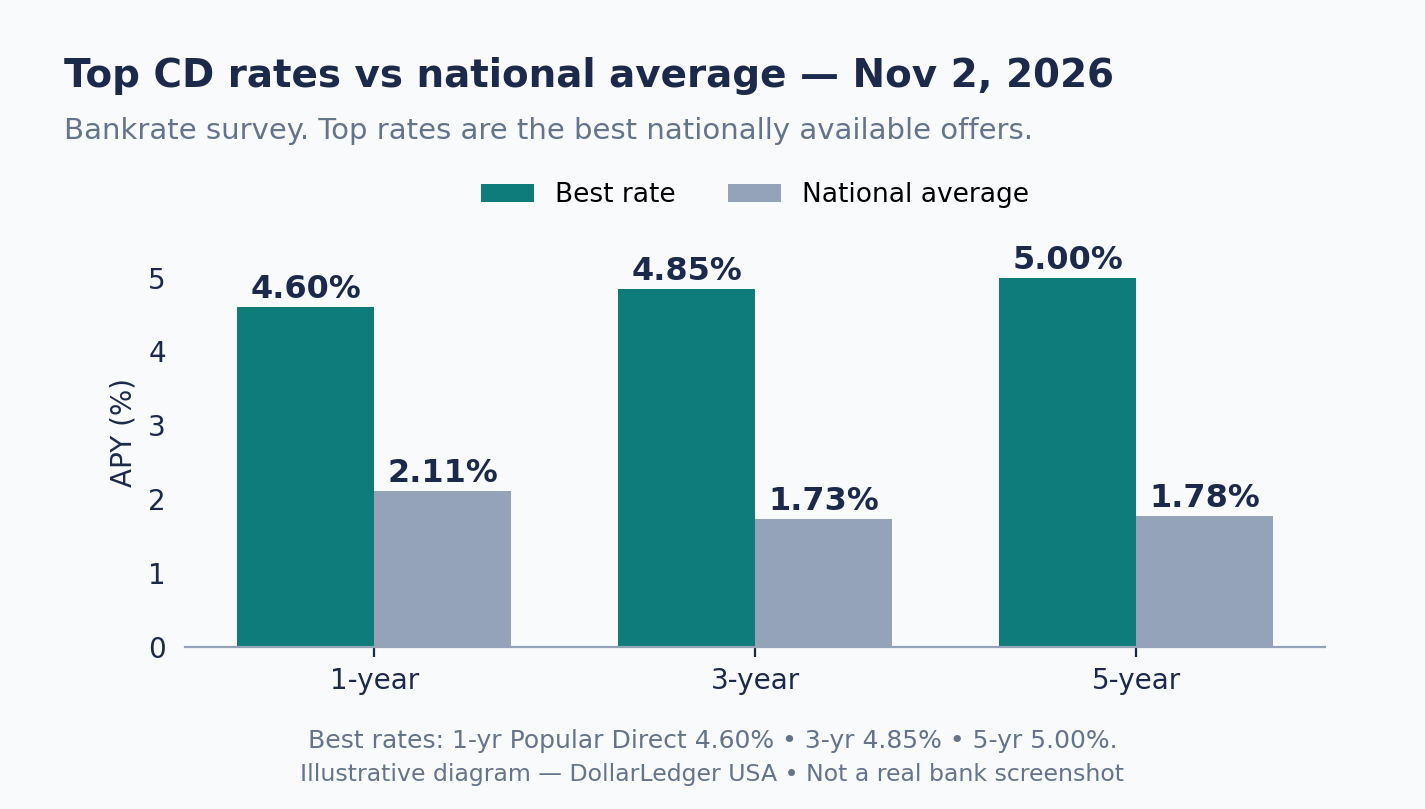
Illustrative diagram — Top CD rates vs national average, Nov 2, 2026. NOT a real bank screenshot.

Photo: A CD is a trade of time for money — the longer you wait, the more you earn. (Photo: Pexels)
Step 3: Work out what you actually earn
What to do: Turn the APY into dollars.
How: What $10,000 earns at the best rate for each term: 1-year CD at 4.60% APY, about $460 in one year. 3-year CD at 4.85% APY, about $1,527 over three years. 5-year CD at 5.00% APY, about $2,763 over five years. 1-year CD at the national average of 2.11% APY, about $211 — less than half the best rate. A high-yield savings account pays around 4.40% APY but lets you withdraw any time — see our best s and how a HYSA works.
Example: Maria needs $10,000 for a house deposit in one year. A 1-year CD at 4.60% earns her about $460; a 5-year CD would lock it away too long.
Common mistake: Comparing a 5-year total ($2,763) with a 1-year total ($460). Always compare the same length of time.
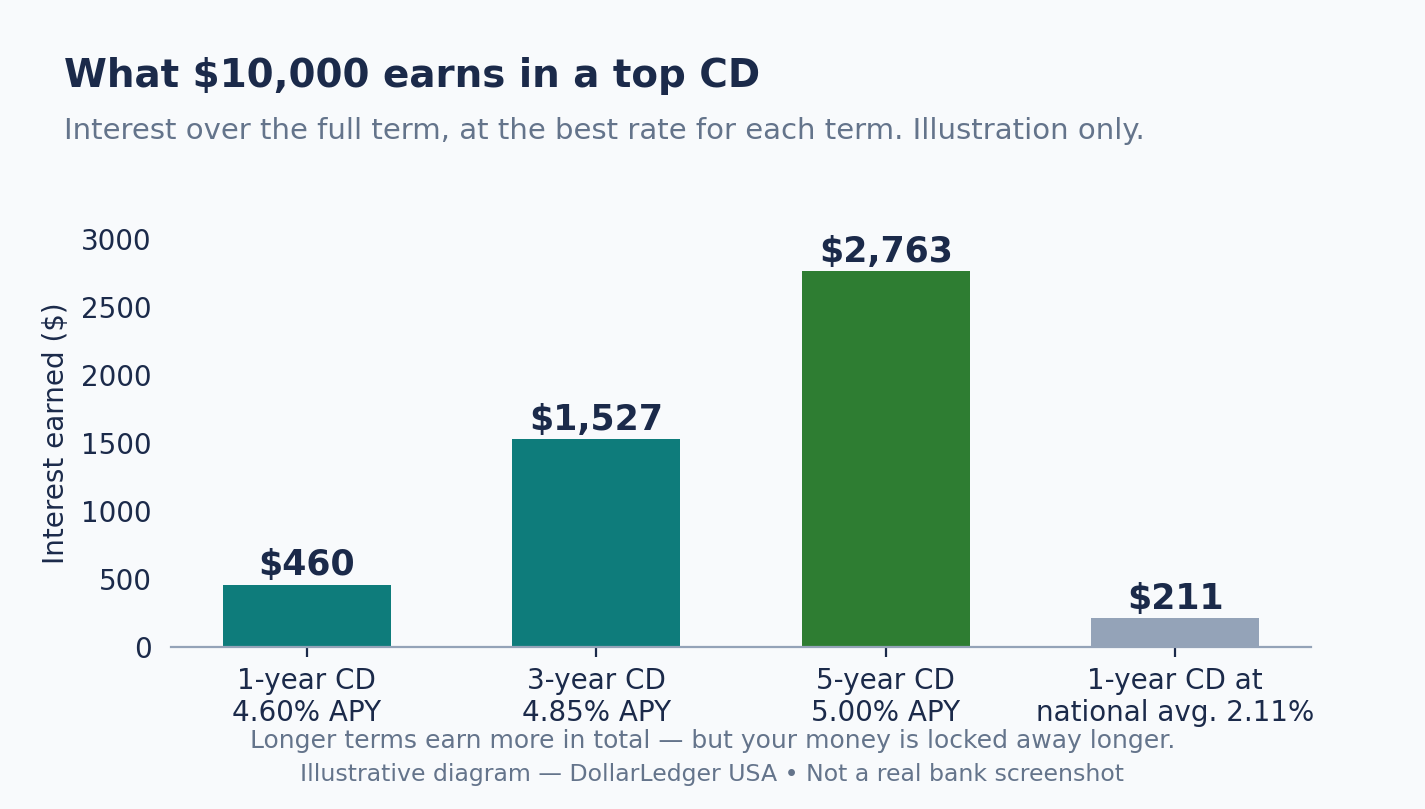
Illustrative diagram — What $10,000 earns in a top CD. NOT a real bank screenshot.
Step 4: Know the early-withdrawal penalty before you lock in
What to do: Read the penalty terms before you lock in.
How: Taking money out before maturity costs an early-withdrawal penalty — usually 90 to 365 days of interest, depending on the term. Longer terms carry bigger penalties: Ally Bank charges 60 days on a 1-year CD, 90 days on a 3-year CD, and 150 days on a 5-year CD. If you have not earned enough interest to cover the penalty, the bank takes the rest from your deposit.
Example: You put $10,000 in a 1-year CD at 4.40% APY, then break it after three months: a 90-day penalty costs about $108 — wiping out what you earned.
Common mistake: Locking away money you might need. Emergency money belongs in a .
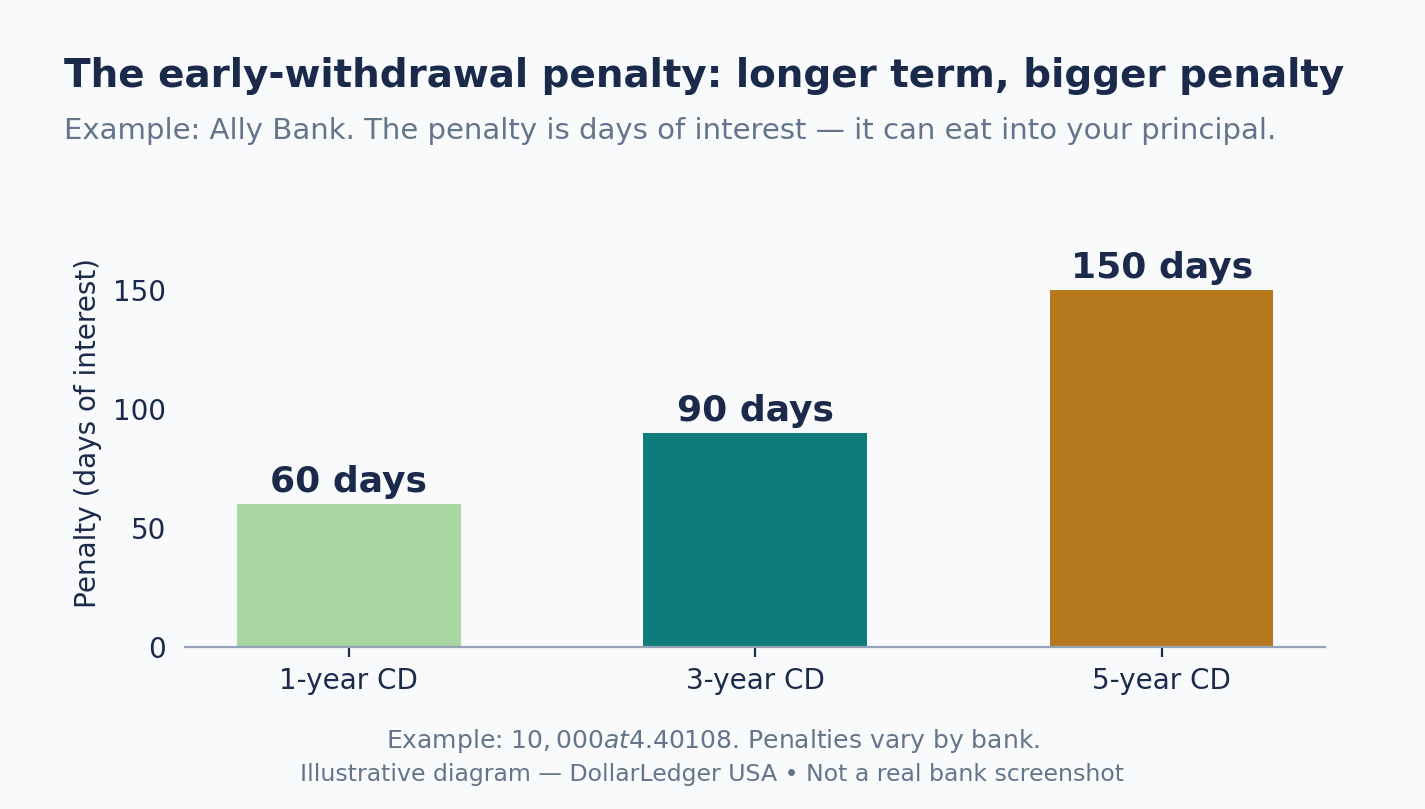
Illustrative diagram — The early-withdrawal penalty: longer term, bigger penalty. NOT a real bank screenshot.
Step 5: Plan for maturity — grace periods and CD ladders
What to do: Decide in advance what happens at maturity — and consider a ladder.
How: At maturity, most banks give you a 7 to 10 day grace period to withdraw or change the term. Do nothing, and many auto-renew it at the current rate — which may be lower. Set a calendar reminder. A ladder fixes the locked-money problem: split $10,000 into five $2,000 CDs of 1, 2, 3, 4 and 5 years, so one matures every year.
Example: James builds a $10,000 ladder with five $2,000 CDs. From year two on, a CD matures every year — he is never more than a year away from cash.
Common mistake: Forgetting the maturity date and letting a CD auto-renew at a lower rate.

Photo: Put the maturity date on your calendar. (Photo: Pexels)
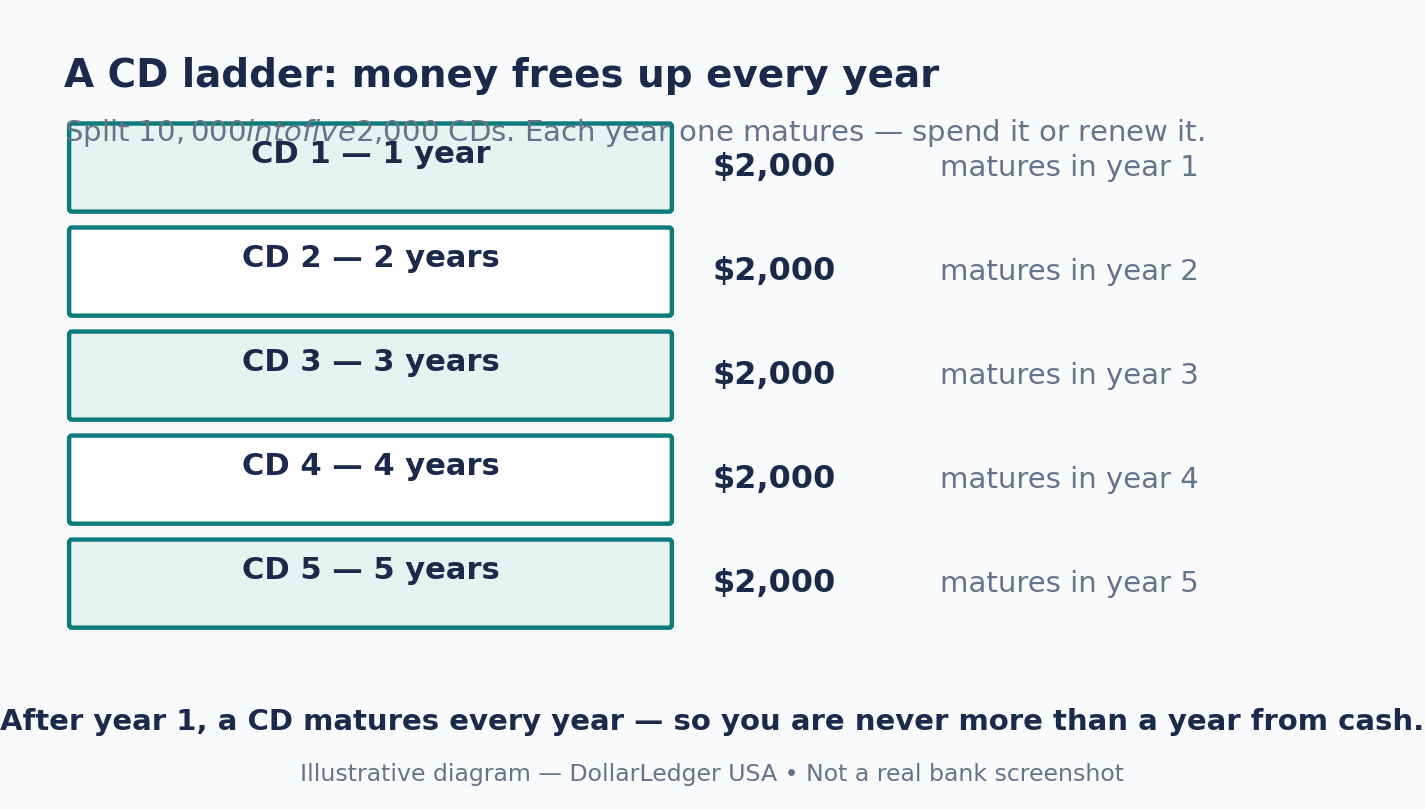
Illustrative diagram — A CD ladder: money frees up every year. NOT a real bank screenshot.
Step 6: Pick your term and open the CD
What to do: Match the term to the date you will need the money.
How: Ask one question: when will I spend this money? Under a year — do not lock it up; use a high-yield savings account or a short CD. About one year — a 1-year CD at up to 4.60% APY. About three years — up to 4.85%. Five years or more — up to 5.00%. Not sure? Pick the shorter term, or build a ladder. Apply on the bank’s website with a photo ID and your Social Security number, fund it with a transfer, and check the bank is FDIC- or NCUA-insured. Check the minimum deposit: some top rates need $10,000; E*TRADE and Barclays need none.
Example: David has $5,000 for a car he will buy in about a year. He picks a 1-year CD at 4.55% APY and earns about $228.
Common mistake: Chasing 5.00% with money you need in a year, or a $10,000 minimum when you only have $5,000.
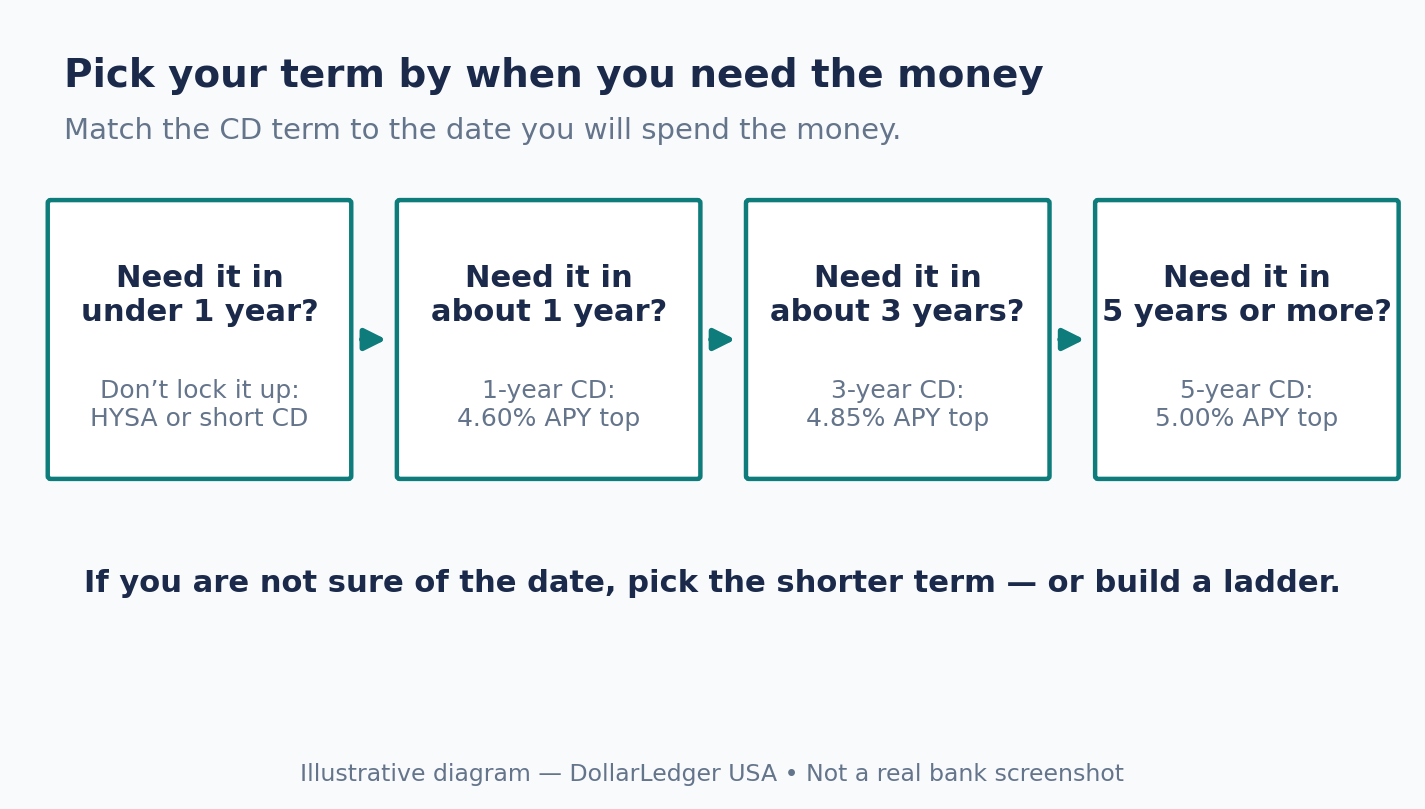
Illustrative diagram — Pick your term by when you need the money. NOT a real bank screenshot.
Checklist
- ☐ I picked a term matching when I need the money.
- ☐ I compared the top rate with the national average.
- ☐ I checked the minimum deposit for the rate I want.
- ☐ I read the early-withdrawal penalty for my term.
- ☐ I checked the bank is FDIC- or NCUA-insured.
- ☐ I set a calendar reminder for the maturity date.
FAQ
Is a CD better than a high-yield savings account?
It depends on when you need the money. A CD locks your rate, so it wins if rates fall — but your money is locked too. A high-yield savings account pays around 4.40% APY and lets you withdraw any time, but its rate can change. For an emergency fund, a savings account usually wins.
What happens when my CD matures?
You get your deposit back plus all the interest. Most banks give you a 7 to 10 day grace period to withdraw or change the term; do nothing, and many auto-renew it at the current rate.
Can I lose money in a CD?
Almost never — your deposit is FDIC-insured up to $250,000. The only risk is the early-withdrawal penalty: break the CD before earning enough interest to cover it, and the bank takes the rest from your deposit.
Are CD rates going up or down?
CD rates usually follow the Federal Reserve’s benchmark rate. When the Fed cuts rates, new CD rates usually fall too, which is why locking in can pay off. Check the current rate before you open a CD.
Do I pay tax on CD interest?
Yes — interest is taxable income in the year you earn it, even if the CD has not matured yet. Your bank sends a Form 1099-INT if you earn $10 or more in a year. Early-withdrawal penalties are tax-deductible.
Sources
- Bankrate, “Best CD Rates of November 2026 — Up to 5.00%” — top rates, Nov 2, 2026: https://www.bankrate.com/banking/cds/cd-rates/
- Bankrate, “What Is a CD (Certificate of Deposit)?” — penalties of 90 to 365 days of interest: https://www.bankrate.com/banking/cds/what-is-a-cd/
- Bankrate, “Here’s When an Early Withdrawal From a CD Is Worth It” — penalty examples by bank: https://www.bankrate.com/banking/cds/cd-early-withdrawal-can-come-at-a-high-price/
- FDIC, Deposit Insurance at a Glance — $250,000 per depositor, per bank, per ownership category: https://www.fdic.gov/consumer-resource-center/deposit-insurance-glance
All rates checked November 2, 2026.
Disclaimer: This article is for education only, not financial advice. Rates change often — confirm the current rate with the bank before opening an account.