How to Build an Emergency Fund on a $40,000 Salary in 2026
 DollarLedger Team
- 03 Nov, 2026
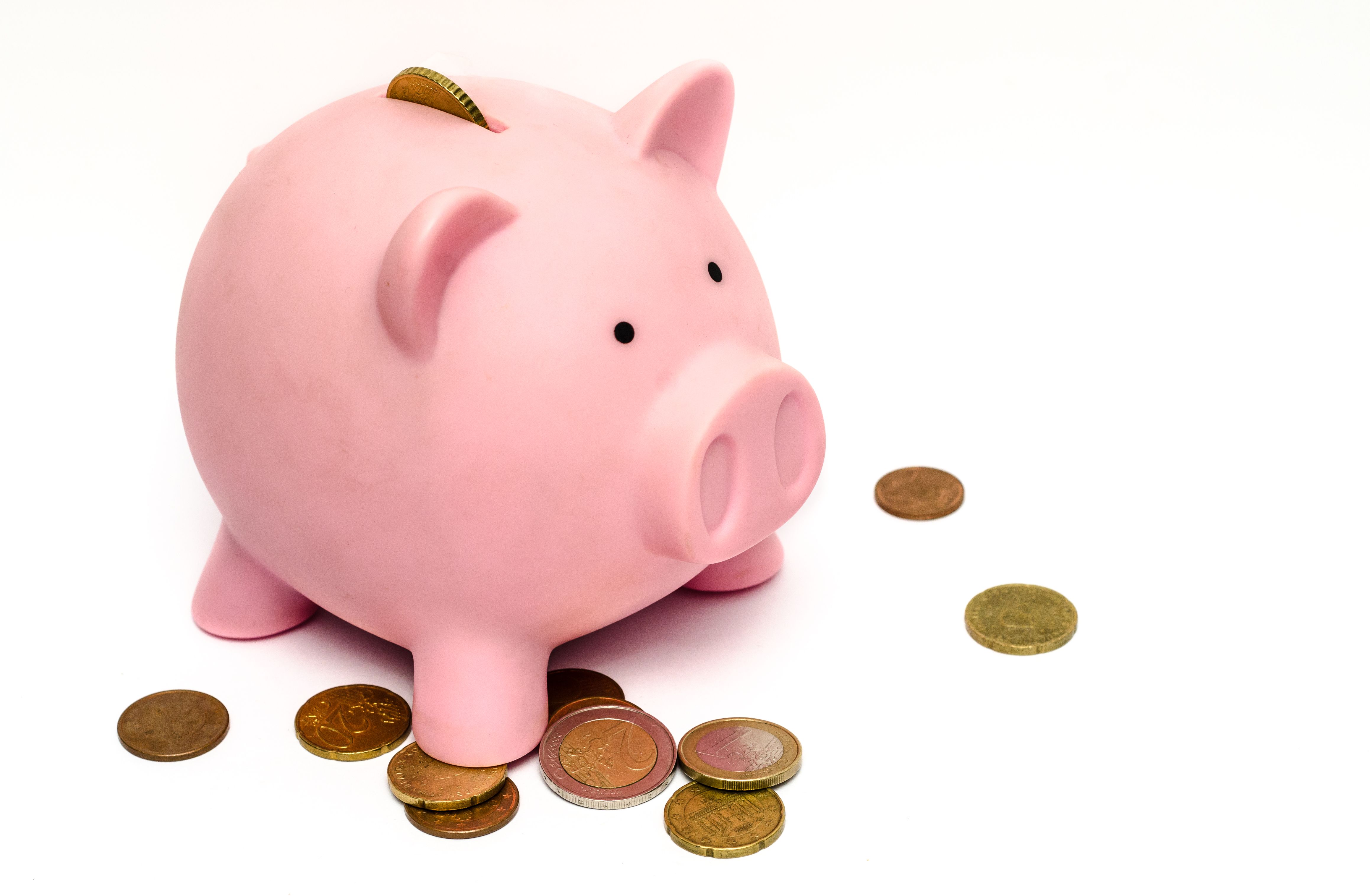
One car repair can wipe out a whole month of pay. On a $40,000 salary, a $900 bill can turn into credit card debt that takes a year to pay off. An emergency fund stops that: cash set aside for unplanned expenses — car repairs, medical bills, a broken appliance, job loss. The Consumer Financial Protection Bureau (CFPB) says even a small amount set aside can provide some financial security. This guide shows how to build one in 2026, with real numbers.
Photo: A piggy bank is the idea — a high-yield account is the same idea, earning interest. (Photo: Pexels)
What You Will Learn
- What your $40,000 salary is worth after tax
- How to add up your essentials
- Your 3- and 6-month fund targets
- How much to save each month, and how long it takes
- Where to keep the fund so it earns interest
Step 1: Work out your real take-home pay
What to do: Find out what actually lands in your bank account each month.
How: A $40,000 salary is $3,333 a month before tax. For a single filer in 2026, the IRS standard deduction is $16,100, so taxable income is $23,900. Federal tax is $2,620: 10% of the first $12,400 plus 12% of the rest. Payroll taxes add $2,480 (Social Security) and $580 (Medicare) — $5,680 in total. Take-home pay is $34,320 a year — $2,860 a month, $1,320 every two weeks.
Example: Alex earns $40,000: gross pay looks like $3,333 a month, but the pay stub shows about $2,860.
Common mistake: Budgeting from gross salary. Plan around $3,333 and every plan is about $470 short.
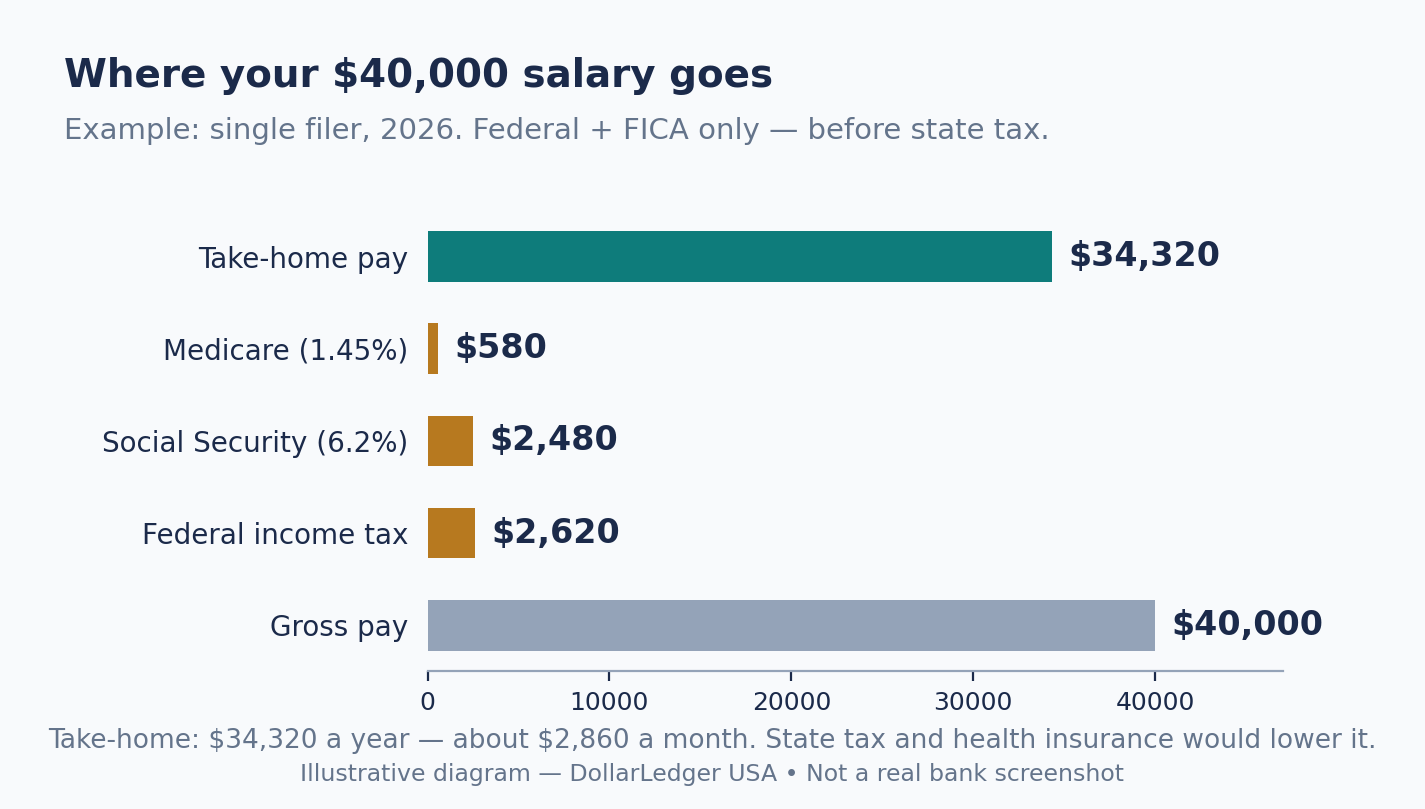
Illustrative diagram — Your $40,000 salary, after federal tax and payroll tax. NOT a real bank screenshot.
Step 2: Add up your essential monthly expenses
What to do: List the bills you would still have to pay if your income stopped tomorrow.
How: Add up one month of essentials from your statements: rent, utilities, groceries, transport, phone, insurance, minimum debt payments. Leave out things you could pause — eating out, streaming, holidays, new clothes. The CFPB and NerdWallet both suggest three to six months of essential expenses, not everything you spend.
Example: Alex’s essentials are $2,000 a month: rent $950, groceries $350, transport $200, utilities $150, insurance $120, minimum debt $170, phone $60. Alex spends about $2,860 most months, but only $2,000 is essential — counting the full $2,860 makes the six-month target $5,160 bigger than needed.
Common mistake: Setting the target from income. If you lost your job, income would be gone — but rent and bills would still be there.
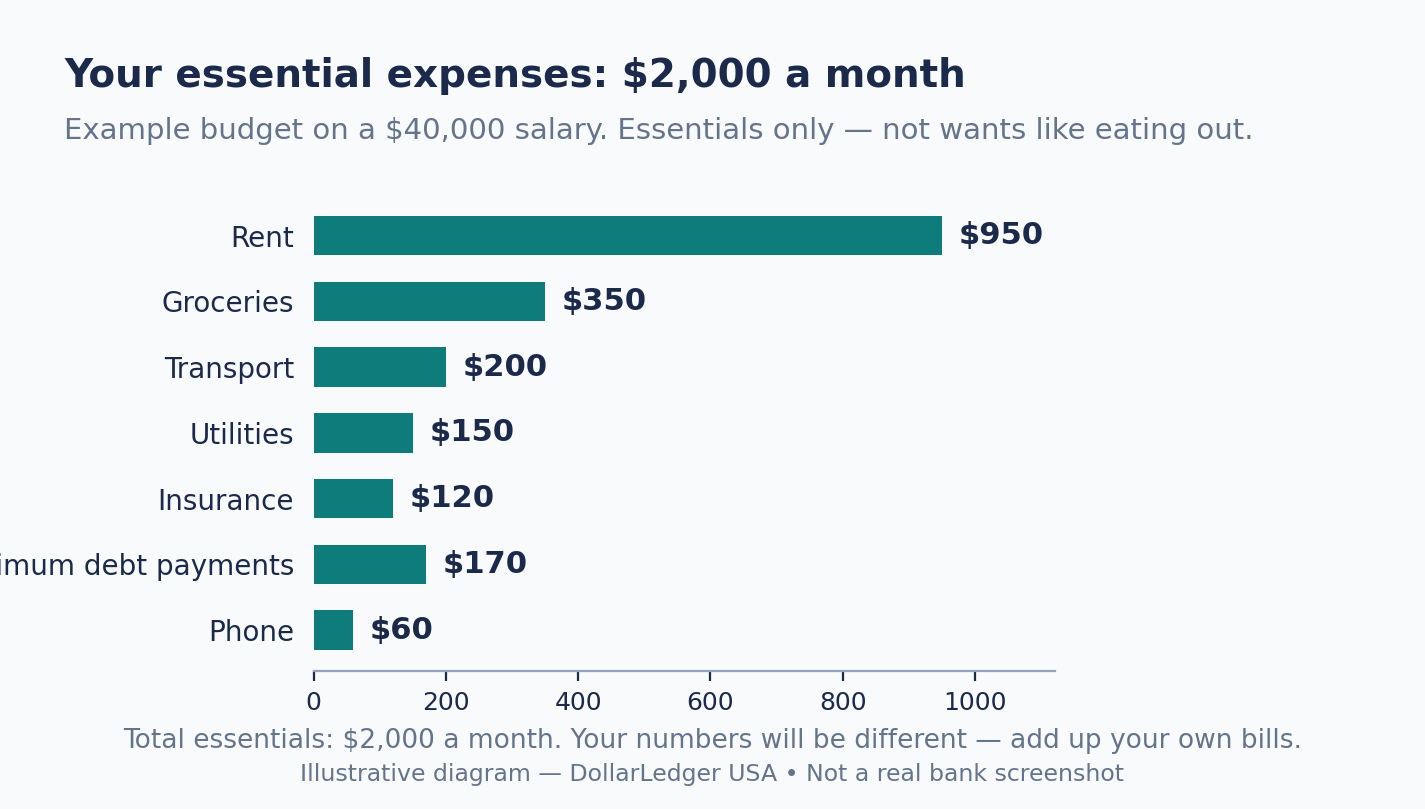
Illustrative diagram — Essentials only: $2,000 a month. NOT a real bank screenshot.
Step 3: Set your target — starter, 3 months, then 6 months
What to do: Turn your essentials into three targets, one at a time.
How: Multiply essentials by three and six: on $2,000, three months is $6,000, six months $12,000. Start with a $1,000 starter fund — NerdWallet suggests $500 as a first goal, and $1,000 covers more. Three months suits stable jobs; six fits single earners, the self-employed, variable income.
Example: Alex writes three targets on the fridge: $1,000, then $6,000, then $12,000. The $1,000 already handles the most common emergencies.
Common mistake: Staring at the six-month target and giving up. Nobody saves $12,000 in a month.
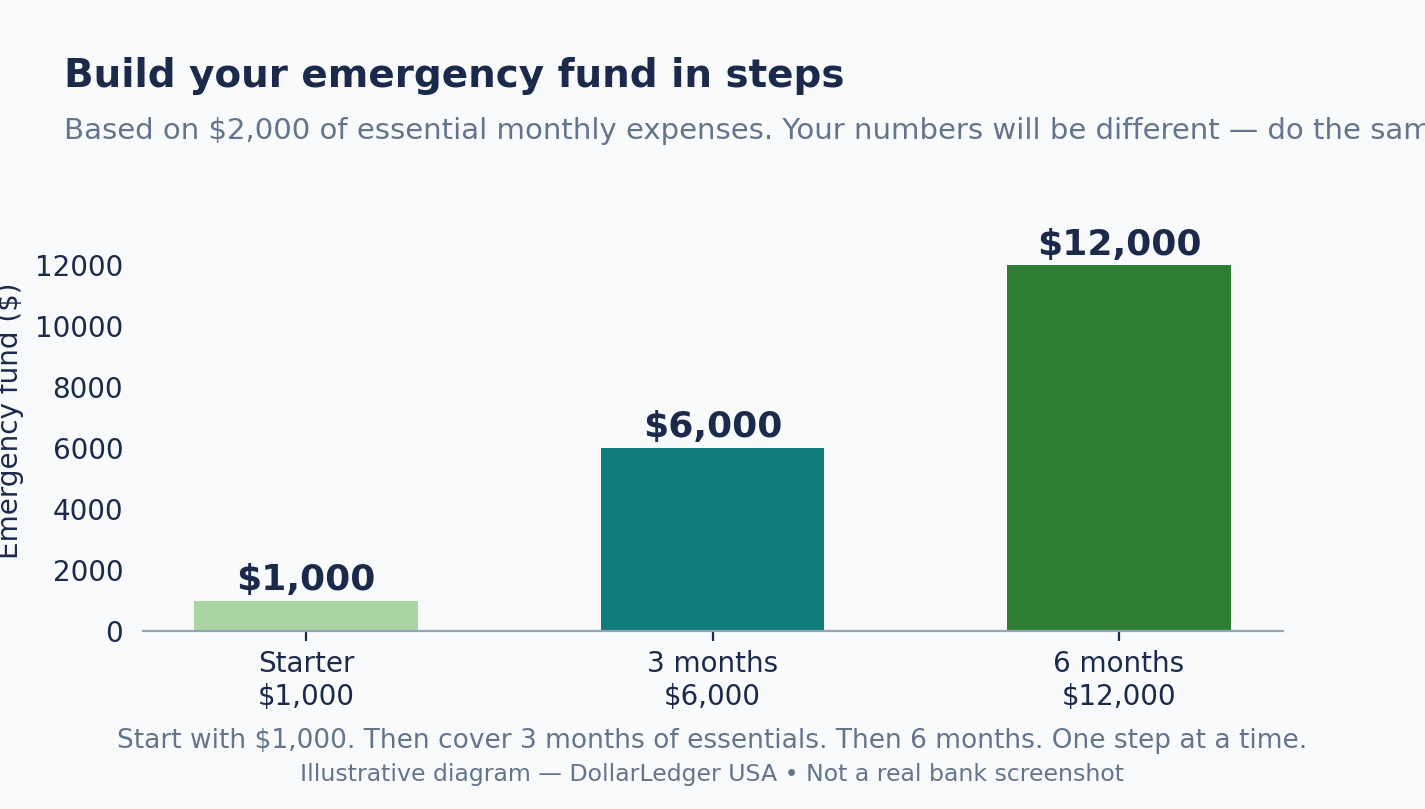
Illustrative diagram — Build your emergency fund in steps. NOT a real bank screenshot.
Step 4: Pick a monthly amount you can keep — then automate it
What to do: Choose a fixed monthly amount, and set it to move on its own on payday.
How: $250 a month is a good starting point: the $1,000 starter fund takes 4 months, the $6,000 target 24 months, the $12,000 target 48 months. Set up an automatic transfer for the day after payday — about $115 per paycheck. Our 50/30/20 budget guide shows how to find the $250 in your budget.
Example: Alex sets up a $250 transfer for the day after payday. By month four the starter fund is done; by month twelve there is $3,000 in the account.
Common mistake: Saving “whatever is left” at month’s end. There is almost never anything left. Pay yourself first, automatically.

Photo: Count your money once, set the transfer, then let payday do the work. (Photo: Pexels)
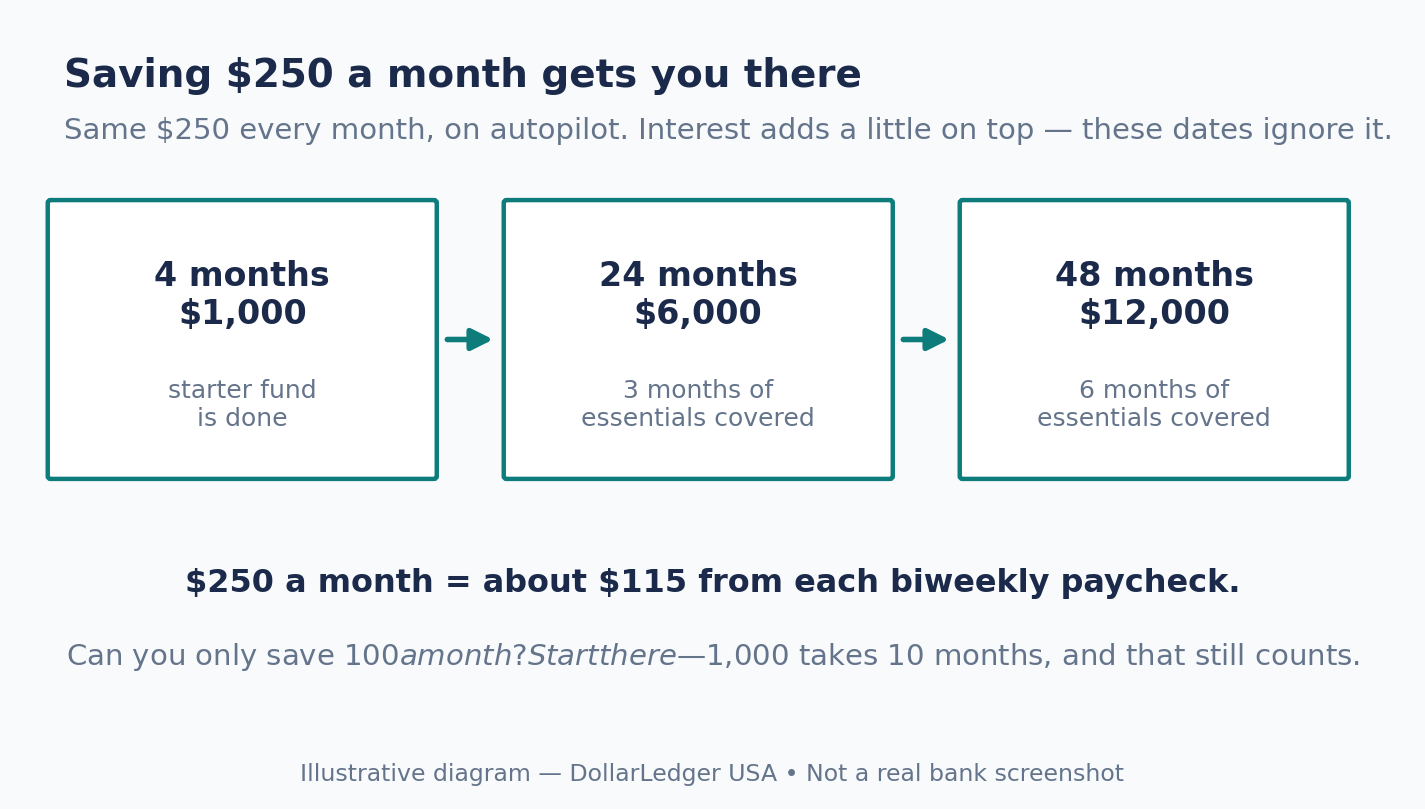
Illustrative diagram — $250 a month, on autopilot. NOT a real bank screenshot.
Step 5: Put the fund in a high-yield savings account
What to do: Keep the fund in a separate high-yield savings account (HYSA) — safe, reachable in a day or two, and earning real interest.
How: The national average savings rate is just 0.38% APY, according to the FDIC. A high-yield account pays around 4% APY or more. On $6,000, 0.38% earns about $23 a year; at 4.40% APY — a real November 2026 rate, no minimum — the same $6,000 earns about $264. On $12,000: about $46 vs about $528. Make sure it is FDIC- or NCUA-insured (up to $250,000 per depositor, per bank). Our guides to the best high-yield savings accounts in USA 2026 and how a high-yield savings account works explain them.
Example: Alex moves the $1,000 starter fund from 0.38% to 4.40% APY. It is still there when the car breaks down — but while it waits, it earns about $44 a year instead of about $4.
Common mistake: Keeping the fund in checking, where it gets spent, or in an old account earning almost nothing.
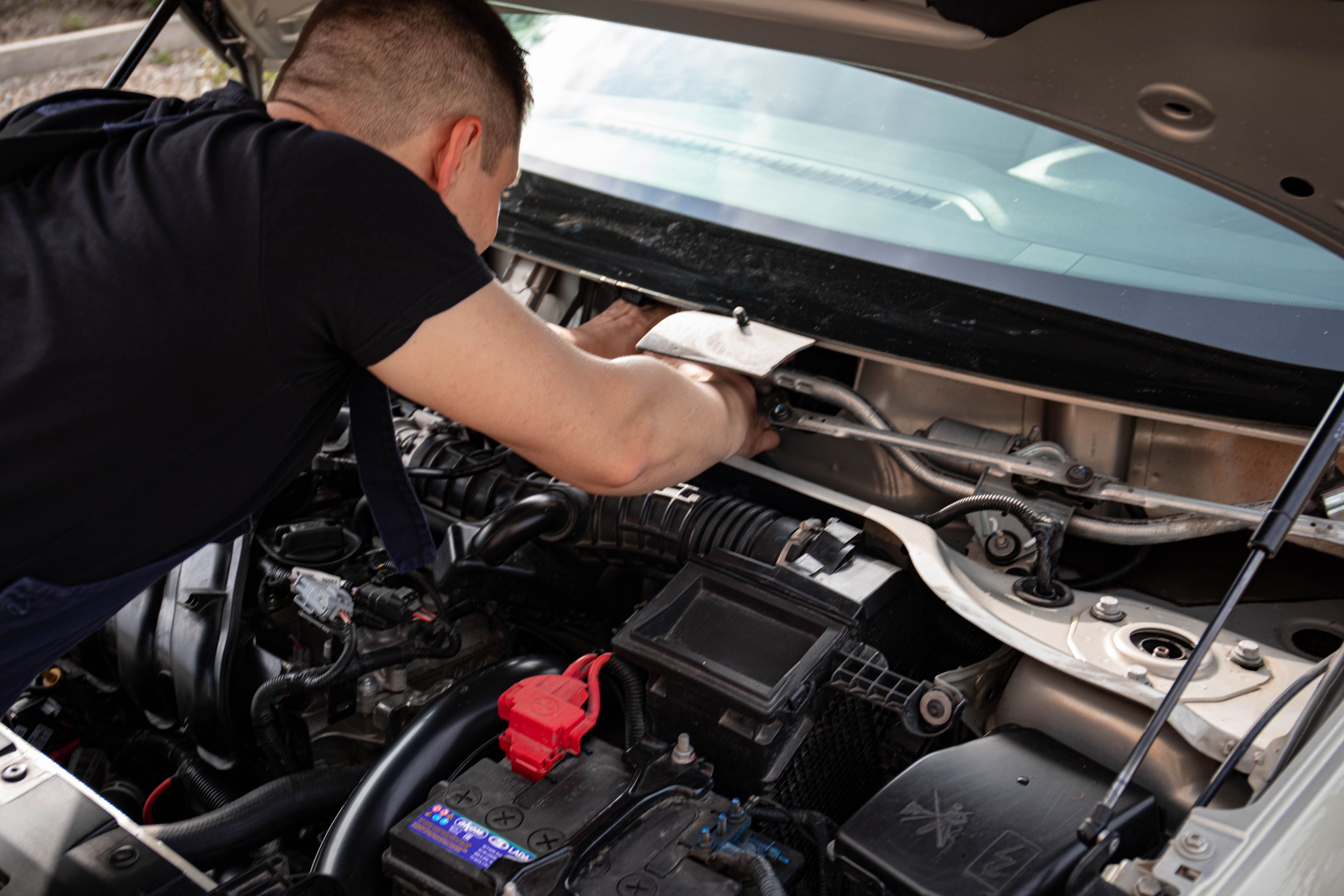
Photo: A car repair is the classic emergency fund moment — the bill arrives with no warning. (Photo: Pexels)
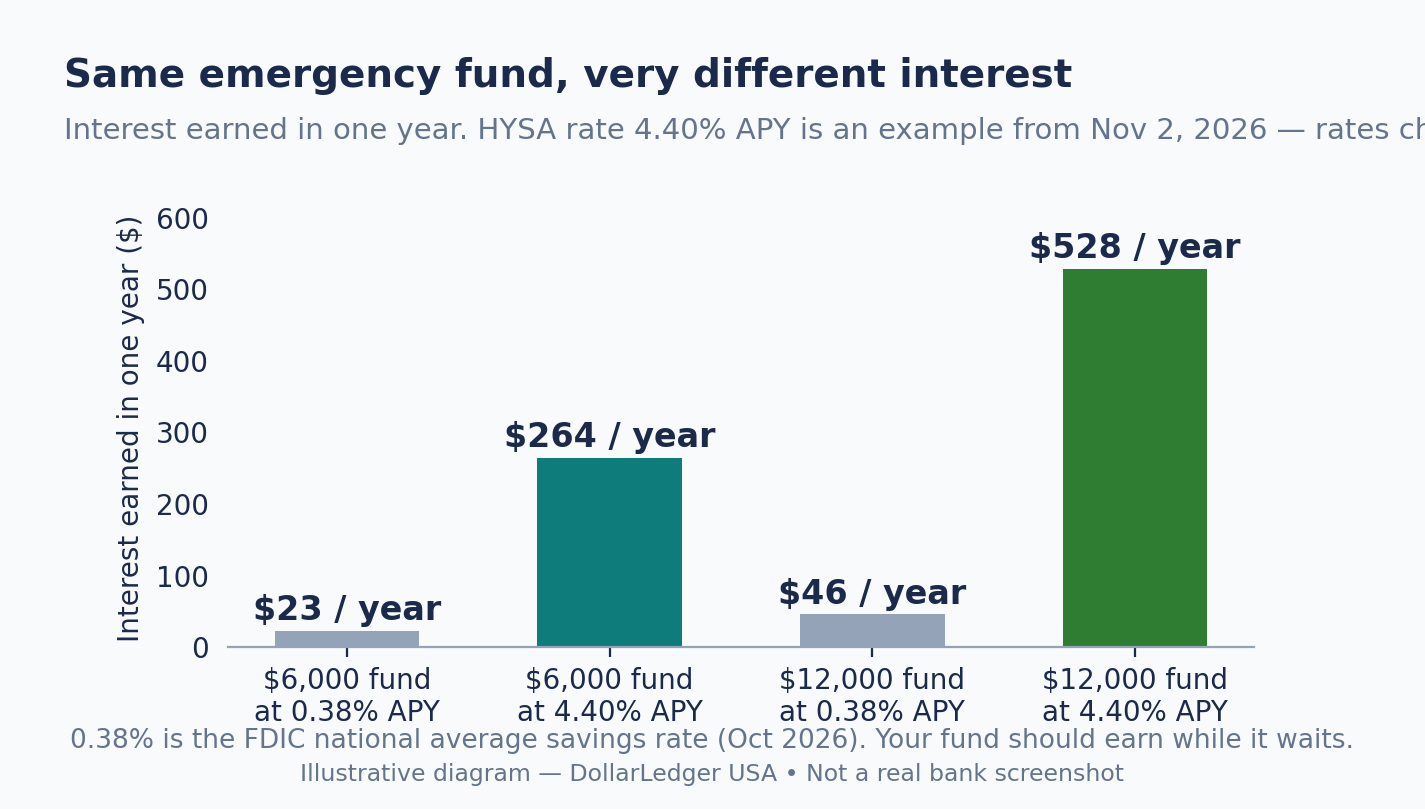
Illustrative diagram — Same fund, very different interest. NOT a real bank screenshot.
Step 6: Set the rules — when to use it, and how to rebuild it
What to do: Write down what counts as an emergency — and what does not.
How: An emergency is unplanned and necessary: a car repair, a medical bill, a broken heater, a loss of income. It is not a holiday, a sale, a new phone, or concert tickets. The CFPB’s advice: set guidelines, but do not be afraid to use the fund. Using it is not a failure — just rebuild it: restart the transfer, even at a smaller amount. Keep it off your credit card — the CFPB notes credit can make a one-time bill grow much larger through interest and fees.
Example: Alex’s car needs a $700 repair in month nine. The fund holds $2,250. Alex pays cash — then keeps the $250 transfer running and is back above $2,250 within three months.
Common mistake: Treating the fund like a second checking account. Every dip for a non-emergency is a hole in the safety net.
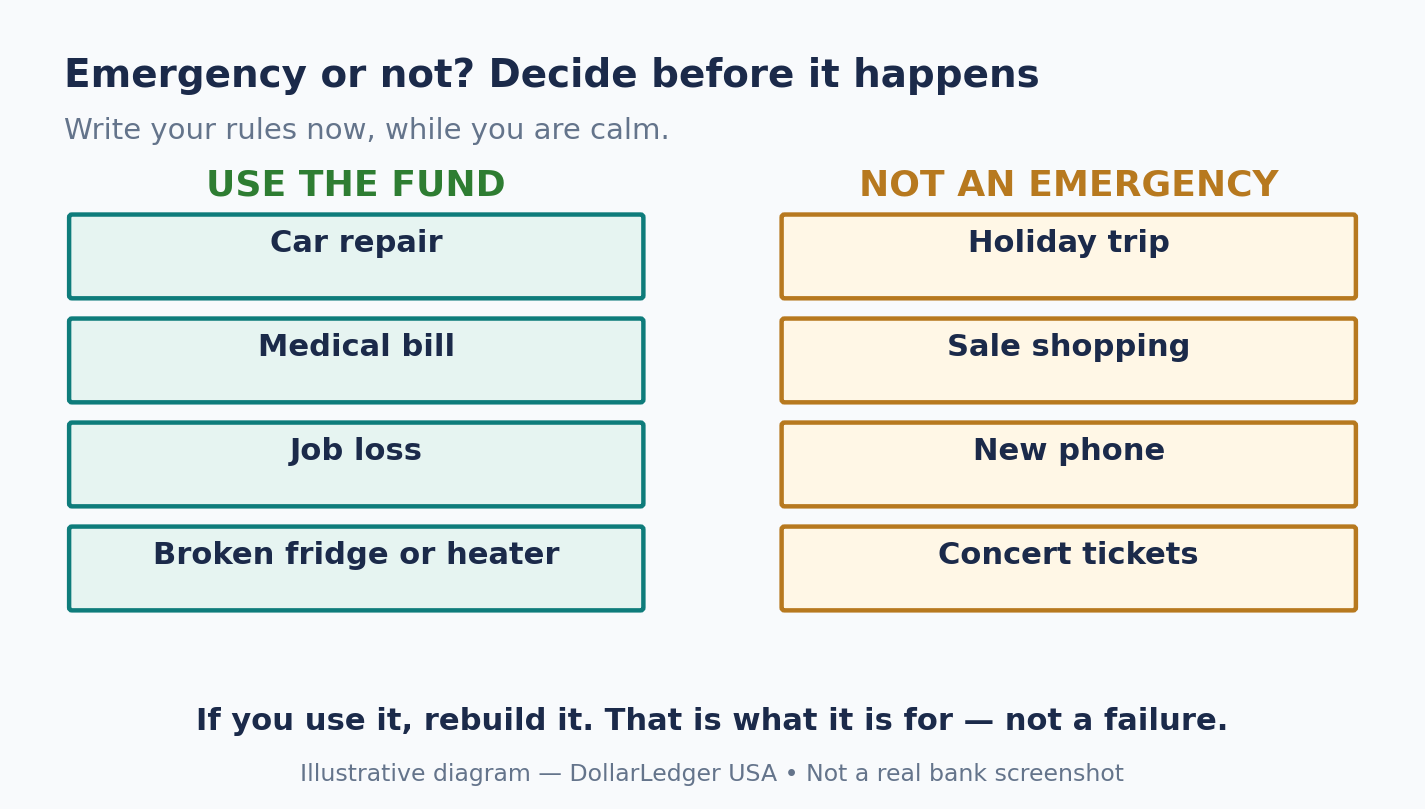
Illustrative diagram — Emergency or not? Decide before it happens. NOT a real bank screenshot.
Checklist
- ☐ I know my take-home pay (about $2,860 a month on $40,000, before state tax).
- ☐ I added up my essential expenses — my number, not the example’s.
- ☐ I wrote down my three targets: $1,000 starter, then 3 months, then 6 months.
- ☐ I set up an automatic transfer for the day after payday.
- ☐ My fund is in a separate FDIC- or NCUA-insured high-yield account.
- ☐ I wrote my “emergency or not” rules down.
FAQ
How much emergency fund do I need on a $40,000 salary?
It depends on your essentials, not your salary. On $2,000 a month, aim for $6,000 (3 months), then $12,000 (6 months). Start with $1,000.
Is $1,000 enough for an emergency fund?
It is a good start, not the finish line. It covers the most common surprises — a car repair, a medical bill, a broken appliance — without debt. Then build toward three months, then six.
Where should I keep my emergency fund?
In a separate high-yield savings account at an FDIC- or NCUA-insured bank or credit union — safe, reachable in one to three business days, earning around 4% APY or more instead of 0.38%. Do not invest it.
What if I can only save $50 a month?
Save the $50. A $1,000 starter fund takes 20 months at that rate — but $300 after six months beats nothing. Raise it whenever your pay rises or a bill ends.
Should I pay off debt first or build an emergency fund first?
Both, in order: build a $1,000 starter fund first, then attack high-interest debt, then build the fund to three and six months. Without the starter fund, the next surprise goes on a credit card.
Sources
- CFPB, “An essential guide to building an emergency fund”: https://www.consumerfinance.gov/an-essential-guide-to-building-an-emergency-fund/
- NerdWallet, “Emergency Fund Calculator: How Much Should I Have?”: https://www.nerdwallet.com/banking/learn/emergency-fund-calculator
- IRS, “Tax inflation adjustments for tax year 2026” (IR-2025-103): https://www.irs.gov/newsroom/irs-releases-tax-inflation-adjustments-for-tax-year-2026-including-amendments-from-the-one-big-beautiful-bill
- Motley Fool, “Best High-Yield Savings Accounts, Nov. 2, 2026”: https://www.fool.com/money/banks/articles/top-savings-account-rates-today-nov-2-2026/
- DollarLedger USA, “Best High-Yield Savings Accounts in USA 2026”: </blog/best-high-yield-savings-accounts-in-usa>
- DollarLedger USA, “How Does a High-Yield Savings Account Work? Explained for Beginners”: </blog/how-does-high-yield-savings-account>
- DollarLedger USA, “How to Budget on a Low Income in USA: 50/30/20 Rule Explained”: </blog/how-to-budget-on-low-income-in-usa>
Rates checked November 2, 2026; confirm the current rate with the bank. The take-home example is a federal-only estimate for a single filer.
Disclaimer: This article is for education only, not financial advice. Rates change often — confirm the current rate with the bank before opening an account.