Health Insurance Open Enrollment in 2026 — How to Choose a Plan (and What Changed on Subsidies)
 DollarLedger Team
- 12 Nov, 2026

Open enrollment is open right now, for 2027 coverage — not 2026 — and it closes on January 15, 2027. The rules changed more this year than in any year since the Marketplace began. The biggest change: the enhanced premium tax credits that ran from 2021 through 2025 expired on December 31, 2025, and Congress has not restored them. Credits are back to the Affordable Care Act structure — only for households between 100% and 400% of the federal poverty level, with a hard cliff above 400%. Figures checked November 12, 2026.
Photo: Open enrollment for 2027 coverage is open now — but the subsidy rules are different this year. (Photo: Pexels)
What You Will Learn
- The two deadlines that decide when coverage starts
- Your income as a share of the poverty level
- What you will pay toward a Silver plan
- Which metal tier fits, and why Silver matters
- How to compare total cost, not just the premium
Step 1: Mark the two deadlines
What to do: Put December 15, 2026 and January 15, 2027 in your calendar — they do different jobs.
How: On HealthCare.gov, open enrollment for 2027 coverage runs November 1, 2026 to January 15, 2027. Enroll by December 15, 2026 for coverage from January 1, 2027, once you pay the first premium. Enroll December 16 to January 15 and coverage starts February 1, 2027 — you lose a month. After January 15 you generally cannot enroll or change plans unless you qualify for a Special Enrollment Period. State-run exchanges set their own dates.
Example: Pick a plan on December 14 and you are covered from January 1; pick it on December 16 and coverage starts February 1 — January is uninsured.
Common mistake: Treating January 15 as the only deadline and losing a month of coverage.
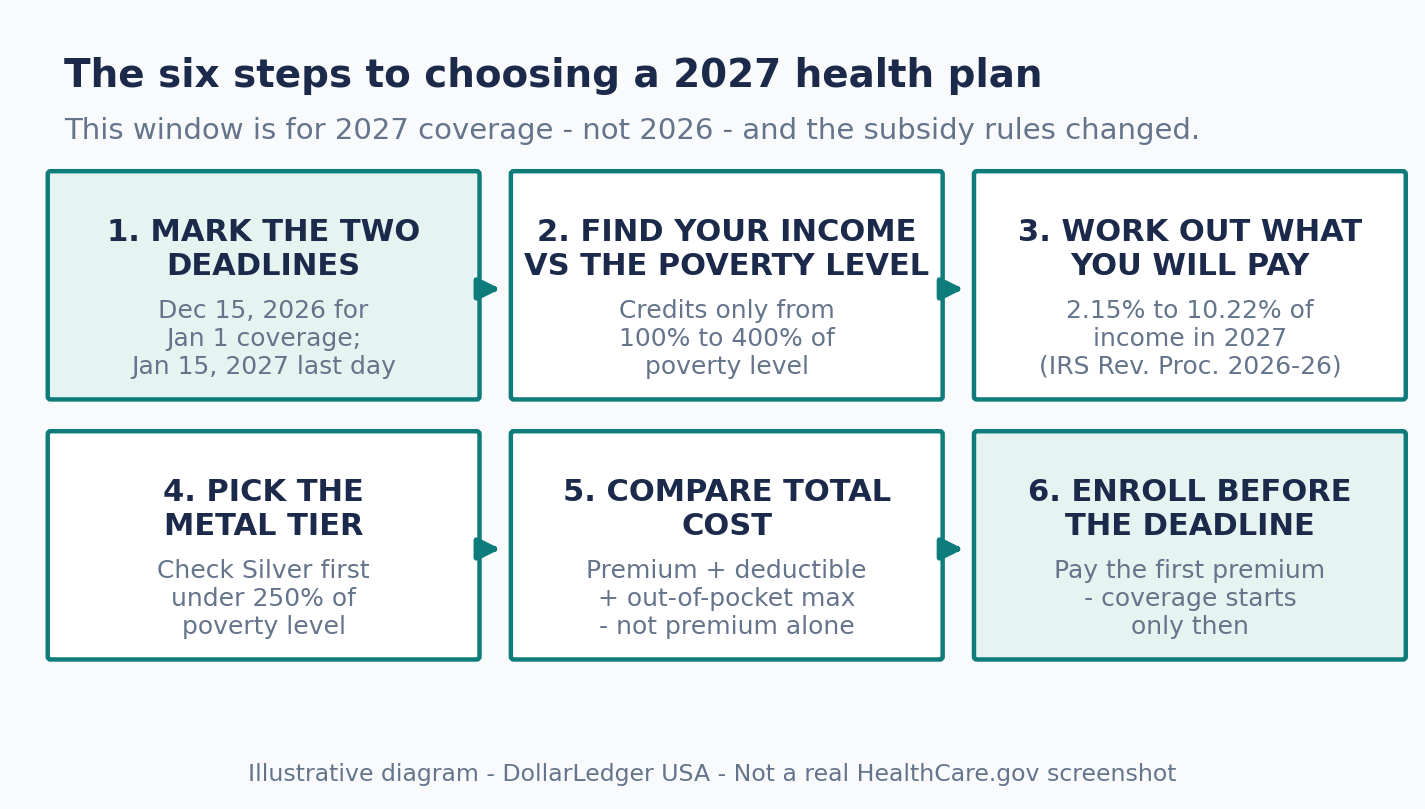
Illustrative diagram - The six steps to choosing a 2027 health plan. NOT a real HealthCare.gov screenshot.
Step 2: Find your income as a share of the poverty level
What to do: Work out where your 2027 income sits against the federal poverty level (FPL) before you shop — it decides whether you get any help.
How: For 2027 coverage the Marketplace uses the 2026 HHS guidelines: $15,960 for one person and $33,000 for a family of four in the 48 contiguous states and D.C., plus $5,680 for each extra person (Alaska and Hawaii are higher). Credits are available only between 100% and 400% of FPL: the cliff is $63,840 for one person, $132,000 for a family of four. One dollar above the line and the whole credit is $0. Below 100% you generally get no credit either — check Medicaid. Use expected 2027 income, not last year’s tax return.
Example: A single person expecting $40,000 in 2027 is at about 251% of poverty — inside the range.
Common mistake: Shopping before checking your FPL band.
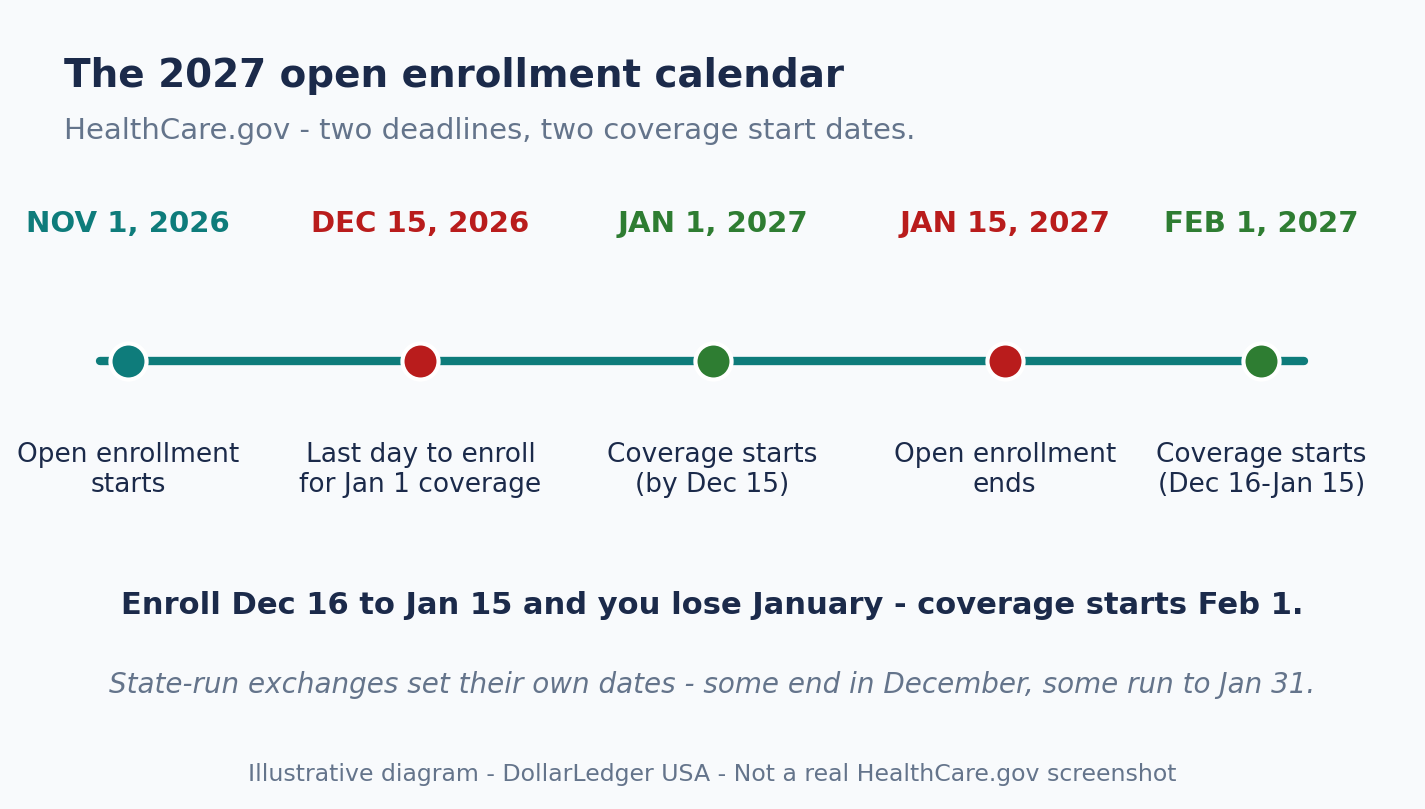
Illustrative diagram - The 2027 open enrollment calendar: two deadlines, two start dates. NOT a real HealthCare.gov screenshot.

Photo: Your income against the poverty level decides whether you get any help at all — check it before you shop. (Photo: Pexels)
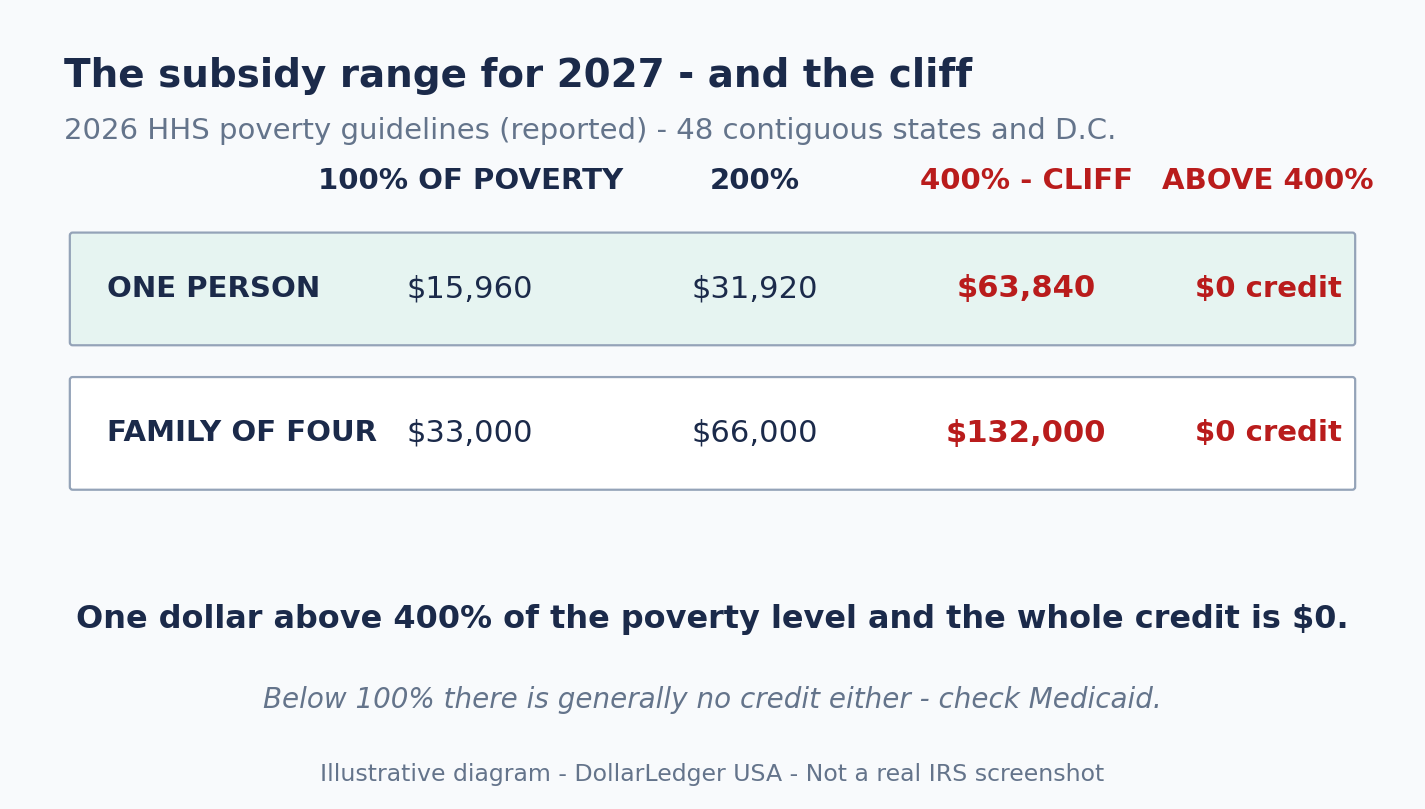
Illustrative diagram - The subsidy range for 2027: 100% to 400% of the poverty level, then a hard cliff. NOT a real IRS screenshot.
Step 3: Work out what you will actually pay
What to do: Estimate your expected contribution toward the benchmark Silver plan.
How: The credit is the benchmark premium minus your expected share of income. For 2027 that share runs from 2.15% of income at the bottom to 10.22% at the top (IRS Rev. Proc. 2026-26). Do not use last year’s figure: for the 2026 plan year the top rate was 9.96% (Rev. Proc. 2025-25). The rate rises with income — about 4.30% at 150% of poverty, 6.78% at 200%, 8.66% at 250% — and is flat at 10.22% from 300% to 400%. Job-based cover has its own test: for 2027 your employer’s self-only premium counts as affordable if it costs you no more than 10.22% of household income (9.96% for the 2026 plan year).
Example: A single person at $31,920 — exactly 200% of poverty — pays about 6.78% of income, about $2,164 a year, about $180 a month, toward the benchmark plan; the credit covers the rest.
Common mistake: Using the 9.96% figure for 2027 coverage — that was the 2026 plan-year rate.
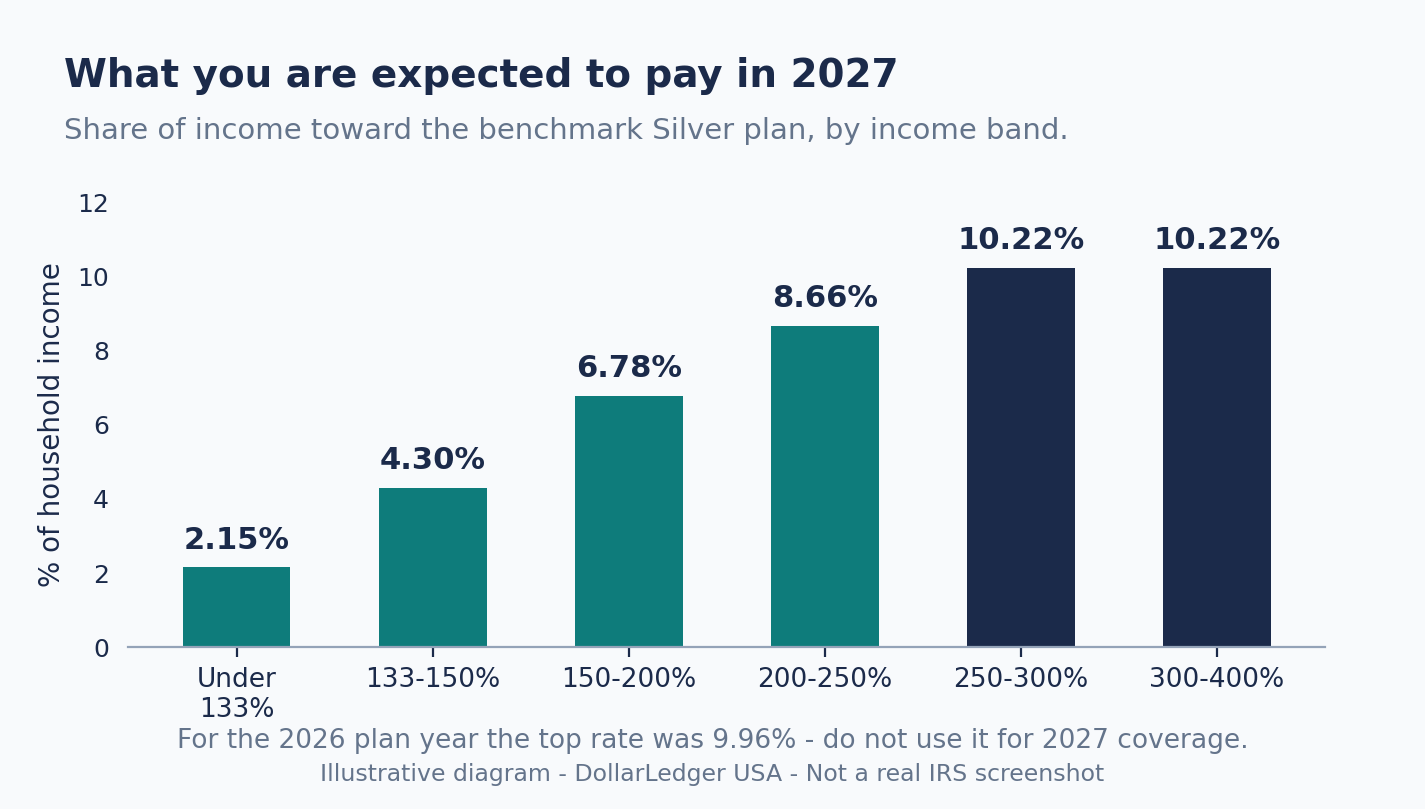
Illustrative diagram - What you are expected to pay in 2027: 2.15% to 10.22% of income. NOT a real IRS screenshot.
Step 4: Pick the metal tier — and check Silver first if you earn under 250% of poverty
What to do: Choose the tier by how much care you expect to use, not by the lowest premium alone.
How: Plans come in four metal tiers showing roughly what share of covered costs each pays: Bronze about 60%, Silver about 70%, Gold about 80% and Platinum about 90% (HealthCare.gov). If your income is 100–250% of the poverty level, look at Silver first: cost-sharing reductions — lower deductibles, copays and out-of-pocket maximums — are available only on Silver plans. At 100–150% of poverty a Silver plan pays about 94% of covered costs, at 150–200% about 87%, and at 200–250% about 73% — better than Gold cover for a Silver premium. Bronze and catastrophic plans can now pair with a health savings account in 2027 (reported) — see HSA vs FSA in 2026: which one saves you more.
Example: At 180% of poverty, Bronze looks cheaper each month — but Silver pays 87% of covered costs against Bronze’s 60%, so one hospital visit can erase a year of premium savings.
Common mistake: Picking Bronze for the low premium while qualifying for Silver cost-sharing reductions.

Photo: Compare tiers on the Marketplace, not on premium alone — Silver can beat Bronze if your income is under 250% of poverty. (Photo: Pexels)
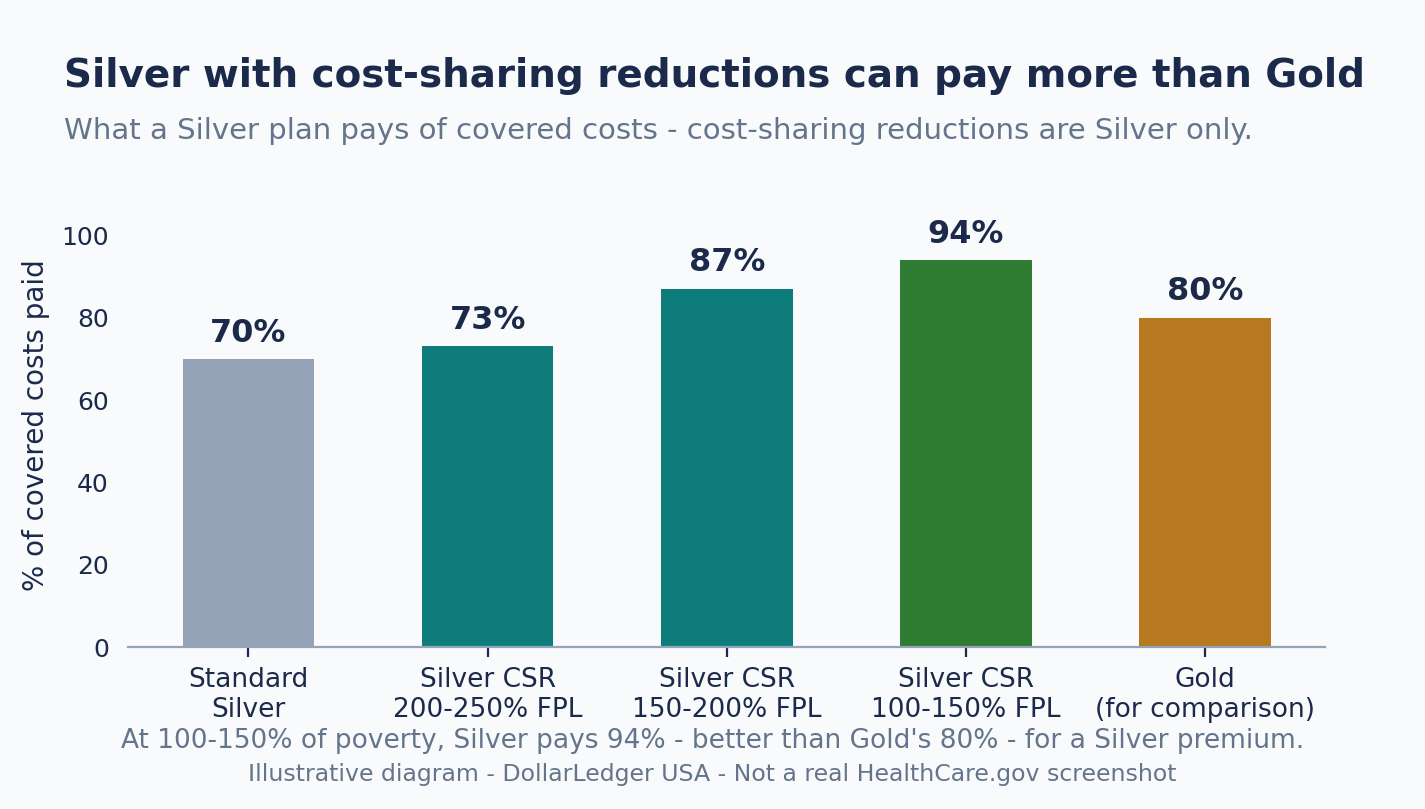
Illustrative diagram - Silver with cost-sharing reductions can pay more than Gold. NOT a real HealthCare.gov screenshot.
Step 5: Compare the total cost, not just the premium
What to do: Add up the full year — premium, deductible, copays and out-of-pocket maximum — for each plan on your shortlist.
How: Benchmark Silver premiums are up 13% on average for 2027 (KFF, reported), so last year’s premium is no guide. CMS says more than 75% of HealthCare.gov shoppers will still have access to a plan at $50 a month or less after credits — but people above the subsidy cliff pay full price. Beyond the premium, check the deductible, the out-of-pocket maximum ($12,000 for an individual in 2027, reported), and whether your doctors and prescriptions are in-network. If a bill still lands, see how to negotiate medical bills in 2026.
Example: Plan A: $280 a month, $6,000 deductible. Plan B: $340 a month, $1,500 deductible. With $4,000 of care, Plan A costs $3,360 + $4,000 = $7,360. Plan B costs $4,080 + $1,500 = $5,580 before copays. The higher premium is cheaper overall.
Common mistake: Choosing the cheapest premium and discovering the deductible at the first hospital visit.
Step 6: Enroll before the deadline — and know what happens if you miss it
What to do: Apply on HealthCare.gov (or your state exchange) and pay the first premium.
How: Have ready: Social Security numbers, your employer’s details, and your best estimate of 2027 household income — guess too low and you may repay some credit at tax time. The year-round window for households under 150% of poverty is gone for 2027 — low income alone no longer opens enrollment during the year. Outside open enrollment you can generally enroll only with a qualifying life event — job loss, marriage, a baby, a move — through a Special Enrollment Period, usually 60 days from the event. Medicaid and CHIP take applications all year. One thing is not settled: the House passed a three-year extension (H.R. 1834, 230–196) on January 8, 2026, but the Senate has not acted and it is not law — enroll under the current rules; if Congress restores the credits later, the Marketplace will recalculate them.
Example: You lose your job on March 1 — that qualifying event usually gives you about 60 days to enroll.
Common mistake: Waiting for Congress to restore the credits before enrolling — the deadline will not wait.
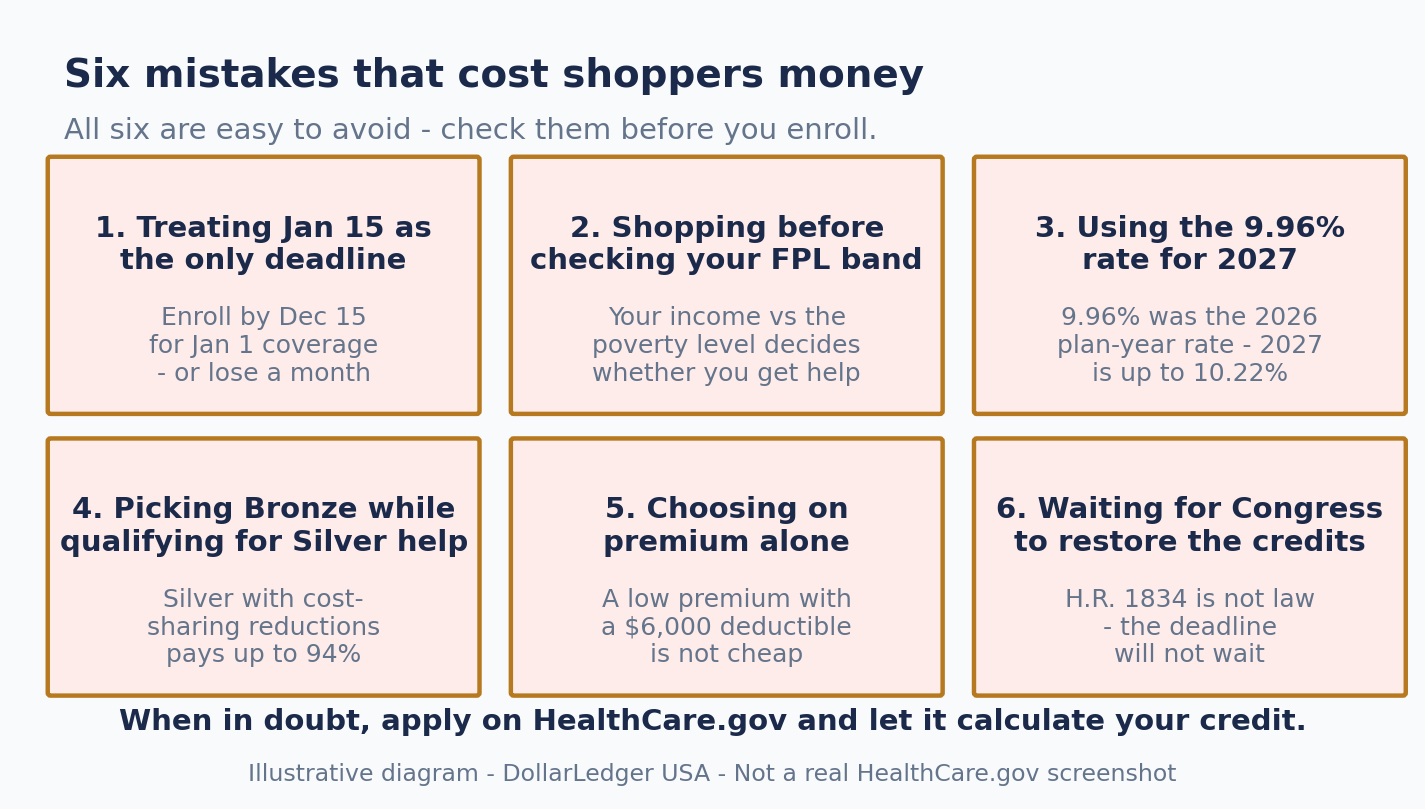
Illustrative diagram - Six mistakes that cost shoppers money. NOT a real HealthCare.gov screenshot.
Checklist
- ☐ December 15, 2026 in the calendar (January 1 coverage); January 15, 2027 as the last day.
- ☐ 2027 income checked against the poverty level and the 400% cliff.
- ☐ Expected contribution worked out (2.15%–10.22% of income for 2027).
- ☐ Silver compared first if I earn under 250% of poverty.
- ☐ Doctors and prescriptions checked in-network.
- ☐ Total yearly cost compared, not just the premium.
- ☐ First premium paid — coverage does not start until it is.
FAQ
When is open enrollment for 2027 health insurance?
November 1, 2026 to January 15, 2027 on HealthCare.gov. Enroll by December 15, 2026 for January 1, 2027 coverage; December 16 to January 15 means coverage from February 1, 2027.
What changed on subsidies for 2027?
The enhanced credits expired December 31, 2025. Credits follow the original Affordable Care Act rules: income between 100% and 400% of the poverty level only, with a hard cliff above 400%. The top expected contribution is 10.22% of income for 2027, up from 9.96% for 2026.
What income qualifies for a premium tax credit in 2027?
From 100% to 400% of the 2026 federal poverty guidelines: $15,960 to $63,840 for one person, $33,000 to $132,000 for a family of four.
What happens if my income is $1 over the 400% cliff?
The whole credit disappears — $0. At $63,840 a single person still gets a credit; at $63,841 there is none.
Can I enroll after January 15, 2027?
Only with a qualifying life event (job loss, marriage, baby, move), through a Special Enrollment Period, usually within 60 days of the event. Medicaid and CHIP accept applications all year.
Sources
- HealthCare.gov, When can you get health insurance? (opened live November 12, 2026): https://www.healthcare.gov/quick-guide/dates-and-deadlines/
- U.S. Internal Revenue Service, Rev. Proc. 2026-26 — 2027 Applicable Percentage Table and Required Contribution Percentage (opened live November 12, 2026): https://www.irs.gov/pub/irs-drop/rp-26-26.pdf
- Centers for Medicare & Medicaid Services, Plan Year 2027 Marketplace Plans and Prices Fact Sheet (opened live November 12, 2026): https://www.cms.gov/newsroom/fact-sheets/plan-year-2027-marketplace-plans-prices-fact-sheet-0
All figures checked November 12, 2026, against HealthCare.gov, the IRS and CMS. Poverty figures are the HHS 2026 guidelines (reported); the premium change is from KFF’s October 30, 2026 analysis (reported).
Disclaimer: For education only, not insurance, tax or medical advice. Confirm your own figures on HealthCare.gov before you enroll.