SNAP Food Stamps in 2026 — Who Qualifies, How Much You Get, and How to Apply
 DollarLedger Team
- 08 Nov, 2026

SNAP — the Supplemental Nutrition Assistance Program, still called food stamps — helps about 40 million Americans buy groceries every month. Yet many people who qualify never apply: the rules look complicated, with two income tests, a benefit formula, and asset limits. This guide explains each piece in plain language. One warning: last year’s numbers are all over the internet. The USDA’s fiscal year 2027 began on October 1, 2026, so the FY2027 figures below are the ones in force now, through September 30, 2027. Last year’s figures are stale.
Photo: SNAP benefits load onto an EBT card and spend like a debit card at grocery stores and markets. (Photo: Pexels)
What You Will Learn
- The two income tests and the FY2027 limits
- How much you can get: the maximums and the 30% benefit formula
- A worked example: a family of four gets $423
- The asset test, and why most states do not apply it
- How to apply
Step 1: Check the two income tests
What to do: Compare your household’s monthly income with the two federal limits — most must pass both.
How: Gross income is all income before deductions. For FY2027, in the 48 states and D.C., the gross limit is 130% of the poverty level: $1,729 a month for one person, $2,345 for two, $2,960 for three, and $3,575 for four, plus $616 per additional person. The net limit is 100% of poverty: $1,330, $1,804, $2,277 and $2,750 for one to four people, plus $474 per additional person. Alaska, Hawaii, Guam and the Virgin Islands have higher limits. Households with a member 60 or older, or disabled, skip the gross test.
Example: A family of four earns $3,400 a month before deductions — under the $3,575 gross limit. After deductions their net income is $2,600 — under the $2,750 net limit. They pass both.
Common mistake: Checking only the gross limit and giving up — deductions often pull net income under the line.
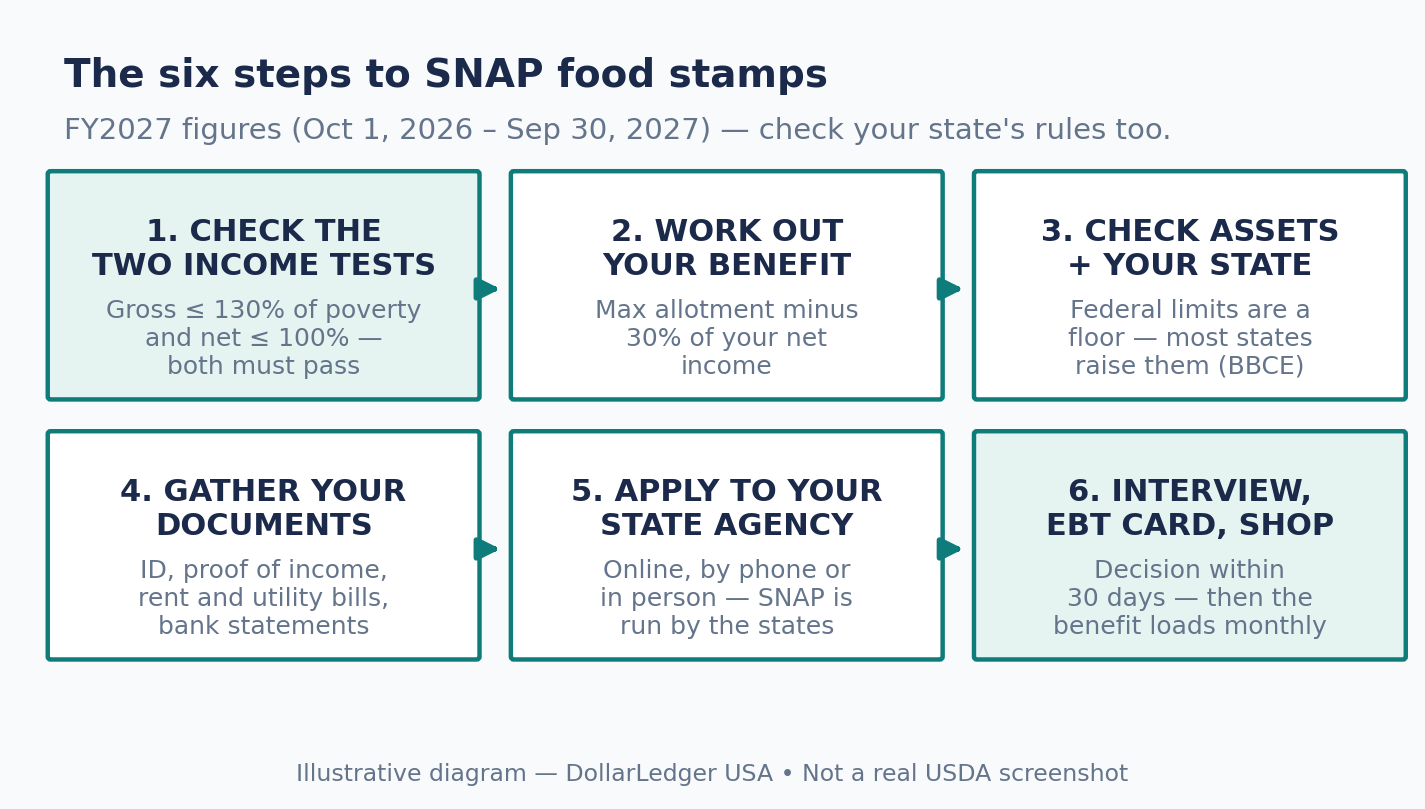
Illustrative diagram — The six steps to SNAP food stamps in 2026. NOT a real USDA screenshot.
Step 2: Work out how much you would get
What to do: Find your household’s maximum allotment and subtract 30% of your net income — that is your monthly benefit.
How: SNAP assumes a household can spend about 30% of its net income on food, and covers the rest of the Thrifty Food Plan, the USDA’s low-cost food budget. So: monthly benefit = maximum allotment − 30% of net income. The FY2027 maximums for the 48 states and D.C.: $306 for one person, $562 for two, $808 for three, $1,023 for four, $1,217 for five, $1,463 for six, $1,616 for seven, and $1,841 for eight, plus $225 per additional person up to 17 people, with households of 18 or more capped at $3,887. The minimum benefit is $25 a month for one- and two-person households.
Example: A family of four with $2,000 a month of net income: 30% of $2,000 is $600, so $1,023 − $600 = $423 a month. With no net income they would get the full $1,023; with $3,000, $123.
Common mistake: Assuming the maximum is what everyone gets — most get less, because the formula subtracts 30% of net income.
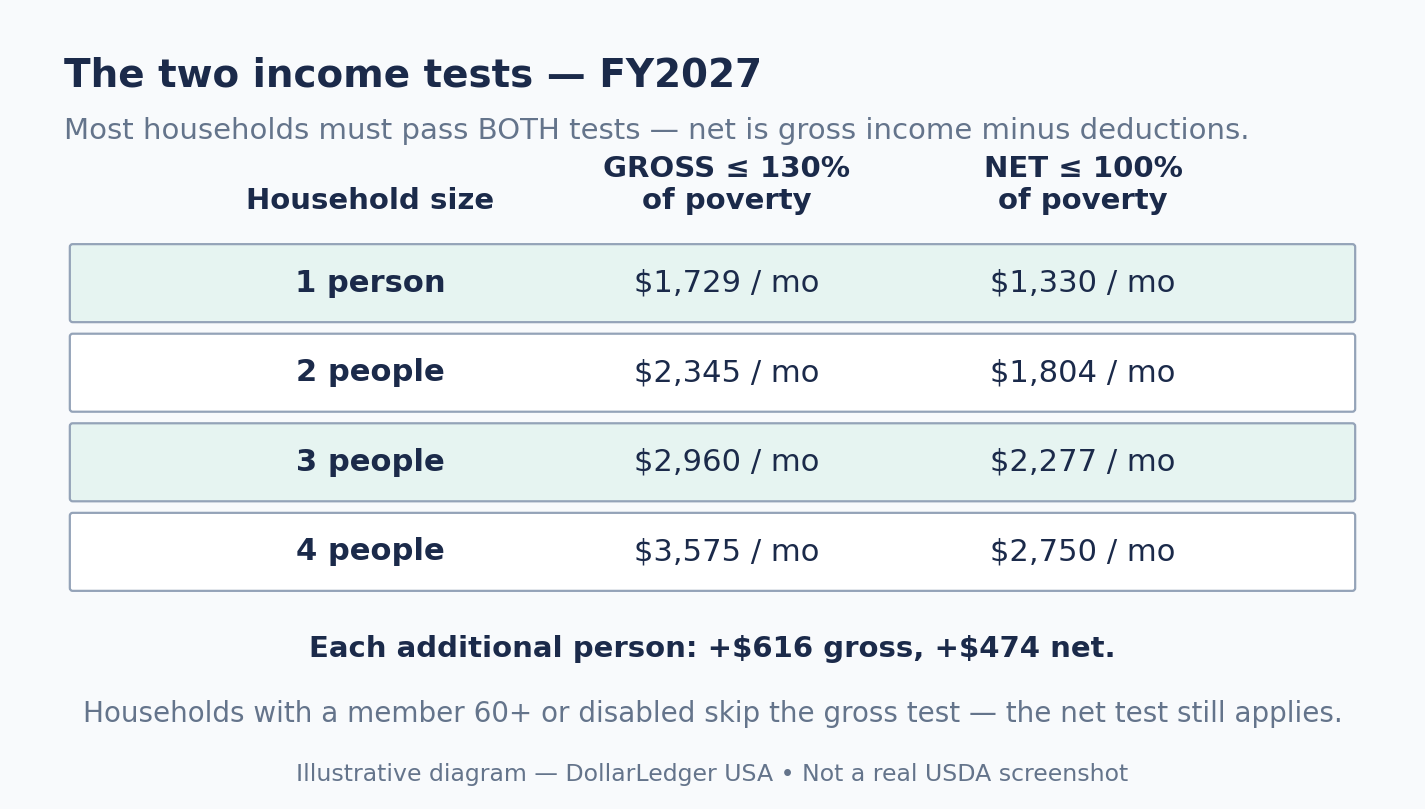
Illustrative diagram — The two income tests, FY2027. NOT a real USDA screenshot.

Photo: The maximum allotment is a ceiling, not a promise — your benefit depends on your net income. (Photo: Pexels)
Step 3: Check the asset test — and your state’s rules
What to do: Check the federal resource limit, then check whether your state even applies it — the federal numbers are a floor, not the final answer.
How: Under the federal rules, countable resources — cash and bank accounts — must be $3,000 or less, or $4,750 if someone in the household is 60 or older or disabled. Your home and retirement accounts do not count (reported). But most states use broad-based categorical eligibility (BBCE): about 46 states have adopted it, letting them raise the gross ceiling to 200% of poverty and waive the asset test in most cases. A proposed federal rule could narrow BBCE, so check your state’s current policy (reported).
Example: A single mother in a BBCE state earns $2,400 a month gross — above the $1,729 federal limit — but her state allows up to 200% of poverty, so she qualifies, and her $5,000 savings does not disqualify her.
Common mistake: Not applying because you have savings — if your state uses BBCE, the asset test may not apply at all.
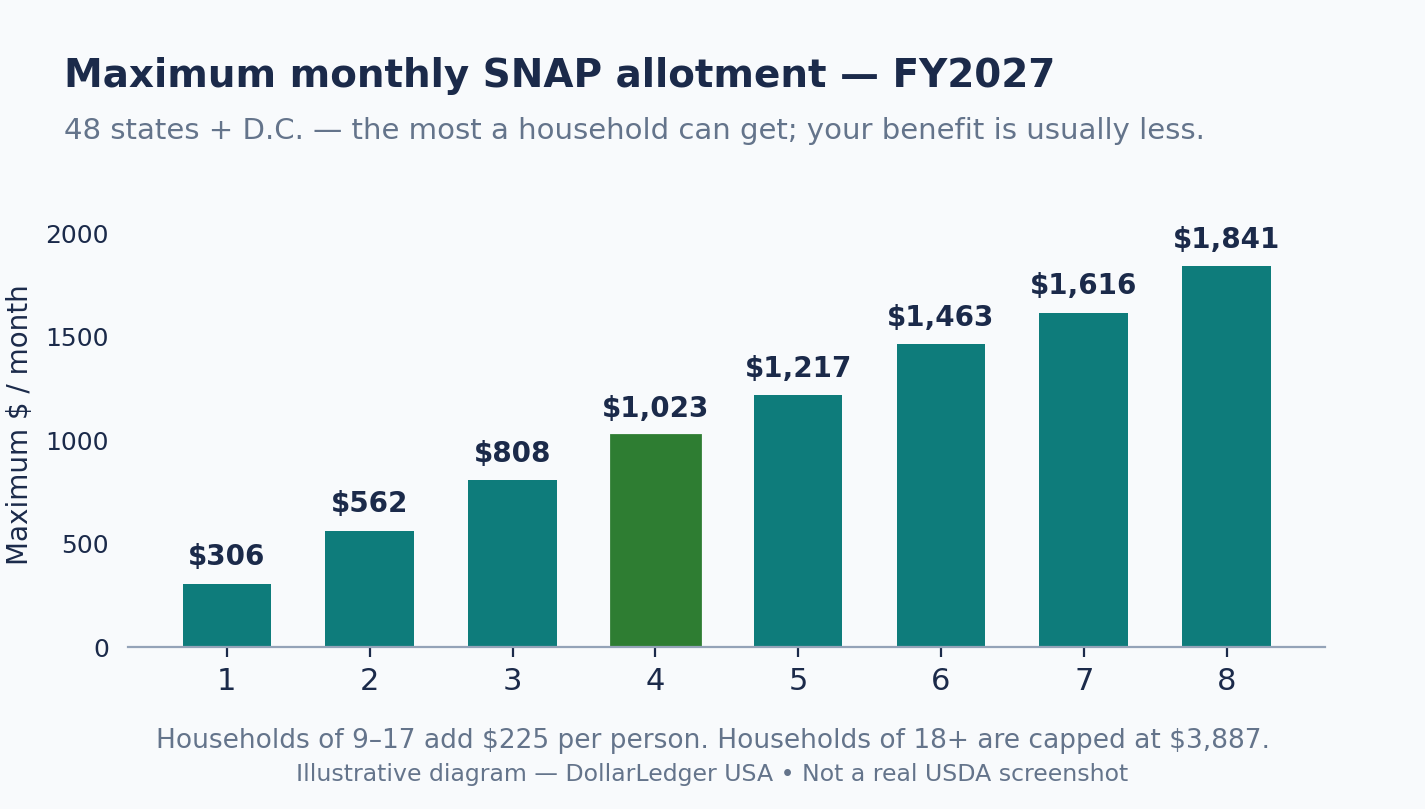
Illustrative diagram — Maximum monthly SNAP allotments by household size, FY2027. NOT a real USDA screenshot.
Step 4: Use deductions to lower your net income
What to do: List every deduction SNAP allows — deductions can turn a failing gross income into a passing net income.
How: Net income is gross income minus deductions. The FY2027 standard deduction is $217 a month for households of one to three people, $229 for four, $268 for five, and $308 for six or more. On top of that, 20% of earned income is deducted, plus dependent care, child support paid, medical expenses for elderly or disabled members, and shelter costs up to the $769-a-month excess shelter cap for the 48 states and D.C. Keep the paperwork: a lease, utility bills, childcare receipts, and pay stubs.
Example: A family of four has a member aged 60, so the gross test does not apply. Their deductions — $229 standard, 20% of earnings, shelter costs — pull net income well under the $2,750 limit.
Common mistake: Forgetting the shelter deduction — rent is usually the biggest cost, and often the deduction that brings net income under the limit.
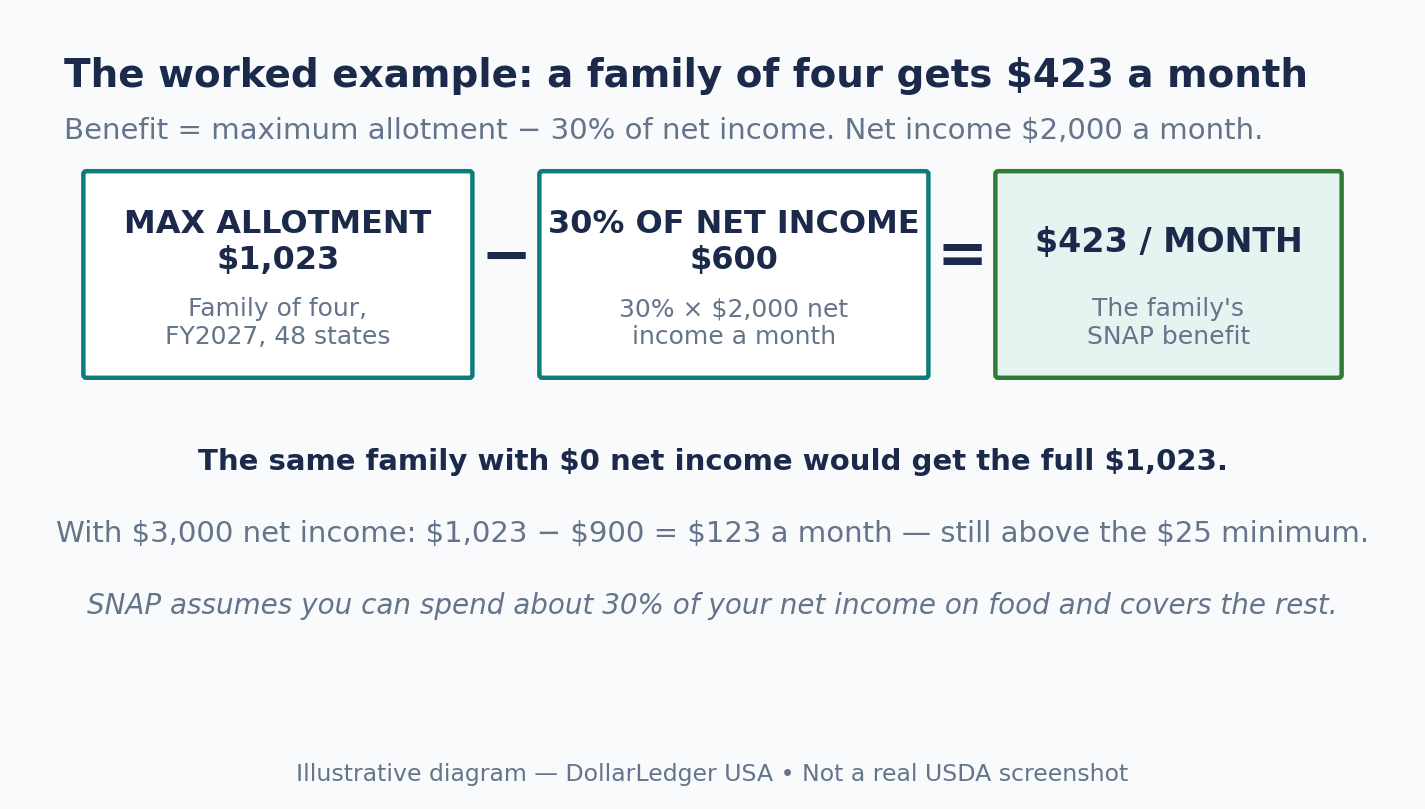
Illustrative diagram — The worked example: a family of four gets $423 a month. NOT a real USDA screenshot.
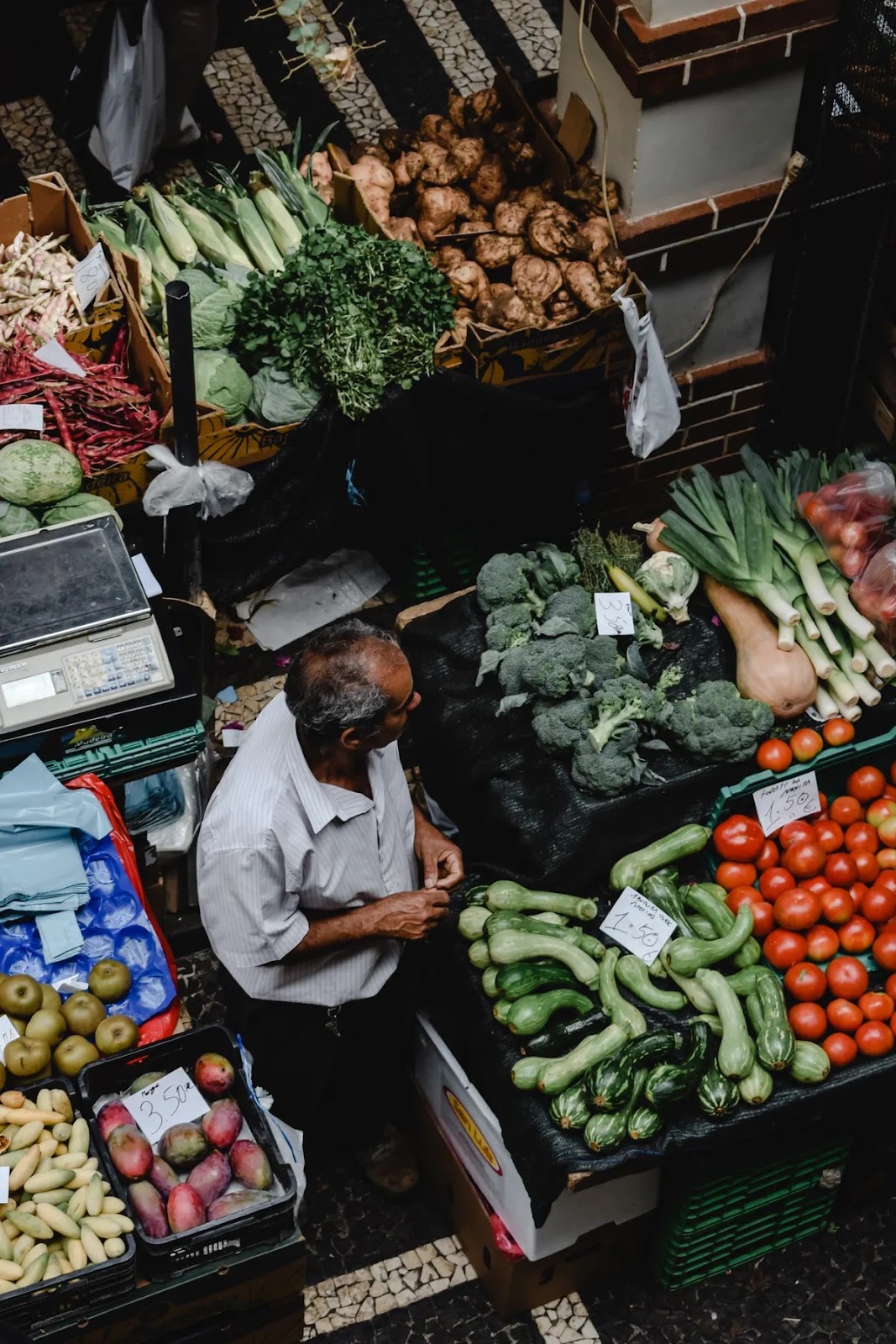
Photo: SNAP can be used at grocery stores and many farmers markets, not just supermarkets. (Photo: Pexels)
Step 5: Apply through your state agency
What to do: Apply to the SNAP agency in your state — there is no single national application.
How: Find your state agency by searching your state name plus “SNAP” or “food assistance”. You can usually apply online, by phone, by mail, or in person, with ID, pay stubs, proof of rent and utilities, and bank statements. The agency then schedules an interview, usually by phone, and must decide within 30 days. Households with very little or no income may qualify for expedited service, with benefits in about 7 days (reported). If approved, the benefit loads monthly onto an EBT card, which works like a debit card at grocery stores and farmers markets. It buys food — not alcohol, tobacco, hot prepared foods, or non-food items.
Example: Maria applies online on Monday, uploads her pay stubs and lease the same day, and does her phone interview on Thursday. Her state approves her in 18 days, and her first $423 loads the next month.
Common mistake: Waiting until the money runs out — the 30-day clock starts when you apply.
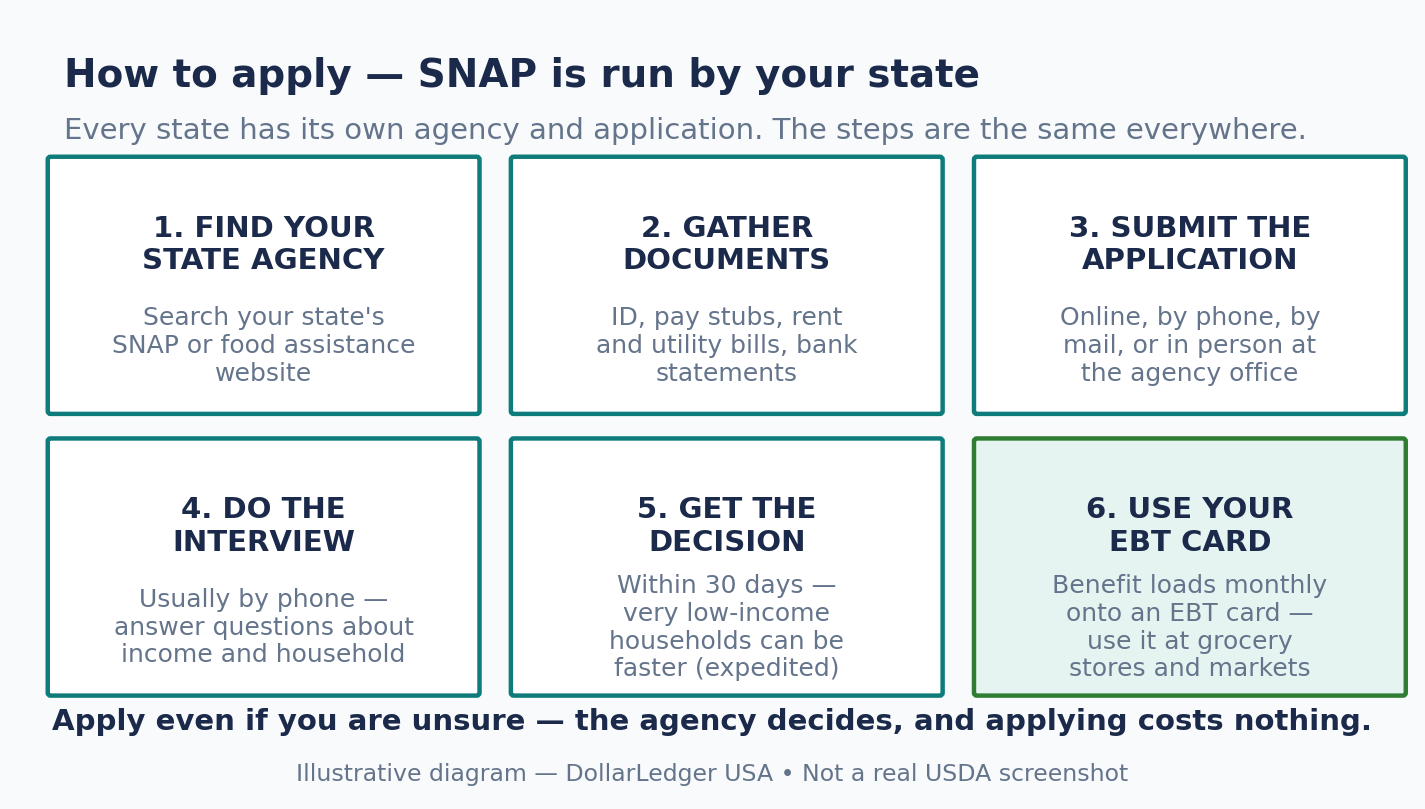
Illustrative diagram — How to apply: SNAP is run by your state. NOT a real USDA screenshot.
Step 6: Keep your benefits — report changes and know the work rules
What to do: Once approved, report changes on time, renew when asked, and know the work rules.
How: Report changes in income, household size or address — late reports can mean overpayments to pay back. Benefits are recertified every 6 to 12 months. On work rules: adults without dependents generally must work or train about 80 hours a month. Under the One Big Beautiful Bill Act (Public Law 119-21, July 4, 2025), work requirements now reach adults aged 55 to 64 and parents whose youngest child is 14 or older (reported). The same law narrowed eligibility from October 1, 2026, to U.S. citizens, lawful permanent residents, Cuban/Haitian entrants, and Compact of Free Association nationals (reported). If a rule affects you, your state agency is the authority.
Example: Tom’s hours rise from 25 to 40 a week. He reports the change the same month, his benefit drops from $423 to $180, and he gets no overpayment notice.
Common mistake: Ignoring the recertification letter — benefits stop if you miss renewal, and reapplying takes another 30 days.
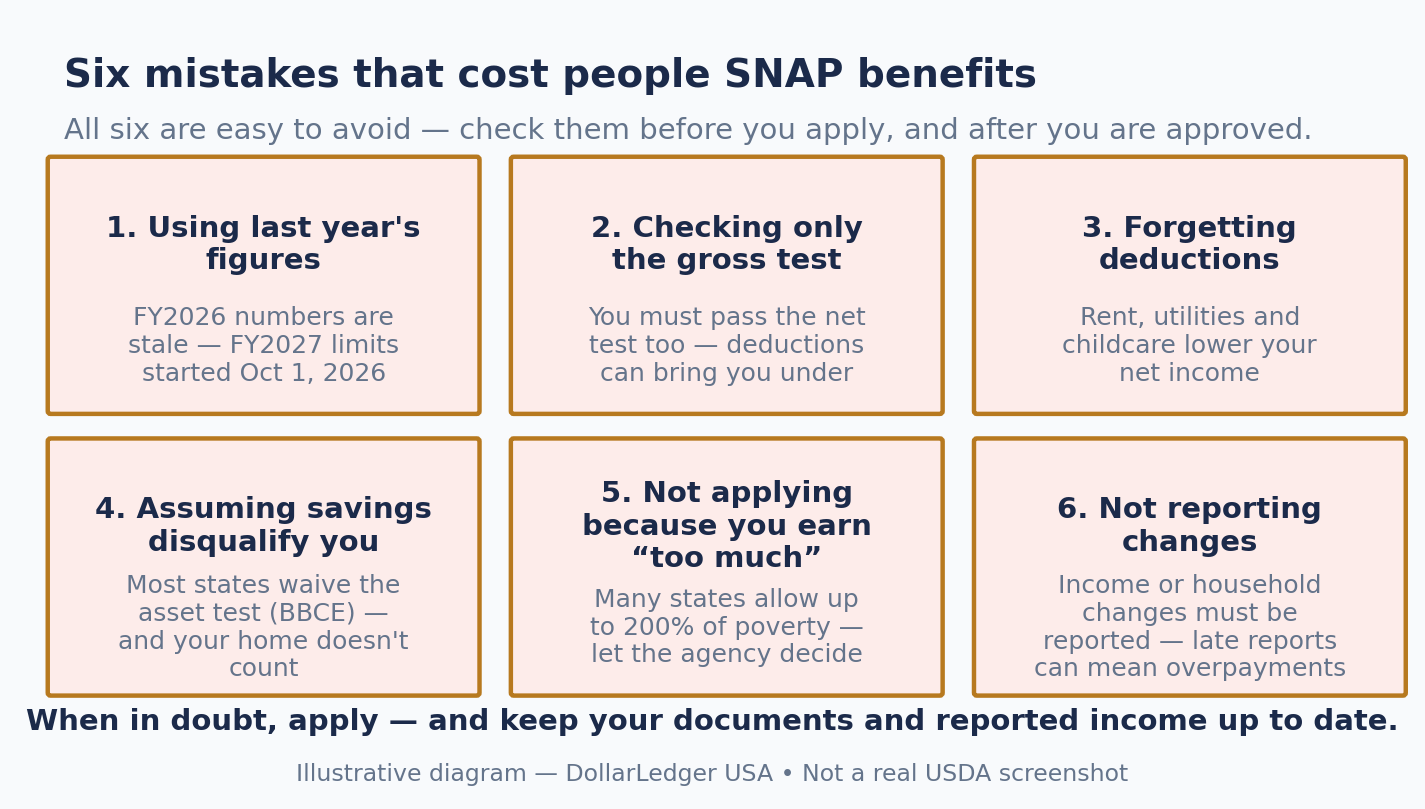
Illustrative diagram — Six mistakes that cost people SNAP benefits. NOT a real USDA screenshot.
Checklist
☐ I checked my household against both income tests (FY2027 limits).
☐ I worked out my benefit with the 30% formula.
☐ I checked the asset test and whether my state uses BBCE.
☐ I listed my deductions and gathered my documents — ID, pay stubs, rent and utility bills, bank statements.
☐ I applied, did the interview, and will report changes on time.
FAQ
How much SNAP can a family of four get in 2026? Up to $1,023 a month, the FY2027 maximum for the 48 states and D.C. With $2,000 of net income, a family of four gets $423; with no net income, the full $1,023.
What is the income limit for SNAP in 2026? For a family of four: gross income $3,575 a month or less, net income $2,750 or less. Many states allow more, up to 200% of poverty — check your state’s limit.
Can I get SNAP if I have savings? Maybe. The federal limit is $3,000, or $4,750 if a member is 60 or older or disabled. But most states waive the asset test, and your home and retirement accounts do not count (reported).
How long does it take to get SNAP after applying? The agency must decide within 30 days. Households with very little or no income may qualify for expedited service, in about 7 days (reported).
Did SNAP rules change in 2026? Yes. The FY2027 adjustment raised the limits and maximums. The One Big Beautiful Bill Act also extended work requirements to adults 55 to 64 and parents whose youngest child is 14 or older, and narrowed eligibility from October 1, 2026 (reported).
Sources
- USDA Food and Nutrition Administration, “SNAP Cost-of-Living Adjustment (COLA) Information” (FY2027)
- USDA Food and Nutrition Administration, “SNAP — Fiscal Year 2027 Cost-of-Living Adjustments” (Aug 21, 2026 memo)
- DollarLedger USA, “How to Build an Emergency Fund on a $40,000 Salary”
All figures checked November 8, 2026, against USDA FY2027 COLA sources.
Disclaimer: For education only, not benefits advice. SNAP rules vary by state — confirm eligibility with your state agency before applying.