How to Check Your Credit Report for Free in 2026 — All 3 Bureaus, Every Week
 DollarLedger Team
- 12 Nov, 2026

Most Americans still think a free credit report is a once-a-year thing. It is not — not any more. Since October 2023, the three big credit bureaus — Equifax, Experian and TransUnion — have let you pull each report once a week, for free, and that weekly access is permanent and still live in 2026: three bureaus times 52 weeks is 156 free reports a year. The catch is the address: exactly one website is authorised by law for this, AnnualCreditReport.com, and lookalikes buy ads to sit above it.
Photo: Your free credit report is weekly now, not once a year — but only from the one official site. (Photo: Pexels)
What You Will Learn
- The only official site — and how to spot the lookalikes
- How to pull all three bureau reports in one sitting, free, every week
- The six sections to check on every report
- Why your three reports disagree — and what to do about it
- How to dispute an error, and the 30-day clock
- A repeat schedule that takes about 15 minutes
Step 1: Go to the only official site
What to do: Type AnnualCreditReport.com into your browser yourself — do not click a search ad to get there.
How: The FTC says only one website is authorised to fill orders for the free reports you are entitled to by law: AnnualCreditReport.com. Copycats put “free report” in their names, buy ads above the real site, and misspell the address hoping you mistype it. The real site never asks for a credit card, and never emails you asking for your Social Security number — the FTC warns any such message is probably a scam.
Example: The top search result says “Free Credit Score + Report — Start Now”. That is an ad for a paid service — close it and type the address yourself.
Common mistake: Clicking the first search result and handing your Social Security number to a lookalike site.
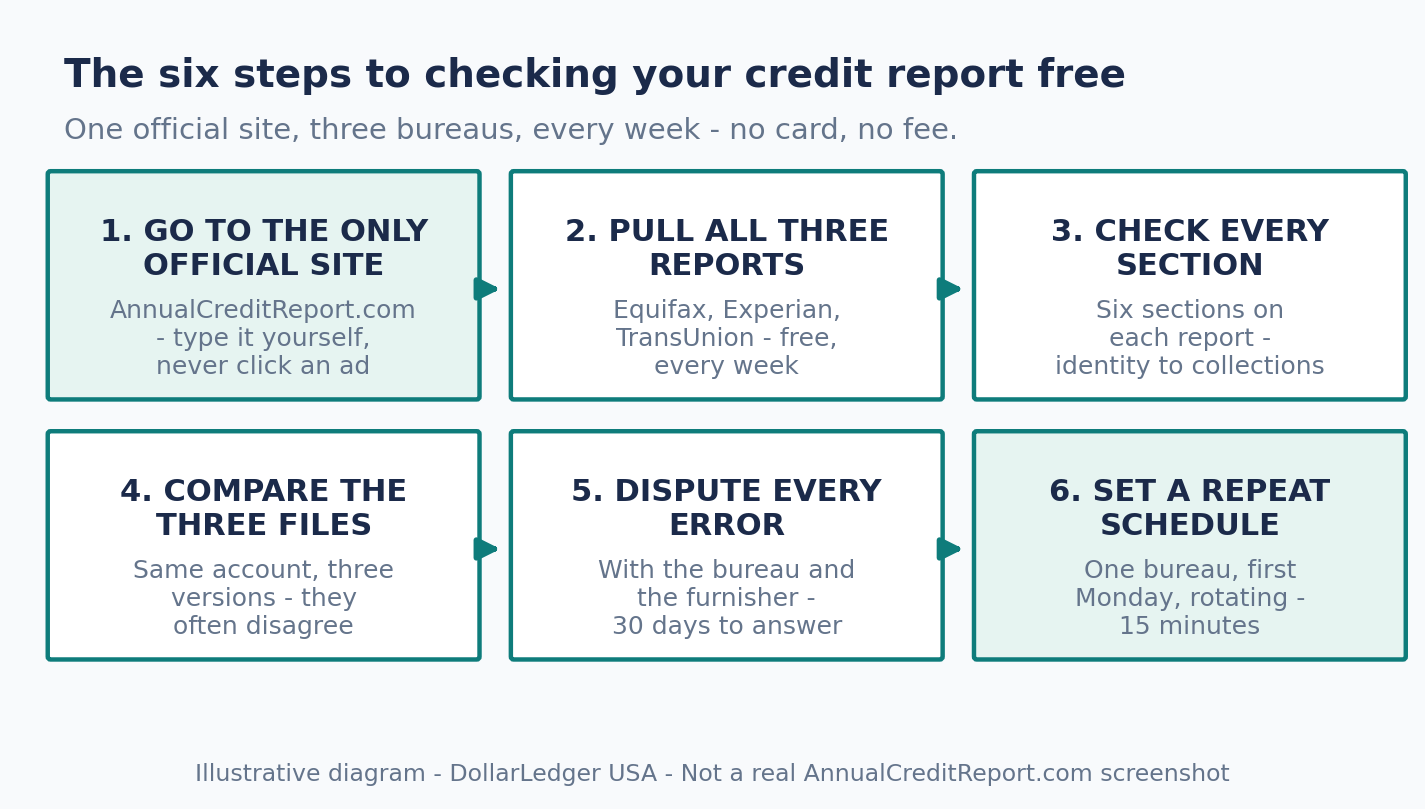
Illustrative diagram - The six steps to checking your credit report for free. NOT a real AnnualCreditReport.com screenshot.
Step 2: Pull all three reports, every week if you like
What to do: Request your reports from Equifax, Experian and TransUnion — one, two or all three at once, as often as weekly.
How: Federal law requires each bureau to give you a free copy once every 12 months. On top of that, the bureaus permanently extended a programme that lets you check each report once a week for free at AnnualCreditReport.com — the FTC states it plainly, and the CFPB page, last reviewed October 15, 2026, says the same. Online access is immediate. By phone, call 1-877-322-8228; by mail, send the Annual Credit Report Request Form to Annual Credit Report Request Service, P.O. Box 105281, Atlanta, GA 30348-5281 — both take about 15 days. Separately, through December 31, 2026, six extra free Equifax reports a year are available at AnnualCreditReport.com or 1-866-349-5191 (CFPB).
Example: Applying for a car loan next month? Pull all three this week, so errors get disputed before a lender sees your file.
Common mistake: Checking only one bureau and assuming the other two match — they often do not.
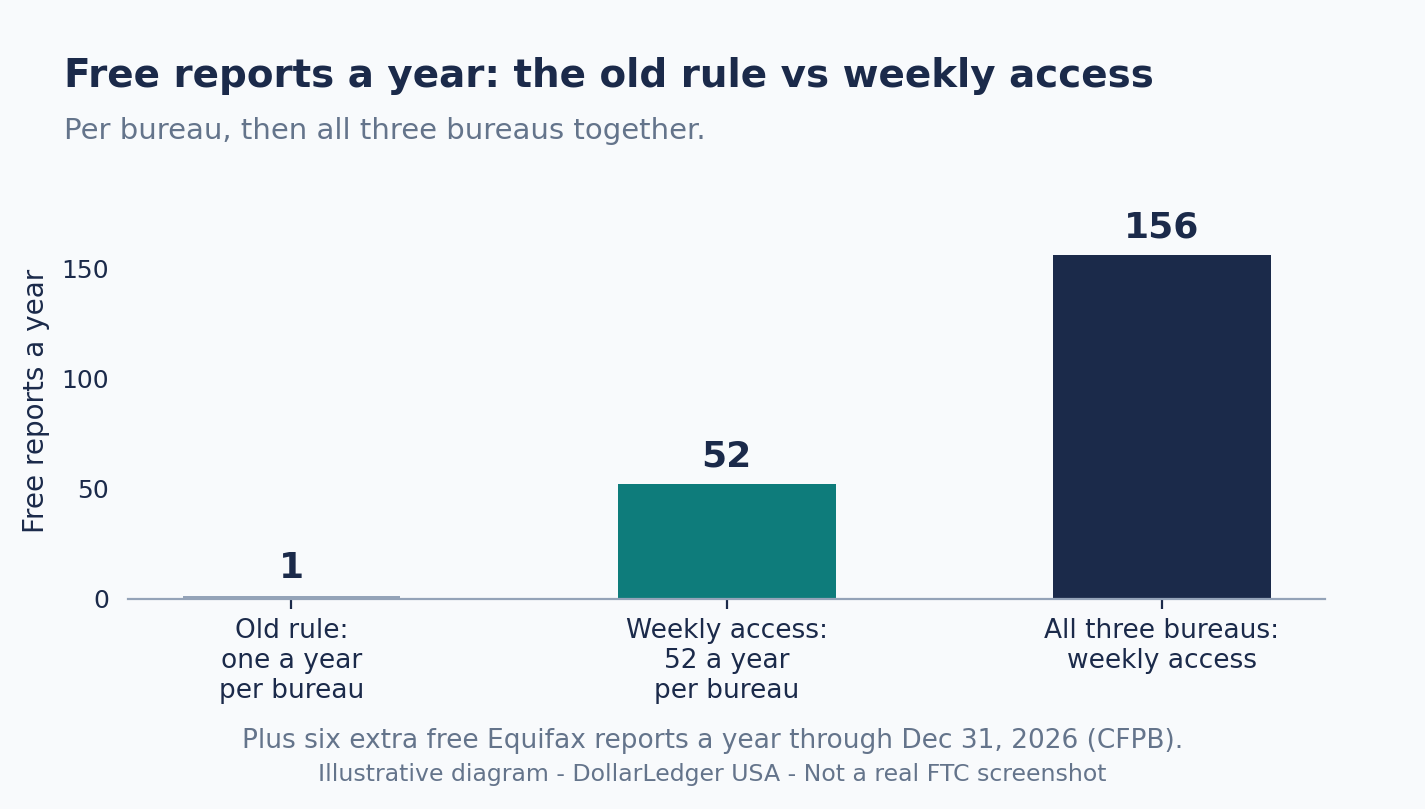
Illustrative diagram - Once a year was the old rule: weekly access means 156 free reports a year. NOT a real FTC screenshot.

Photo: Pull all three reports in one sitting — online access is immediate. (Photo: Pexels)
Step 3: Check every section of the report
What to do: Read all six sections of each report, not just the first page.
How: First, identity details — a wrong spelling or an address you never lived at can mean a mixed file or identity theft. Second, every account: is it yours, and is a closed account wrongly shown as open? Third, balances and limits — a wrong limit makes your card use look higher than it is. Fourth, payment history — an on-time payment shown late is an error. Fifth, hard inquiries — one from a lender you never applied to is a red flag. Sixth, collections and public records — anything not yours needs a dispute. An FTC study cited by the CFPB found one in five people had an error on at least one of their credit reports.
Example: Your report shows a $2,400 store card you never opened — bureau error or identity theft, either way dispute it.
Common mistake: Glancing at the top of the report and skipping the inquiries and collections sections, where the worst surprises live.
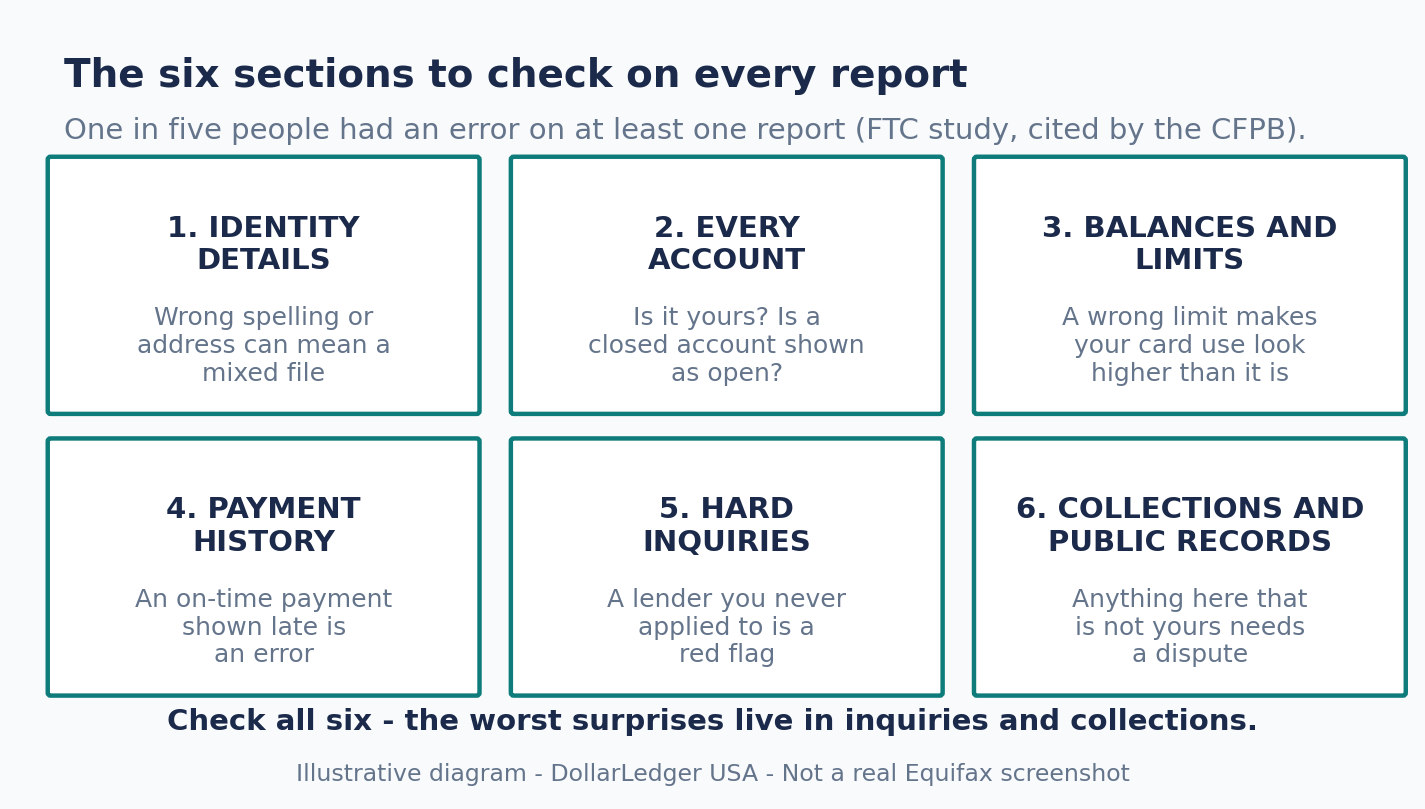
Illustrative diagram - Six sections to check on every report. NOT a real Equifax screenshot.
Step 4: Compare the three files side by side
What to do: Line up the same account across all three reports and note where they disagree.
How: The FTC is blunt: each bureau gets its information from different sources, so one bureau’s report might not match the other two. One may show a balance the others miss, a paid-off loan may still show as open, and a credit limit can differ by thousands of dollars. A lender may pull any one of the three — so check each account three times: same balance, same limit, same status, same payment history. Note the bureau and the date; your dispute goes to that bureau, and tell the lender too.
Example: Experian shows your card limit as $5,000, TransUnion $3,000 — on the TransUnion file your card looks far more maxed out, so dispute it there.
Common mistake: Finding one clean report and assuming the other two are clean too.
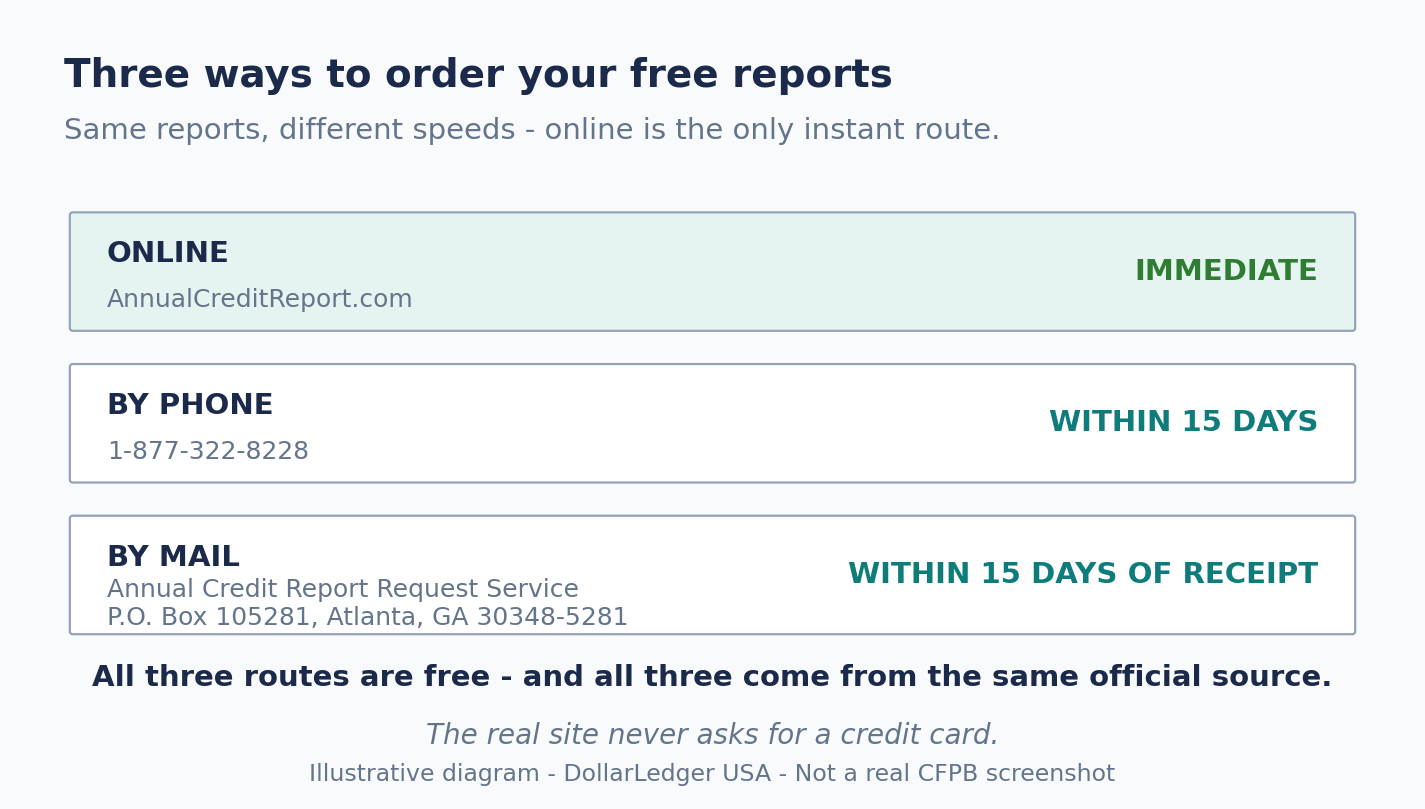
Illustrative diagram - Online is immediate; phone and mail take about 15 days. NOT a real CFPB screenshot.

Photo: Compare the same account across all three files — they often disagree. (Photo: Pexels)
Step 5: Dispute every error — in two places
What to do: Dispute each error with the bureau that shows it, and also with the company that supplied the wrong information.
How: Disputing costs nothing — online, by mail or by phone. The CFPB says a bureau generally must investigate within 30 days (up to 45 days in some cases) and then has five business days to tell you the results. Explain in writing what is wrong and why, with copies — never originals — of supporting documents. If the information is inaccurate or cannot be verified, it must be corrected or removed. Dispute with the furnisher too — it generally must respond within 30 days. Two limits: accurate negative information, like a late payment you really made, generally cannot be removed early, and no company can charge you to “fix” what you can dispute free yourself.
Example: A $310 collection for a medical bill you already paid — dispute it with the bureau, send the furnisher your receipt, and keep the confirmation number.
Common mistake: Paying a “credit repair” company to dispute for you — the dispute is free, and only you can supply the proof.
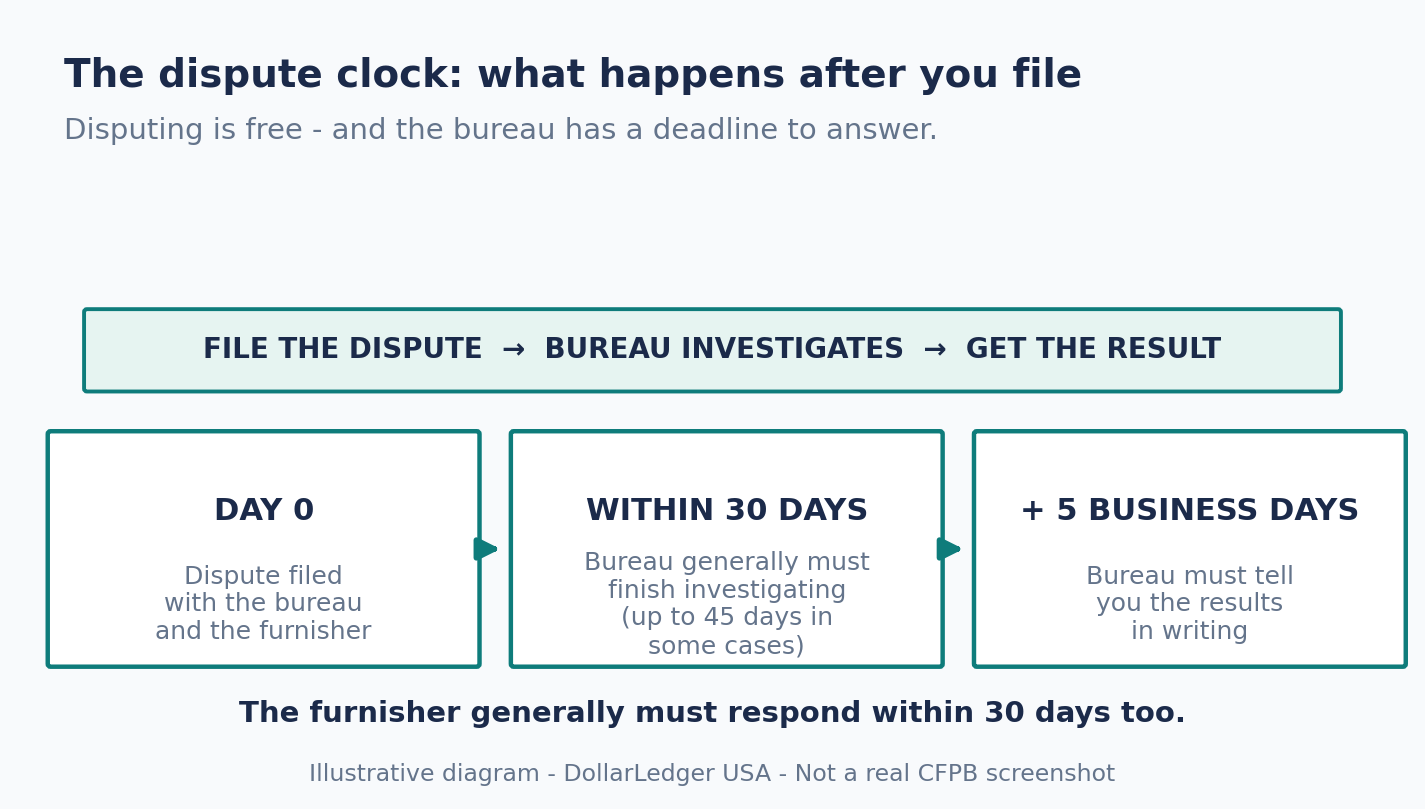
Illustrative diagram - The dispute clock: 30 days to investigate, five business days to tell you. NOT a real CFPB screenshot.
Step 6: Set a repeat schedule — 15 minutes, then forget it
What to do: Put a repeating reminder in your calendar and check on a fixed rhythm, not when something goes wrong.
How: Checking your own report never hurts your score — AnnualCreditReport.com says so directly, because your own request is a soft look, not a lender’s hard inquiry, and lenders never see it. A simple rhythm: pull one bureau on the first Monday of each month, rotating Equifax, Experian, TransUnion — all three covered every quarter. Or pull all three every three months, and always before you apply for credit, a loan, insurance, housing or a job. The free report does not include a credit score — the report is the raw data; the score is a separate number calculated from it. To move that number, start with our guide to how to improve your credit score fast in 2026; with no credit history at all, start with how to build credit from scratch in 2026.
Example: First Monday of the month, 15 minutes, one bureau: January Equifax, February Experian, March TransUnion, then repeat.
Common mistake: Checking once, finding nothing, and never looking again — new errors and fraud can appear at any time.
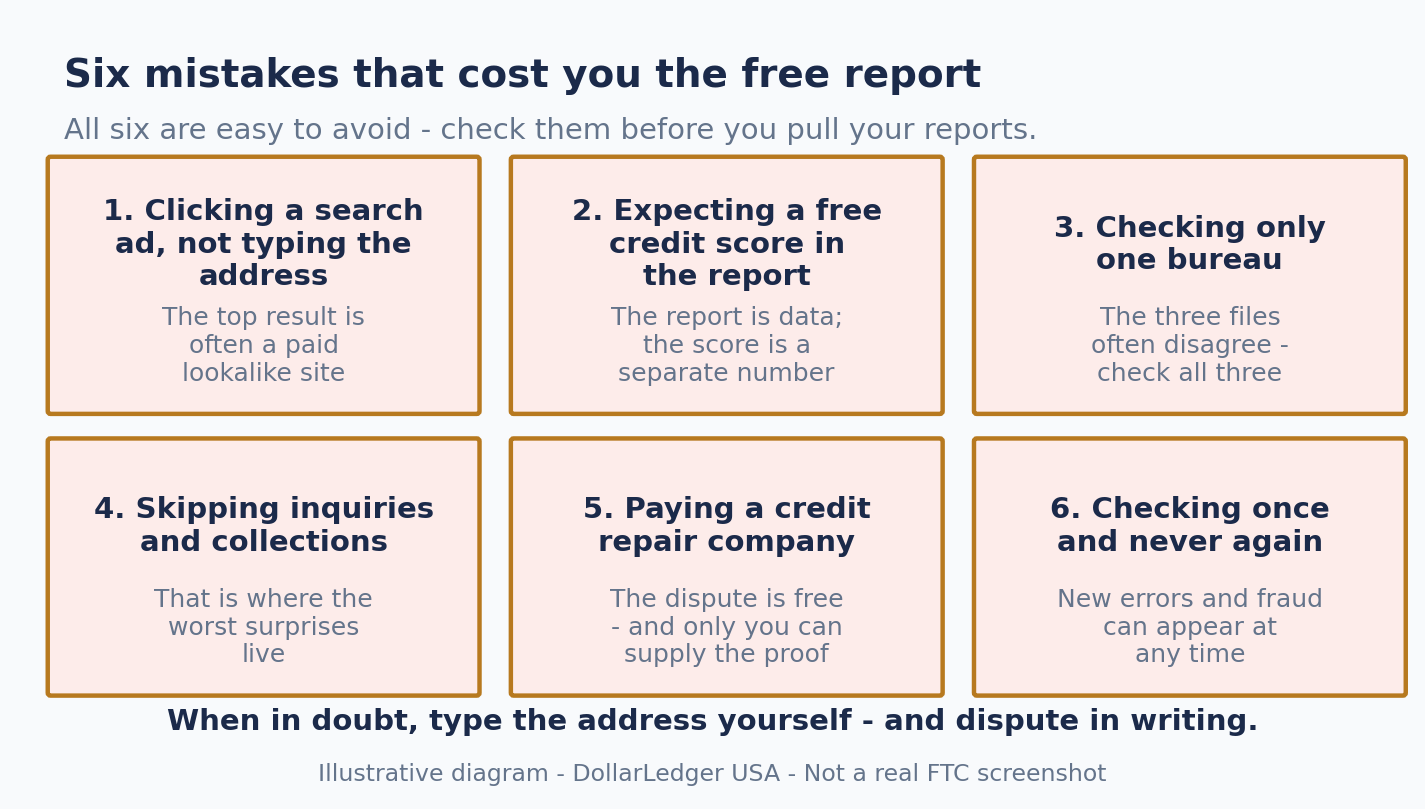
Illustrative diagram - Six mistakes that cost you the free report. NOT a real FTC screenshot.
Checklist
☐ Typed AnnualCreditReport.com in the address bar — no search ad.
☐ Pulled all three reports: Equifax, Experian, TransUnion.
☐ Checked all six sections on each report.
☐ Compared the same accounts across all three files.
☐ Disputed every error with the bureau and the furnisher; kept confirmation numbers.
☐ Calendar reminder set: one bureau, first Monday, rotating.
FAQ
Is a free credit report really weekly now, not once a year?
Yes. Federal law guarantees one free report per bureau every 12 months, but the bureaus permanently extended weekly online access — the FTC states it, and the CFPB page (last reviewed October 15, 2026) says you can view your reports online for free once a week.
Will checking my own credit report lower my credit score?
No. Your own request is a soft look, not a lender’s hard inquiry. AnnualCreditReport.com states that checking your reports there will not affect your credit scores.
Does the free credit report include my credit score?
No — and do not let any site promise otherwise. The report is the raw data: accounts, balances, payment history, inquiries. The score is a separate number calculated from that data. Many card issuers show a free score on your monthly statement.
I found an account I never opened. What do I do first?
Dispute it with the bureau showing it and the company that reported it, in writing, with copies of any proof. Then place a fraud alert on your file and report the identity theft at IdentityTheft.gov, the FTC’s recovery site.
Sources
- AnnualCreditReport.com, the official source for free credit reports (opened live November 12, 2026): https://www.annualcreditreport.com/
- Federal Trade Commission, Consumer Advice: Free Credit Reports (opened live November 12, 2026): https://consumer.ftc.gov/articles/free-credit-reports
- Consumer Financial Protection Bureau, How do I get a free copy of my credit reports? (opened live November 12, 2026; last reviewed October 15, 2026): https://www.consumerfinance.gov/ask-cfpb/how-do-i-get-a-free-copy-of-my-credit-reports-en-5/
All figures checked November 12, 2026, against AnnualCreditReport.com, the FTC and the CFPB. The six extra Equifax reports are per the CFPB’s Your Money, Your Goals toolkit; the “one in five” figure is an FTC study cited by the CFPB — both reported as reported.
Disclaimer: For education only, not financial, tax or investment advice.