Best 0% APR Balance Transfer Cards 2026
 DollarLedger Team
- 04 Nov, 2026

A 0% APR balance transfer card is a pause button on credit card interest. You move a balance to a new card at 0% for up to 21 months, so every dollar you pay cuts the balance — not interest. The average American carries about $6,610 in card debt, Motley Fool Money reports — at around 22% APR, roughly $120 a month goes to interest. But it is not free: a 3% to 5% fee, a deadline, and a regular APR of roughly 17% to 29% on anything left when the window ends. This guide compares the best 0% APR balance transfer cards of 2026 — checked November 3, 2026 — with a payoff plan to clear the balance before the interest returns.
Photo: A balance transfer pauses interest — with a payoff plan. (Photo: free stock)
What You Will Learn
- How a balance transfer works, and what it costs
- Which cards offer the longest 0% window in 2026 — up to 21 months
- The fee math on a $5,000 balance
- A monthly payoff plan that ends at zero
- The traps that cancel the savings
Step 1: Understand how a balance transfer works
What to do: Learn the mechanics.
How: A balance transfer moves debt to a new card that charges 0% APR on the transferred balance. The new card pays off your old card. Two rules: you cannot transfer between two cards from the same issuer, and a transfer takes five days to six weeks — keep paying your old card until it moves.
Example: Priya owes $5,000 on a store card at 24% APR. She transfers it to a 0% card, and for 21 months her payments cut the balance.
Common mistake: Stopping payments on the old card the day you apply. A missed payment while it processes means a late fee and a credit score ding.
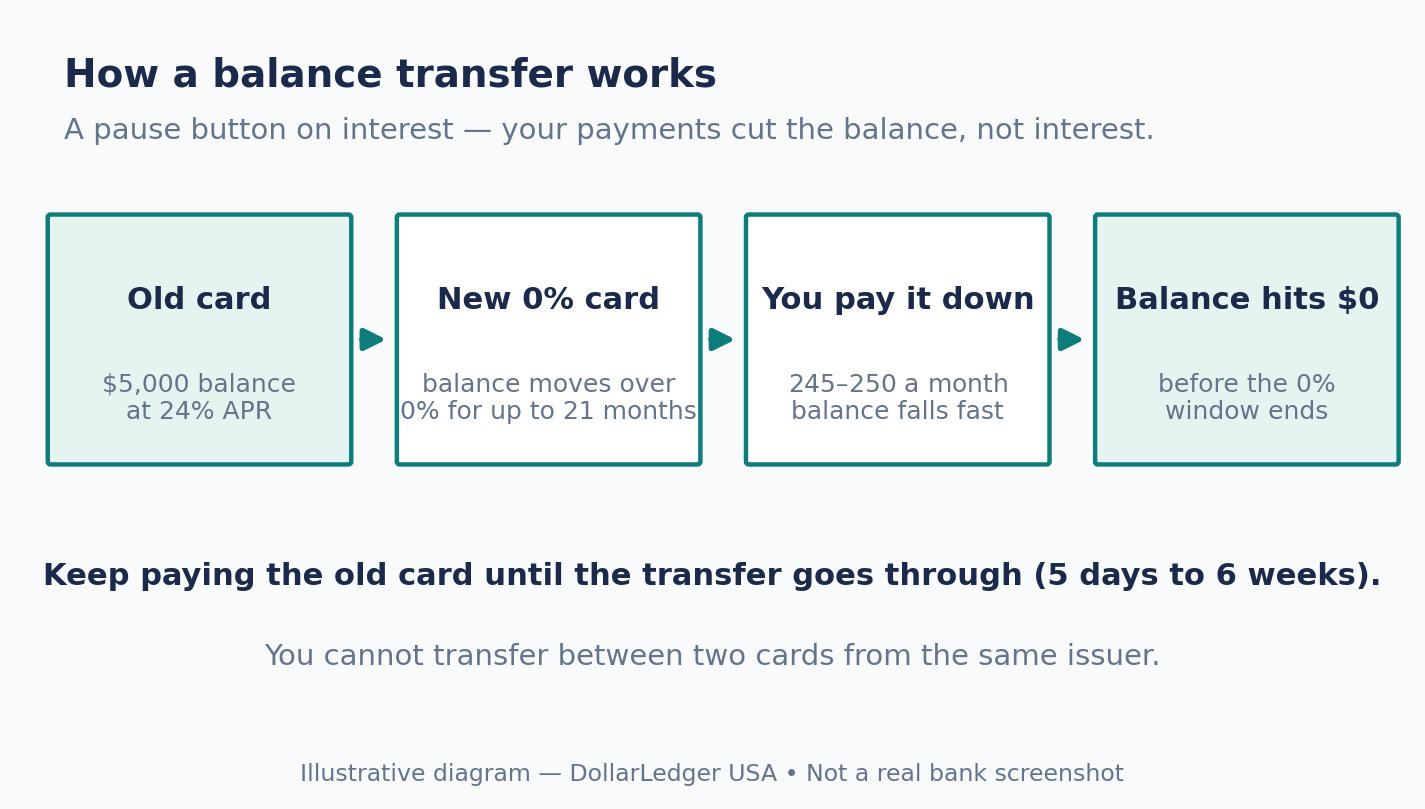
Illustrative diagram — How a balance transfer works. NOT a real bank screenshot.
Step 2: Compare the longest 0% windows
What to do: Pick the longest window you can use — more months means a smaller monthly payment.
How: The longest 0% offers in 2026 run 21 months; all six cards below have no annual fee. Figures are reported offers checked November 3, 2026 — confirm current terms first.
- Citi Diamond Preferred — 0% for 21 months on transfers (12 months on purchases). Fee 3% ($5 min) in the first 4 months, then 5%; then 16.74%–27.49% variable.
- Wells Fargo Reflect — 0% for 21 months on purchases and transfers (within 120 days). Fee 5% ($5 min); then 17.74%, 24.24% or 28.49% variable.
- Chase Slate — 0% for 21 months on purchases and transfers. Fee 5% ($5 min); then 18.49%–28.49% variable.
- Discover it Balance Transfer — 0% for 18 months on balance transfers, 3% intro fee.
- Citi Double Cash — 0% for 18 months on transfers only, plus2% cash back. Fee 3% intro, then 5%; then 18.49%–28.74% variable.
- Chase Freedom Unlimited — 0% for 15 months on purchases and transfers, plus 1.5%–5% cash back. Fee 3% ($5 min) in the first 60 days, then 5%; then 18.49%–27.99% variable.
Example: On $5,000, Citi’s 3% fee is $150; a 5% fee is $250 — the same 21 months.
Common mistake: Picking the longest window and ignoring the fee. A 3% fee beats a 5% fee on a small balance.
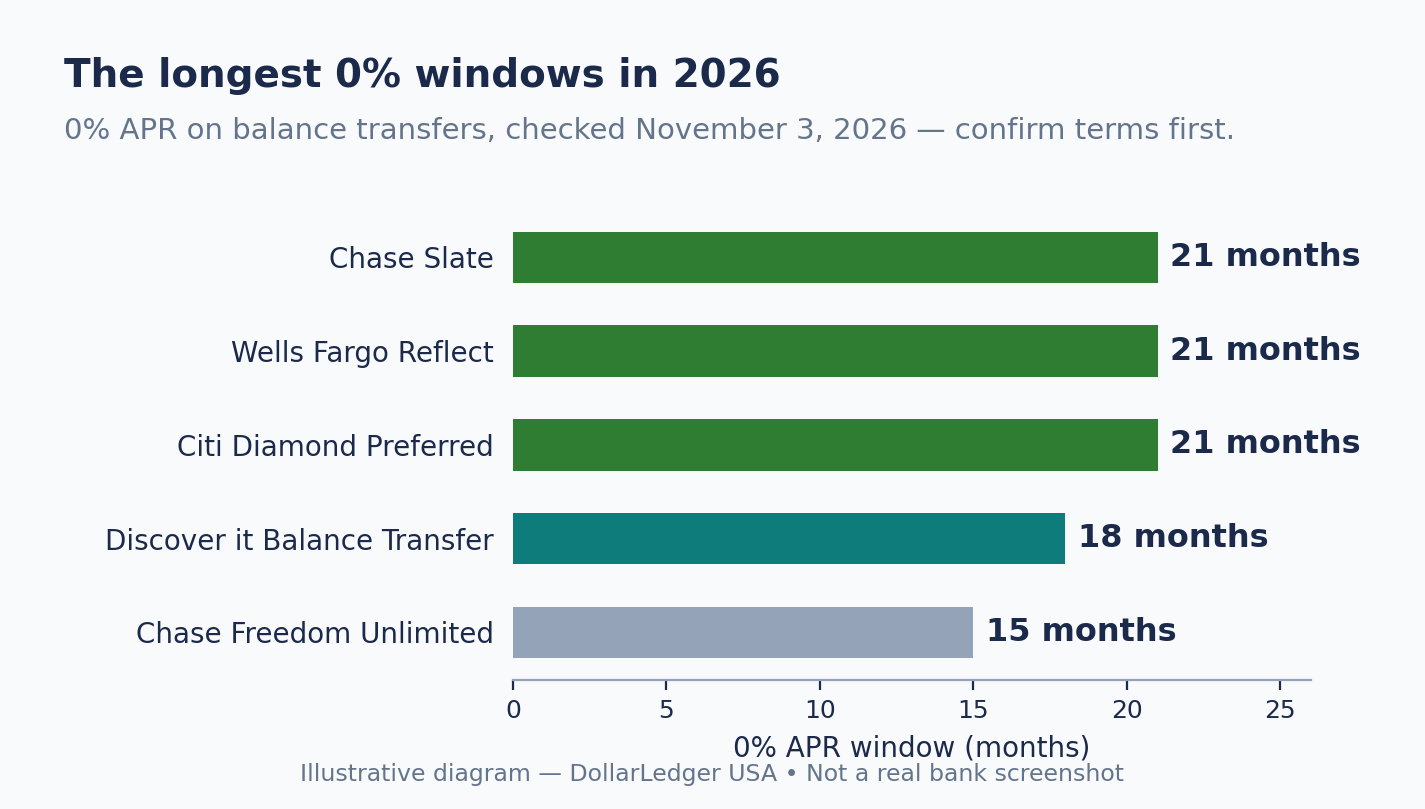
Illustrative diagram — The longest 0% windows in 2026. NOT a real bank screenshot.

Photo: The fee is the real price of 0%. (Photo: free stock)
Step 3: Do the fee math — is the transfer worth it?
What to do: Compare the fee with the interest of staying put.
How: The fee is a percentage of the amount transferred, usually 3% to 5%, with a $5 minimum. On $5,000, a 3% fee is $150 and a 5% fee is $250. At 22% APR, $5,000 paid at $250 a month takes about two years and costs roughly $1,200 in interest — so the $150–$250 fee for 21 months at 0% saves you roughly $1,000.
Example: You transfer $5,000 at 3%. Your new balance is $5,150 — the fee is added to what you owe.
Common mistake: Transferring a small balance. On $500 you could pay it off in two months anyway.
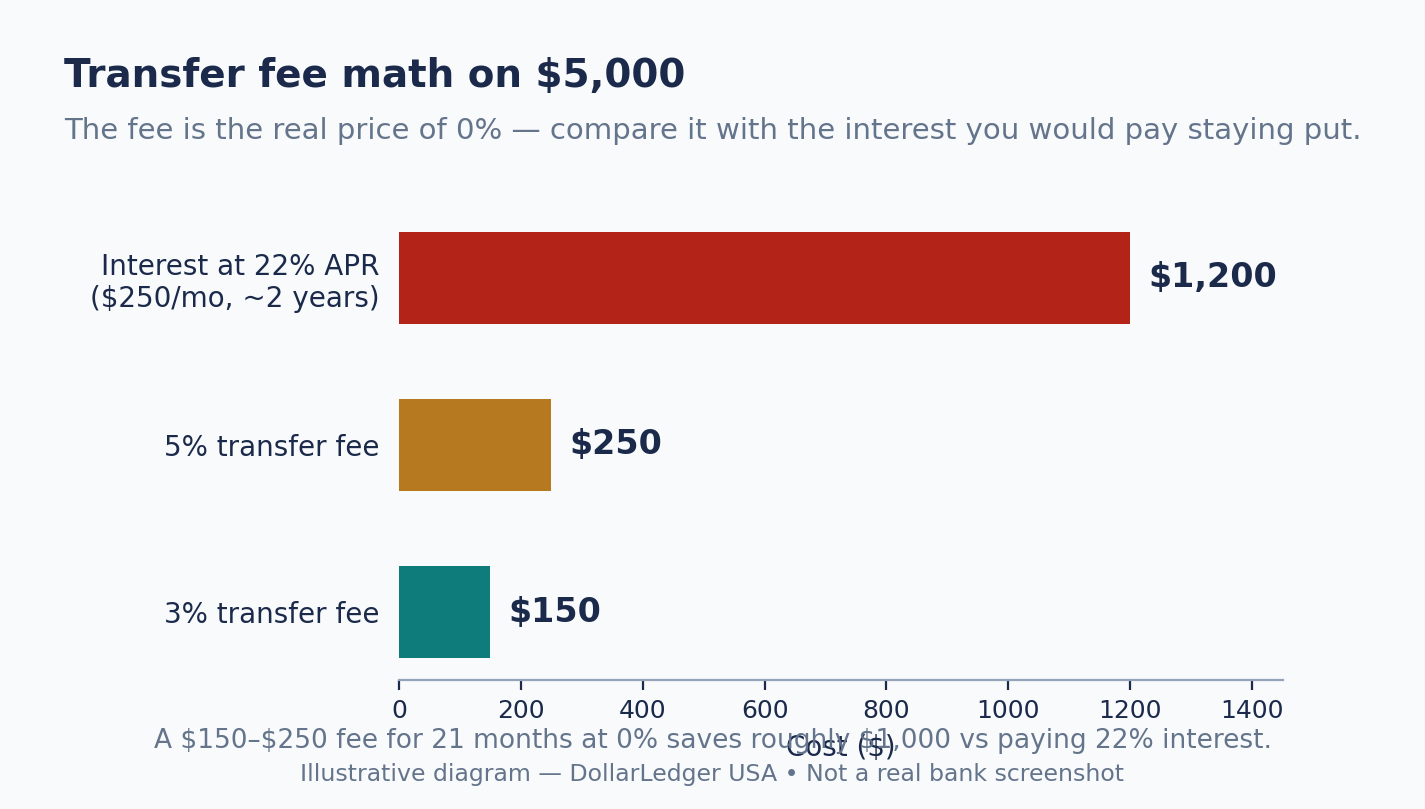
Illustrative diagram — Fee vs interest avoided on $5,000. NOT a real bank screenshot.
Step 4: Build a payoff plan that ends at zero
What to do: Divide what you owe — balance plus fee — by the 0% months, and pay that every month.
How: A $5,000 transfer to the Citi Diamond Preferred at 3% means you owe $5,150 over 21 months — about $245 a month. On the Wells Fargo Reflect at 5%, $5,250 — exactly $250 a month. Set up autopay. If you cannot afford that, move only the part you can clear in time. Our emergency fund guide shows how to free up cash.
Example: Maria transfers $4,200 at a 3% fee, so she owes $4,326 over 21 months — $206 a month.
Common mistake: Paying only the minimum. On $5,000 at 22% APR, minimum payments alone can take over 16 years.
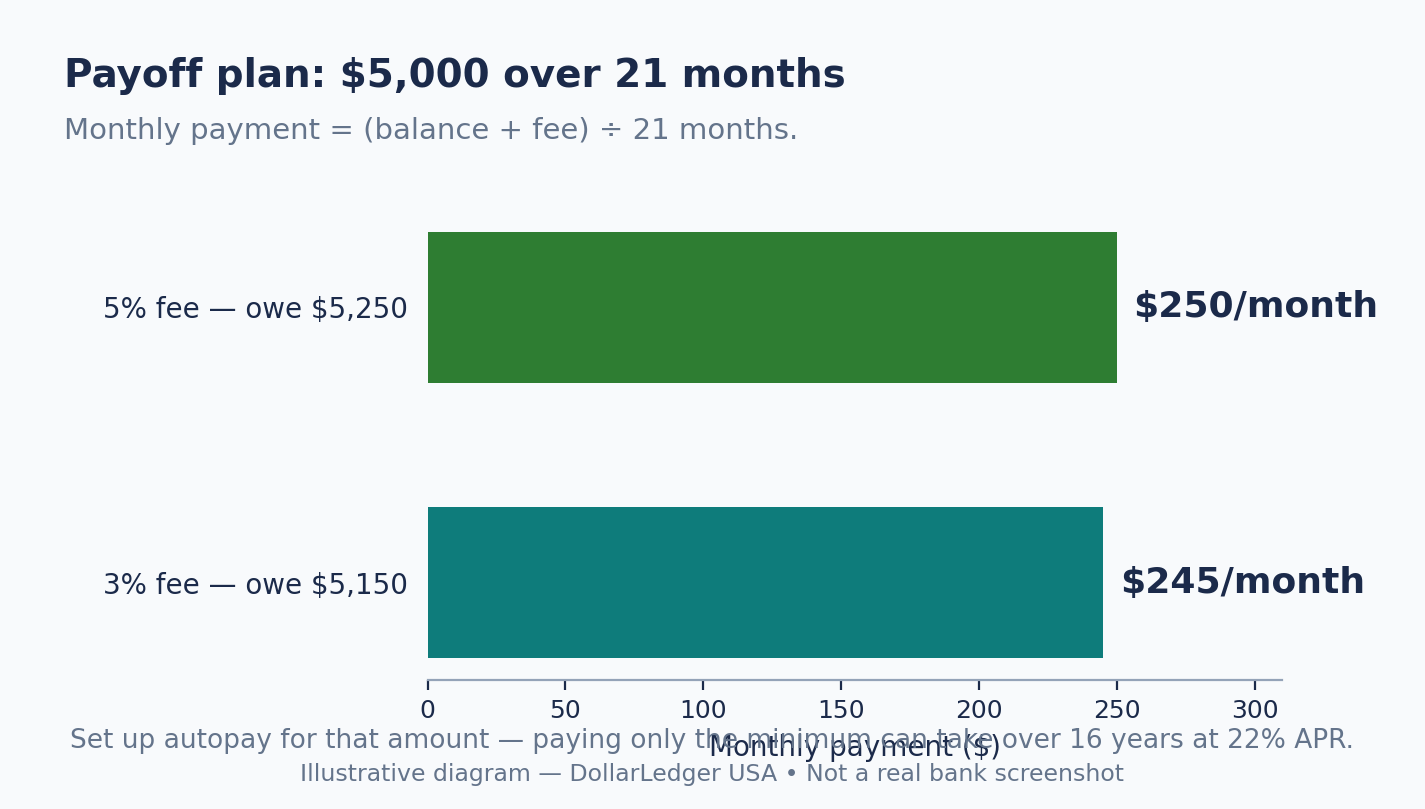
Illustrative diagram — Your monthly payoff number. NOT a real bank screenshot.
Step 5: Avoid the traps that cancel your savings
What to do: Watch the fine print that turns a 0% deal expensive.
How: Four traps do the most damage. New purchases: the CFPB warns you lose the grace period and pay interest until the whole balance is paid in full — so do not shop on this card. Late payments: more than 60 days late, and the issuer can raise your rate on all balances. Deadlines: Citi’s 3% fee needs the first 4 months, Reflect’s 0% needs 120 days, Freedom Unlimited’s 3% fee needs 60 days. Re-borrowing: paying off the old card frees up its limit — many run it back up. See our budgeting guide.
Example: James transfers $5,000, then charges a $600 repair to the same card — that $600 earns interest at once.
Common mistake: Closing the old card after the transfer. Keeping it open protects your utilization and credit history.
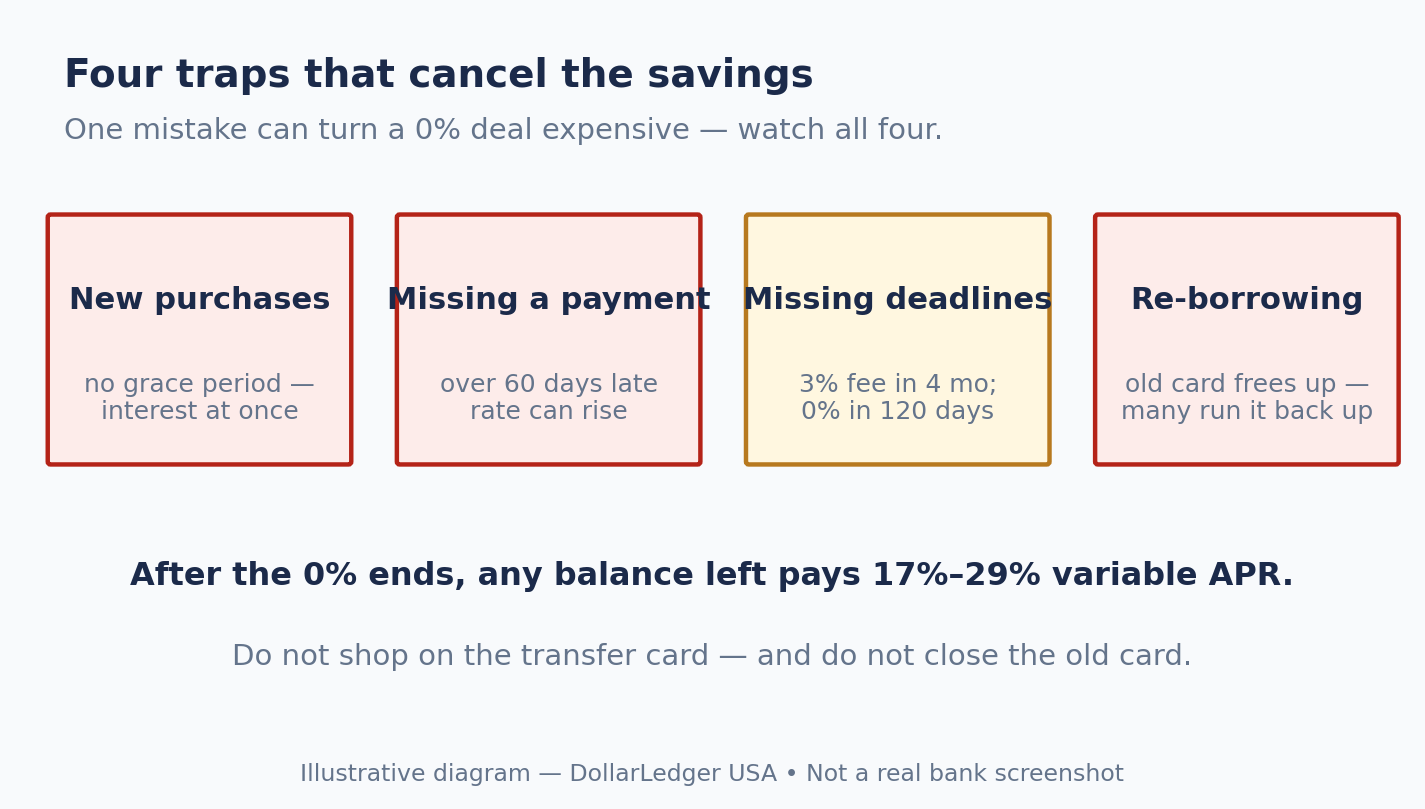
Illustrative diagram — Four traps that cancel the savings. NOT a real bank screenshot.
Step 6: Apply, transfer, and finish on time
What to do: Apply for one card, move the balance inside the deadline, and put the end date on your calendar.
How: Check your score first — the best 0% offers need good to excellent credit, around 670 or higher. Apply for one card only; each application can lower your score. Once approved, request the transfer right away to land inside the fee deadline — you cannot transfer from a card issued by the same bank. Set up autopay and a reminder for one month before the intro ends.
Example: David checks his score (712) and transfers $5,000 in week one — locking in the 3% fee.
Common mistake: Applying for three cards at once. Multiple applications can lower your score and reduce your chances.

Photo: Put the end of your 0% window on the calendar. (Photo: free stock)
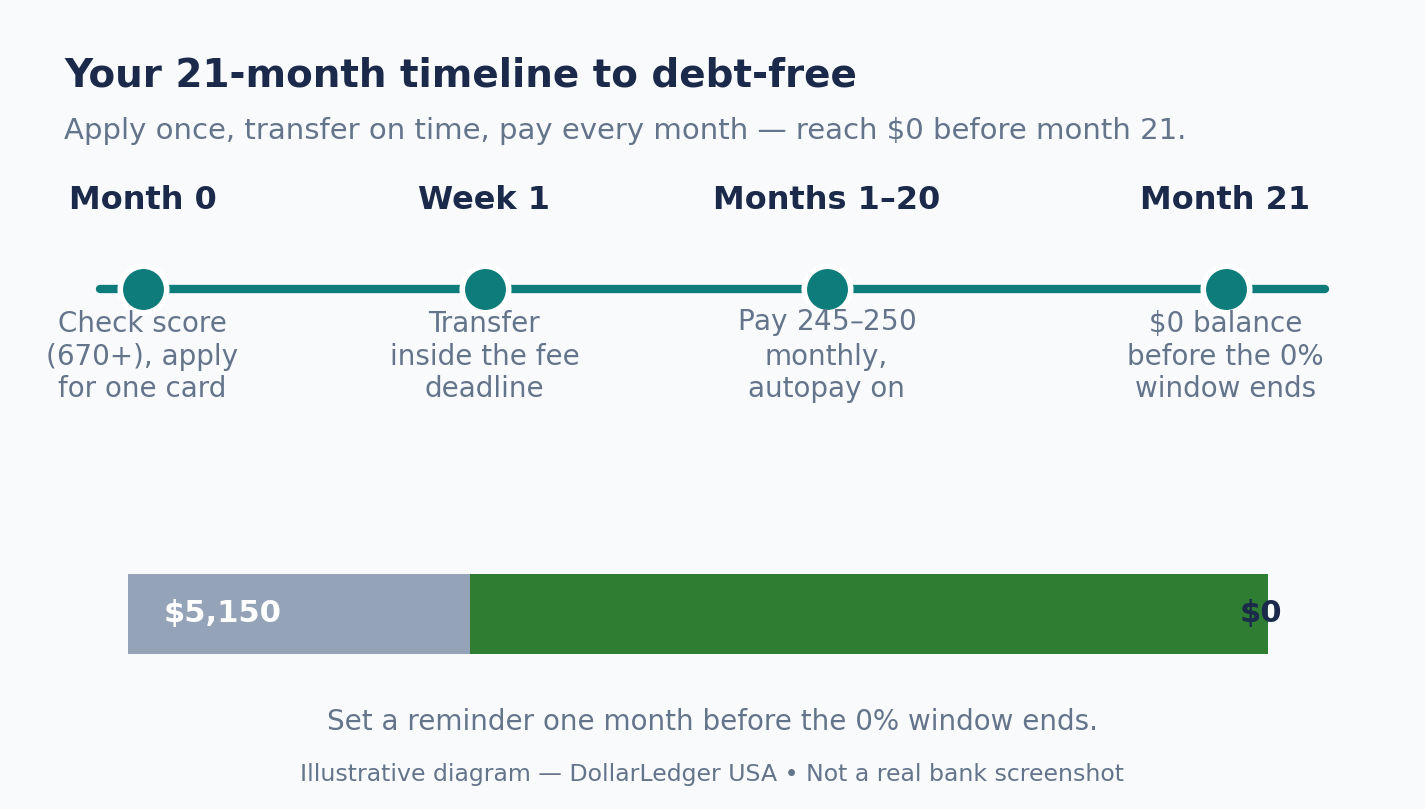
Illustrative diagram — Your 21-month timeline to debt-free. NOT a real bank screenshot.
Checklist
- ☐ I compared the 0% window AND the transfer fee.
- ☐ My credit score is 670 or higher.
- ☐ My old card is from a different issuer.
- ☐ Payoff: (balance + fee) ÷ months.
- ☐ Autopay set for at least that amount.
- ☐ Calendar reminder set before the 0% ends.
FAQ
Is a 0% balance transfer really free? No. The 0% rate applies to interest, but almost every card charges a 3% to 5% fee — $150 to $250 on $5,000, added to what you owe.
What happens if I don’t pay it off before the 0% period ends? Any remaining balance earns interest at the regular variable APR — roughly 17% to 29%. That is why the Step 4 payoff plan matters more.
Can I transfer a balance between two cards from the same bank? No. Issuers do not let you transfer between two of their own cards.
Will a balance transfer hurt my credit score? It can dip slightly at first — applying triggers a hard inquiry. Over time it usually helps: a new card lowers your utilization.
Sources
- Motley Fool Money, “Save $1,000+ on Interest: My 5 Favorite Balance Transfer Cards Available Now” — 21-month offers, fees and APRs: https://www.fool.com/money/credit-cards/articles/save-1000-on-interest-my-5-favorite-balance-transfer-cards-available-now/
- CFPB, “What do I need to know about consolidating my credit card debt?” — grace-period warning, 60-day rule: https://www.consumerfinance.gov/ask-cfpb/what-do-i-need-to-know-if-im-thinking-about-consolidating-my-credit-card-debt-en-1861/
All rates and fees checked November 3, 2026.
This article is for education only, not financial advice. Confirm current terms with the card issuer before applying.