Car Insurance Rates in 2026 — What You Should Pay, and How to Lower Your Premium
 DollarLedger Team
- 11 Nov, 2026
Your renewal just arrived $35 a month higher than last year, and nothing about you changed — same car, same address, no tickets. NerdWallet’s November 2026 analysis puts the median full-coverage premium up 32% since January 2023. But the national average is not your price. Depending on the source and the driver, full coverage in 2026 runs from about $187 to $238 a month. Here is the benchmark, the levers that move your quote, and six steps to a lower premium. All figures were checked on November 11, 2026.
Photo: Your renewal is not your price — the national benchmark for full coverage in 2026 is $187 to $238 a month. (Photo: Pexels)
What You Will Learn
- The 2026 benchmark — and why three sources give three numbers
- What your state charges, cheapest to most expensive
- How credit, tickets, crashes and age move your premium
- How to get three comparable quotes
- Deductible and coverage changes that save money
- Discounts to stack before your next renewal
Step 1: Know your benchmark before you renew
What to do: Compare your renewal price with the current national range before you pay it.
How: Full coverage is liability plus collision and comprehensive — cover for the other driver and your own car. Three averages, three different drivers — read the label with the number. Insurify’s November 2026 quotes (clean record, $1,000 deductibles) put full coverage at $187 a month. NerdWallet’s November 2026 analysis (a 35-year-old with good credit and a clean record, 2023 Camry LE) puts it at $2,357 a year, about $196 a month. InsuranceQuotes (rates filed September 30, 2026, 40-year-old, good credit, 2024 Camry) puts it at $238 a month. So a fair benchmark is roughly $187 to $238 a month. Liability-only is far cheaper: $99 a month (Insurify), and state-minimum cover $650 a year, about $54 a month (NerdWallet).
Example: At $260 a month you sit above all three benchmarks, so shop. At $190 you are inside the range.
Common mistake: Treating one website’s average as “the” rate.
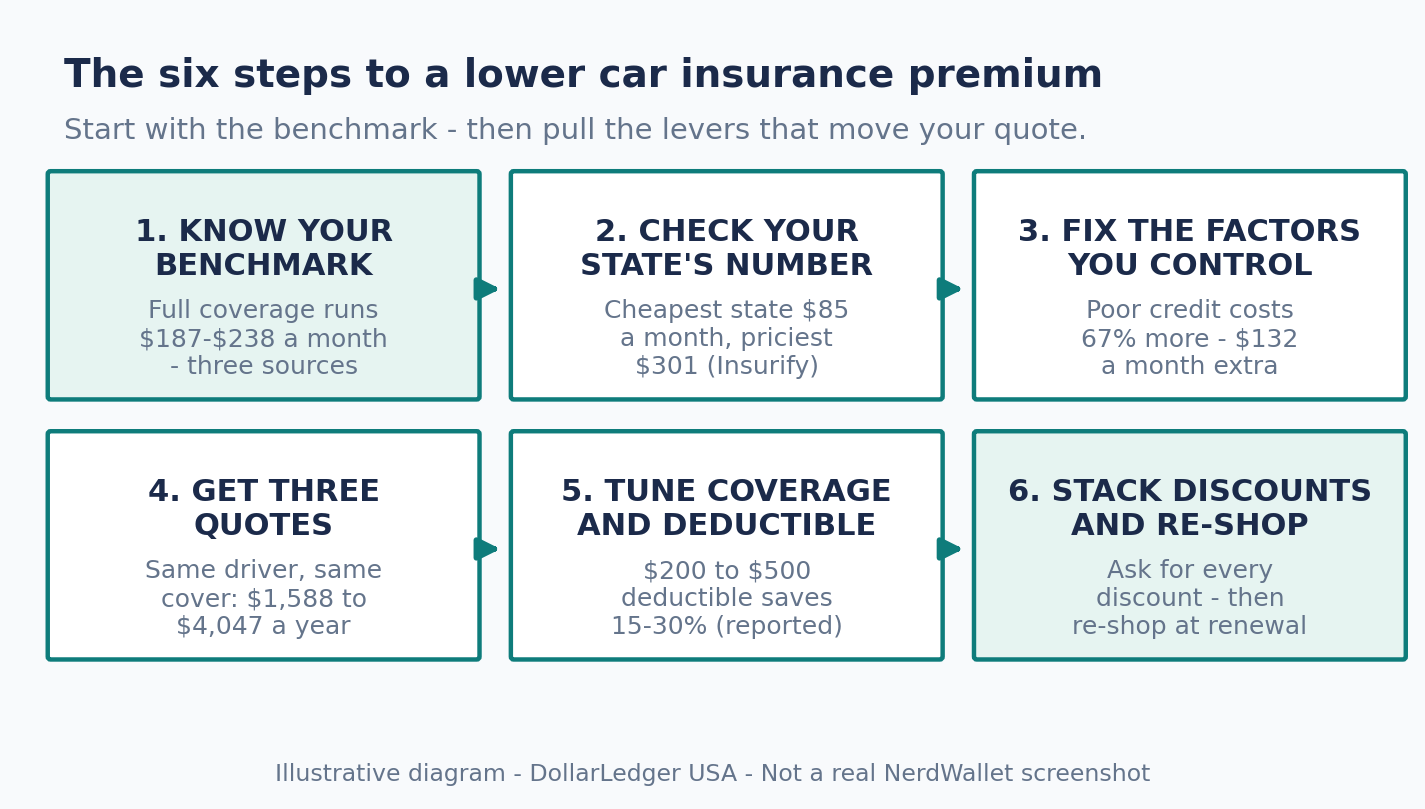
Illustrative diagram - The six steps to a lower car insurance premium. NOT a real NerdWallet screenshot.
Step 2: Check your state’s number
What to do: Look up your state’s average before judging your own premium.
How: Your state moves your premium as much as your driving — different rules, weather, theft and repair costs. The sources disagree on the ranking. NerdWallet (November 2026): cheapest Wyoming ($1,148 a year, about $96 a month), Vermont ($1,556), New Hampshire ($1,578); most expensive Louisiana ($4,290 a year, about $358 a month), New Jersey ($3,718). Insurify (November 2026): cheapest New Hampshire ($85 a month), Wyoming ($94); most expensive Maryland ($301 a month). InsuranceQuotes (same 40-year-old driver everywhere): cheapest Ohio ($137 a month), most expensive Nevada ($407 a month) — though that Nevada figure rests on only four insurers, so treat it as a high-end benchmark.
Example: The same driver pays $137 a month in Ohio and $407 in Nevada — a $3,240-a-year gap for moving state lines.
Common mistake: Comparing your premium with a friend in another state.
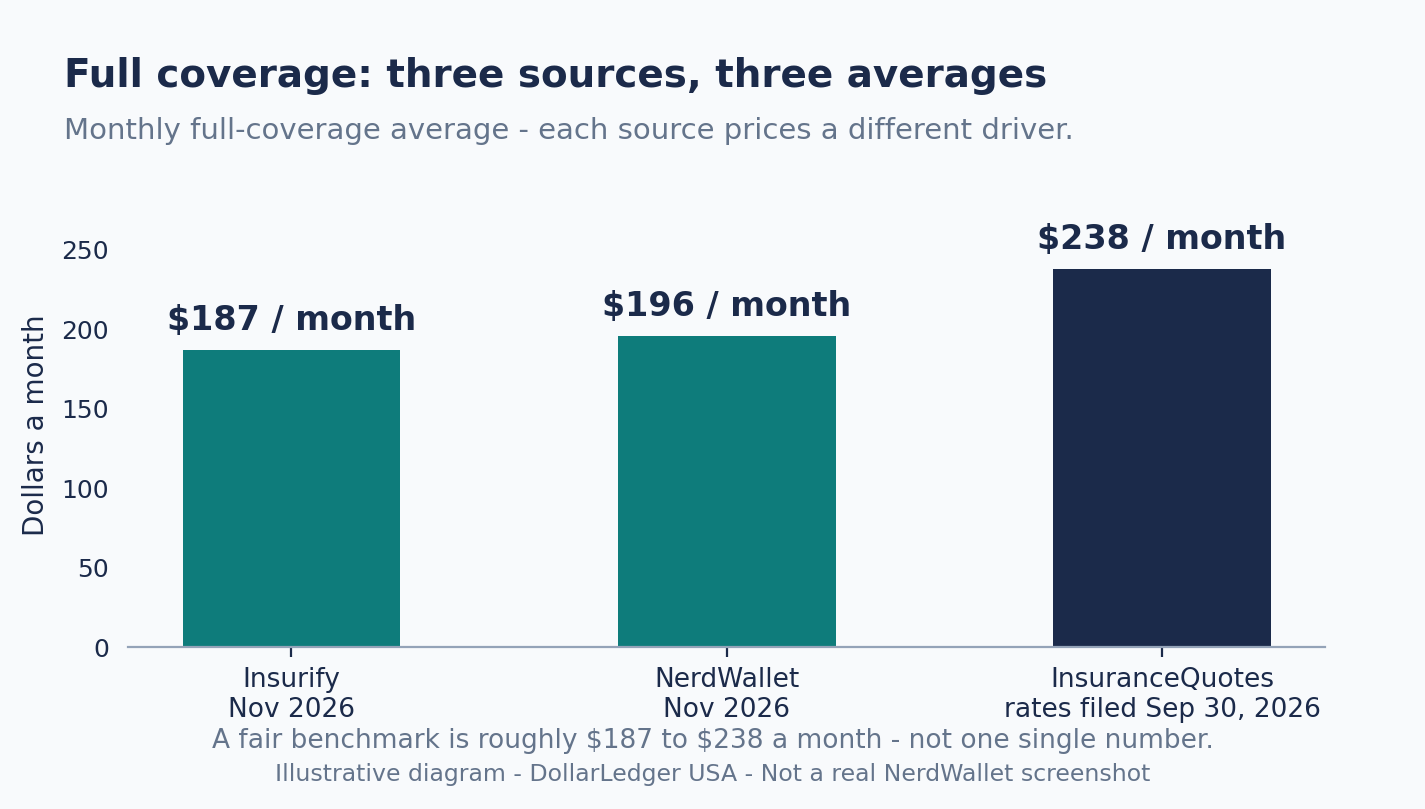
Illustrative diagram - Three sources, three averages: each prices a different driver. NOT a real NerdWallet screenshot.
Photo: SUVs and luxury cars usually cost more to insure — the car you drive is part of the price. (Photo: Pexels)
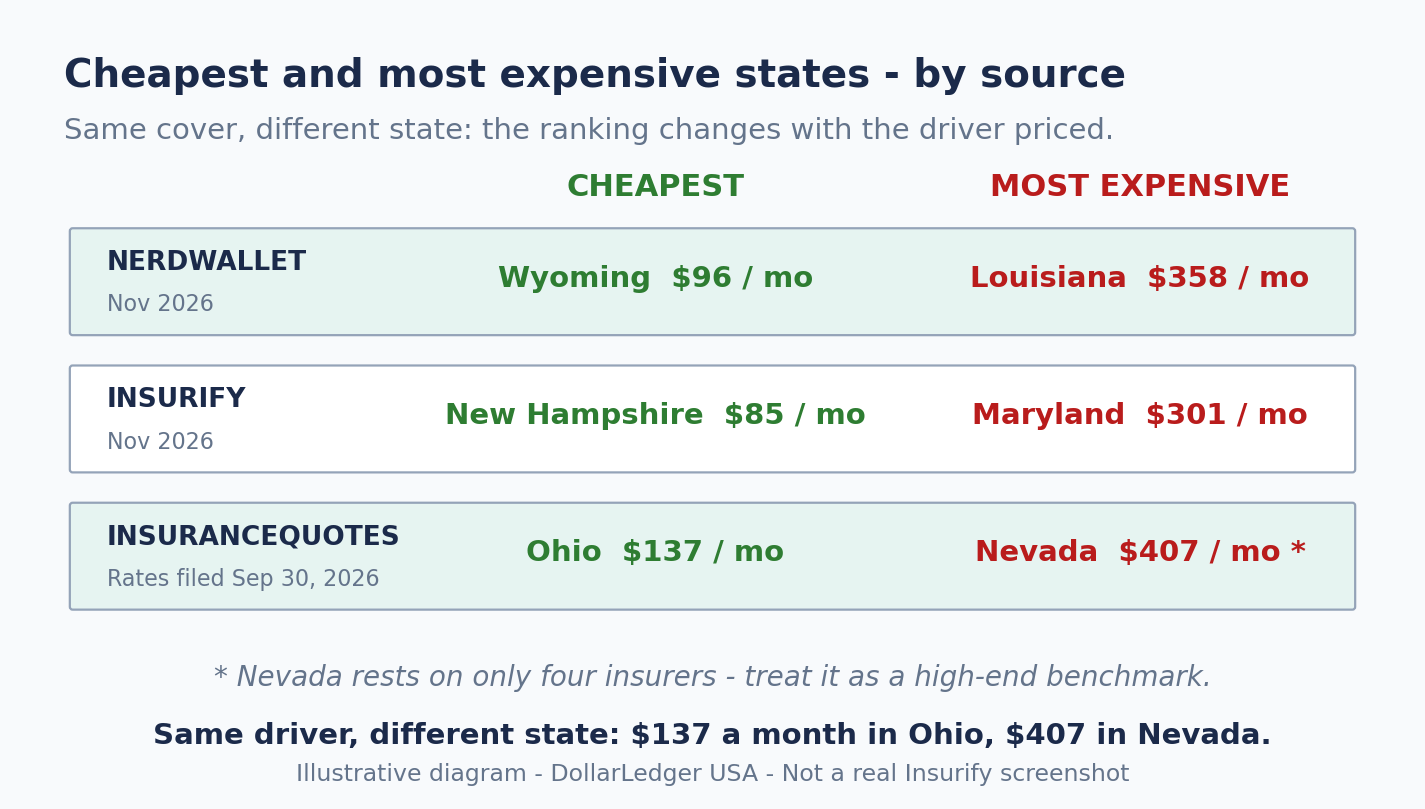
Illustrative diagram - Cheapest and most expensive states differ by source — check your own state. NOT a real Insurify screenshot.
Step 3: Fix the rating factors you control
What to do: Work on the three factors that move your quote most: credit, driving record and age.
How: Credit is the factor most drivers miss. NerdWallet (November 2026): full coverage is $3,939 a year with poor credit and a clean record, against $2,357 with good credit — 67% more, $1,582 a year, about $132 a month extra. Most states let insurers use a credit-based insurance score; California, Hawaii and Massachusetts do not. Check your credit reports for errors before you shop. One speeding ticket lifts the average to $3,022 a year (28% more), one at-fault crash to $3,514 (49% more), and one DUI to $4,424 (88% more); violations usually stay on your record for three to five years. Age matters too: a 20-year-old with a clean record and good credit averages $4,712 a year ($393 a month), double the 35-year-old’s $2,357.
Example: Two 35-year-olds, same Camry, clean records: good credit pays about $196 a month, poor credit about $328 — $132 a month more for the same cover.
Common mistake: Assuming credit has nothing to do with car insurance.
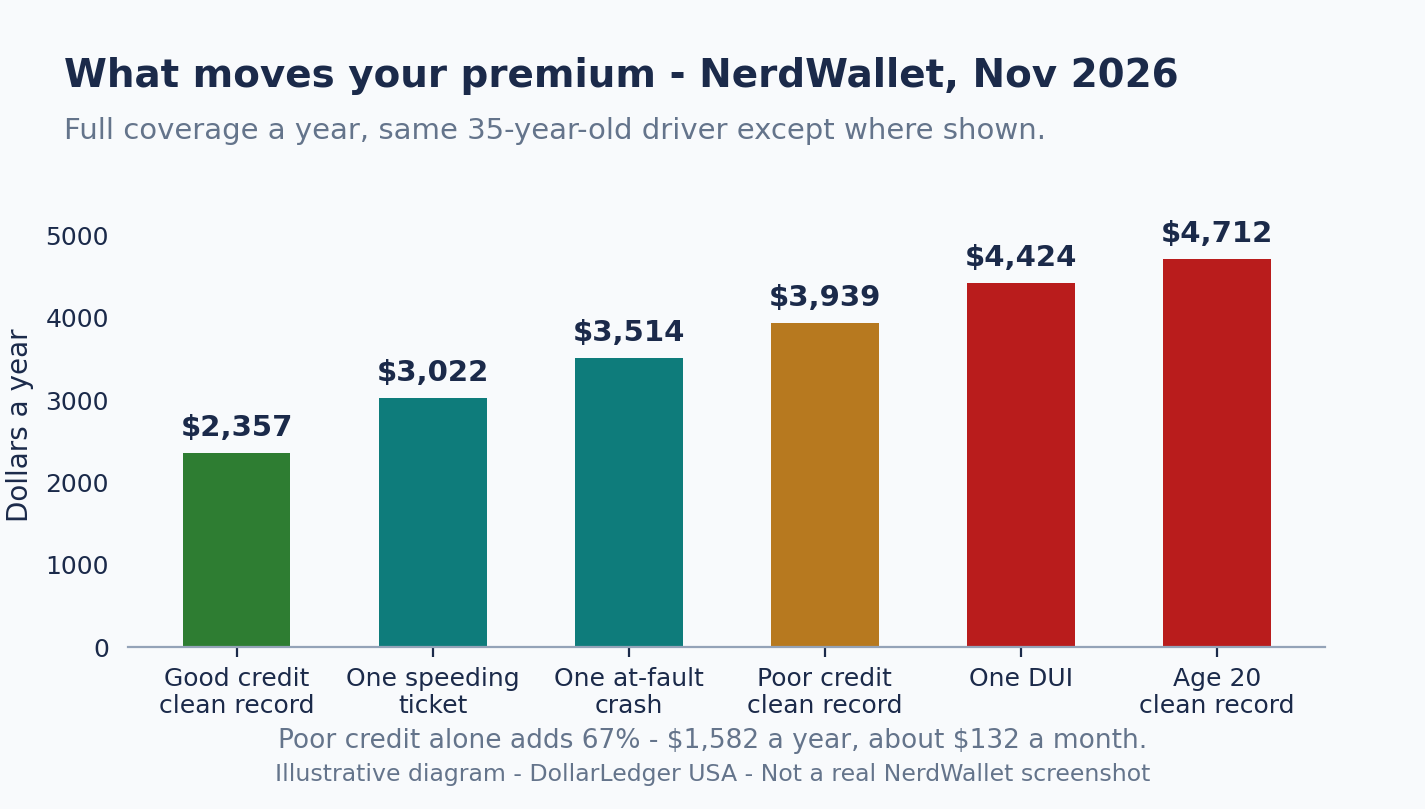
Illustrative diagram - What moves your premium: credit, record and age. NOT a real NerdWallet screenshot.
Step 4: Get three quotes the same way
What to do: Get at least three quotes, with identical coverage on each one, before your renewal date.
How: The NAIC, the body behind state insurance regulators, says it pays to shop around because prices differ — get at least three quotes. Make them comparable: the same liability limits, deductibles and optional cover on every quote — otherwise you are comparing different products. Re-shop at every renewal and after big life changes. The payoff is large: NerdWallet’s November 2026 averages for the same 35-year-old driver run from $1,588 a year at Travelers to $4,047 at Farmers — a $2,459-a-year spread. (State Farm $1,985, GEICO $2,020, Progressive $2,280.) USAA averages $1,587, but only for military families, veterans and some federal employees.
Example: A driver on the Farmers average who finds the Travelers average for the same cover saves $2,459 a year.
Common mistake: Getting one quote and renewing, or comparing quotes with different deductibles.
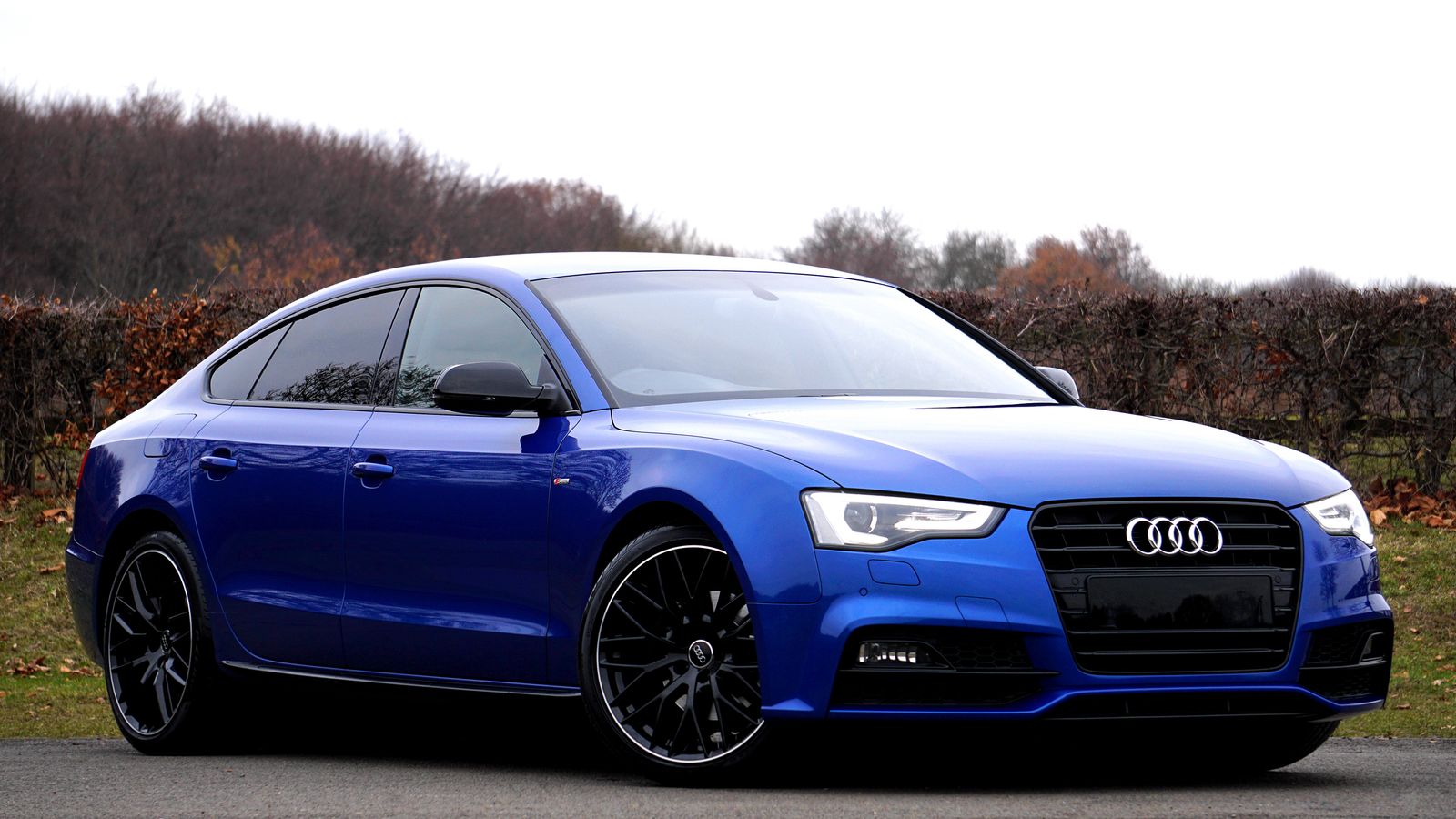
Photo: The same driver can be quoted $1,588 a year by one large insurer and $4,047 by another — get three quotes. (Photo: Pexels)
Step 5: Tune coverage and deductible
What to do: Raise your deductible if you can afford it, and drop cover your car no longer needs.
How: A deductible is what you pay before the insurer pays, and it applies to collision and comprehensive — not liability. The Insurance Information Institute says raising the deductible from $200 to $500 can cut collision and comprehensive costs by 15% to 30% (reported), and $1,000 can save 40% or more (reported) — but only take the higher deductible if you could pay it tomorrow from savings. For an older car, consider dropping collision and comprehensive if they cost more than 10% of the car’s value a year (the Institute’s 10-times rule, reported). Keep liability high enough to protect what you own — state-minimum cover is about $54 a month (NerdWallet), but it only pays the other driver. If you financed or leased your car, your lender requires full coverage — see our guide to the best auto loan rates in 2026 and how to get them.
Example: A $3,000 car with $450-a-year collision and comprehensive cover pays 15% of its value every year — dropping it saves $450 a year, but a crash is on you.
Common mistake: Raising the deductible to $1,000 with no emergency fund, or dropping to minimum cover while still owing on the car.
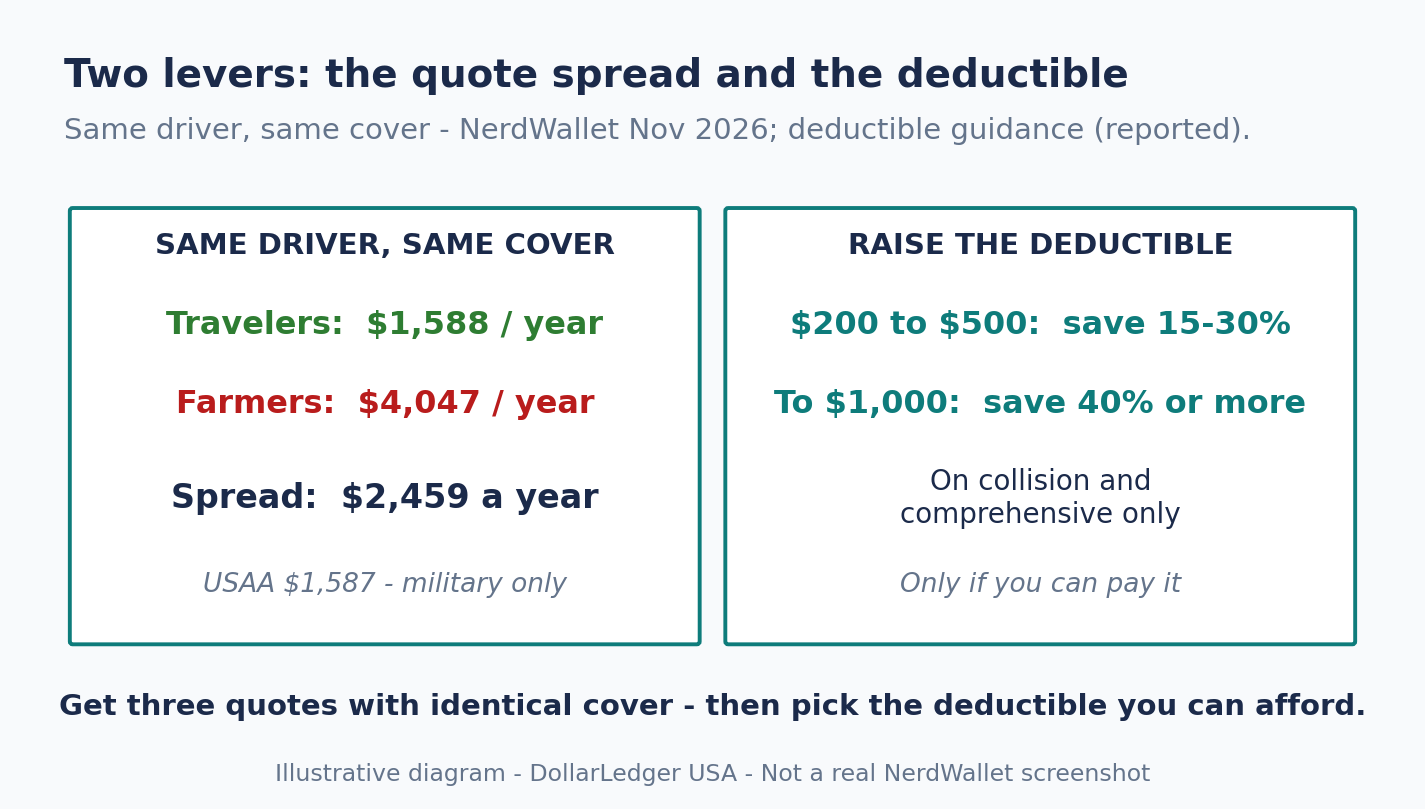
Illustrative diagram - The quote spread and the deductible lever. NOT a real NerdWallet screenshot.
Step 6: Stack discounts and re-shop every renewal
What to do: Ask for every discount you qualify for, then set a reminder to re-shop at the next renewal.
How: The NAIC lists these discounts: multi-car, driver education, a good student under 25, a mature driver aged 50 to 65, safety equipment, anti-theft devices, and home and auto with the same company. Discounts vary by company and state — ask about them at every renewal, as they are not always applied automatically. While you review insurance, check your family cover too — see term vs whole life insurance in the USA. Re-shop at every renewal and after any move, marriage or new car. If you were treated unfairly, the NAIC says to contact your state insurance department.
Example: Bundling home and auto, adding a good-student discount and switching to pay-in-full stacks three savings on one policy — ask for each by name.
Common mistake: Assuming loyalty pays. The saving goes to the driver who shops.
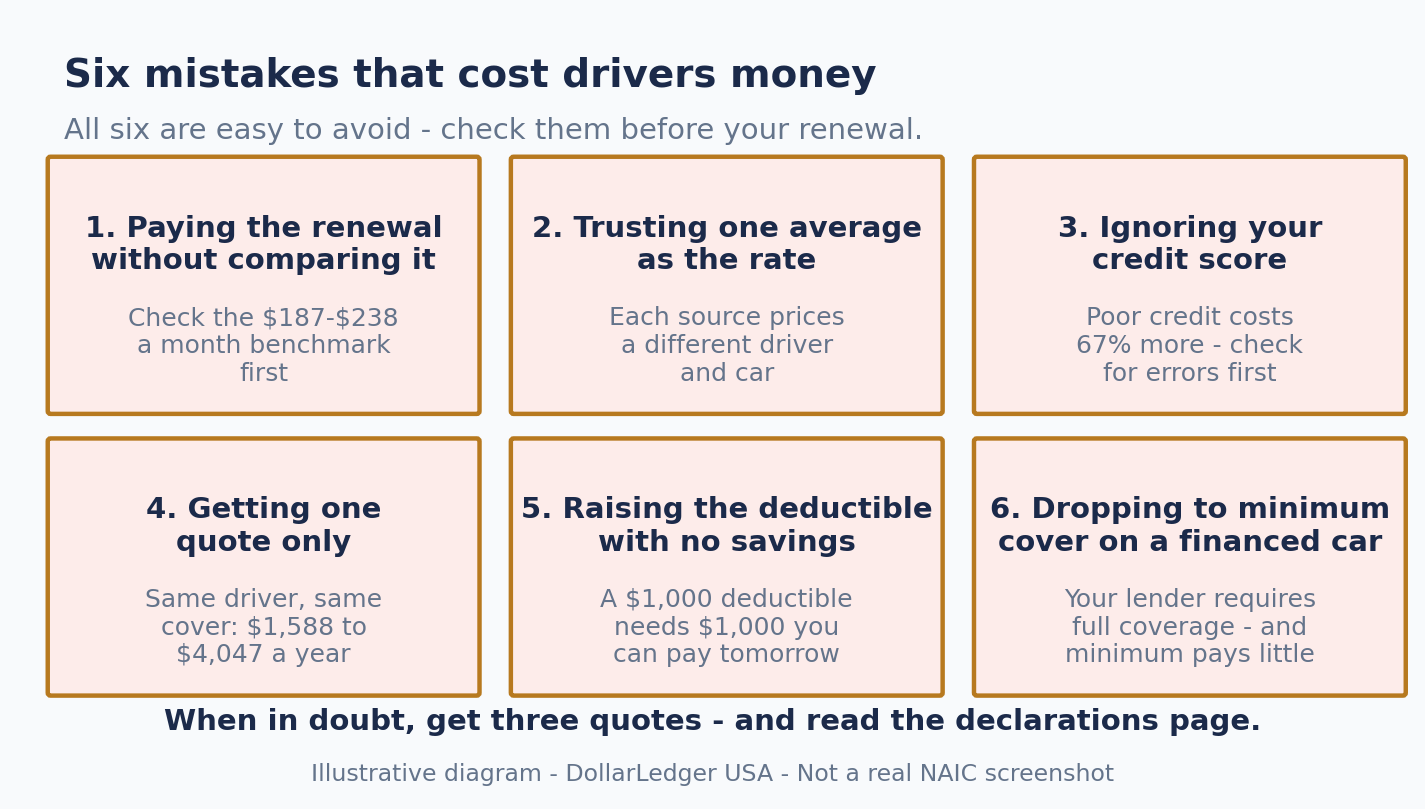
Illustrative diagram - Six mistakes that cost drivers money. NOT a real NAIC screenshot.
Checklist
- My renewal compared with the $187–$238 a month benchmark.
- My state’s average checked.
- Credit reports checked for errors.
- Three identical-coverage quotes.
- A deductible I could pay tomorrow from savings.
- Every discount asked for, and confirmed.
- Renewal date in the calendar — re-shop, don’t auto-renew.
FAQ
What is a fair price for full coverage car insurance in 2026?
About $187 to $238 a month. NerdWallet’s November 2026 median for a 35-year-old with good credit and a clean record is $2,357 a year, about $196 a month — your price depends on state, age, credit, record, car and ZIP code.
Why is my car insurance so much higher than the average?
The average driver does not exist. Your state alone can triple the price — $137 a month in Ohio, $407 in Nevada (InsuranceQuotes). Poor credit adds 67%, a DUI 88%, and a 20-year-old pays about double a 35-year-old (NerdWallet).
What is the cheapest state for car insurance in 2026?
They price different drivers, so they disagree. Cheapest: Wyoming about $96 a month (NerdWallet), New Hampshire $85 (Insurify), Ohio $137 (InsuranceQuotes). Most expensive: Louisiana $358 (NerdWallet), Maryland $301 (Insurify), Nevada $407 (InsuranceQuotes).
How much can I save by raising my deductible?
Going from a $200 to a $500 deductible can cut collision and comprehensive costs by 15% to 30%, and $1,000 can save 40% or more (Insurance Information Institute, reported). Only those two covers — not liability — and only if you can pay the deductible from savings.
Sources
- National Association of Insurance Commissioners, Tips for Saving on your Auto Insurance (opened live November 11, 2026): https://content.naic.org/article/consumer-insight-tips-saving-your-auto-insurance
- NerdWallet, Average Cost of Car Insurance, November 2026 analysis (opened live November 11, 2026): https://www.nerdwallet.com/insurance/auto/average-car-insurance-cost
- Insurify, Average Car Insurance Rates as of November 2026 (opened live November 11, 2026): https://insurify.com/car-insurance/news/average-car-insurance-rates-november-2026
All figures checked November 11, 2026, against NerdWallet, Insurify and InsuranceQuotes (rates filed September 30, 2026). InsuranceQuotes figures are attributed in the text.
Disclaimer: For education only, not insurance, tax or investment advice. Rates vary by state, insurer, driver and car, and change often — get your own quotes before you buy.