How to Pay Off Credit Card Debt Fast in 2026 - Avalanche vs Snowball, With Real Math
 DollarLedger Team
- 09 Nov, 2026

Americans owed $1.263 trillion on credit cards at the end of June 2026, according to the Federal Reserve Bank of New York. The average borrower with a bank credit card carried $6,610 in the second quarter of 2026, according to TransUnion (reported). The price is steep: the Federal Reserve’s G.19 release puts the average rate on accounts charged interest at 22.36% for Q3 2026, preliminary, released November 6, 2026. At that rate, the minimum payment can stretch a $6,610 balance over more than 20 years.
Photo: The average borrower with a bank credit card carried $6,610 in the second quarter of 2026. (Photo: Pexels)
What You Will Learn
- The minimum-payment trap: over $11,000 of interest on an average balance
- Avalanche vs snowball, with real numbers on three cards
- What $150, $200 or $250 a month does to your payoff
- When a 0% balance transfer helps - and when it hurts
- What to do if you cannot make the minimums
Step 1: List every card - balance, APR, and minimum
What to do: Write down every card you owe money on, with three numbers each: balance, APR, and minimum payment.
How: Open each statement or app and copy the numbers into one list. Sort it twice: by balance, smallest to largest, and by APR, highest to lowest - you need both orders in Step 3. Add up the balances for your total debt, and the minimums for the floor you must pay each month.
Example: Maya has three cards: A, $800 at 19%; B, $2,200 at 26%; C, $3,610 at 22%. Her total is $6,610, the average balance. By balance the order is A, B, C; by APR it is B, C, A. Her minimums add up to about $190 a month.
Common mistake: Picking a payoff method before listing the cards. You cannot pick a target card until you can see all of them.
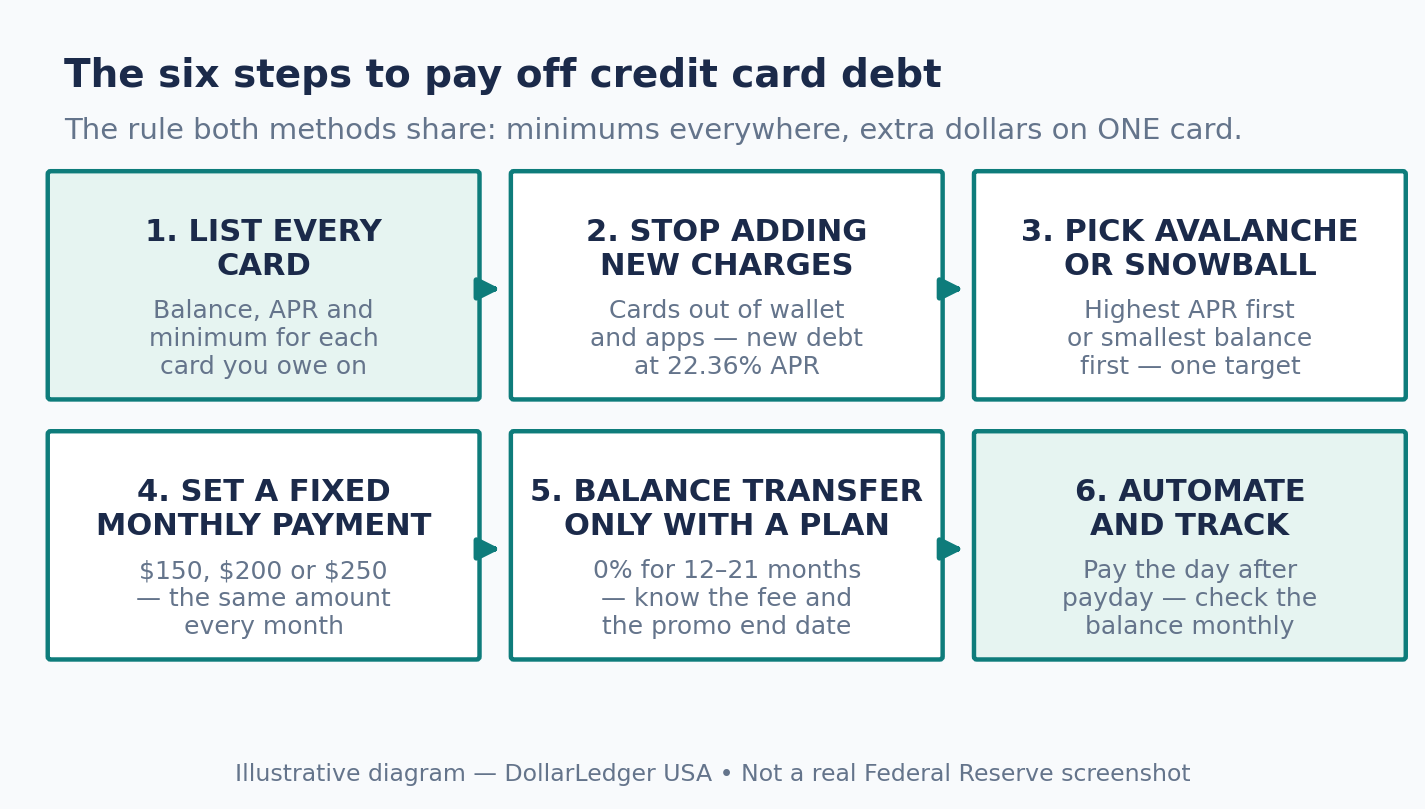
Illustrative diagram - The six steps to pay off credit card debt in 2026. NOT a real Federal Reserve screenshot.
Step 2: Stop adding new charges
What to do: Freeze new spending on every card you are paying off until the balance is zero.
How: Take the cards out of your wallet and your phone. Remove saved card numbers from shopping apps and websites, and turn off one-click checkout. Pay for daily spending with a debit card or cash, and move automatic bills to your debit card or bank account. Without this step the other five do not work: every new charge is new debt at 22.36%.
Example: Maya’s streaming, food delivery and ride-share apps all had Card C saved. She removed it from all three and moved two subscriptions to her debit card. Her Card C balance stopped growing the same week.
Common mistake: Paying extra on one card while charging on another. That is not paying off debt - it is moving it around.
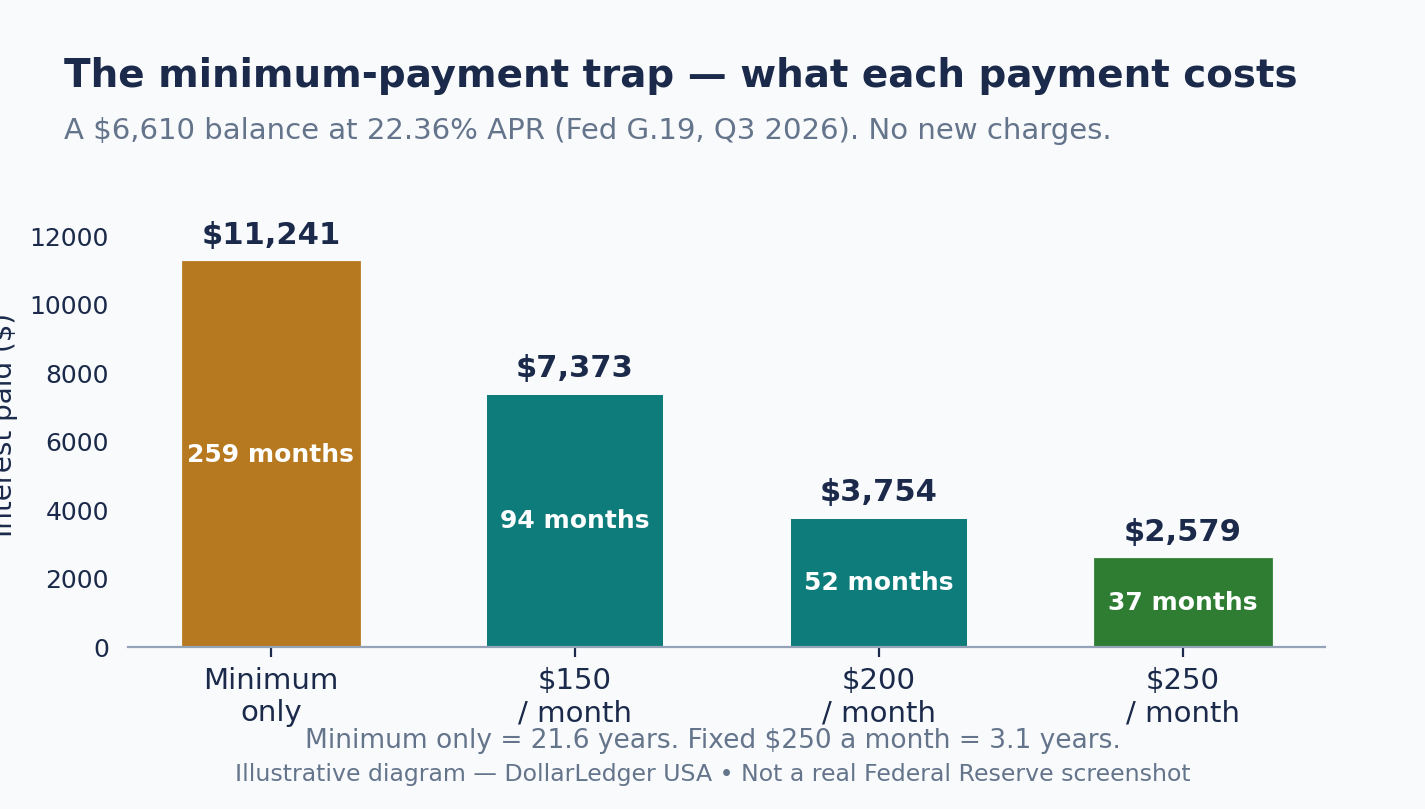
Illustrative diagram - The minimum-payment trap: what each payment level costs on a $6,610 balance at 22.36% APR. NOT a real Federal Reserve screenshot.

Photo: Run your own numbers before you pick a payment - the difference between the minimum and a fixed payment is thousands of dollars. (Photo: Pexels)
Step 3: Pick your method - avalanche or snowball
What to do: Choose one target card. Pay the minimum on every card, and put every extra dollar on that one card until it is gone, then move to the next.
How: Avalanche targets the highest APR first and saves the most interest. Snowball targets the smallest balance first and gives the fastest win. Both follow the same rule: minimums everywhere, all extra money on ONE card. Kellogg research, published in the Journal of Consumer Research, found concentrating repayment on one account improves follow-through (reported).
Example: Maya can pay $450 a month in total. Snowball: Card A ($800) is gone in month 3, all three clear in 18 months, $1,220 of interest. Avalanche: the first card goes in month 8, all three clear in 18 months, $1,168 of interest. Avalanche saves $52; snowball gives a first win five months sooner.
Common mistake: Splitting the extra money across all cards. That feels fair, but no card gets paid off early, and no win arrives to keep you going.
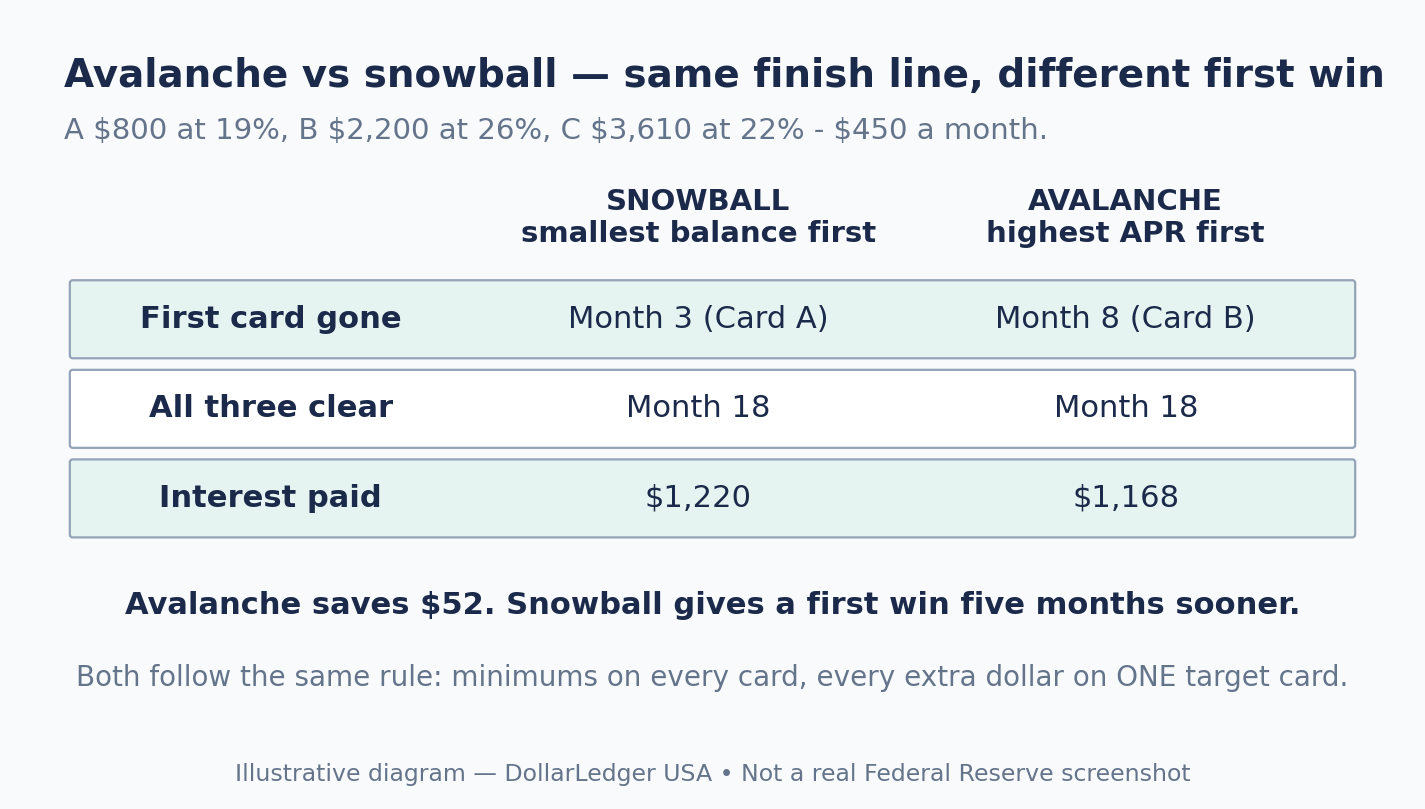
Illustrative diagram - Avalanche vs snowball on a $6,610 balance: same finish line, different first win. NOT a real Federal Reserve screenshot.
Step 4: Set a fixed monthly payment - and see what it buys
What to do: Replace the shrinking minimum with a fixed payment you send every month.
How: The minimum shrinks as the balance shrinks, which is exactly why it takes so long. Pick a fixed number you can hold: $150, $200 or $250 a month. The math below uses the average $6,610 balance at 22.36% APR from the Federal Reserve’s G.19 release, with no new charges. The minimum-only row assumes a typical minimum of the month’s interest plus 1% of the balance.
Example: Minimums only: 259 months - 21.6 years - and $11,241 in interest, more than the balance itself. $150 a month: 94 months (7.8 years), $7,373. $200: 52 months (4.3 years), $3,754. $250: 37 months (3.1 years), $2,579. Every $50 step up saves years and thousands of dollars.
Common mistake: Thinking the balance is falling fast. Early on, most of the minimum is interest: the first minimum on $6,610 is about $189, and about $123 of it is interest.
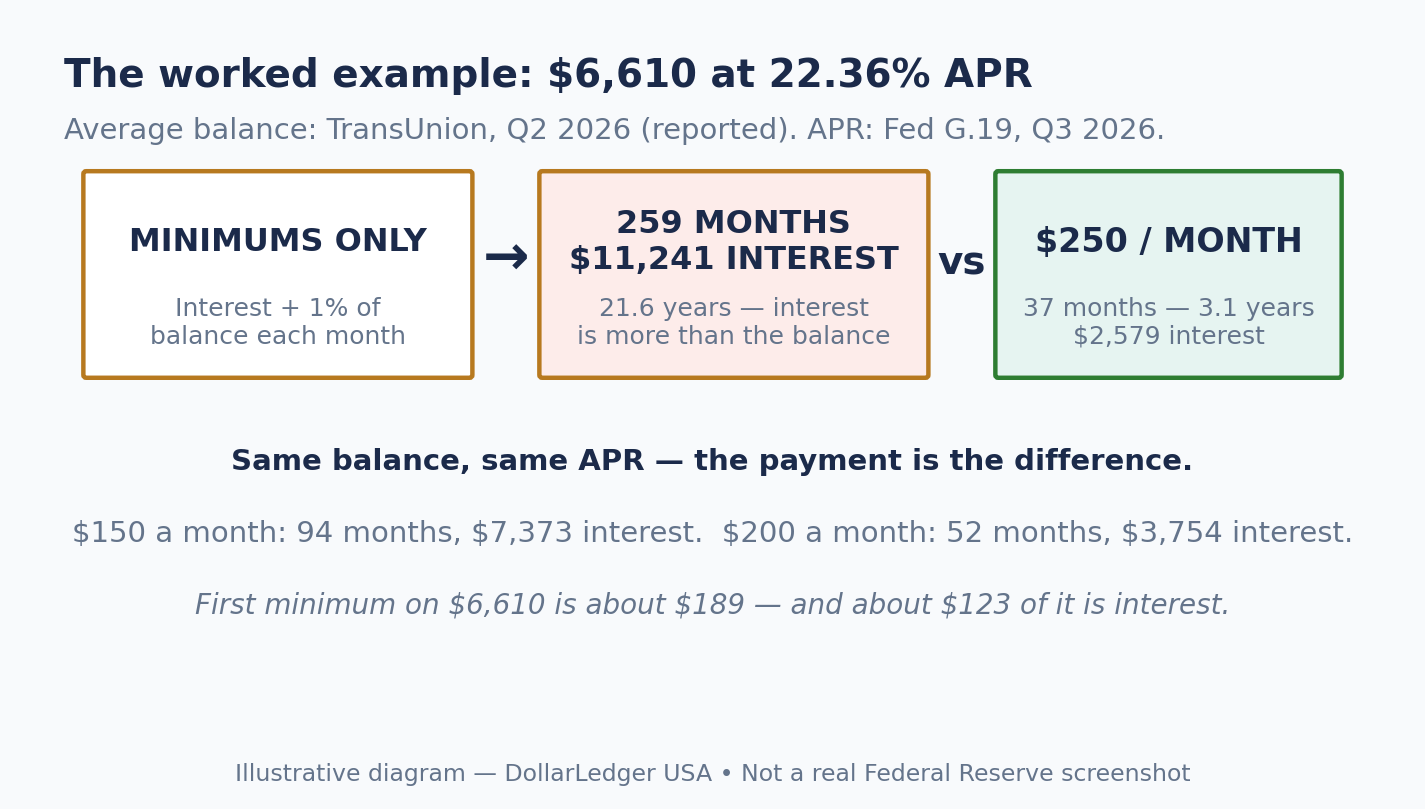
Illustrative diagram - The worked example: minimums vs $250 a month on a $6,610 balance. NOT a real Federal Reserve screenshot.

Photo: A fixed payment beats a shrinking minimum every time - pick a number and hold it. (Photo: Pexels)
Step 5: Use a balance transfer only with a payoff plan - or call your issuer
What to do: Before you move a balance, work out the fee, the payment that clears it before the promo ends, and what happens if it does not.
How: A balance transfer card typically offers 0% APR for 12 to 21 months, with a fee of 3% to 5% of the amount moved (reported). On $6,610, a 4% fee is $264, so $6,874 must be repaid. Clearing that in 18 months takes $382 a month, every month. If the balance is still there when the promo ends, the rate jumps to the regular APR, often above 20%. Only transfer an amount you can clear inside the promo. Our guide to 0% APR balance transfer cards explains how to compare offers.
Example: Maya moves $2,200 from Card B (26%) to a 0% card for 18 months, pays an $88 fee at 4%, and clears it at $128 a month. She does not move the whole $6,610: $382 a month is more than she can hold.
Common mistake: Treating a balance transfer as a payoff. It is a pause on interest, not a payment: without the monthly plan, the debt is still there when the rate jumps.
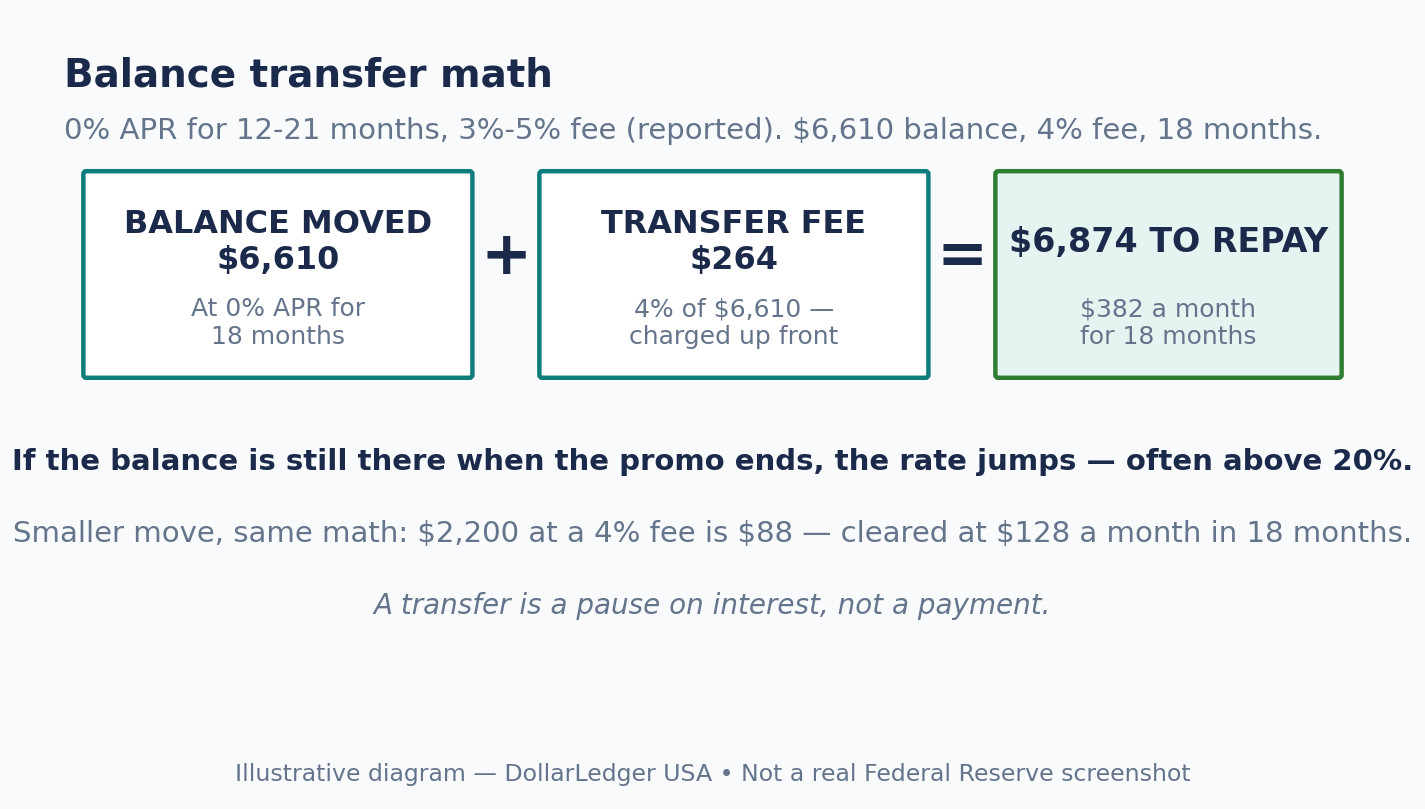
Illustrative diagram - Balance transfer math: the fee is real, and the promo clock is real. NOT a real Federal Reserve screenshot.
Step 6: Automate it, track it, and know what to do if you cannot pay
What to do: Automate the fixed payment for the day after payday, and act early if the minimums become impossible.
How: Set an automatic payment, and check the balance on the first of each month. If you cannot make a minimum, call the issuer BEFORE you miss the payment and ask for a lower APR or a hardship program. The Federal Trade Commission says creditors may be willing to negotiate. A nonprofit credit counselor can set up a debt management plan, often with lower rates. Avoid for-profit debt settlement companies that tell you to stop paying: the FTC warns they can leave you owing more, with a damaged credit score.
Example: Maya’s issuer cut Card B’s APR from 26% to 18% for 12 months when she asked early.
Common mistake: Waiting until you have already missed payments. Missed minimums for 4 to 6 months can lead to a charge-off, which hurts your credit score badly - and the debt is still owed.
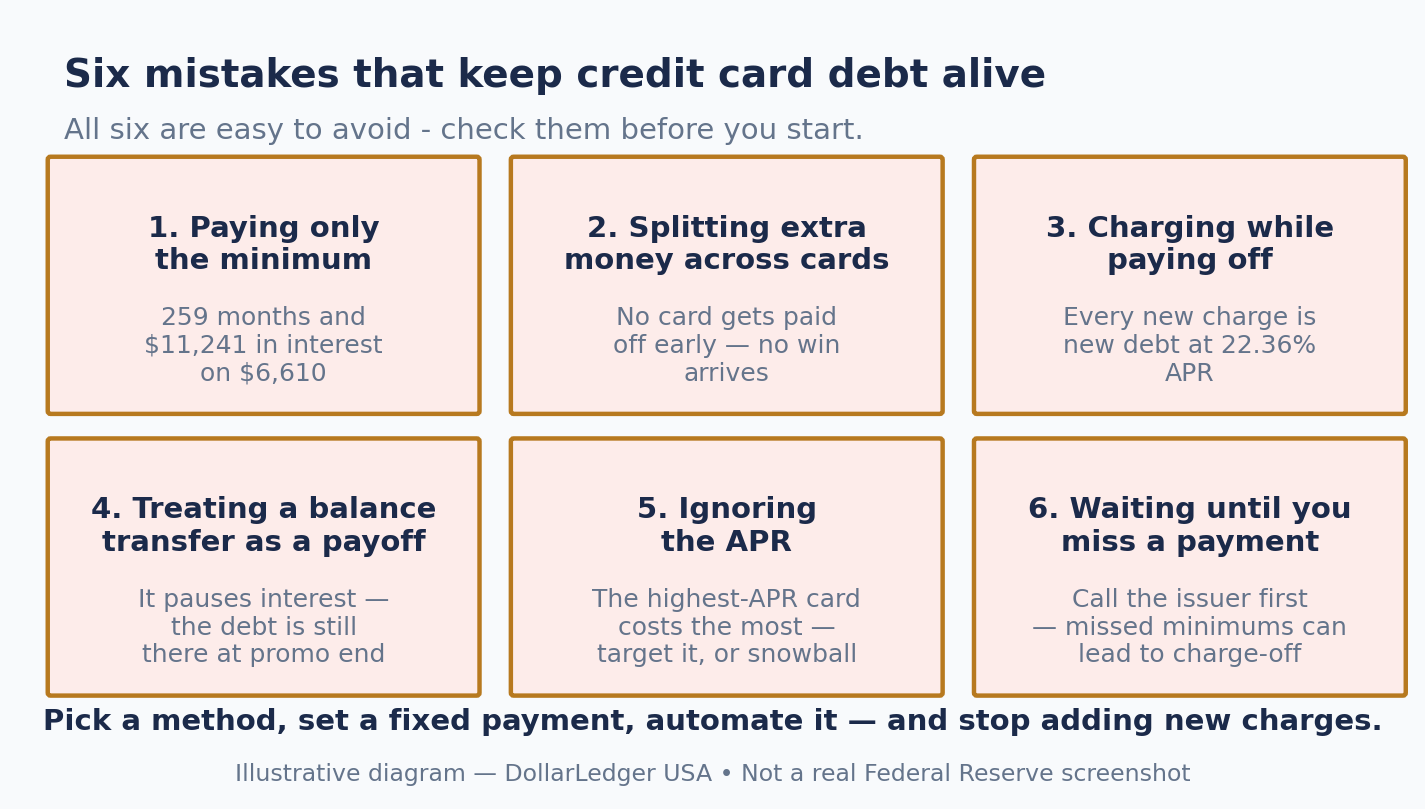
Illustrative diagram - Six mistakes that keep credit card debt alive. NOT a real Federal Reserve screenshot.
Checklist
- I listed every card with its balance, APR and minimum.
- I removed saved cards from apps and stopped new charges.
- I picked one target card and put all extra money on it.
- I set a fixed monthly payment and know my payoff date.
- If I used a balance transfer, I know the fee and promo end date.
- I automated the payment and check monthly.
FAQ
How fast can I pay off $6,610 of credit card debt?
At 22.36% APR (Federal Reserve G.19, Q3 2026), $250 a month clears it in 37 months with $2,579 of interest. At $200 it takes 52 months and $3,754. Minimums only: 259 months and $11,241 in interest.
Is avalanche or snowball better?
Avalanche saves the most interest: it targets the highest APR first. Snowball gives the fastest first win: it targets the smallest balance first. On three cards totaling $6,610 at $450 a month, both finish in 18 months; avalanche saves $52, snowball clears the first card in month 3 instead of month 8.
Does a balance transfer really save money?
Only with a payoff plan. A 0% offer for 12 to 21 months usually charges a 3% to 5% fee (reported). On $6,610 at 4%, that is $264, and $382 a month clears $6,874 in 18 months. If you cannot hold that, transfer less.
What happens if I only pay the minimum?
Very slowly: most of the minimum is interest. On $6,610 at 22.36%, minimums only take 21.6 years and cost $11,241 in interest - more than the original balance.
What should I do if I cannot make the minimum payment?
Call the issuer before you miss it and ask for a lower APR or a hardship program. The FTC advises calling creditors early to work out a payment plan. A nonprofit credit counselor can also help.
Sources
- Federal Reserve, “Consumer Credit - G.19” (November 6, 2026 release): https://www.federalreserve.gov/releases/g19/current/
- Federal Reserve Bank of New York, Household Debt and Credit Report, Q2 2026 (August 11, 2026): https://www.newyorkfed.org/newsevents/news/research/2026/20260811
- Federal Trade Commission, “How To Get Out of Debt”: https://consumer.ftc.gov/articles/how-get-out-debt
- DollarLedger USA, “Best 0% APR Balance Transfer Cards in 2026”: </blog/best-0-apr-balance-transfer-cards-2026>
All figures checked November 9, 2026, against the G.19 release (November 6, 2026), the New York Fed Q2 2026 report, and the FTC. Payoff figures are DollarLedger’s own math on the stated inputs.
Disclaimer: For education only, not financial advice. Your APR and terms depend on your issuer - check your own statements.