How Much House Can I Afford in USA 2026? The 28/36 Rule, Worked Out
 DollarLedger Team
- 09 Nov, 2026

A lender will approve you for more house than you can comfortably afford. That is the trap in this question: the biggest number on your pre-approval letter is not your budget. The comfortable number is the 28/36 rule - keep total housing costs at or under 28% of your gross monthly income, and all monthly debts, housing included, at or under 36%. The rate used here is 7.18% for a 30-year fixed loan, the Freddie Mac Primary Mortgage Market Survey average for the week ending November 5, 2026. The national median existing-home price is $417,500, the National Association of Realtors figure for September 2026.
Photo: The lender’s maximum is not your budget - run the 28/36 rule first. (Photo: Pexels)
What You Will Learn
- The 28/36 rule, and why it is stricter than a lender’s limit
- Your two caps: housing, and all debts together
- A worked example: what $100,000 a year buys at 7.18%
- The forgotten costs: taxes, insurance, PMI, HOA, maintenance
- What income the $417,500 median home needs
Step 1: Learn the 28/36 rule
What to do: Use two percentages of your gross monthly income as your ceiling.
How: Gross monthly income is your pay before taxes and deductions, divided by 12. The 28% front-end rule caps your total monthly housing cost at 28% of it: principal and interest, property taxes, homeowners insurance, mortgage insurance (PMI) if you pay it, and HOA dues. The 36% back-end rule caps your housing cost plus every other monthly debt - car loan, student loan, minimum credit card payments, personal loan - at 36% of the same income. The CFPB calls this the debt-to-income ratio, or DTI. Its Your Money, Your Goals worksheet uses the same 28% and 36% guidelines (reported). It is a planning guideline, not a law.
Example: On $100,000 a year, gross monthly income is $8,333 - a $2,333 housing cap and a $3,000 total-debt cap.
Common mistake: Treating the lender’s approval as a budget. A lender checks debts on your credit report, not your real life.
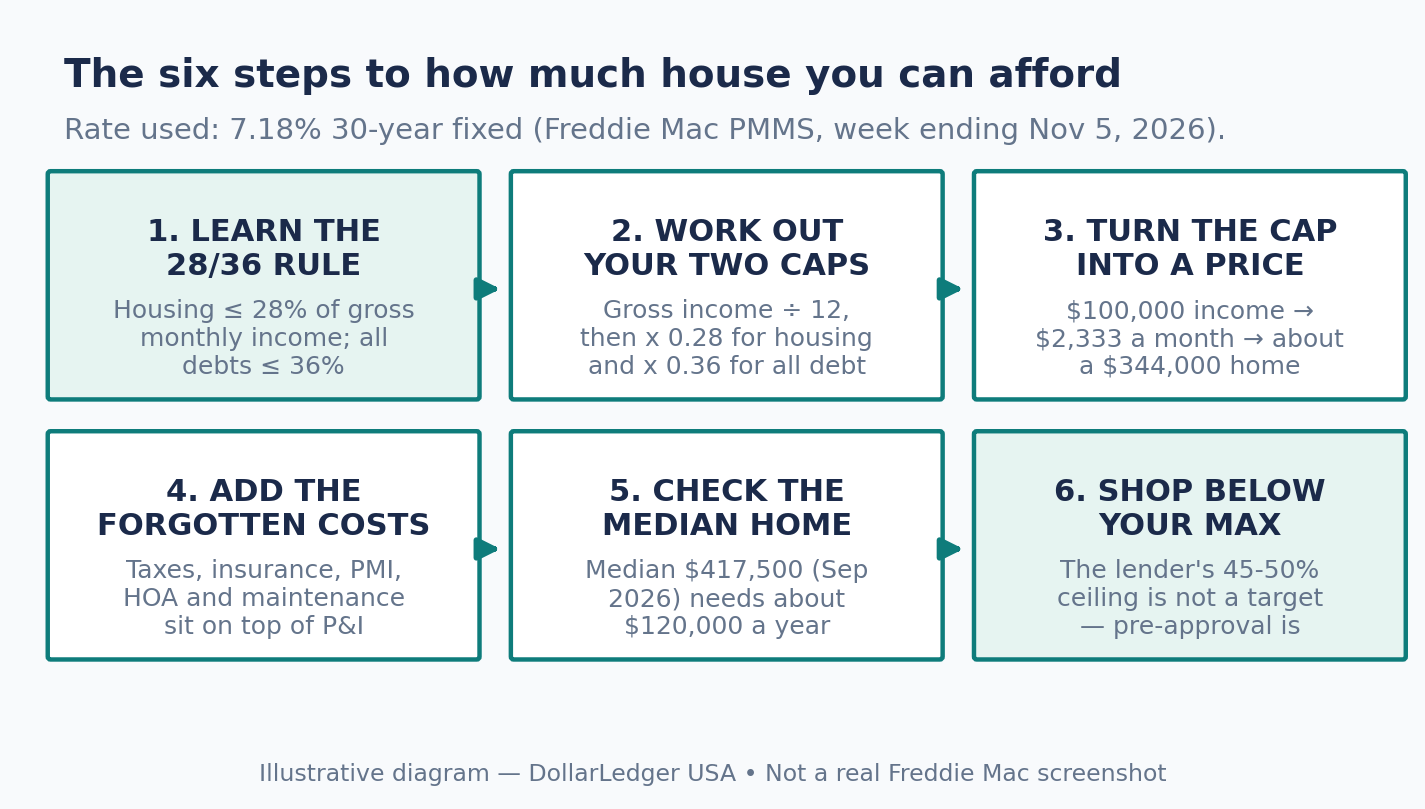
Illustrative diagram - The six steps to how much house you can afford in 2026. NOT a real Freddie Mac screenshot.
Step 2: Work out your two caps
What to do: Turn your annual income into two monthly caps, then find which one binds.
How: Divide your gross annual income by 12. Multiply by 0.28 for the housing cap and by 0.36 for the total-debt cap. Then subtract your other monthly debt payments from the total-debt cap. The lower of the two is your real housing budget.
Example: On $100,000 a year, the caps are $2,333 for housing and $3,000 for all debt. With no other debts, your budget is $2,333. With $900 a month of car and student loan payments, the back-end cap leaves $2,100 for housing - lower than $2,333, so it binds.
Common mistake: Using take-home pay. The rule is built on gross income.
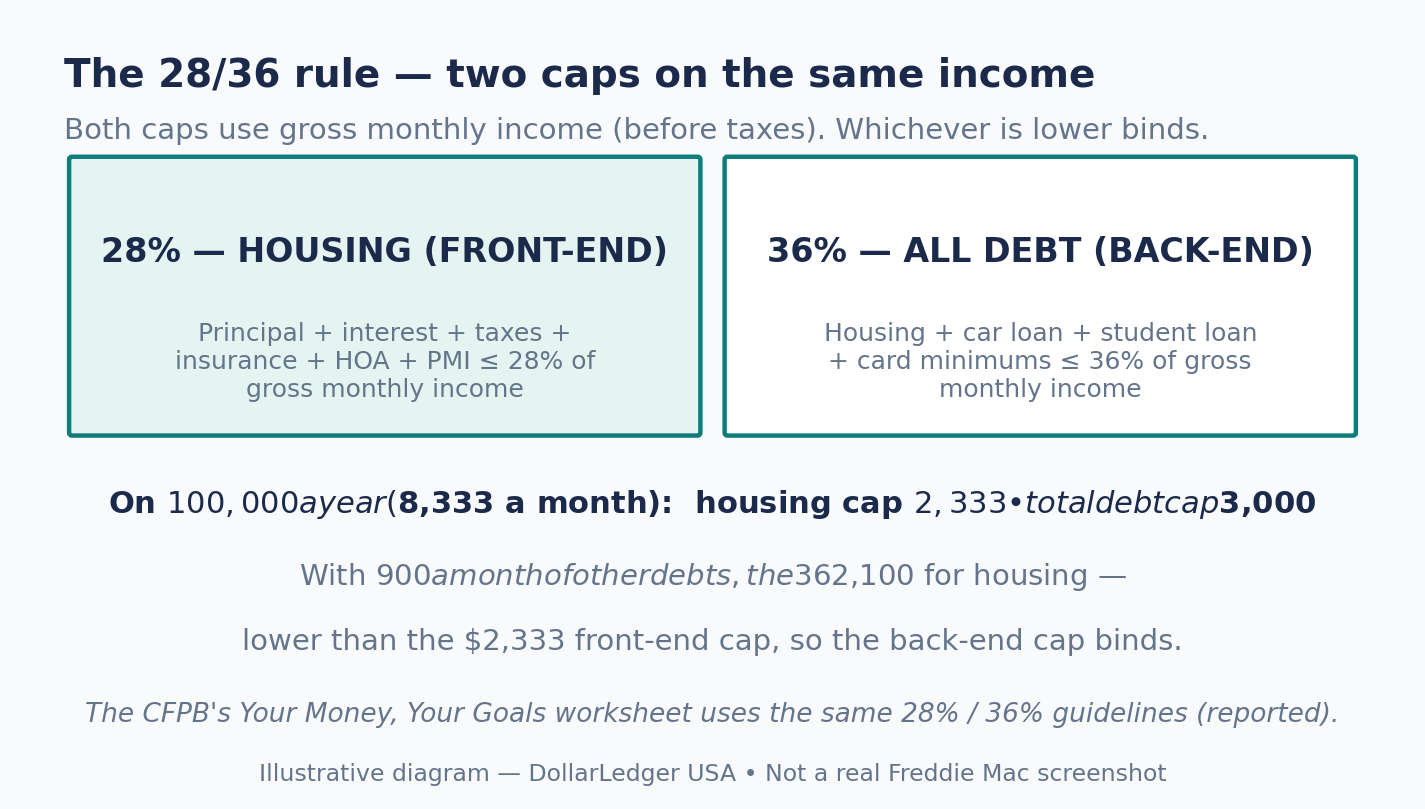
Illustrative diagram - The 28/36 rule: two caps on the same income. NOT a real Freddie Mac screenshot.

Photo: Before you sign anything, run the two caps on your own income - not the lender’s maximum. (Photo: Pexels)
Step 3: Turn the housing cap into a home price
What to do: Turn your monthly housing budget into the most expensive home it can carry.
How: A monthly housing payment has four parts: principal and interest, property taxes, homeowners insurance, and PMI or HOA if they apply. At 7.18% on a 30-year loan, each $1,000 of loan costs about $6.77 a month in principal and interest. This worked example assumes 20% down, a property tax rate of 1.1% of the home price a year, and $1,800 a year of homeowners insurance. Those last two are assumptions - use local quotes. The same method gives a rough price for any income - see the chart in Diagram 3.
Example: On $100,000 a year, the housing cap is $2,333 a month. A $344,000 home with 20% down ($68,800) leaves a $275,200 loan. Principal and interest come to $1,864 a month, property tax to $315, and insurance to $150. The total is $2,329 a month, just under the $2,333 cap.
Common mistake: Pricing from the loan payment alone. Taxes and insurance add roughly $465 a month here.
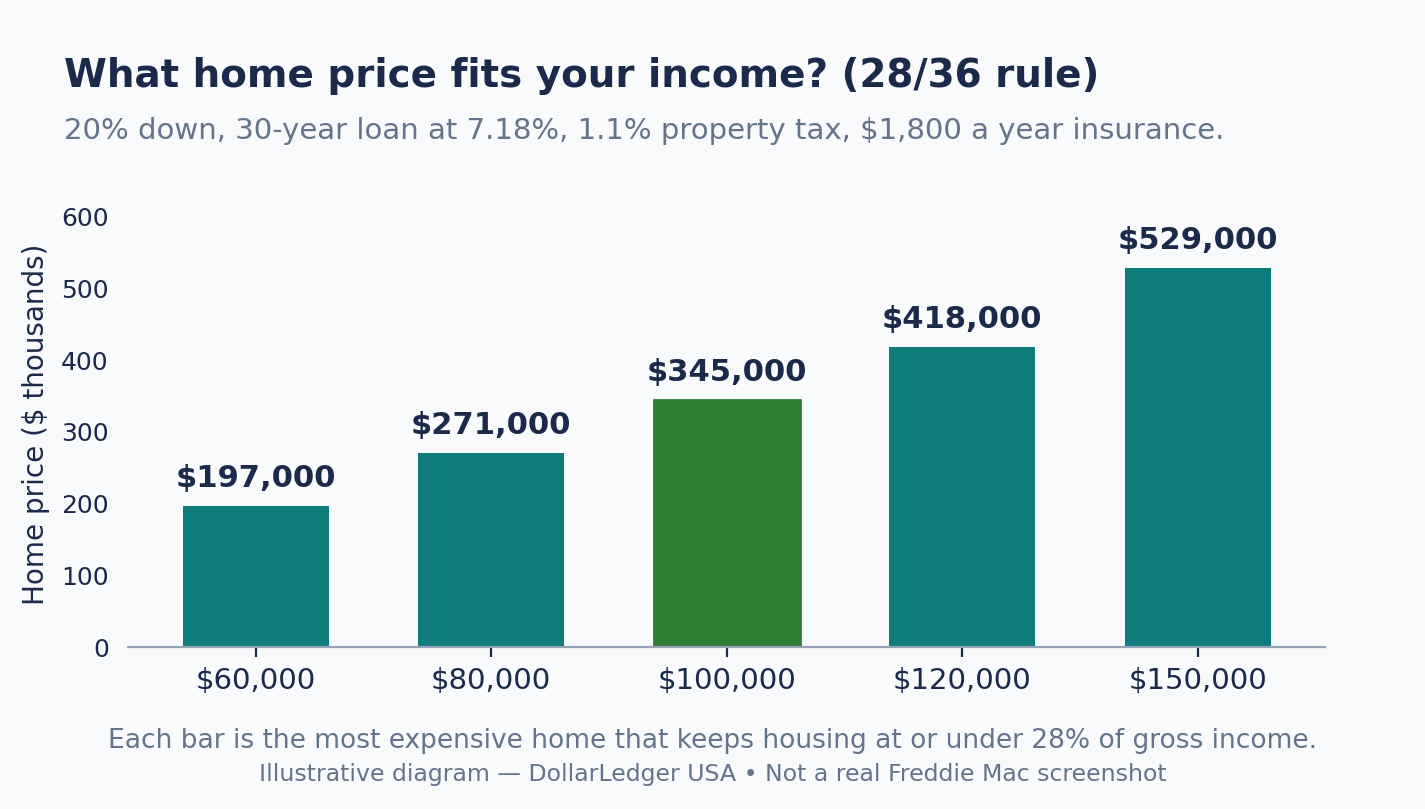
Illustrative diagram - What home price fits your income under the 28/36 rule. NOT a real Freddie Mac screenshot.
Step 4: Add the forgotten costs
What to do: Add the five costs outside principal and interest before you decide a price is safe.
How: First, property tax: about 1.1% of the price a year here. Second, homeowners insurance: $1,800 a year here. Third, PMI: with less than 20% down, lenders usually require private mortgage insurance, roughly 0.3% to 1% of the loan a year (reported). On a $344,000 home with 10% down, a $309,600 loan at 0.5% a year adds about $129 a month, inside the 28%. Fourth, HOA dues: say $250 a month in this example, also inside the 28%. Fifth, maintenance: the common rule of thumb is 1% of home value a year (reported), about $287 a month here. Maintenance sits outside the 28% rule - that slack pays for the roof and the furnace.
Example: Take the $344,000 home from Step 3 with 10% down instead of 20%. PMI adds about $129 a month, so the payment rises to about $2,458, above the $2,333 cap. The same house is no longer inside the rule.
Common mistake: Budgeting for the mortgage and forgetting the house. These five costs together can exceed $800 a month.
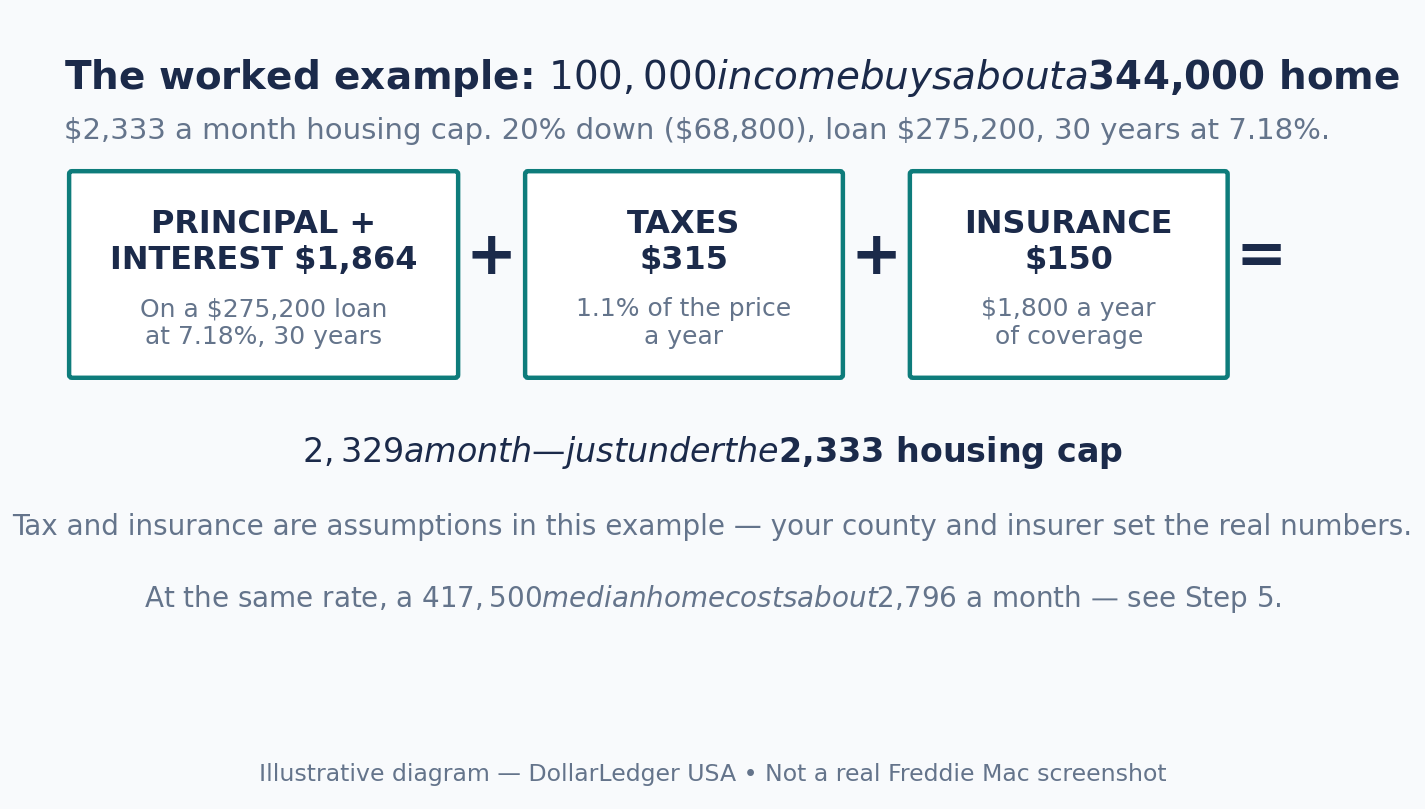
Illustrative diagram - The worked example: $100,000 income buys about a $344,000 home. NOT a real Freddie Mac screenshot.

Photo: Taxes, insurance, PMI, HOA and maintenance are part of the real monthly cost - add them before you offer. (Photo: Pexels)
Step 5: Check the median home against your income
What to do: Compare your number with the national median, then your region’s median.
How: The National Association of Realtors reported a median existing-home price of $417,500 for September 2026, up 1.3% from a year earlier. At 7.18% with 20% down, that home costs about $2,796 a month: $2,263 of principal and interest, $383 of tax at 1.1%, and $150 of insurance. To keep that inside the 28% rule you need about $120,000 a year of gross income. Regional medians in September 2026: Northeast $523,600, Midwest $329,600, South $361,000, West $613,600.
Example: A household earning $90,000 has a housing cap of $2,100 a month and an affordable price near $308,000 - about $110,000 below the national median. Shop below the median, look at smaller markets, or raise the down payment.
Common mistake: Treating the national median as the entry price. It is the middle of what sold, not the cheapest home in your town.
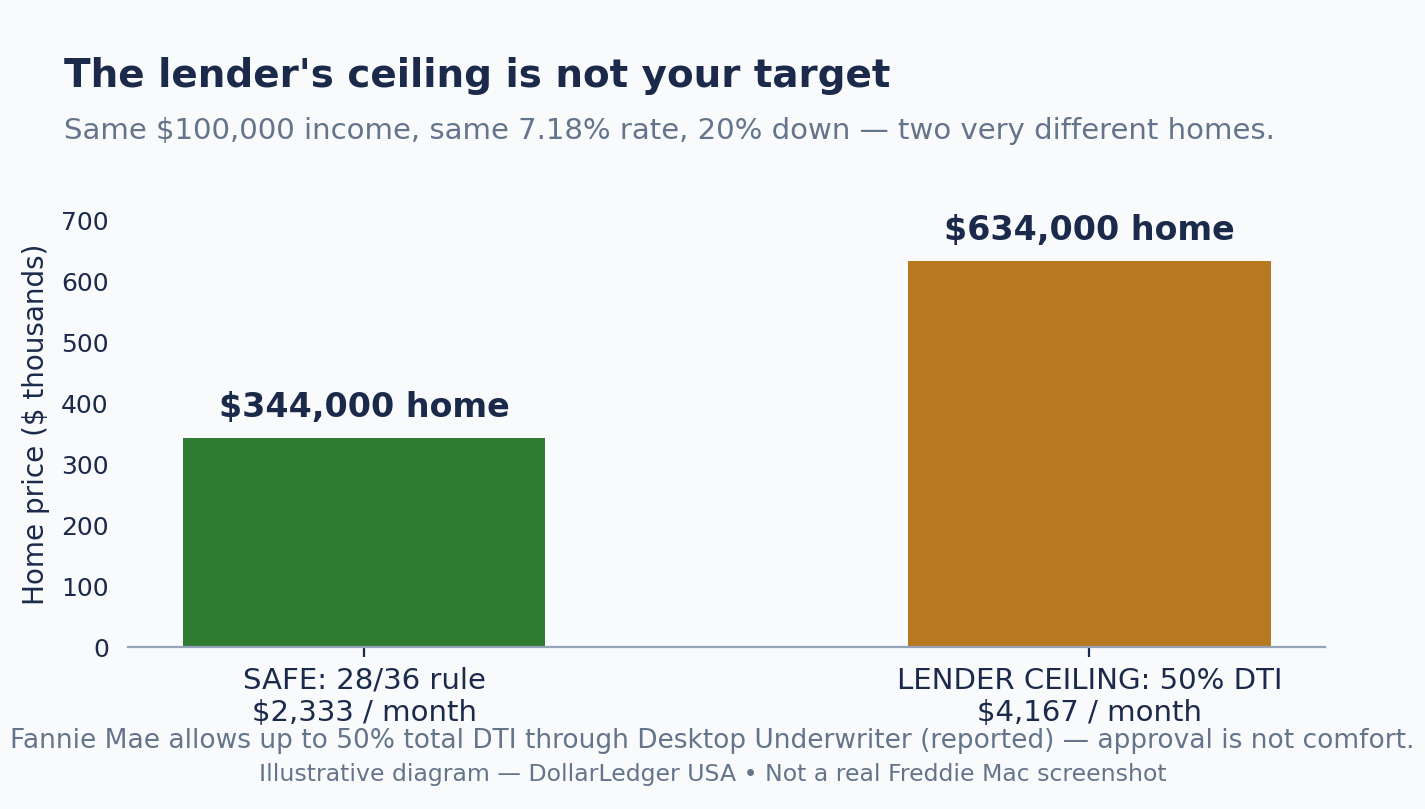
Illustrative diagram - The lender’s ceiling is not your target. NOT a real Freddie Mac screenshot.
Step 6: Shop below your max and get pre-approval
What to do: Set your search ceiling below the 28/36 number, then get pre-approved.
How: Fannie Mae’s Selling Guide sets a maximum total DTI of 36% for manually underwritten loans, rising to 45% when the borrower meets its credit-score and reserve requirements, and 50% for loans approved through its Desktop Underwriter system (reported). On $100,000 a year, 50% DTI allows a housing payment of $4,167 a month, which at 7.18% buys about a $634,000 home - nearly double the $344,000 the 28/36 rule supports. Get pre-approved anyway: sellers take pre-approved offers seriously. Treat the pre-approval as the lender’s ceiling and your 28/36 number as your budget. If you already own and rates fall later, refinancing is a separate decision - see our guide.
Example: Two buyers both earn $100,000. One buys the $344,000 home and keeps $1,834 a month of slack. The other buys at the ceiling and has none when the furnace fails in year two.
Common mistake: Shopping at the pre-approval amount. Search $20,000 to $50,000 below your 28/36 price.
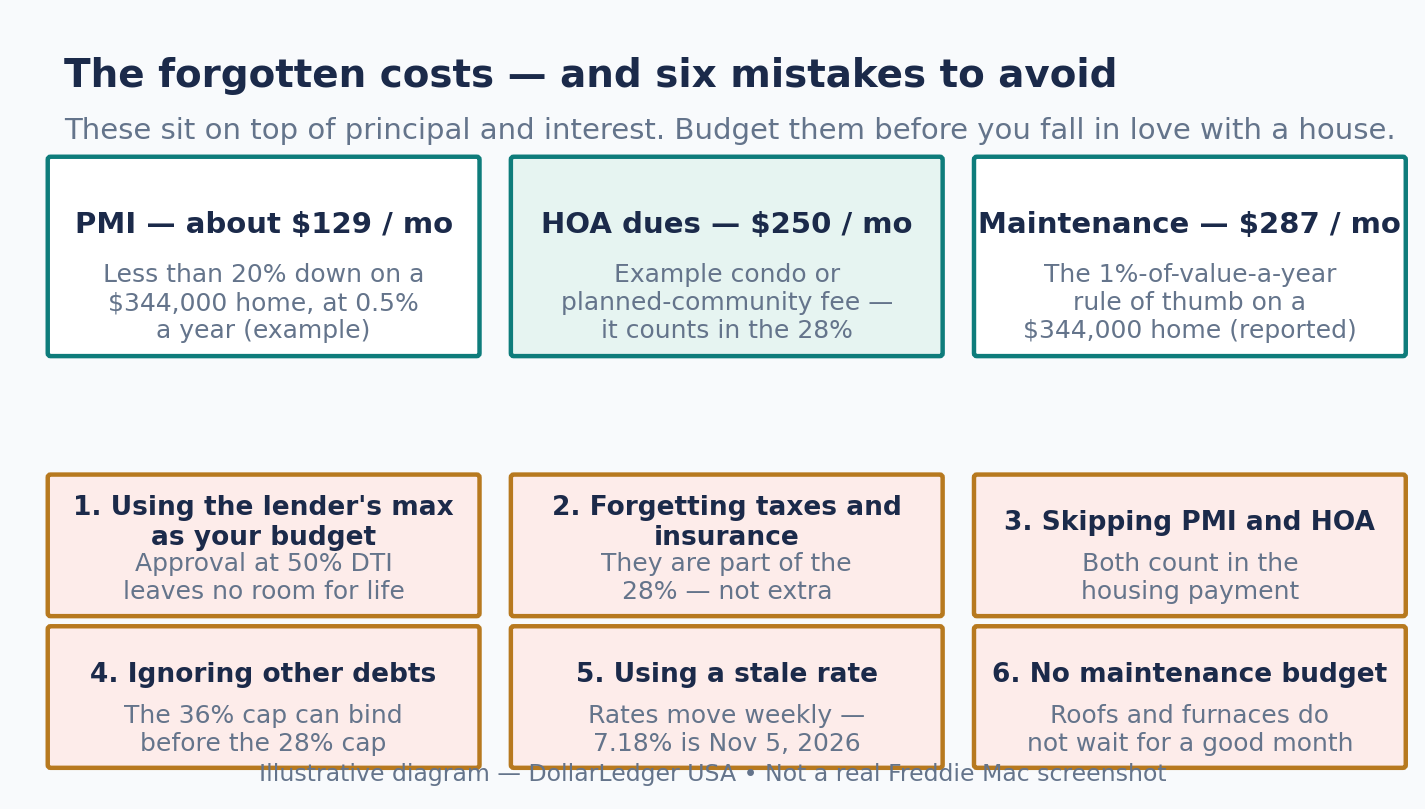
Illustrative diagram - The forgotten costs, and six mistakes to avoid. NOT a real Freddie Mac screenshot.
Checklist
- I worked out my 28% housing cap and 36% total-debt cap from my gross income.
- I subtracted my other debts from the 36% cap and took the lower cap as my budget.
- I turned the housing budget into a home price at the current 30-year rate.
- I added PMI, HOA and maintenance on top of principal and interest.
- I compared my number with my region’s median price.
- I will shop below my 28/36 price and get pre-approved before I offer.
FAQ
How much house can I afford on $100,000 a year in 2026?
About a $344,000 home with 20% down at 7.18% on a 30-year loan, keeping housing at $2,333 a month. With $900 a month of other debts, about $308,000.
What is the 28/36 rule?
Keep housing costs - principal, interest, taxes, insurance, PMI and HOA - at or under 28% of gross monthly income, and all monthly debts at or under 36%. The CFPB’s Your Money, Your Goals worksheet uses the same guidelines (reported).
What income do I need to buy the median home in 2026?
About $120,000 a year. The median was $417,500 in September 2026, costing about $2,796 a month at 7.18% with 20% down.
Will a lender approve me for more than the 28/36 rule allows?
Yes. Fannie Mae allows up to 50% total DTI through Desktop Underwriter (reported). On $100,000 a year that approves about a $634,000 home, but the payment leaves no room for saving.
What is the 30-year mortgage rate right now?
Freddie Mac’s Primary Mortgage Market Survey averaged 7.18% for the week ending November 5, 2026, down from 7.24% the week before. Check the latest survey before you lock.
Sources
- Consumer Financial Protection Bureau, “What is a debt-to-income ratio?”
- Freddie Mac, “Mortgage Rates - Primary Mortgage Market Survey” (30-year fixed 7.18%, week ending November 5, 2026)
- National Association of Realtors, “Existing-Home Sales Increased 1.5% in September” (median $417,500, September 2026)
All figures checked November 9, 2026, against the Freddie Mac PMMS page, the CFPB debt-to-income page and the NAR September 2026 release. The 28/36 guideline, Fannie Mae DTI limits, PMI range and 1% maintenance rule are reported claims. Home prices are the author’s calculations from the stated assumptions.
Disclaimer: For education only, not mortgage advice. Get a written quote and a pre-approval before you make an offer.