What Happens to Your 401(k) When You Change Jobs in 2026 — The 4 Options, Ranked
 DollarLedger Team
- 12 Nov, 2026

You changed jobs. Your 401(k) did not follow you — it is still with your old employer’s plan, and nothing happens automatically. The money stays invested, but you can no longer add to it, and a small balance can be moved without your say. You have four options: three cost nothing; the fourth can take roughly 40% in tax and penalties. Here are the four options ranked, the two traps to check, and six steps to move the money. Figures checked November 12, 2026, against IRS Topic 413 and Topic 558.
Photo: Your 401(k) does not follow you when you change jobs — you have to choose what happens to it. (Photo: Pexels)
What You Will Learn
- What your old plan can do if you do nothing
- The four options, ranked by cost
- New plan or IRA: which fits you
- Why a direct rollover wins
- The Rule of 55 and the company-stock trap
- Finishing the move
Step 1: Find out what you actually have
What to do: Log in to your old plan and note three things: your vested balance, any 401(k) loan, and any employer stock.
How: Your vested balance is the part you keep. Your own contributions are always vested; matching vests on a schedule. The vested balance decides what the plan may do. Under SECURE 2.0, a plan can force out a vested balance of $7,000 or less for distributions after December 31, 2023 (the old limit was $5,000). At $1,000 or less, the plan can mail you a check; from $1,001 to $7,000, it must roll the money into an IRA in your name; above $7,000, it generally cannot force it out.
Example: You leave with $4,200 vested and ignore the old plan’s letters. The plan can move it into a default IRA — usually a low-yield, cash-like account — and you may not notice for years.
Common mistake: Assuming the money follows you.
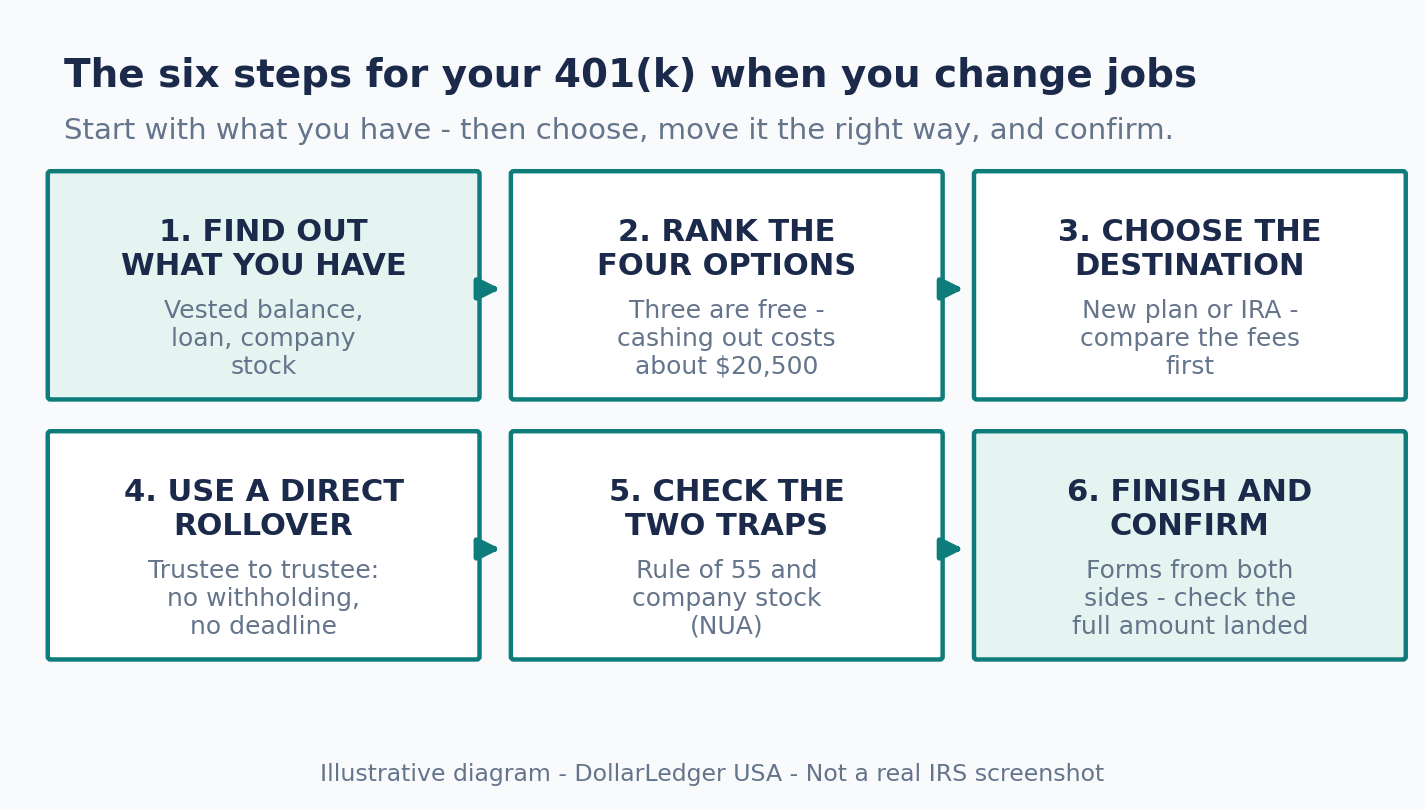
Illustrative diagram - The six steps for your 401(k) when you change jobs. NOT a real IRS screenshot.
Step 2: Rank the four options by cost
What to do: Compare all four before you pick one — three are free, one is expensive.
How: 1. Leave it in the old plan. Free. Your money stays invested, and you keep the Rule of 55 and the special tax treatment on company stock (Step 5). Downside: an extra account and the old plan’s fees. 2. Roll it into your new employer’s plan. Also free. One account, strong creditor protection. Check the new plan accepts rollovers. 3. Roll it into an IRA. A direct rollover is tax-free, widest choice. The price: the Rule of 55 and the special treatment on company stock both die in an IRA. 4. Cash out. Almost never wins. The money is taxed as ordinary income, plus a 10% additional tax under 59½ (Topic 558), and 20% is withheld up front. On a $50,000 cash-out, one worked example puts the total at about $20,500: 24% federal ($12,000), 7% state ($3,500) and the 10% penalty ($5,000), leaving about $29,500.
Example: Two workers each leave with $50,000. One rolls it into an IRA and keeps all $50,000; the other cashes out and keeps about $29,500.
Common mistake: Cashing out to pay a bill.
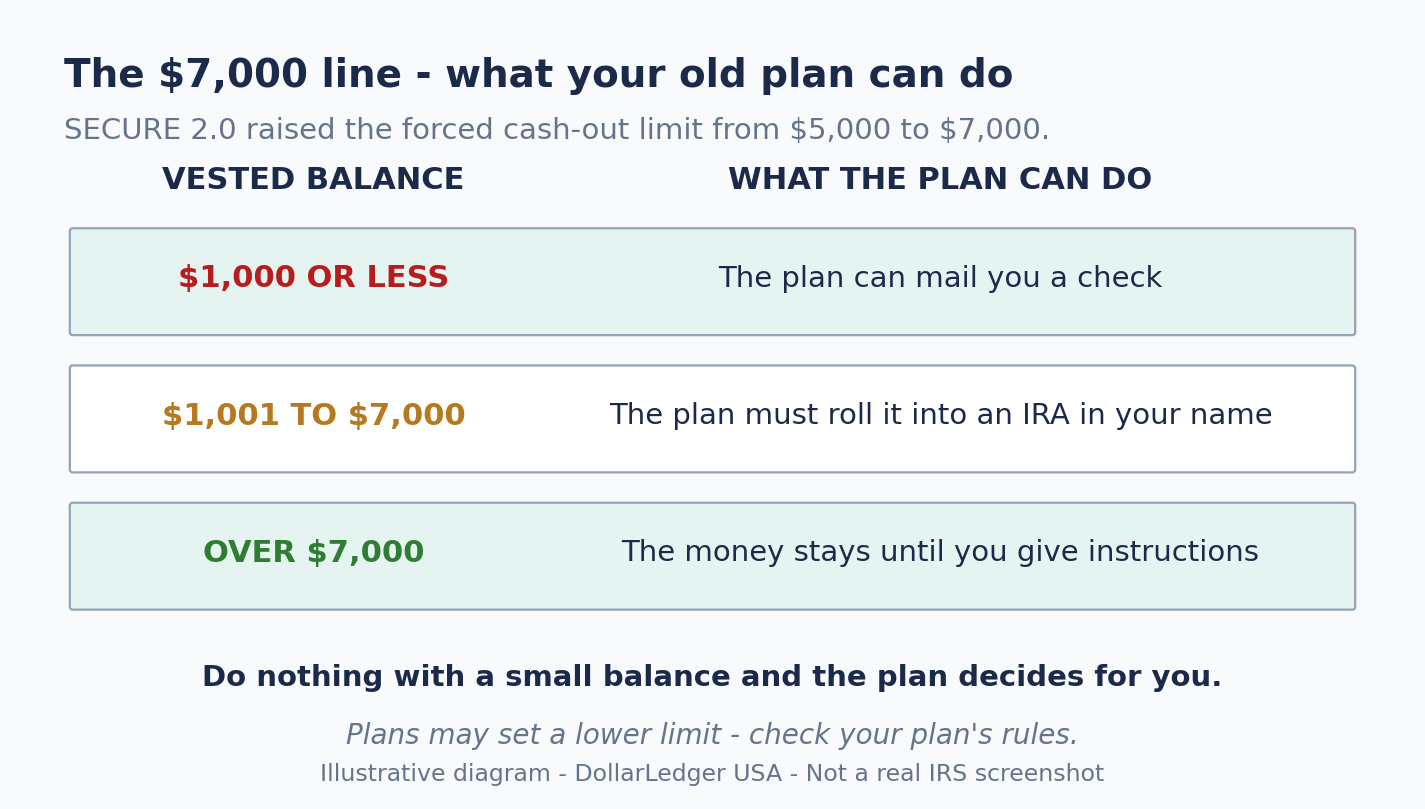
Illustrative diagram - The $7,000 line decides what your old plan can do without asking you. NOT a real IRS screenshot.

Photo: Before you pack the box, find out your vested balance — it decides what your old plan can do. (Photo: Pexels)
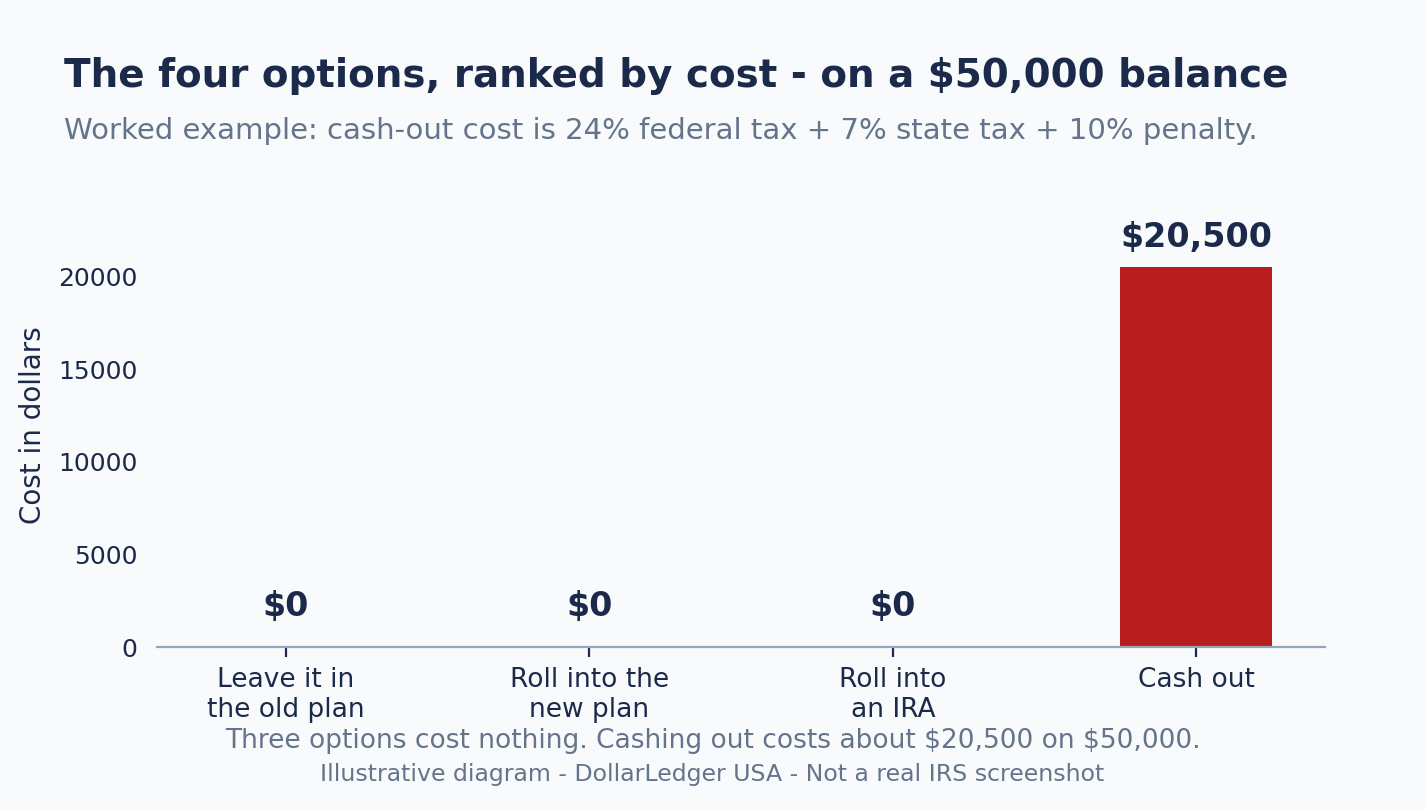
Illustrative diagram - Three options cost nothing; cashing out costs about $20,500 on a $50,000 balance in the worked example. NOT a real IRS screenshot.
Step 3: Choose the destination if you move it
What to do: If you move the money, pick the destination on purpose — new plan or IRA.
How: The new plan usually wins for one account, strong creditor protection, and backdoor Roth room — or if you might need the Rule of 55 later (Step 5). An IRA usually wins for the widest choice, lower fees, and one place to gather old 401(k)s. Compare fees: a plan at 0.9% a year on $28,000 costs $252 a year; index funds in an IRA at 0.05% cost about $14 — a $238-a-year gap. Check the rollover chart: pre-tax 401(k) money can go to a traditional IRA or another pre-tax plan, but Roth 401(k) money must go to a Roth IRA or Roth 401(k). Rollovers do not count against your contribution limit — see 401(k) contribution limits in 2026.
Example: A 34-year-old with $28,000 saves about $238 a year in an IRA at 0.05% versus a plan at 0.9% — unless she needs the Rule of 55.
Common mistake: Rolling into an IRA for lower fees without checking for company stock.
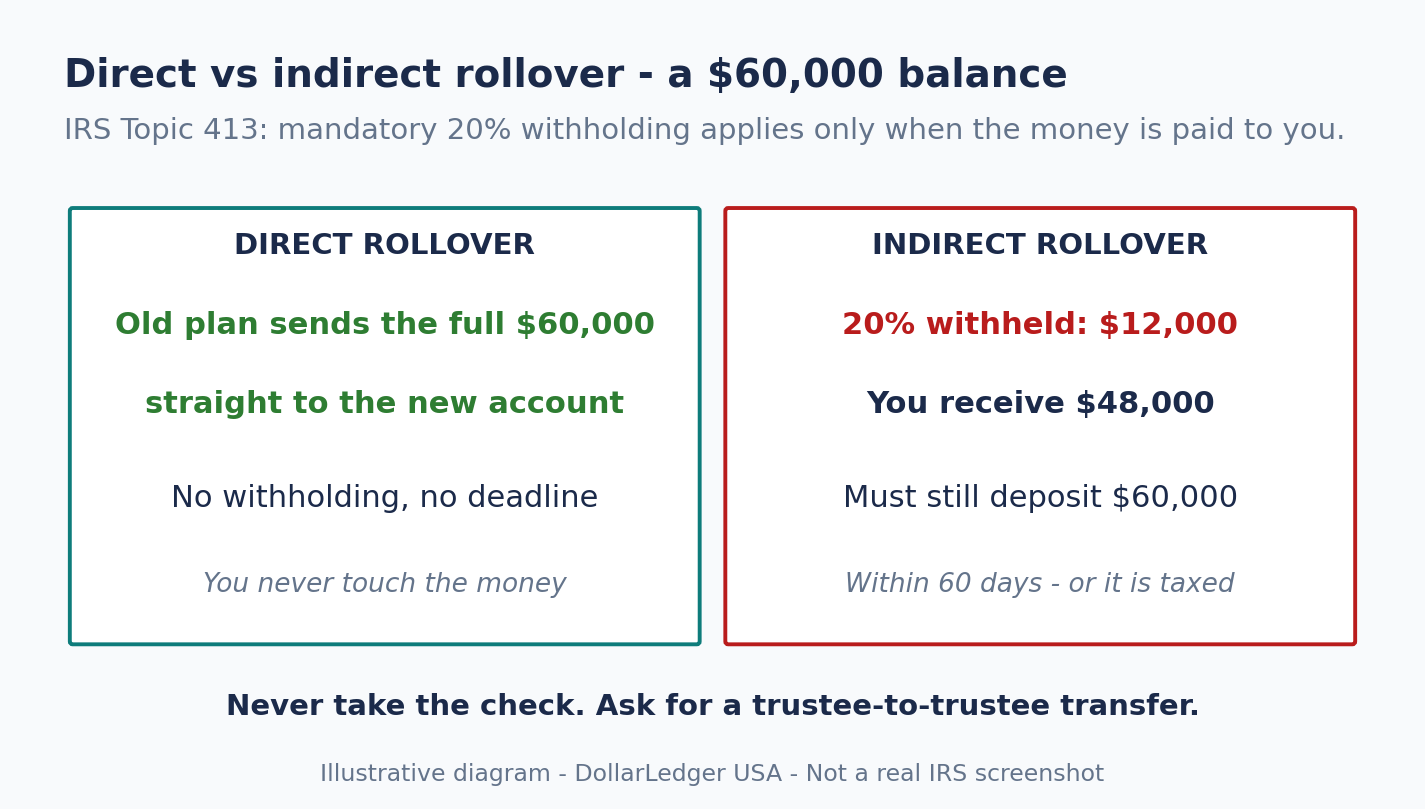
Illustrative diagram - Direct rollover: no withholding, no deadline. Indirect rollover: 20% withheld and 60 days to replace it. NOT a real IRS screenshot.
Step 4: Use a direct rollover — never take the check
What to do: Move the money trustee-to-trustee: the old plan sends it straight to the new plan or IRA — never to you.
How: With a direct rollover, the payer transfers the distribution directly to another eligible plan, and mandatory withholding does not apply (IRS Topic 413). No deadline clock: you never touch the money. With an indirect rollover, the plan pays you instead: you have 60 days to roll it over, and any taxable distribution paid to you is subject to mandatory 20% federal withholding. To roll over the full amount, top up the withheld 20% yourself. Whatever you do not roll over is taxed, plus the 10% tax if you are under 59½. One more limit: only one indirect rollover in any 12-month period between your IRAs.
Example: A $60,000 indirect rollover: 20% is withheld ($12,000), you receive $48,000, and you must still deposit the full $60,000 within 60 days. Deposit only the $48,000, and the missing $12,000 is taxed — plus a $1,200 penalty under 59½.
Common mistake: Taking the check “just for a few weeks”, then missing the 60-day deadline.
Step 5: Check the two traps before you move anything
What to do: Before you sign any rollover form, check whether the Rule of 55 or company stock applies — both are lost by rolling over at the wrong moment.
How: The Rule of 55 is an exception to the 10% additional tax: if you separated after age 55, withdrawals from that employer’s plan escape the penalty (IRS Topic 558). The protection dies the moment you roll the money into an IRA — so if you leave at 56 and may need money before 59½, leave it in the plan. Second, company stock: net unrealized appreciation (NUA) can tax the growth on your employer’s stock at long-term capital gains rates — but only if the shares go in kind to a taxable brokerage account. Roll the stock into an IRA first and NUA treatment is lost permanently (IRS Publication 575). An outstanding 401(k) loan usually falls due when you leave.
Example: You leave at 56 with $200,000 and need $20,000 before 59½. Withdrawing under the Rule of 55 costs no penalty; rolling it all into an IRA first adds a $2,000 penalty.
Common mistake: Rolling everything into an IRA at 55, then finding the 10% penalty applies.

Photo: At 55 or older, the Rule of 55 can make leaving the money in the old plan the cheaper choice. (Photo: Pexels)
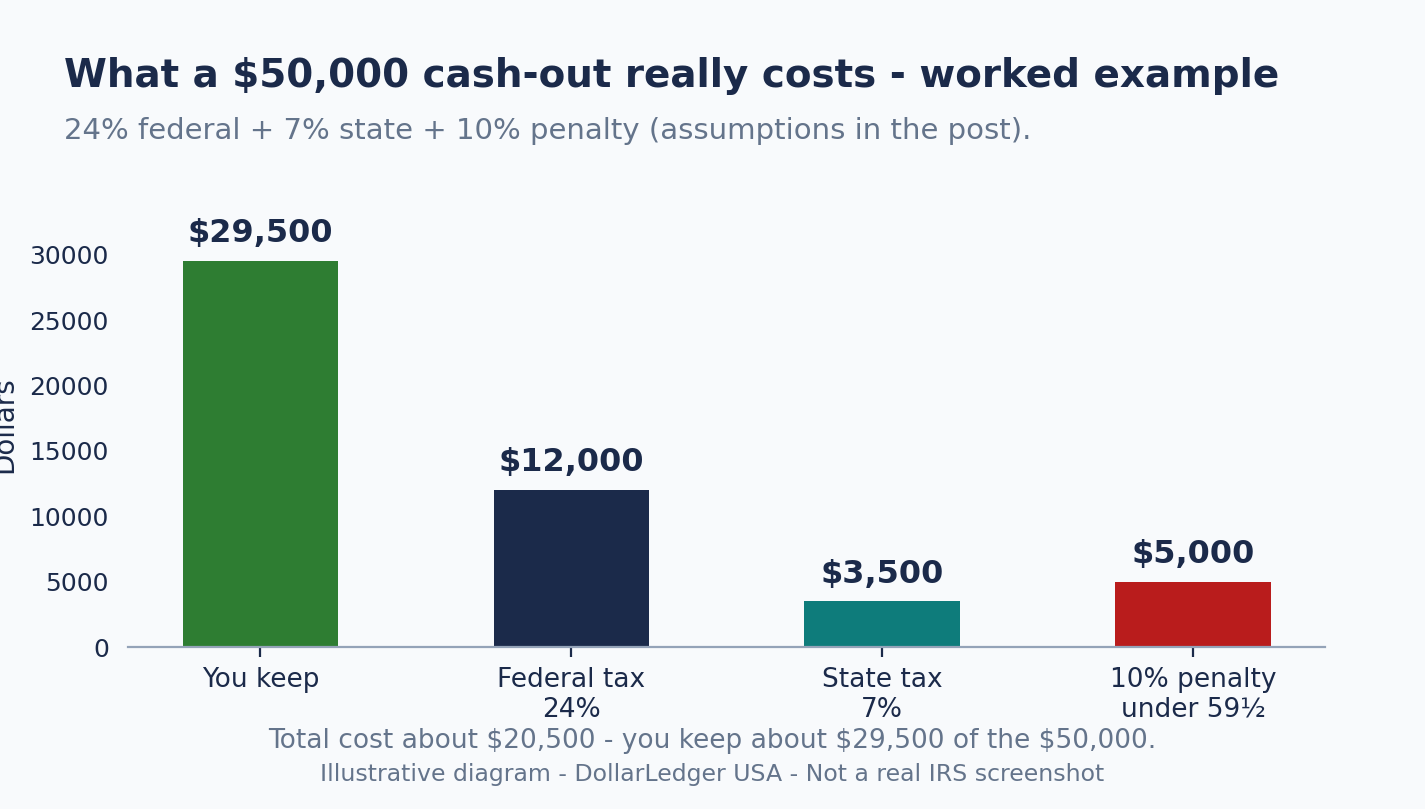
Illustrative diagram - A $50,000 cash-out keeps about $29,500 in the worked example. NOT a real IRS screenshot.
Step 6: Finish the paperwork and confirm the money landed
What to do: Get the forms from both sides and do not stop until the new account shows the full amount.
How: Ask your old plan for its rollover-out form and your new provider for its rollover-in instructions. When it lands, check the new account shows the full balance — a shortfall means the rollover went indirect by mistake. Keep the Form 1099-R. Update your beneficiaries. Do not count on auto-portability: it is still rolling out — the Labor Department’s final rule was sent to White House review on September 14, 2026 and is not yet published, and Roth 401(k) money is excluded. For the bigger picture, see how much to save for retirement by age.
Example: You sign the rollover form and the money is still not in the new IRA three weeks later — call both sides. Rollovers stall on a wrong account number more often than on any tax rule.
Common mistake: Assuming the rollover is done because you signed the form, and noticing a year later that the money never moved.
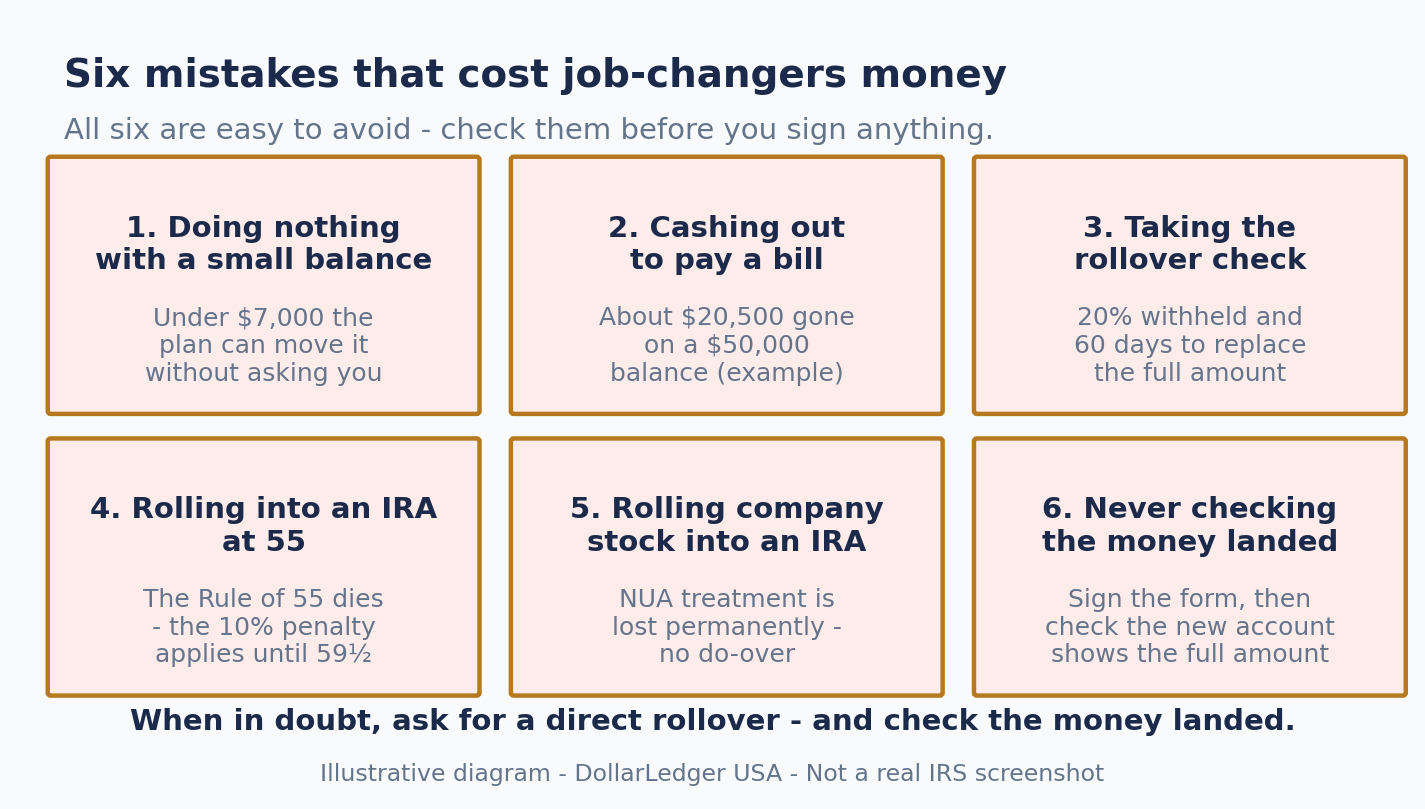
Illustrative diagram - Six mistakes that cost job-changers money. NOT a real IRS screenshot.
Checklist
☐ Vested balance checked — under $7,000?
☐ All four options compared.
☐ Destination chosen: new plan or IRA.
☐ Direct rollover requested — no check to me.
☐ Rule of 55 checked if 55 or older.
☐ Company stock checked for NUA.
☐ Full balance landed; 1099-R kept; beneficiaries updated.
FAQ
What happens to my 401(k) if I do nothing?
It stays invested with your old plan. At $7,000 or less the plan can force it out — $1,000 or less as a check, $1,001–$7,000 into an IRA in your name. Above $7,000 it stays until you act.
Can I roll my old 401(k) into my new employer’s plan?
Yes, if the new plan accepts incoming rollovers — most do. Use a direct rollover so no tax is withheld. A rollover does not count against your contribution limit.
How long do I have to roll over my 401(k)?
With a direct rollover there is no deadline. With an indirect rollover the IRS gives you 60 days, and 20% is withheld up front (IRS Topic 413).
Does rolling into an IRA affect the Rule of 55?
Yes — it ends it. The Rule of 55 lets you withdraw from that employer’s plan without the 10% penalty if you separated in or after the year you turned 55 (IRS Topic 558). In an IRA, that exception no longer applies.
Sources
- IRS, Topic No. 413 — Rollovers from Retirement Plans (opened live November 12, 2026): https://www.irs.gov/taxtopics/tc413
- IRS, Topic No. 558 — Additional Tax on Early Distributions from Retirement Plans Other Than IRAs (opened live November 12, 2026): https://www.irs.gov/taxtopics/tc558
- IRS, Rollover Chart (opened live November 12, 2026): https://www.irs.gov/pub/irs-tege/rollover_chart.pdf
All figures checked November 12, 2026, against IRS Topic 413, IRS Topic 558 and the IRS Rollover Chart. The $50,000 and $60,000 examples are our own arithmetic. NUA is reported from IRS Publication 575; auto-portability from the Labor Department’s agenda (September 2026).
Disclaimer: For education only, not tax or investment advice.