How to Ask for a Raise in 2026 — What a Good Raise Looks Like and How to Negotiate It
 DollarLedger Team
- 08 Nov, 2026

Most people ask for a raise the wrong way: they walk in, say they work hard and need more money, and hope the manager agrees. That is a plea, and pleas get sympathy and a 3% adjustment. A raise is a negotiation, and negotiations run on numbers: what employers are budgeting, what your role pays, and one clear ask. This guide covers what a good raise looks like in 2026, the dollar math on $60,000, the exact script, the right moment, and what to do if the answer is no. All figures checked November 8, 2026.
Photo: A raise conversation is a negotiation with numbers — not a plea. Come with evidence, not just effort. (Photo: Pexels)
What You Will Learn
- What a good raise looks like in 2026 — the benchmarks and the official figures
- How to find your market rate for your exact role and city
- The dollar math: what each percentage is worth on $60,000
- The four-sentence script for the meeting
- When to ask — and when to wait
- What to trade for if the answer is no
Step 1: Know the benchmark — what a good raise looks like in 2026
What to do: Learn what employers are budgeting before you name a number.
How: Mercer’s September 2025 QuickPulse survey of 1,157 US compensation leaders put 2026 total salary budgets at 3.5% on average, including 3.3% for merit. WorldatWork (3.6% mean) and WTW (3.5%) agree. Promotions pay more: Mercer’s October 2025 survey of 1,013 organisations reported about 8.7% on average for a one-level promotion, with about 9% of workers expected to be promoted in 2026. The official figures agree: the BLS Employment Cost Index shows private-industry wages rose 3.1% over the year ending September 2026, but after inflation wages fell 0.6% — prices (CPI-U) were up 3.7%.
Example: That is why 3.5% is the floor, not the target: on $60,000 it is $2,100 a year, and with prices up 3.7% it barely keeps your buying power flat. A strong performer should ask for 5% or more.
Common mistake: Asking for “a raise” with no number. Without one, your manager picks — and it will be the budget average.
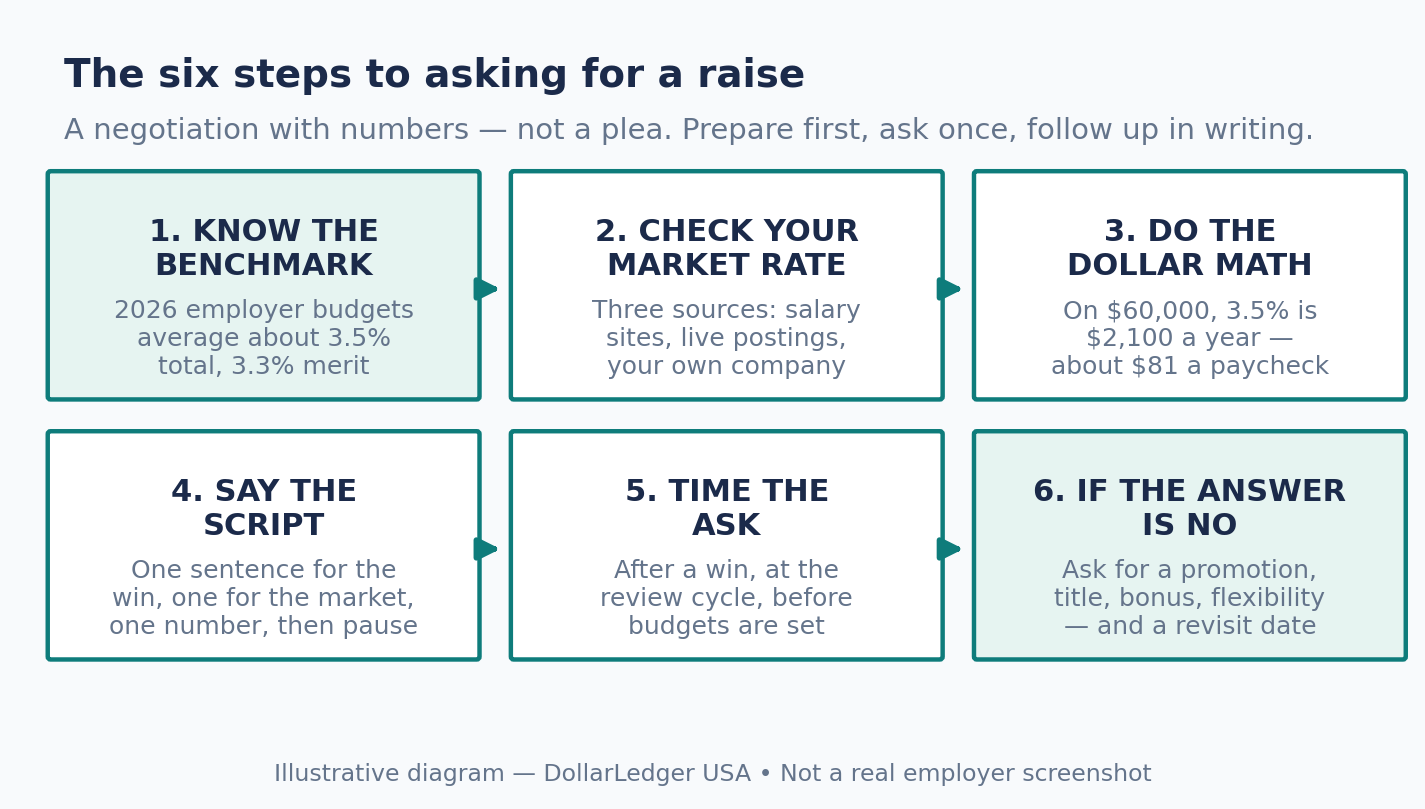
Illustrative diagram — The six steps to asking for a raise in 2026. NOT a real employer screenshot.
Step 2: Check your market rate — what your exact role pays
What to do: Find what employers pay right now for your title, city and level.
How: Use three sources. First, salary sites such as Glassdoor, Payscale and Salary.com — filter by your city and experience, not the national average. Second, live job postings: the listed range is what the market will pay today, and several US states now require ranges. Third, your own company’s listings — if your employer is hiring your role above your pay, that is your strongest evidence. One number from one site is weak; a range from three is a case.
Example: Priya earns $60,000 as a customer success specialist in Austin. Three postings list $68,000 to $76,000, and Payscale shows a median of $71,000. She is paid about $11,000 below the market median — a raise to $68,000 is a correction, not a favour.
Common mistake: Quoting a national average for another city or a senior title. Your manager will check, and one wrong number undermines the case.
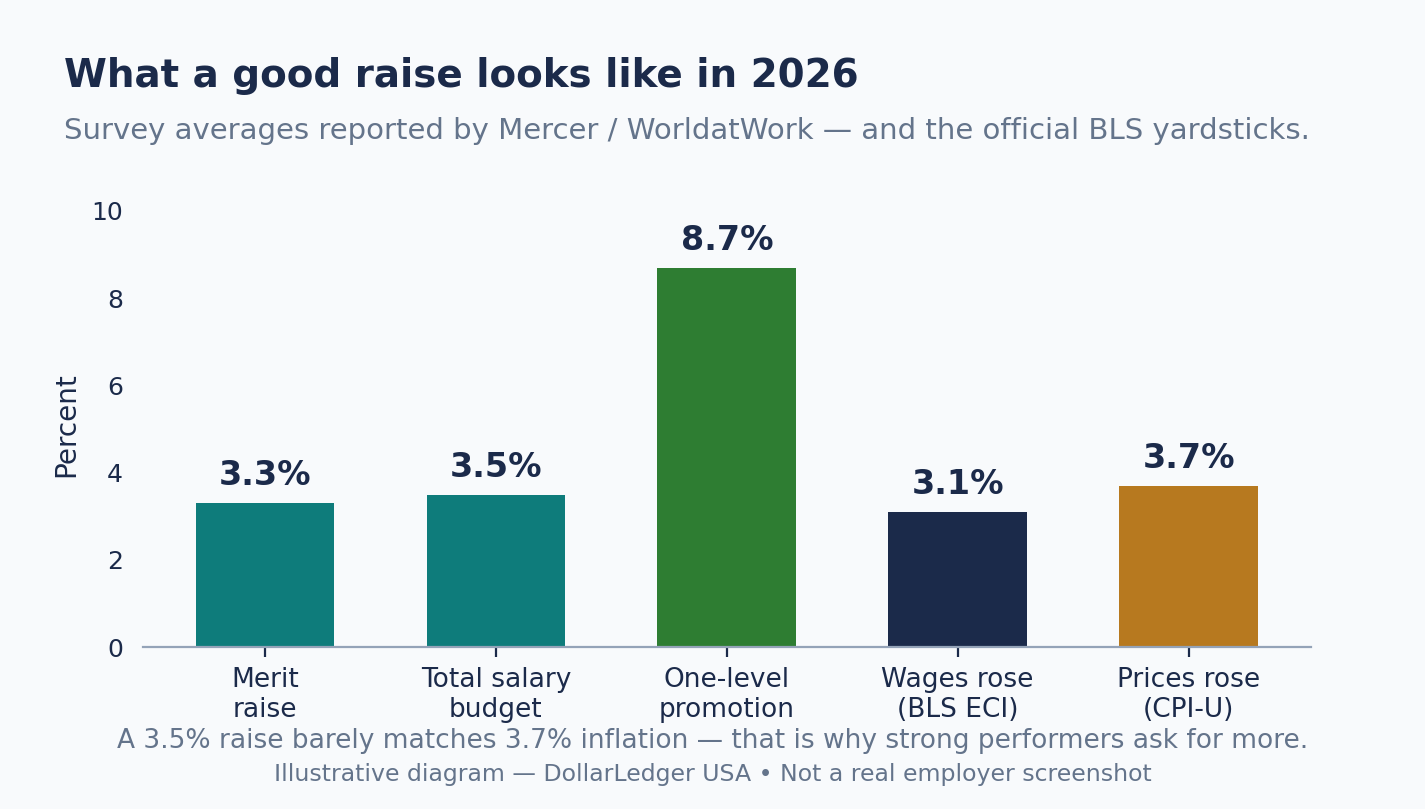
Illustrative diagram — What a good raise looks like in 2026: the survey averages and the official BLS figures. NOT a real employer screenshot.

Photo: The goal is an agreement both sides can live with — your evidence makes that possible. (Photo: Pexels)
Step 3: Do the dollar math — what each percentage is worth
What to do: Turn your percentage into dollars per year and per paycheck before the meeting.
How: Take your salary and multiply. On $60,000, the average merit increase of 3.3% is $1,980 a year, about $76 per biweekly paycheck before tax. The average total budget of 3.5% is $2,100 a year, about $81 per paycheck. A strong ask of 5% is $3,000 a year, about $115 per paycheck. A promotion at the 8.7% average is $5,220 a year, about $201 per paycheck. Your own numbers work the same way: salary times percentage, divided by 26 for a biweekly paycheck or by 12 for a month.
Example: Marcus earns $60,000 and asks for 5% — $3,000 a year, roughly $190 to $200 a month after tax. He worked it out at home, not on the spot.
Common mistake: Asking for a percentage you never converted into dollars.
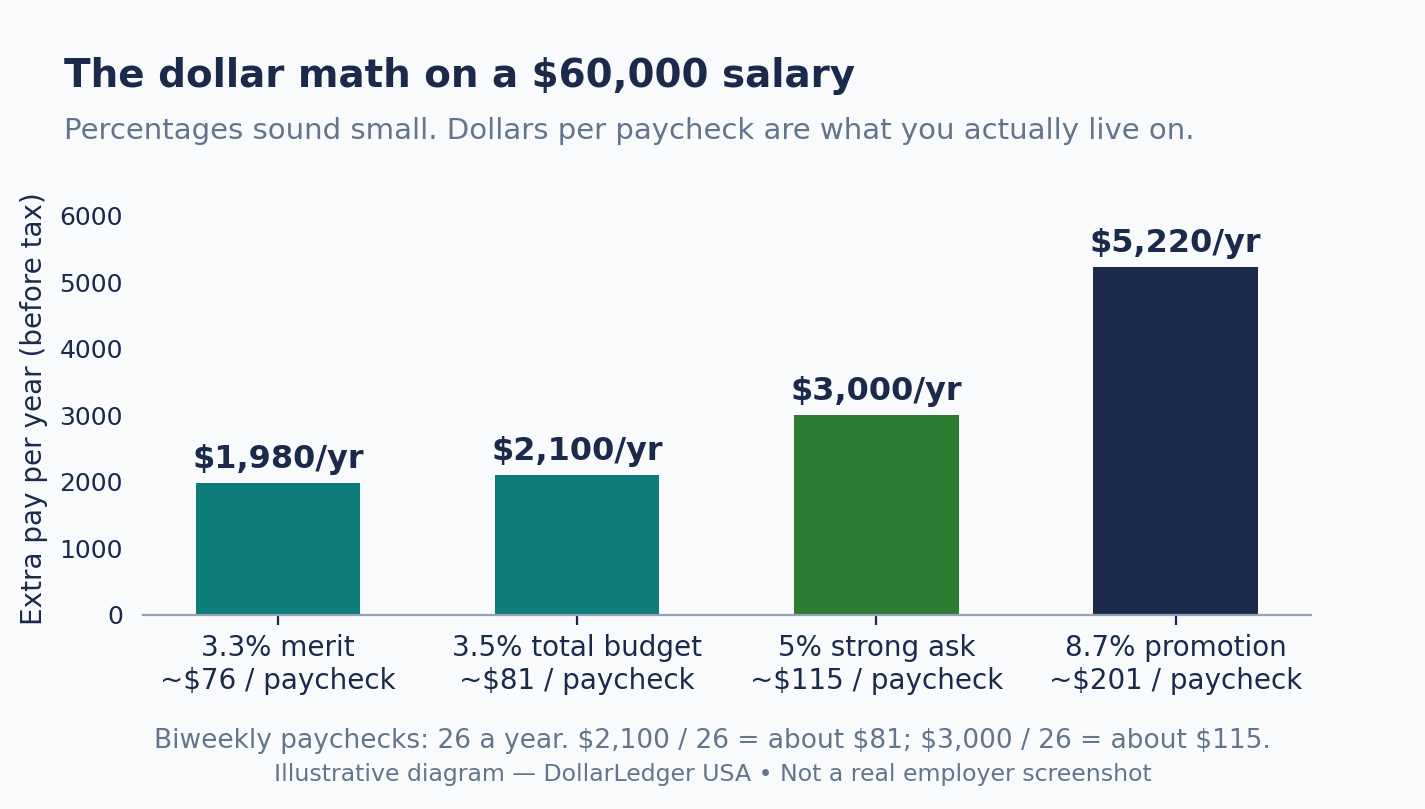
Illustrative diagram — The dollar math on a $60,000 salary, before tax. NOT a real employer screenshot.
Step 4: Learn the script — four sentences, then stop talking
What to do: Memorise four sentences: the win, the market, the number, the pause.
How: One, open with your strongest win: “I’d like to talk about my pay. This year I shipped the new onboarding flow, which cut support tickets by 30%.” Two, name the market: “The market rate for this role is now around $70,000, and my pay is below it.” Three, state one number — never a range, because the employer will pick the bottom: “I’m asking for $70,000, based on that work and the market.” Four is silence. Stop talking and let your manager answer — people who keep talking after the ask talk their own number down. If your manager says “let me think about it”, agree a date and send a one-page summary the same day.
Example: Ana used this script: her manager said “I need to check the budget”, they met again in two weeks, and the raise was approved at the number she named.
Common mistake: Apologising, or listing every task. One win with a number beats ten tasks with none.
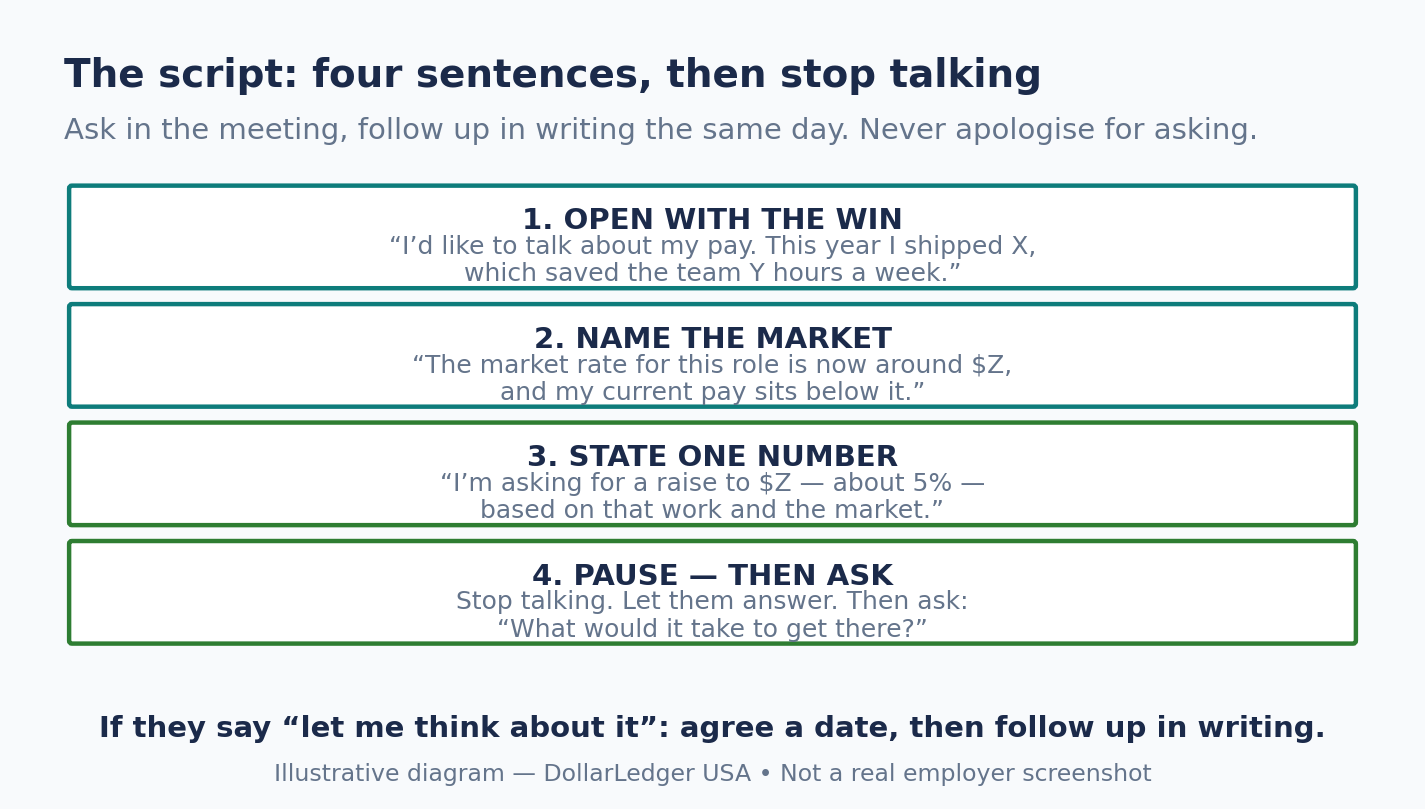
Illustrative diagram — The script: four sentences, then stop talking. NOT a real employer screenshot.

Photo: Write the script down and practise it once out loud — the meeting is not the time to find the words. (Photo: Pexels)
Step 5: Time the ask — after a win, before budgets are set
What to do: Pick the week, not just the day.
How: The best moments are right after a visible win, during the review cycle, or after taking on a bigger role. The best window is two to four weeks before salary budgets are set — ask your manager when that happens, because a raise agreed after budgets are locked has to wait a year. If the review cycle is months away, ask for an off-cycle review. The bad moments are just as clear: during layoffs or a hiring freeze, right after a missed target, in a group meeting, or by email.
Example: Ben shipped a project that saved his team a contractor’s fee in October; budgets are set in November. He booked the last week of October, while the win was fresh. His colleague waited until February and was told to wait until next year.
Common mistake: Asking the week you are frustrated, or the day after a bad review.
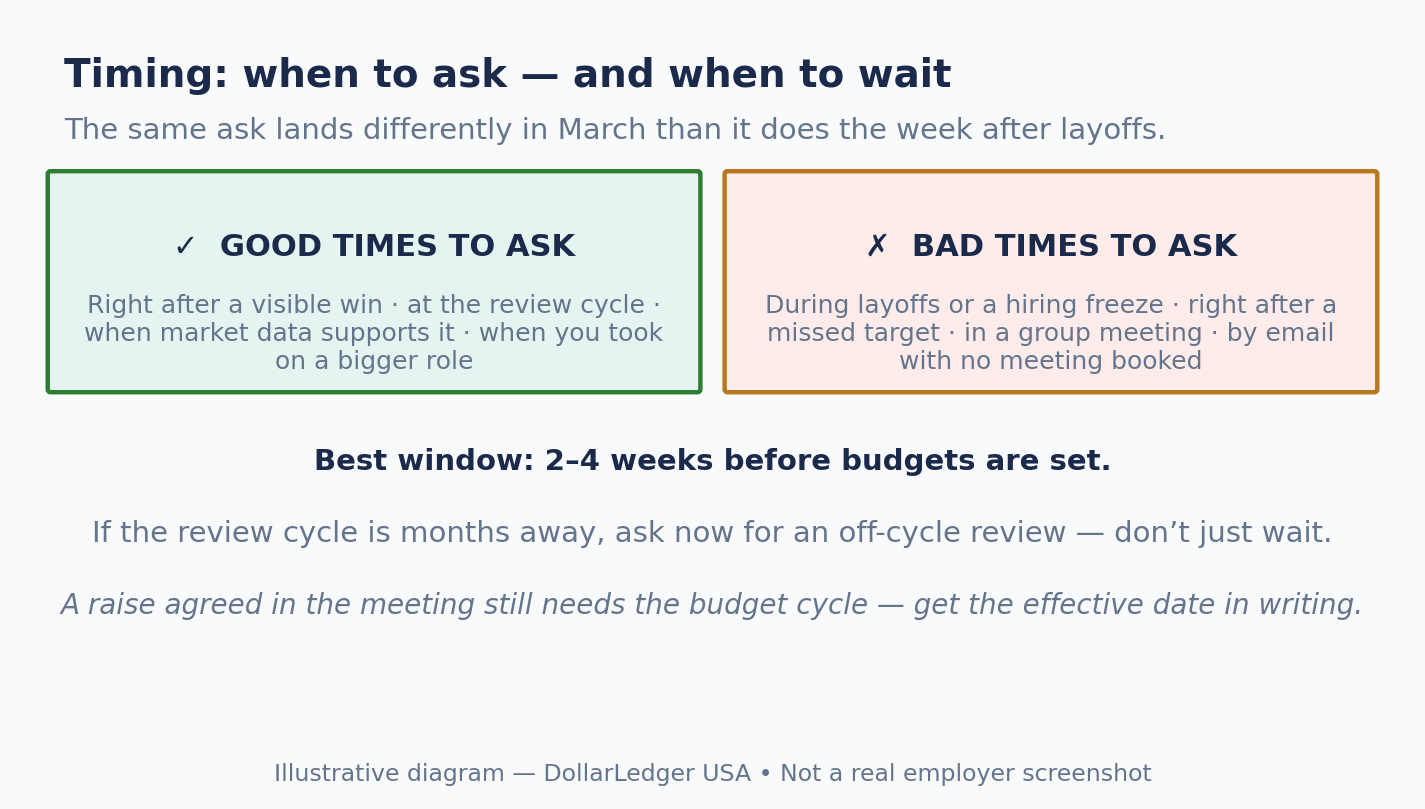
Illustrative diagram — Timing: when to ask, and when to wait. NOT a real employer screenshot.
Step 6: If the answer is no — trade the raise for something else
What to do: A “no” starts a second negotiation — leave with something of value and a date.
How: Ask what it would take to get there, then trade: a promotion, which averages about 8.7%; a one-time bonus now; a title change, which raises your market value; flexibility; or a learning budget — a course the company pays for. Get the most important part in writing: a revisit date. “Let’s review this again on March 1” is a commitment; “we’ll see” is not.
Example: Sofia’s manager said there was no budget until the next cycle. She left with a $2,000 bonus, a title change, and a written review date of March 1. At that review she got the raise — and the new title raised her market rate too.
Common mistake: Quitting on the spot, or threatening to leave without another offer. A threat you cannot carry out destroys trust.
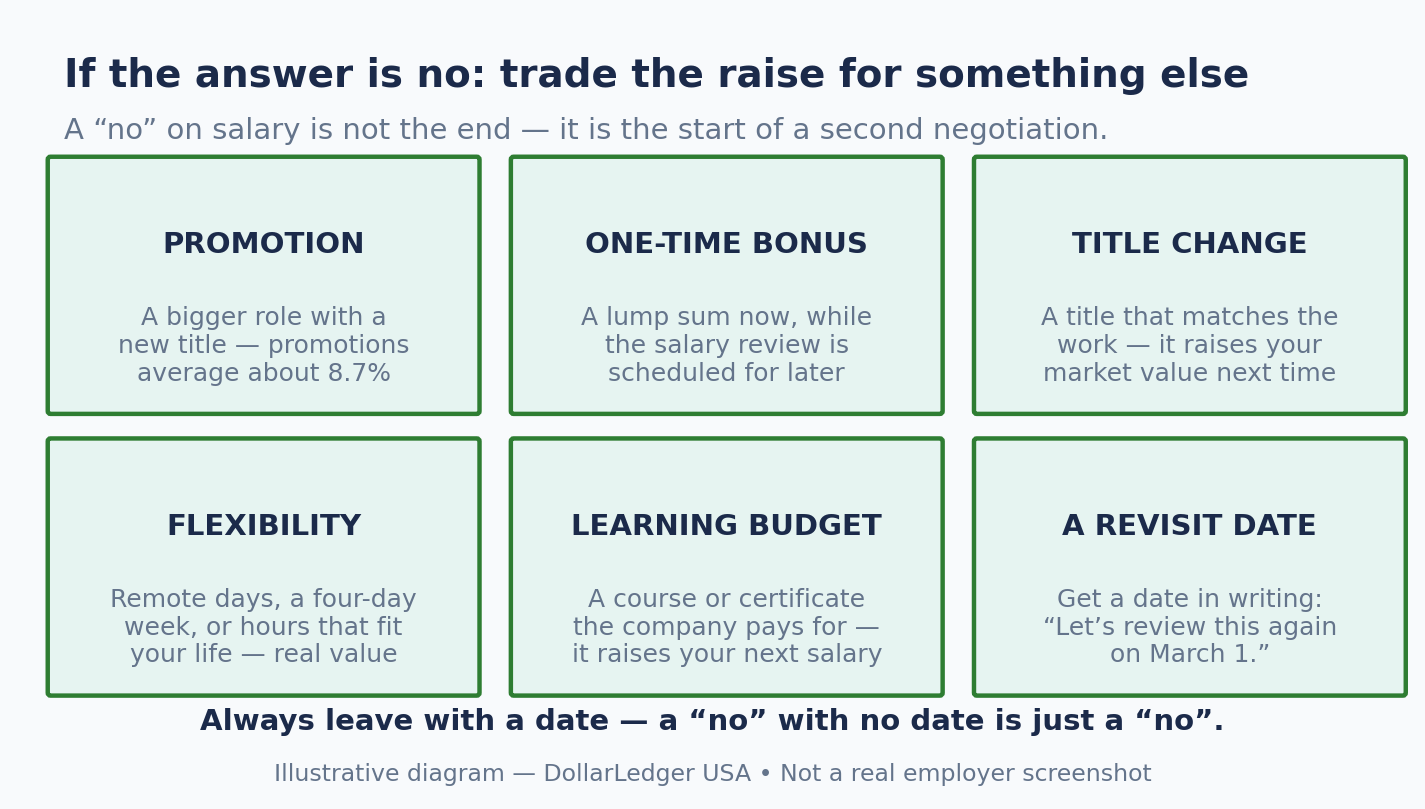
Illustrative diagram — If the answer is no: trade the raise for something else. NOT a real employer screenshot.
Checklist
- ☐ I know the 2026 benchmarks: 3.5% total, 3.3% merit, about 8.7% for a promotion.
- ☐ I have my market range from three sources, with city and level.
- ☐ I can state my ask in dollars and per paycheck.
- ☐ I have the script in four sentences — and I will stop talking after the number.
- ☐ I know the budget date and have booked the ask before it.
- ☐ I have a second ask ready if the answer is no.
FAQ
What is a good raise in 2026? About 3.5% in total salary budgets, with 3.3% for merit, per Mercer’s surveys reported by WorldatWork. But prices rose 3.7% over the year ending September 2026, so 3.5% barely keeps your buying power flat. A good raise for a strong performer is 5% or more; a promotion averages 8.7%.
How much is a 5% raise on $60,000? $3,000 a year before tax — about $115 per biweekly paycheck, or $250 a month. After tax, roughly $190 to $200 a month.
Should I give a salary range when I ask? No. Name one number — if you say “$65,000 to $70,000”, your manager will hear $65,000.
When is the best time to ask for a raise? Right after a visible win, during the review cycle, and ideally two to four weeks before salary budgets are set.
What should I do if my boss says no to a raise? Ask what it would take, then negotiate for something else: a promotion, a bonus, a title change, flexibility, or a paid course. Get a revisit date in writing.
Sources
- WorldatWork, “Mercer Forecasts 3.5% Total Salary Increase Budgets for 2026”: https://worldatwork.org/publications/workspan-daily/mercer-forecasts-3-5-total-salary-increase-budgets-for-2026
- U.S. Bureau of Labor Statistics, “Employment Cost Index Summary — September 2026”: https://www.bls.gov/news.release/eci.nr0.htm
- DollarLedger USA, “How to Build an Emergency Fund on a $40,000 Salary”: </blog/how-to-build-emergency-fund-on-40000>
All figures checked November 8, 2026, against the WorldatWork Mercer summary and the BLS releases. Survey figures are reported employer averages.
Disclaimer: This article is for education only, not career or financial advice. Pay varies by employer and location — confirm current figures with the sources above.