HYSA vs Money Market Account vs CD — Which Is Best for You?
 DollarLedger Team
- 03 Nov, 2026

You have cash to save, and three accounts all promise interest: a high-yield savings account (HYSA), a money market account, and a certificate of deposit (CD). The top rates are close — HYSA 4.40% APY, money market 4.05%, 1-year CD 4.60% — so the rate alone will not decide it. What matters is access: how fast you can get your money, and what it costs to take it early. This guide compares all three, in plain English.
Photo: Three accounts, three jobs. (Photo: Pexels)
What You Will Learn
- What a HYSA, a money market account and a CD each do
- The top rate for each account, and what $10,000 earns in a year
- How access works: withdrawals, cards, or locked money
- Which account fits an emergency fund, bills, and long-term savings
- How to decide in 60 seconds
Step 1: Meet the three accounts
What to do: Learn what each account is.
How: A high-yield savings account (HYSA) is a normal savings account that pays much more interest — the best pay around 4.40% APY, against a national average of 0.38% APY. You can withdraw any time, but the rate is variable. A money market account mixes savings and checking: it pays interest, and many come with a debit card and checks. The best pay around 4.05% APY, also variable. A certificate of deposit (CD) is a fixed deal: you lock money away for 1, 3 or 5 years, and the bank locks your rate. The best 1-year CD pays 4.60% APY. All three are FDIC-insured up to $250,000 per depositor.
Example: A HYSA is a jar you can open any day. A money market account is a jar with a card attached. A CD is a jar with a lid that only opens on a set date.
Common mistake: Mixing up a money market account with a money market fund. The account is a bank deposit, FDIC-insured. The fund is an investment, and is not FDIC-insured.
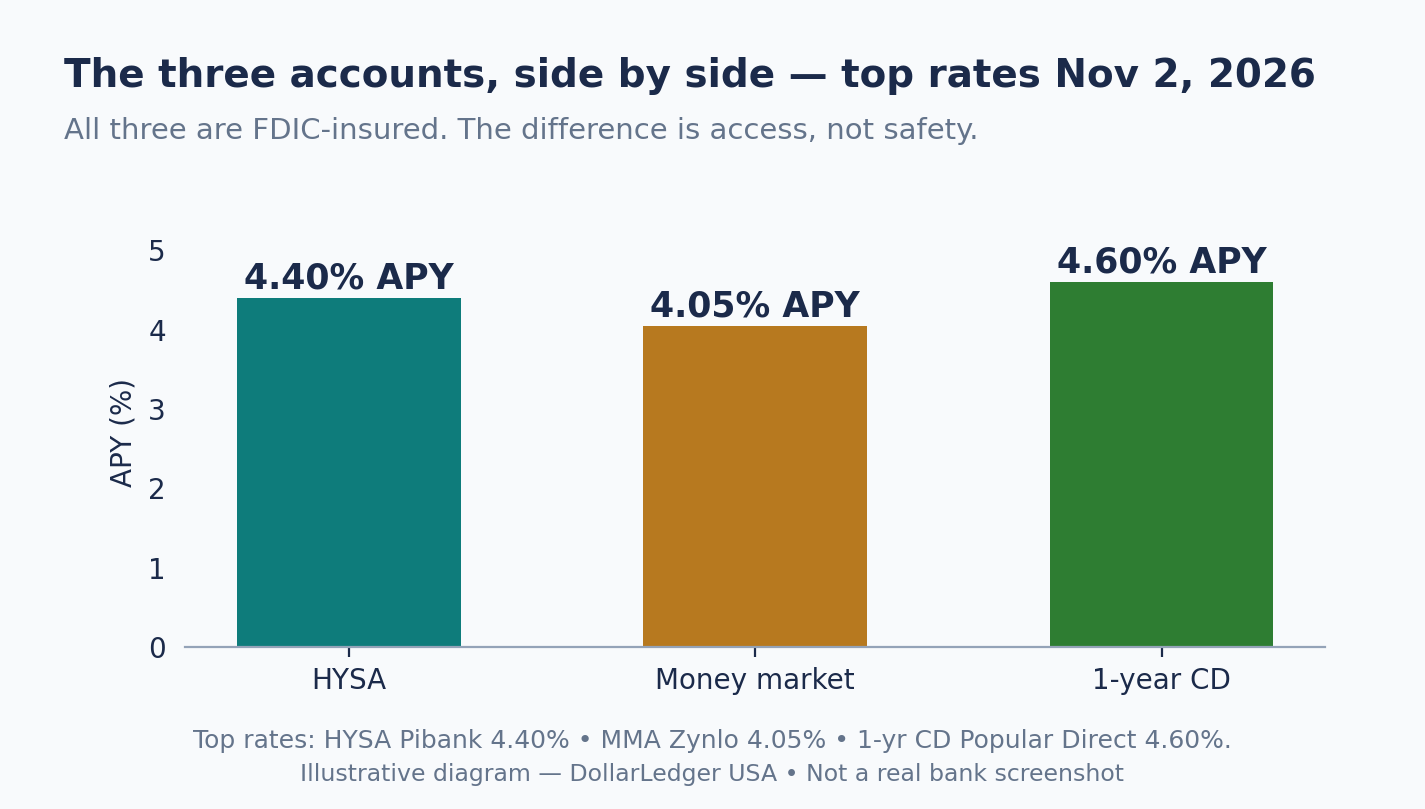
Illustrative diagram — The three accounts, side by side, Nov 2, 2026. NOT a real bank screenshot.
Step 2: Compare access — the real difference
What to do: Ask how fast you can get your money out.
How: A HYSA lets you withdraw any time — transfers take 1 to 3 business days. A money market account adds a debit card and checks, so you can pay a bill straight from the account. A CD locks your money until the term ends, and taking it out early costs a penalty. The CD pays the highest rate, but only if you can leave the money alone.
Example: Your car breaks down: a $900 repair. From a HYSA or money market account, you move the money the same day. From a CD, you pay a penalty to break it early.
Common mistake: Picking the CD for the highest rate, then needing the money early — the penalty can wipe out months of extra interest.
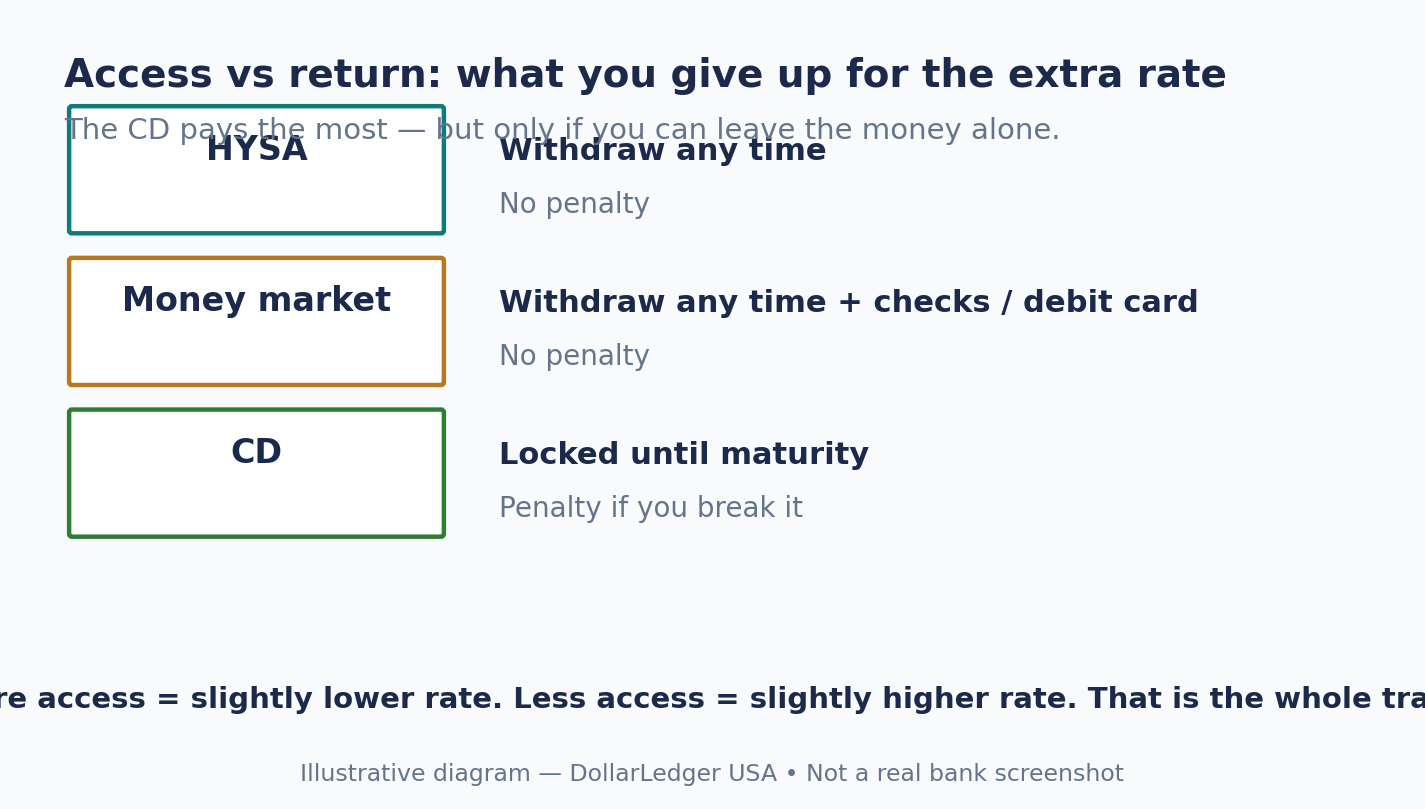
Illustrative diagram — Access vs return: what you give up for the extra rate. NOT a real bank screenshot.
Step 3: Compare what $10,000 earns in one year
What to do: Turn each rate into dollars.
How: At the top rate for each account, checked November 2, 2026, $10,000 earns in one year: HYSA 4.40% APY, about $440; money market 4.05% APY, about $405; 1-year CD 4.60% APY, about $460. The gap is $55 a year — real money, but small next to access. Averages are far lower: savings 0.38%, 1-year CD 2.11%.
Example: Sarah keeps $10,000 as her emergency fund in a HYSA at 4.40% and earns about $440 in a year. A 1-year CD at 4.60% would pay about $20 more — but lock the money away for a year.
Common mistake: Chasing a $20 or $55 difference while ignoring minimums: Bank5 Connect pays 4.00% APY with a $100 minimum; Zynlo Bank pays 4.05% APY with no minimum.

Photo: Plan first, then pick. (Photo: Pexels)
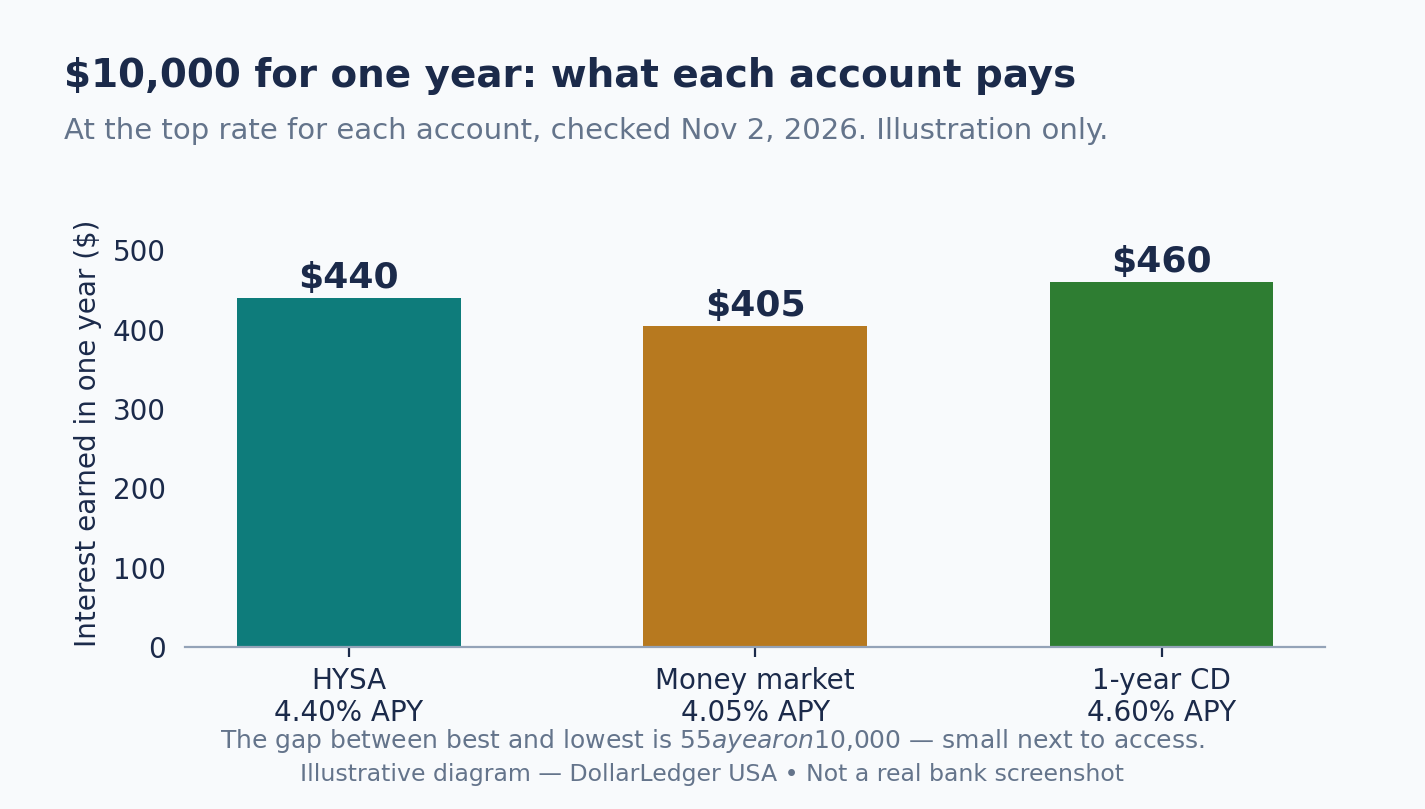
Illustrative diagram — $10,000 for one year: what each account pays. NOT a real bank screenshot.
Step 4: Match each account to its job
What to do: Give each pile of money the account that fits its job.
How: An emergency fund — three to six months of expenses — belongs in a HYSA: a strong rate, reachable any day. Bills and spending money belong in a money market account: the debit card and checks let you pay from it directly while it earns interest. Money you will not touch for a year or more — a house deposit, a car, a wedding — belongs in a CD, where the locked rate pays extra. See our guides to the best high-yield savings accounts and how a HYSA works.
Example: James keeps $9,000 in a HYSA as his emergency fund, $2,000 in a money market account for bills, and $5,000 in a CD for a car in 18 months.
Common mistake: Keeping everything in one account. One account means one trade-off for all your money.
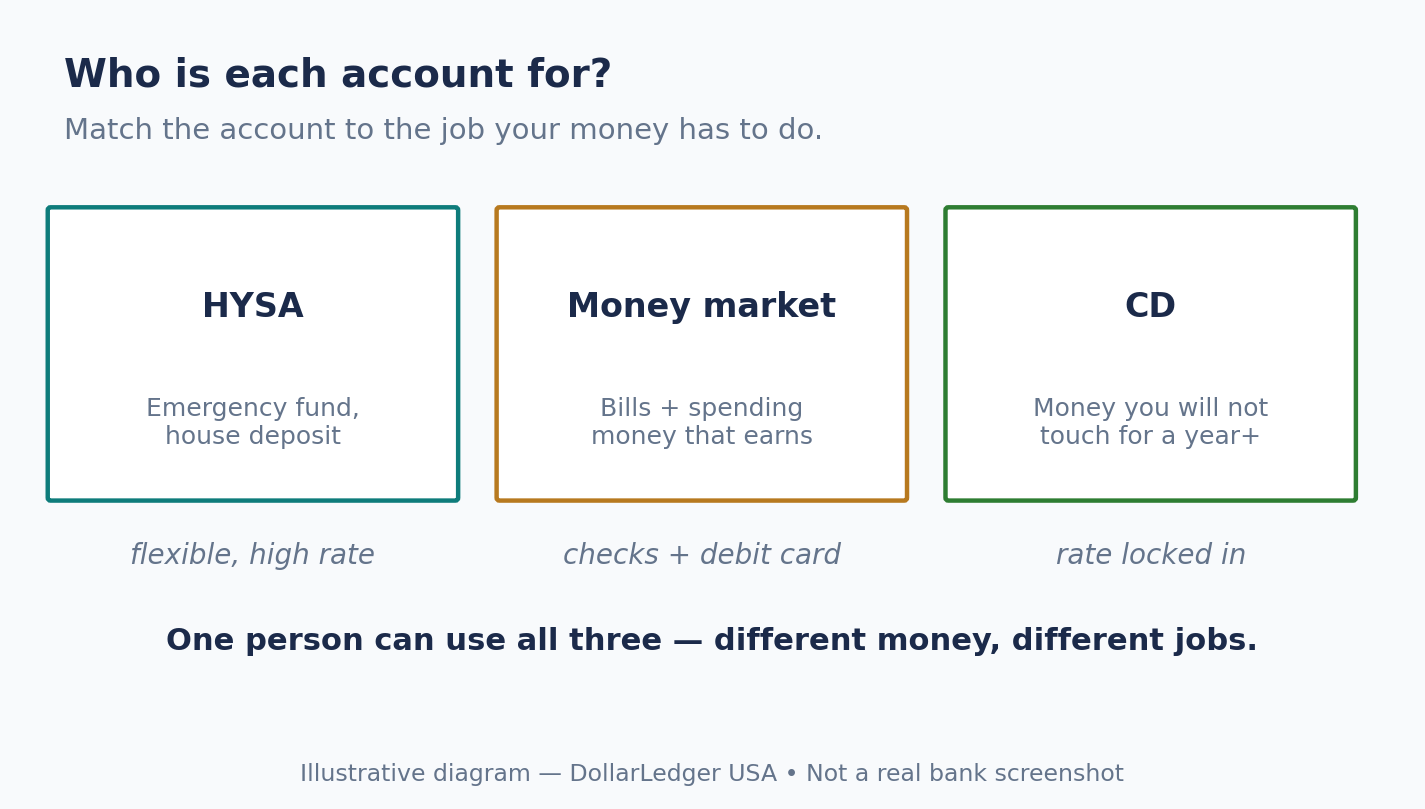
Illustrative diagram — Who is each account for? NOT a real bank screenshot.
Step 5: Know how each rate can change
What to do: Understand variable versus fixed rates.
How: HYSA and money market rates are variable — they usually follow the Federal Reserve’s benchmark rate (3.75% to 4.00% in September 2026). When the Fed cuts rates, HYSA and money market rates usually fall too. A CD rate is fixed for the whole term. So a CD wins when you think rates will fall, and a HYSA wins when you think they will rise. Re-check every six months — a 1% gap on $10,000 is $100 a year.
Example: If the Fed cuts rates again, a HYSA paying 4.40% today might pay 4.00% next year, while a 1-year CD keeps paying 4.60% until it matures.
Common mistake: Opening a HYSA and never looking at it again. Last year’s best rate may be this year’s average rate.

Photo: Each goal gets the account that fits it. (Photo: Pexels)
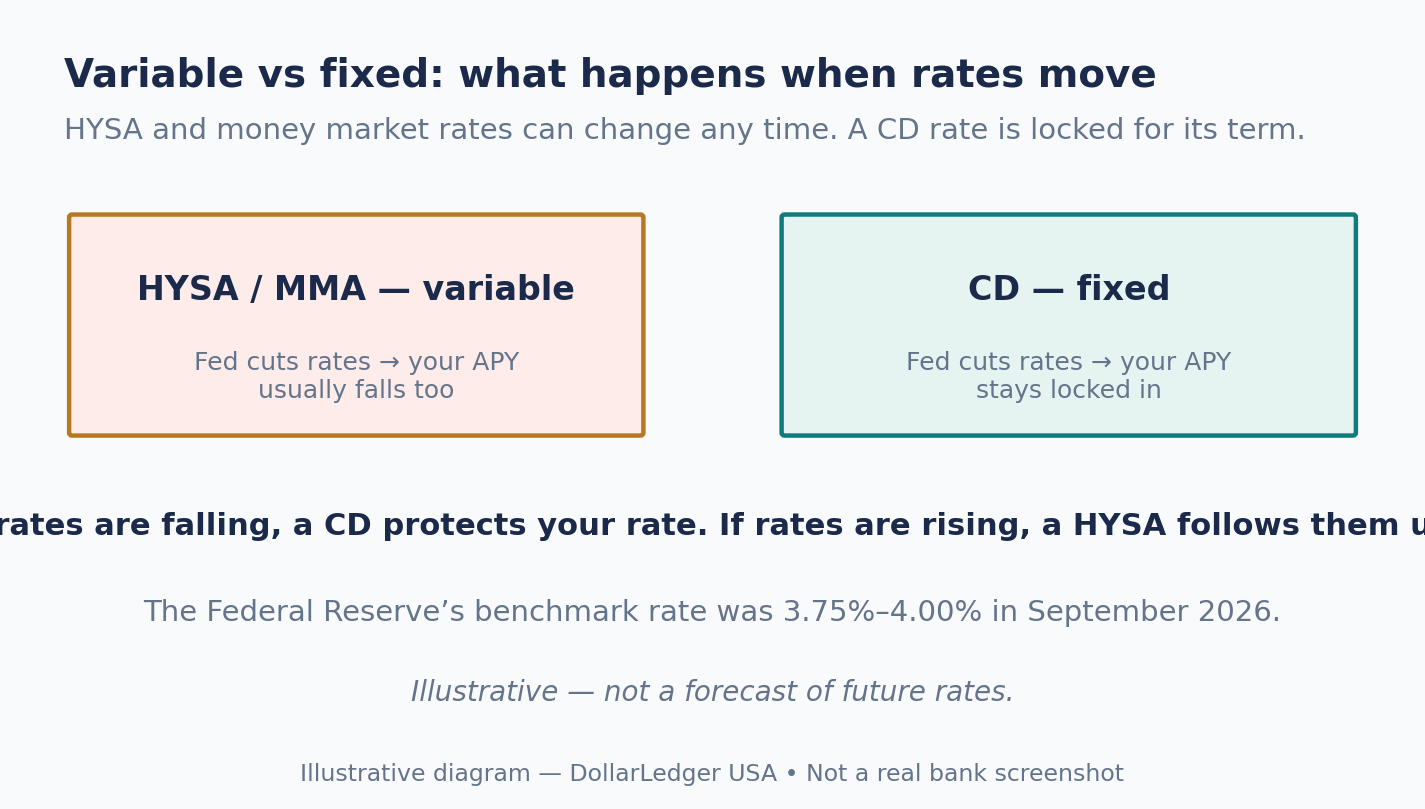
Illustrative diagram — Variable vs fixed: what happens when rates move. NOT a real bank screenshot.
Step 6: Decide in 60 seconds
What to do: Answer four questions in order.
How: 1. Might you need this money any day? Yes — a HYSA: your emergency fund. 2. Do you want to spend from the account with checks or a debit card? Yes — a money market account. 3. Will you not touch it for a year or more? Yes — a CD, and pick the term that matches the date. 4. Not sure? Split it: part in a HYSA for flexibility, part in a CD for the locked rate. Open the account with a photo ID and your Social Security number, and check the bank is FDIC- or NCUA-insured.
Example: Maria has $15,000: $5,000 she might need any day in a HYSA, $3,000 for bills in a money market account, $7,000 for a house deposit in a CD.
Common mistake: Treating the choice as permanent. You can move money any time a better rate appears — the only cost is the CD penalty.
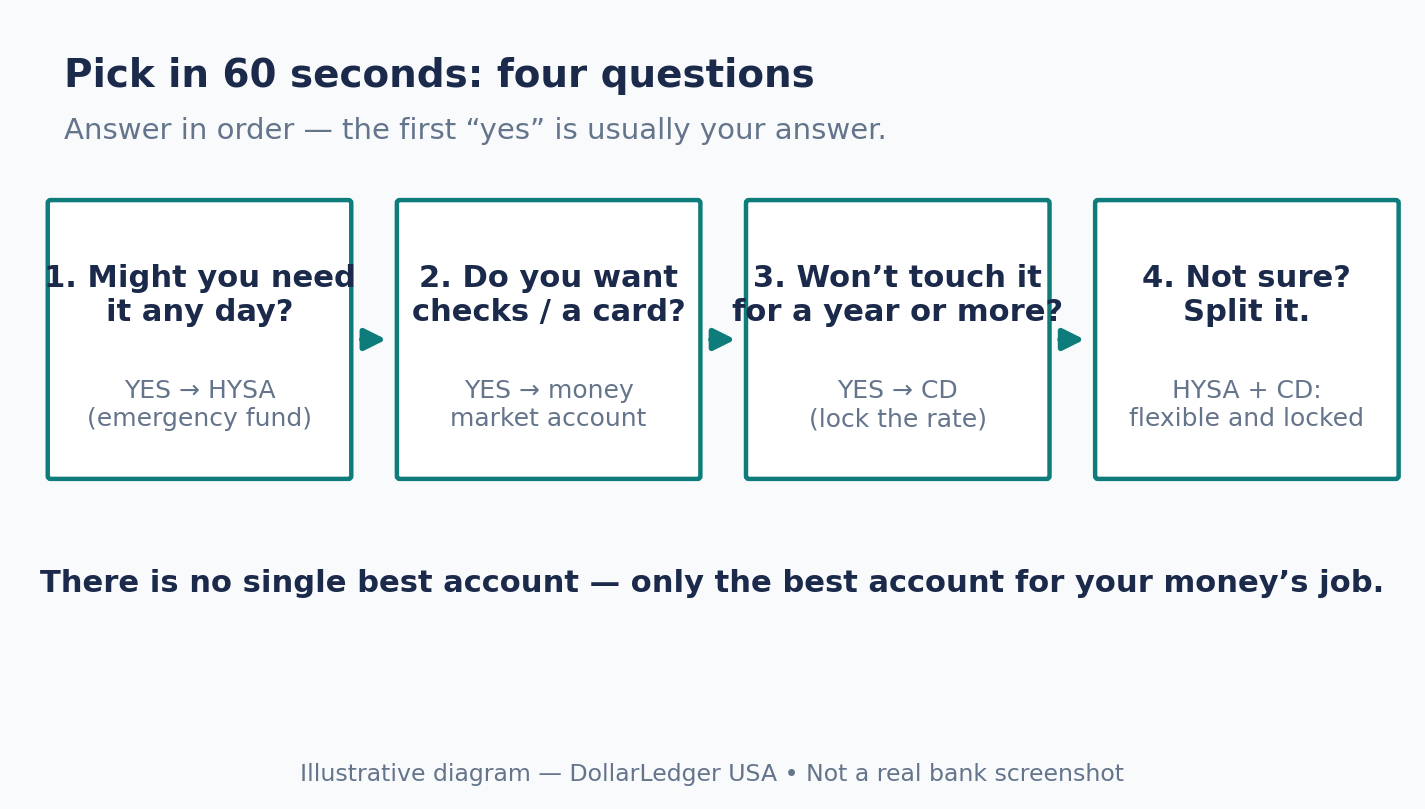
Illustrative diagram — Pick in 60 seconds: four questions. NOT a real bank screenshot.
Checklist
- ☐ I know what each pile of money is for, and when I need it.
- ☐ I compared the top rate for each account.
- ☐ I checked minimums, fees, and the debit card.
- ☐ I checked the CD’s penalty before locking money away.
- ☐ I checked every bank is FDIC- or NCUA-insured.
- ☐ I set a reminder to re-check rates in 6 months.
FAQ
Which is best: HYSA, money market account, or CD?
There is no single best account — only the best one for your money’s job. A HYSA wins for emergency money, a money market account for spending money, and a CD for money you will not touch for a year or more. Many people use all three.
Is a money market account safe?
Yes, if it is a bank deposit account at an FDIC-insured bank: deposits are protected up to $250,000 per depositor, per bank, per ownership category.
Can I lose money in a money market account or HYSA?
No. Both are deposit accounts, not investments, so your balance never drops with the market. A CD can only lose money through its early-withdrawal penalty.
Do money market accounts have monthly fees?
Some do, some do not. The best right now have no monthly fees — Zynlo Bank’s money market account at 4.05% APY has no minimum and no monthly fee. Check the fee and minimum first.
Which pays the most interest right now?
As of November 2, 2026: top 1-year CD 4.60% APY, top HYSA 4.40% APY, top money market account 4.05% APY. But the CD locks your money too, while the other two let you withdraw any time.
Sources
- Bankrate, “Best Money Market Account Rates of November 2026 — Up to 4.05%” — Zynlo Bank 4.05%, Bank5 Connect 4.00%, Ally 3.20%: https://www.bankrate.com/banking/money-market/rates/
- Bankrate, “Best CD Rates of November 2026 — Up to 5.00%” — top 1-year CD 4.60% APY, Nov 2, 2026: https://www.bankrate.com/banking/cds/cd-rates/
- FDIC, Deposit Insurance at a Glance — $250,000 per depositor, per bank, per ownership category: https://www.fdic.gov/consumer-resource-center/deposit-insurance-glance
- Motley Fool, “Best High-Yield Savings Accounts Today, Nov. 2, 2026” — top HYSA rates, national average 0.38% APY: https://www.fool.com/money/banks/articles/top-savings-account-rates-today-nov-2-2026/
All rates checked November 2, 2026.
Disclaimer: This article is for education only, not financial advice. Rates change often — confirm the current rate with the bank before opening an account.