Cash Back vs Travel Rewards: Which Credit Card Is Better for You in 2026
 DollarLedger Team
- 04 Nov, 2026

Every dollar you spend can come back as cash — or a trip. A flat 2% cash-back card pays $240 a year on $1,000 a month, with no annual fee and nothing to track. A travel card earning 2 miles per dollar can pay the same $240 — or $480, if you redeem the miles well — but it usually charges a $95 fee and takes effort. Which wins? It depends on how much you travel, and how much work you will do for your rewards. This guide compares cash back and travel rewards in 2026, checked November 3, 2026, with break-even math on $1,000 a month.
Photo: Cash back or a free trip — it depends on how you travel. (Photo: free stock)
What You Will Learn
- How cash back works, and what it is worth
- How travel points gain and lose value
- The break-even math on $1,000 a month
- When travel wins, and when cash wins
- How to pick your card — and pay no interest
Step 1: How cash back works
What to do: Learn what cash back is worth — one cent per point, every time.
How: A cash-back card pays you dollars, not points. The simplest is a flat-rate card: the Wells Fargo Active Cash Card earns 2% on every purchase, no annual fee, no categories to track. Spend $1,000, get $20 back. Category cards pay more in some places, less in others: the Freedom Unlimited earns 5% on Chase travel, 3% on dining and drugstores, 1.5% on everything else — also no annual fee. Redeem it as a statement credit or bank deposit — one dollar is always worth one dollar. No blackout dates.
Example: You spend $1,000 a month on the Active Cash : $20 back a month, $240 a year.
Common mistake: Chasing a 5% category you rarely use — it only pays if your spending matches.
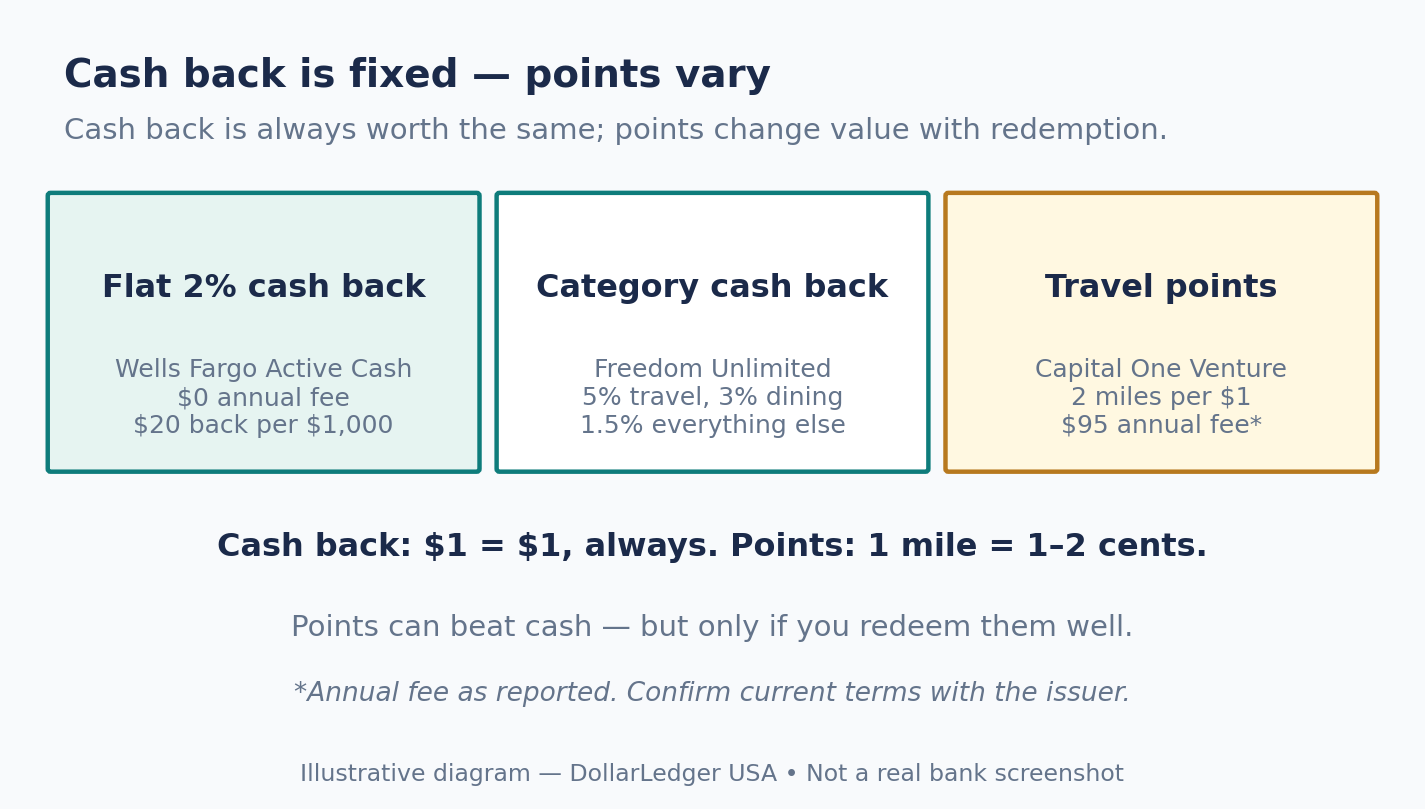
Illustrative diagram — Cash back fixed, points vary. NOT a real bank screenshot.
Step 2: How travel points work
What to do: Learn how points get their value — and how they lose it.
How: A travel card pays in points or miles, whose value depends on how you redeem them. The Capital One Venture Rewards Card earns 2 miles per dollar, with a reported $95 fee. Through the issuer’s portal they are usually worth about 1 cent each — like cash. Transfer them to a partner and they can be worth more — NerdWallet reports Capital One miles to Wyndham at 2.3 cents.
Example: 24,000 miles a year: $240 at 1 cent each, $480 at 2 cents.
Common mistake: Hoarding points for “someday.” Programs change prices, so a point you never use is worth zero.
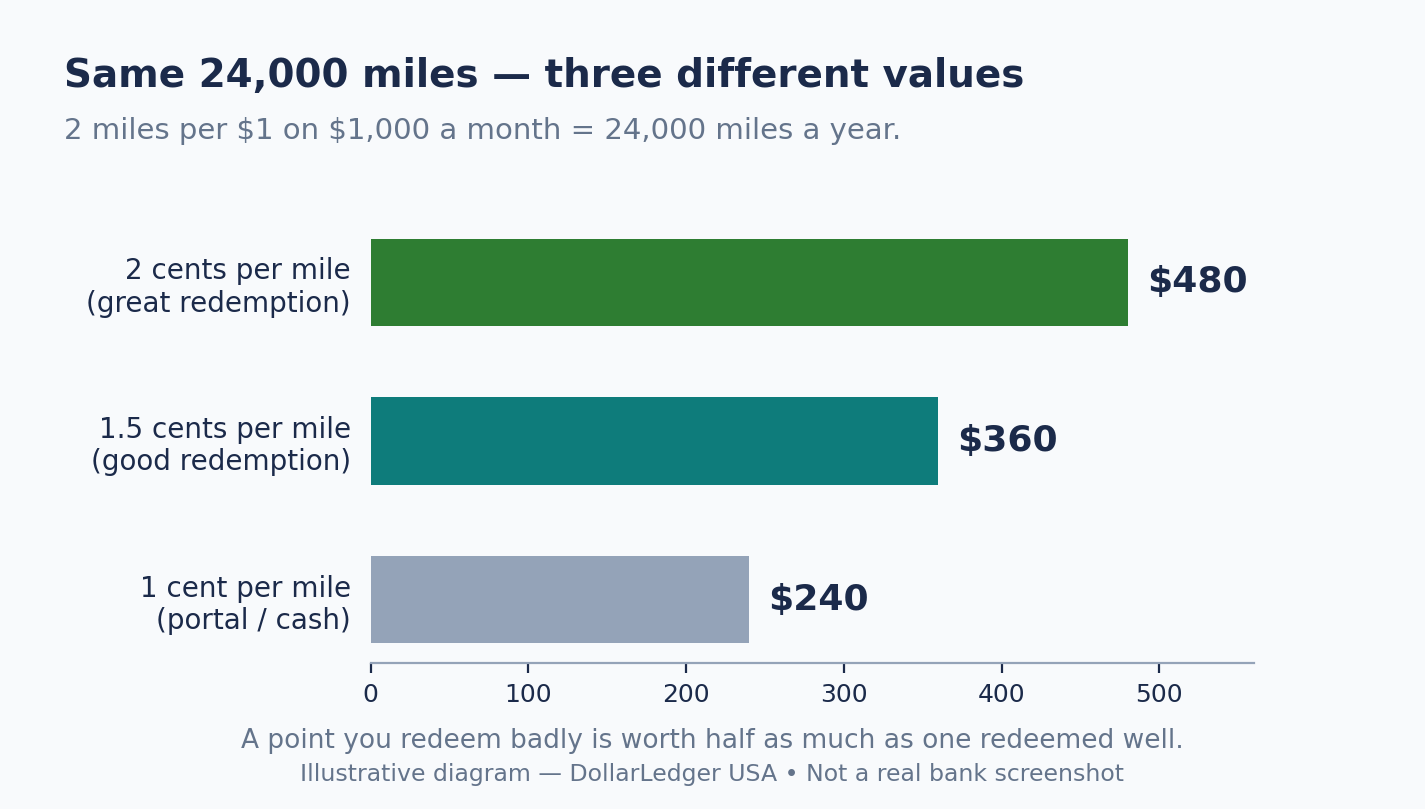
Illustrative diagram — Same miles, two values. NOT a real bank screenshot.

Photo: Cash back is money in your pocket the month you earn it. (Photo: free stock)
Step 3: The $1,000-a-month break-even
What to do: Run the numbers before you pick a side.
How: Take $1,000 a month — $12,000 a year.
- Flat 2% cash back (Active Cash): $20 a month, $240 a year, no fee — net $240.
- Category card (Freedom Unlimited — $700 everyday at 1.5%, $200 dining at 3%, $100 drugstores at 3%): $19.50 a month, $234 a year — net $234.
- Travel miles (Venture, 2 miles per $1): 24,000 miles a year. At 1 cent: $240 – $95 = $145 net. At 1.5 cents: $360 – $95 = $265. At 2 cents: $480 – $95 = $385.
Break-even: miles must be worth about 1.4 cents each to beat the free 2% card. Below that, cash wins; above it, travel wins — if you redeem them that well.
Example: You fly twice a year and redeem at 2 cents a mile — your $1,000 a month returns $385 a year after the fee.
Common mistake: Comparing earn rates, not net value. Two miles per dollar sounds better than 2% cash back — until the $95 fee and a 1-cent redemption eat it.
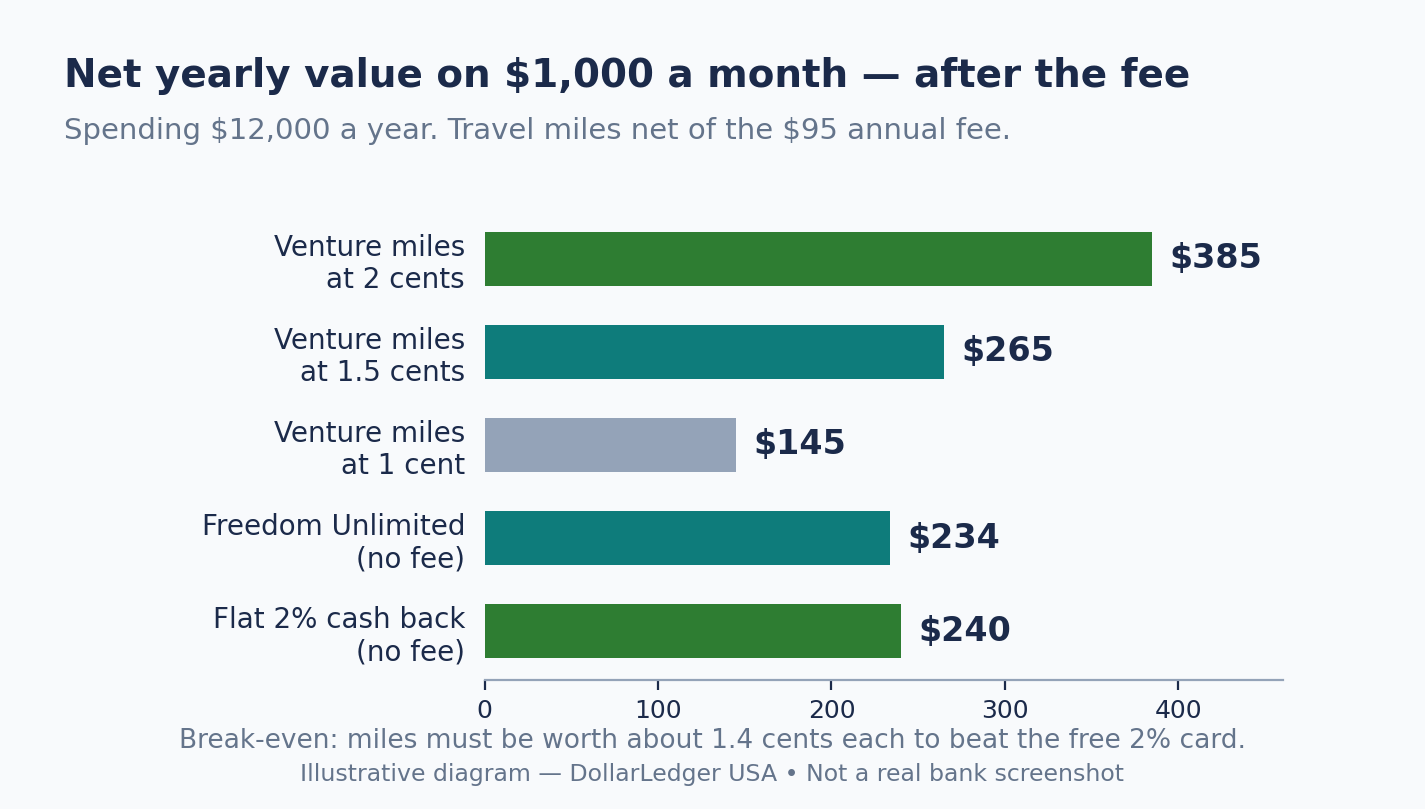
Illustrative diagram — Break-even: miles must be worth about 1.4 cents each. NOT a real bank screenshot.
Step 4: When travel rewards win
What to do: Check whether your travel habits clear the bar.
How: Travel rewards win when three things are true. You travel at least twice a year. You redeem through transfer partners or a travel portal above about 1.4 cents per mile — the break-even from Step 3. And you use the perks: the Sapphire Preferred includes a $100 annual hotel credit, up to $120 toward TSA PreCheck every four years, and no foreign transaction fees — perks that can cover the $95 fee alone. Its reported 75,000-point welcome bonus after $5,000 in the first 3 months can be worth a flight by itself.
Example: Three trips a year at 2 cents a mile, plus the $100 hotel credit — travel beats cash by hundreds.
Common mistake: Paying a $95 fee, then redeeming points for cash at 1 cent each.
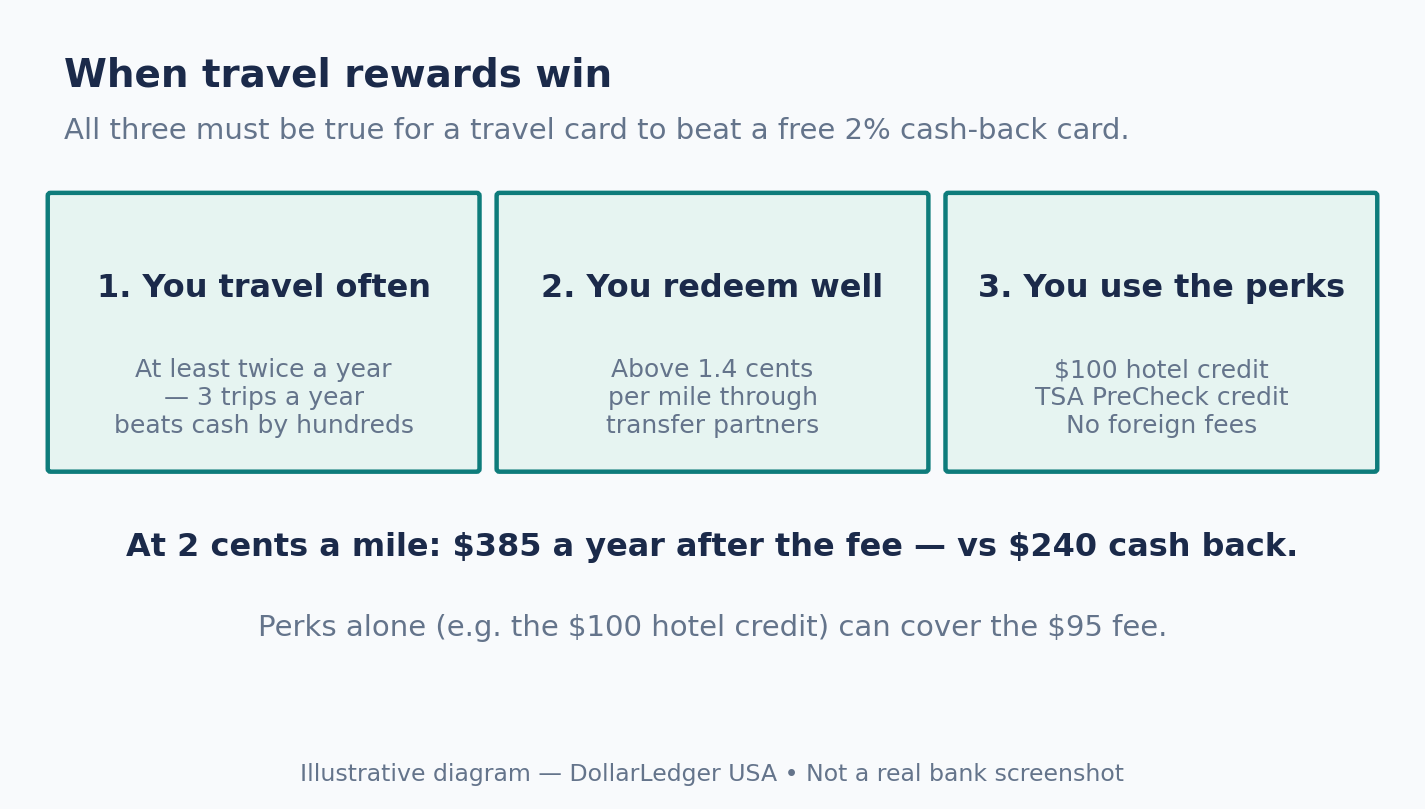
Illustrative diagram — Three checks that say travel will win for you. NOT a real bank screenshot.
Step 5: When cash back wins
What to do: Be honest about how much you travel.
How: Cash back wins when you travel rarely, or not at all. A point you never redeem is worth zero; cash back lands the month you earn it. Cash back also wins on simplicity: no award charts, no blackout dates, no partners to learn, no annual fee. Watch the foreign transaction fee: Active Cash and Freedom Unlimited both charge 3% on foreign purchases, wiping out the 2% reward. Sapphire Preferred charges none.
Example: One trip a year: a flat 2% card returns $240 a year.
Common mistake: Picking a travel card for the bonus, then never travelling. The bonus is one-time; the fee comes back every year.

Photo: If you rarely travel, the simplest card wins. (Photo: free stock)
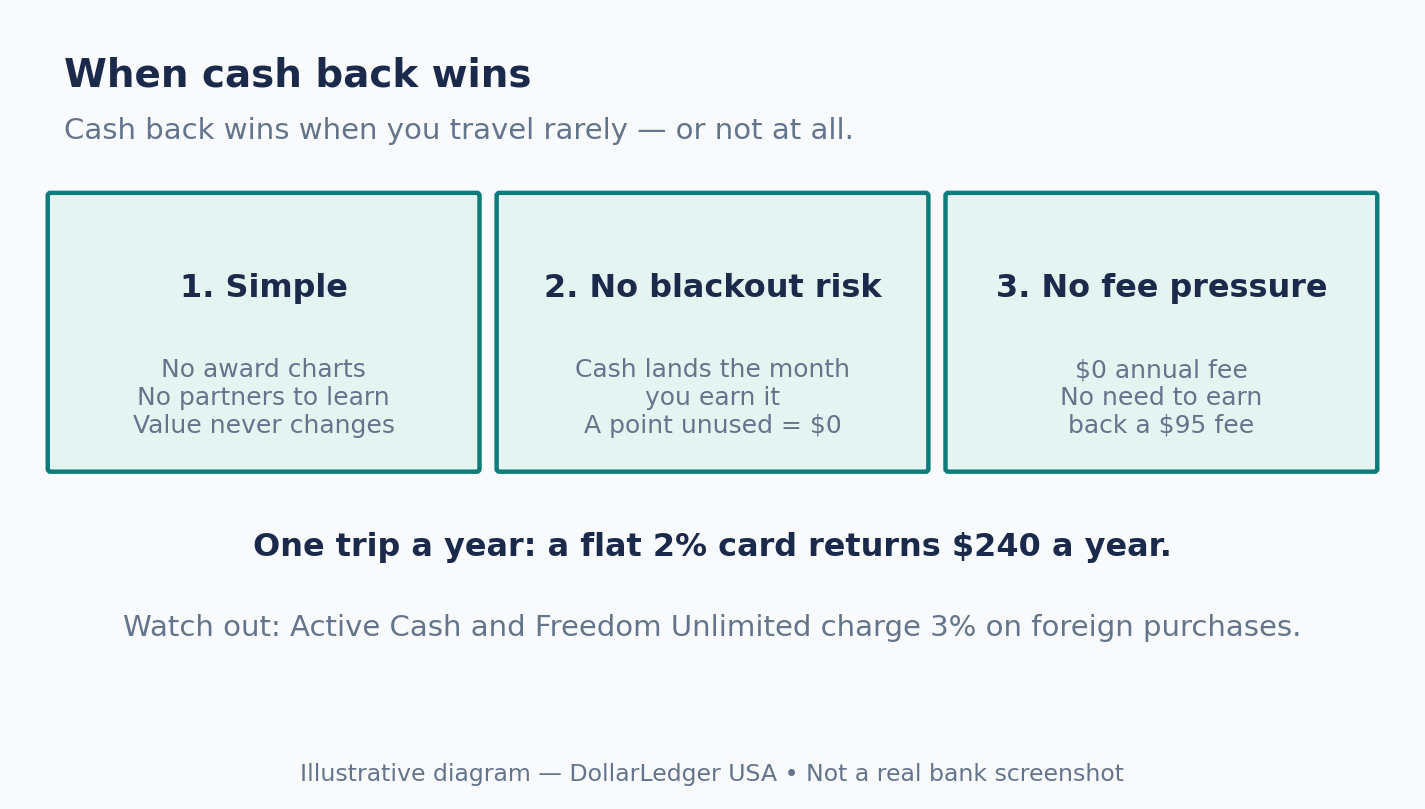
Illustrative diagram — Three checks that say cash will win. NOT a real bank screenshot.
Step 6: Pick your card — and use it without paying interest
What to do: Match the card to your life, then pay it in full.
How: How much do I travel? If rarely, take the free 2% card. Will I redeem points well? If not, take the cash. Can Ipay in full every month? This matters most: at roughly 19% to 29% APR, carrying a balance wipes out a 2% reward in a month. Rewards only pay when the balance is zero. If you do travel, pair the cards: Freedom Unlimited for everyday spending, Sapphire Preferred for travel and dining, then move Freedom points to Sapphire. Our budgeting guide keeps the balance at zero; our saving $1,000 guide shows what to do with cash back.
Example: You spend $1,000 a month and pay in full: the Active Cash returns $240 a year.
Common mistake: Carrying a balance for rewards. A 2% reward never beats 19% interest.
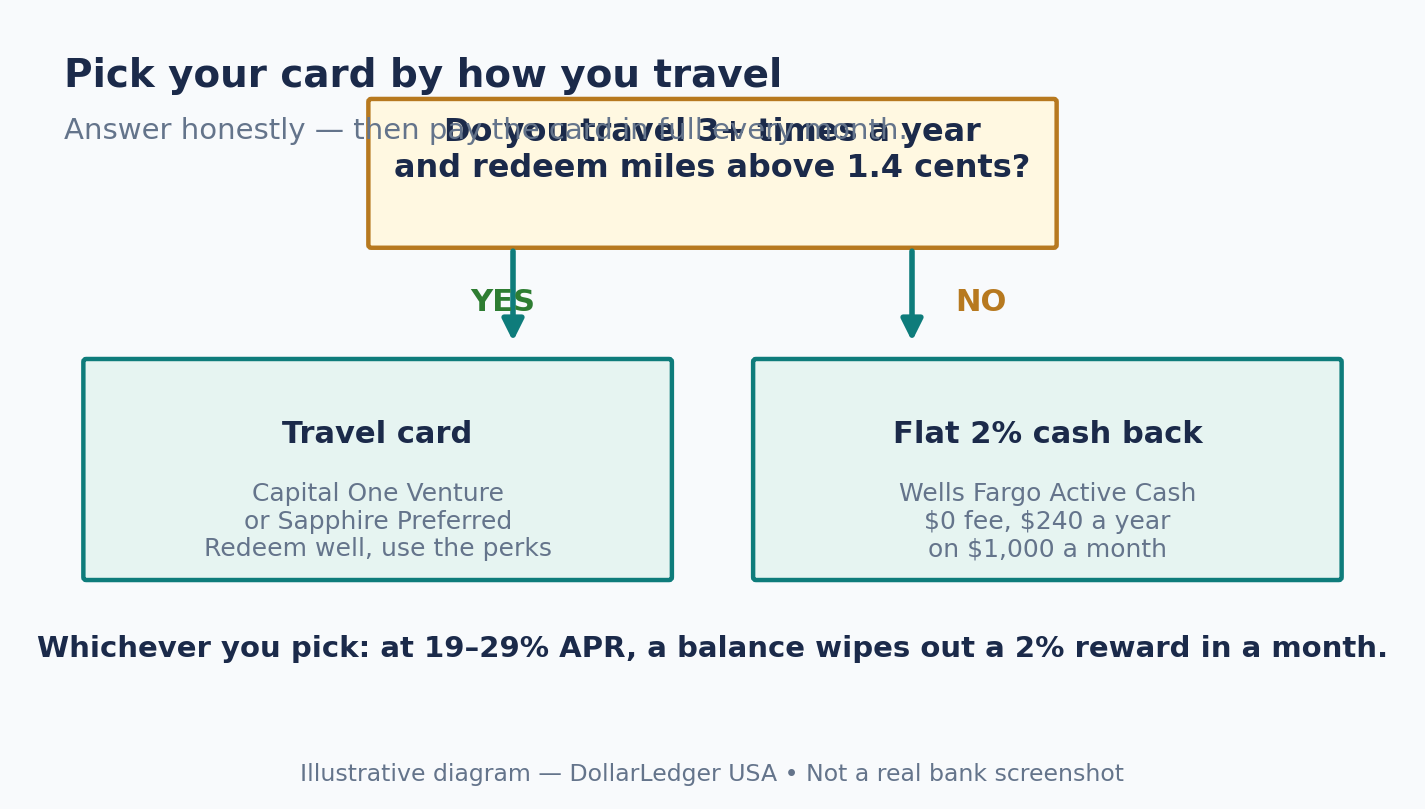
Illustrative diagram — Pick your card by how you travel. NOT a real bank screenshot.
Checklist
- ☐ I know how much I travel each year.
- ☐ Net yearly value: rewards minus the annual fee.
- ☐ Miles worth more than 1.4 cents each.
- ☐ Foreign transaction fee checked.
- ☐ No annual fee unless the perks cover it.
- ☐ Balance paid in full every month.
FAQ
Is cash back or travel rewards better? For most people, cash back — NerdWallet calls it the clear winner for many, because it is cheaper and more flexible. Travel wins only if you travel often, redeem points above 1 cent each, and use the perks.
How much must I travel for a travel card to win? Roughly twice a year or more, with redemptions above about 1.4 cents per mile. Below that, a free 2% card returns more after the $95 fee.
Can I have both a cash-back and a travel card? Yes. Use a flat 2% card for everyday spending and a travel card for trips, or pair the Freedom Unlimited with the Sapphire Preferred. Do not pay two fees for perks you never use.
Do travel points expire? It depends on the program. Points on most general travel cards do not expire while the account stays open, but airline and hotel miles can expire, and programs can change a point’s value. Redeem regularly instead of hoarding.
Sources
- NerdWallet, “Cash Back vs. Travel Rewards: How to Choose” — cash back vs points: https://www.nerdwallet.com/credit-cards/learn/cash-back-vs-travel-how-to-choose-your-credit-card-rewards
- NerdWallet, “Freedom Unlimited vs. Sapphire Preferred” — $95 fee, bonus, point values, perks: https://www.nerdwallet.com/credit-cards/learn/freedom-unlimited-vs-sapphire-preferred
- Upgraded Points, “Freedom Unlimited vs. Active Cash [2026]” — 2% flat vs category rates: https://upgradedpoints.com/credit-cards/freedom-unlimited-card-vs-wells-fargo-active-cash-card/
All figures checked November 3, 2026.
This article is for education only, not financial advice. Confirm current terms with the card issuer before applying.