Freelancer Taxes in USA 2026 — Self-Employment Tax, Quarterly Payments and Deductions
 DollarLedger Team
- 07 Nov, 2026

Nobody withholds tax from a freelancer’s invoice. That freedom is also the trap: the first year freelancing, many people spend the full payment, then discover in April that they owe thousands in tax — plus a penalty for paying late. The fix is a simple routine: set aside money from every payment, pay four times a year, and claim the deductions the IRS allows. This guide walks through self-employment tax, the quarterly payment calendar, and a worked example on $100,000 of freelance income — all figures checked November 7, 2026, against IRS pages.
Photo: Freelancing means you are the payroll department now — including the tax part. (Photo: Pexels)
What You Will Learn
- What self-employment tax is — and why it is 15.3%
- The $100,000 example: about $22,365 total federal tax
- The four quarterly due dates for 2026 — and the safe harbour
- The deductions that cut the bill: half SE tax, QBI, home office, health insurance
- How to set up the routine
- Six mistakes first-year freelancers make
Step 1: Understand the two taxes inside every freelance dollar
What to do: Learn the difference between income tax and self-employment tax — you owe both.
How: When you work for an employer, Social Security and Medicare taxes are split 7.65% and 7.65%. When you work for yourself, you pay both halves. That combined tax is called self-employment (SE) tax: 15.3% — 12.4% for Social Security and 2.9% for Medicare. It applies to 92.35% of your net earnings — your business profit after expenses. The 12.4% Social Security part only applies up to the 2026 base of $184,500 of combined wages and net earnings; the 2.9% Medicare part has no cap. You must pay SE tax and file Schedule SE if your net earnings were $400 or more. On top of SE tax comes ordinary income tax.
Example: Lena earns $60,000 in net freelance profit. Her SE tax base is $55,410, and 15.3% of that is about $8,478 — before a single dollar of income tax.
Common mistake: Thinking the 15.3% is your whole tax bill. It is not — it sits on top of income tax.
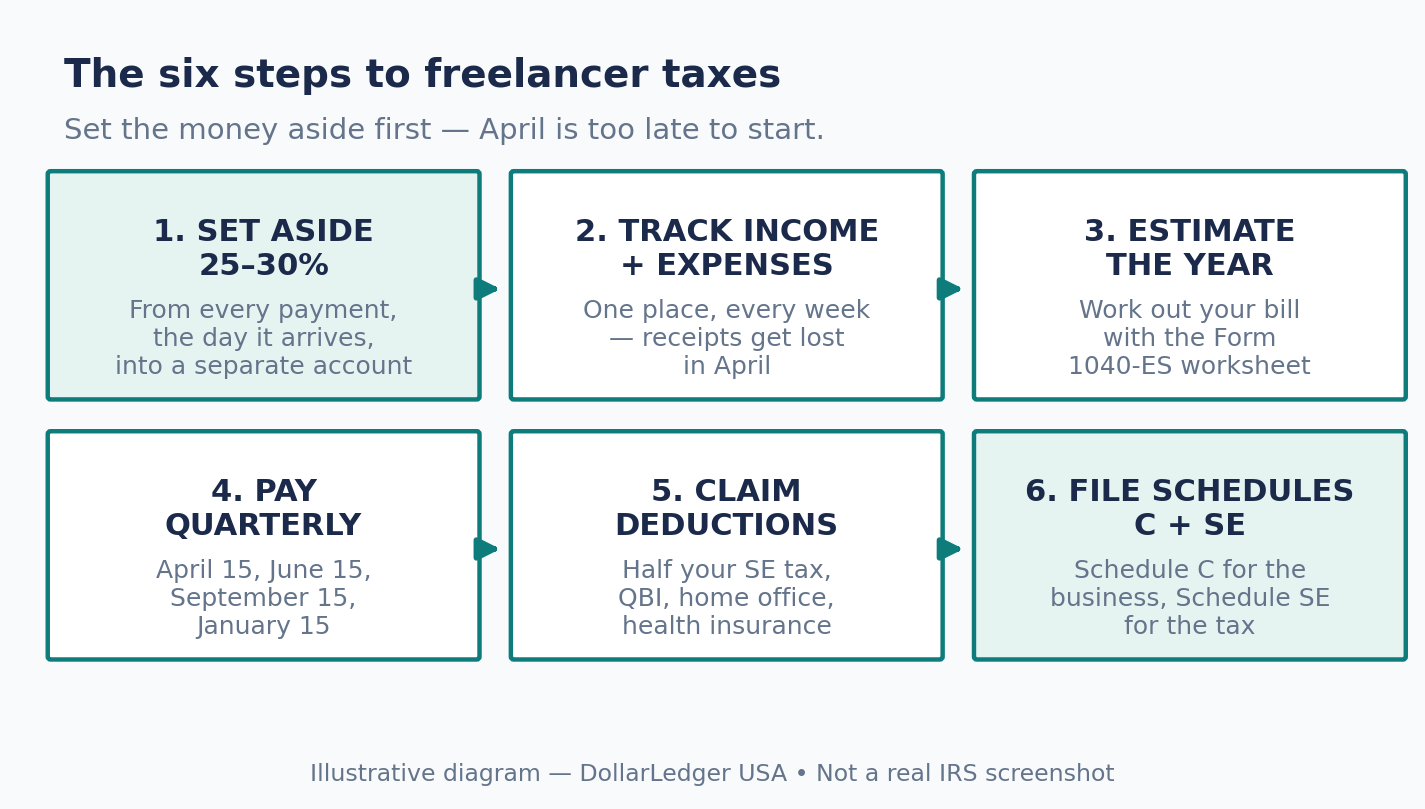
Illustrative diagram — The six steps to freelancer taxes in 2026. NOT a real IRS screenshot.
Step 2: Set aside 25–30% of every payment, the day it arrives
What to do: Open a separate savings account for tax, and move 25–30% of every payment into it the day the money lands.
How: The percentage is a rule of thumb: at $100,000 of net income the total federal bill is about 22% (see Step 3), so 25% covers federal tax with a cushion, and 30% covers it if you also owe state tax. Move the money immediately — willpower fails by April. Keep the tax account separate. If a client pays late, the set-aside waits with it.
Example: Omar is paid $4,000 in January and moves $1,000 (25%) to his tax account the same day — by April 15 he has set aside enough for his first quarterly payment.
Common mistake: Setting aside a percentage of gross invoices instead of net profit — or nothing at all.
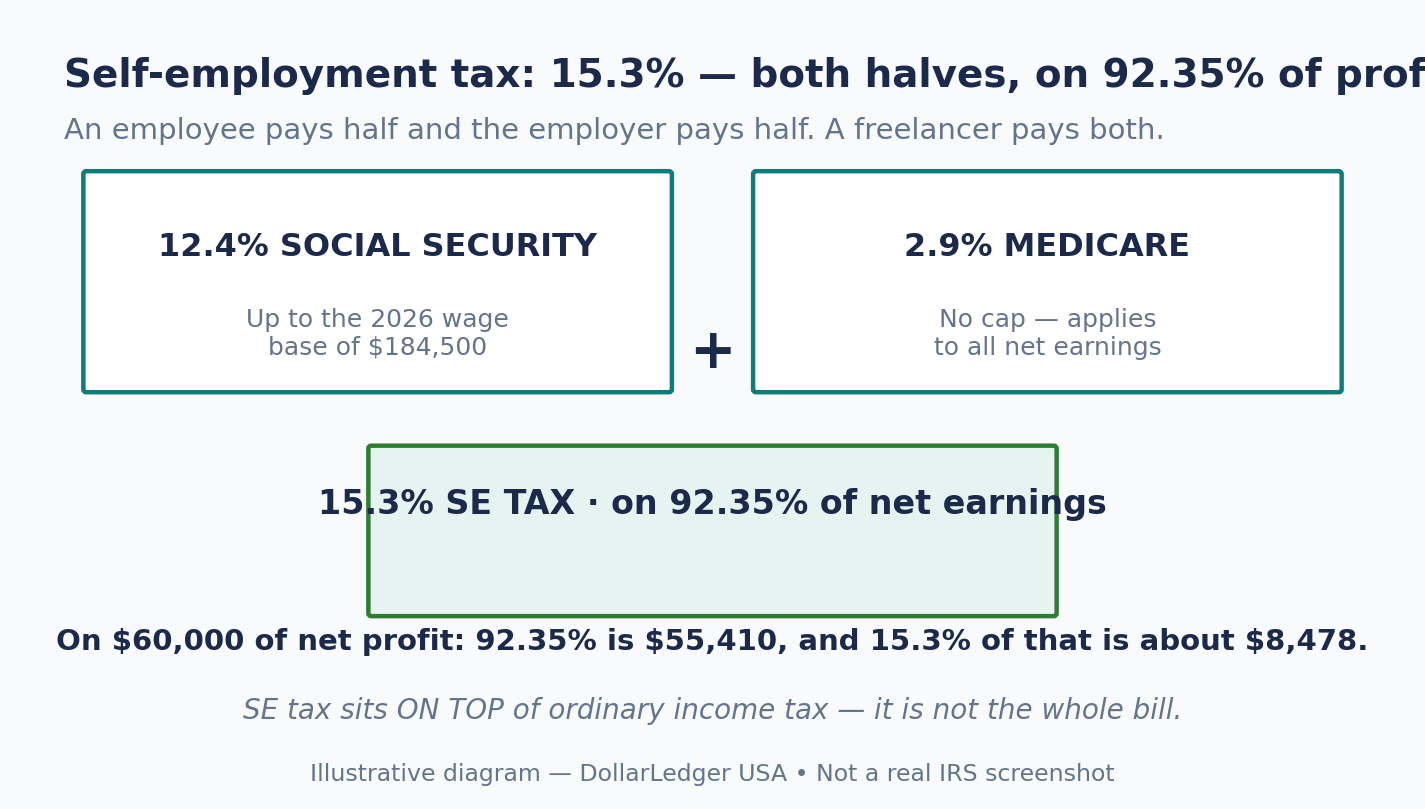
Illustrative diagram — The 15.3% self-employment tax, and what it applies to. NOT a real IRS screenshot.
Photo: The worked example below uses real 2026 IRS figures — check your own numbers with Form 1040-ES. (Photo: Pexels)
Step 3: Work out your number — the $100,000 example
What to do: Run the calculation once for your own income, using the same steps as this example.
How: Take a single filer with $100,000 of net freelance income in 2026, no other income, taking the standard deduction. First, SE tax: 92.35% of $100,000 is $92,350, and 15.3% of that is $14,130. Second, half the SE tax ($7,065) is deductible, so adjusted gross income is $92,935. Third, the QBI deduction — up to 20% of qualified business income — is about $15,367 here, after the IRS limit. Fourth, the 2026 standard deduction for a single filer is $16,100 (IRS Revenue Procedure 2025-32), so taxable income is $61,468. Fifth, income tax at the 2026 brackets (10% to $12,400, 12% to $50,400, 22% to $105,700) is about $8,235. Total federal tax: about $22,365 — roughly 22% of the $100,000, or about $5,591 a quarter.
Example: Compare that with an employee earning $100,000: their payroll tax is about half the SE tax, and their employer pays the other half. The freelancer’s extra cost is real — but so are the deductions an employee cannot claim.
Common mistake: Using last year’s tax bill as this year’s estimate when your income doubled. The safe harbour protects you — but only if you pay it.
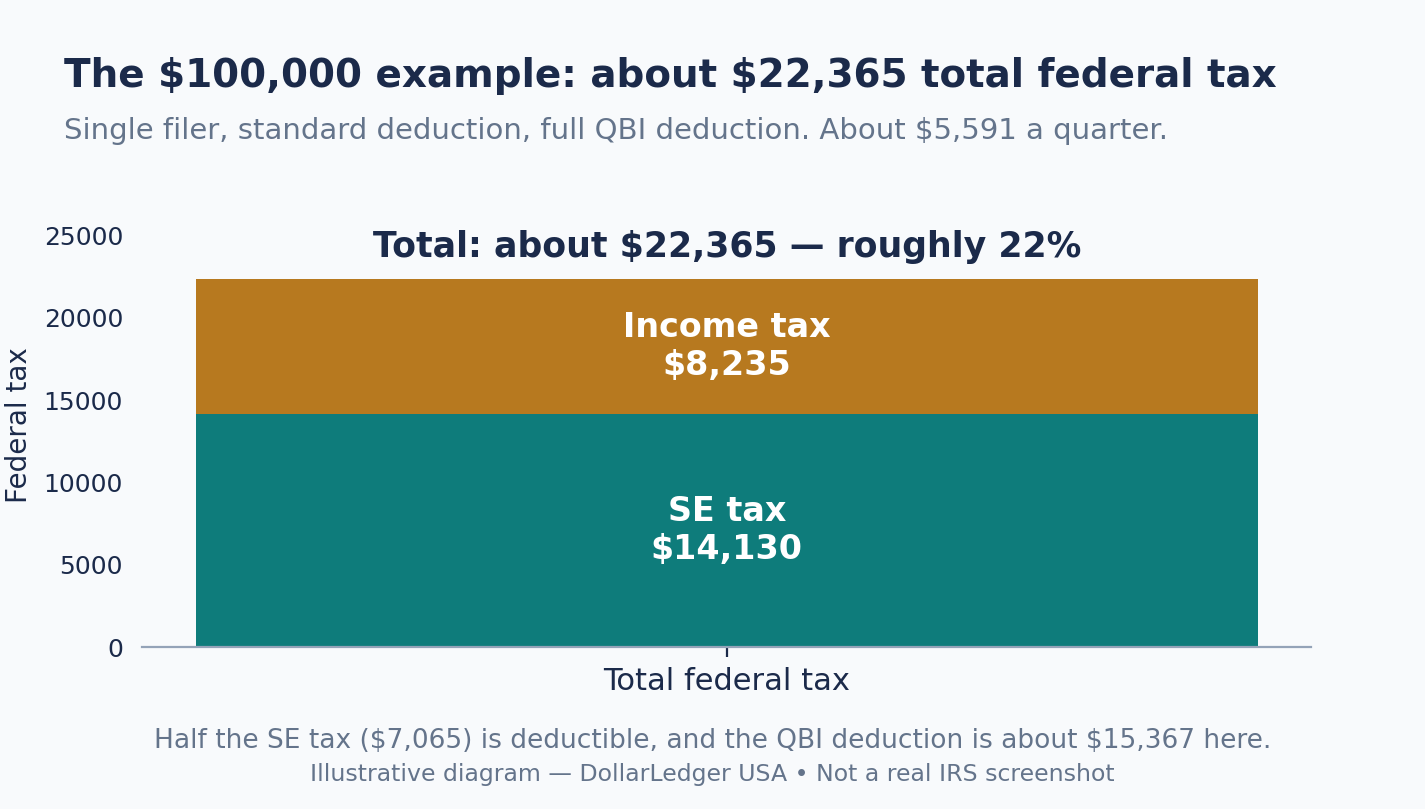
Illustrative diagram — The $100,000 example: single filer, standard deduction, full QBI deduction. Illustration, not tax advice. NOT a real IRS screenshot.
Step 4: Pay four times a year — and know the safe harbour
What to do: Pay estimated tax in four instalments using Form 1040-ES.
How: If you expect to owe $1,000 or more after withholding and credits, estimated payments are required. For 2026 income the due dates are April 15, June 15 and September 15, 2026, and January 15, 2027 — the quarters are uneven. The Form 1040-ES worksheet turns your expected annual bill into four equal payments. The safe harbour: pay at least 100% of last year’s total tax (110% if your prior-year AGI was over $150,000), in four equal instalments, and no penalty applies even if you owe more.
Example: Nadia owed $12,000 last year and expects to owe $20,000 this year. She pays $3,000 a quarter — 100% of last year’s tax — and owes the remaining $8,000 at filing time with no penalty, because she met the safe harbour.
Common mistake: Missing the June 15 payment because the “quarter” feels wrong — it covers only April and May. Set a reminder for all four dates in January.
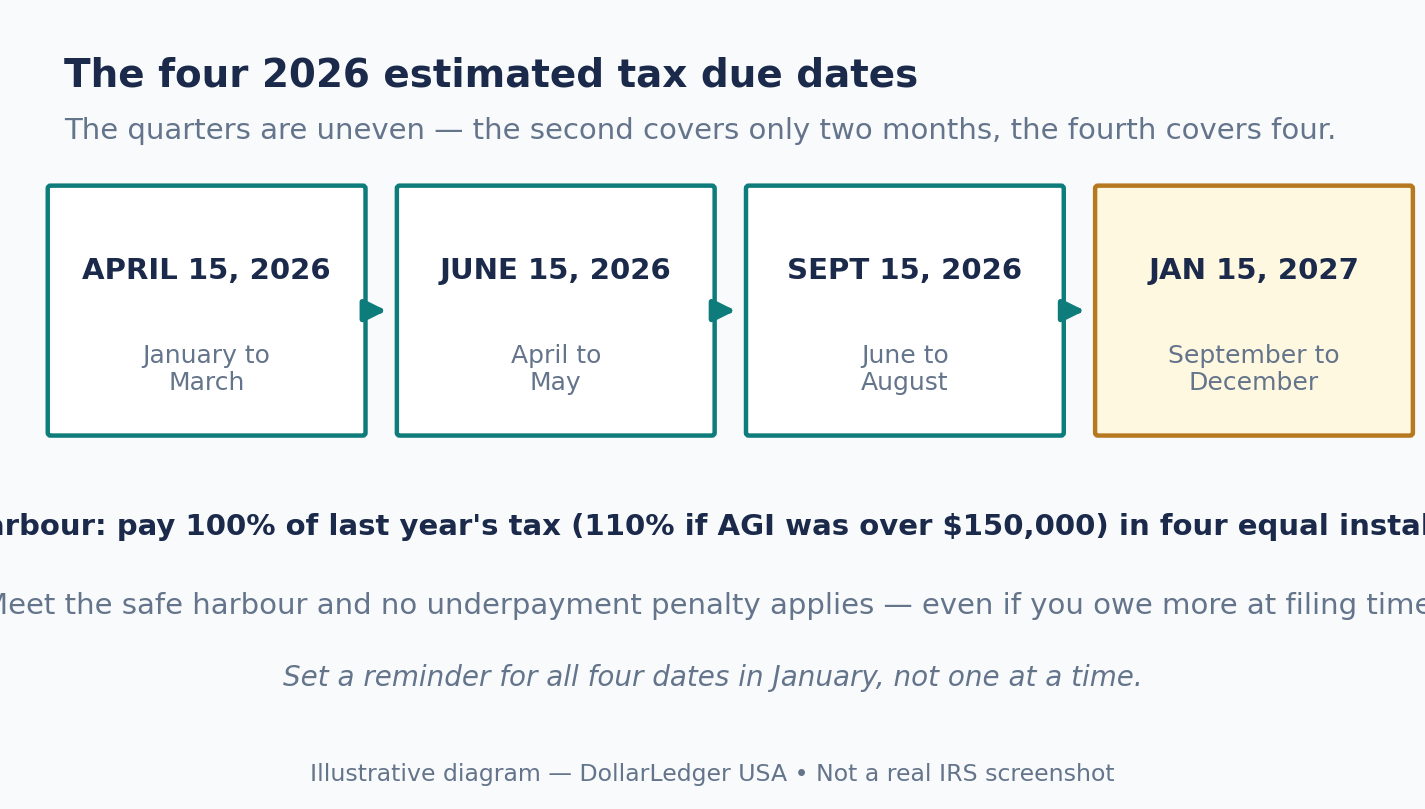
Illustrative diagram — The four 2026 estimated tax due dates, and the safe harbour rule. NOT a real IRS screenshot.

Photo: Track every expense as it happens — reconstructing a year of receipts in April is how deductions get lost. (Photo: Pexels)
Step 5: Claim the deductions that cut the bill
What to do: Track every deductible expense, and claim the big above-the-line deductions.
How: Business expenses go on Schedule C — software, a laptop, phone, travel, and part of your internet bill. The home office deduction covers a space used regularly and exclusively for business: $5 per square foot up to 300 square feet ($1,500 maximum) under the simplified method, or actual expenses under the regular method. Health insurance premiums for the self-employed are deductible above the line, as is half of your SE tax. The QBI deduction lets most freelancers deduct up to 20% of qualified business income — phasing above $201,750 single and $403,500 married filing jointly in 2026. And retirement savings cut the bill twice: a SEP IRA allows up to 25% of compensation, and a Solo 401(k) allows up to $24,500 for 2026 plus an employer contribution.
Example: Ben’s net profit is $100,000. He claims a $1,500 home office, $6,000 in health insurance, and puts $10,000 into a Solo 401(k). Those deductions cut his taxable income by $17,500 before the standard deduction and QBI — worth roughly $3,850 at his 22% marginal rate.
Common mistake: Deducting personal expenses as business ones — the family holiday, the whole phone bill when half is personal.
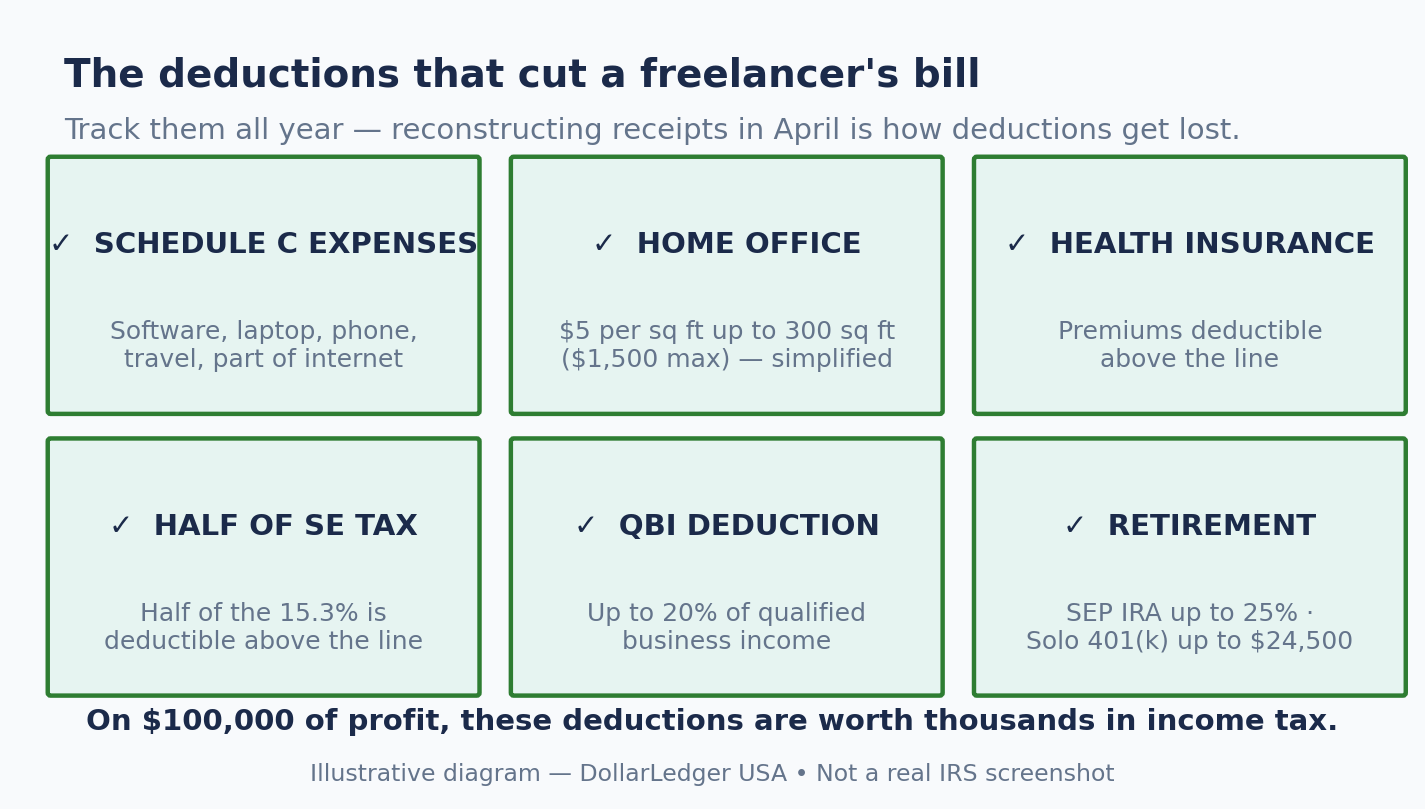
Illustrative diagram — The deductions that cut a freelancer’s bill. NOT a real IRS screenshot.
Step 6: File with Schedules C and SE — and fix the routine for next year
What to do: File with Schedule C and Schedule SE, then adjust your set-aside for next year.
How: Schedule C reports your business income and expenses; Schedule SE calculates the SE tax on the net profit. Your SE tax and income tax go on Form 1040, and half the SE tax goes on Schedule 1. If you received a Form 1099-NEC — required when a client pays you $600 or more — check it against your records; income is taxable whether or not you received a 1099. After filing, compare your actual bill with what you set aside and adjust the percentage.
Example: Zoe set aside 25% all year and her actual bill came to 22% — she gets a small refund. Her friend set aside nothing, owes $18,000, and pays it on a credit card at 24% APR.
Common mistake: Treating the refund as free money. A big refund means you lent the IRS your money all year interest-free.
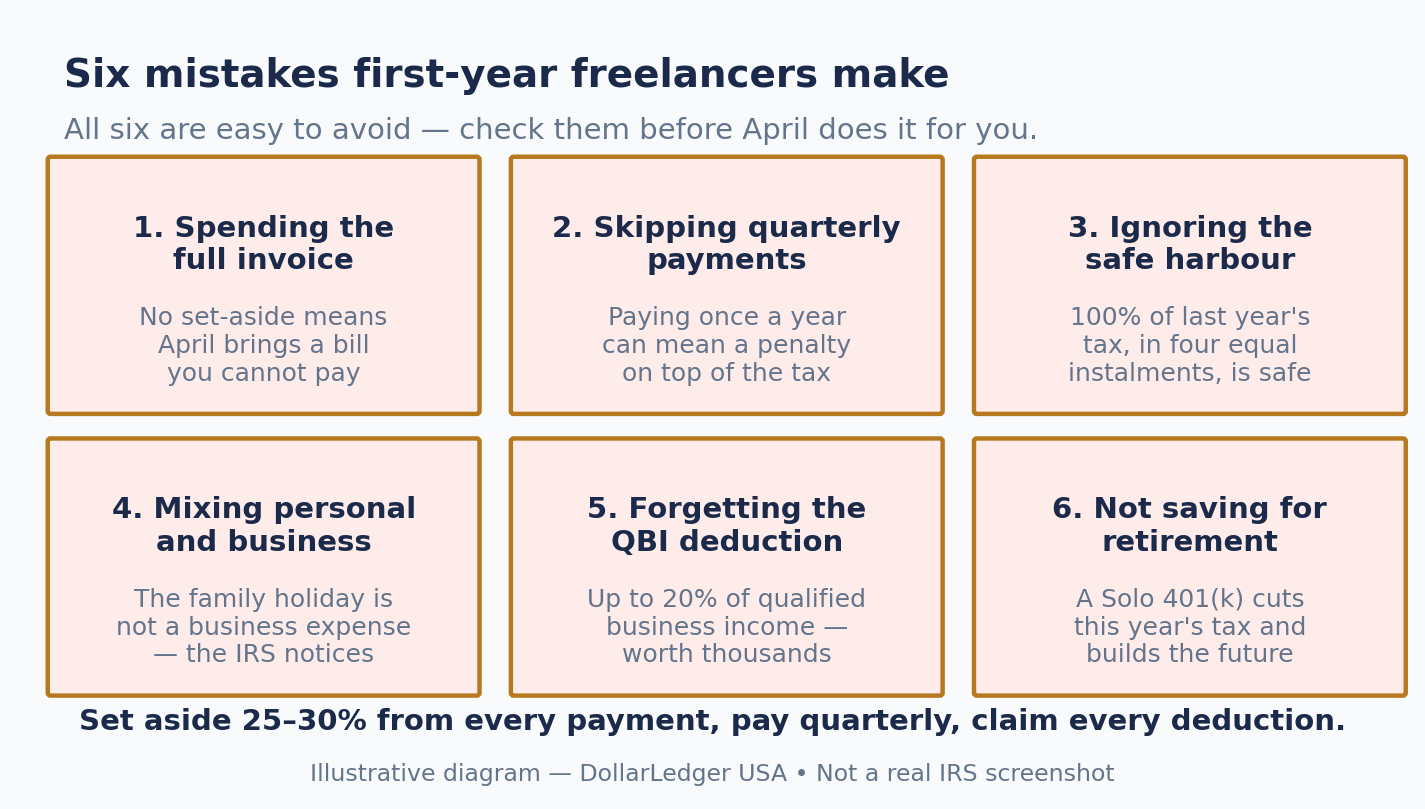
Illustrative diagram — Six mistakes first-year freelancers make. NOT a real IRS screenshot.
Checklist
- ☐ I opened a separate tax account and set up the 25–30% rule.
- ☐ I track income and expenses every week.
- ☐ I estimated my annual bill with Form 1040-ES.
- ☐ I paid all four quarterly instalments on time.
- ☐ I claimed the home office, health insurance, half SE tax and QBI.
- ☐ I filed Schedules C and SE, and adjusted my set-aside.
FAQ
How much tax do freelancers pay in the USA? Roughly 22% of net income in federal tax at $100,000 for a single filer claiming the standard deduction and QBI — about $14,130 in SE tax and $8,235 in income tax. Your rate depends on income, filing status and deductions; state tax is extra.
What is the self-employment tax rate for 2026? 15.3% — 12.4% for Social Security and 2.9% for Medicare — applied to 92.35% of net earnings. The Social Security part only applies up to $184,500 in 2026.
When are quarterly estimated taxes due in 2026? April 15, June 15 and September 15, 2026, and January 15, 2027.
What happens if I do not pay quarterly taxes? You may owe an underpayment penalty — interest on the amount paid late. Paying 100% of last year’s tax (110% if your prior-year AGI was over $150,000) in four equal instalments avoids the penalty.
Sources
- IRS, “Self-Employment Tax (Social Security and Medicare Taxes)”: https://www.irs.gov/businesses/small-businesses-self-employed/self-employment-tax-social-security-and-medicare-taxes
- DollarLedger USA, “How to Budget on Low Income in USA — The 50/30/20 Rule”: </blog/how-to-budget-on-low-income-in-usa>
- DollarLedger USA, “How to Build an Emergency Fund on a $40,000 Salary”: </blog/how-to-build-emergency-fund-on-40000>
All figures checked November 7, 2026, against IRS pages and Revenue Procedure 2025-32.
Disclaimer: This article is for education only, not tax advice. Tax situations vary — confirm current figures with the IRS or a qualified tax professional before filing.