How Much Does Unemployment Pay in USA 2026? Weekly Amounts, Weeks and How to Apply
 DollarLedger Team
- 08 Nov, 2026

Losing a job is stressful enough without a second shock: the unemployment check is much smaller than your old paycheck — and how much smaller depends on where you live. The same worker earning $1,000 a week could get about $500 a week in one state and only $235 in another. There is no single national amount — each state sets its own formula, maximum, and weeks. The average benefit actually paid in April to June 2026 was $500.61 a week, according to Labor Department data. Below: how your amount is worked out, what each state pays, and how long it lasts.
Photo: The first step after a layoff is paperwork, not panic — file the claim, then plan the budget. (Photo: Pexels)
What You Will Learn
- How your weekly amount is calculated
- State maximums: $235 in Mississippi to $1,208 in Washington
- The worked example: $1,000 of pay, about $500 of benefit
- How many weeks you can collect — the average is 15.8 weeks
- How to file, certify weekly, and meet the job-search rule
- Six mistakes that cost people benefits
Step 1: Check you qualify before you file
What to do: Confirm the three tests — you lost the job through no fault of your own, you earned enough last year, and you are able and available to work.
How: It covers workers laid off or who lost a job through no fault of their own. Quitting or being fired for misconduct usually disqualifies you. Your state also checks earnings in a “base period” — usually the first four of the last five quarters — where you must have earned a minimum amount. Self-employed workers and freelancers are usually not eligible — they have not paid into the program.
Example: Maria was laid off when her warehouse closed and earned $52,000 last year — she passes. Her colleague, who quit the same week to travel, does not.
Common mistake: Assuming you do not qualify and never filing. The state decides eligibility — not your old employer.
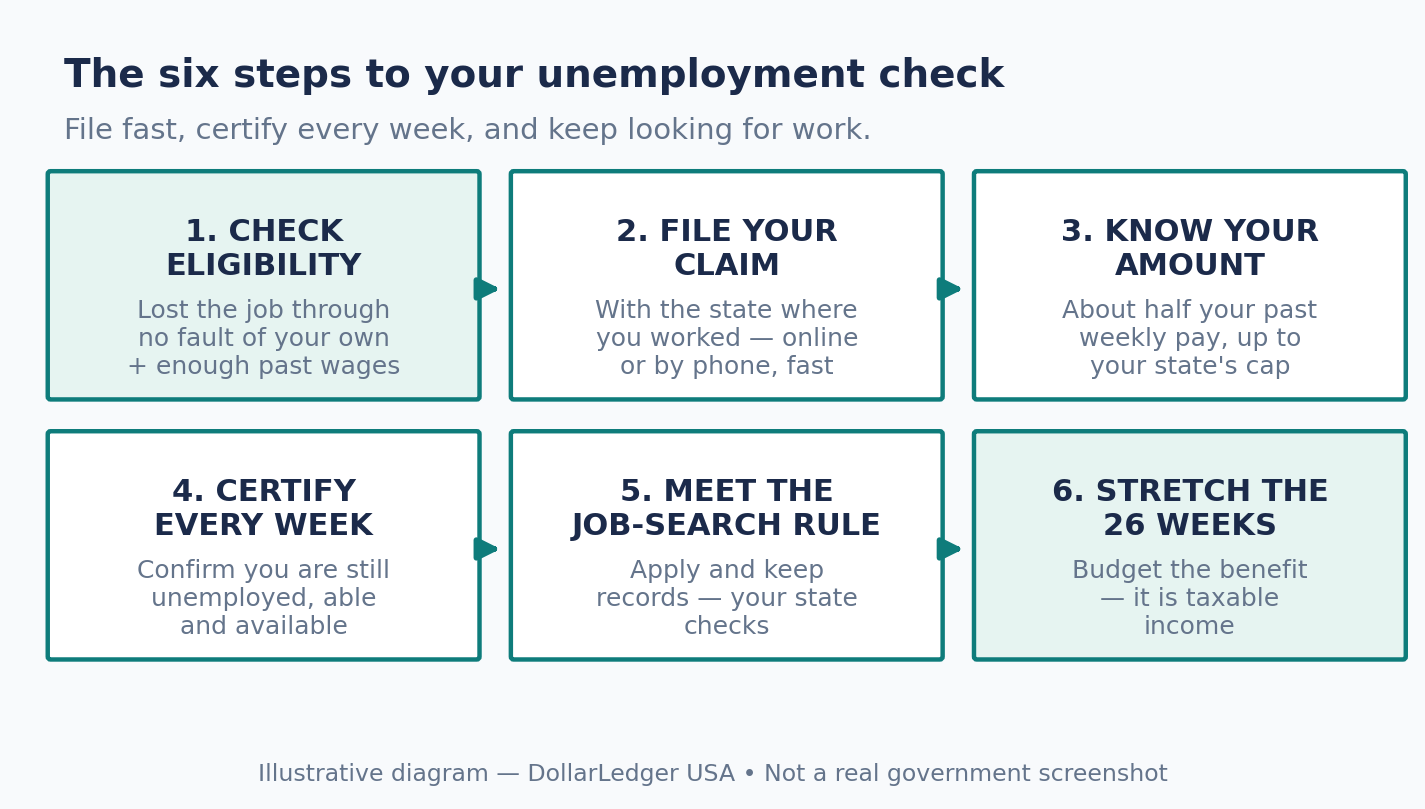
Illustrative diagram — The six steps to your unemployment check in 2026. NOT a real government screenshot.
Step 2: File your claim fast, with the state where you worked
What to do: File as soon as you lose work, with the agency in the state where you worked — online or by phone — and have your documents ready.
How: Find your state agency through the Labor Department’s CareerOneStop Unemployment Benefits Finder. You will usually need your Social Security number, employer details, and earnings history. File in the state where you worked, even if you now live elsewhere. Never pay anyone to file for you — no program charges a fee. It generally takes two to three weeks to receive your first check, the Labor Department reports, and most states have an unpaid waiting week first.
Example: James is laid off on a Friday and files online on Monday, pay stub in hand; his claim is approved in two weeks. His friend waits a month — and that month is gone for good.
Common mistake: Filing late — claims are rarely backdated, so every week you wait is a week you will never be paid for.
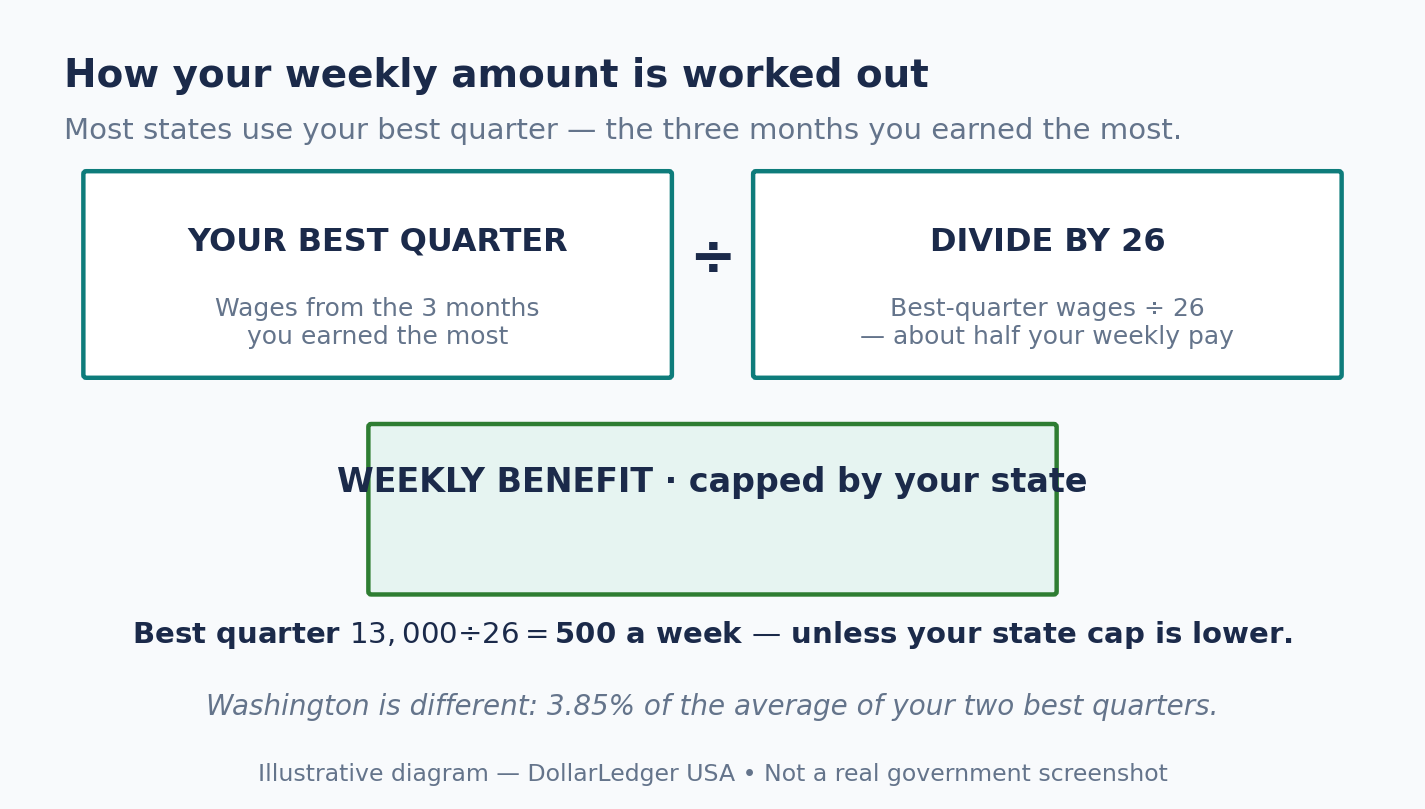
Illustrative diagram — How your weekly unemployment amount is worked out. NOT a real government screenshot.

Photo: Gather your pay stubs and employer details before you file — the form asks for them. (Photo: Pexels)
Step 3: Work out what you will get — the formula and the state caps
What to do: Estimate your benefit from your best quarter, then check your state’s maximum — the cap decides it for most higher earners.
How: Most states take your best quarter’s wages and divide by 26 — roughly half your past weekly pay. Washington is different: it pays 3.85% of the average of your two highest quarters. Whatever the formula gives, your state maximum caps it. Under state laws in effect in July 2026, maximums ran from $235 in Mississippi and $275 in Florida, to $450 in California, $869 in New York, $1,105 in Massachusetts — plus $25 per dependent — and $1,208 in Washington, the highest in the country. Washington’s maximum rose from $1,152 to $1,208 for claims opened on or after July 5, 2026; the minimum rose from $366 to $383. The maximum is a ceiling, not a promise — the average actually paid was $500.61 a week.
Example: Two workers each earned $1,000 a week. In California the formula gives about $500, but the $450 cap cuts it to $450; in Mississippi the same $500 is cut to $235.
Common mistake: Budgeting on the state maximum — the lower of your formula amount and your state’s cap is your benefit.
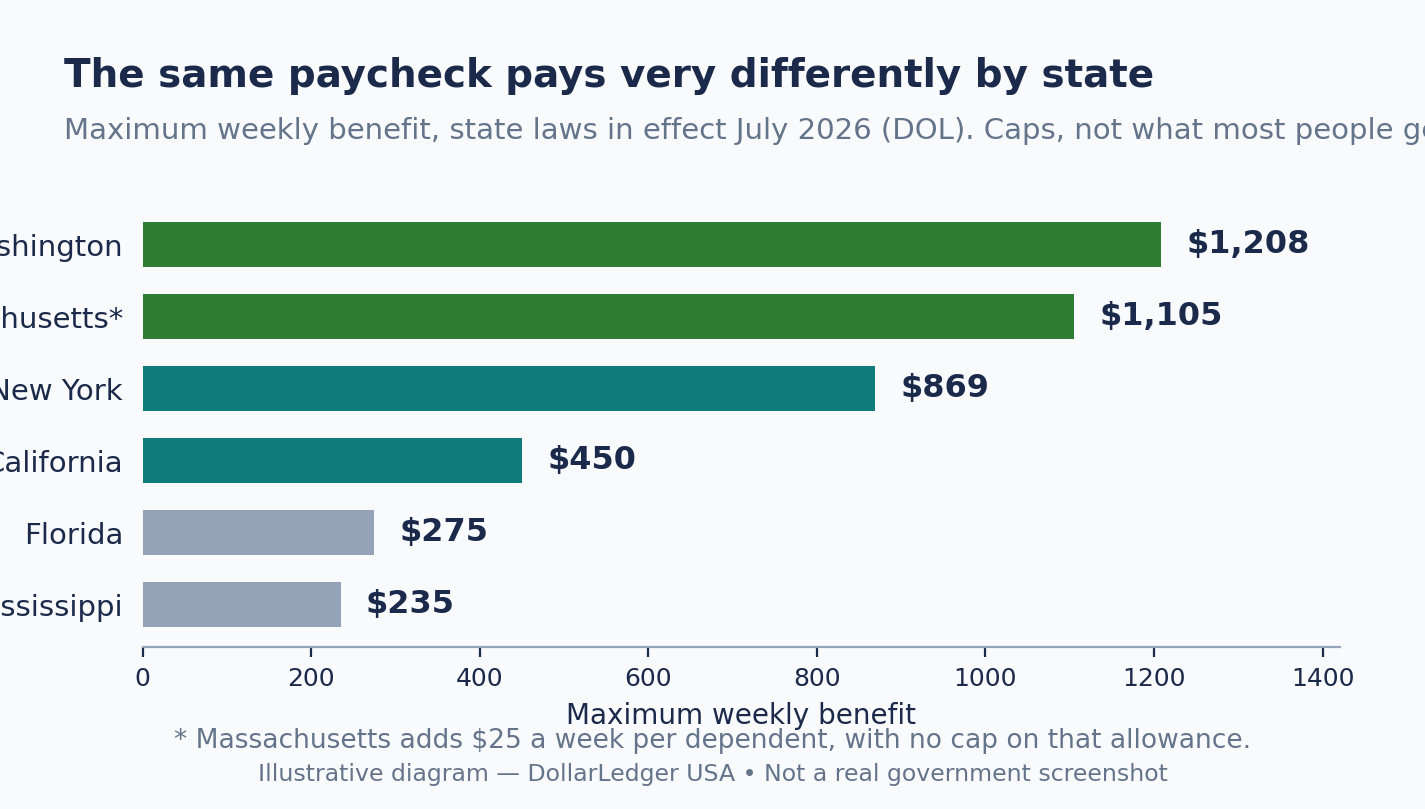
Illustrative diagram — Maximum weekly benefits under state laws in effect July 2026 (DOL). These are caps, not what most people receive. NOT a real government screenshot.
Step 4: Run the numbers — the $1,000-a-week worked example
What to do: Take your best quarter, divide by 26, apply your state’s cap, and multiply by the weeks you can collect — that is what the claim is worth.
How: Say you earned $1,000 a week. Your best quarter is 13 weeks at $1,000 — $13,000. Divide by 26 and you get $500 a week; over 26 weeks, about $13,000 in total. Now apply the cap: in New York, $500 is below the $869 maximum, so you receive the full $500. In Mississippi, the $235 cap cuts it to $235 — about $6,110 over 26 weeks. In Washington, the $1,208 cap does not bite.
Example: Priya earned $1,000 a week in Texas, where the formula gives about $500. She budgets on $500 a week for six months.
Common mistake: Treating 26 weeks of payments as guaranteed. You are only paid for weeks you certify.
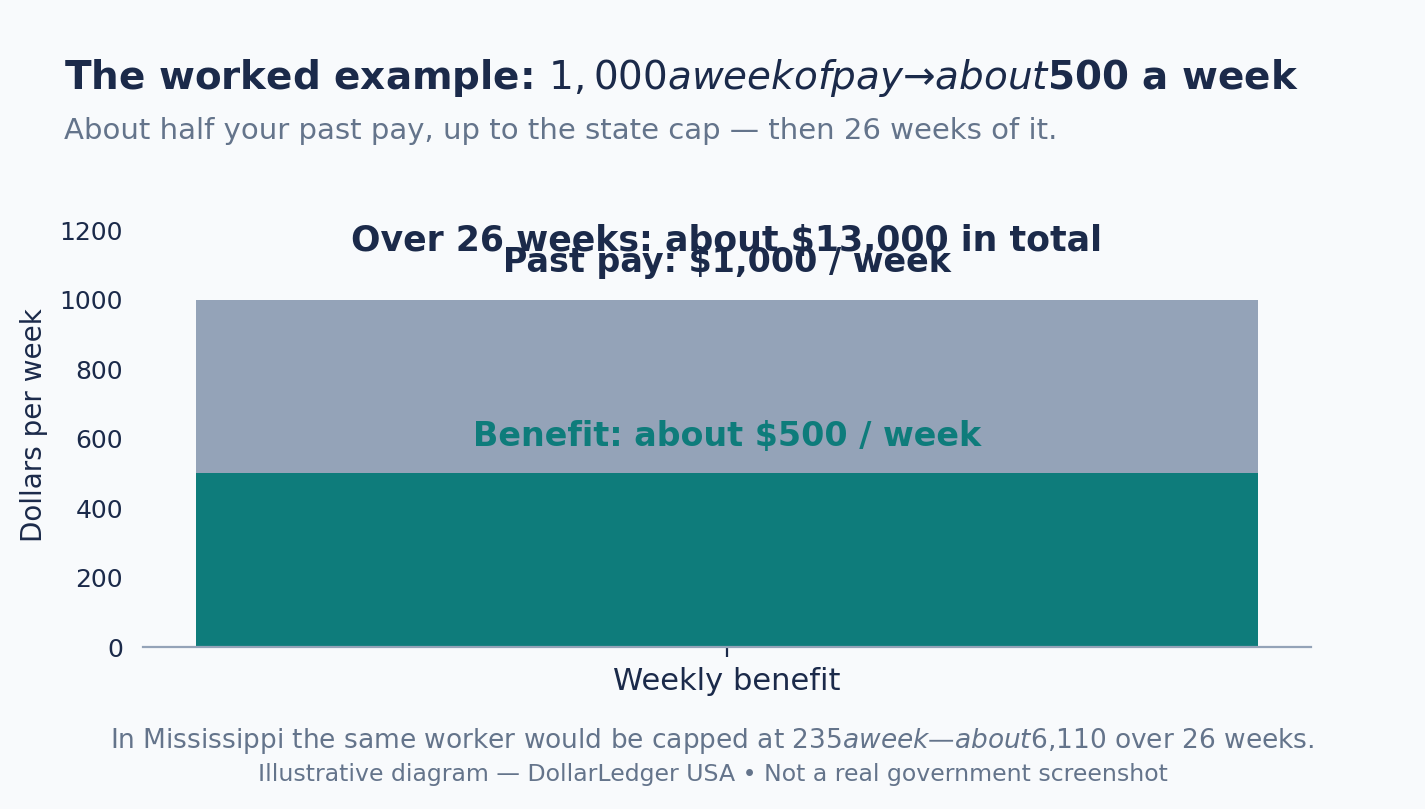
Illustrative diagram — The worked example: $1,000 a week of pay becomes about $500 a week of benefit. NOT a real government screenshot.

Photo: File your weekly certification on time — a missed week can stop your payment. (Photo: Pexels)
Step 5: Certify every week and prove you are looking for work
What to do: Certify every week you want to be paid, report earnings, and log every job you apply for.
How: Most states require you to certify each week — confirming you are still unemployed, able and available to work. Many states also require a set number of job-search activities per week, and they can ask for the records. Keep a log: date, employer, job title, and how you applied. If you pick up part-time work, report the earnings — most states reduce your benefit for that week, but unreported earnings are treated as fraud and can mean repayment and penalties. Some states also require you to register with the state job bank or your local American Job Center. Even if a payment is late, keep certifying.
Example: Alex certifies every Sunday and logs four applications a week. When his state asks for proof in week six, he has it ready.
Common mistake: Skipping a week because you were busy. A missed certification can stop your payment, and some states will not pay for the missed week.
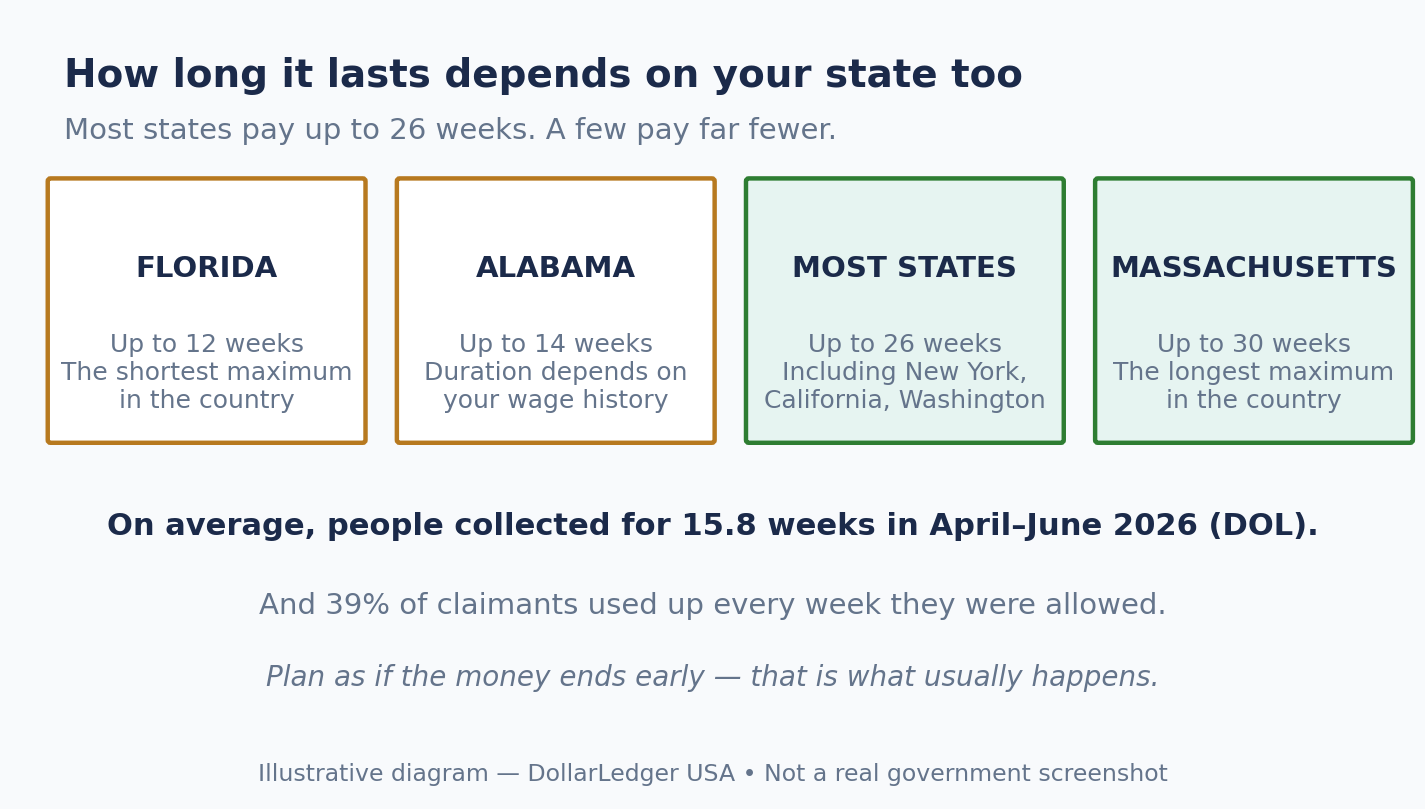
Illustrative diagram — Duration varies by state, and most people collect far fewer than the maximum weeks. NOT a real government screenshot.
Step 6: Plan for the end — weeks run out and the money is taxable
What to do: Budget as if the benefit ends early, set money aside for tax, and build an emergency fund.
How: Most states pay up to 26 weeks, but Florida pays as few as 12, Alabama up to 14, and Massachusetts up to 30. In practice, people collect far less: on average, claimants collected for 15.8 weeks in April to June 2026, and about 39% used up every week allowed. When benefits end, there is no automatic extension — the federal Extended Benefits program only switches on in high unemployment, and no state had triggered it as of September 2026. The money is also taxable: benefits must be reported as income on your federal return, and in most states on your state return too. You can ask your state to withhold federal tax — usually 10%.
Example: Sam’s benefit is $500 a week. He asks for 10% withholding, so $450 lands each week, and he plans on 16 weeks of payments — not 26.
Common mistake: Treating 26 weeks as guaranteed income. Plan for the average and keep the job search going from week one.
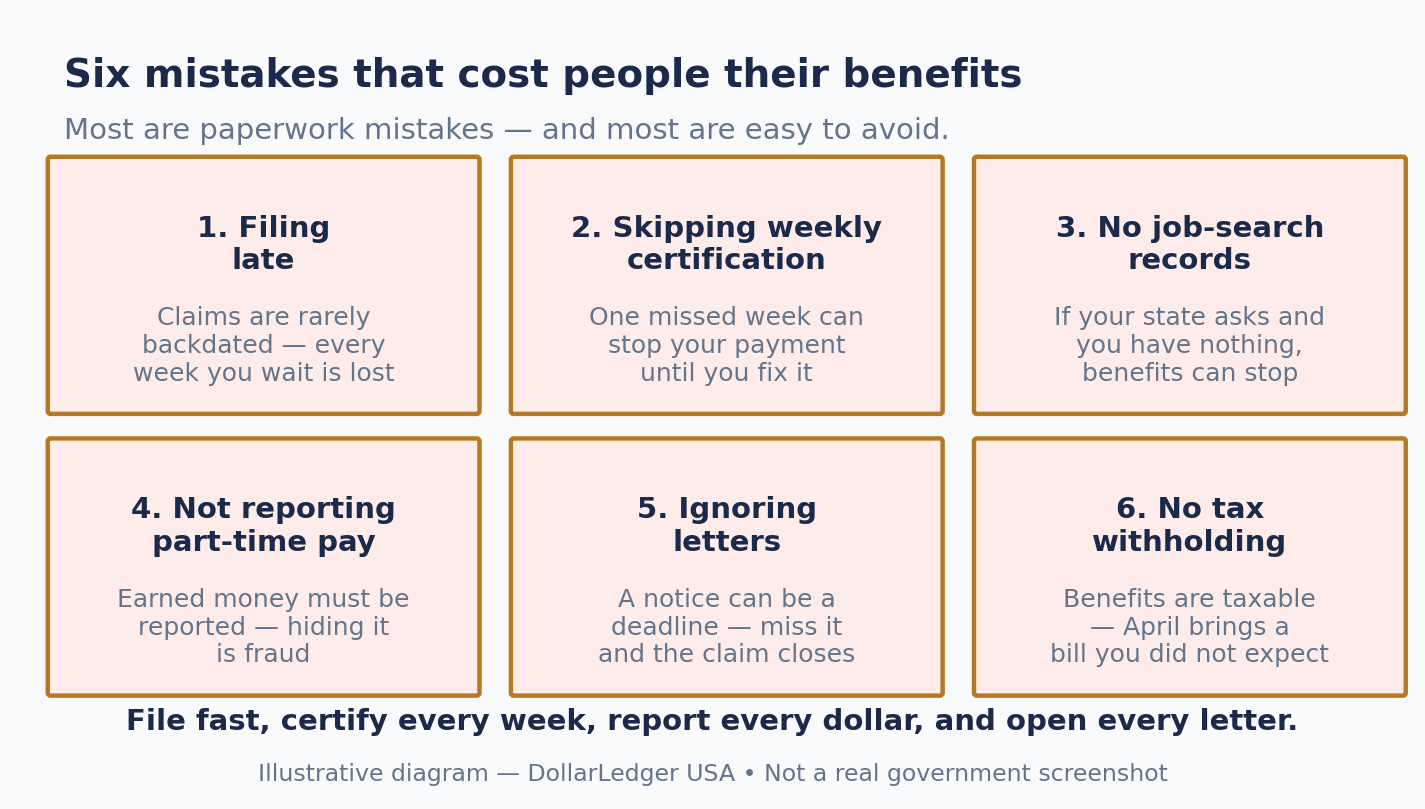
Illustrative diagram — Six mistakes that cost people their unemployment benefits. NOT a real government screenshot.
Checklist
☐ I filed with the state where I worked, as soon as I lost the job.
☐ I know my state’s formula and maximum.
☐ I worked out my weekly amount from my best quarter.
☐ I certify every week and log every job application.
☐ I report part-time earnings the week I earn them.
☐ I asked for tax withholding and planned for under 26 weeks.
FAQ
How much does unemployment pay in the USA in 2026? On average, $500.61 a week was paid in April to June 2026. Your amount depends on your past wages and your state: maximums run from $235 in Mississippi to $1,208 in Washington.
How is the weekly unemployment amount calculated? Most states divide your best quarter’s wages by 26 — roughly half your past weekly pay — then cap it at the state maximum. Washington uses 3.85% of the average of your two highest quarters.
How many weeks can you collect unemployment? Most states pay up to 26 weeks; Florida as few as 12, Alabama up to 14, Massachusetts up to 30. The average collected was 15.8 weeks.
How long until the first unemployment check? Generally two to three weeks after you file, the Labor Department reports — and most states have an unpaid waiting week first.
Is unemployment income taxable? Yes — report benefits as income on your federal return, and in most states on your state return too. You can ask for 10% federal tax withholding.
Sources
- U.S. Department of Labor, Significant Provisions of State UI Laws (effective July 2026)
- CareerOneStop (U.S. Department of Labor), Unemployment Benefits Help Page
- DollarLedger USA, “How to Build an Emergency Fund on a $40,000 Salary”
All figures checked November 8, 2026, against the U.S. Department of Labor.
Disclaimer: For education only, not benefits or tax advice. Amounts and rules vary by state — confirm current figures with your state agency.