How to Check Your Credit Score for Free in 2026 — Score vs Report
 DollarLedger Team
- 14 Nov, 2026

Most people check the wrong thing. They pull their free credit report, look for a number, and find none — because the report is not the score. The report is the full record: every account, every balance, every late payment. The score is a three-digit number calculated from that record, usually 300 to 850. And there is not one score — there are many, made by different companies. The good news: you can get a real score free, in about five minutes, and checking it never hurts it. All figures were checked on November 13, 2026.
Caption: Photo: The report is the record, the score is the number — and both are free to check. (Photo: Pexels)
What You Will Learn
- Report vs score — why the free report has no number
- Three free ways to get a real FICO Score
- FICO vs VantageScore — why they differ, and which one lenders use
- Why you need all three bureaus, not just one
- How to fix the report behind the score
- The two moves that raise your score fastest
Step 1: Know the difference — report vs score
What to do: Learn which document you are looking at before you chase a number.
How: Your credit report is the raw file: every card, loan, balance, payment and inquiry, kept separately by Equifax, Experian and TransUnion. Each bureau’s report is free every week at AnnualCreditReport.com — the only website the FTC authorises — or by calling 1-877-322-8228. But the report contains no score: the CFPB is clear the free reports do not include one. The score is a three-digit number, usually 300 to 850, calculated from the data in the report. And there is more than one: FICO and VantageScore use different formulas, and each bureau’s file can differ.
Example: Your Equifax report shows a $1,800 balance and one late payment; your score turns that into a number — 672, say.
Common mistake: Paying for your “free report” — it is free only at AnnualCreditReport.com.
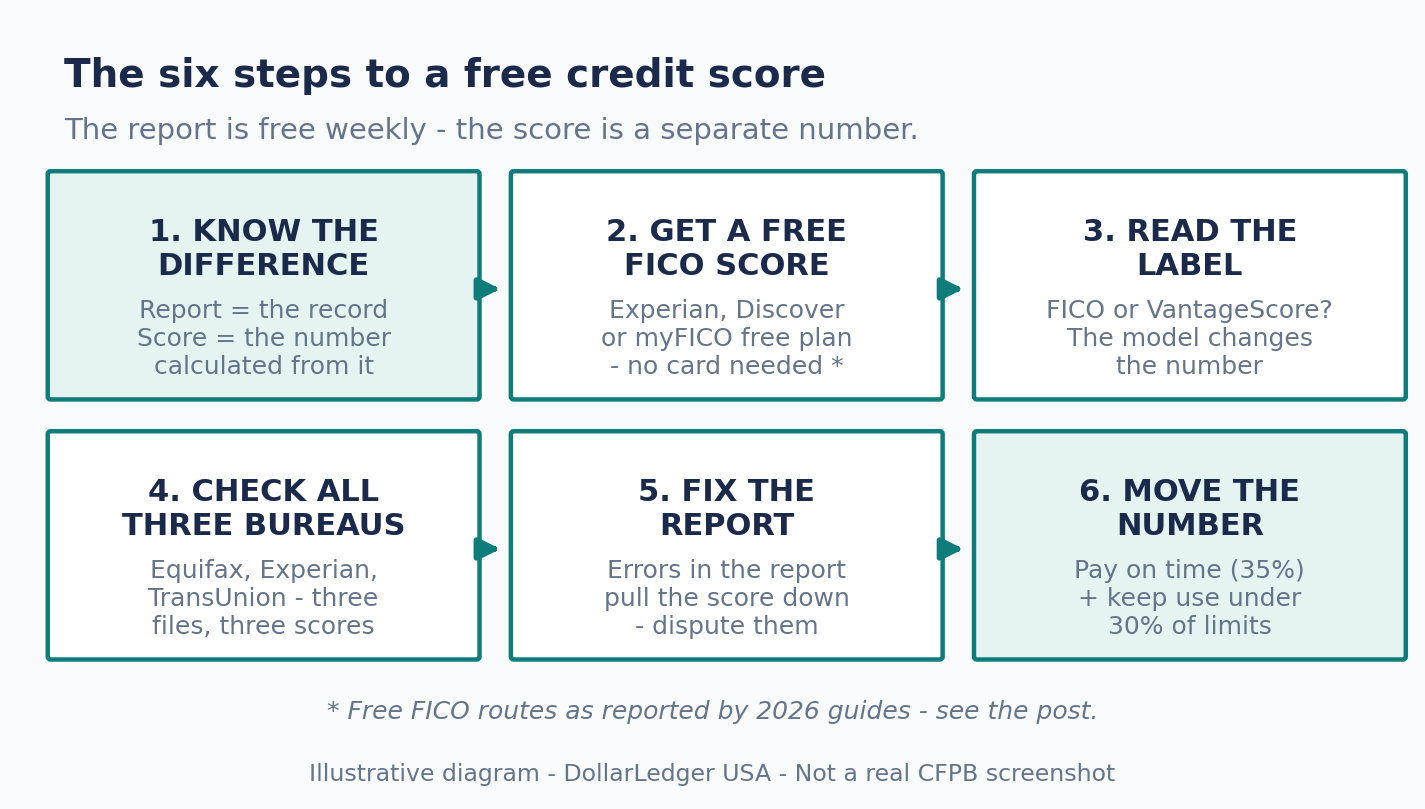
Caption: Illustrative diagram - The six steps to a free credit score. NOT a real CFPB screenshot.
Step 2: Get a real FICO Score for free
What to do: Get the score most lenders use — free, without paying and without a card.
How: The CFPB says many card companies and lenders give customers a free score, as do nonprofit credit and housing counsellors. Start with your own bank or card issuer — many show a free score in the app or on your statement. If yours does not, use a free route (reported): an Experian free account, Discover Credit Scorecard (no Discover card needed) and myFICO’s free plan each give a free FICO Score 8. None asks for a credit card. If a site wants your card number first, close it — that is a lookalike.
Example: Maya opens a free Experian account and sees a FICO Score 8 of 721.
Common mistake: A “free trial” that becomes a monthly fee — the CFPB warns a trial may last only a set period, then you must cancel or pay.
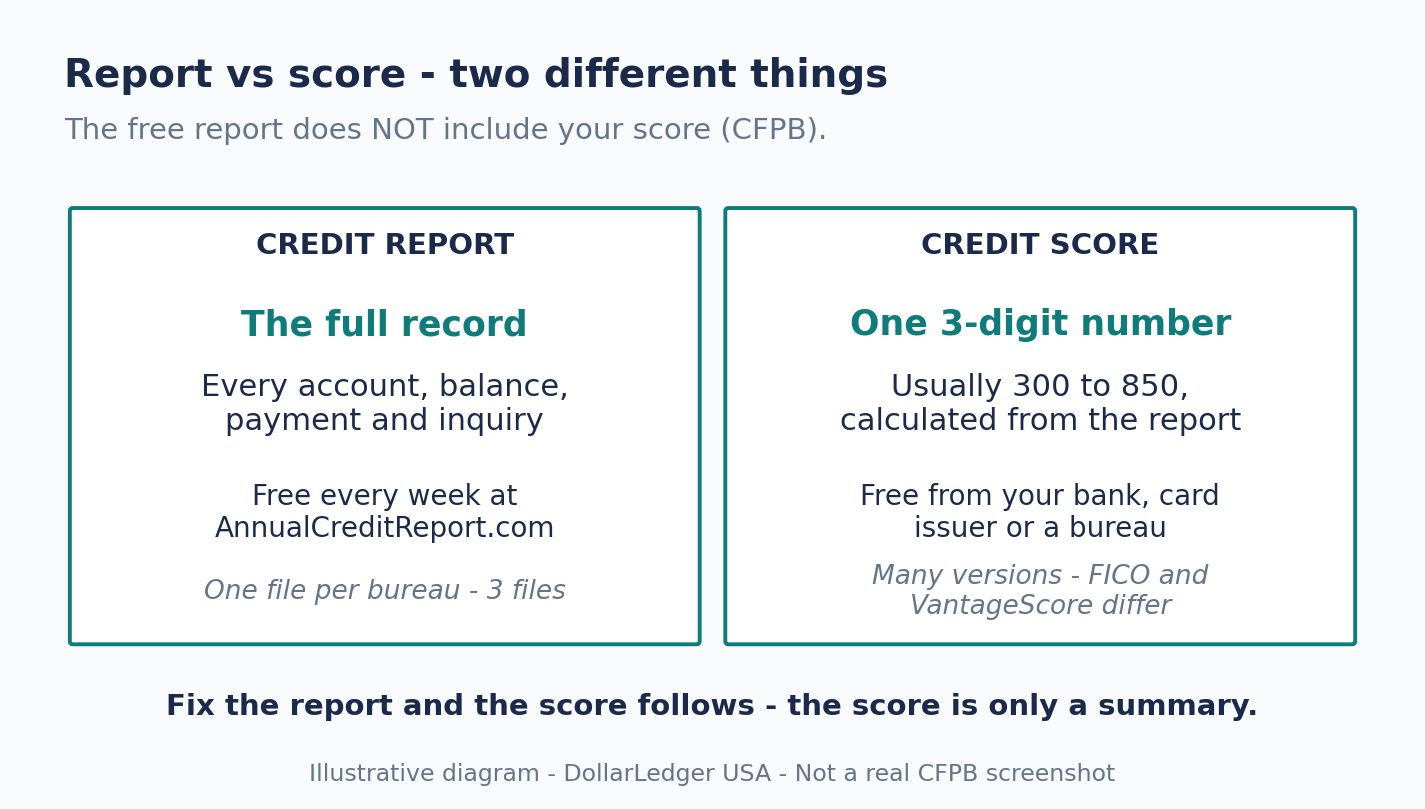
Caption: Illustrative diagram - Report vs score: two different things. NOT a real CFPB screenshot.

Caption: Photo: Start with the app you already have — your bank or card issuer may show a free score. (Photo: Pexels)
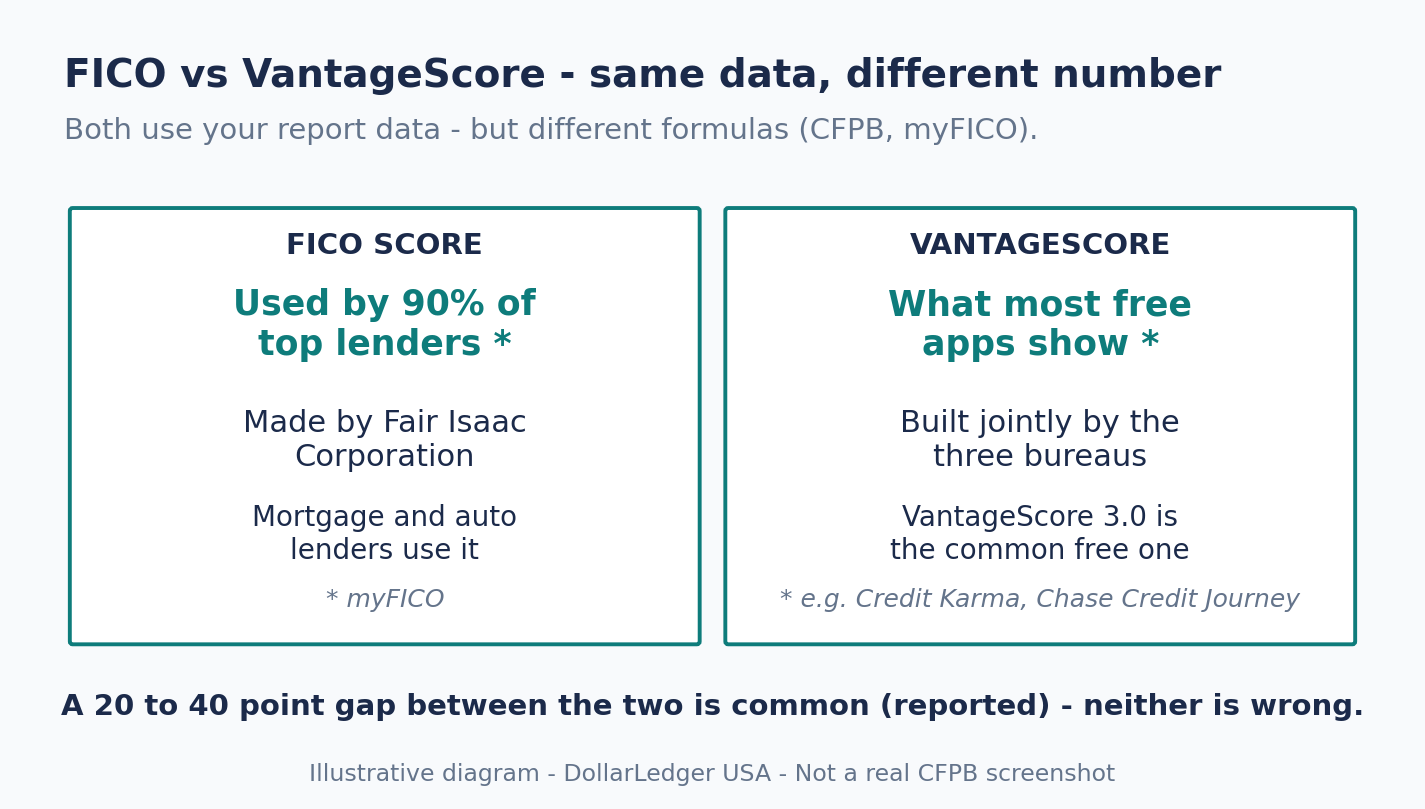
Caption: Illustrative diagram - FICO vs VantageScore: same data, different number. NOT a real myFICO screenshot.
Step 3: Read the label — FICO or VantageScore?
What to do: Read the model name on your score before you compare it with anything.
How: FICO is made by the Fair Isaac Corporation and used by 90% of top lenders (myFICO). Mortgage and auto lenders check it first. VantageScore was built jointly by the three bureaus, and VantageScore 3.0 powers most free apps (reported). Both read the same report data on a 300 to 850 scale, but they weigh the factors differently, so the numbers differ. A gap of 20 to 40 points between the two is common (reported) — the formulas disagree. FICO’s bands: below 580 Poor, 580 to 669 Fair, 670 to 739 Good, 740 to 799 Very Good, 800+ Exceptional.
Example: Credit Karma shows 745 while Discover shows a FICO Score 8 of 712. Both are honest numbers from the same file — different models, different answers.
Common mistake: Celebrating a 745 VantageScore, then being surprised when the lender’s FICO number comes in lower.
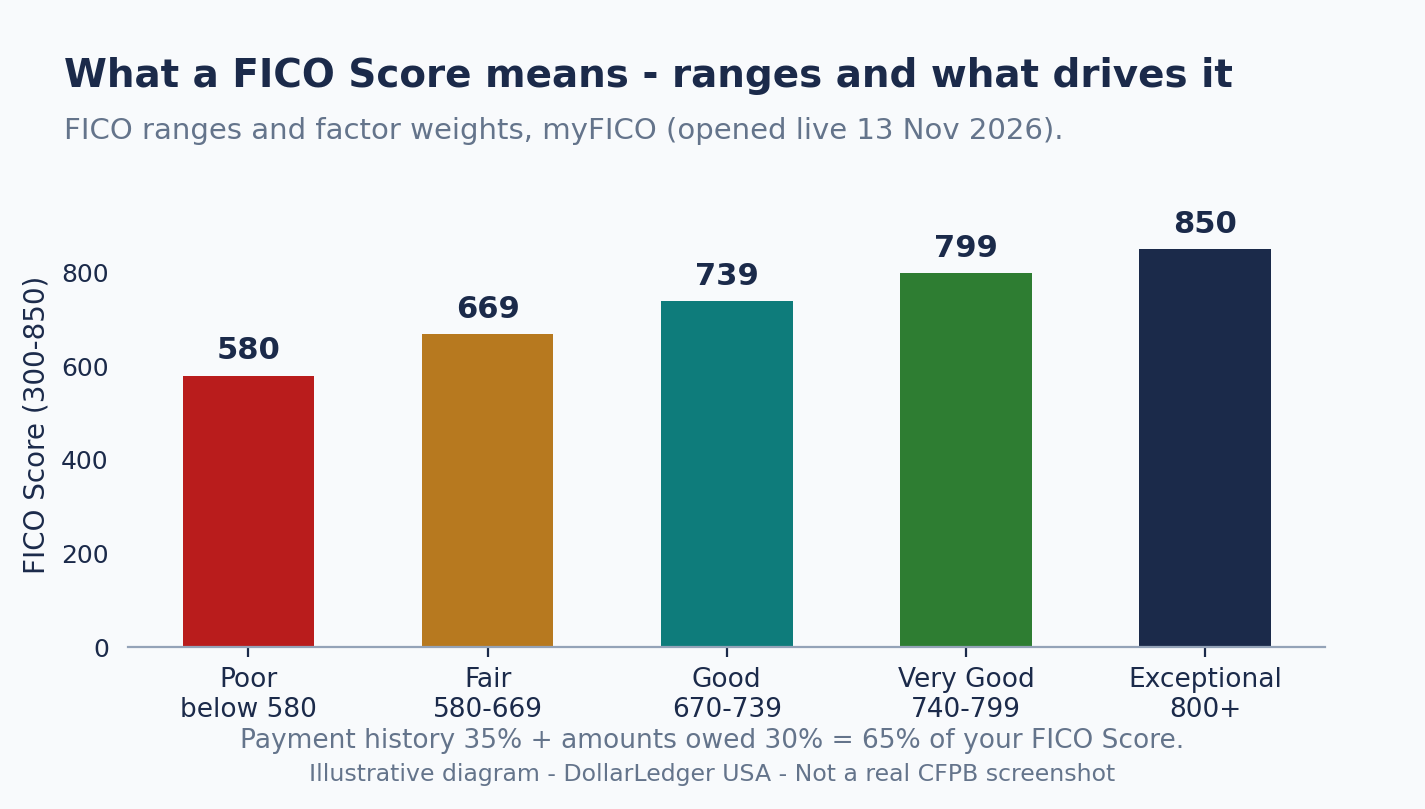
Caption: Illustrative diagram - FICO ranges and what drives the score. NOT a real myFICO screenshot.
Step 4: Check all three bureaus
What to do: Cover all three bureaus — one score is not the whole picture.
How: The three bureaus keep separate files that do not always match: an account can appear on one file and be missing from another. A lender can pull any bureau’s file. Pair your sources: Credit Karma gives VantageScore 3.0 from Equifax and TransUnion (reported), and a free Experian account gives a FICO Score 8 (reported) — together they cover all three files. Mortgage lenders often use older FICO versions — FICO 5, 4 and 2 (reported).
Example: A store card appears on your Experian file but not on Equifax — same you, different files.
Common mistake: Checking one bureau once and assuming the other two files say the same thing.

Caption: Photo: One bureau’s file is not the whole picture — check all three before you apply. (Photo: Pexels)
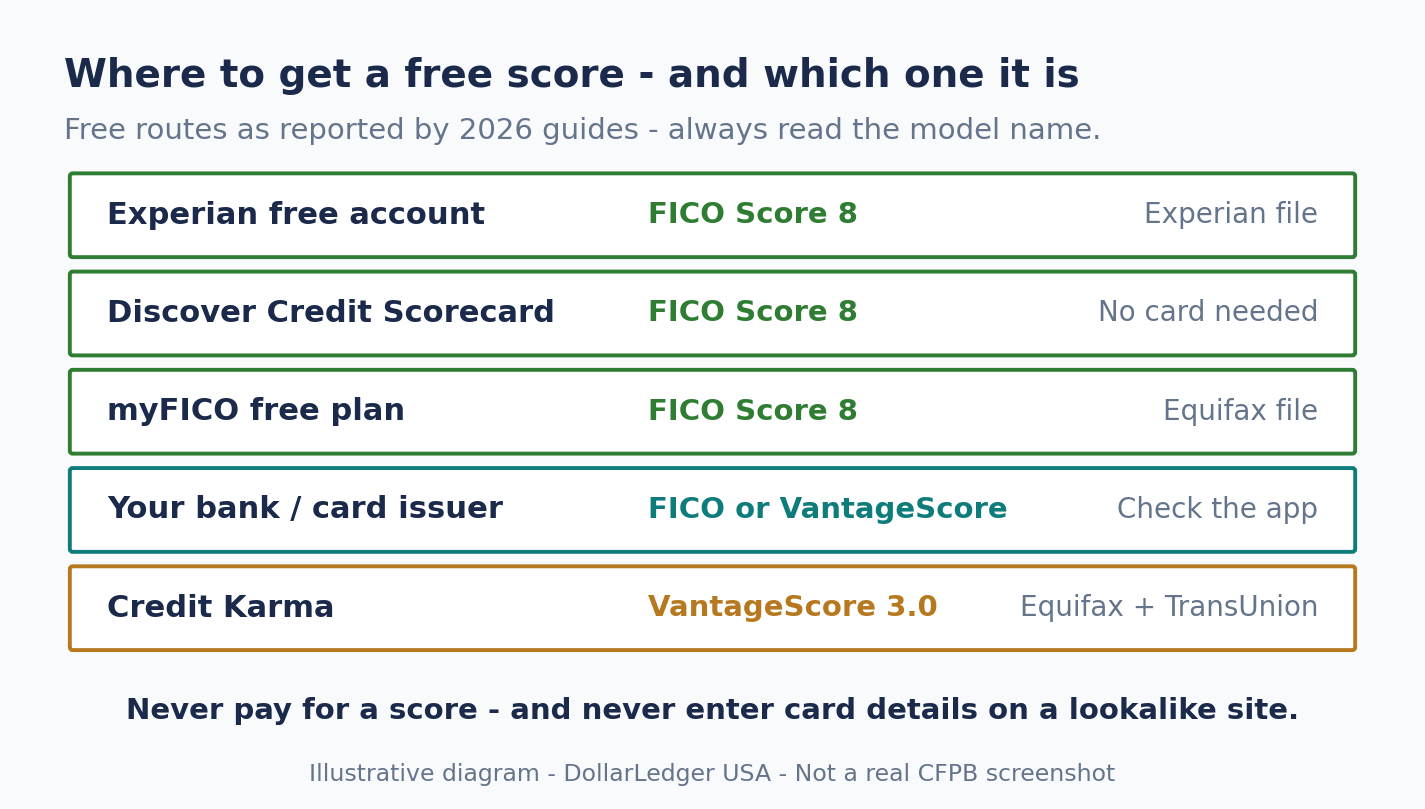
Caption: Illustrative diagram - Where to get a free score, and which one it is. NOT a real CFPB screenshot.
Step 5: Read the report behind the score — and dispute anything wrong
What to do: Fix the data, and the score follows.
How: The CFPB says report mistakes could hurt your credit history and your score, so check regularly. Pull all three reports free every week at AnnualCreditReport.com and look for accounts that are not yours, wrong late payments and wrong balances. If you find an error, dispute it with the credit bureau and the company that reported it. For the full report walkthrough, see our guide to checking your credit report for free in 2026. The score is calculated from the report, so fixing the data is the only way to fix the number.
Example: A $400 collection account that is not yours sits on your TransUnion file — dispute it, and the score can recover.
Common mistake: Trying to dispute the score itself — it is only a calculation. Dispute the wrong item in the report, and the score follows.
Step 6: Move the number — on-time payments and low utilisation
What to do: Use the two levers that matter most.
How: MyFICO puts payment history at 35% of a FICO Score and amounts owed at 30% — together 65% of the number. The CFPB agrees: paying on time has the greatest impact, so set up autopay for at least the minimum. Then keep balances low: the CFPB advises keeping use under 30% of your limit. Our guide to improving your credit score fast in 2026 shows the faster route: pay before the statement closing date — the statement balance is what the bureaus see — and aim for under 10%. Checking your own score or report is a soft inquiry and never lowers it (CFPB).
Example: One card, $1,000 limit, $450 balance — 45% utilisation. Pay $200 before the statement closes and the balance drops to $250, or 25%.
Common mistake: Paying in full on the due date while the statement still shows a high balance, or closing an old card.
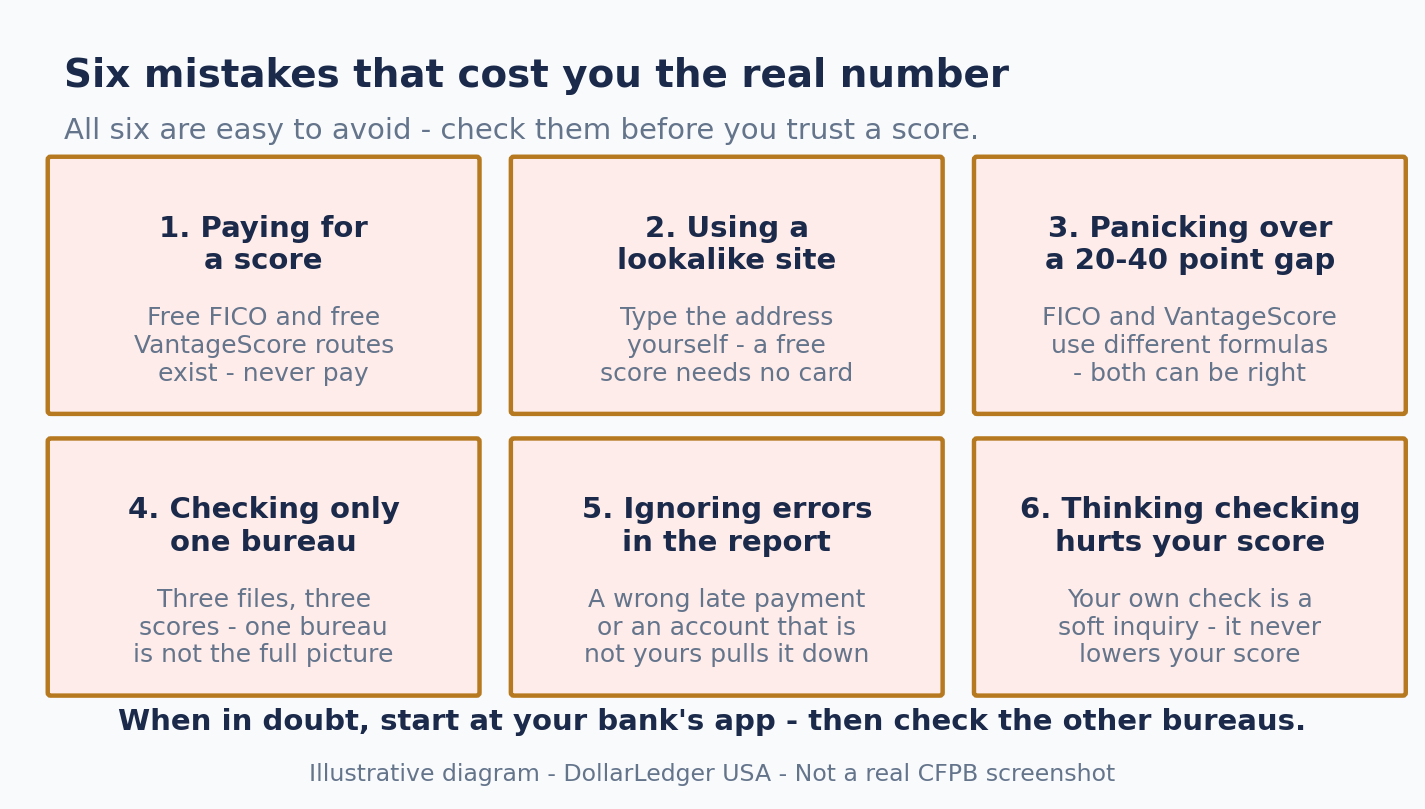
Caption: Illustrative diagram - Six mistakes that cost you the real number. NOT a real CFPB screenshot.
Checklist
- Report pulled free at AnnualCreditReport.com — all three bureaus.
- Free FICO Score 8 in hand.
- Model name noted — FICO or VantageScore.
- All three bureau files checked, not just one.
- Report errors disputed with the bureau and the furnisher.
- Autopay on for at least the minimum, every account.
- Utilisation under 30% — under 10% if you can.
FAQ
Is checking my credit score really free?
Yes. Your report is free every week at AnnualCreditReport.com, and a score is free from your bank or a bureau’s free tier. A legitimate free score never asks for a card number — if it does, you are on a lookalike site.
Does checking my own score lower it?
No. Checking your own score or report is a soft inquiry: only you can see it, and it never lowers your score. Only a hard inquiry — when you apply for new credit — can move it.
Why is my Credit Karma score different from my FICO score?
Because they are different models reading the same file. Credit Karma shows VantageScore 3.0; most lenders use a FICO Score. A gap of 20 to 40 points is common (reported).
Which score will a mortgage lender use?
A FICO Score — often an older version, FICO 5, 4 or 2 (reported), not the FICO Score 8 you see for free. If a mortgage is in your plans, watch your FICO Score; the free FICO Score 8 is the closest free guide to it.
What is a good credit score in 2026?
On the FICO scale, 670 to 739 is Good, 740 to 799 Very Good, 800 and above Exceptional (myFICO). Below 580 is Poor, 580 to 669 Fair.
Sources
- Consumer Financial Protection Bureau, Where can I get my credit scores? (opened live November 13, 2026): https://www.consumerfinance.gov/ask-cfpb/where-can-i-get-my-credit-scores-en-316/
- myFICO, What is a FICO Score and why is it important? (opened live November 13, 2026): https://www.myfico.com/credit-education/what-is-a-fico-score
- Consumer Financial Protection Bureau, Understand your credit score (opened live November 13, 2026): https://www.consumerfinance.gov/consumer-tools/credit-reports-and-scores/understand-your-credit-score/
All figures checked November 13, 2026, against the CFPB, myFICO and the FTC.
Disclaimer: For education only, not financial, tax or investment advice. Credit rules and scoring models change — confirm the current figures on consumerfinance.gov before you decide.