Best First Credit Card in USA 2026 — No Credit History
 DollarLedger Team
- 04 Nov, 2026
No credit history? No card. No card? No history. That is the trap every first-time cardholder in the USA runs into. The best first credit cards in 2026 are built for exactly this: secured, student and no-deposit starter cards that report to the bureaus from month one. This guide compares the best options, checked November 3, 2026.
Photo: Your first card builds credit. (Photo: Pexels)
What You Will Learn
- What “no credit history” means
- The three kinds of first card
- The best first cards in 2026
- How on-time payments and low utilization build your score
- What to avoid: fees and closing your card early
Step 1: Understand what “no credit history” means
What to do: Find out where you stand before you apply.
How: Having no credit history means the three credit bureaus — Equifax, Experian and TransUnion — have no file on you. You are “credit invisible”, which is not bad credit: nobody has reported you missing payments. A FICO score generally needs one account open for six months — most people get their first score then, if the card reports to the bureaus.
Example: Priya, 22, has a job but never had a loan or a card. One secured card gives her a score in six months.
Common mistake: Applying for five regular cards only adds hard inquiries.
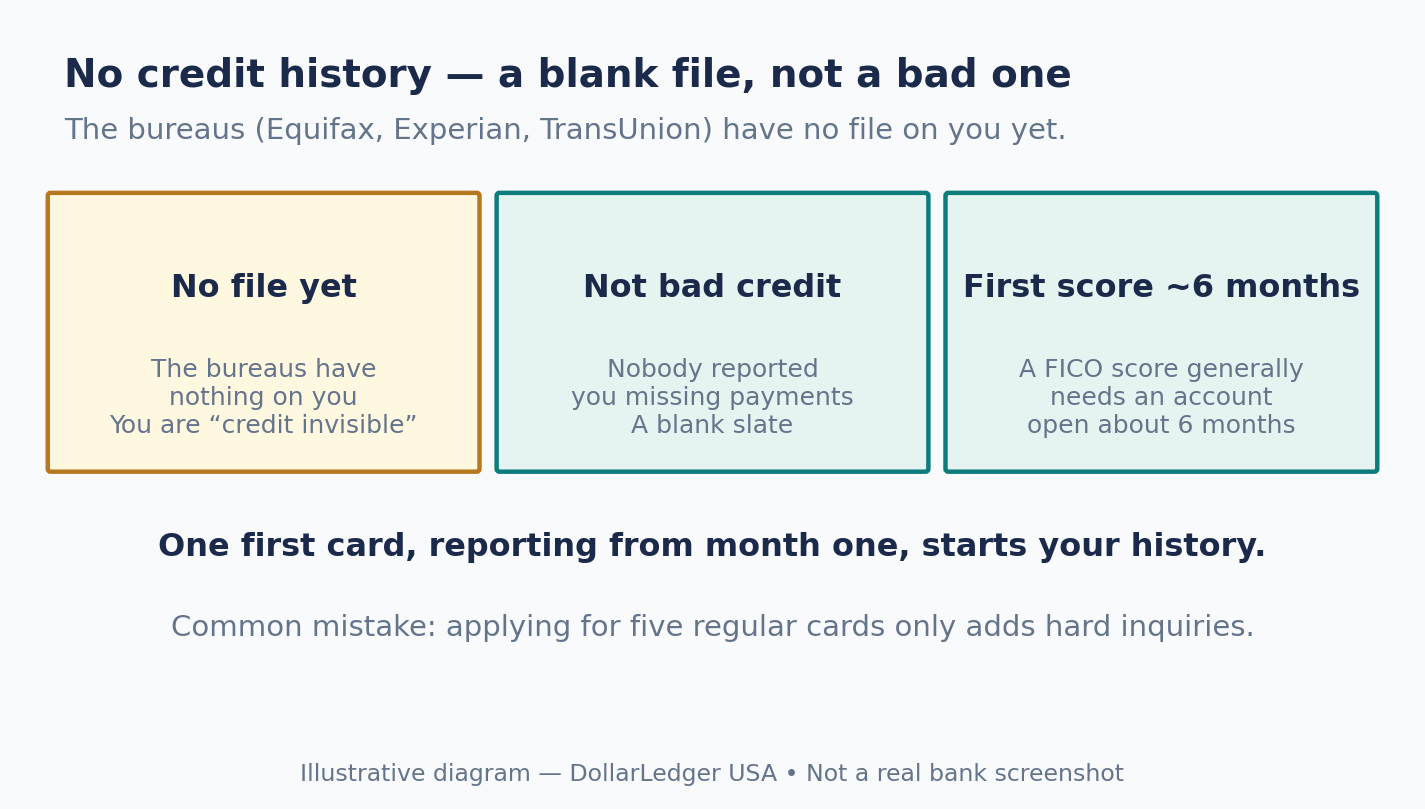
Illustrative diagram — no history is not bad credit. NOT a real bank screenshot.
Step 2: Pick your card type — secured, student or starter
What to do: Match the card type to your situation.
How: A secured card asks for a refundable deposit, usually $200, which becomes your credit limit — the easiest card to get with no history, and you get the deposit back when you graduate or close the account in good standing. A student card is for college students: no deposit, but you typically need your own income. A no-deposit starter card starts with a small limit and a high APR — pay in full every month. Check first: does it report to all three bureaus?
Example: Rohan, a student with a part-time job, fits a student card. Arjun, 26 and working full-time, fits a secured card.
Common mistake: Picking a card for its welcome bonus instead of its fees.
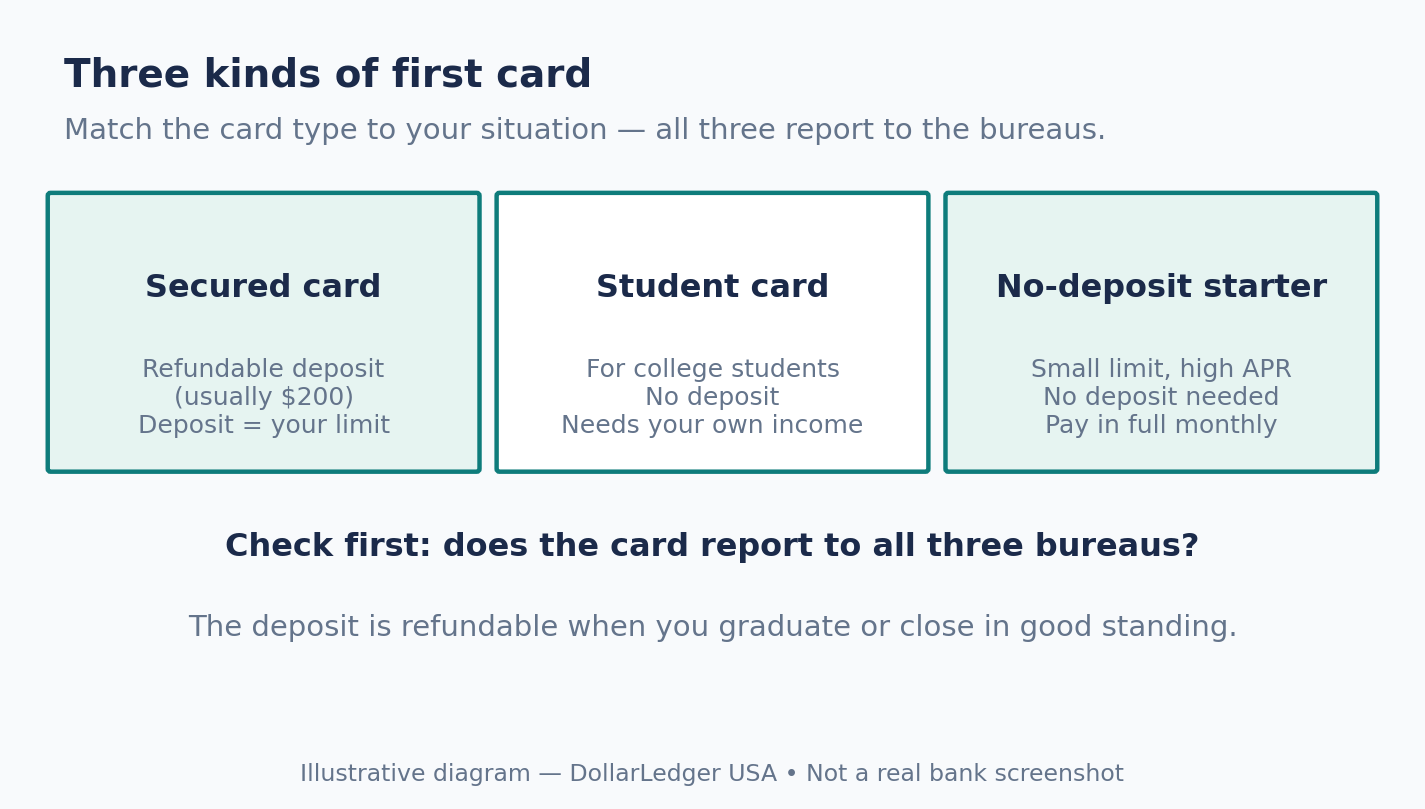
Illustrative diagram — Three kinds of first card. NOT a real bank screenshot.

Photo: The deposit is refundable — not a fee. (Photo: Pexels)
Step 3: Compare the best first cards in 2026
What to do: Compare the three best beginner cards, then pick one.
How: Terms checked November 3, 2026 — confirm with the issuer first. Discover it® Secured Cash Back is the strongest secured option: a refundable deposit as low as $49, $99 or $200 for a credit line of at least $200; 5% cash back in rotating quarterly categories (up to $1,500 per quarter, activation required), 1% on everything else, with first-year Cashback Match; $0 annual fee; and it reports to all three bureaus. Discover reviews accounts periodically for an upgrade, with your deposit returned — no set date promised. Chase Freedom Rise® is the best no-deposit starter: no deposit, $0 annual fee, 1.5% cash back on all purchases — no credit profile needed. For students, the Capital One Savor Student card earns unlimited 3% cash back on groceries, dining, entertainment and streaming — $0 annual fee, no deposit.
Example: If you can spare a refundable deposit, Discover pays you while you build credit. If not, Chase Freedom Rise needs no deposit.
Common mistake: Paying a fee for a “credit builder” card when $0-fee options exist.
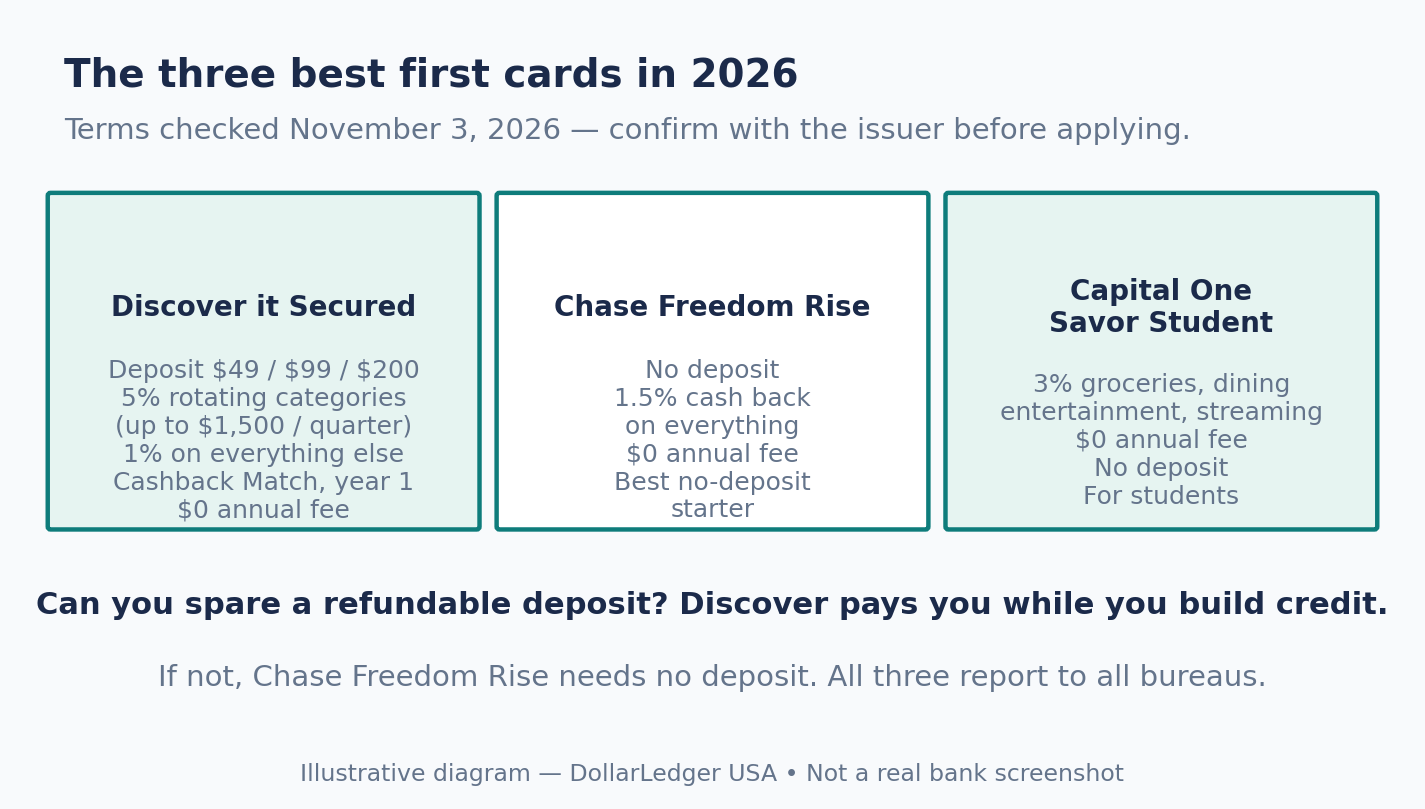
Illustrative diagram — The three best first cards, compared. NOT a real bank screenshot.
Step 4: Use the card the right way — on time, and under 30%
What to do: Make two habits automatic: pay on time, and keep your balance low.
How: Repayment history is the number one factor in most credit scores, says the CFPB — so pay on time every time, and set up autopay for at least the minimum. The second habit is utilization — how much of your limit you use. Keep it under 30%. You need no balance to build credit — paying in full gives the best scores and lowest interest. Bureaus see the balance on your statement closing date, not the due date — so pay most of it off before the statement closes. Payment history is ~35% of a FICO score, utilization ~30%.
Example: Arjun’s $200-limit card: he spends $60, pays $50 before the statement closes, and the bureaus see $10 — 5% utilization.
Common mistake: Maxing out a small limit because you pay in full. The bureaus saw it first.
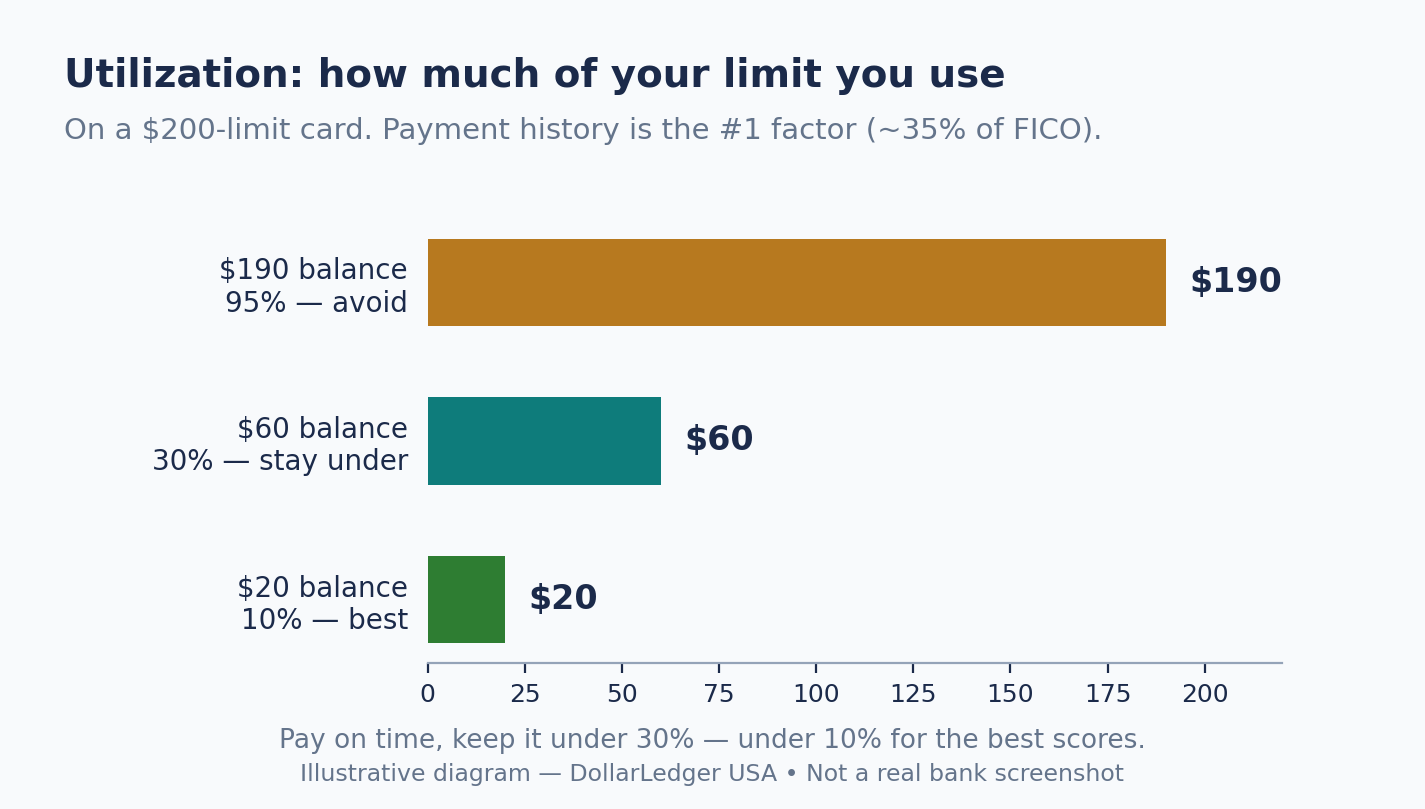
Illustrative diagram — $20 is 10%, $190 is 95%. NOT a real bank screenshot.
Step 5: Build your score month by month for six months
What to do: Follow a simple six-month routine.
How: Month 1: use the card for one small purchase and set up autopay for the full statement balance. Months 2–3: keep spending under 30% of your limit, ideally under 10%, and pay before the statement closing date. Month 4: check your credit reports free at AnnualCreditReport.com. Month 6: your first FICO score should appear. Saving too? Park it in a high-yield savings account — see our best high-yield savings accounts in the USA — and budget with the 50/30/20 budget on a low income.
Example: Priya spends $40 a month on her $200-limit card, paid off before the statement closes. At month six she has a score.
Common mistake: Opening three starter cards at once. One card, used well, is better.

Photo: One card, used well for six months, is enough to start. (Photo: Pexels)
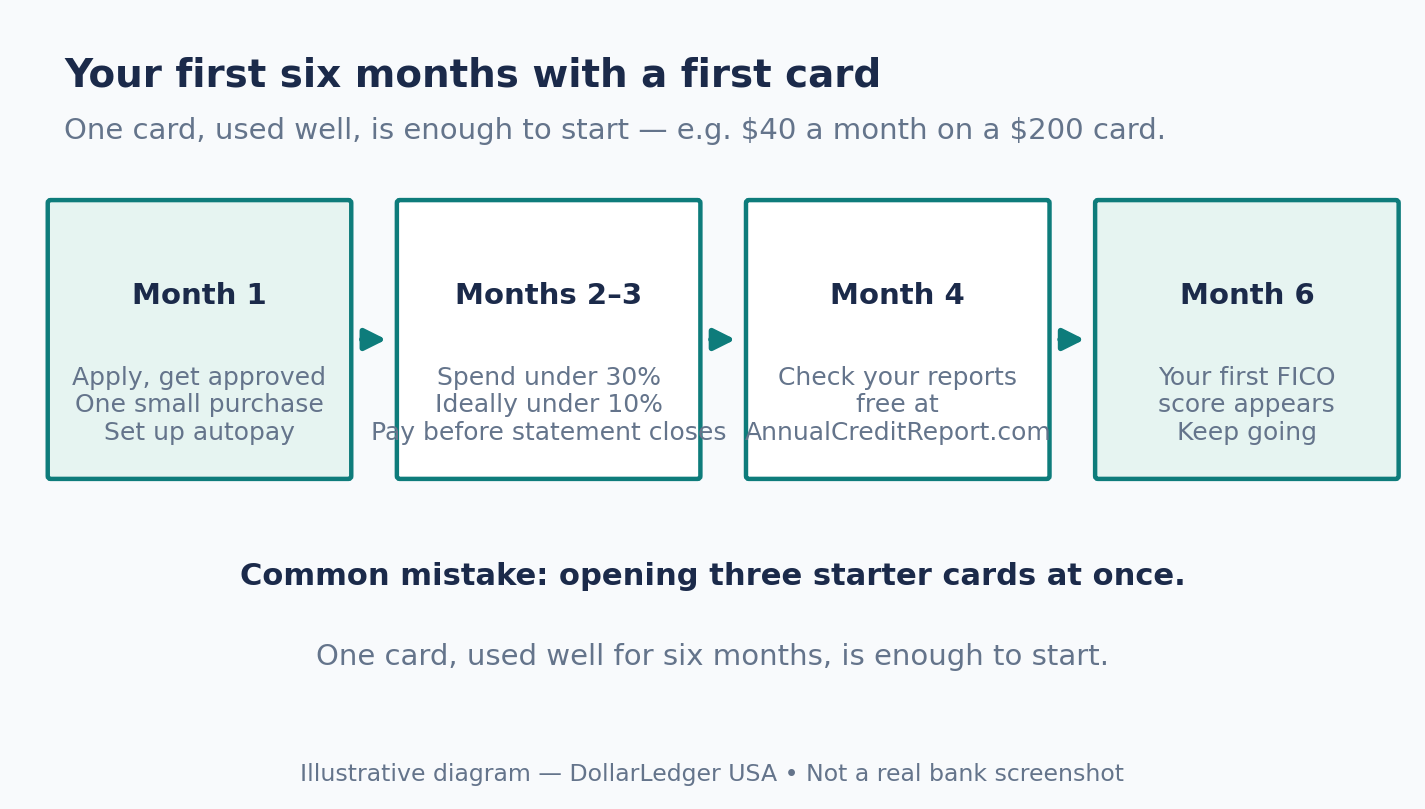
Illustrative diagram — Your first six months with a first card. NOT a real bank screenshot.
Step 6: Graduate, upgrade — and what never to do
What to do: Move up without throwing away the history you built.
How: After six to twelve months of on-time payments and low balances, ask whether your secured card can graduate — upgrading the same account keeps its history on your report, and your deposit is refunded. If not, keep it open and apply for one better card. Never do these three things: close your first card in its first year — you lose its history and your available credit shrinks; pay an annual fee for a card you have outgrown — ask to switch it to a no-fee card; or carry a balance to “prove” yourself — the CFPB is clear you need no outstanding debt for a good score.
Example: After eight months, Arjun’s Discover card graduates and his deposit comes back — same account, same history.
Common mistake: Closing your first card the day you get a better one.
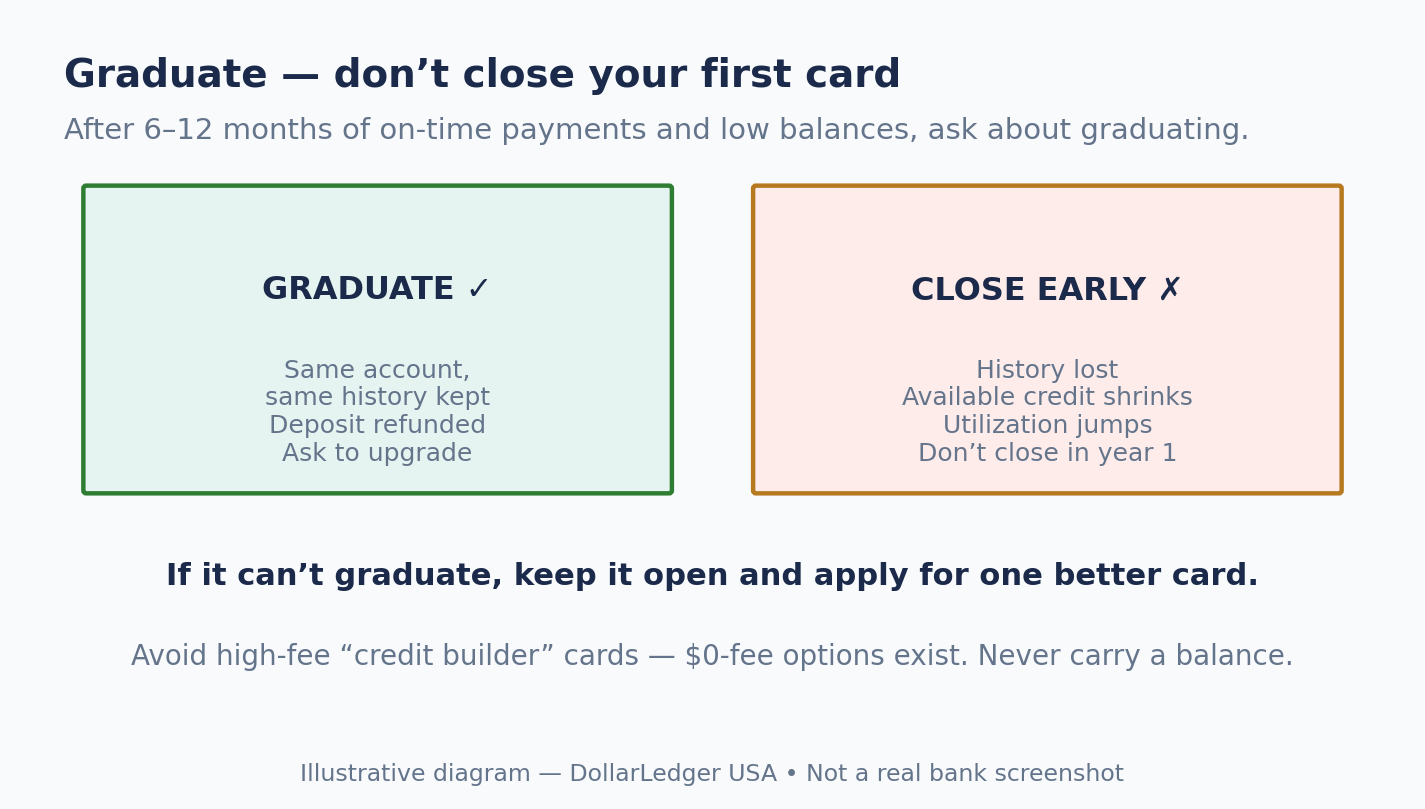
Illustrative diagram — Graduate, don’t close: keep your first card’s history. NOT a real bank screenshot.
Checklist
- ☐ I know my type: secured, student or starter.
- ☐ I picked a $0-fee card reporting to all three bureaus.
- ☐ I set up autopay for the minimum payment.
- ☐ I keep spending under 30%.
- ☐ I pay before the statement closing date.
- ☐ I checked my credit reports.
- ☐ I will not close my first card in its first year.
FAQ
Can I get a credit card with no credit history at all? Yes. Secured, student and no-deposit starter cards are made for this — Discover it Secured and Chase Freedom Rise both accept people with no credit profile.
How much deposit does a secured card need? It depends on the card. Discover it Secured asks for a refundable $49, $99 or $200 for a credit line of at least $200. You get it back on graduation or closure in good standing.
How long does it take to get a credit score? About six months. A FICO score generally needs an account open for six months — if the card reports to the bureaus and you pay on time.
Does a secured card build credit as fast as a regular card? Yes, if it reports to all three bureaus — on-time payments count the same on any card.
Should I close my first card once I get a better one? Usually no, at least not in the first year. Closing it removes your oldest account’s history and shrinks your available credit — ask to switch it to a no-fee card instead.
Sources
- Consumer Financial Protection Bureau, “How do I get and keep a good credit score?”: https://www.consumerfinance.gov/ask-cfpb/how-do-i-get-and-keep-a-good-credit-score-en-318/
- NerdWallet, “Discover it Secured Card Unveils New Deposit Requirements, Improved Rewards” (Oct 6, 2026) — $49 deposit, 5% categories: https://www.nerdwallet.com/credit-cards/news/discover-it-secured-new-rewards-deposit-requirements
- NerdWallet, “Chase Freedom Rise: As Good As A Credit-Builder Gets” (updated Sep 22, 2026) — no deposit, 1.5% cash back: https://www.nerdwallet.com/credit-cards/reviews/chase-freedom-rise?trk_channel=web&trk_copy=Chase+Freedom+Rise%3A+As+Good+As+A+Credit-Builder+Card+Gets&trk_element=hyperlink&trk_elementPosition=6&trk_location=PostList&trk_subLocation=tiles
All card terms checked November 3, 2026.
This article is for education only, not financial advice. Confirm the current terms with the issuer before applying.