Cash Stuffing Method: Does It Really Work in 2026?
 DollarLedger Team
- 03 Nov, 2026

Scroll TikTok for ten minutes and you will see it: someone sliding twenty-dollar bills into labelled envelopes. It is called cash stuffing, and the main hashtag had over 3.5 billion views by early 2026, according to SoFi. But it is not new: it is the envelope system your grandparents used, given a new name and a camera. So does it really work in 2026, in a world of online shopping and tap-to-pay? The honest answer: yes, for some people, for some spending, for a while — but it has real risks the videos rarely show.
Photo: Cash stuffing is the old envelope system with a new name. (Photo: Pexels)
What You Will Learn
- What cash stuffing is, and how to set it up
- Why it works: cash is harder to spend than cards
- Who it helps most
- The risks: lost cash, no interest, no FDIC protection
- A safer hybrid
Step 1: How cash stuffing works
What to do: Understand the system before you withdraw a dollar.
How: On payday, withdraw your variable spending money in cash — groceries, gas, eating out, fun — and divide it into labelled envelopes, one per category. Spend only from the envelope for that category; when it is empty, spending stops until next payday. Fixed bills stay on autopay, never in envelopes.
Example: Paid every two weeks? Withdraw $400: $200 groceries, $75 gas, $75 dining out, $50 fun. Rent and bills stay in the bank.
Common mistake: Stuffing every dollar, including rent money, into envelopes. Rent cannot be paid from an envelope.
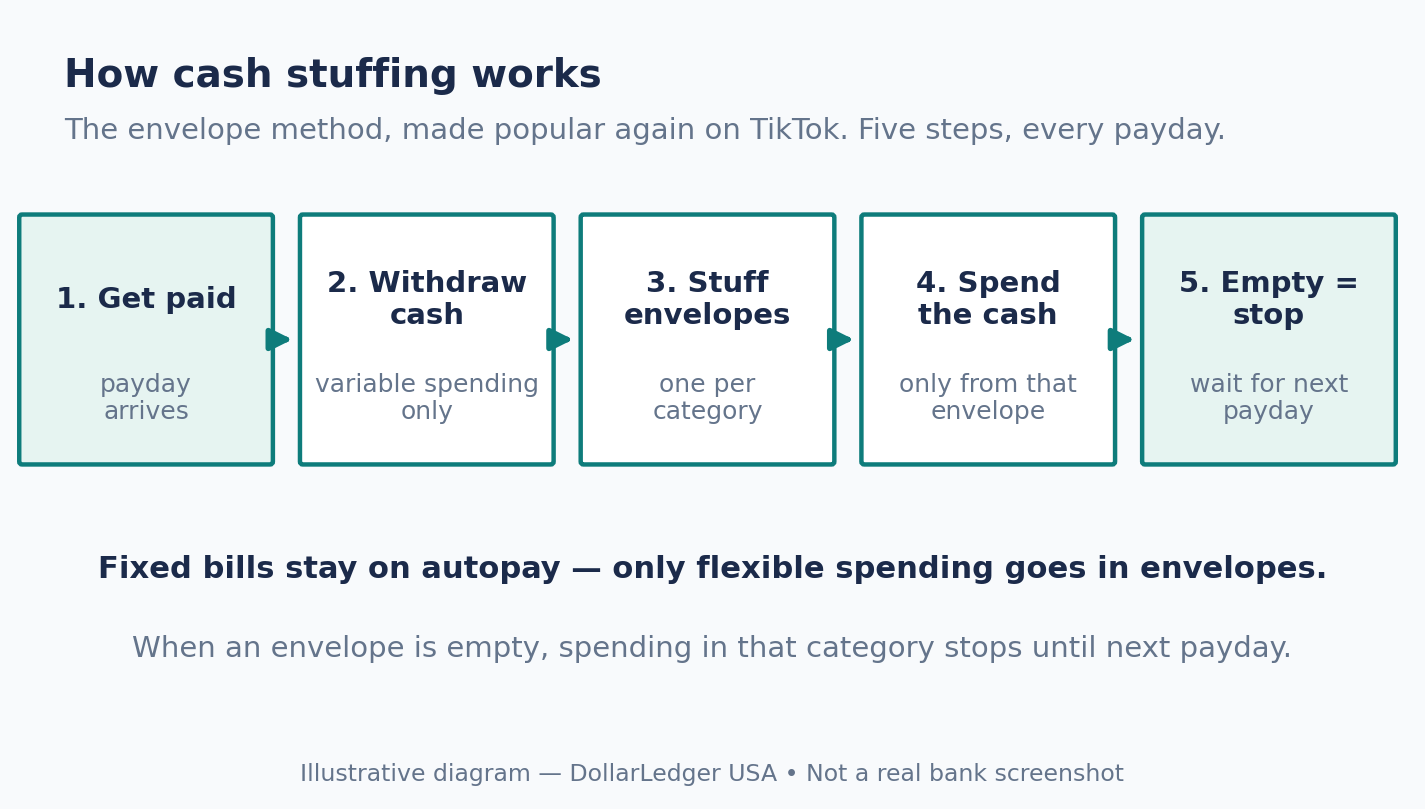
Illustrative diagram — How cash stuffing works. NOT a real bank screenshot.
Step 2: Set up your envelopes
What to do: Pick five or six categories, give each a realistic amount, and stuff them on payday.
How: Look at what you actually spent last month, not what you wish you spent. Most people start with groceries, gas, dining out, fun and personal care. Use real numbers: if you spent $450 on groceries last month, do not stuff $200 and expect a miracle. Six to eight categories is enough — more becomes a chore.
Example: Stuff $800 for the month: groceries $400, gas $150, dining out $100, fun $100, personal $50. If groceries run out, cook what is in the kitchen — do not borrow from gas.
Common mistake: Making twenty envelopes on day one — a binder of tiny categories takes an hour to stuff and a week to abandon.

Photo: Withdraw only your variable spending money, not your whole paycheck. (Photo: Pexels)
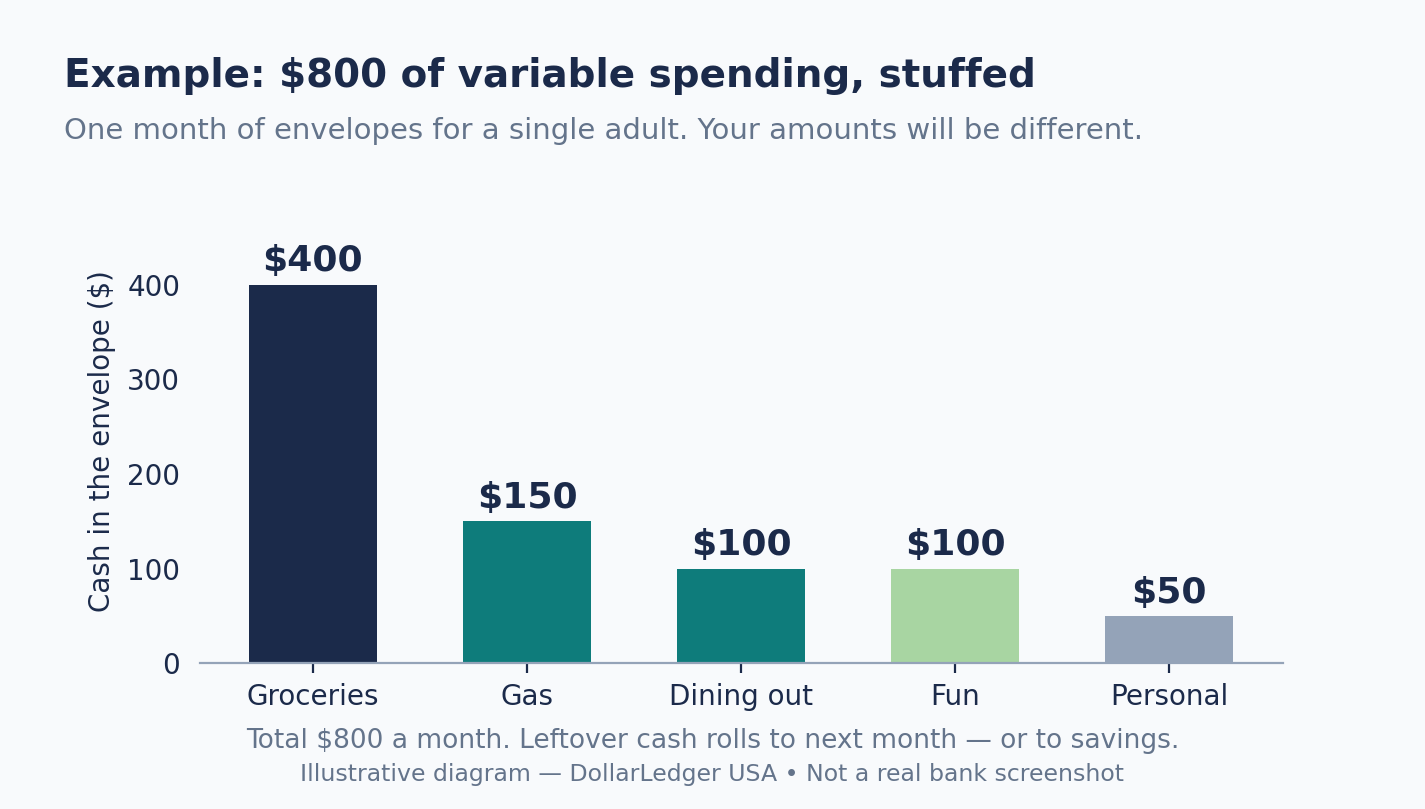
Illustrative diagram — Example: $800 of variable spending, stuffed. NOT a real bank screenshot.
Step 3: Why it works — and who it helps
What to do: Use the psychology on purpose — and check whether it helps you.
How: Cash stuffing works because of the “pain of paying”: handing over physical money feels like a loss in a way tapping a card does not. You see the envelope getting thinner, so you stop. The empty envelope is a hard stop: no swiping past the limit, no overdraft fee, no credit card interest. It helps most if you overspend without noticing.
Example: Jasmine Taylor, a Texas woman profiled by FOX Business, paid off $70,000 of debt in about two years using cash stuffing. Her story is real, not a promise.
Common mistake: Thinking cash stuffing fixes a budget that does not exist. If rent and bills already take your whole paycheck, envelopes cannot create money.
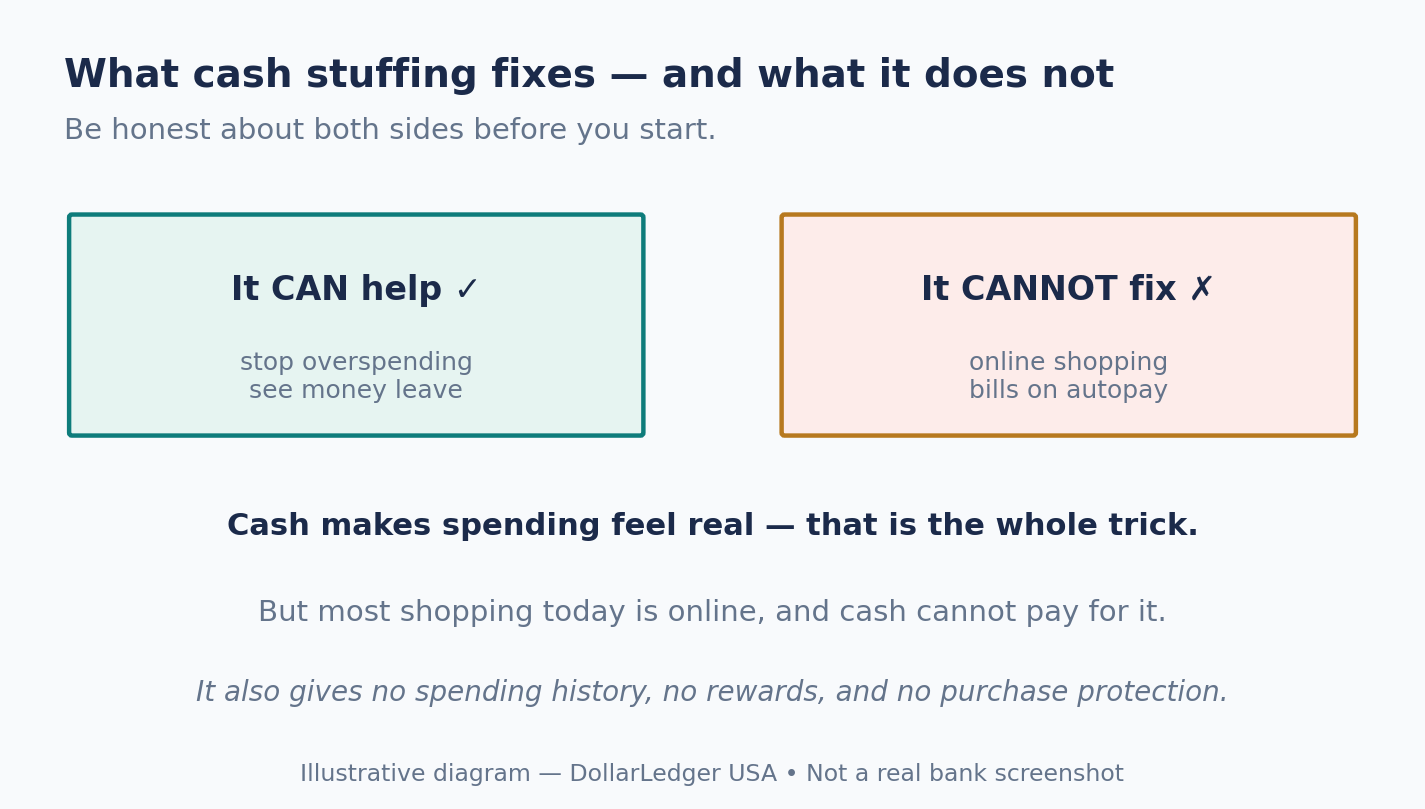
Illustrative diagram — What cash stuffing fixes, and what it does not. NOT a real bank screenshot.
Step 4: Know the risks
What to do: Before you keep hundreds of dollars at home, understand what you give up.
How: Cash at home has no FDIC protection. Money in an FDIC-insured bank is protected up to $250,000 per depositor, per bank, per ownership category. Cash stolen, lost or destroyed is usually gone forever, and most home insurance covers only a small amount of stolen cash, often around $200. Cash also earns nothing: $1,000 in an envelope earns $0 in a year, while the same $1,000 in a high-yield account at 4.40% APY earns about $44. Cash also misses card rewards and purchase protection, and cannot pay online.
Example: You keep a $2,000 emergency fund in cash because it feels safer to see it. In a year it earns $0 instead of about $88 in a high-yield account — and a break-in may cost you all but $200 of it.
Common mistake: Keeping your whole emergency fund in cash. Cash stuffing is a spending tool, not a savings tool — your emergency fund belongs in the bank. Our guide to how a high-yield savings account works explains why.

Photo: Cash has no paper trail. A bank account gives records, protection and interest. (Photo: Pexels)
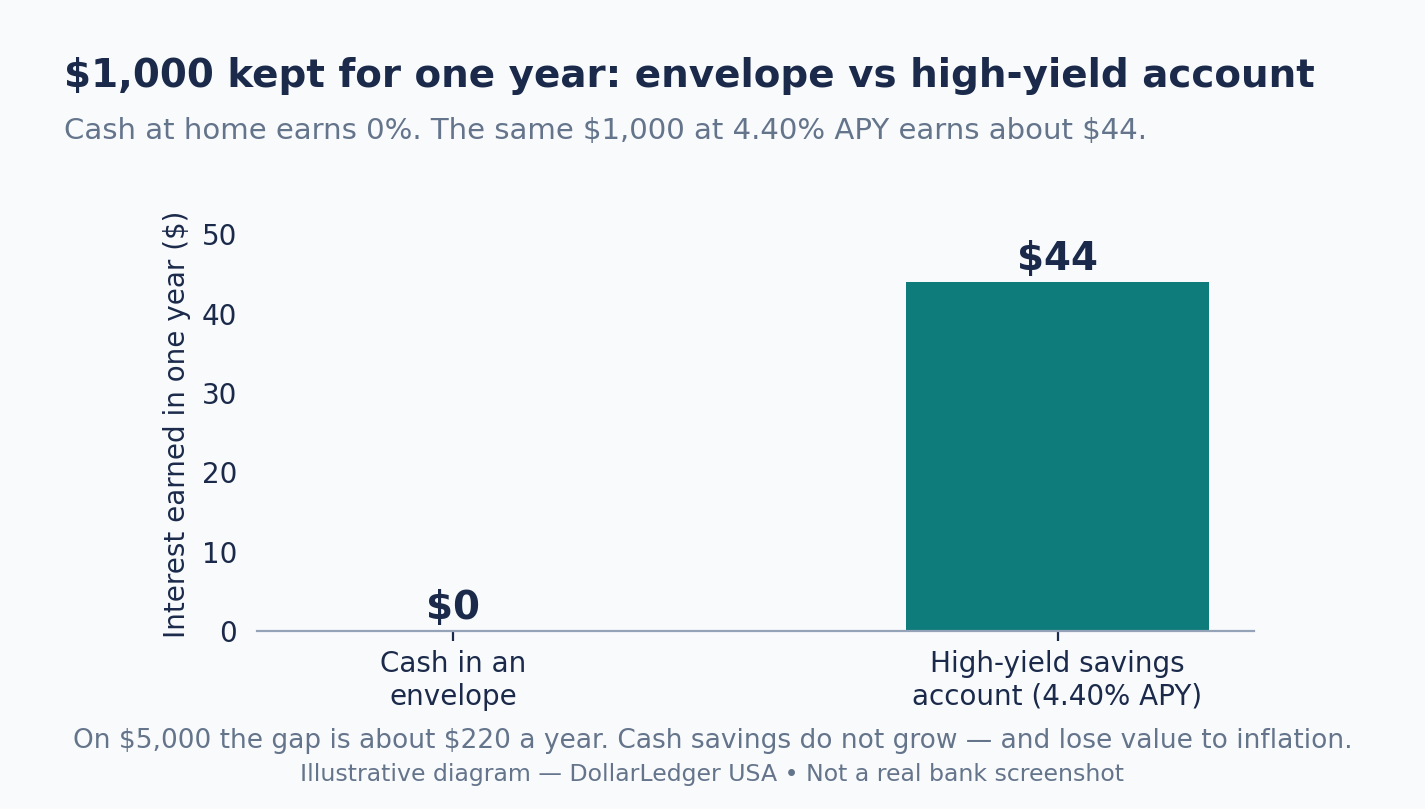
Illustrative diagram — $1,000 for one year: envelope vs high-yield account. NOT a real bank screenshot.
Step 5: Use sinking funds
What to do: Give irregular bills their own envelopes, so they never surprise you.
How: A sinking fund is an envelope for a bill you know is coming but do not pay every month: car insurance, registration, holiday gifts, a yearly subscription. Divide the yearly total by 12 and stuff that much monthly. When the bill arrives, the money is there — surprises become plans.
Example: Car insurance $600 a year: stuff $50 a month. Car registration $300 a year: $25 a month. Holiday gifts $240 a year: $20 a month. That is $95 a month — and no more surprise bills.
Common mistake: Stuffing sinking funds in cash and forgetting them for a year. Money in an envelope for eleven months earns nothing and can be lost.
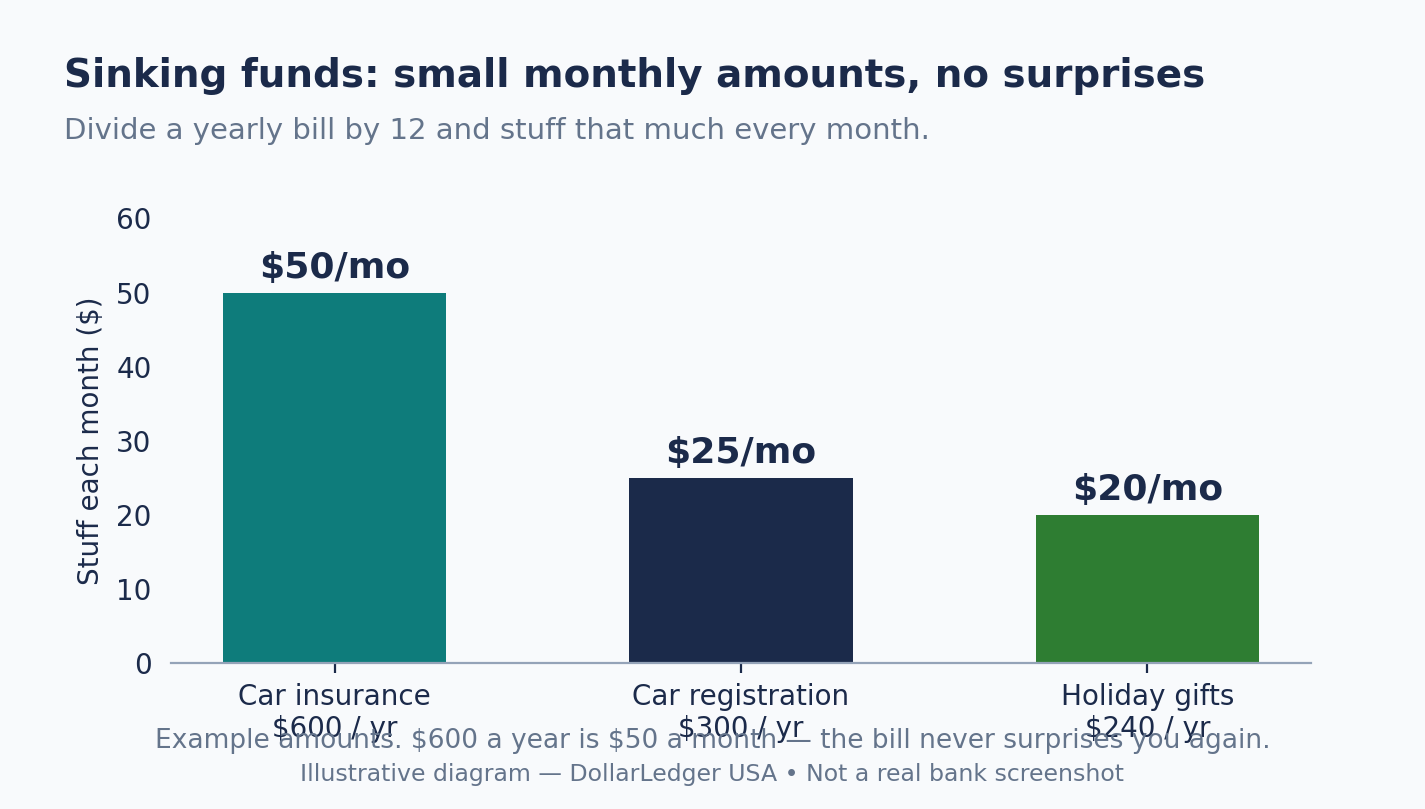
Illustrative diagram — Sinking funds: small monthly amounts, no surprises. NOT a real bank screenshot.
Step 6: Try the safer hybrid
What to do: Keep the discipline of envelopes, but keep most money where it is safe and growing.
How: Let your paycheck arrive by direct deposit. Keep fixed bills on autopay. Send savings straight to a high-yield savings account — the best accounts pay around 4% APY or more in 2026, and your money is FDIC-insured. Withdraw cash for spending only, one week at a time, so you never carry more than a few hundred dollars. If you overspend in one envelope, move money from another — in the open — instead of quietly swiping a card.
Example: On $3,000 a month take-home, Maya sends $600 to her high-yield account on payday, pays $1,800 of bills by autopay, and withdraws $150 a week for groceries and fun. After three months she has $1,800 saved, earning interest.
Common mistake: Treating the hybrid as a failure of “real” cash stuffing. Videos show full binders because binders look good on camera — your goal is spending less than you earn, without risking your savings.
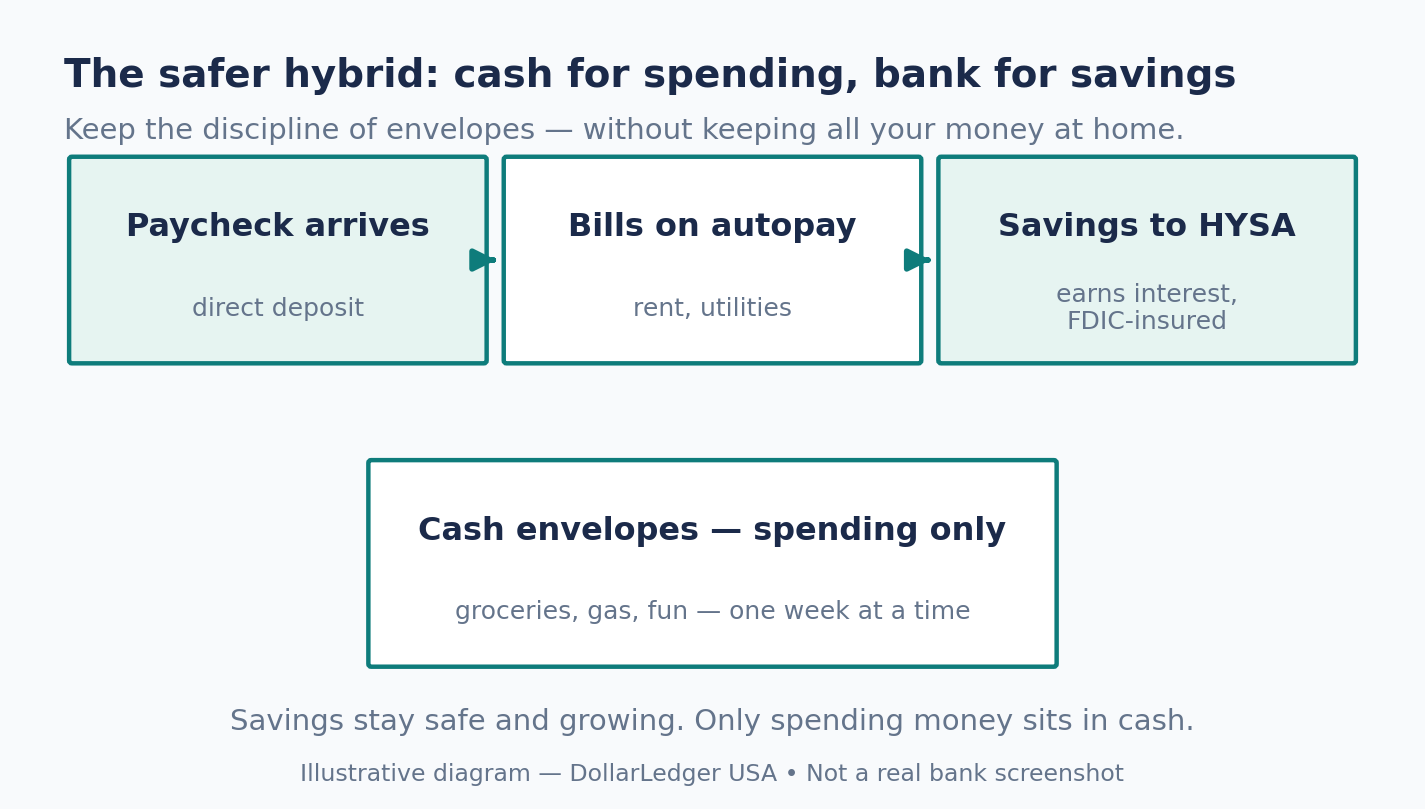
Illustrative diagram — The safer hybrid: cash for spending, bank for savings. NOT a real bank screenshot.
Checklist
- I know last month’s real spending before stuffing anything
- I started with five or six envelopes, not twenty
- Rent and fixed bills stay on autopay — never in envelopes
- I never keep more than a week or two of cash at home
- My emergency fund is in an FDIC-insured bank account
- I will review after one month and drop what does not work
FAQ
Does cash stuffing really work?
It can work for flexible costs like groceries, dining out and fun — the empty envelope is a hard limit cards do not give you. It does not work for online shopping or autopay bills, and no study shows it saves a set amount for everyone.
How much cash should I stuff each month?
Only variable spending — groceries, gas, dining out and fun. Most beginners stuff $200 to $500 a week. Never stuff rent money or your emergency fund. If unsure, start with groceries for one month.
Is cash stuffing safe?
It carries real risk: cash at home can be stolen, lost or destroyed, with no FDIC protection and only small insurance cover, often around $200. Keep only a week or two of spending cash at home.
Can I do cash stuffing without cash?
Yes — that is digital envelope budgeting. Apps let you set the same category limits on cards and accounts. You lose the “pain of paying” feeling, but you keep the limits, records and FDIC protection.
Is cash stuffing better than the 50/30/20 rule?
They do different jobs. The 50/30/20 rule decides how much goes to needs, wants and savings; cash stuffing controls spending inside those buckets. Use both: 50/30/20 for the plan, envelopes for the spending.
Sources
- SoFi, “Cash Stuffing: What Is It and Why Is It So Popular?” — #cashstuffing over 3.5 billion views as of early 2026: https://www.sofi.com/learn/content/cash-stuffing/
- CNBC Select, “Cash Stuffing: What’s Wrong with TikTok’s Viral Budgeting Trend” — benefits and trade-offs: https://www.cnbc.com/select/cash-stuffing-whats-wrong-with-tiktoks-viral-budgeting-trend/
- FDIC, Deposit Insurance at a Glance — $250,000 per depositor, per bank, per ownership category: https://www.fdic.gov/consumer-resource-center/deposit-insurance-glance
Jasmine Taylor is a FOX Business profile — one person’s story, not a guarantee. The 4.40% APY figure is from our guide to the best high-yield savings accounts in 2026, checked November 2, 2026.
Disclaimer: This article is for education only, not financial advice. Cash stuffing is not right for everyone — keep savings in an FDIC-insured account.