How Much Should You Save for Retirement by Age in 2026?
 DollarLedger Team
- 04 Nov, 2026

“How much should I have saved by now?” is one of the most searched retirement questions in America — and the honest answer starts with a simple yardstick. Fidelity, one of the largest retirement plan providers in the USA, publishes a widely quoted guideline: aim to have saved 1x your annual salary by age 30, 3x by 40, 6x by 50, 8x by 60, and 10x by 67. These are aspirational milestones, not requirements — and most Americans are behind them. This guide turns those milestones into real dollar amounts, checked November 4, 2026.
Photo: 1x your salary by 30, 10x by 67 — the milestones are a guide, not a grade. (Photo: Pexels)
What You Will Learn
- Fidelity’s retirement milestones: 1x by 30, 3x by 40, 6x by 50, 8x by 60, 10x by 67
- What those milestones mean in dollars on a $60,000 and a $100,000 salary
- The 15% rule that powers the milestones — and what it assumes
- What to do if you are behind in your 20s, 30s, 40s, 50s or 60s
- The 4% rule: turning your nest egg into yearly retirement income
- A realistic catch-up plan, including catch-up contributions after 50
Step 1: Learn Fidelity’s milestones — 1x, 3x, 6x, 8x, 10x
What to do: Compare your current retirement savings to the milestone for your age.
How: Fidelity’s guideline, published on its retirement viewpoints pages, says to aim for retirement savings equal to 1x your salary by 30, 3x by 40, 6x by 50, 8x by 60, and 10x by 67. The guideline assumes you start saving at 25, save 15% of your income every year including any employer match, invest mostly in stocks, and retire at 67.
Example: If you earn $60,000 at 30, the milestone is $60,000 saved. At 40, on the same $60,000 salary, it is $180,000.
Common mistake: Treating the milestones as a pass-or-fail test. They are planning targets built on optimistic assumptions — a steady career, no long gaps, no big withdrawals. Being behind is normal.
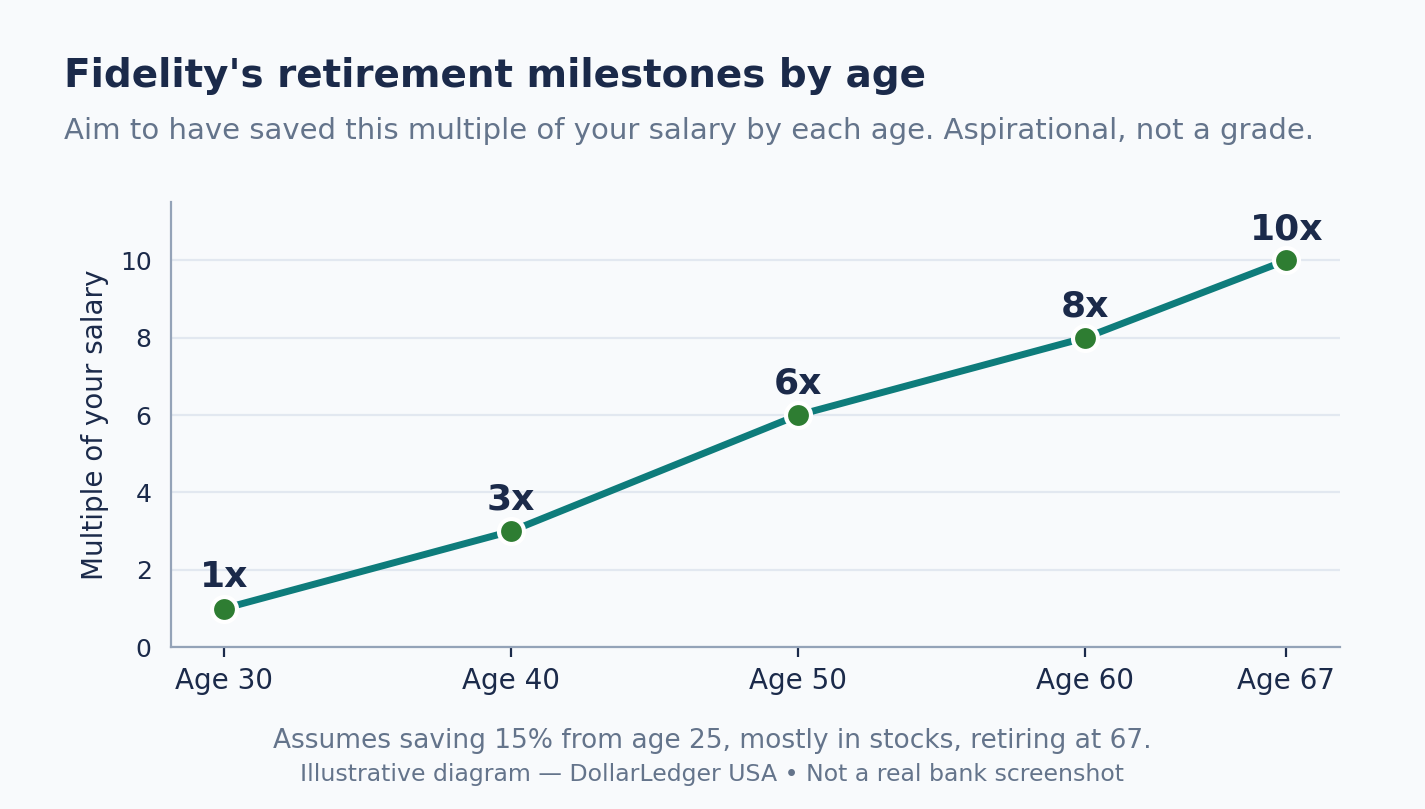
Illustrative diagram — Fidelity’s retirement savings milestones by age. NOT a real bank screenshot.
Step 2: Turn the milestones into real dollars
What to do: Multiply your salary by the milestone for your age to get your personal target.
How: On a $60,000 salary, the targets are $60,000 by 30, $180,000 by 40, $360,000 by 50, $480,000 by 60, and $600,000 by 67. On a $100,000 salary, they become $100,000 by 30, $300,000 by 40, $600,000 by 50, $800,000 by 60, and $1,000,000 by 67.
Example: Two friends both earn $100,000 at 50. One has $600,000 saved and is on track. The other has $200,000 — but still has 17 years to catch up.
Common mistake: Comparing your savings to someone else’s salary multiple. A person earning $150,000 “should” have far more saved than a person earning $50,000 — the multiple is personal, not a league table.
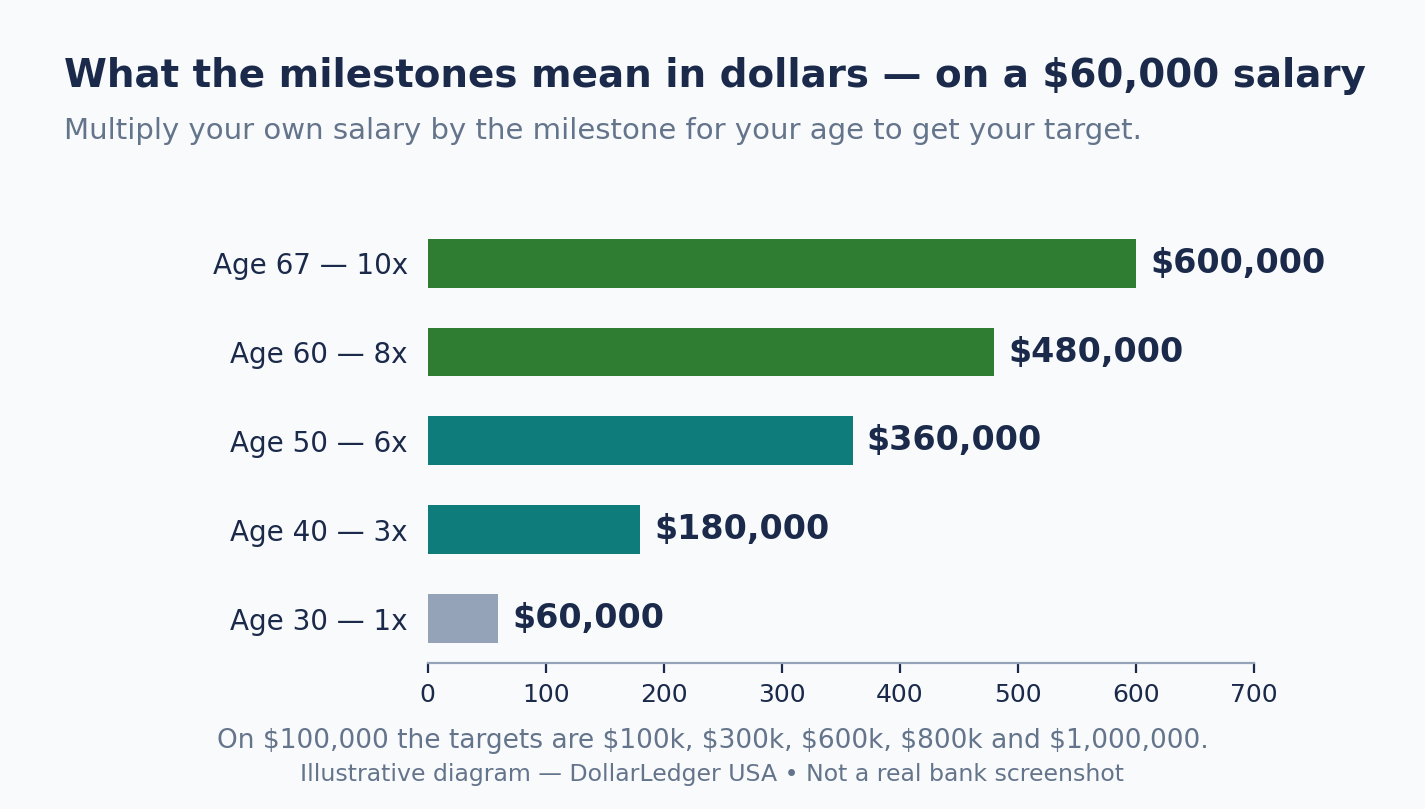
Illustrative diagram — What the milestones mean in dollars on a $60,000 salary. NOT a real bank screenshot.

Photo: Your target follows your salary — check it against your own pay, not someone else’s. (Photo: Pexels)
Step 3: Follow the 15% rule — the engine behind the milestones
What to do: Aim to save 15% of your gross income for retirement every year, including your employer match.
How: The 15% rule is the engine that makes Fidelity’s milestones work: save 15% of your pay from age 25, including the employer match, invest mostly in stocks, and the milestones roughly follow. On a $60,000 salary, 15% is $9,000 a year, or $750 a month. If your employer matches 3% of pay, you only need to contribute 12% yourself to reach 15% in total. If 15% is out of reach today, start at the full match and raise your rate by 1% a year.
Example: Maria earns $60,000, contributes 10% ($6,000), and her employer matches 3% ($1,800) — 13% in total, or $7,800 a year. Raising her own rate by 1% a year gets her to 15% in two years.
Common mistake: Saving 15% of take-home pay instead of gross pay.
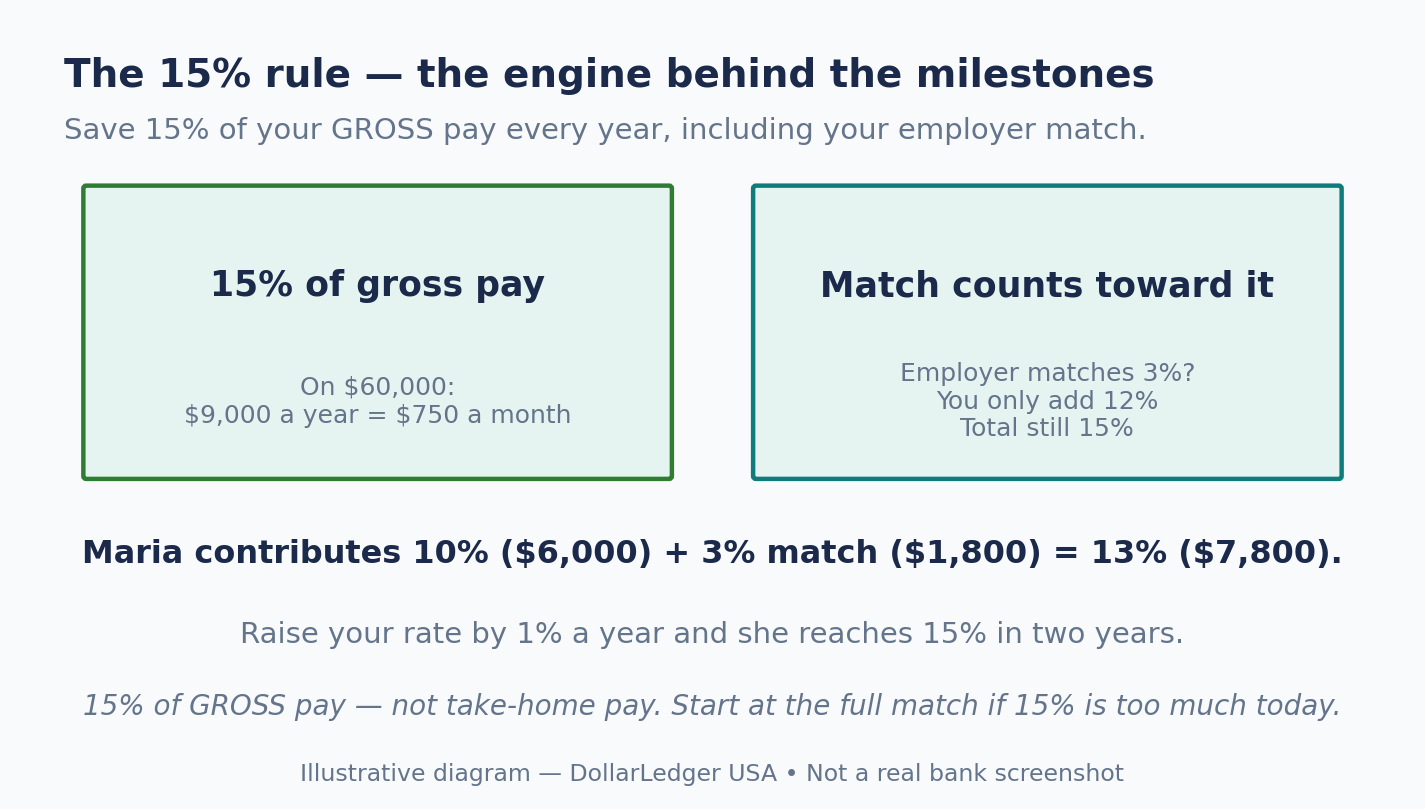
Illustrative diagram — The 15% rule: save 15% of gross pay, including the match. NOT a real bank screenshot.
Step 4: Know what to do if you are behind — decade by decade
What to do: Find your decade below and take the one action that matters most right now.
How: In your 20s, the single best move is to start and grab the full employer match — time is worth more than the amount. In your 30s, raise your rate by 1% every year and automate it so lifestyle creep does not eat your raises. In your 40s, check your milestone and cut the biggest recurring costs. In your 50s, use catch-up contributions — in 2026 workers 50 and over can add an extra $8,000 to a 401(k), and ages 60 to 63 can add $11,250. In your 60s, delay Social Security, work a few extra years, and cut spending — each extra year of work is one more year of saving and one fewer year of withdrawals.
Example: A 45-year-old with $100,000 saved on a $90,000 salary is at about 1.1x. Raising savings from 8% to 15% can add hundreds of thousands by 67.
Common mistake: Giving up because the milestone looks unreachable. Being at half the milestone with 20 years left is fixable; saving nothing because the target feels too big is not.
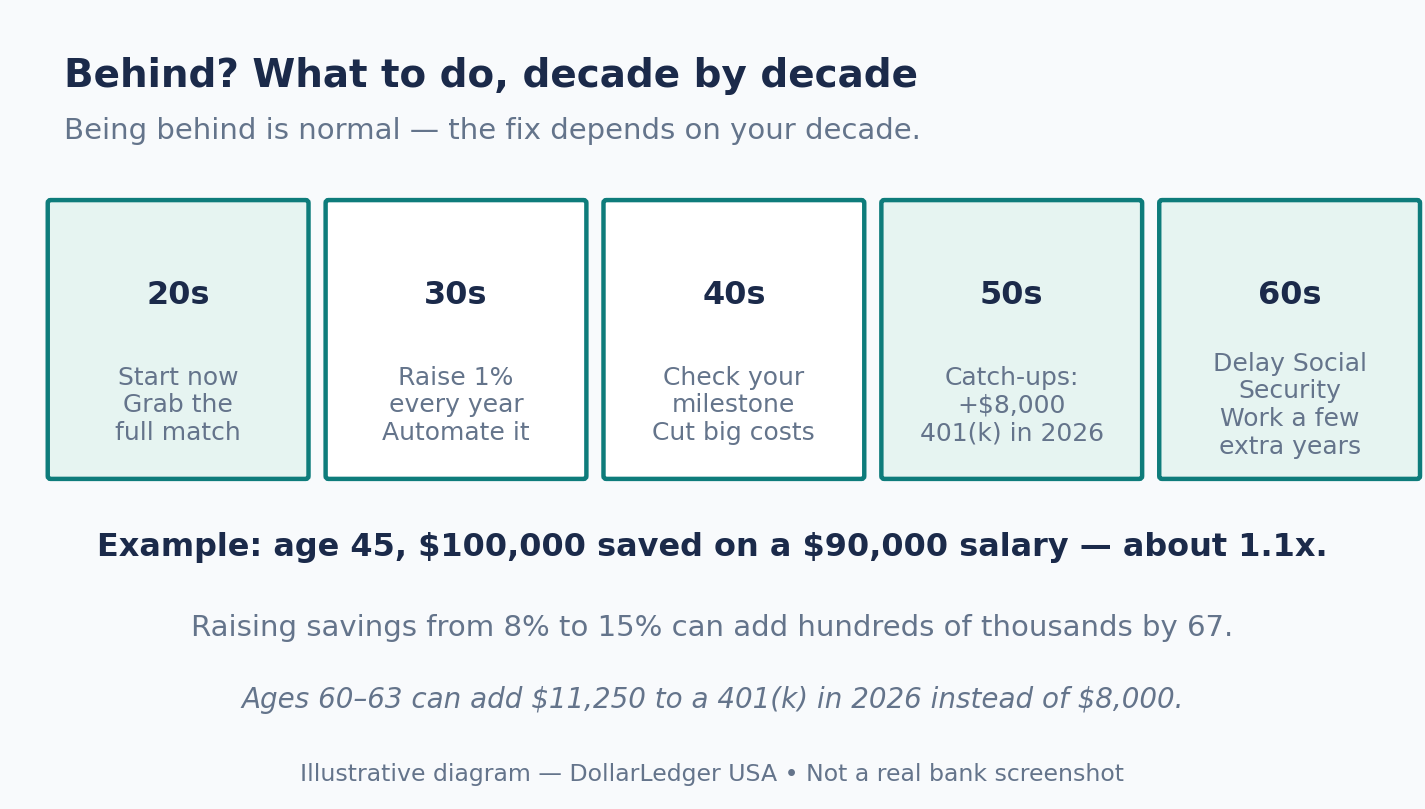
Illustrative diagram — What to do if you are behind, decade by decade. NOT a real bank screenshot.
Step 5: Use the 4% rule to turn savings into income
What to do: Multiply your target nest egg by 4% to see the yearly income it could provide.
How: The 4% rule is a commonly used guideline: withdraw about 4% of your portfolio in your first year of retirement, then adjust that amount for inflation each year, and the money should last roughly 30 years. So $600,000 times 4% is $24,000 a year. One million dollars times 4% is $40,000 a year.
Example: You retire at 67 with $600,000 and $24,000 a year from Social Security. The 4% rule adds $24,000 from savings — $48,000 a year, or 80% of a $60,000 salary.
Common mistake: Planning to live on 4% of your savings while ignoring taxes, health care, and inflation. Run the numbers after tax, and budget health care separately.

Photo: Retirement income is savings plus Social Security — plan for both together. (Photo: Pexels)
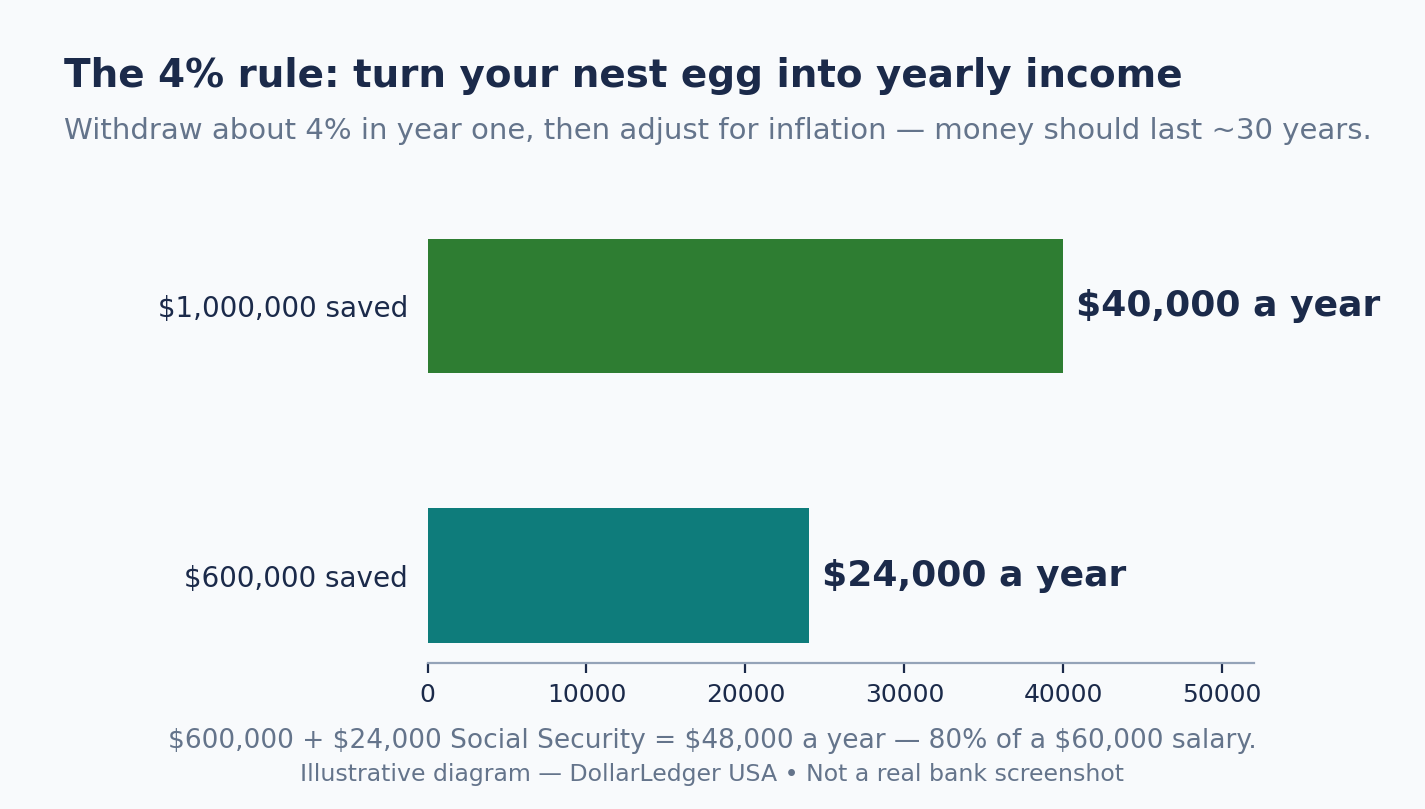
Illustrative diagram — The 4% rule: your nest egg times 4% is your yearly income. NOT a real bank screenshot.
Step 6: Build your catch-up plan — starting today
What to do: Write down your milestone, your current savings, the gap, and the one change you will make this month.
How: Start with three numbers: your salary, your milestone for your age, and your current retirement balance. The gap is your target minus your balance. Then pick the lever that fits your decade: raise your 401(k) rate by 1%, open or fund an IRA (the 2026 IRA limit is $7,500, with a $1,100 catch-up at 50+), or automate an extra transfer on payday. Before you raise retirement savings, make sure your emergency fund is solid — see our emergency fund guide.
Example: You are 52, earn $85,000, and have $150,000 saved. Your 50s milestone is 6x, or $510,000 — a $360,000 gap. Saving 15% ($12,750 a year) plus the $8,000 catch-up, with growth, can close most of it by 67.
Common mistake: Raiding retirement savings for a house, a car, or a child’s college fund. Every withdrawal resets years of compounding and can trigger tax and a 10% penalty before age 59½.
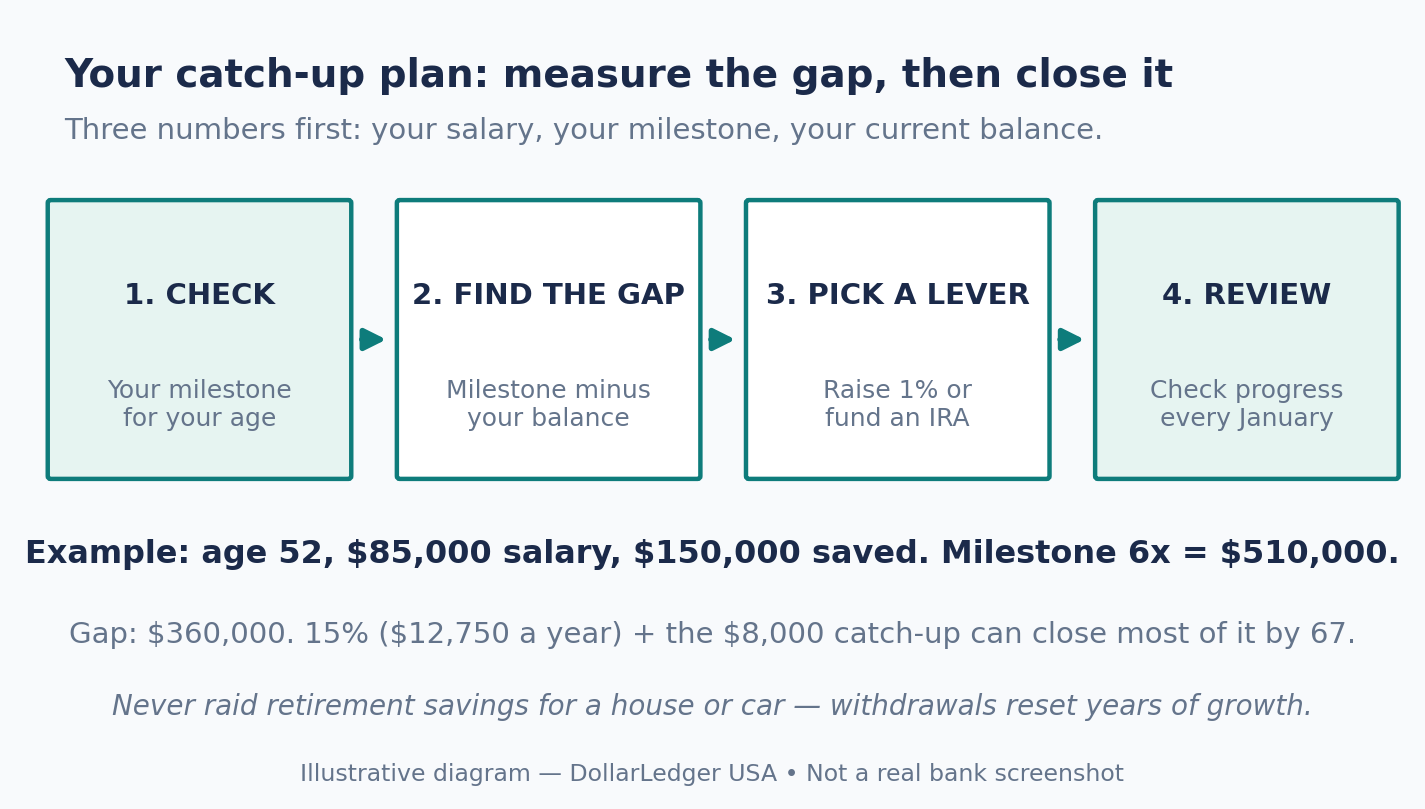
Illustrative diagram — Your catch-up plan: measure the gap, then close it step by step. NOT a real bank screenshot.
Checklist
- ☐ I know my milestone: 1x by 30, 3x by 40, 6x by 50, 8x by 60, 10x by 67.
- ☐ I turned the milestone into dollars using my own current salary.
- ☐ I know my savings rate — and whether it is near 15% including the match.
- ☐ I picked the one catch-up action for my decade.
- ☐ I used the 4% rule to see what my nest egg would pay each year.
- ☐ I wrote down my gap and the change I will make this month.
FAQ
How much should I have saved for retirement by age 30?
1x your annual salary by 30 — $60,000 saved on a $60,000 salary. It is aspirational, not a requirement.
What is the 15% retirement savings rule?
Save 15% of your gross income for retirement each year, including your employer match, starting around age 25. It is the savings rate behind Fidelity’s milestones.
What is the 4% rule for retirement?
Withdraw about 4% of your portfolio in your first year of retirement, then adjust for inflation yearly. On $600,000 that is $24,000 a year — a rough guide for a retirement of about 30 years.
I am 50 and far behind — can I still catch up?
Yes. Workers 50 and over can make catch-up contributions — an extra $8,000 to a 401(k) in 2026, or $11,250 at ages 60 to 63 — and delaying retirement by a few years is one of the most powerful levers available.
Are Fidelity’s milestones realistic for most people?
They assume steady saving of 15% from age 25 with no long gaps. Average balances lag far behind — what matters is the direction you are moving.
Sources
- Fidelity, “How much do I need to retire?” — the 1x/3x/6x/8x/10x milestones and the 15% savings guideline: https://www.fidelity.com/viewpoints/retirement/how-much-do-i-need-to-retire
- IRS, “401(k) limit increases to $24,500 for 2026, IRA limit increases to $7,500” (IR-2025-111) — 2026 catch-up limits: https://www.irs.gov/newsroom/401k-limit-increases-to-24500-for-2026-ira-limit-increases-to-7500
All figures checked November 4, 2026.
Disclaimer: This article is for education only, not financial advice. Savings guidelines and tax rules change — confirm current figures with the IRS or a qualified financial professional before acting.