Roth IRA Contribution Limits 2026 — How Much Can You Contribute?
 DollarLedger Team
- 04 Nov, 2026

A Roth IRA is one of the most powerful retirement accounts in the United States because the money grows tax-free and comes out tax-free in retirement. You pay tax on the money before it goes in, and then you never pay tax on the growth or the withdrawals, as long as you follow the rules. But you cannot put in an unlimited amount, and you cannot contribute at all if your income is too high. This guide explains the Roth IRA contribution limits for 2026, checked November 4, 2026: who can contribute, how the income phase-outs work, the deadline, and what to do if you put in too much.
Photo: The 2026 Roth IRA limit is $7,500 — but your income decides how much of it you can use. (Photo: Pexels)
What You Will Learn
- The 2026 Roth IRA limit: $7,500 under age 50, $8,600 at age 50 and over
- Why you need earned income to contribute
- The income phase-outs for single filers and married couples
- Why the $7,500 limit is shared across all your IRAs, not per account
- How to turn the yearly limit into a simple monthly amount
- What happens if you over-contribute, and how to fix it
Step 1: Know the 2026 limit — $7,500, or $8,600 if you are 50 or older
What to do: Learn the exact limit that applies to you before you contribute a single dollar.
How: The IRS announced the 2026 limits in news release IR-2025-111, published November 13, 2025. For most people under 50, the limit is $7,500. If you turn 50 during the year, your limit is $8,600 — the extra $1,100 is called a “catch-up contribution”. The limit applies to the total across all your IRAs, not to each account separately.
Example: Maya is 34 and earns $60,000 a year, so her 2026 limit is $7,500. Her father Robert is 55, so his limit is $8,600.
Common mistake: Thinking the limit is $7,500 per account. The total across all your IRAs together is still $7,500, or $8,600 if you are 50 or older.
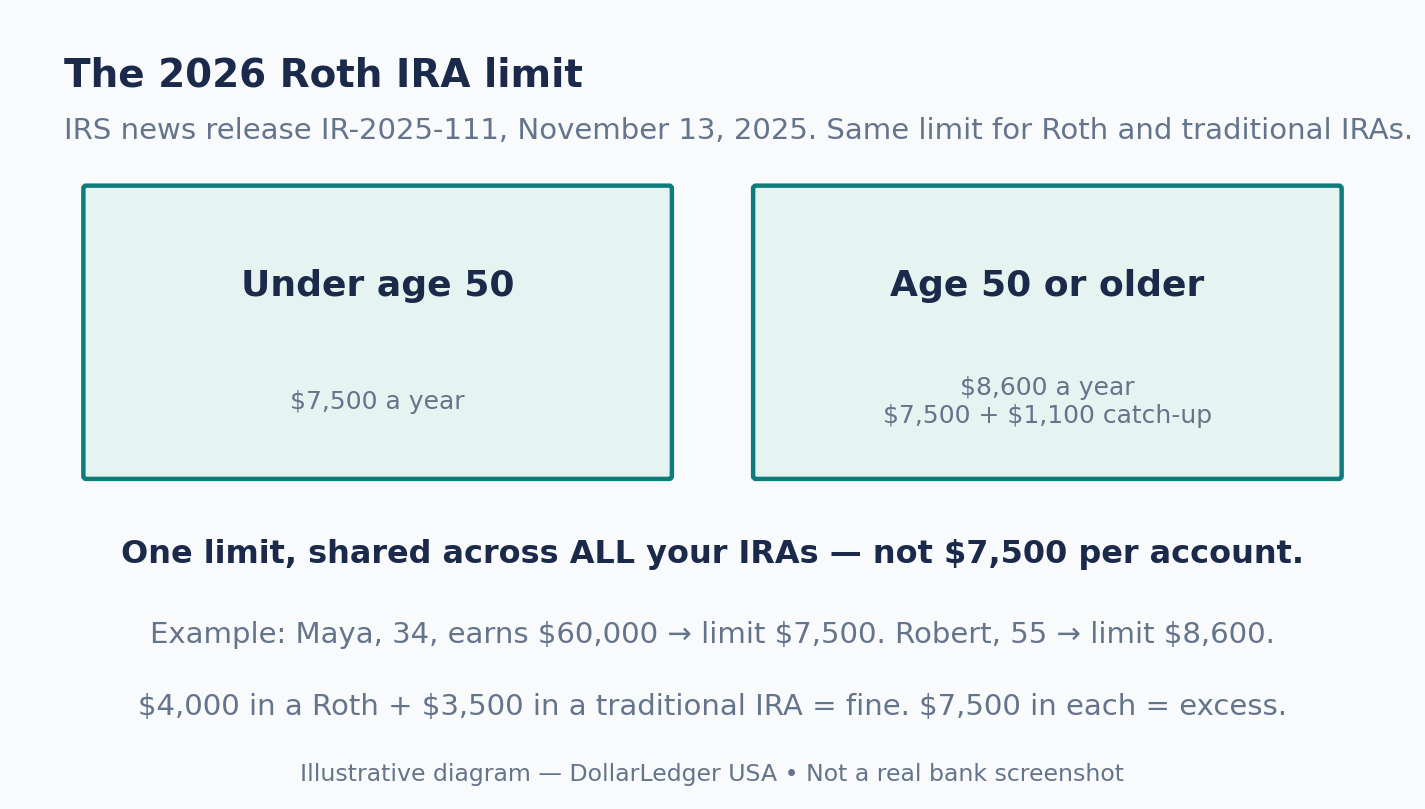
Illustrative diagram — The 2026 IRA limit: $7,500, or $8,600 with the age-50 catch-up. NOT a real bank screenshot.
Step 2: Check you have earned income — no earned income, no contribution
What to do: Confirm you have enough earned income in 2026 before you contribute.
How: A Roth IRA contribution must come from earned income: wages, salary, tips, bonuses, commissions, or self-employment income. The IRS does not count pensions, Social Security, interest, dividends, capital gains or gifts as earned income. A student with a part-time job can contribute; a person living only on investment income cannot.
Example: Daniel earned $3,200 from a part-time campus job in 2026, so he can contribute up to $3,200.
Common mistake: Contributing $7,500 from savings when you only earned $2,000 that year. The extra $5,500 is an excess contribution, and the 6% penalty applies until it is fixed.
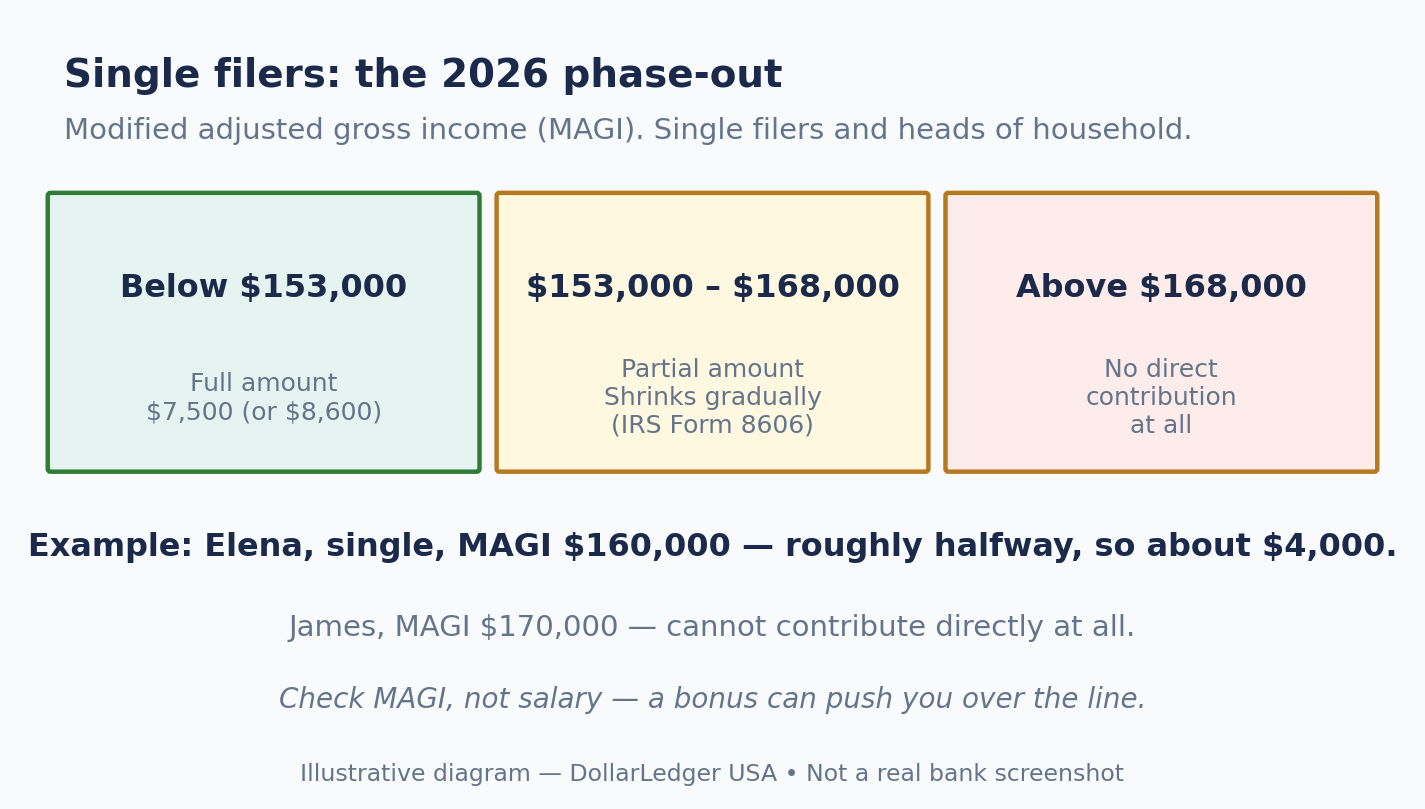
Illustrative diagram — Single filers: full $7,500 below $153,000, partial up to $168,000, none above it. NOT a real bank screenshot.

Photo: Married couples get a higher income range — but the phase-out still applies. (Photo: Pexels)
Step 3: Work out the income phase-out for single filers
What to do: Check your modified adjusted gross income, known as MAGI, against the 2026 phase-out range.
How: Even with earned income, the IRS reduces how much you can contribute directly once your income passes certain levels. These levels are called the income phase-outs. If your MAGI is below the range, you can contribute the full $7,500 (or $8,600). If your MAGI is in the range, you can contribute a reduced amount. If your MAGI is above the range, you cannot contribute directly at all — but a “backdoor Roth IRA” may still be possible, and we explain it in a separate guide.
Example: Elena is single, age 40, with a MAGI of $160,000 in 2026. She is roughly halfway through the phase-out range, so she can contribute roughly half of her limit — about $3,750.
Common mistake: Using your salary instead of your MAGI. A bonus or freelance income can push your MAGI into the phase-out range, even if your salary looks fine.
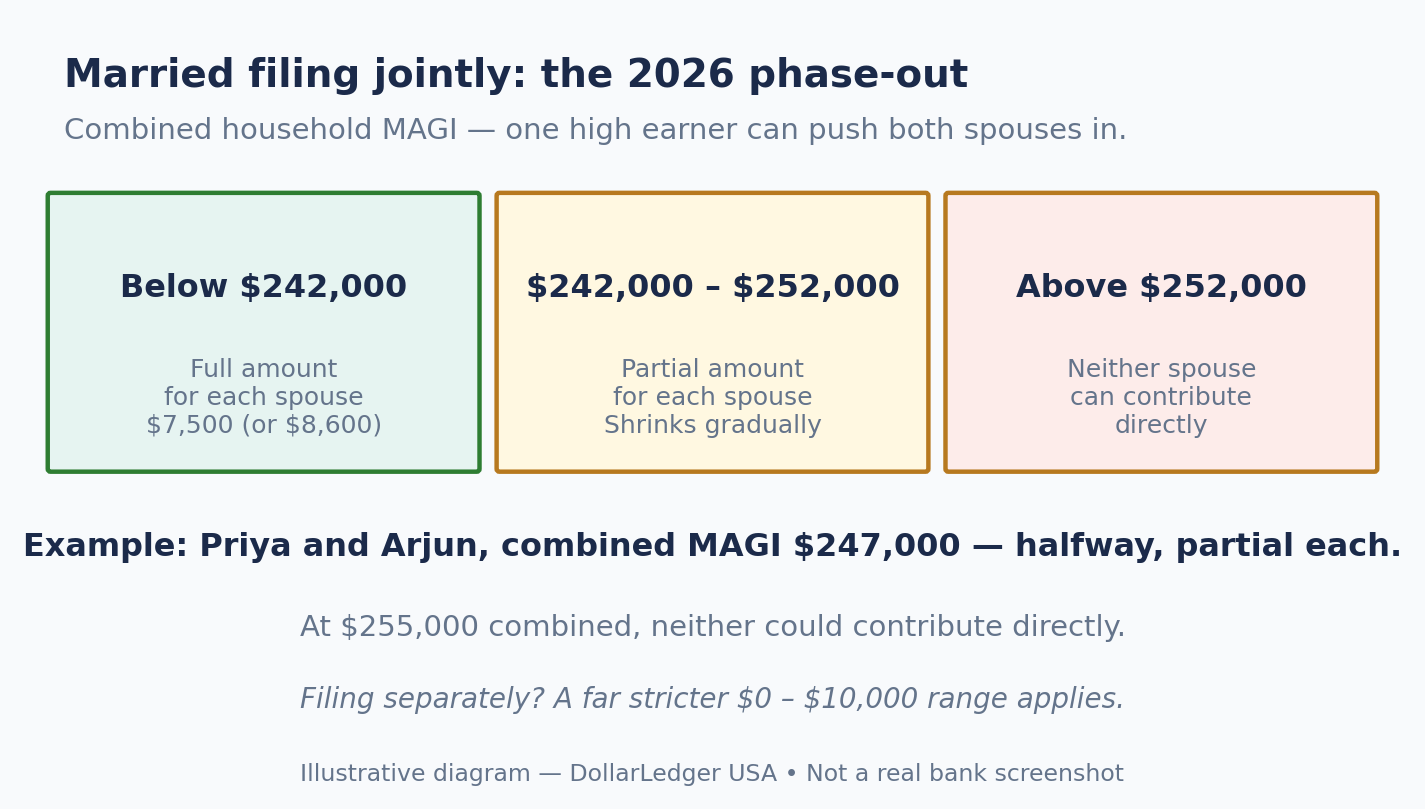
Illustrative diagram — Married filing jointly: full amount below $242,000, partial up to $252,000, none above it. NOT a real bank screenshot.
Step 4: Work out the income phase-out for married couples
What to do: If you are married, check the higher phase-out range for couples filing jointly, and the lower range if you file separately.
How: For 2026, married couples filing jointly can contribute the full amount if their combined MAGI is below $242,000, a reduced amount between $242,000 and $252,000, and nothing above $252,000. A married person filing separately can contribute a reduced amount only between $0 and $10,000 of MAGI.
Example: Priya and Arjun file jointly with a combined MAGI of $247,000 in 2026. They are halfway through the phase-out range, so they can contribute roughly half of their combined limit.
Common mistake: Assuming the married limit applies per person, based on each spouse’s own salary. The phase-out applies to the couple’s combined MAGI, not to each salary separately.
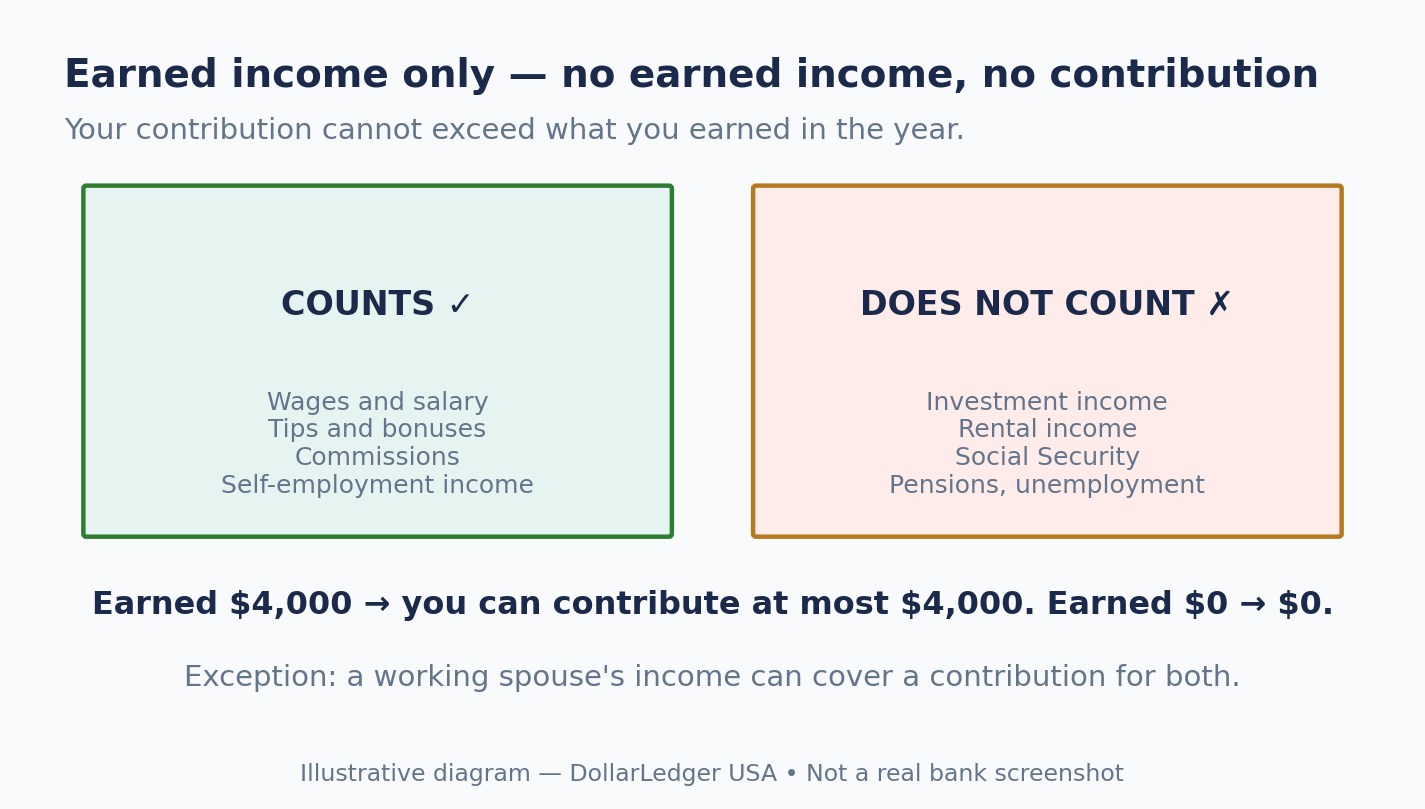
Illustrative diagram — Earned income only: your contribution cannot exceed what you earned. NOT a real bank screenshot.
Step 5: Turn the yearly limit into a monthly habit
What to do: Divide your limit by 12 and set up an automatic monthly contribution, so you reach the full limit without noticing it.
How: The full $7,500 limit works out to $625 a month, or about $717 a month for the $8,600 limit at age 50 and over. Set up an automatic transfer on payday so the money moves before you can spend it. Build an emergency fund first — our emergency fund guide explains how to build one on a $40,000 salary. If you cannot afford $625 a month, even $100 a month adds up to $1,200 a year, and that is a strong start.
Example: Carlos is 29 and earns $55,000 a year. He sets up a $625 monthly transfer, and by December he has contributed the full $7,500.
Common mistake: Waiting until December and then trying to find $7,500 all at once. Most people cannot do that, so they miss the limit entirely.

Photo: $625 a month adds up to the full $7,500 — small steps beat one big scramble. (Photo: Pexels)
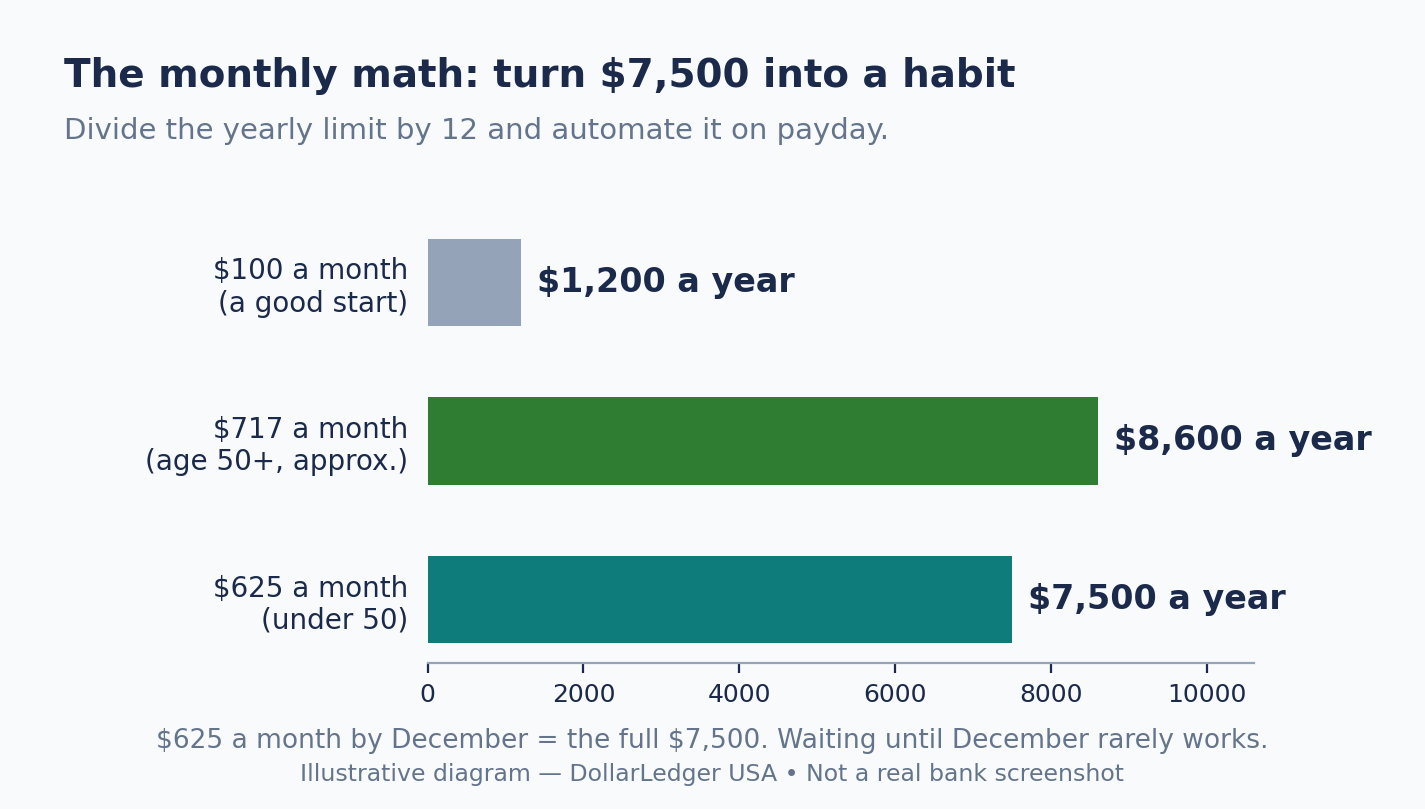
Illustrative diagram — The monthly math: what the 2026 limit looks like per month. NOT a real bank screenshot.
Step 6: Know the deadline — and how to fix an over-contribution
What to do: Remember you have until the tax filing deadline to contribute for 2026, and act fast if you put in too much.
How: You can make 2026 Roth IRA contributions until the tax filing deadline, April 15, 2027 — three and a half months after the year ends. If you contribute too much, you can fix it by withdrawing the excess, plus any earnings on it, before April 15, 2027. If you leave the excess in place, the IRS charges 6% tax on it for every year it stays there.
Example: Tom contributed $7,500 in January 2026, but a bonus pushed his MAGI to $175,000, above the $168,000 limit for single filers. He withdraws the excess before April 15, 2027, and avoids the 6% tax.
Common mistake: Discovering the excess contribution on your tax return and doing nothing about it. The 6% tax then applies every year until the excess is removed.
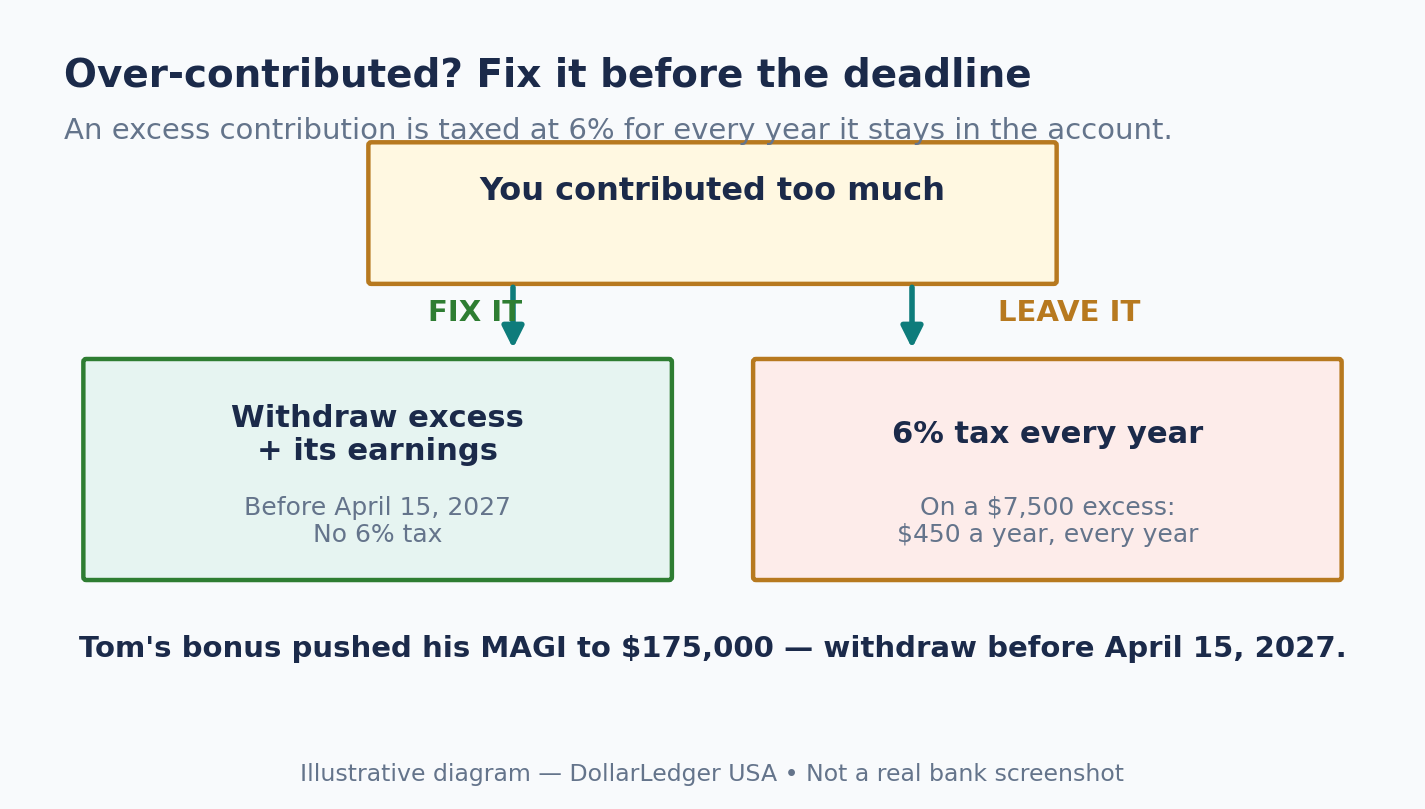
Illustrative diagram — Fix an over-contribution before the deadline, or pay 6% every year. NOT a real bank screenshot.
Checklist
- ☐ My 2026 limit is $7,500, or $8,600 if I am 50 or older.
- ☐ I have enough earned income in 2026 to cover it.
- ☐ I checked my MAGI against the phase-out.
- ☐ I counted all my IRAs together — one combined limit.
- ☐ I set up a monthly contribution ($625 a month).
- ☐ I know the April 15, 2027 deadline and the excess fix.
FAQ
How much can I contribute to a Roth IRA in 2026?
Up to $7,500 if you are under 50, or $8,600 if you are 50 or older, according to the IRS. You also need earned income at least equal to your contribution, and your income must be below the phase-out range.
Can I contribute to a Roth IRA if I earn over $168,000 as a single filer?
Not directly. Above $168,000, a single filer cannot contribute directly to a Roth IRA. A “backdoor Roth IRA” is a different route: you contribute to a traditional IRA first, then convert it. It has extra rules, so check with a tax professional first.
What is the deadline for 2026 Roth IRA contributions?
April 15, 2027, the tax filing deadline. You can contribute for 2026 at any time during 2026, and up to April 15, 2027.
What happens if I contribute too much to my Roth IRA?
The excess amount is taxed at 6% for every year it stays in the account. Withdraw the excess, plus any earnings on it, before April 15, 2027, to avoid the tax.
Can I contribute to both a Roth IRA and a traditional IRA in the same year?
Yes, but the $7,500 limit (or $8,600 if you are 50 or older) is shared across both accounts. For example, $4,000 in a Roth IRA and $3,500 in a traditional IRA is fine, but not $7,500 in each.
Do I need earned income to contribute?
Yes. You cannot contribute more than you earned in the year, and you cannot contribute at all if you had no earned income. Pensions and investment income do not count.
Sources
- IRS, “401(k) limit increases to $24,500 for 2026, IRA limit increases to $7,500” (IR-2025-111, Nov 13, 2025) — 2026 IRA limits, income phase-outs and the Saver’s Credit: https://www.irs.gov/newsroom/401k-limit-increases-to-24500-for-2026-ira-limit-increases-to-7500
All limits and phase-outs checked November 4, 2026.
Disclaimer: This article is for education only, not financial advice. Tax rules change often — confirm current limits with the IRS or a tax professional before contributing.