Best Auto Loan Rates in 2026 - How to Get the Best Car Loan Before You Visit the Dealer
 DollarLedger Team
- 10 Nov, 2026

The best auto loan rate is decided before you visit the dealer, not at the dealer. Walk in without one and the dealer sets the terms. Walk in with a preapproval and the dealer has a rate to beat: on a $35,000 loan over 60 months, the median credit union rate costs about $2,017 less in interest than the average bank rate. All figures were checked on November 10, 2026. Warning: there is no single average auto loan rate - three sources give three different numbers, because each measures a different group of borrowers.
Photo: The rate is decided before you get here - get preapproved first, then let the dealer try to beat it. (Photo: Pexels)
What You Will Learn
- Why the published averages disagree, and which one applies to you
- What rate your credit tier actually pays, new and used, and why a credit union usually beats a bank
- How to compare the dealer’s offer, and the new car-loan interest tax deduction
Step 1: Check your credit score and know your tier
What to do: Check your credit score and find your tier before you apply anywhere.
How: Your credit tier is the biggest single factor in your rate. Experian’s Q2 2026 new-car averages (VantageScore 4.0) run from 4.41% for super prime (781 to 850) to 16.11% for deep subprime (300 to 500); prime 6.15%, near prime 9.71%, subprime 13.52%. Used cars run higher in every tier. Check your free reports at AnnualCreditReport.com for errors.
Example: On a $30,000 new-car loan over 60 months, 4.41% costs about $558 a month and 16.11% costs about $731 a month - a gap of about $173 a month, or $10,394 overall.
Common mistake: Applying first and checking your score after.
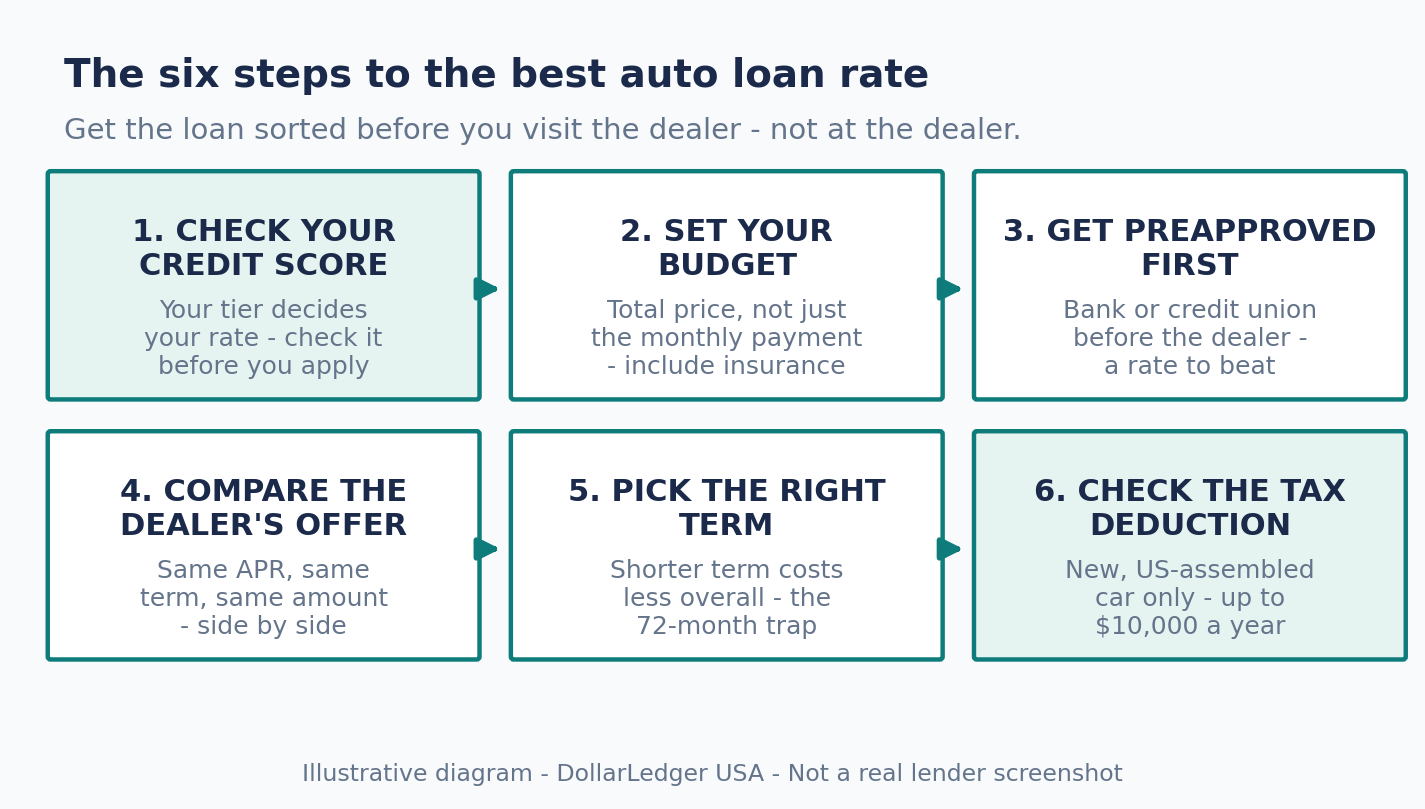
Illustrative diagram - The six steps to the best auto loan rate. NOT a real lender screenshot.
Step 2: Set your budget before you shop for cars
What to do: Decide the total price and the monthly payment you can afford before you look at any car.
How: In Q2 2026, Experian reported the average new-car loan was $43,610 at 6.35% APR ($765 a month) and the average used-car loan was $27,852 at 11.19% ($542 a month). Those are averages, not targets - your payment must fit your own budget after rent, bills, food, and savings. Insurance, tax, title, and registration come on top. A bigger down payment lowers the amount financed.
Example: Maya can afford $600 a month for a car, all in. With insurance and tax, that means a loan payment of about $450, so she shops near $25,000, not $40,000.
Common mistake: Shopping by monthly payment alone - a dealer can always cut it by stretching the loan.
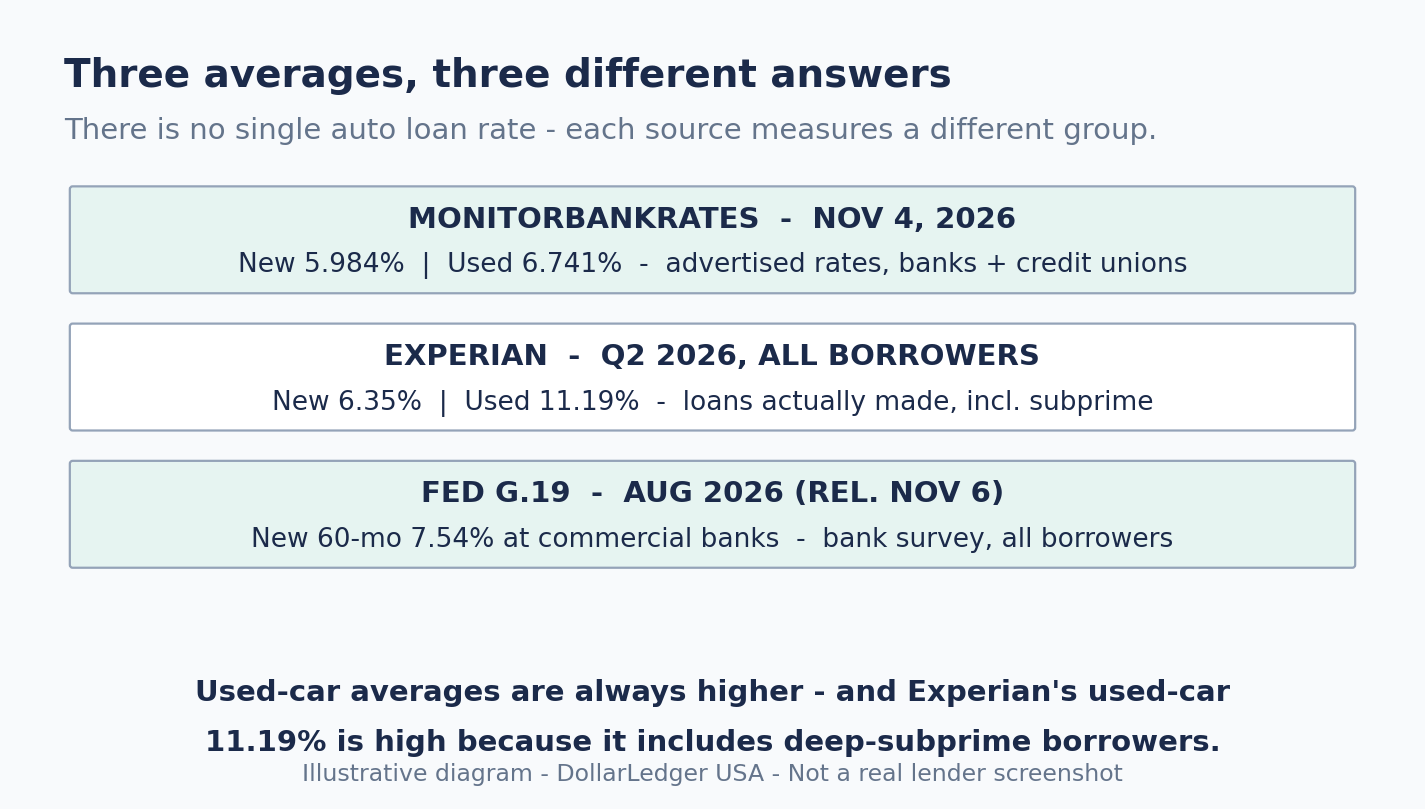
Illustrative diagram - Three averages, three different borrower groups. NOT a real lender screenshot.
Step 3: Get preapproved at a bank or credit union first
What to do: Apply for preapproval at your bank and one credit union before you visit any dealer.
How: A preapproval states your rate, term, and maximum amount. The CFPB advises getting quotes from a bank or credit union before going to the dealership, because the dealer gets a “buy rate” from a lender and may add a markup as its pay for arranging the loan. Credit unions are usually cheapest: on November 10, 2026, the median new-car rate across 1,327 credit unions was 5.49% APR (reported, RateAPI), while the Federal Reserve’s G.19 put the average 60-month new-car loan at commercial banks at 7.54% for August 2026. Keep all applications inside about 14 days, so the inquiries generally count as one (CFPB).
Example: On a $35,000 loan over 60 months, the credit union median of 5.49% costs about $668 a month and the bank average of 7.54% costs about $702 a month - saving about $34 a month, or about $2,017 overall.
Common mistake: Letting the dealer run your credit first, with no competing offer in hand.
Photo: Get the keys with a preapproval already in hand. (Photo: Pexels)
Step 4: Compare the dealer’s offer line by line
What to do: Make the dealer beat your preapproval on the same terms: compare APR, term, and amount financed, not just the payment.
How: Show the dealer your preapproval and ask them to beat it in writing. Compare the APR first, because it includes interest plus lender fees. Then check the term and the amount financed match: a lower payment on a longer loan is not a better deal. Add-ons like warranties and gap insurance are optional - rolling them into the loan means paying interest on them for years. A manufacturer promotional rate that beats your preapproval is worth taking - unless it costs you a cash rebate. And never sign a deal that lets the dealer change the financing later (yo-yo financing).
Example: The dealer offers 6.9% over 72 months at $595 a month; your credit union preapproval is 5.49% over 60 months at $668. The dealer loan costs about $2,740 more in interest - ask the dealer to match 5.49% and keep the 60-month term.
Common mistake: Signing without reading the APR, term, and total of payments.
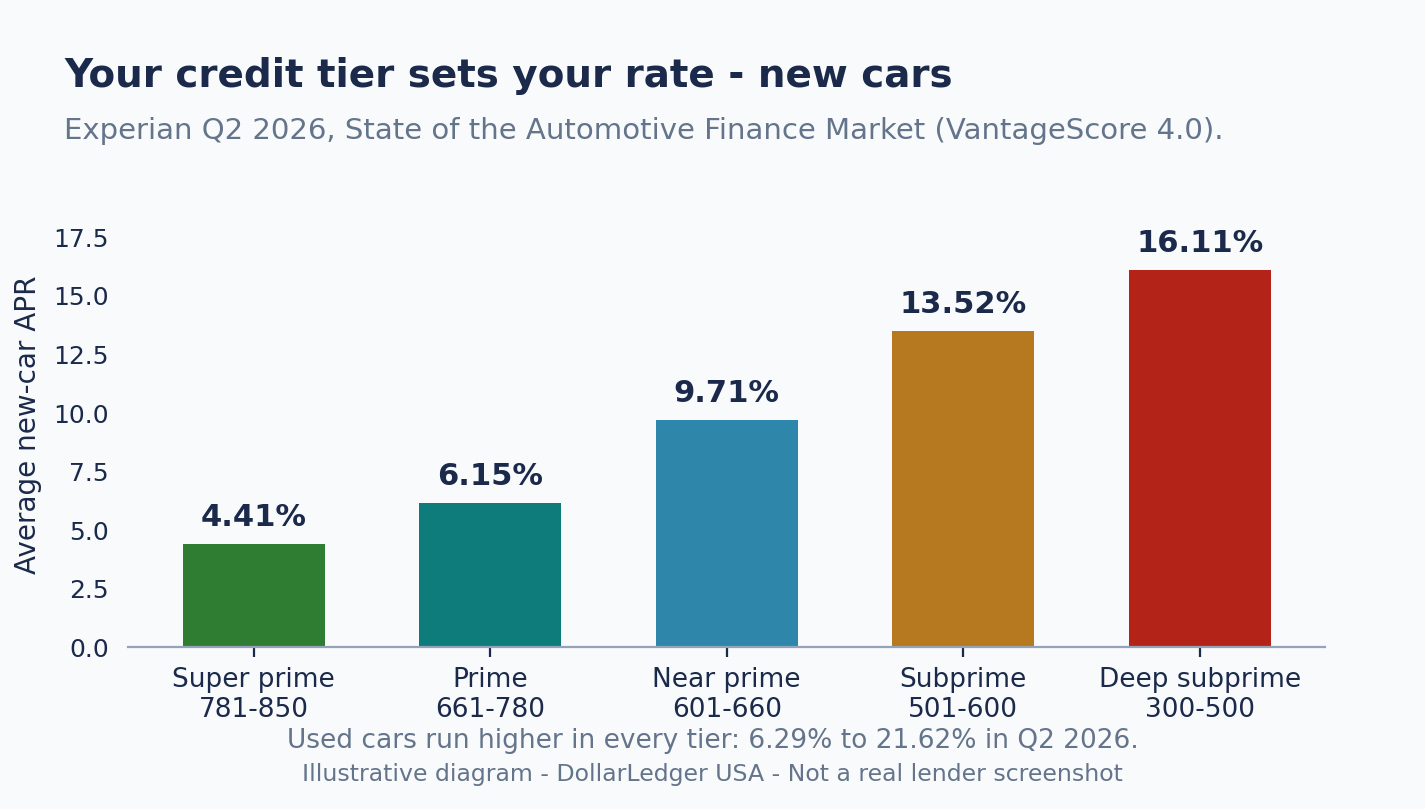
Illustrative diagram - What your credit tier pays on a new car, Experian Q2 2026. NOT a real lender screenshot.
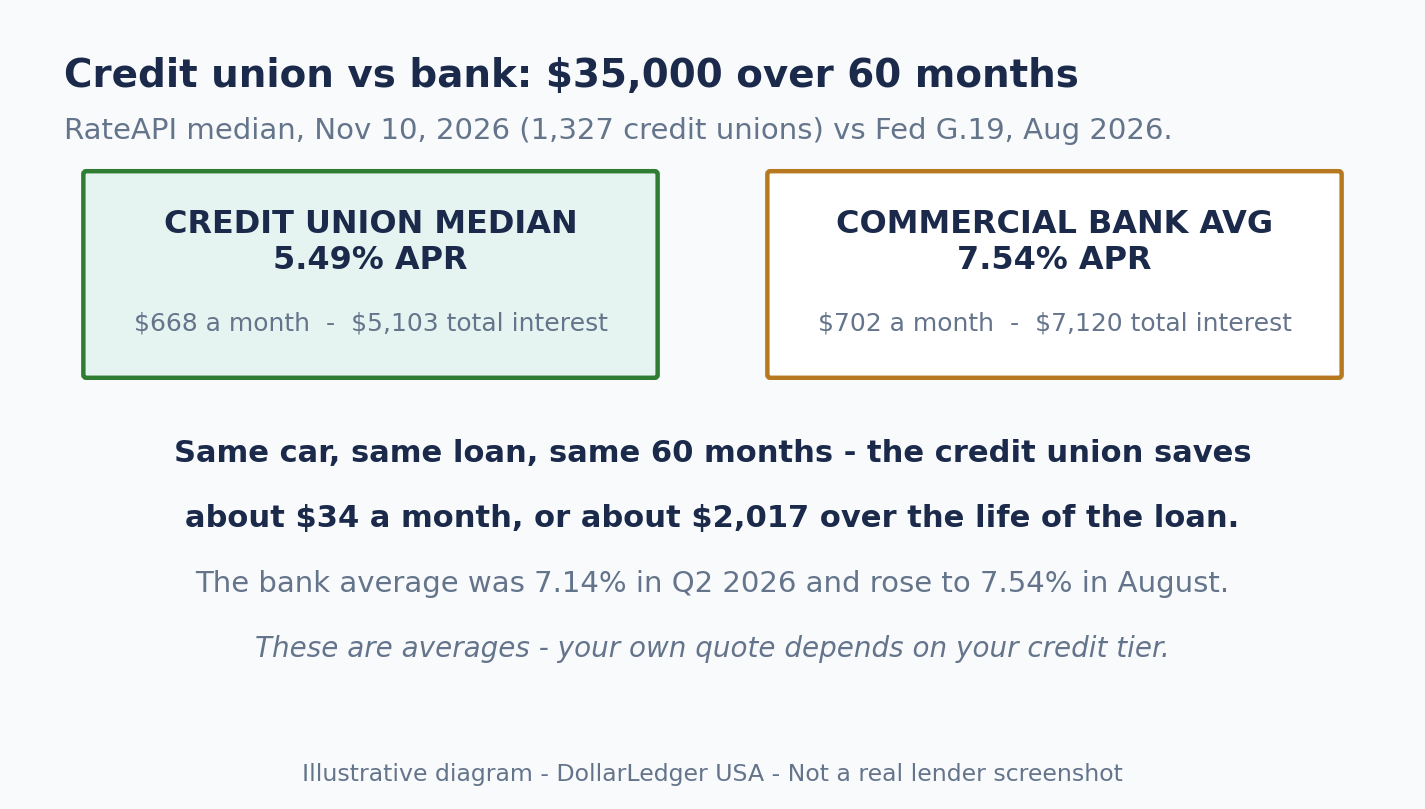
Illustrative diagram - Credit union vs bank on a $35,000 loan over 60 months. NOT a real lender screenshot.
Step 5: Pick the shortest term you can afford
What to do: Choose the shortest term whose payment fits your budget; avoid 72- and 84-month loans unless you have no choice.
How: A longer term cuts the payment but raises the total interest. At the November 4, 2026 new-car average of 5.984% (MonitorBankRates), a $35,000 loan costs $822 a month over 48 months ($4,443 interest), $676 over 60 months ($5,583), and $580 over 72 months ($6,745). The 72-month loan saves $96 a month against the 60-month loan but costs $1,162 more in interest, and $2,302 more than the 48-month loan. If the payment only works at 84 months, the car is too expensive.
Example: Two buyers finance the same $35,000 car at 5.984%. The 48-month buyer pays $822 a month and $4,443 in interest. The 72-month buyer pays $580 a month and $6,745 in interest.
Common mistake: Taking the 84-month loan to afford a pricier car, then owing more than it is worth.

Photo: The dealer’s offer has to beat your preapproval to win. (Photo: Pexels)
Step 6: Check the new car-loan interest tax deduction
What to do: Before you sign, check whether the new federal deduction for car loan interest applies to you - and do not count on it if it does not.
How: For tax years 2025 through 2028, the IRS allows a deduction of up to $10,000 a year in qualified vehicle loan interest, whether or not you itemize. But the tests are strict: the vehicle must be new, with its original use beginning with you - used and leased vehicles do not qualify - and its final assembly must be in the United States. The loan must have been taken out after December 31, 2024, secured by a first lien, for personal use, on a vehicle under 14,000 pounds. The deduction phases out above $100,000 of modified adjusted gross income ($200,000 joint) and ends at $150,000 ($250,000 joint); you must report the VIN. It is a deduction for interest paid, not a refund of your payments - on a typical loan the interest in a year is far below $10,000.
Example: Sam buys a new US-assembled SUV in 2026 on a January 2026 loan, with income under $100,000. He can deduct the interest he pays in 2026, up to $10,000. His brother buys the same model used - no deduction.
Common mistake: Buying a pricier car for the $10,000 headline, then learning it does not qualify.
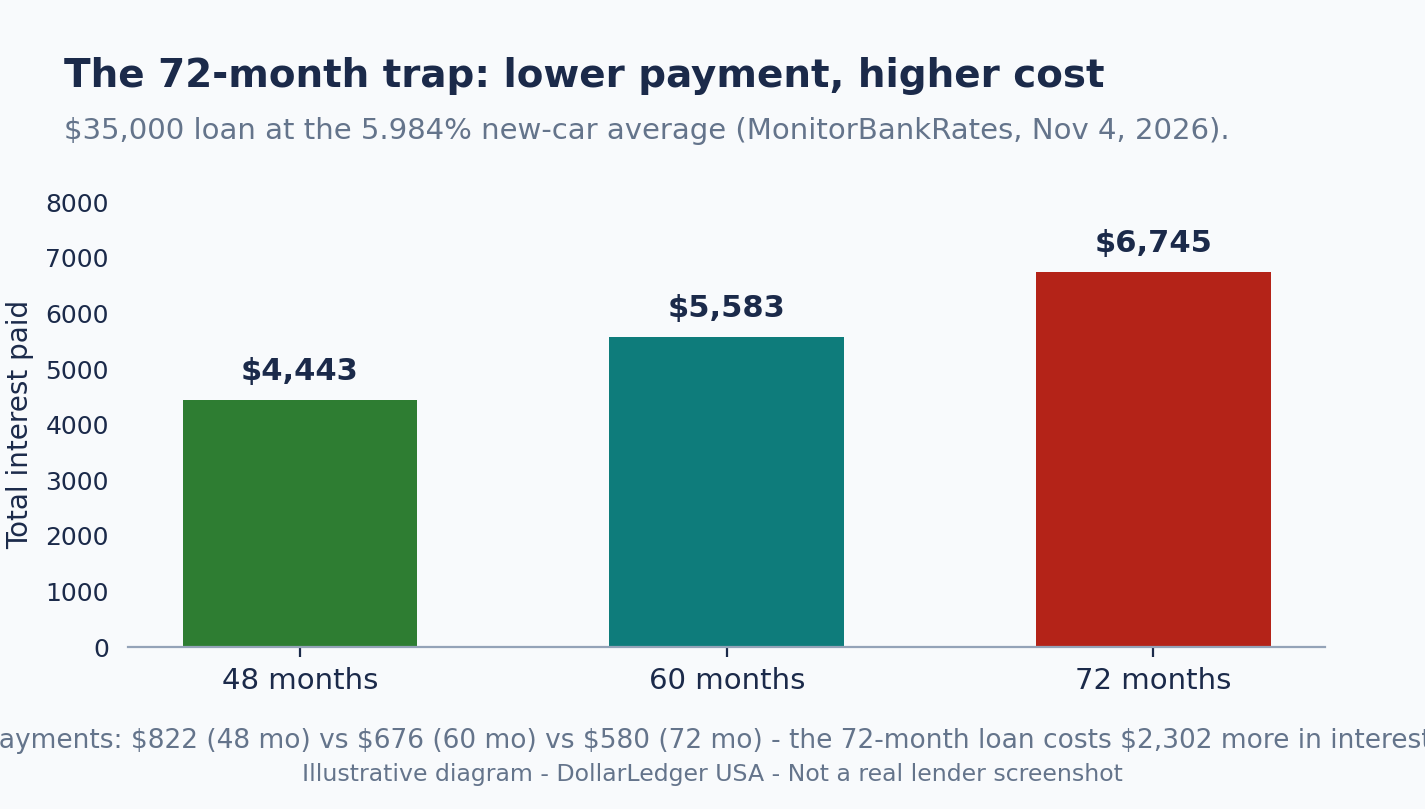
Illustrative diagram - The longer the term, the more interest you pay. NOT a real lender screenshot.
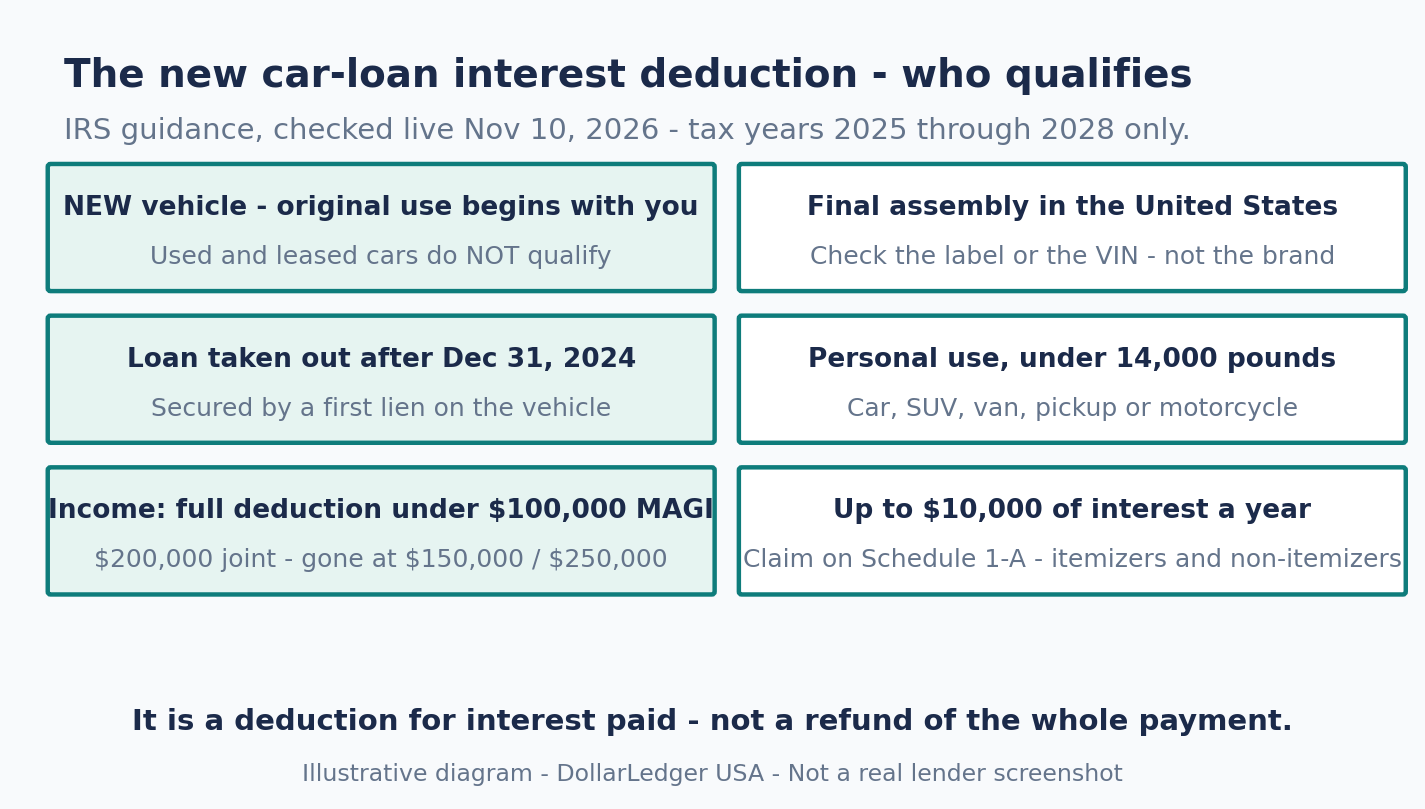
Illustrative diagram - The tax deduction checklist: every box must be ticked. NOT a real lender screenshot.
Checklist
- ☐ I checked my credit score and know my tier.
- ☐ I have a written preapproval before visiting the dealer.
- ☐ I compared the dealer’s APR, term, and amount financed with my preapproval.
- ☐ I picked the shortest term I can afford, and checked the deduction rules.
FAQ
What is a good auto loan rate in 2026?
It depends on your credit tier. In Q2 2026, Experian reported super prime borrowers averaged 4.41% on new cars and prime borrowers 6.15%, against 6.35% new and 11.19% used overall. A rate near your tier’s average is a good result.
Does shopping for an auto loan hurt my credit score?
Only a little, and only if you spread it out. The CFPB says auto loan inquiries within 14 to 45 days of each other generally count as one inquiry, so do all your applications inside about two weeks.
Should I finance at the dealer or at a bank?
Get the bank or credit union offer first, then let the dealer try to beat it. Dealer-arranged financing can cost more because the dealer may add a markup to the lender’s buy rate.
Is a used-car loan always more expensive than a new-car loan?
Almost always. On November 4, 2026, MonitorBankRates reported 5.984% for new cars and 6.741% for used cars, and Experian’s Q2 2026 averages were 6.35% new against 11.19% used.
Can I deduct my car loan interest on my taxes?
Only if the loan qualifies: for tax years 2025 through 2028, up to $10,000 a year of interest may be deductible on a loan for a new, US-assembled vehicle for personal use, taken out after December 31, 2024, with phase-outs from $100,000 ($200,000 joint). Used cars, leases, and foreign-assembled cars do not qualify.
Sources
- Federal Reserve, G.19 Consumer Credit (release Nov 6, 2026; opened live Nov 10, 2026): https://www.federalreserve.gov/releases/g19/current/
- Consumer Financial Protection Bureau, ways to buy or finance a car (opened live Nov 10, 2026): https://www.consumerfinance.gov/ask-cfpb/what-is-the-difference-between-dealer-arranged-and-bank-financing-en-759/
- IRS, Working Families Tax Cuts, no tax on car loan interest (opened live Nov 10, 2026): https://www.irs.gov/newsroom/working-families-tax-cuts-individuals-and-workers
- DollarLedger USA, How to Get a Personal Loan in USA 2026: </blog/how-to-get-personal-loan-in-usa-2026>
Disclaimer: For education only, not tax or investment advice. Rates change daily - confirm your own rate with the lender before you sign.