How to Find a Legitimate Remote Job in USA 2026 — Real Boards, Real Pay, and the Scams to Avoid
 DollarLedger Team
- 08 Nov, 2026

Remote work is real in the United States — and so are the fake jobs that imitate it. The Bureau of Labor Statistics reported that 22.4% of people at work teleworked during 2025 — about 35.4 million people. That is a large, real market — and a large target. The Federal Trade Commission reported losses to job and employment agency scams rose from $90 million in 2020 to $501 million in 2024, while reports tripled. Fake listings look professional and the pay looks generous — that is the bait. This guide works the other way round: vet first, apply second.
Photo: Real remote work is common in the USA — about 22.4% of people at work teleworked in 2025, the BLS reported. (Photo: Pexels)
What You Will Learn
- Where real remote jobs live — and where the fakes are
- How big the job-scam problem is, in the FTC’s reported figures
- What entry-level remote work really pays
- A 5-minute check before every application
- Six red flags that end an application
Step 1: Start where real remote jobs live
What to do: Search sources close to the employer, not the biggest pile.
How: Real remote roles live in five places: the company’s own career page; We Work Remotely and Remote.co, both free remote-only boards; FlexJobs, which hand-screens listings for a paid subscription (reported at about $25 a month — check the current price); and LinkedIn with the Remote filter, as a starting point only. Big aggregators are for discovery, never trust.
Example: Priya finds the same customer service job on an aggregator and on the company’s careers page, and applies through the company page. Her friend applies through a text link to an aggregator-only listing — and never hears back. There was no job.
Common mistake: Treating listing count as quality. Ten thousand results is not ten thousand jobs.
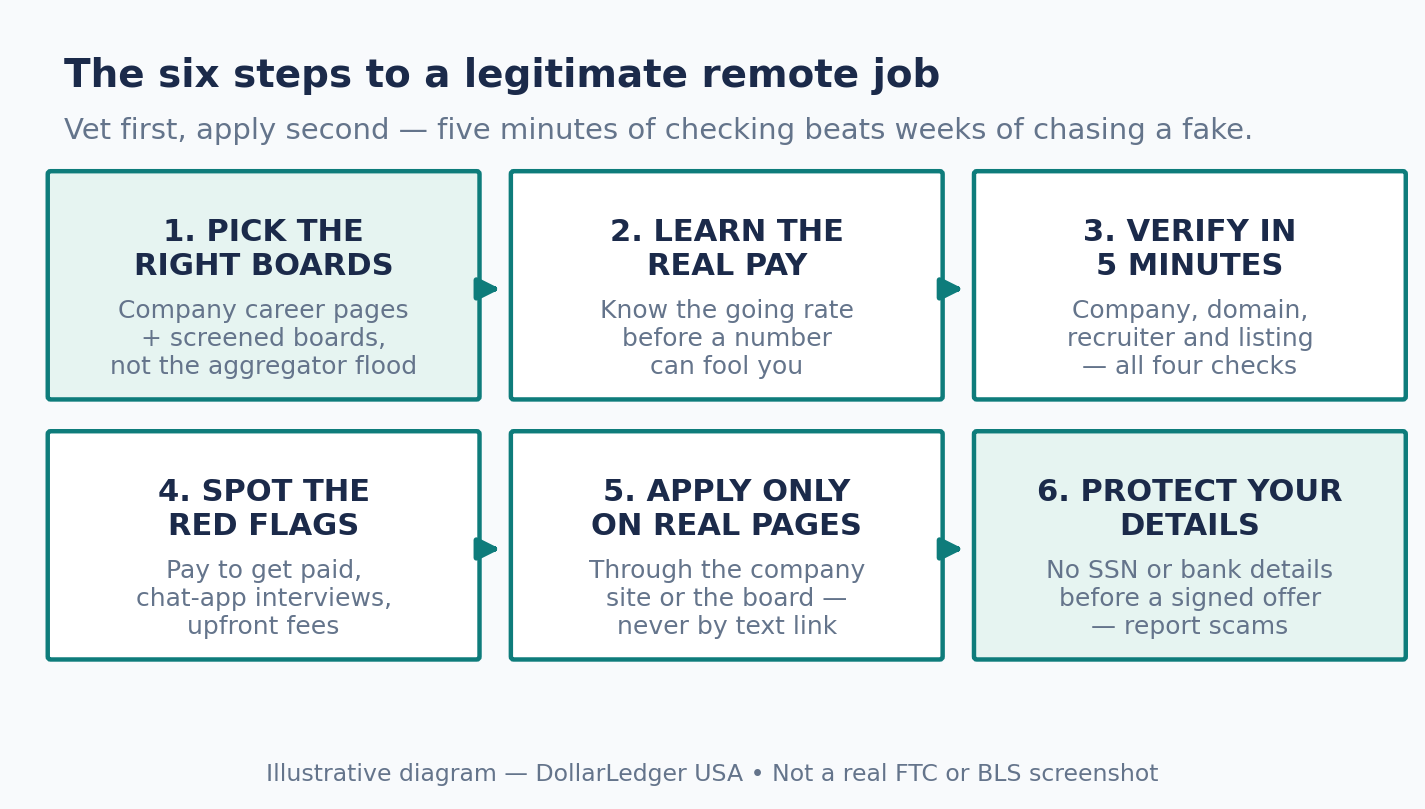
Illustrative diagram — The six steps to a legitimate remote job in 2026. NOT a real FTC or BLS screenshot.
Step 2: Know how big the job-scam problem is
What to do: Learn the scale before you click, so a too-good offer triggers suspicion, not excitement.
How: The FTC’s March 2025 release: reports of job and employment agency scams tripled from 2020 to 2024, reported losses rose from $90 million to $501 million, and there were 104,946 reports in 2024 alone. These are reported figures — most scams are never reported. The FBI’s Internet Crime Complaint Center reported separately: 24,688 employment scam complaints in 2025, with $362.9 million in reported losses. The agencies count different things, so do not add them. Both point the same way: remote work is a favourite disguise, because a job you never visit is easy to fake.
Example: A listing promises $45 an hour for data entry, no experience, start tomorrow — and asks you to message a recruiter on WhatsApp. That is the standard script, not a generous employer.
Common mistake: Thinking scams only catch careless people — they target people who need work urgently.
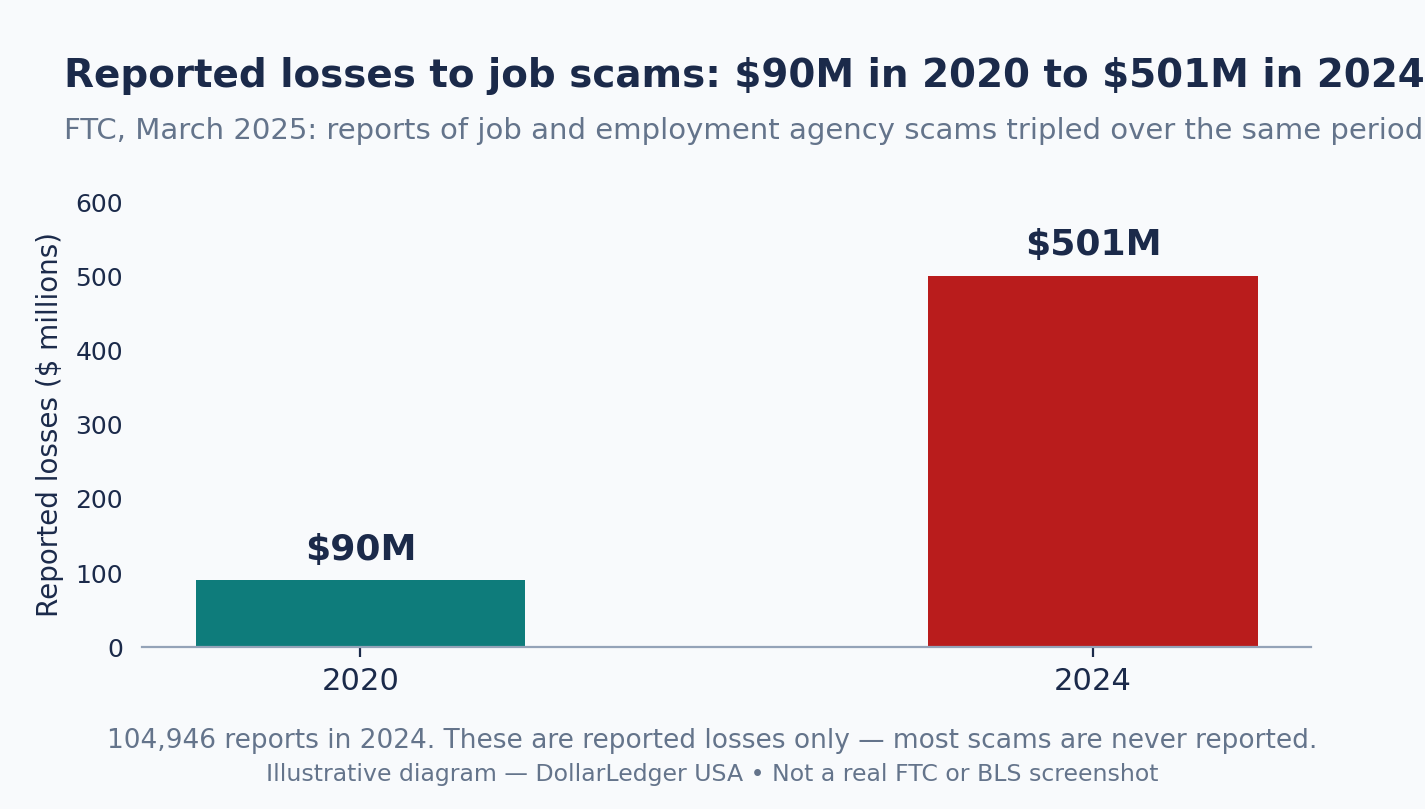
Illustrative diagram — Reported losses to job scams grew more than fivefold in four years. NOT a real FTC screenshot.

Photo: Know the going rate before a pay figure can fool you — Step 3 is the cheapest scam filter there is. (Photo: Pexels)
Step 3: Learn the real pay before you believe a number
What to do: Memorise the going rate for your role, so an inflated offer warns you instead of tempting you.
How: Entry-level remote work pays ordinary wages: customer service is commonly reported at roughly $13 to $19 an hour, data entry at roughly $12 to $18 an hour. Experienced roles pay more, but pay matches the skill asked for. So when a listing offers $40 to $60 an hour for basic data entry with no experience and no interview, the number itself is the red flag — no employer pays a beginner three times the market rate. Check the range for your role before you apply, and write it down.
Example: One data entry listing offers $15 an hour, a typing test and a video interview; another offers $55 an hour, no experience, no interview, start today. The first is a job; the second is a trap — and the trap is the pay figure.
Common mistake: Applying first, checking pay later. Once a ‘recruiter’ is praising you, walking away feels like losing something.
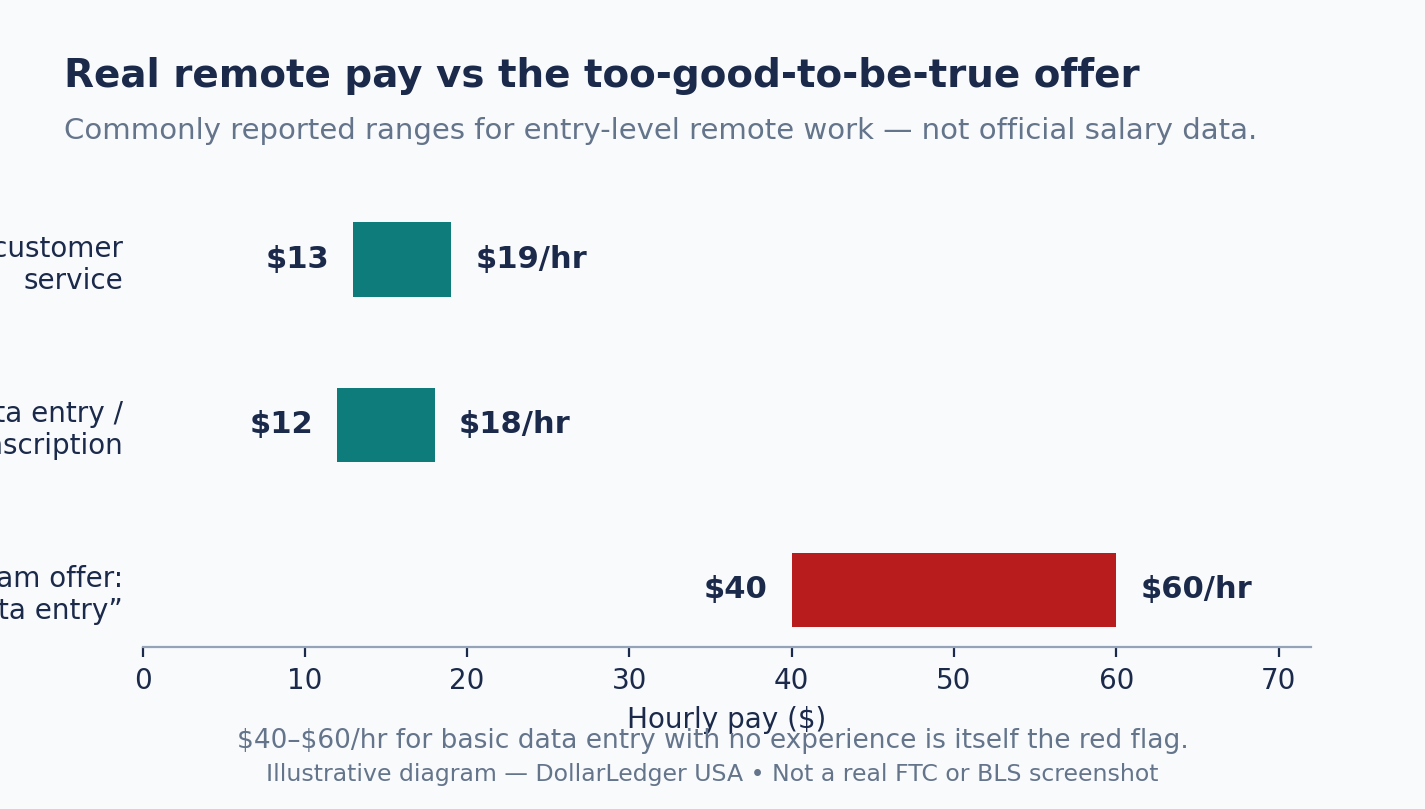
Illustrative diagram — Real remote pay vs the too-good-to-be-true offer. NOT a real salary survey screenshot.
Step 4: Search like a screener, not a scroller
What to do: Use the boards from Step 1 properly — filters, alerts, and a rule that every listing is traced back to the employer.
How: On LinkedIn, turn on the Remote and date filters; ignore anything older than two weeks unless it is on the company site. Set alerts on We Work Remotely and Remote.co for your exact role. On every listing, click through: is the job on the company’s career page with the same title and pay? If not, treat it as unverified. Check target companies’ career pages weekly — the best roles are often filled before they reach an aggregator.
Example: Marcus sets alerts and checks five companies’ career pages every Monday; in three weeks he applies to nine verified roles. His cousin scrolls an aggregator two hours a day and applies to forty listings — six ask him to pay for ‘training’ first.
Common mistake: Applying to everything that looks roughly right. Ten careful applications beat forty rushed ones.
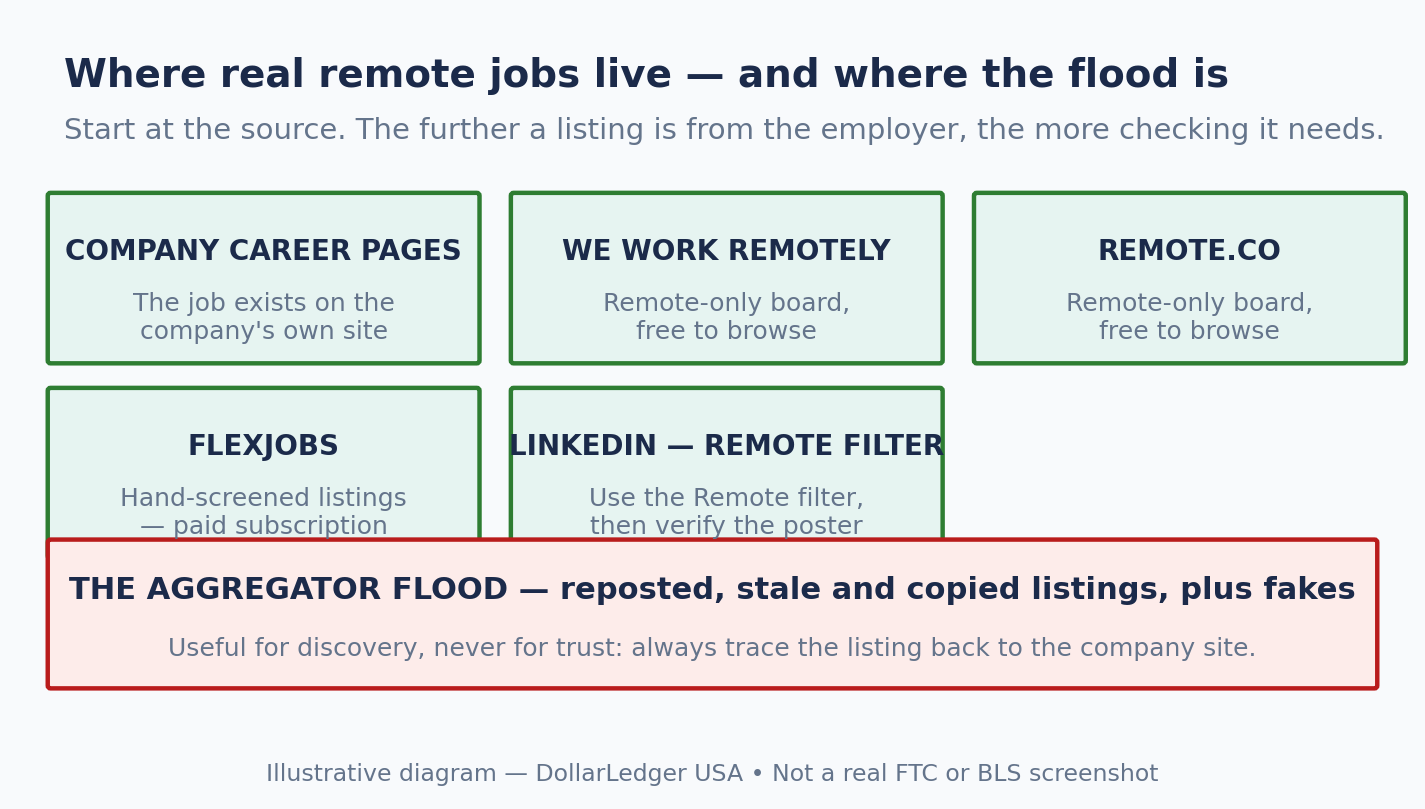
Illustrative diagram — Where real remote jobs live, and where the flood is. NOT a real job board screenshot.

Photo: Five minutes of checking before you apply is the whole routine — Step 5 takes less time than making this coffee. (Photo: Pexels)
Step 5: Run the 5-minute verification routine before every application
What to do: Check four things — company, listing, domain, search — before you send anything.
How: One, the company: a real website, address and history. Two, the listing: the same job on the company’s career page, same title and pay. Three, the domain: the recruiter’s email ends in the company domain — not Gmail, and not a one-letter lookalike. Four, the search: the company name plus ‘scam’, ‘review’ or ‘complaint’. Then insist on a real interview — video or in person, with a named hiring manager. If any check fails, stop: you have lost five minutes, not your money or your identity.
Example: Ana gets a message from a ‘recruiter’ at a well-known retailer. The email is from Gmail, the job is not on the career page, and a search shows others reporting the same message as a scam. She deletes it — and next week gets a video interview for a real listing on the career page.
Common mistake: Verifying the company but not the recruiter — the company can be genuine while the messenger is not.
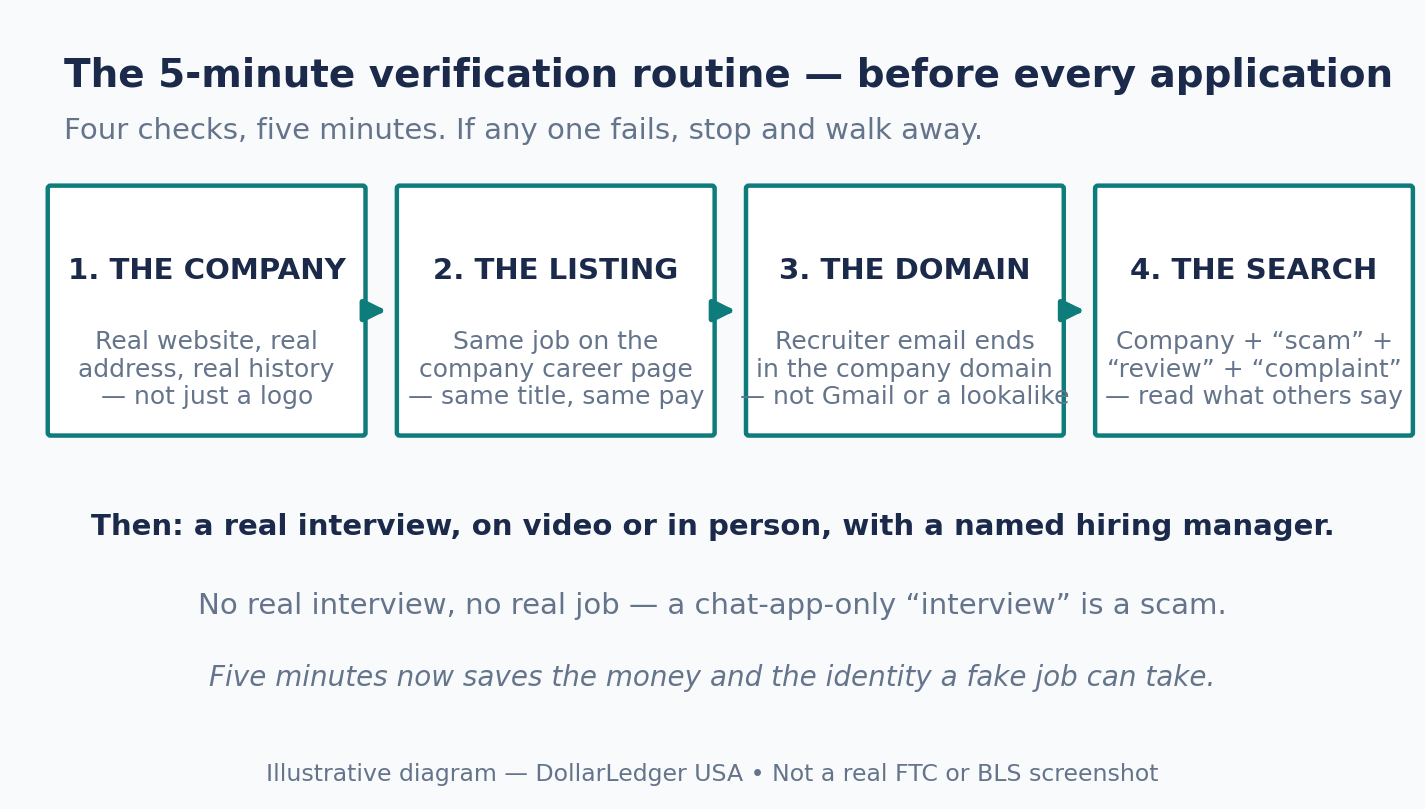
Illustrative diagram — The 5-minute verification routine, before every application. NOT a real FTC screenshot.
Step 6: Spot the red flags and protect your details
What to do: Learn the six signs that end an application on the spot, and keep sensitive details private until a signed offer.
How: The FTC’s rule is simple: honest employers never ask you to pay to get a job. Never pay for training, equipment or a background check; never accept a chat-app-only interview; never trust a recruiter off the company domain; never share your Social Security number or bank details before a signed offer; never deposit a check and send part back, or buy gift cards with it — the check will bounce and your bank will want the money back; never pay by crypto, wire or gift card. See one? Stop, report it at ReportFraud.ftc.gov, and tell the real company its name is being used.
Example: A ‘recruiter’ sends Ben a $2,000 check for a laptop from their ‘approved supplier’ and asks for the change back. Ben sends $800 — then his bank says the check is fake. The job never existed; the $800 was the job.
Common mistake: Thinking a signed offer letter means the job is real. Scammers fake those too — verify the offer through the company, using contact details you found yourself.
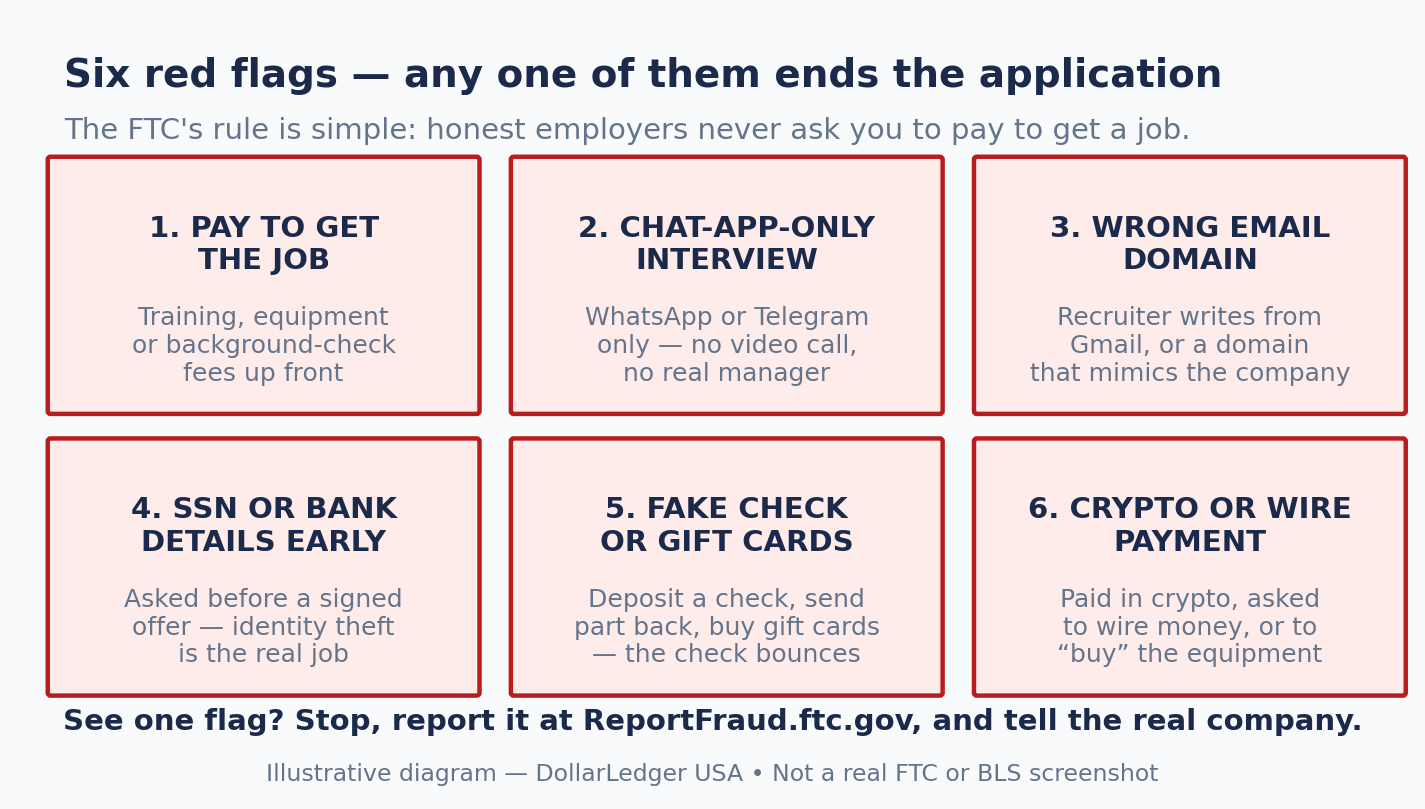
Illustrative diagram — Six red flags: any one of them ends the application. NOT a real FTC screenshot.
Checklist
- ☐ I searched career pages and screened boards, not aggregators.
- ☐ I know the real pay range for my role.
- ☐ I ran the 5-minute check before applying.
- ☐ I checked the recruiter’s domain.
- ☐ I never paid for training, equipment or a background check.
- ☐ I shared no SSN or bank details before a signed offer.
FAQ
Where can I find legitimate remote jobs in the USA? On company career pages, remote-only boards like We Work Remotely and Remote.co, FlexJobs (hand-screened, paid), and LinkedIn with the Remote filter — always tracing the listing back to the company’s site.
How do I know if a remote job is a scam? Confirm the company and listing on its career page, check the recruiter’s email domain, and search the company name with ‘scam’, ‘review’ and ‘complaint’. Any request to pay, a chat-app-only interview, or a demand for your Social Security number before a signed offer means scam.
What do real remote entry-level jobs pay? Customer service is commonly reported at roughly $13 to $19 an hour, data entry at roughly $12 to $18 an hour. An offer of $40 to $60 an hour for basic data entry with no experience is itself the red flag.
Is FlexJobs legitimate? Yes — a paid, hand-screened remote job board, not a scam. Reported prices are about $25 a month or about $40 for three months; check the current price first. Screening removes most junk; it does not guarantee a job.
What should I do if I already paid a job scammer? Ask the payment company to reverse it, call your bank, and report it to the FTC at ReportFraud.ftc.gov. If you shared your Social Security number, consider a fraud alert or credit freeze.
Sources
- Federal Trade Commission, March 2025 fraud data release: https://www.ftc.gov/news-events/news/press-releases/2025/03/new-ftc-data-show-big-jump-reported-losses-fraud-125-billion-2024
- U.S. Bureau of Labor Statistics, Table 59, 2025 Annual Averages: https://www.bls.gov/cps/cpsaat59.htm
- DollarLedger USA, “Freelancer Taxes in USA 2026”: </blog/freelancer-taxes-in-usa-2026-self>
All figures checked November 8, 2026, against FTC and BLS pages. Reported figures are what people reported — most scams are never reported.
Disclaimer: Education only, not legal or career advice. Confirm current prices and listings before you pay or apply.