Backdoor Roth IRA in 2026 — When Your Income Is Too High for a Direct Roth
 DollarLedger Team
- 14 Nov, 2026

You earn too much for a Roth IRA — the front door is closed. For 2026, direct Roth contributions phase out at $153,000–$168,000 of modified adjusted gross income (MAGI) for single filers and heads of household, and $242,000–$252,000 for married couples filing jointly (IRS, IR-2025-111). The backdoor Roth IRA is the workaround: contribute to a traditional IRA without a tax deduction, then convert it to a Roth IRA. There is no income limit on the conversion itself. But the backdoor has a trap — the pro-rata rule. If you hold any pre-tax money in a traditional, SEP or SIMPLE IRA, part of every conversion is taxed. All figures checked November 13, 2026.
Caption: Photo: The backdoor Roth is two legal steps — a nondeductible contribution, then a conversion. The tax trap is in the middle. (Photo: Pexels)
What You Will Learn
- Whether the front door is really closed for you
- The pro-rata rule, and your tax bill before you convert
- How a 401(k) rollover makes a backdoor clean
- Two deadlines that are not the same date
- Converting and reporting it on Form 8606
Step 1: Check whether the front door is really closed
What to do: Work out your modified adjusted gross income (MAGI) first.
How: For 2026, a single filer or head of household can contribute in full below $153,000 of MAGI, a reduced amount between $153,000 and $168,000, and nothing at $168,000 or more. For married couples filing jointly, the range is $242,000 to $252,000. Married filing separately is the harsh one: if you lived with your spouse at any time in the year, the range is $0 to $10,000. MAGI is adjusted gross income with a few add-backs, and Roth conversion income does not count. See the full 2026 table in our Roth IRA contribution limits guide.
Example: A single filer at $160,500 MAGI sits halfway through the $15,000 range, so the $7,500 limit is cut in half to $3,750.
Common mistake: A high salary alone does not lock you out — MAGI counts, and 401(k) and HSA contributions lower it.
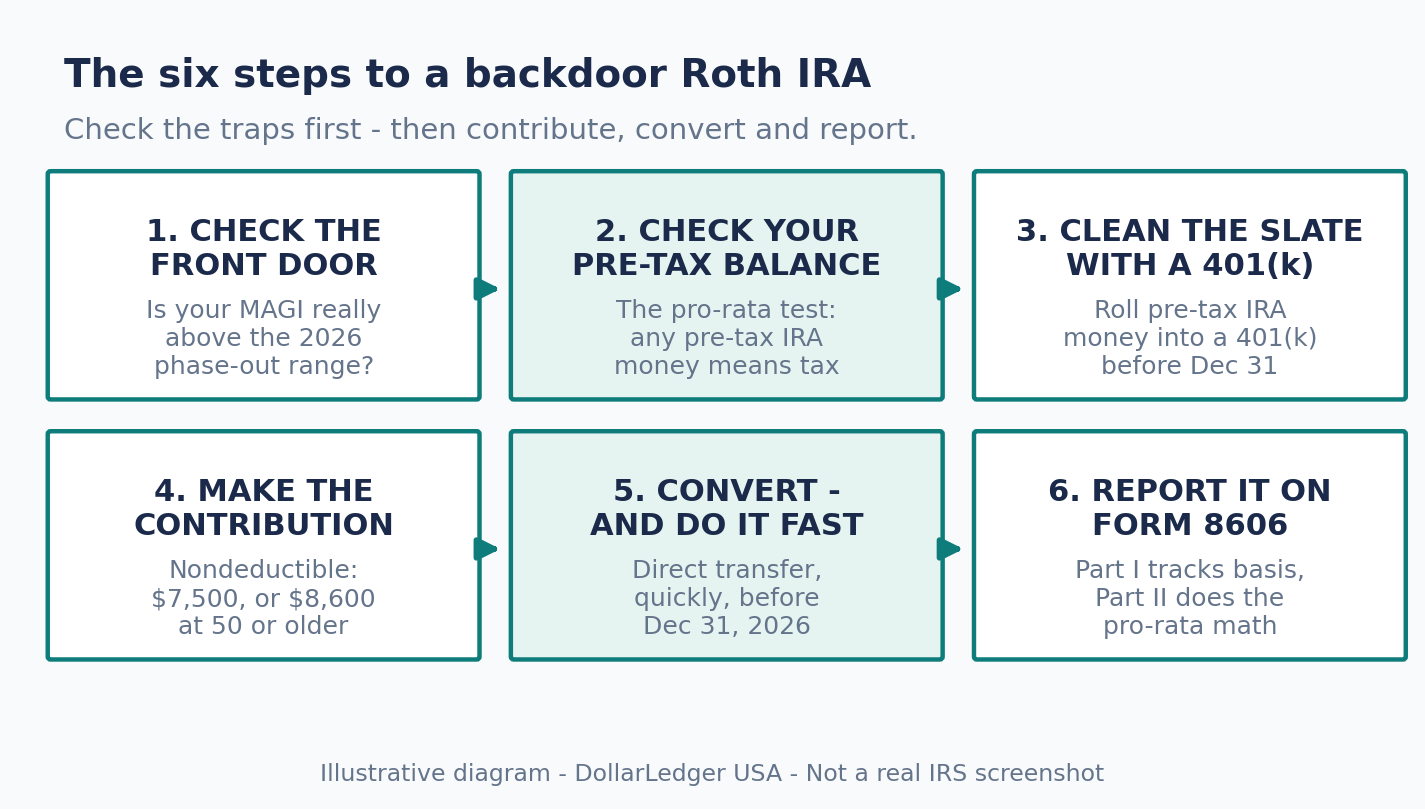
Caption: Illustrative diagram - The six steps to a backdoor Roth IRA. NOT a real IRS screenshot.
Step 2: Check your pre-tax IRA balance — the pro-rata test
What to do: Add up all pre-tax money in your traditional, SEP and SIMPLE IRAs.
How: The IRS does not let you cherry-pick only after-tax dollars to convert. Under the pro-rata rule, all your traditional, SEP and SIMPLE IRAs count as one pool, and every dollar you convert is the same mix of pre-tax and after-tax money as the whole pool. It uses the fair market value of all those accounts on December 31 of the conversion year. Your after-tax share is your nondeductible basis divided by that total; the rest is taxable income. A 401(k) is not in the pool — see Step 3.
Example: With $67,500 pre-tax in an old rollover IRA plus a $7,500 nondeductible contribution, your pool is $75,000 and your after-tax share is 10%. Convert $7,500: only $750 is tax-free; $6,750 is added to your income. At a 24% marginal rate, that is a $1,620 surprise tax bill.
Common mistake: Thinking the conversion is tax-free because the contribution was nondeductible — the pre-tax money in your other IRAs is taxed.
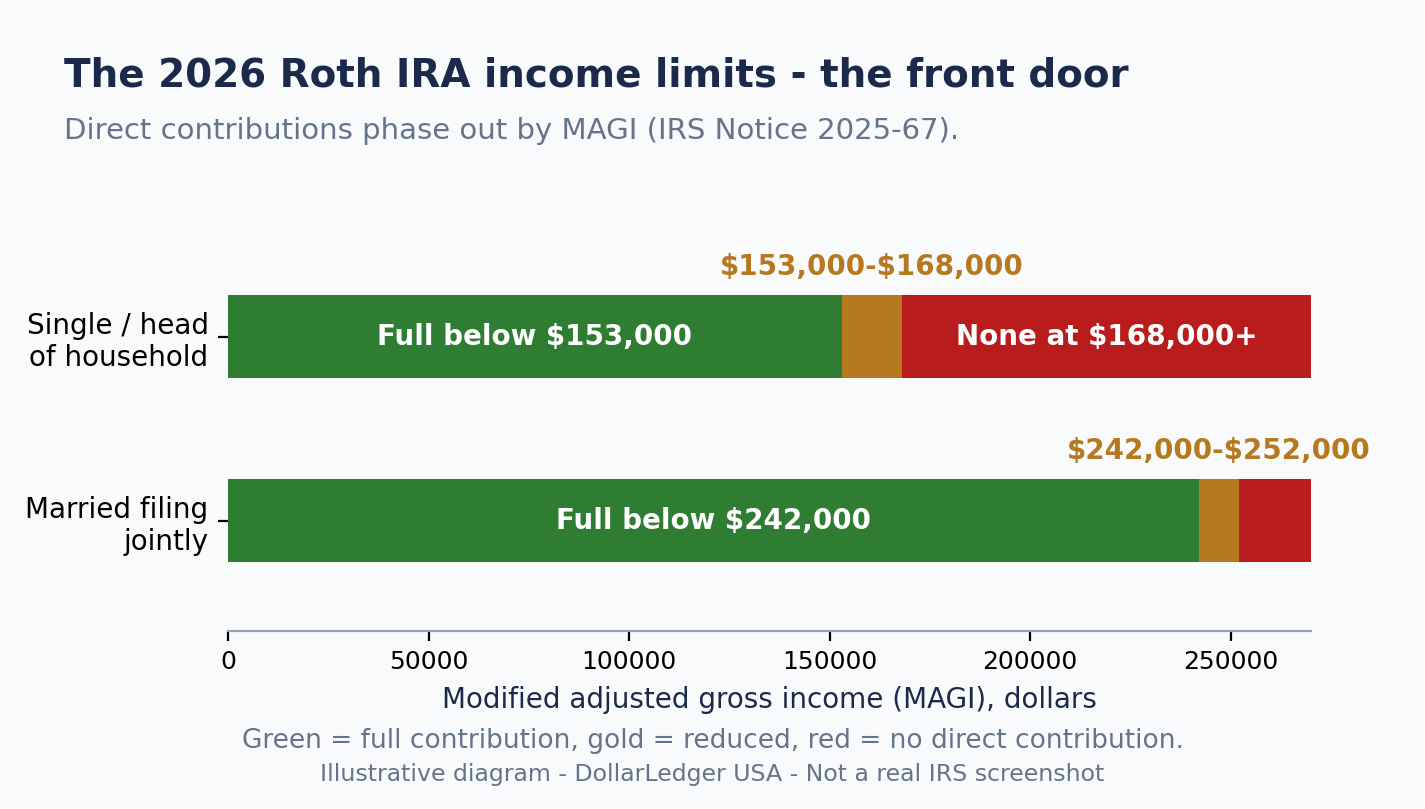
Caption: Illustrative diagram - The 2026 Roth IRA income limits (IRS Notice 2025-67). NOT a real IRS screenshot.
Caption: Photo: Run the pro-rata math before you convert — the tax bill is decided by your December 31 IRA balances. (Photo: Pexels)
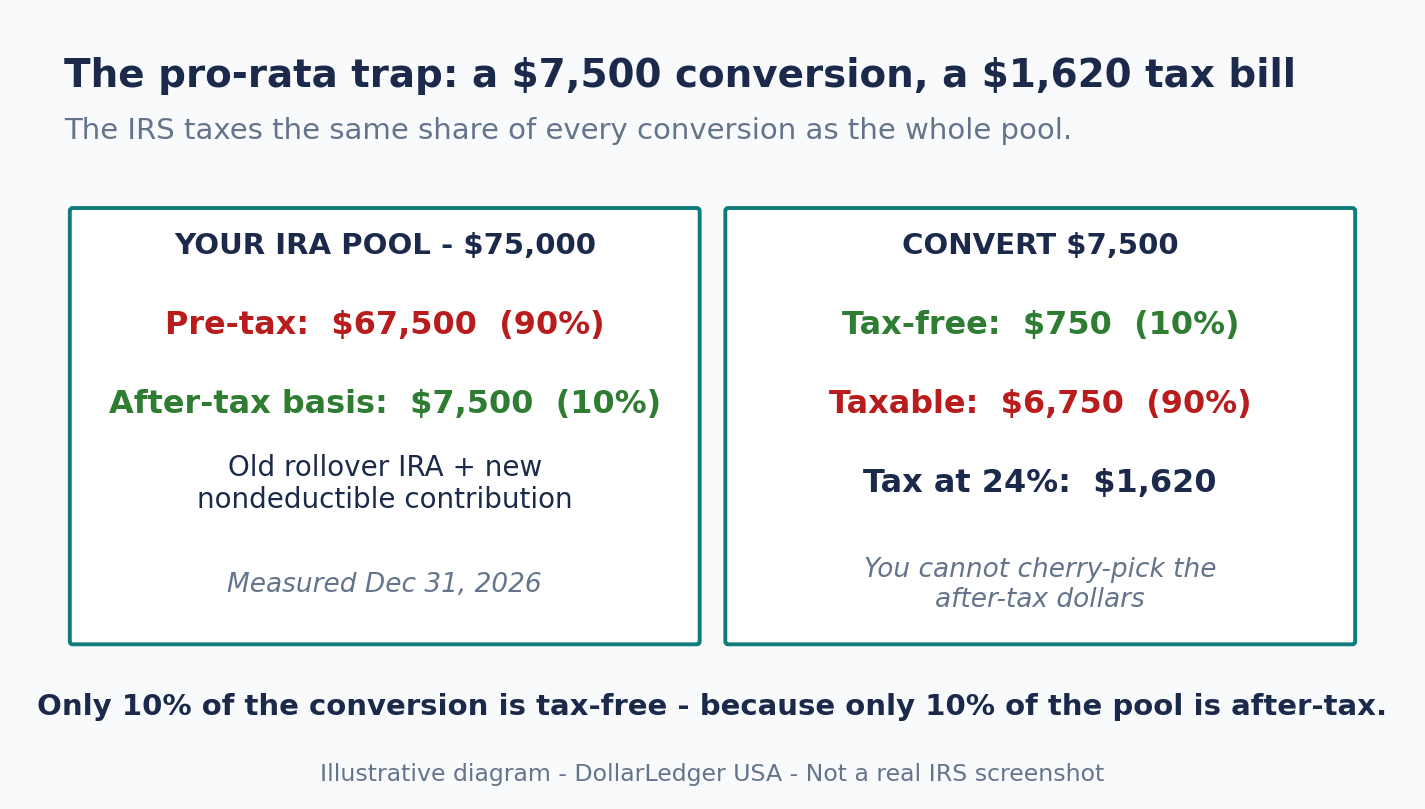
Caption: Illustrative diagram - The pro-rata trap: a $7,500 conversion with a $1,620 surprise tax bill. NOT a real IRS screenshot.
Step 3: Clean the slate first — roll pre-tax money into your 401(k)
What to do: If you hold pre-tax IRA money, move it into an employer 401(k) before converting, if your plan accepts roll-ins.
How: Because 401(k) balances are not counted in the pro-rata pool, rolling pre-tax IRA money into your employer’s 401(k) shrinks it. Move all of it and your pre-tax IRA balance is $0, so the backdoor is clean. Ask your plan administrator whether it accepts roll-ins from IRAs; most large plans do. Only pre-tax money can move — your after-tax basis stays in the IRA. Finish before December 31 of the conversion year — the IRS measures the pool on that date. With no current 401(k), a solo 401(k) works the same way.
Example: The same saver rolls the $67,500 pre-tax into a 401(k) first. The IRA pool is now just the $7,500 nondeductible contribution — 100% after-tax — so converting $7,500 costs $0 in tax, apart from earnings.
Common mistake: Converting first and never rolling the pre-tax money into the 401(k). The December 31 snapshot then taxes most of the conversion.
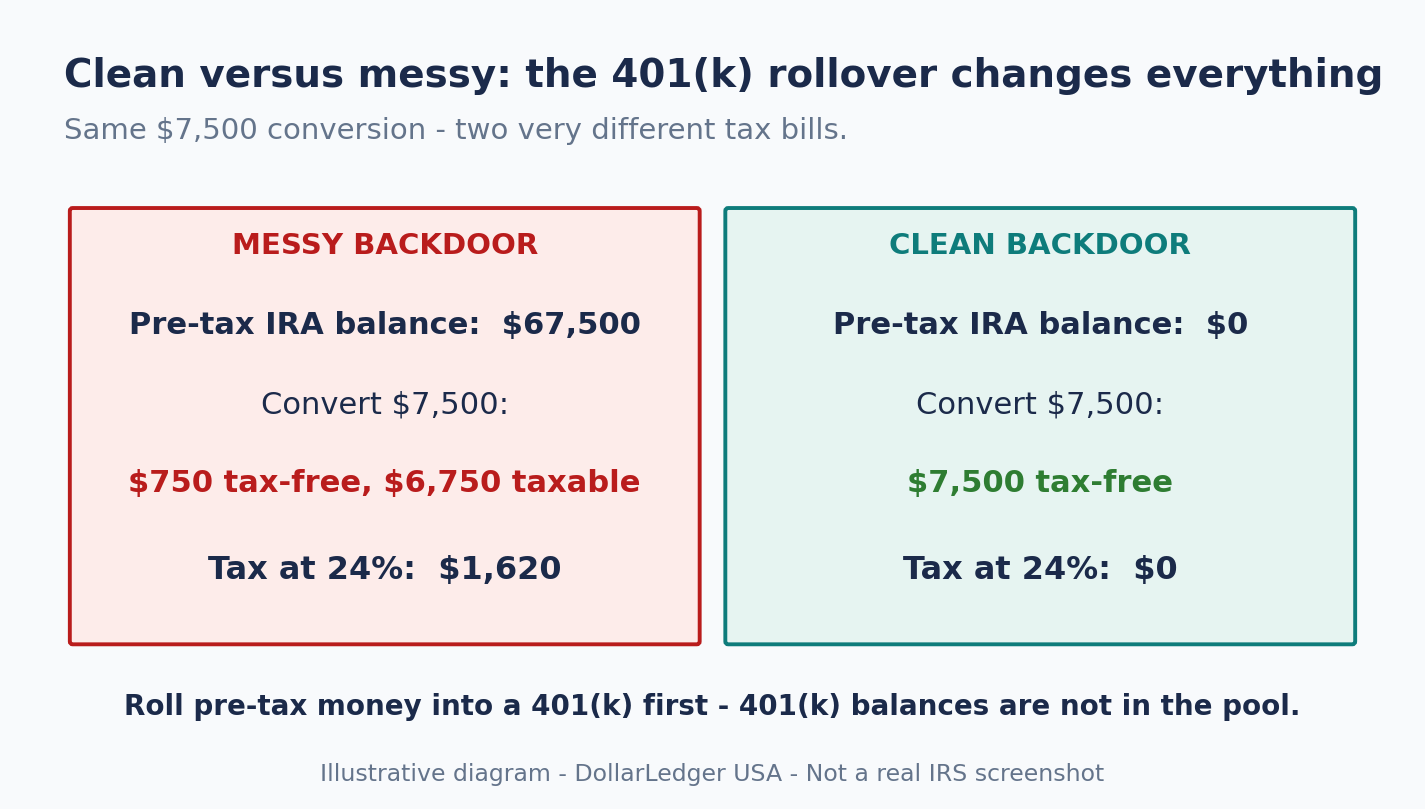
Caption: Illustrative diagram - Clean versus messy: the 401(k) rollover is what makes the backdoor tax-free. NOT a real IRS screenshot.
Step 4: Make the nondeductible contribution
What to do: Contribute to a traditional IRA and do not deduct it — the “backdoor” entry.
How: For 2026, the combined limit across all your IRAs is $7,500 under 50, or $8,600 at 50 or older (IRS). You need earned income at least equal to your contribution. Tell your broker it is nondeductible, and keep the confirmation. With no deduction, the contribution itself creates no tax bill; the tax question is only about the conversion. A traditional IRA and a Roth IRA are taxed in opposite ways — see our Roth vs traditional IRA guide for 2026.
Example: A 45-year-old earning $180,000 contributes $7,500 in March 2026 and marks it nondeductible. Her 401(k) already holds her old pre-tax IRA money, so her pool is 100% after-tax.
Common mistake: Forgetting to tell anyone the contribution was nondeductible. Without Form 8606 (Step 6), the IRS has no record that the money was already taxed.
Step 5: Convert — and do it fast
What to do: Move the money from the traditional IRA to the Roth IRA by direct trustee-to-trustee transfer, as soon as you can after contributing.
How: With a direct transfer you never touch the money, so nothing is withheld and there is no 60-day deadline. Convert quickly: earnings before the conversion are pre-tax, so they are taxable when converted. A same-week conversion means pennies of earnings; six months later can mean real tax. Conversions have no income limit and no dollar limit — the $7,500 limit applies to contributions, not conversions. A conversion counts in the year it happens, so for 2026 it must be completed by December 31, 2026. There is no undo button: conversions made since 2018 cannot be recharacterized back. No Roth IRA yet? See how to open a Roth IRA in 2026.
Example: The $7,500 sits in a money-market fund for five days, earning $4. Convert $7,504 and only the $4 is taxable — about $1 of tax at 24%.
Common mistake: Taking a personal cheque and missing the 60-day window. A direct transfer avoids the deadline and the withholding.

Caption: Photo: Convert quickly after contributing — every dollar of earnings before the conversion is taxable. (Photo: Pexels)
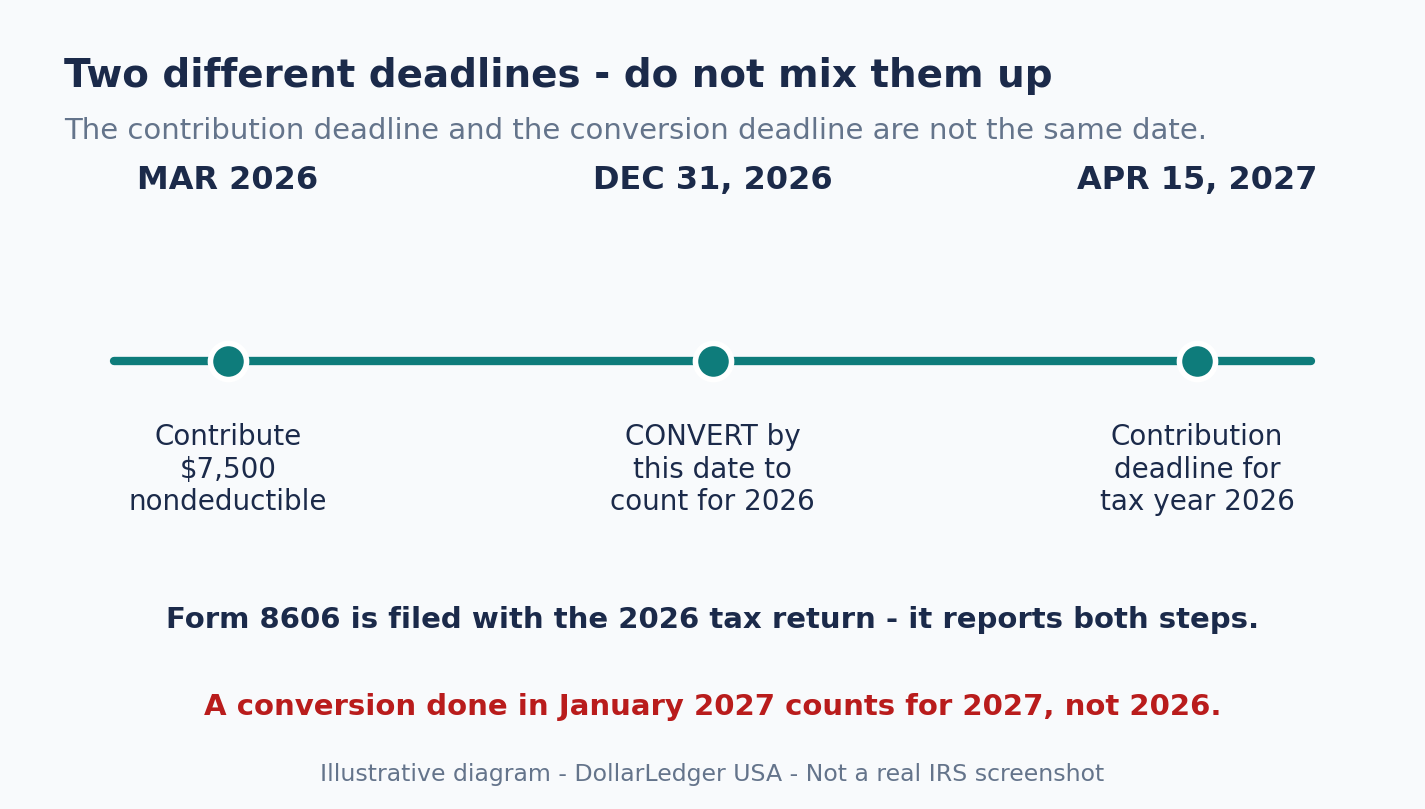
Caption: Illustrative diagram - Two different deadlines: contribute by April 15, 2027, convert by December 31, 2026. NOT a real IRS screenshot.
Step 6: Report it right — Form 8606
What to do: File IRS Form 8606 with your return for every year you contribute nondeductible money or convert.
How: Form 8606 is how the IRS knows you have after-tax dollars in your traditional IRAs. Part I tracks nondeductible contributions and carries your basis forward; Part II computes the taxable part. File it for both the contribution year and the conversion year; if both are 2026, one form covers both. Your custodian sends Form 1099-R and Form 5498, but neither decides the tax — Form 8606 does. Skip Form 8606 and the IRS has no record of your basis — the whole conversion can be treated as taxable. Keep every 8606.
Example: Our saver files Form 8606 for 2026 showing a $7,500 nondeductible contribution, a $0 pre-tax balance on December 31, and a $7,504 conversion, $4 taxable. Next year her basis is $0 — the money is now in the Roth.
Common mistake: Filing without Form 8606 because the tax software did not ask. If you made a nondeductible contribution, answer yes when it asks.
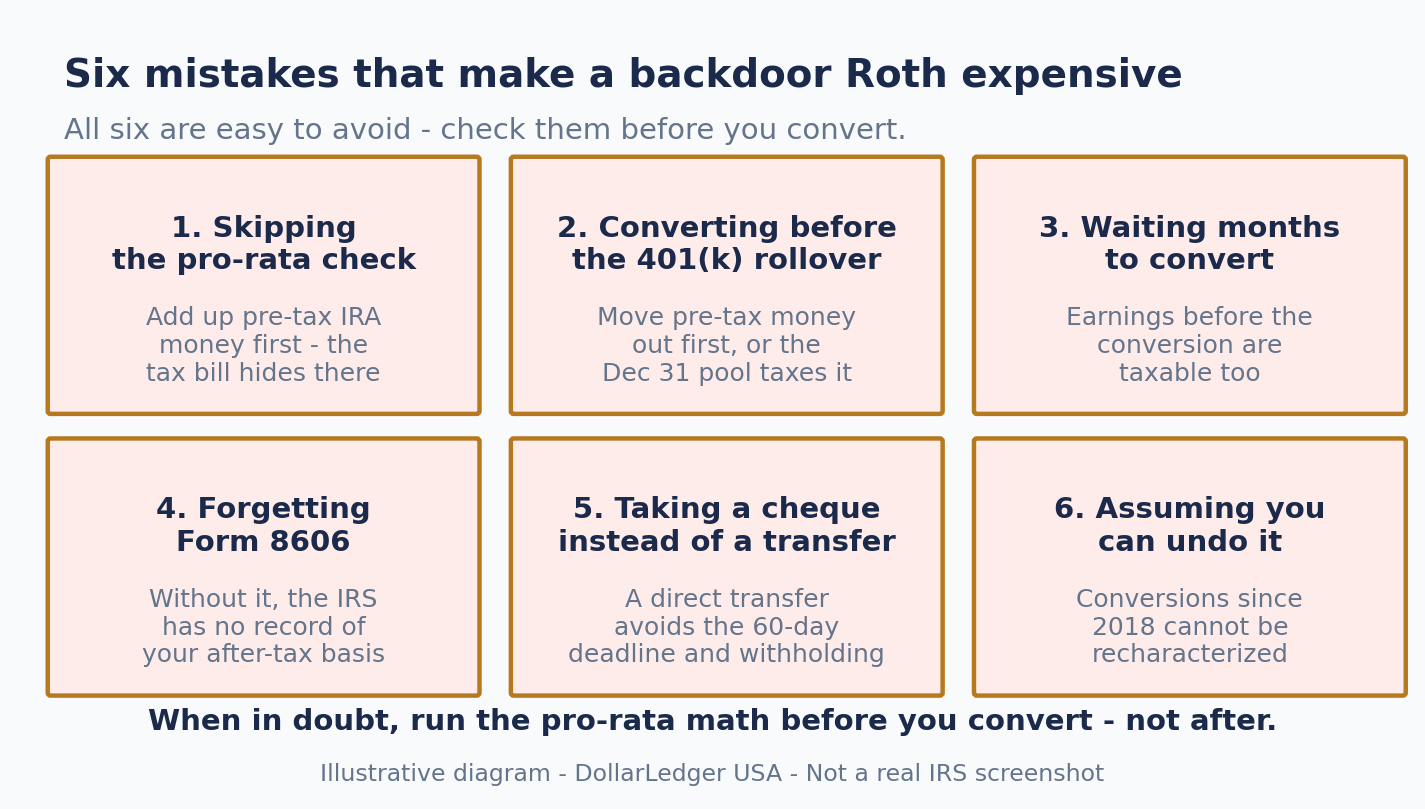
Caption: Illustrative diagram - Six mistakes that make a backdoor Roth expensive. NOT a real IRS screenshot.
Checklist
- MAGI checked — front door closed.
- Pre-tax IRA balances added up.
- Pre-tax money in a 401(k) before Dec 31, 2026.
- Nondeductible contribution made — $7,500, $8,600 at 50+.
- Conversion by direct transfer, before Dec 31, 2026.
- Form 8606 filed; 1099-R and 5498 kept.
FAQ
Is the backdoor Roth IRA legal?
Yes. It combines two steps the IRS rules allow: a nondeductible traditional IRA contribution, then a conversion with no income limit. The IRS has never blessed the combined strategy by name, so keep the paperwork clean.
How much tax will I owe on a backdoor Roth?
It depends on your pre-tax IRA balance. With a $0 balance, a fast conversion costs almost nothing. With pre-tax money in the pool, the pro-rata rule taxes the same share — $1,620 at 24% in our example.
Can I do a backdoor Roth every year?
Yes, with earned income and within the annual limit — $7,500 for 2026, $8,600 at 50 or older. The conversion has no annual dollar limit; repeat the checks yearly.
I have a rollover IRA from an old 401(k) — can I still do a backdoor Roth?
Yes, but that rollover IRA is pre-tax money in the pool, so the conversion is partly taxable. The usual fix is to roll it into your current 401(k) first.
Does the five-year rule apply to a backdoor Roth conversion?
If you are under 59½, each conversion has its own five-year clock — withdrawing it within five years can trigger a 10% additional tax. Roth earnings are tax-free only once your first Roth IRA is five years old and you are 59½ or older.
Sources
- IRS, 401(k) limit increases to $24,500 for 2026, IRA limit increases to $7,500 (IR-2025-111) — opened live November 13, 2026: https://www.irs.gov/newsroom/401k-limit-increases-to-24500-for-2026-ira-limit-increases-to-7500
- IRS, Topic No. 413, Rollovers from retirement plans — opened live Nov. 13, 2026: https://www.irs.gov/taxtopics/tc413
- IRS, Retirement Topics — IRA Contribution Limits — opened live Nov. 13, 2026: https://www.irs.gov/retirement-plans/plan-participant-employee/retirement-topics-ira-contribution-limits
All figures checked November 13, 2026, against the IRS pages above. The pro-rata formula and Form 8606 mechanics follow IRS Publication 590-A and the Form 8606 instructions.
Disclaimer: For education only, not financial, tax or investment advice. Confirm your numbers in IRS Publication 590-A or with a tax professional before you convert.