Roth IRA vs Traditional IRA: Which Is Better for You in 2026?
 DollarLedger Team
- 04 Nov, 2026

A Roth IRA and a traditional IRA look almost identical on the surface. Both let your money grow for decades, and both share the same 2026 contribution limit of $7,500, or $8,600 if you are age 50 or older. The difference is when you pay tax, and that single difference changes everything. With a Roth IRA, you pay tax now and never again. With a traditional IRA, you get a tax break now and pay tax later, when you withdraw the money in retirement. Pick the wrong one and you can pay thousands more in tax than you needed to. This guide compares the two for 2026, checked November 4, 2026, with the one question that decides between them and examples for a young saver and a high earner.
Photo: Roth or traditional? The answer comes down to one question about your tax rate. (Photo: Pexels)
What You Will Learn
- The core difference: pay tax now with a Roth, or pay tax later with a traditional IRA
- The 2026 limits, which are the same $7,500 for both accounts
- The one-question test that picks the right account for you
- When a traditional IRA deduction is cut by a workplace plan
- How withdrawals and required minimum distributions differ in retirement
- Who should pick which — and why you can split between both
Step 1: Understand the core difference — pay tax now, or pay tax later
What to do: Learn how the tax treatment works first.
How: A Roth IRA is funded with money you have already paid tax on, so there is no deduction — but the money grows tax-free and comes out tax-free in retirement, after 59½ and five years. A traditional IRA works the other way around: contributions may be tax-deductible, but every dollar withdrawn in retirement is taxed as income. The Roth taxes the seed; the traditional taxes the harvest.
Example: You put $7,500 in a Roth IRA and it grows to $30,000 — the $22,500 of growth is tax-free. The same $7,500 in a traditional IRA also grows to $30,000, but the whole $30,000 is taxed on withdrawal.
Common mistake: Thinking a deduction now is always better. A low rate today and a higher rate later means it saves little now and costs far more later.
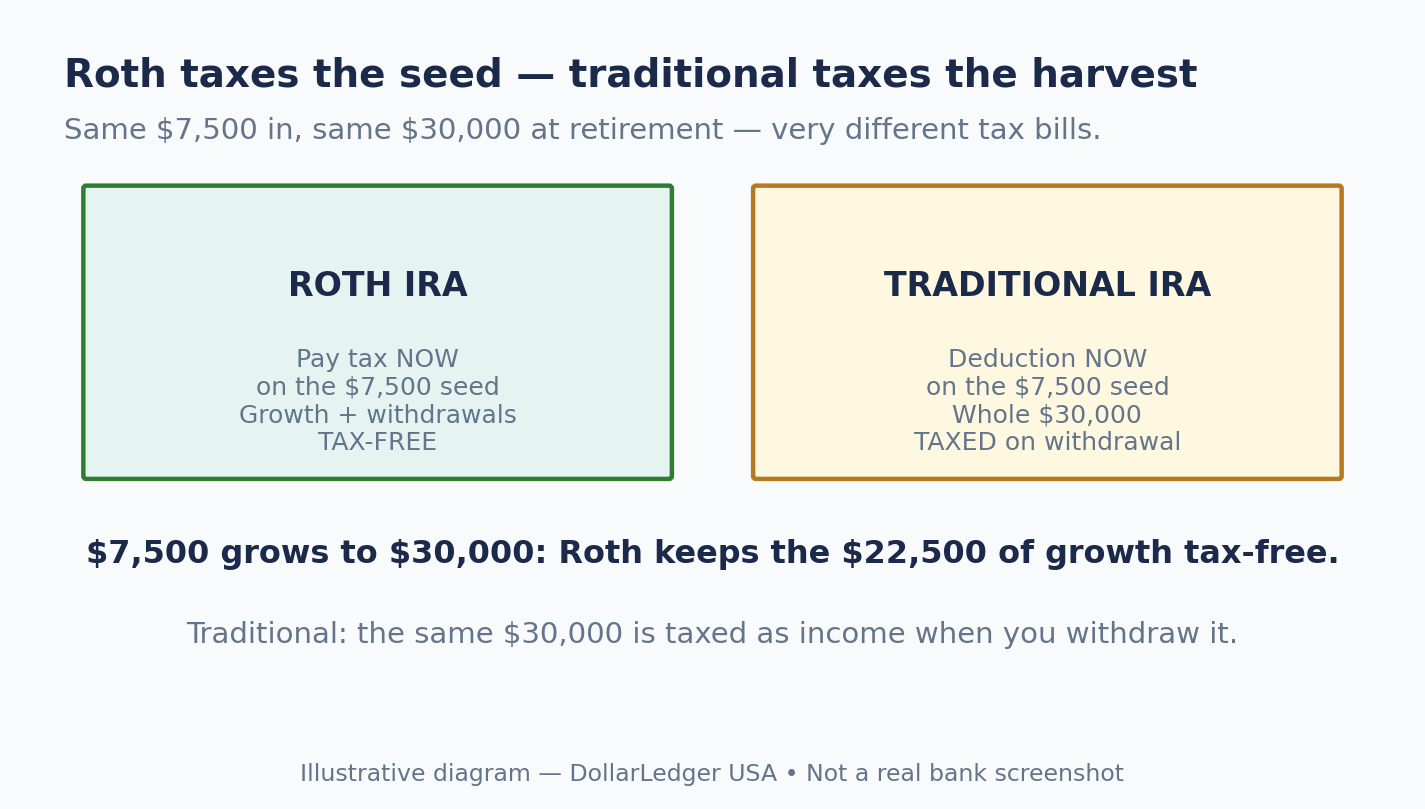
Illustrative diagram — Roth taxes the seed; traditional taxes the harvest. NOT a real bank screenshot.
Step 2: Compare the two accounts side by side for 2026
What to do: Put the two accounts next to each other so the differences are clear.
How: The IRS announced the 2026 limits in IR-2025-111 (November 13, 2025). The limit is identical for both: $7,500 if you are under 50, or $8,600 with the $1,100 catch-up at 50 or older — combined across both, so you cannot put $7,500 in each. A Roth IRA has an income limit: in 2026, single filers can contribute the full amount below $153,000 of MAGI, a reduced amount up to $168,000, and nothing above that. In retirement, Roth withdrawals are tax-free; traditional withdrawals are taxed.
Example: Sara is 45, earns $70,000, and has a 401(k) at work. The Roth gives her tax-free withdrawals later; the traditional gives her a deduction now, but only a partial one.
Common mistake: Assuming the $7,500 limit applies to each account separately. Putting $7,500 in each means a $7,500 excess contribution, taxed at 6% a year.
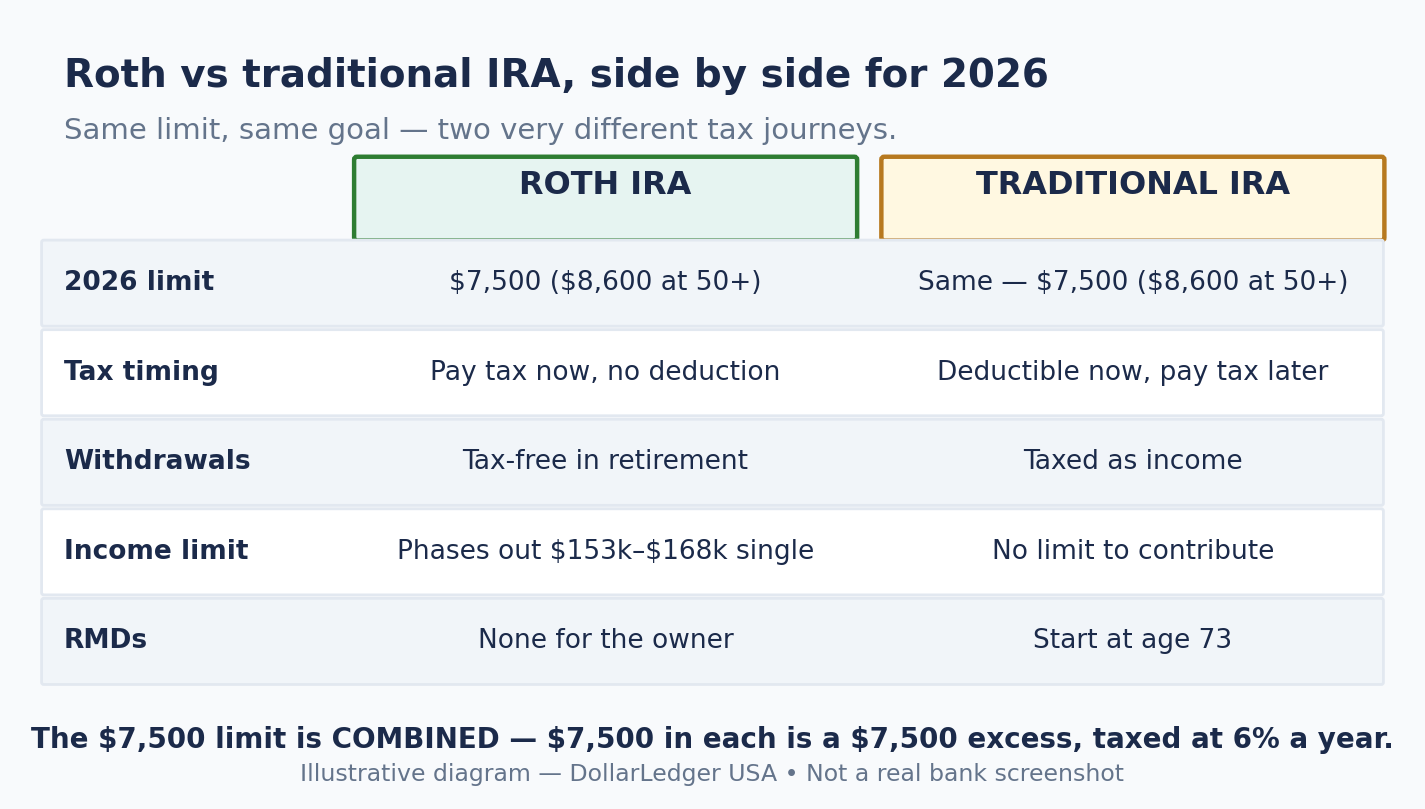
Illustrative diagram — Roth vs traditional IRA, side by side for 2026. NOT a real bank screenshot.

Photo: Same limit, same goal — two very different tax journeys. (Photo: Pexels)
Step 3: Ask the one question that decides it
What to do: Compare your tax rate now with the rate you expect in retirement.
How: If your rate is lower now, a Roth IRA wins: you pay a little tax now and nothing later. If your rate is higher now, a traditional IRA wins: the deduction saves more today. The question is not about tax now or tax later in general — it is about your rate in each period. A backdoor Roth IRA is a separate option if you earn too much.
Example: You pay 12% now and expect 22% in retirement — choose the Roth and lock in the low rate. You pay 32% now and expect 12% in retirement — choose the traditional and take the bigger saving now.
Common mistake: Comparing your marginal rate today with your average rate in retirement. Use the marginal rate in both, because the contribution is taxed at the top slice.
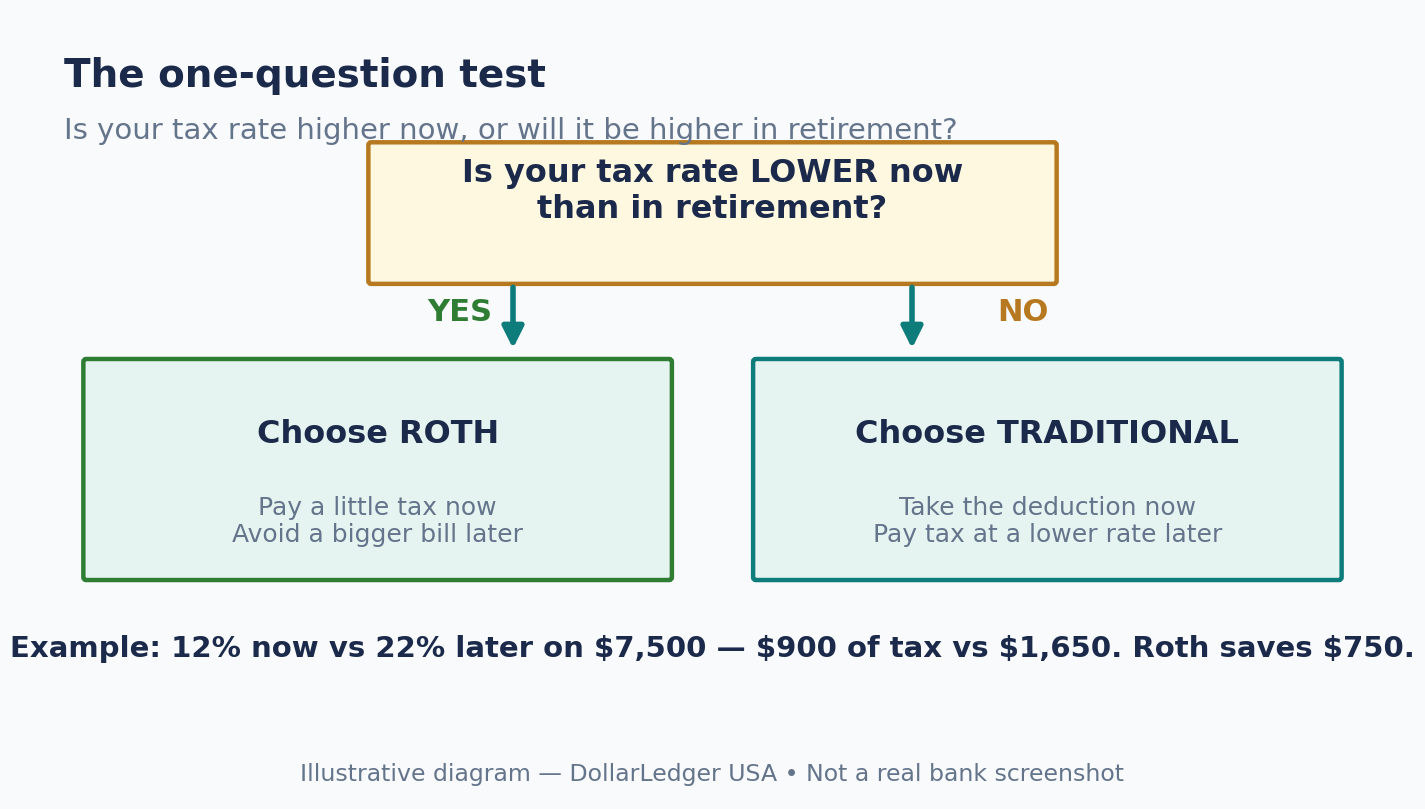
Illustrative diagram — The one-question test: higher tax rate now, or in retirement? NOT a real bank screenshot.
Step 4: Check the traditional IRA deduction rules if you have a workplace plan
What to do: Check whether your traditional IRA contribution is deductible, and how much.
How: If you or your spouse has a 401(k) at work, the deduction for a traditional IRA phases out. For single filers in 2026, a full deduction is available only below $95,000 of MAGI, and no deduction above $112,000. A Roth IRA has no deduction to lose, and if your income is too high for a Roth, a backdoor Roth IRA is a separate option.
Example: Mark is 38 and single, earns $90,000, and has a 401(k) — he gets the full deduction on a traditional IRA. Anna earns $105,000 with a 401(k) — she can still deduct, but only part of the contribution.
Common mistake: Assuming a workplace plan blocks a traditional IRA altogether. A covered worker can still contribute; only the deduction may be reduced or lost.
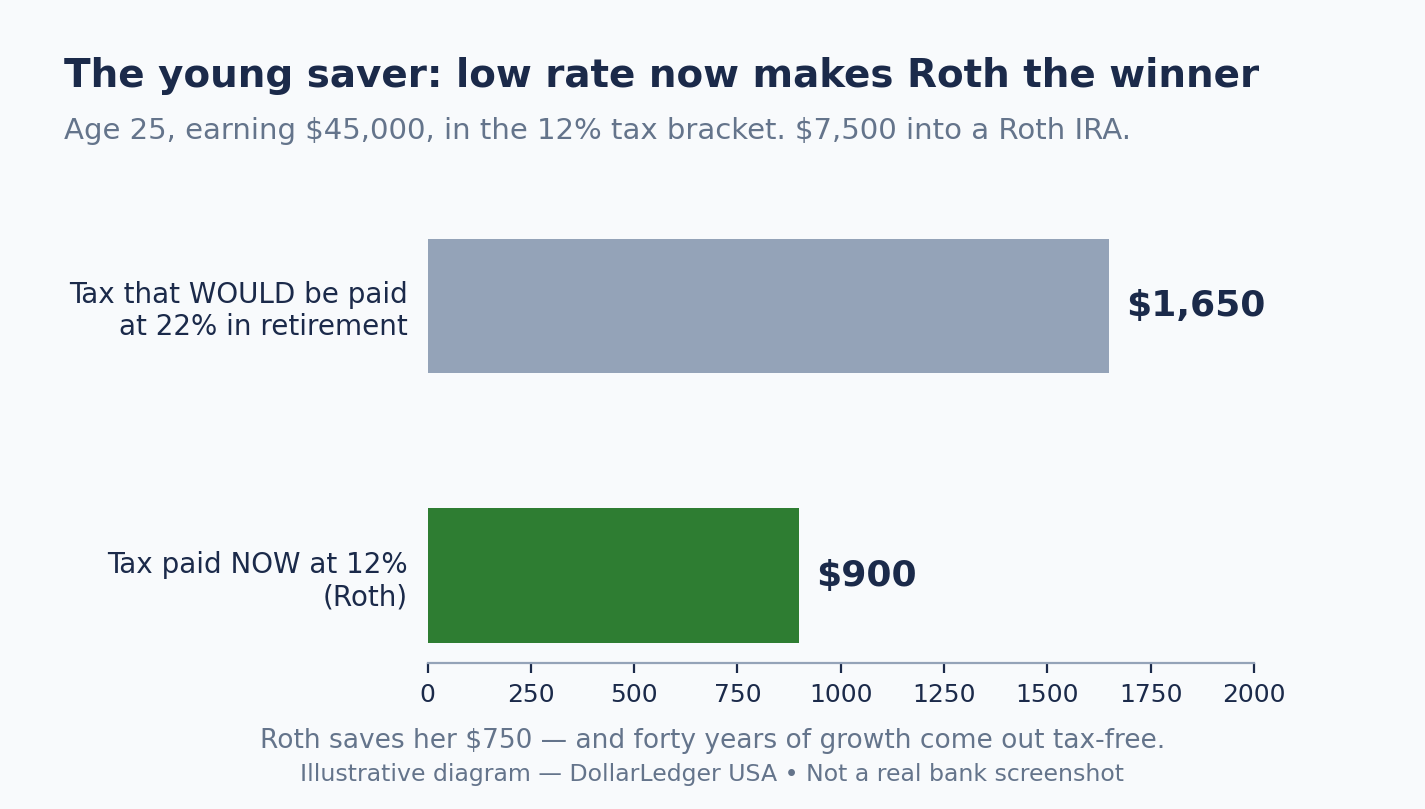
Illustrative diagram — The young saver: low tax rate now makes the Roth the clear winner. NOT a real bank screenshot.
Step 5: Compare the young saver and the high earner
What to do: See how the same $7,500 works out for people at opposite ends of the income scale.
How: A young saver in a low bracket has time on her side: 40 years of tax-free growth beats a small deduction today. A high earner in a high bracket gets far more from the deduction now than tax-free growth later, especially if the tax rate drops in retirement. The right account depends on your rate, your age, and whether you will keep earning more.
Example: The 25-year-old puts $7,500 in a Roth IRA, pays $900 in tax, and the whole $45,000 it grows to is tax-free. The 55-year-old puts $7,500 in a traditional IRA and saves $2,400 in tax today. Both win, for opposite reasons.
Common mistake: Telling the 25-year-old to take the traditional deduction because it sounds good. At 12% it is worth only $900; forty years of tax-free growth is worth far more.
Photo: Your tax bracket today is the clue — check it before you choose an IRA. (Photo: Pexels)
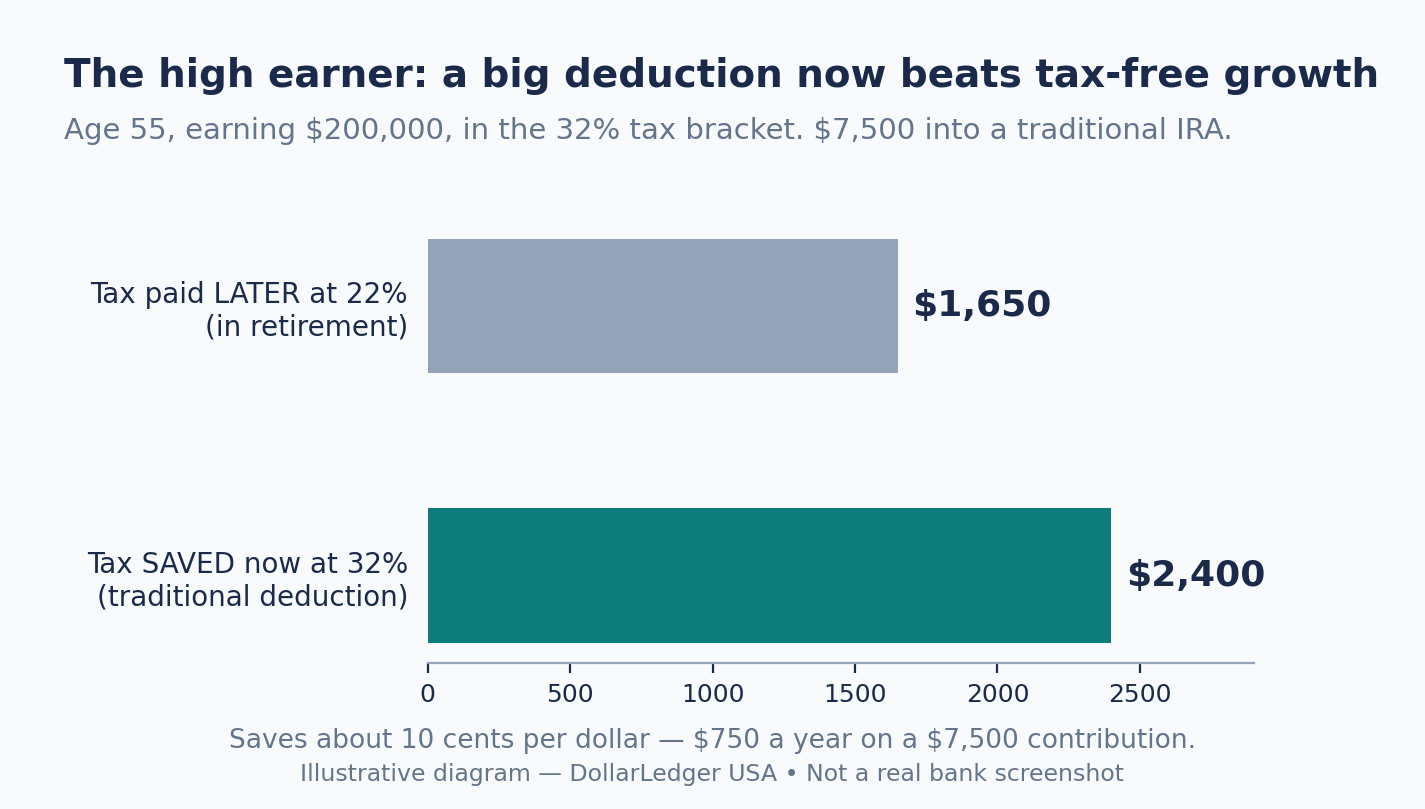
Illustrative diagram — The high earner: a big deduction now beats tax-free growth later. NOT a real bank screenshot.
Step 6: Check withdrawals, RMDs, and how to split between both
What to do: Look at how you get the money out, because that shapes the best choice.
How: Roth IRA withdrawals of contributions are always tax-free; earnings are tax-free after age 59½ and five years. Traditional IRA withdrawals are taxed as income, and required minimum distributions (RMDs) start at age 73. Roth IRAs have no RMDs while you are alive, which makes them good for leaving money behind. If you are not sure, split the $7,500 between the two — you are allowed to do both in the same year.
Example: Linda, 60, holds both accounts. She withdraws from her traditional IRA first and leaves her Roth untouched.
Common mistake: Forgetting about RMDs until age 73 arrives. A large traditional IRA can force big taxable withdrawals into a higher bracket.
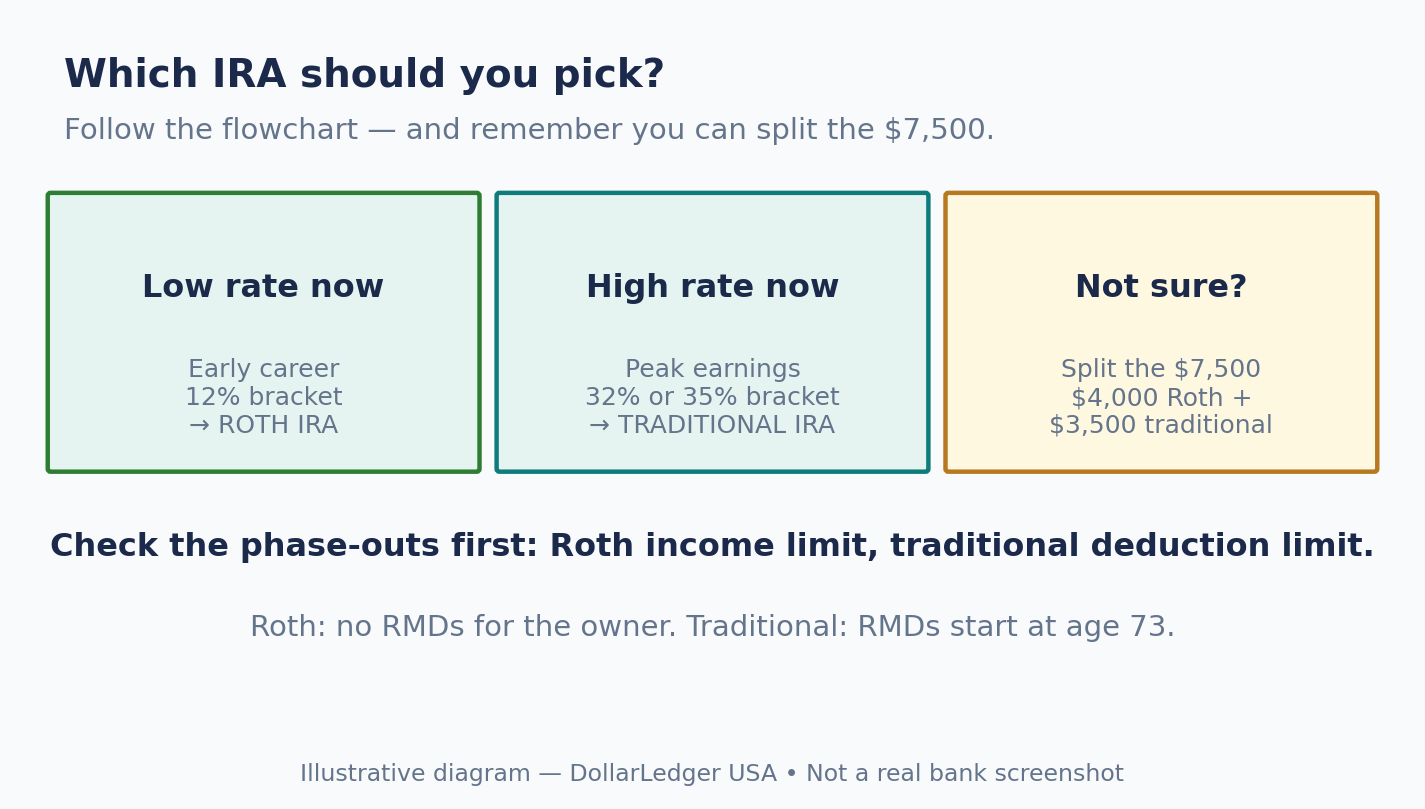
Illustrative diagram — Which IRA should you pick? Follow the flowchart. NOT a real bank screenshot.
Checklist
- ☐ I know the core difference: a Roth taxes the seed, a traditional taxes the harvest.
- ☐ I know the 2026 limit is $7,500 (or $8,600 at 50+), shared across both accounts.
- ☐ I asked the one question: is my tax rate higher now, or in retirement?
- ☐ I checked the traditional IRA deduction rules for my workplace plan.
- ☐ I compared the young saver and the high earner — and know which one I am.
- ☐ I know the withdrawal rules and RMDs — and that I can split the $7,500.
FAQ
Can I contribute to both a Roth IRA and a traditional IRA in 2026?
Yes, but the $7,500 limit (or $8,600 if you are 50 or older) is combined across both accounts. For example, you could put $5,000 in a Roth IRA and $2,500 in a traditional IRA.
Is a Roth IRA better than a traditional IRA?
It depends on your tax rate. A Roth IRA is usually better if you are in a low tax bracket now and expect to be in a higher bracket in retirement. A traditional IRA is usually better if you are in a high tax bracket now and expect a lower rate later.
Does a Roth IRA have required minimum distributions?
No. Unlike a traditional IRA, a Roth IRA has no RMDs while the owner is alive. A traditional IRA requires distributions starting at age 73. That rule also applies to an inherited Roth IRA.
What if my income is too high for a Roth IRA?
If your income is above the Roth IRA limits, you cannot contribute directly. A backdoor Roth IRA is a separate option, but it has its own tax rules. Check current guidance or a tax professional before you use it.
Sources
- IRS, “401(k) limit increases to $24,500 for 2026, IRA limit increases to $7,500” (IR-2025-111) — 2026 IRA limits and phase-outs: https://www.irs.gov/newsroom/401k-limit-increases-to-24500-for-2026-ira-limit-increases-to-7500
- Fidelity, “How much do I need to retire?” — retirement savings guidelines: https://www.fidelity.com/viewpoints/retirement/how-much-do-i-need-to-retire
All limits and phase-outs checked November 4, 2026.
This article is for education only, not financial advice. Tax rules change often — confirm current limits with the IRS or a tax professional before contributing.