Social Security Benefits in 2026 — How Much You Get, When to Claim, and What the COLA Really Adds
 DollarLedger Team
- 08 Nov, 2026

The average Social Security check rose to $2,071 a month in January 2026. That headline sounds like a $56-a-month raise — and it is, on paper. But the check that lands in your bank account is decided by three numbers working together: your earnings history, the age you claim, and the annual cost-of-living adjustment — minus the Medicare premium that comes straight out of the check. This guide walks through all three, with the official 2026 figures, checked November 8, 2026.
Photo: The average retired worker’s check is $2,071 a month in 2026 — but your own check depends on your earnings, your claiming age, and the COLA. (Photo: Pexels)
What You Will Learn
- How your 35 best earning years set your benefit
- What the 2.8% COLA adds — $56 a month on average
- Why claiming at 62, 67 or 70 changes the check by hundreds
- How the $202.90 Part B premium eats part of the raise
- The 2026 SSI amounts and earnings-test limits
- Six mistakes that shrink a check
Step 1: Find your PIA — your earnings record is the foundation.
What to do: Find your Primary Insurance Amount (PIA) — your benefit if you claim at full retirement age.
How: Social Security takes your 35 highest-earning years, adjusts each for wage growth, and averages them into Average Indexed Monthly Earnings (AIME). That average runs through a formula with two “bend points” — $1,286 and $7,749 of AIME for anyone turning 62 in 2026. The formula replaces 90% of the first $1,286, 32% of the amount between the two points, and 15% of anything above $7,749. The result is your PIA. Only earnings up to the $184,500 taxable maximum count, and a year with no earnings counts as a zero in your 35.
Example: Maria’s AIME is $3,000, so her PIA is about $1,706 a month — 90% of $1,286 plus 32% of the rest.
Common mistake: Never checking the earnings record. A missing year lowers your PIA for life — check it on ssa.gov every year or two.
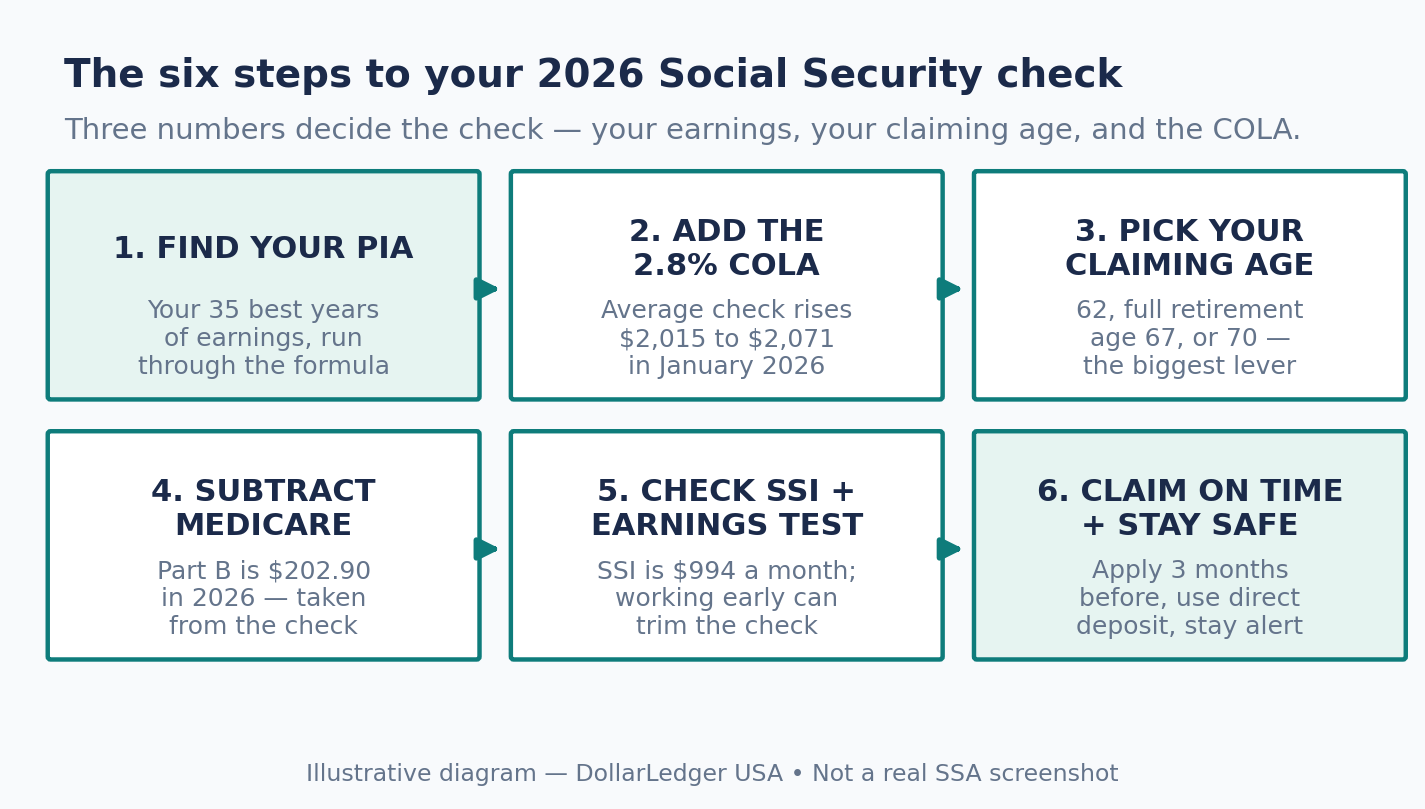
Illustrative diagram — The six steps to your 2026 Social Security check. NOT a real SSA screenshot.
Step 2: Add the 2026 COLA — 2.8%, worth $56 a month on average.
What to do: Add the 2026 cost-of-living adjustment — it applies automatically, but know what it is worth.
How: The COLA comes from the Consumer Price Index for Urban Wage Earners (CPI-W): the third-quarter 2025 average of 317.265, against 308.729 a year earlier, gives a 2.8% increase, announced October 24, 2025. The same 2.8% also raises Supplemental Security Income (SSI). SSA’s estimated averages for January 2026: all retired workers $2,071 (up from $2,015), an aged couple both receiving benefits $3,208 (up from $3,120), and all disabled workers $1,630 (up from $1,586). The COLA can never reduce your benefit.
Example: Tom’s benefit was $1,800 a month; the 2.8% COLA adds about $50, taking him to roughly $1,850 — about $600 more a year.
Common mistake: Treating the COLA as a pay rise. It only keeps your benefit level with prices — and part of it is taken back by the Medicare premium, as Step 4 shows.
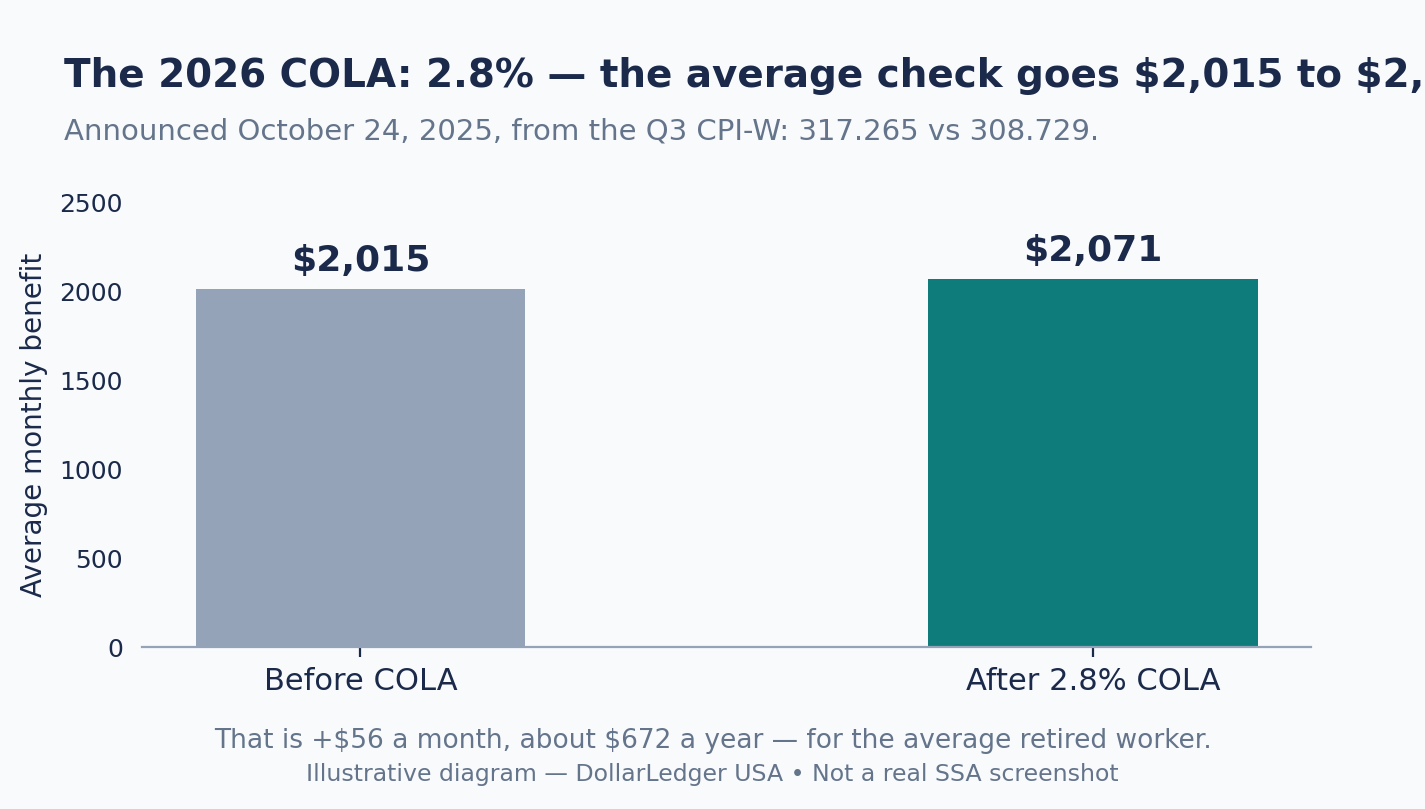
Illustrative diagram — The 2026 COLA: 2.8%, worth $56 a month on average. NOT a real SSA screenshot.

Photo: Claiming age is the biggest single decision — the same earnings record can produce three very different checks. (Photo: Pexels)
Step 3: Pick your claiming age — the biggest lever you control.
What to do: Choose your claiming age on purpose. For anyone born in 1960 or later, full retirement age (FRA) is 67.
How: You can claim as early as 62, but that cuts your benefit by up to 30% from your PIA — permanently. Claim at your FRA and you get 100% of your PIA. Wait past FRA and you earn delayed retirement credits of about 8% a year, up to age 70 — about 24% over your PIA in total. The 2026 maximums: $2,969 at 62, $4,152 at FRA, $5,181 at 70 — but those need a lifetime of earnings at the taxable maximum.
Example: Ana’s PIA is $2,000. Claiming at 62 gives her about $1,400 a month for life; waiting to 70 gives about $2,480 — $1,080 more a month.
Common mistake: Claiming at 62 by default. If you are healthy and working, each year you wait adds about 8% — a guaranteed increase no investment promises.
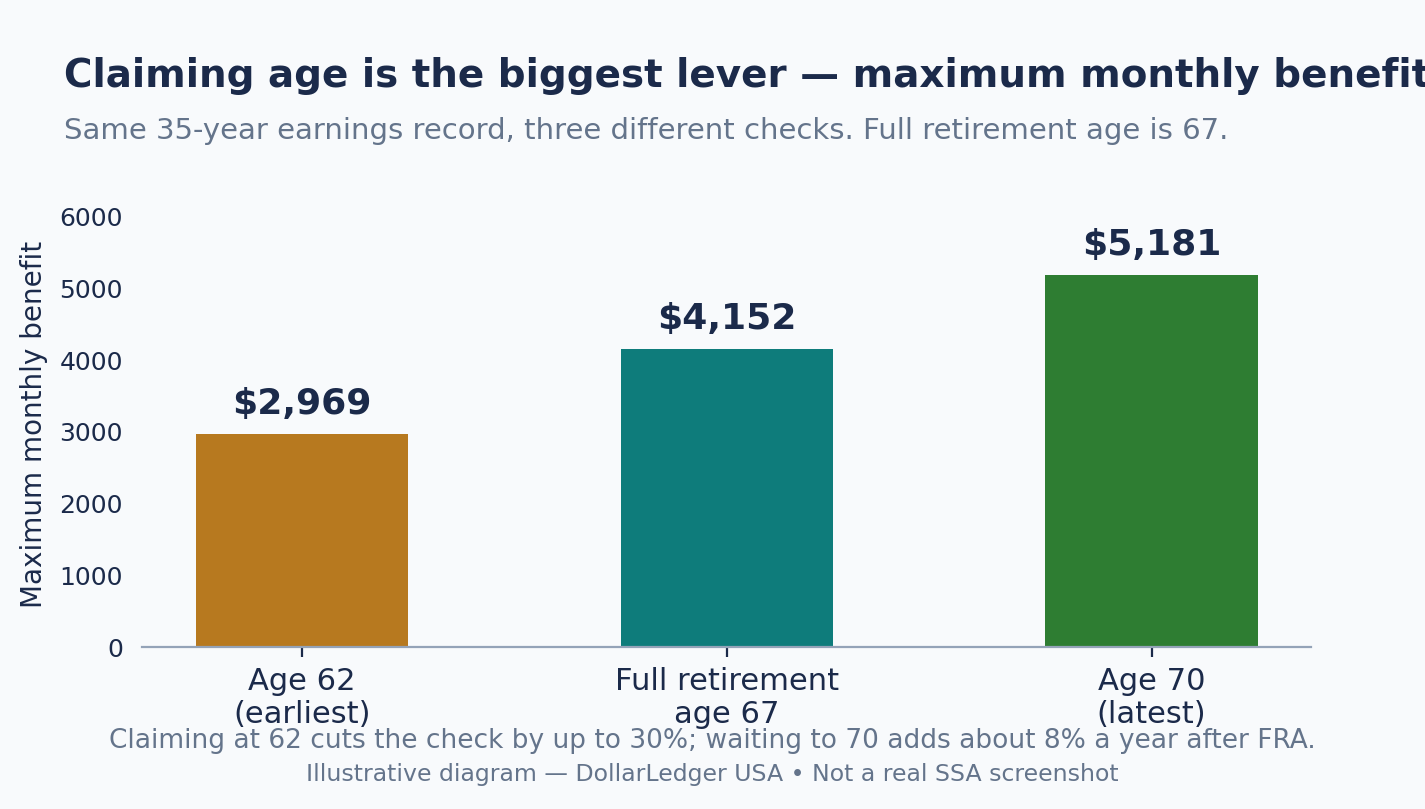
Illustrative diagram — Claiming age is the biggest lever: the maximum check at 62, 67 and 70. NOT a real SSA screenshot.
Step 4: Subtract the Medicare Part B premium before you celebrate.
What to do: Work out your net check — after Part B — because that is the money you live on.
How: Part B is usually taken straight out of your Social Security payment. For 2026 the standard premium is $202.90 a month, up $17.90 from $185 — nearly 10%, far bigger than the 2.8% COLA. So the average retiree’s $56 raise loses $17.90 to the premium, leaving a net gain of about $38 a month. Higher earners pay an IRMAA surcharge above $109,000 single or $218,000 joint, based on the tax return from two years earlier. The hold-harmless rule stops the rise cutting most people’s net benefit — though not for IRMAA payers.
Example: Ruth received $1,830 ($2,015 minus the $185 premium). In 2026 she receives $1,868.10 ($2,071 minus $202.90) — a real gain of $38.10 a month, not $56.
Common mistake: Budgeting the full $56 raise. Always subtract the new premium first, and check whether IRMAA applies to you.
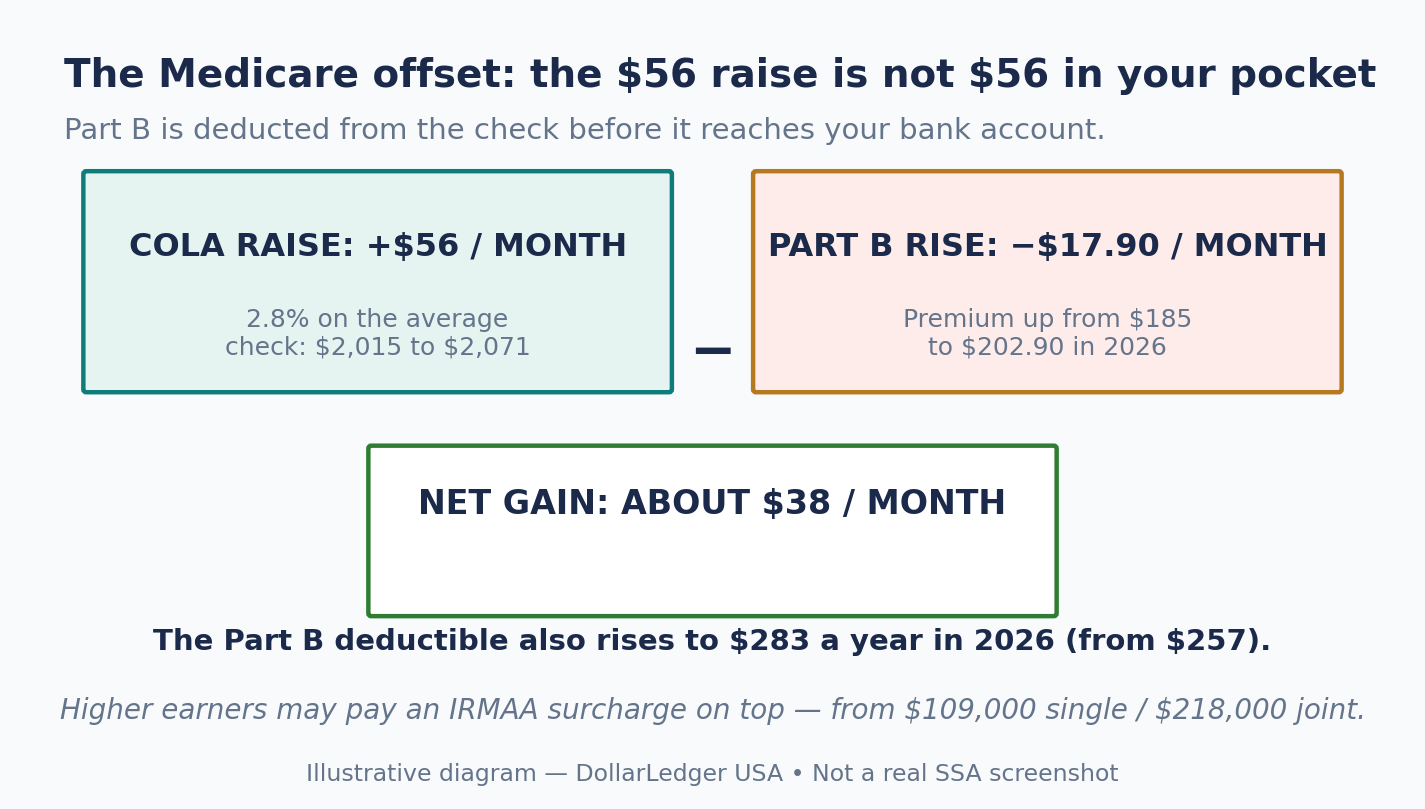
Illustrative diagram — The Medicare offset: the $56 raise is not $56 in your pocket. NOT a real SSA screenshot.

Photo: SSI and the earnings test use different 2026 numbers — check whether either one applies to you before you claim. (Photo: Pexels)
Step 5: Check SSI and the earnings test if they apply to you.
What to do: If your income is very low, check SSI — and if you claim early and keep working, check the earnings test.
How: Supplemental Security Income (SSI) is for people with limited income and resources. The federal SSI payment standard for 2026 is $994 a month for an individual and $1,491 for a couple, after the 2.8% COLA. Resource limits are $2,000 (individual) and $3,000 (couple); many states add a supplement. The earnings test: if you claim before FRA and keep working, SSA withholds $1 for every $2 earned above $24,480 a year ($2,040 a month) in 2026. In the year you reach FRA the limit is $65,160 a year ($5,430 a month), with $1 withheld per $3 over. At FRA the test stops, and withheld months are credited back.
Example: Dan claims at 63 and earns $30,000 — $5,520 over the limit, so SSA withholds about $2,760, roughly $230 a month.
Common mistake: Thinking the earnings test is a tax. It is a delay, not a loss.
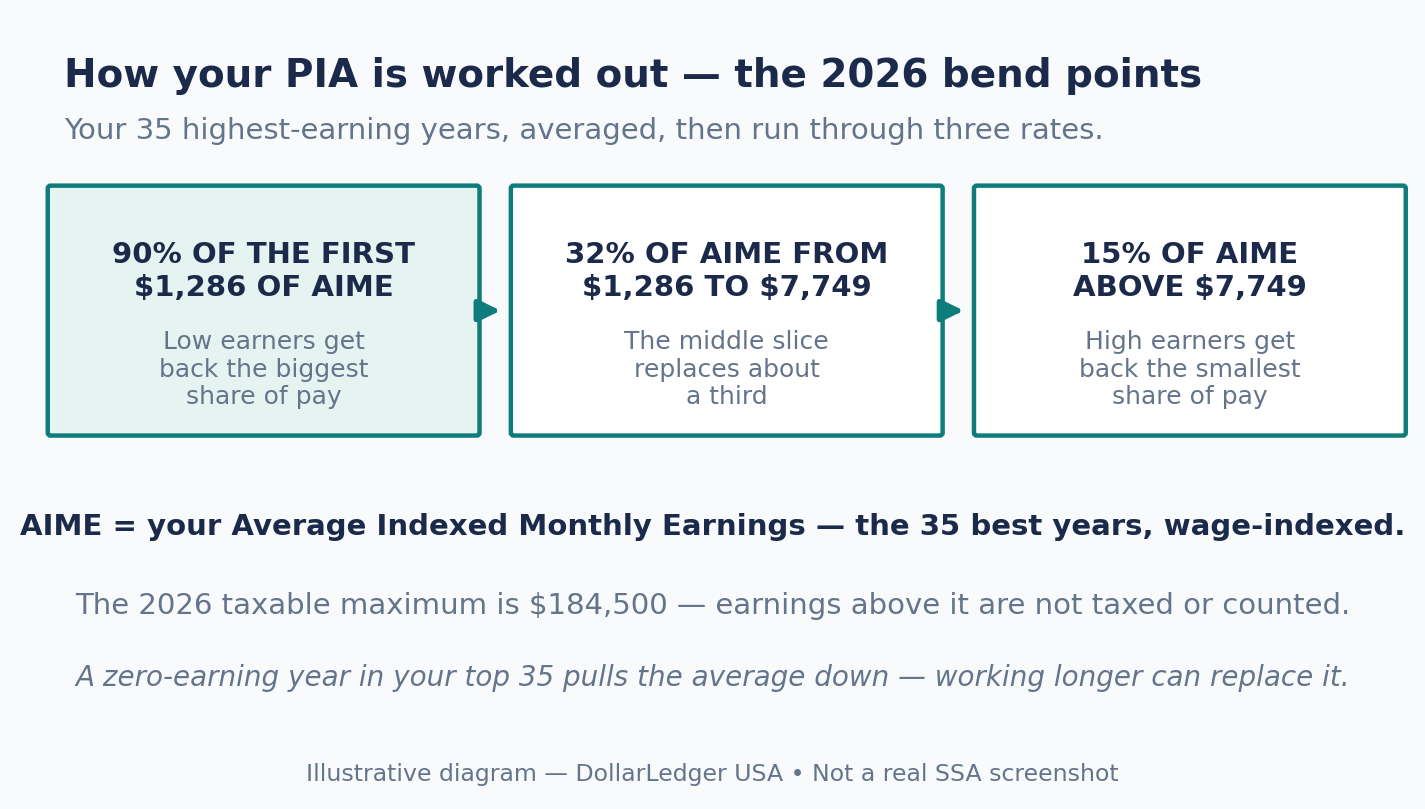
Illustrative diagram — How your PIA is worked out: the 2026 bend points. NOT a real SSA screenshot.
Step 6: Claim on time, check the deposit, and protect the check.
What to do: Apply a few months before payments should start, verify the first deposit, and guard against scams.
How: You can apply up to four months early — online at ssa.gov is fastest for most people. Check the first payment: the amount, the Part B deduction, and any tax withholding. Up to 85% of your benefit can be taxable depending on other income, so many retirees have federal tax withheld to avoid an April bill. Finally, protect the check: SSA never calls to threaten you or demand gift cards or wires. Any such call is a scam — hang up and report it.
Example: Paul applies in October for benefits starting in January. His first deposit arrives in February — Social Security pays a month behind — and matches his award letter minus the $202.90 Part B premium.
Common mistake: Applying the week you turn 62 and expecting payment the same month. Payments run a month behind, and a late application can cost you a month.
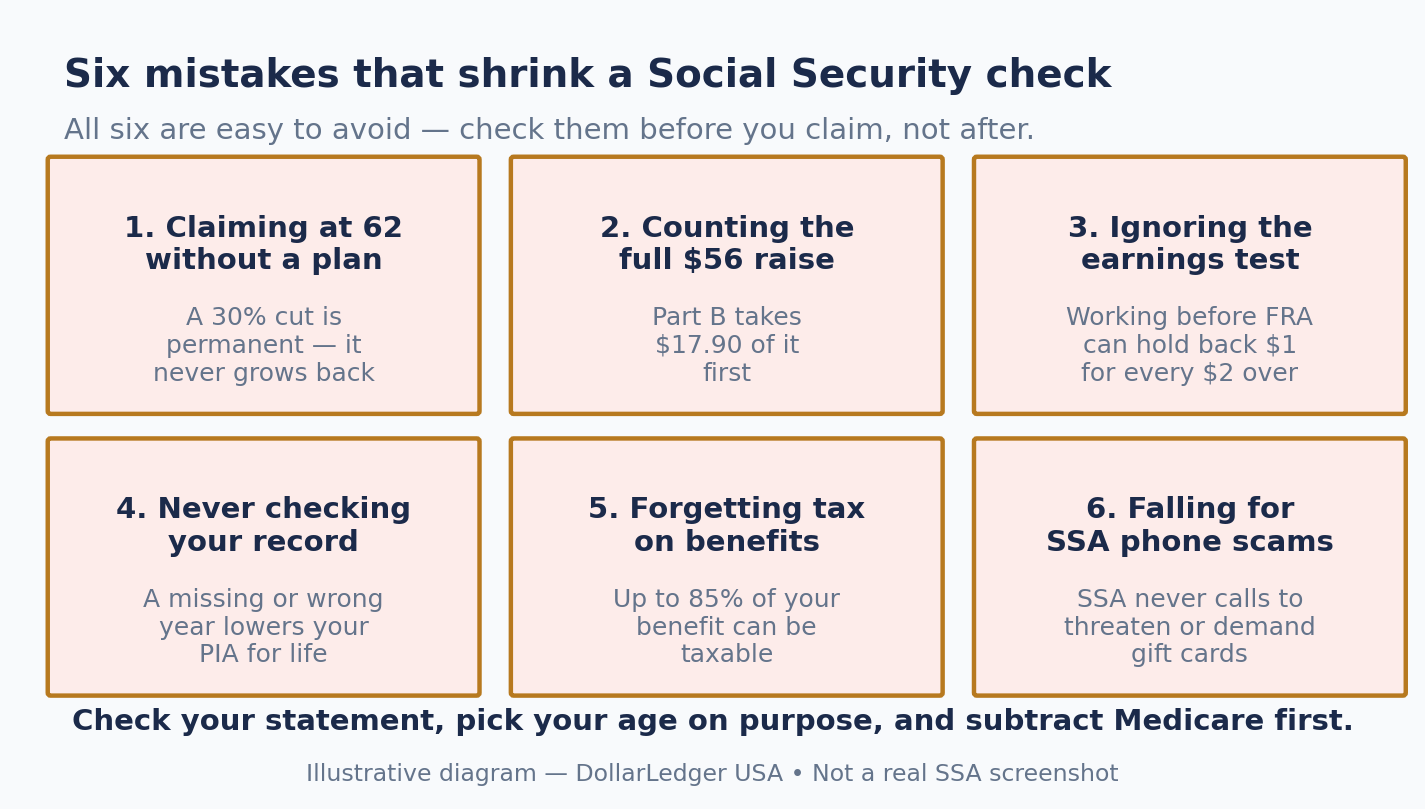
Illustrative diagram — Six mistakes that shrink a Social Security check. NOT a real SSA screenshot.
Checklist
☐ I checked my earnings record and PIA on ssa.gov.
☐ I know what the 2.8% COLA adds to my own benefit.
☐ I chose my claiming age on purpose: 62, 67 or 70.
☐ I subtracted the $202.90 Part B premium to find my net check.
☐ I checked SSI and the earnings test if either applies to me.
☐ I applied early, verified the first deposit, and watch for scams.
Frequently Asked Questions
How much is the average Social Security check in 2026? The average for all retired workers is $2,071 in January 2026, up from $2,015. An aged couple both receiving benefits averages $3,208, and the average disabled worker gets $1,630.
What is the Social Security COLA for 2026? 2.8%, announced October 24, 2025, from the third-quarter CPI-W (317.265 vs 308.729). The same 2.8% raises SSI payments.
Should I claim Social Security at 62 or wait until 70? Claiming at 62 cuts your benefit by up to 30% permanently; waiting to 70 adds about 8% a year after FRA, or about 24% in total. Waiting pays off if you live into your late 70s or beyond; claiming early makes sense if you need the income now.
Does Medicare take money out of my Social Security check? Yes — Part B is usually deducted automatically. The 2026 standard premium is $202.90 a month, up $17.90 from $185, so the average retiree keeps about $38 of the $56 raise. Higher earners may also pay an IRMAA surcharge.
Has the 2027 COLA been announced? Yes — 3.6%, announced October 14, 2026. That is next year’s number, for payments from January 2027; every figure in this article is the 2026 figure.
Sources
- SSA 2026 COLA fact sheet
- CMS 2026 Medicare Parts A & B premiums
- How to Open a Roth IRA in 2026 — A Beginner’s Step-by-Step Guide
All figures checked November 8, 2026, against the SSA fact sheet and the CMS announcement.
Disclaimer: Education only, not benefits or tax advice — confirm your own figures with the Social Security Administration before claiming.